Showing posts with label Crom Dubh. Show all posts

Sunday, 23 January 2022

Market Cross at Kells

This Sunday started quite well...

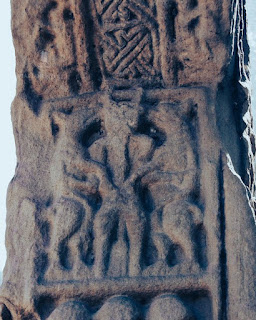
Archaeologist Neil Jackman @JackmanNeil posted this very interesting picture on his twitter account:


With these comments:

An unusual, and a little unsettling, depiction on the c.9/10th century Market Cross at Kells, County Meath.

It features a human-like bearded figure with horns, flanked by two beasts (wolves or lions?) on their hind legs. Could it be a rare depiction of the devil?

Early Irish high crosses usually (though not exclusively) depict religious scenes, along with the beautiful ornamentation.

Dr Francis Young @DrFrancisYoung, Historian of religion & beliefs then commented that:

The iconography of Satan hadn't yet settled down by that point; I don't think there are c9th representations of Satan with horns. If I had to guess, I'd say this is a Classical reference and the figure is most likely Pan/Faunus, representing wild untamed nature. As a rule of thumb, if in doubt about early medieval iconography, it's usually a garbled Classical reference...

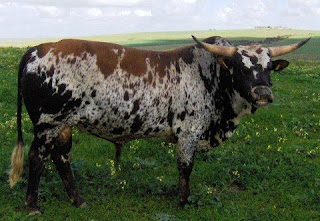
Eeee wasn't there some fella called Crom Dubh, whom pretty much all early Irish saints defeated at some point or another, who was linked to bulls, and who could even turn to a bull himself? Particularly a speckled one...

The horns on the "devil" from the Market Cross at Kells look very much like bull horns to me...

I talked about Crom Dubh bull folklore in my post "Bull of Crom Dubh"...

Crom Dubh apparently lived all over Ireland...Including Dun Briste. 

And guess what: "Crom Dubh (also) had two hounds of dogs...and if ever there were [wicked] mastiffs these two dogs were they..." 

I talked about this legend in my post "Dun Briste"...

So here we have a "bull god flanked by two hounds"...Is this enough to identify this image as a depiction of Crom Dubh? Of course not. But it is a possibility that we can't ignore...Especially because this would be the only known depiction of Crom Dubh ever found that matches the folklore depictions of this old Irish god...

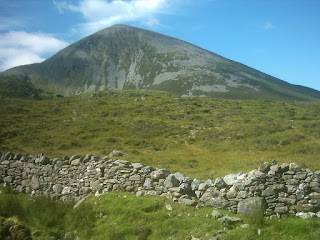
Croagh Patrick, the Irish "Holy mountain". 


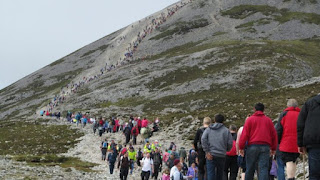
Once "the holy mountain of Crom Dubh" the old Irish Sun/Sky god and god of agriculture, it became "the holy mountain of St Patrick", after he "defeated" Crom Dubh... The day of the annual pilgrimage to the top of the mountain is still known locally as "Domhnach Crom Dubh" which means "Crom Dubh's Sunday"... 


Thursday, 1 April 2021

Zodiac killer

Elamite seal. Iran. From "The Elamite Cylinder Seal Corpus, c. 3500–1000 BC" by Karen Jane Gardon.

Soooo What's this all about?

Top row:

Autumn (symbolised by a lion) follows summer (symbolised by a bull)...This is the moment in time that this seal marks. This is why we have a lion chasing bull and  the cross in the upper panel...I talked about the symbols of the seasons in this post...

So what about the bottom row with two bulls facing each other? 

Based on the horn shape and no hump, these are bulls of the Eurasian wild cattle, aurochs...

Beginning of August, the end of summer, beginning of autumn, is also when Eurasian wild cattle, aurochs used to mate...During this time auroch bulls fought (faced) each other for females...I talked about the reproductive cycle of aurochs in my post "Ram and bull"....

By the way, this is also the time when Eurasian lions main mating season started too...I talked about this in my post "Musth"...

This is the hottest part of the year in the northern hemisphere, which is why this is the day of Helios...In the Balkans this is the day of St Elijah the Thunderer, the Thundering Sun...

Why Thundering Sun? I talked about the "weird" link between the sun and thunder god in my post about Croesus and Apollo, The thundering Sun...

The reason why we have Thundering Sun God is easy to see from this chart of thunderstorm frequency in Europe...

Interestingly, in Bosnia, on the day of Thundering Sun, the day that marks the end of summer beginning of autumn, the day when aurochs used to fight, people sacrifice bulls and hold bull fights...I talk about this in my post "Alidjun"

So it seems that both the upper and the lower panel of this seal point at the same moment in the Solar year...The moment when the lion (autumn) catches up with the bull (summer) and when bulls fight...

What does this have to do with Europe? Well the key for deciphering images like this one is found in, of all places, Balkan Slavic folklore, remnants of mythologies and religions of ancient people which mixed in the Balkans, and which are preserved to this day by Slavic peasants.

It was the parallels between the bull cult found in Serbia and the bull cult found in Ireland that made me think: "we are dealing with something ancient here"... and led me to deciphering of the first animal calendar marker: bull...

After that I started looking at other well known animal calendar markers, collectively known as Zodiac...And what I found was that they all mark mating or birthing seasons of animals in question...In Europe...I talked about this in the articles linked to this page about "Zodiac"....

After this I started looking at Ancient Eurasian and North African mythologies which were full of animal images...All the ones I touched so far, turn out to also be calendar markers derived from the behavior of animals in question...

It seems that mythologies were built around ancient agricultural calendar, which probably has the common root in the fertile crescent, 15,000-10,000 BC...And which used animal calendar markers to mark different parts of the solar year, important for early farmers...

This same symbolic system was then used throughout the ancient world as the agriculture spread...The mythologies developed around it are full of "monsters made up of different animal parts", "gods with animal heads or bodies", "masters of animals" and "mysterious animal images"...

Which no one understands any more...Well...Maybe we can now understand these crazy bits of our common heritage a bit better...

There is just one problem...

The problem is that "there is nothing mysterious or holy or enlightening or mind blowing" at the bottom of the rabbit hole...

There is no all powerful wizard behind the curtain holding a magic wand looking up at the stars and constellations...Just a sweaty peasant holding a plough and looking up at the sky wandering if the Sky God will be cruel or merciful this year...

Not something you can make a career of "speculating what mystery lies behind"...

I was already told by some people that "when they see that my article is about calendar they just skip it"...

Because it's boring...

The best comment I got so far was that I was a "Zodiac killer"...Cause I killed the mystery that zodiac held for so many people and turned it into an agricultural calendar...

To read more about ancient animal and plant calendar markers, start here…then check the rest of the blog posts related to animal calendar markers I still didn't add to this page, and finally check my twitter threads I still didn't convert to blog post...I am 9 months behind now...

Tuesday, 29 December 2020

Harvest in Scotland


Harvesting in Scotland by a Scottish painter Joseph Farquharson (1846-1935). 

Scottish harvest customs. From "Carmina Gadelica - Hymns and Incantations, Ortha Nan Gaidheal, Volume I" by Alexander Carmichael [1900]


Reaping blessing. From "Carmina Gadelica - Hymns and Incantations, Ortha Nan Gaidheal, Volume I" by Alexander Carmichael [1900]


The Sun god to whom Scots gave thanks for their grain and their wellbeing is Crom Dubh of the Irish (Scots). The deity to whom the Irish prayed in the Early Bronze Age "Grange Circle" on the first day of the harvest. 


The biggest and the only square stone in the circle is still known as the Crom Dubh stone. And next to it is the pile of flat bread like stones known as the Grain Child...


I talked about this amazing ancient monument in my post "Grange circle

He was the good whose holy mountain was and is the holiest place in Ireland. Except it is now called St Patrick's mountain...


I talked about this in my post "Sun mountain"...

They prayed to him on the last Sun-day in July, which is still known in the area around the holy mountain as the "Domhnach Crom Dubh" which means "Crom Dubh's Sunday"...

People prayed to Crom Dubh because they believed that "It was he who was giving them the light of the day, the darkness of the night, and the change of seasons"...Basically The Sun...I talked about this in my post "Dun Briste"...

Crom Dubh was said to be another name for Dagda, the Giving God of the Irish... 
Hromi Daba was another name for Dabog, the Giving God of the Serbs...

Both of these gods had a bull cult associated with them...

I talked about this in my posts "Bull of Crom Dubh" and "Bull of Grom Div (Hromi Daba)"...

And Dabog (Hromi Daba), The Sun God, is the god to whom Slavs still "raised stones" until very recently "for the weather". 


Just like the Early Bronze Age Irish raised stones and built stone circles to Dagda (Crom Dubh)??? 

I talked about these weather manipulation rituals involving stones in "The last megalithic ritual in Europe" and "Weather stones"...

The Sun God of the Pagan Serbs, Dabog, Hromi Daba, became the Devil of the Christian Serbs. 
The Sun God of the Pagan Irish, Dagda, Crom Dubh became the Devil of the Christian Irish. 

But after all these years, in Ireland "By Crom" still means "By God" 🙂 


Friday, 21 August 2020

Dun Briste

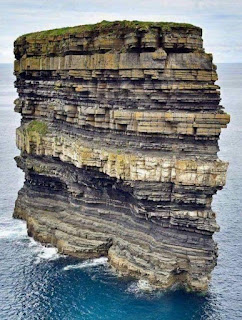
This is Dún Briste (literally Broken Fort) in Co. Mayo, Ireland. This 50 metres tall sea-stack stands just off Downpatrick Head, in the townland of Knockaun, east of the quiet village of Ballycastle. The stack is crowned by an old ruined fort...

There is a local legend that explains the name "Broken Fort". It was collected by Douglas Hyde and published in 1914 book "Legends of Saints & Sinners"...It is called "St Patrick and Crom Dubh" and I will here give a short version...With interpretation 🙂

...Before St. Patrick came to Ireland there lived a chieftain...in Co. Mayo, and his name was Crom Dubh. Crom Dubh lived beside the sea in a place...which is now called Dún Briste, or Broken Fort. My story will tell why it is called Dún Briste...

...Crom Dubh was one of the worst men that could be found, but as he was a chieftain over the people of that country he had everything his own way; and that was the bad way, for he was an evil-intentioned...man, with desire to be avenged on every one who did not please him...

...He had two sons... (who were) were worse than himself, and that leaves them bad enough! Crom Dubh (also) had two hounds of dogs...and if ever there were [wicked] mastiffs these two dogs were they....

...And, to go further, Crom Dubh had a big fire kindled...Anyone who displeased him, used to be brought before Crom Dubh, as he sat beside the fire, and Crom used to pass judgment upon him, and after the judgment the man used to be thrown into the fire...

...It is said that a fairy sweetheart walked with Crom Dubh, and giving him knowledge according as he used to require it. And every scheme hatched against Crom Dubh to put him out of the world, he overcame them all, for he had too much wizardry from the fairy sweetheart...

...The fame of Crom Dubh and his two sons, and his two mastiffs, went far and wide, for their evil-doing; and the people were so terrified at his name, not to speak of himself, that they used to hide their faces in their bosoms when they used to hear it mentioned in their ears...

...Crom Dubh was continuing his evil deeds for many years...and every year it was getting worse...Some say that he was a native of hell...But people had no knowledge of God or Mary...and for that reason they could not put trust in any person beyond Crom Dubh...

Here is the interesting bit 🙂 

...because they thought, bad as he was, that it was he who was giving them the light of the day, the darkness of the night, and the change of seasons... 

Who gives light and darkness and seasons? The sun god of course...The god for whom the Bronze Age Grange stone circle was built. 

The stone circle aligned to Crom Dubh's day, the day that marks the moment of maximum heat and to summer solstice, the day of maximum daylight...

It is Crom Dubh that St Patrick had to defeat to Christianise the Irish...After which Patrick took over Crom Dubh's holy mountain

And became "the one who decides the faith of the Irish"... 

And so enters Patrick:

...During this time St. Patrick was going throughout Ireland, working diligently and baptising many people....

...St. Patrick began explaining to the Pagans about the light and glory of the heavens. Some gave ear to him, but the most of them paid him no attention...Patrick took all those who listened...to be baptised to the well which is now called Tobar Phadraig or Patrick's Well...

...When these Pagans got the seal of Christ on their forehead...they began telling St. Patrick about the doings of Crom Dubh and his evil ways, and they besought him...to chastise Crom Dubh, rightly or wrongly, or to give him the Christian faith if it were possible...

Interesting right? The pagans get baptised and the Old God becomes Devil. Actually not even Devil, as that would give the Old God too much importance. The Old God becomes an Evil Chieftain...Much easier to deal with...

To cut the long story short, St Patrick arrives to Crom Dubh's house "...with his defensive company with him..."

Now does this imply that St Patrick used force during his conversion of the Irish?

...Crom Dubh set his dogs on St Patrick, with coals of fire coming out of their mouths, and a blue venomous light burning in their eyes...But Patrick tamed Crom Dubh's hounds and they become Patrick's hounds. Then Patrick extinguished Crom Dubh's fire. Then Patrick tried to "put the seal of Christ on Crom Dubh's forehead, but Crom Dubh did not give any ear to St. Patrick's words"...

...Then Crom Dubh tried "deviltry, druidism, witchcraft and  black art" trying to gain the victory over St. Patrick. But it was all no use for him, for the words of God were more powerful than the deviltry of the fairy sweetheart...

Finally:

...St. Patrick gave a blow of his crozier to the cliff under the base of the gable of the house, and he separated that much of the cliff from the cliffs on the mainland, and that is to be seen there today...and that is the cliff that is called Dún Briste or Broken Fort...

...Crom Dubh had to remain on top of the cliff "until the midges and the scald crows had eaten the flesh off his bones". And that is the death that Crom Dubh got...

...The people gathered in multitudes from every side doing honourable homage to St. Patrick, and the pride of the world on them that an end had been made of Crom Dubh...There was a well near and handy, and he baptised them all...

...There is not a year from that out that the people used not to make a pilgrimage to the well, on the anniversary of that day; and that day is the last Sunday of the seventh month, and the name of the Sunday is Crom Dubh's Sunday...

And so the people, on whose foreheads Patrick put the sign of the cross, after he banished their Sun God Crom Dubh, continued celebrating Crom Dubh's day...🙂 Under the pretext that they celebrated the victory of Patrick over Crom Dubh...I mean the day is still today known as "Domhnach Crom Dubh" which means "Crom Dubh's Sunday"...

Being a proper Sun God, Crom Dubh's day is Sunday. But not any Sunday. Sunday marking the middle of the hottest part of the year, the time when Sun's fire burns the strongest (like Crom Dubh's fire). Which accidentally falls in the middle of the Dog Days (like the Crom Dubh's ones which breathe fire and have light flashing out of their eyes)...

Oh by the way, did you know that right about the time when Patrick killed the Sun God and extinguished his fire, there was a major drop in temperature in Europe? You see the sudden drop in the second part of the 5th century AD?

How cool is this story? 

It is a historical account of the forceful conversion of the Irish and turning of their Sun god into Devil basically, by "The Patron Saint" of the Irish St Patrick "and his defensive company"...Oh and of the beginning of the medieval ice age...
Thursday, 15 August 2019

Bull of Grom Div

Storm clouds over norther Serbia, 2nd of August.


Terrible storms hit Serbia yesterday and today. Crops were destroyed, houses damaged, people killed. 

In Serbian the expression "On vedri i oblači" means "he rules", "he has absolute control, absolute power". Literally this expression means "he makes the sky clear and cloudy"... Storm clouds over northern Serbia... You can read more about this in my post "The power of the Thunder Giant

You can see why agricultural societies, like the Early Slavic society, would consider the Sky God, Perun to be the Supreme god... Procopius, 6th c. Byzantine historian, who tells us that the Slavs “believe that one god, the maker of lightning, is alone lord of all things...

Interestingly the 2nd of August is the old day of Perun, Slavic Thunder god. Painting depicting Perun by Andrey Shishkin.  


I like that Shishkin depicted Perun with a blazing sun on his chest. This is because Perun's day falls in the middle of Kresovi (Fires), the hottest part of the year in the Northern hemisphere.  You can read more about this in my post "Two Crosses"

This is why the 2nd of August is also the day of Helios, The burning sun. Today in Serbia known as the the day of St Elijah. St Elijah who every year gets so angry, that he wants to burn the world into cinder... Very saint like 🙂 


You can read more about St Elijah the Thunderer in my post "Thundering sun god". 

But St Elijah doesn't burn the world to cinder. Because his wife Ognjena Marija (Fiery Mary) calms him down. Ognjena Marija who is also known as Perunika. The wife of Perun, who has burning sun at its heart 🙂 Here is Ognjena Marija surrounded by Perun's burning wheels...


You can read more about Ognjena Marija in my post "Ognjena Marija".


The fact that Perun comes on the 2nd of August, when Sun is the hottest is symbolically depicted through Perun's wheel being basically Svetovid's wheel on fire...


Basically Perun and Svetovid are one and the same. 

You can read more about Svetovid in my post "The Horseman". 

So Perun comes at the moment of maximum heat to announce the beginning of the cooling of the northern hemisphere...This is part of the never ending change of the climate as a result of the never ending interplay between the Father Sun, Sky (Male principle) and Mother Earth (Female principle).  


You can read more about this in my post "Yin and Yang" and "Square and Compases";  


That Perun (thunder) really has Svetovid (sun) at its heart can be seen from the latest scientific data. It shows that it is the high speed solar wind particles which directly cause lightning. 


You can read more about this in my post "Sun Thunder Fire";

Svetovid (Sun) through Perun (Thunder) creates (Fire) Svarog. Fire (Svarog) heats up Sun (Svetovid) who creates lightning (Perun). In Slavic mythology this is symbolically represented by Triglav (Three headed) god... 

"Because it is a great secret how come Svarog (hevenly and earthly fire) is at the same time Perun (thunder) and Svetovid (Sun)..." From Book of Veles...


You can read more about this in my post "Triglav Trojan Trinity Trimurti Agni". 

In Slavic mythology, Perun's main "opponent" is Veles. He is "the great horned snake" who "stole heavenly cows from Perun". Every year on his day, 2nd of August, "Perun defeats Veles" and "rescues his heavenly cows"... 

Great snake is another name for a Dragon, a fire breathing beast. In Serbian mythology Dragon is just "an old male snake". Serbian word for dragon "zmaj" is a masculine form of the Serbian word for snake "zmija". And snakes are solar animals who Slavs believed "eat sun's heat, sun's fire" and cause sun to cool down and summer to end. You can read more about this in my post "Apep".

Fire breathing dragon is the symbol of sun's heat, sun's fire which causes draught.


Heavenly cows are clouds and their milk is rain. 


Basically Veles, the fire breathing Dragon, is the end of summer heat which dries the sky and the land and causes draughts. And guess what. The end of summer, the hottest part of the year in the northern hemisphere, which is by Balkan Slavs called "kresovi" (fiers), is also known as "dog days" and falls in the middle of Leo zodiac sign. St Austell Norman baptismal font with a dragon standing between the lions (in the middle of Leo) on top of a dog??? 


You can read more about this symbolism in my post "St Austell font" and "You will trample the great lion and the serpent". 

And every year, in the middle of Leo, in the middle of Dog Days, on Perun's day, 2nd of August, Perun "kills" Veles. Summer (draught) ends and Autumn (rain) begins. 

The reason why Veles is "horned snake" or more precisely "horned dragon" is because Veles is not just dragon, he is also a bull (hence his love of heavenly cows🙂). This is because Veles is summer, and summer starts in Taurus. You can read more about this Dragon-Bull duality in my post "Water bull" where I talk about Balkan legends which equate dragons and monstrous bulls. 

At the beginning of summer the bull of summer is young, fertile and life creating. At the end of summer the bull of summer is old, sterile and life destroying. And has to be slaughtered before it destroys everything...Which is what happens on day of Perun...The bull is killed, summer ends. 


Interestingly, bull is also the animal sacrificed in Serbia on Perun's day, which falls on the same day as Lughnasadh (Crom Dubh day) in Ireland (2nd of August, Last Sunday in July or First Sunday in August, the beginning of Autumn). You can read more about sacrificial animals in Serbian culture in my post "Sacrificial animals"


This tradition of sacrificing bulls to Perun was attested by Procopius, 6th c. Byzantine historian, who tells us that the "Slavs sacrifice to Perun oxen and every victim.”  

Now remember my post "Bull of Crom Dubh"? In it I talked about the link between bull and mysterious Irish Sun (Sky) god and god of Agriculture, Crom Dubh. The Irish celebrated him on the Lughnasadh, Crom Dubh Day, the First Sunday in August and sacrificed bulls to him. As I said at the end of that post, there is one more god to whom people sacrificed bulls at the end of summer: Grom Div (which means Thunder Giant, Thunder God in Serbian), Perun...Interestingly in Serbian folklore (and only in Serbian folklore, not any other Slavic folklore), Dabog (Giving god), who is at the same time Sun god and Rain god (Sky god) is also known as Hromi Daba. Believe or not, in Irish folklore, Crom Dubh is said to be another name for Dagda (Giving god)...

In Bosnia every first Sunday in August, people organise traditional bull fights. These were originally probably organised as part of the old Perun day celebration which revolved around "bull sacrifice"... You can read more about these bull fights in my post "Bo-Vo". 


Day of Perun, sorry day of Helios, sorry day of St Elijah the Thunderer 🙂 is so important that it is also celebrated by Balkan Muslims (Serbs who converted to Islam during Turkish rule) as Alidjun, meaning "The day of Ali (Elijah)". More about this in my post "Alidjun"

As I said, the reason why bull is sacrificed on this day is because this is the day when summer ends. And the summer starts in Taurus (Bull). So killing the bull is symbolic killing of the summer, summer heat. But bull is also symbol for grain which grew through the summer and is ready to be harvested. In most of Europe, harvest (from Old English "hærfest" meaning autumn) begins at the beginning of August. And so killing of the bull on Perun's day is also symbolic killing of the grain, beginning of harvest. You can read more about this in my post "Klas". 


In Ireland this is Crom Dubh day, the day of first fruits when in the distant past even first born were sacrificed to the God of Grain, Crom Dubh, but to whom until recently people sacrificed bulls as replacements for human sacrifice. You can read more about these ancient sacrifices to Crom Dubh in my post "How old is Crom Dubh".

In Cornwall the last sheaf of wheat is ceremonially "slaughtered" while crying "we have cut the neck" (of summer). 


In Slavic countries the last sheaf of wheat is called "Velesova brada" (Veles's beard)...Veles (summer) has been slaughtered...Harvest is finished...


Interestingly, in some Slavic areas this last sheaf is called Perun's beard...and in Bulgaria the last sheaf of wheat is dedicated (sacrificed) to St Vlas, Christianised Veles...

So what is the link between Irish Crom Dubh, Serbian Hromi Daba and Grom Div?

I believe that Grom Div arrived to Ireland during Bronze Age, when we find many stone circles being aligned to his day, 2nd (1st) of August, beginning of harvest, Crom Dubh Day, Lughnasadh. There, the true meaning of God's name was forgotten and was replaced with the closest Gaelic words Crom Dubh (stooped dark???, strange name for sun, sky god). I believed that Crom Dubh then arrived to the Balkans during Early Iron Age. By then the original name of the Sky God, Grom Div, was long forgotten and Gaelic Crom Dubh was replaced with the closest Serbian words Hromi Daba (lame daba???, daba means nothing in Serbian). But both the Irish and the Serbs preserved the ancient link between the Sky god and the bull and his day which marks the end of summer and beginning of autumn.

This explanation, I know, opens sooooo many "difficult" questions...

I also believe that this is one the most important links found in European folklore and mythology, the link which is a key for understanding a lot of forgotten ancient lore encoded in numerous legends, rituals and monuments scattered throughout Eurasia and North Africa...I have been writing extensively about this on my blog.

Saturday, 10 August 2019

Bull of Crom Dubh

Large thick, carved, rectangular standing stones, like these two, are in east Cork (Ireland) known as ‘bull stones’. When asked why, people say "probably because once they tied the bull to them…." (From Patheos: Bull Stones : the approach of Domhnach Chrom Dubh )


The most spectacular large thick, carved, rectangular standing stone in Ireland can be found in the Bronze Age Grange Stone Circle. But there it is called Crom Dubh stone.


Interestingly the ceremonial entrance into the circle is aligned with the sunrise on the 1st (2nd) of August, Lughnasadh, the day that marks the beginning of the grain harvest in Ireland. 

Lughnasadh is actually Crom Dubh day. The last Sunday in July or the first Sunday in August depending on the area is known as Domhnach Chroim Duibh - Corm Dubh Sunday. You can read more about this in my post "Reek Sunday"

The Grange stone circle, which is also locally known as Rannach Crom Dubh, is said to be built by Crom Dubh, old Sun and Grain god of Ireland himself. Archaeologists found lots of cattle bones in the circle, suggesting that cattle (bulls) could have been sacrificed inside the circle...You can read more about Grange stone circle in my post "Grange circle"

And interestingly, the bull was until recently still sacrificed to Crom Dubh on Lughnasadh, Domhnach Crom Dubh (Crom Dubh's Sunday). 


In this story from Irish folklore commission archives, Crom Dubh offers a bull  to St Brendan as an animal to be sacrificed during the building of a church.

"Saint Brendan and his brethren are erecting a church at Cloghane, at the foot of Mount Brandon. They ask the local pagan chieftain, Crom Dubh, for a contribution. He volunteers a bull, knowing full well that the bull is wild and dangerous. Brendan's monks attach a halter to the bull's neck and lead the animal placidly away. The bull was slaughtered and his meet was eaten by the workers and his blood was used for mortar. Crom Dubh is furious and demands the bull's return. Brendan writes the words Ave Maria on a slip of paper and suggests to Crom Dubh that the paper weighs more than the bull. Nonsense, asserts the pagan chieftain. A scale is arranged and, sure enough, the paper outweighs the bull. Crom Dubh is so impressed that he submits to conversion, along with all of his tribe."

A pattern (patron saint day) to Crom Dubh's honor is held in the village of Ballybran on the last day of every July ever since. It is called in Irish Domach Crom Dubh (Crom Dubh Sunday). In the old days, the turas (pilgrimage) was made at dawn. That would mean a night climb or a vigil on the hill. The ’rounds’ consisted of praying at the ruined oratory and then encircling it and the pillar-stone and the ‘graves’ nine times while saying the Rosary, and ended by taking a drink from the well. When these exercises finished, pilgrims went down the eastern slope to the village, where a famous Patron was held. Some villagers add that the Patron used to take place in the graveyard around the head which represented Crom Dubh. Marie MacNeill attested to the antiquity of the head and surmised that the stone was probably taken to the top of Mount Brendon for the harvest festival of Lughnasad.

In the OS Name Books for this parish, dated 1841, there is a note indicating that Croum Dhu was the god of the harvest whom pagans worshipped...

Symbolically this describes the conversion of the Irish to christianity, the defeat of Crom Dubh, the Old Sun God of the Irish. This defeat of Crom Dubh is usually in the in the southern part of Ireland attributed to St Brendan and in the northern half of Ireland to St Patrick.

But also, bulls are a replacement for human sacrifice. And Crom Dubh, under his old name Crom Cruach, demanded human sacrifices...The fact that the bull's blood was used for mortar points at human sacrifices performed to insure successful erection of buildings. This type of human sacrifices was recorded in epic poetry from Serbia. Similar rituals, today involving animal sacrifices on house walls are still practiced during building of a new houses in Serbia. You can read more about it in my post "New house".


What is even more astonishing is the description of the pattern, the saint's day celebration from Ballybran. It is dedicated not to st Brendan but to Crom Dubh. How is this possible?

I believe that after Christianisation people just continued with the old Celebration of Crom Dubh, held on his day, as before. Farmers are very superstitious and very conservative when in comes to rituals related to farming. And Crom Dubh being directly linked to grain farming, had to be respected, and his rituals had to be performed, Christianity or no Christianity, or the harvest might fail...

One other thing is very interesting. Does the fact that the the original mass used to be held on the graveyard confirm that Crom Dubh Day pattern in Ballybran was an ancestor cult celebration...And would that also indicate the Crom Dubh was seen as an ancestral deity?

Another story, from Galway, also links Crom Dubh with a bull.

On his way into Mayo, St Patrick came to Maam Eán, the only pass in the Maam Turk mountains. Looking down on a vast pastiche of misty tones of cream, green and gold all the way to the ocean, tradition tells us that he blessed Connemara, before moving on.

The great Irish scholar Máire Mac Neill tells us that before St Patrick arrived on the scene, the mountain pass, between two remote territories, was guarded by the pagan god Crom Dubh.

The god was originally associated with fertility and good harvests, but the threat of Christianity made him watchful, and distrustful of strangers.

"When Crom Dubh saw St Patrick climbing towards him he changed his shape into a fierce speckled bull (tarbh breac) and charged at the saint.


There was a fearsome struggle as the saint wrestled with him. After some time, as the two forces pushed, heaved, and dragged each other over the mountainside, the saint eventually forced his enemy into the lake where it drowned. The lake has since been known as Loch an Tairbh – the bull’s lake. The legend then goes to state that since St Patrick drove the bull into the lake, there is a strange red glow on it ever since. Interestingly another legend tells us that the lake is enchanted, and that a giant serpent (ollphéist ) is imprisoned in its depths."

Legends about bulls and dragons (great serpents) living in lakes and demanding human sacrifices can be found in several places in the Balkans. You can read more about this in my post "Water bull".


There is another legend which says that when the bull saw St Patrick, he was overcome with repentance, and knelt before him.

Maam Eán was a place where up to the end of the 19th century a famous Pattern, where large crowds gathered, took place every year on Garlic/Garland Sunday (the last Sunday in July), Crom Dubh Sunday...

"In Aughagower, Co Mayo there is a church and a round tower in Aughagower graveyard which was built by St Patrick who is the Patron saint of the village. Crom Dubh was a man who lived in Liscarney, and he was very rich. When St. Patrick was building the tower in Aughagower this man gave him a bull for food for his men. After this Crom Dubh got sorry for giving the bull. He went to St. Patrick and told him to give him back the bull. The bull was killed and St. Patrick told his men to gather all the bones and the skin. They did so and St. Patrick rose him to life again. Crom Dubh took the bull and went home. It is said that the bull killed him afterward. After this event the saint went up to the north of Ireland."


In Munster and Connacht folklore Crom's bull was believed to be immortal.

In one of the legends "St Patrick requests food from Crom Dubh, and Crom Dubh sends his live bull to St. Patrick, hoping that St. Patrick will be killed by the animal.  Crom Dubh’s "evil plan" doesn’t work, because the bull willingly surrenders and offers itself up to be sacrificed: slaughtered, skinned, roasted and eaten.  This enrages Crom Dubh and after the bull had been consumed, he demands that Saint Patrick return his bull to him, knowing full well that this was a preposterous request.  To Crom Dubh’s amazement, Saint Patrick instructs that the animals hide and bones be reconstructed and he resurrects the bull.  At this point, there are two variations of the story’s finale, but both are obviously Christian-centered.  One is with Crom Dubh being so awestruck that he immediately converts to Christianity.  Another is where the bull kills the Pagan Crom Dubh..."

The bull is the symbol of summer, because summer starts in Taurus, Bull. Bull is also the symbol of grain which grows during the summer and is harvested during autumn. As summer ends bull (summer, grain) gets symbolically "killed" (autumn arrives and grain gets harvested). The grain is then eaten but summer comes again next year and new grain grows and is on Crom Dubh's day again ready to be "killed" and eaten...

Around Galway Bay at Samain every household skinned and roasted a bull in honour of Crom Dubh, and one may assume that Crom Dubh and the Bull were originally synonymous."


Crom Dubh being the harvest deity had both first and last fruit sacrifices dedicated to him, which is why we find bull sacrifices to Crom Dubh performed both at Lughnasadh (beginning of autumn, harvest) and at Samhain (end of autumn harvest).  

At Cois Fhairrge, Galway, Ireland, bulls were sacrificed to Crom Dubh (harvest-giver and weather-ruler) as late as the 18th century. The hide of the bull would be preserved and sleeping in it was a rite of divination

This preserving of the skin of the bull sacrificed to Crom Dubh is very interesting because the Irish annals say that bull skin was used to select the next High King of Ireland.

The Tarb fheis, or bull feast, was a ceremony used to select the next High King. It involved the sacrifice of a white bull, after which the Druid, or poet, would ‘chew the flesh and drink the broth’. Following this meal, the poet was wrapped in the bull’s raw hide to dream. If his dream was unsuccessful in identifying the new King, he faced death.

According to the Togail Bruidne Dá Derga, ‘The Destruction of Da Derga’s Hostel’, on this occasion, the poet dreamed the future King would arrive in Tara naked and surrounded by birds. Young Conaire Mór was out hunting birds, when the leader of the flock suddenly threw off his feathers and revealed himself as the King of Birds, and Conaire’s true father. He advised Conaire of the details of the new prophecy, whereupon the young man immediately removed his clothes and set off for Tara accompanied by the Bird King and his flock. Thus the prophecy was fulfilled.

This ceremony is also explicitly described in a story preserved in the Lebor na hUidre, or ‘Book of the Dun Cow’, c 1106 AD, in a story called Serglige con Culainn, or ‘The Wasting Sickness of Cuchulainn’.

This seems to show that the Irish kings drew their authority directly from Crom Dubh.

This following ritual performed on the Mount Callan in County Clare is very interesting. In "On the Evidences Bearing on Sun-Worship at Mount Callan, Co. Clare":

Professor O'Looney:

"...about the ancient assemblies of Buaile na Greine and the ceremonies which took place at Altoir na Greine in olden times...I think the topographical features of the place, and the fact that the sun is dominant on this particular spot from early dawn till evenings close, is the true origin of the name Buaile na Greine which simply means the Plain of the Sun or the Sun beaten lawn. The application of the word Altoir is not older perhaps than the time of Michael Comyn's romance of Torolb Mac Sháirin, the only written work in which the name Altóir na Greine is applied to this great stone altar or table. It is more probable that Alt na Greine the height or eminence of the sun, one of the older names of this peak, was converted into Altóir in after times, and that the name Altóir na Greine applied by Michael Comyn to the great stone monument which then stood on this eminence, prevails to the present day while the older name of the place is entirely forgotten.
It seems to me that the assemblies on buaile na Greine were the representatives of the ancient Oenachs, fairs, and Tocomracs or general assemblies, of that part of the country.
You will see from the passages I translate from Michael Comyn's account of the adventures of Torolb Mac Stairn and his three sons that the slaying and immolating of quadrupeds formed part of the ceremonies at Altóir na Greine, indeed I may say we have no other ceremony but that and we have the important additional statement that the ceremony closed with the cooking and eating of the quadruped killed there.

The killing of the quadruped at Altoir na Greine goes far in support of my view that those assemblies represented the more ancient Oenachs. The poem on the celebrated Oenach Tailtein preserved in the books of Lecan and Ballymote contains the following quatrain from which it appears that a similar practice formed part of the rites of that ancient fair.

The three forbidden bloods:
Patrick preached (against) in it
(i.e. in the fair of Tailtein)
Yoke oxen and slaying of milch cows
And the burning of the first fruits
(first born)

The Oenach of Buaile na Greine dwindled down to be little more than a local patron but, however thinned the population was by extermination and other misfortunes the traditional custom of meeting on Buaile na Greine still continued in one form or another. The same delightful eminence on which Altoir na Greine stood still continued a favourite resort on certain festive occasions: and the sports, games, and feasts were celebrated till very recently. The games and sports of later days were nothing more than hurling, wrestling, jig dancing and other simple feats of that class, and, as the inhabitants of the place were not over wealthy in latter days, the feasts were of a homely sort and very simple..."

Professor O'Looney is wrong on so many accounts here.

1. Every place facing south and unobstructed by anything else is the place "where the sun is dominant on this particular spot from early dawn till evenings close". How many other such places are called Buaile na Greine (enclosure of the sun) or Altoir na Greine (altar of the sun)? Plus we know that another site where people gather on Crom Dubh day was a pre Christian solar cult centre. This is the Holy mountain of Crom Dubh, where St Patrick finally defeated Crom Dubh, the mountain which was then renamed into Croagh Patrick (Patrick's mountain). The ancient Bronze Age carved stone, now called Patrick's chair :) is the place from where an extremely rare solar spectacle, the ruling sun, can be observed twice a year. The extraordinary phenomenon of the rolling sun down the slope of Croagh Patrick was perfectly captured in this animated gif made from still images by one of my favourite Irish photographers, Ken Williams.


You can read more about the holy mountain of Crom Dubh in my post "Sun mountain". 

2. Fairs were in the past usually organised on holy days. The bigger the holy day the bigger the fair. So it is quite possible that the gathering around the Altoir na Greine also involved the fair.
3. The "slaying and immolating of quadrupeds" and "cooking and eating of the quadruped killed" at gatherings always has religious connotations. Communal feast are sacrificial feast where the deity is one of the participants. The feast that was organised on the day of Crom Dubh and which consisted of roasted bulls, animals sacred to Crom Dubh, was a sacrificial feast dedicated to Crom Dubh. That killing of bulls at fairs was indeed a religious ceremony can be seen from the explicit ban by St Patrick of "sacrificing bulls and first fruits", both sacrifices "demanded" by Crom Dubh.

Now continuing in "On the Evidences Bearing on Sun-Worship at Mount Callan, Co. Clare" Sr Samuel Ferguson goes on to say:

"...In Mount Callan in County Clare, on Domnach Lunasa, or Lammas Sunday, the first Sunday of the Month of August, people celebrated first - fruits day, and a great day on Buaile na Greine (enclosure, circle of the sun). On Laammas Sunday, called Domnach Crom Dubh, and anglicised Garland Sunday every household was supposed to feast his family and household on the first fruits, and the farmer who failed to provide his people with new potatoes, new bacon, and white cabbage on that day, was called a Felemair Gaoithe, or wind farmer, and if a man dug new potatoes before Crom Dubh's Day he was considered a needy man, and hence this Sunday was called first - fruits Sunday. On this day all went to Buaile na Greine with their contribution and their lons (or food supplies) to hold the fair.

The ceremonies consisted of strewing summer flowers on the altar and festive mound, of which we have been speaking up to this, under the name of Altóir na Greine, or Altar of the Sun, but which is on this day used as the altar of Crom Dubh.

The assemblage of this day is called Comthineol Chruim Duibh, or the congregation or gathering of Crom Dubh. And the day is called from him Domnach Chrom Dubh, or Crom Dubh's Sunday, now called Garland Sunday by the English speaking portion of the people of the surrounding districts.
The name is supposed to have been derived from the practice of strewing garlands of flowers on the festive mound on this day as homage to Crom Dubh: hence the name Garland Sunday.
Assuredy I saw blossoms and flowers deposited upon it on the first Sunday of August 1844, and put some upon it myself as I saw done by those who were with me. I was then a mere lad, but very inquisitive. The assembly was at this time a mere gathering of boys.
We thus find a new deity introduced on the Altar of the Sun, and sun - worship and pig - worship upset.

If you ask me who Chrom Dubh was I can only tell you I asked the question myself on the spot. I was told that Chrom was a god, and that Dubh or Dua meant a sacrifice, which in combination made Crom Dubh or Crom Dua that is, Crom's Sacrifice: and this Sunday was set apart for the feast and commemoration of this Crom Dubh, whoever he may have been.

The feast, games and sports of this day merged into a sort of patron or festive fair, which continued to be celebrated on Buaile na Greine for a considerable time. The principal amusements were feasting, drinking, and singing, racing, hurling, dancing and other such sports, the patron being sometimes held for several days. The priests and wise old men of the surrounding parishes, growing tired of this practice admonished the people to abandon the custom of going to Mount Callan, and counselled them to give up customary feasts and patron of Buaile na Greine, and subsequently they got up a patron at St. Muchans, in the Union of Ennistymon whither they invited all to come.
Hence they set up races, goals, moneen dances and other sports to attract the people hither, and here, while the young and sportive were at their sports, the old and pious were engaged in performing rounds at St Muchans Holy well and praying on the bed of the patron saint.

This patron of St Muchan's was subsequently removed to Leacht Uí Chonchobair, now Lahinch where the tribe of O' Connor of Corcomroe were in the habit of meeting to celebrate the Oenach Gabha or mourning assembly (fair) of their chieftain O'onnor, King of Western Corcomroe, who was buried in that place and who Leacht (monumental pile) gave the name Leacht Uí Chonchobair to this place.

The Leacht has now disappeared and its place is now occupied by the Victoria Hotel at lahinch, and I question if there are many who can tell much of its history, and nothing now remains to commerate the last of the O'Connors Kings of western Corcomroe, but the word Leacht, the present contracted form of Leacht Uí Chonchobair, or Lahinch.

Thus I have collected the traditional history of the ancient assemblies of Buaile na greine, showing how it has existed perhaps from a time even anterior to Conan Maol down to the present day, and how it still survives, probably in greater multitudes and more true to the characteristics of an ancient Oenach or Tochomrac Tuatha than it was since the system of territorial and tribe government, under the ancient Brehon Laws, ceased to give a political importance to those assemblages, of which, I have no doubt, the Oenach of Buaile na Greine was one.

As for the Altoir na Greine, I saw it in 1844 - 1845. The altar was a rude construction much in the form of a large bin or chest, but empty underneath. The altar past was composed of seven large grey flags - four upright flags standing in the ground, two at either end, about four feet apart, and one great flag reaching down upon them, and two upright flags standing in the ground behind them on the western side and rising about two feet or eighteen inches above the table stone of the altar. there were some stones of various shapes and sizes around it, at the back and at the ends and an elevation or mound of clay and small stones. Its position was south west from Leaba Chonain. You looked south west across the lake to Crag na Sean Ean.

In the year 1859 I met a poor man who fixed a temporary residence near this part of the mountain. He told me he made a cabbage garden in this locality, and as stones were scarce to fence it, he broke up the whole altar structure and split the large rocks and flags with his crowbar to make a fence for his garden. It will be observed that the man of the cabbage garden died soon after. I was at his funeral soon after. The stones were subsequently removed and utilized in making and patching the line of road that runs underneath, from Synge's lodge to the Hand Road.

I must claim the indulgence of my readersfor the frolixity of these quotations. But the matters discussed are so interesting and from so inherent a part of the history of the mountain that without their inclusion, the story of Leaba and Leac Chonaín would be incomplete..."

In Armagh there is the story of a bull that prevented Patrick from building a church, so Patrick cursed him and he went mad. Eventually the bull was caught and killed, and buried under a standing stone at Corran. This stone, part of The Bull’s Tracks, was once associated with the bull of Cualgne (from the Cattle Raid of Cooley). Another version of the story says that St Patrick was trying to build a church on Armaghbreague mountains during the day, but the bull kept destroying it during the night. After the church was destroyed for the third time, St Patrick got so mad, he picked up the bull and flung it from the mountain. The bull landed on the spot today marked with the bull stone.


On an island north of Skye there was a tradition of sacrificing a bull in August, on a day dedicated to "going around some ruinous chapels, taking of omens from a hole in a round stone…, adoring of wells and … pouring of milk upon hills as oblations."

Interestingly there is another God whose name sounds almost exactly like Crom Dubh, to whom bull has been sacrificed on the 2nd of August...I will talk about this in my next post: Bull of Grom Div...You can read more about this in my post "Bull of Grom Div".