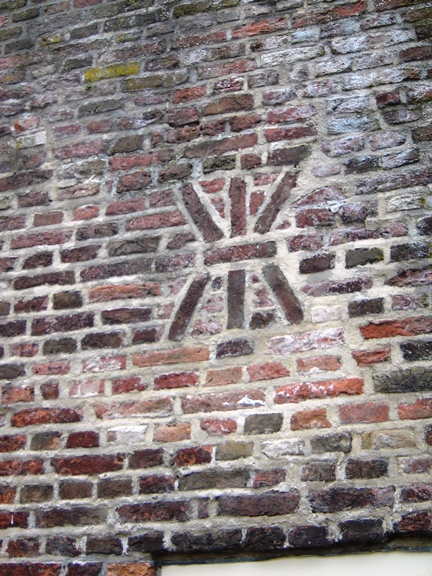
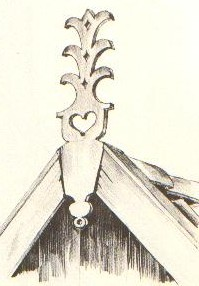
This is so called Donderbezem (thunder broom), a protective symbol used in Holland and northern Germany as a protection from lightning strikes and evil spirits.
These symbols were either built into brick walls of the houses...This example is from the city wall of Elburg, Holland, and dates to 14th century...
Or they were engraved on the metal parts used as wall or door frame reinforcement...This one is from Nijmegen, Holland, and dates to 16th century. It is even made to look like a broom...
Or they were placed on the ridge of a roof pointing to the sky...This one is from Vleerbosch, Haarle/Tubbergen, and dates to 20th century.
Most sources will tell you that these symbols were connected with the Germanic god of thunder (Thunar/Donar/Thor) and that the origin of this symbol is the Younger Futhark Haglaz rune which means "hailstone"...
What is interesting is no one really knows why this symbol is called "thunder broom"...Apart from a vague belief that a broom would keep evil spirits from entering your home, cause broom is used for cleaning, expelling...
That thunder broom being a broom is important, can be seen from the fact that there is a variant of Donderbezem symbol built into brick walls which actually looks like a broom. This example is from Altengamme near Hamburg, Germany, and dates to 20th century.
The broom pointing up looks very much like another rune, this time Elder Futhark rune, Algiz...Which means "Protection"...From thunder and lightning?
That thunder broom being a broom is important, can also be seen from the fact that most of the Donderbezem symbols placed on the ridge of a roof actually look like a broom too...These examples are from Rekken in Berkelland province, Holland.
That thunder broom being a broom is important, can also be seen from the fact that sometimes actual brooms were hang under the roof as a protection from thunder...
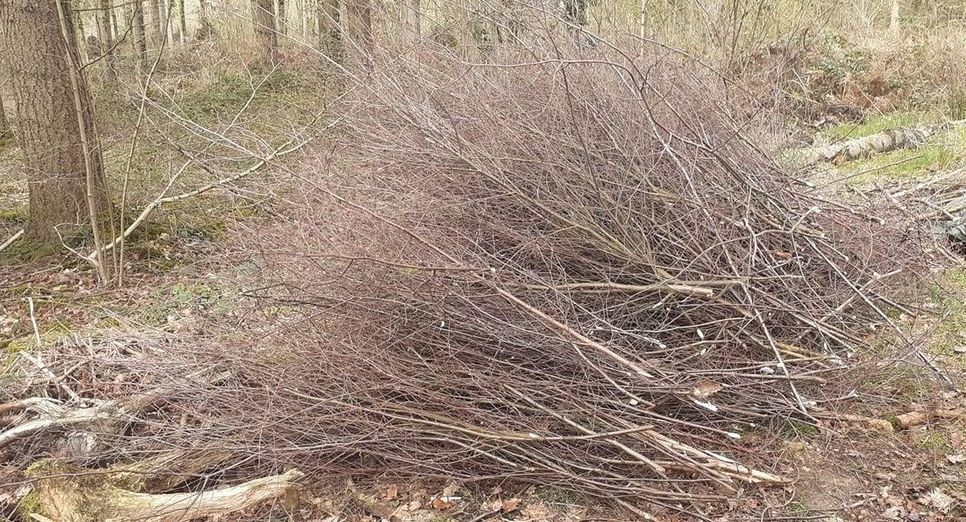
Originally a Donderbezem was just a bundle of twigs stuck under the roof of the house...Technically brooms were originally just bundles of twigs. Like these ones...So it was in affect a broom stuck under the roof of the house that was the original Donderbezem (thunder broom)...
But as I said, I couldn't find any explanation in Germanic mythology or folklore for why people would believe that a broom was able to protect their houses from thunder strike. I have to admit I didn't do a thorough search, so I could've missed some important info. Anyone knows?
Traditionally, brooms are made from the twiggy growth of the birch tree, and the craft was particularly strong in areas where birch coppices abounded...
So I thought: could it be that the reason why broom was used as a protection against thunder strikes was because birch tree was believed to protect against thunder strikes?
Again, I couldn't find anything in Germanic mythology or folklore about people believing that birch was able to protect their houses from thunder strike. I have to admit I didn't do a thorough search, so I could've missed some important info. Anyone here knows?
But interestingly, Slavs believed that the birch, planted near the house, repels evil and protects from lightning...And even better, they believed that stuck under the roof of the house, birch branches (broom) protected the house from the lightning, storm, and hail...🙂
Wow...Strange...So what about Donderbezem? Where did that belief come from? This is map of Utrecht, city in Central Holland, dated to 1581...
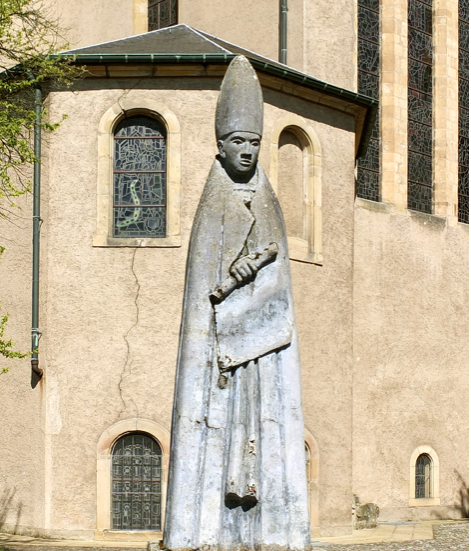
And this is Willibrord (658 – 739 AD), a Northumbrian missionary saint, known as the "Apostle to the Frisians" in the modern Netherlands. He became the first Bishop of Utrecht...I talked about him in my post "Axe of Martin"....
Bede says: "Pepin gave Willibrord a place for his episcopal see in his famous castle, which, in the ancient language of those people (who originally built it), is called Wiltaburg (the town of the Wilti), but in the French tongue Utrecht..."
Wilti, of Wiltzi were a West Slavic tribe. During the time of Charlemagne, Wilti were in alliance with the Saxons, fighting against the Franks who were allied with another Slavic tribe, Obodriti...
You can read more about Slavs among Anglo Saxons in my post "The origin of Anglo-Saxon race" which talks about the 1906 book "Origin of the Anglo – Saxon race" by Thomas William Shore...
Slavs lived all over Northern Holland and Northern Germany (Donderbezem country) until they were either exterminated or germanised during hundreds of years of Anti Slavic crusades...
So is it possible that Donderbezem is a remnant of old Slavic belief that birch and birch twigs (broom) can protect the house from thunder strikes?
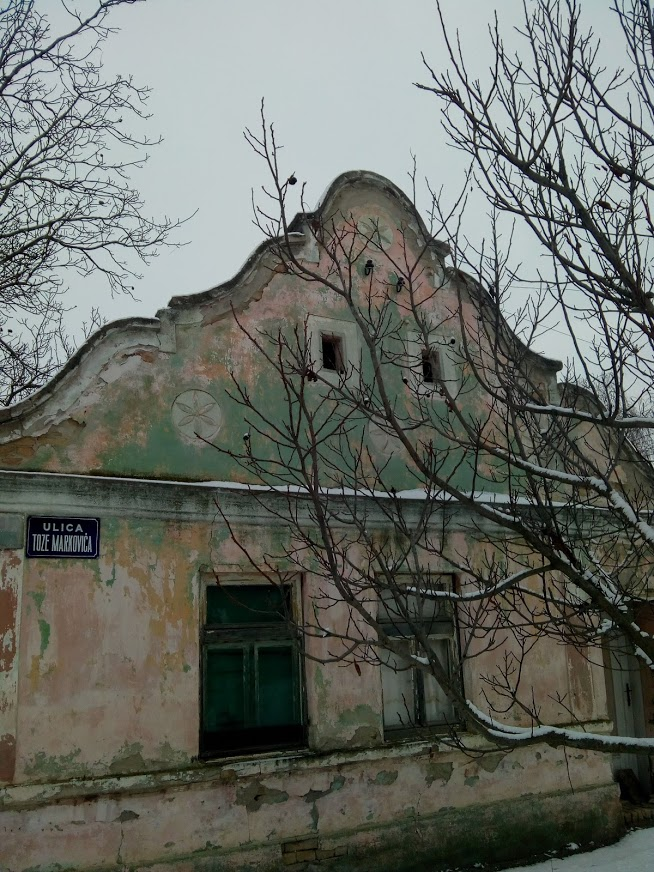
Interestingly, some of the roof Donderbezem look like this...
See that rosette? That's Perunika, The flower of Perun (Slavic thunder god). Also known as "Gromoviti znak" (Thunder mark), it was carved into wood, stone, plaster on Slavic houses as a protection against...thunder...
Like this...BTW, do you notice how much Perunika looks like Donderbezem aka Haglaz rune???
Interesting, right? And mysterious...
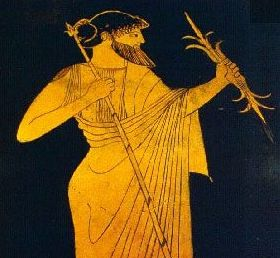
Now it is possible that this is also linked in some way to the shape of the κεραυνός (keraunos), the lightning bolt of Zeus...
And is it possible that this is also linked to वज्र (vajra) the thunderbolt of Indra...
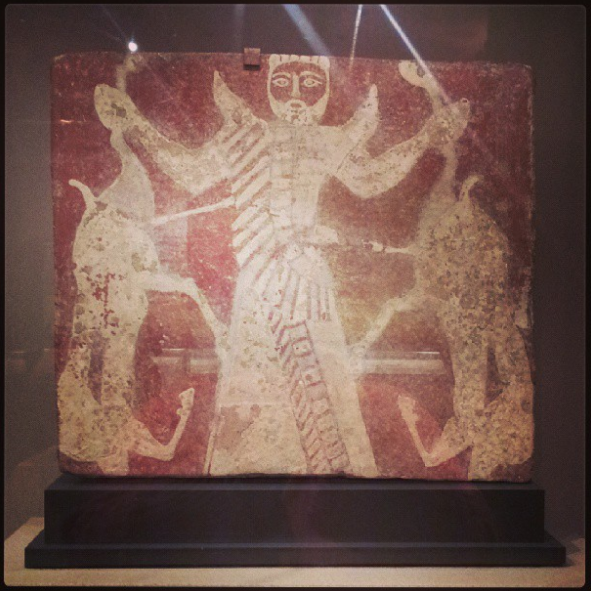
And is it possible that this is also linked to the unnamed lightning weapon wielded by Ninurta?
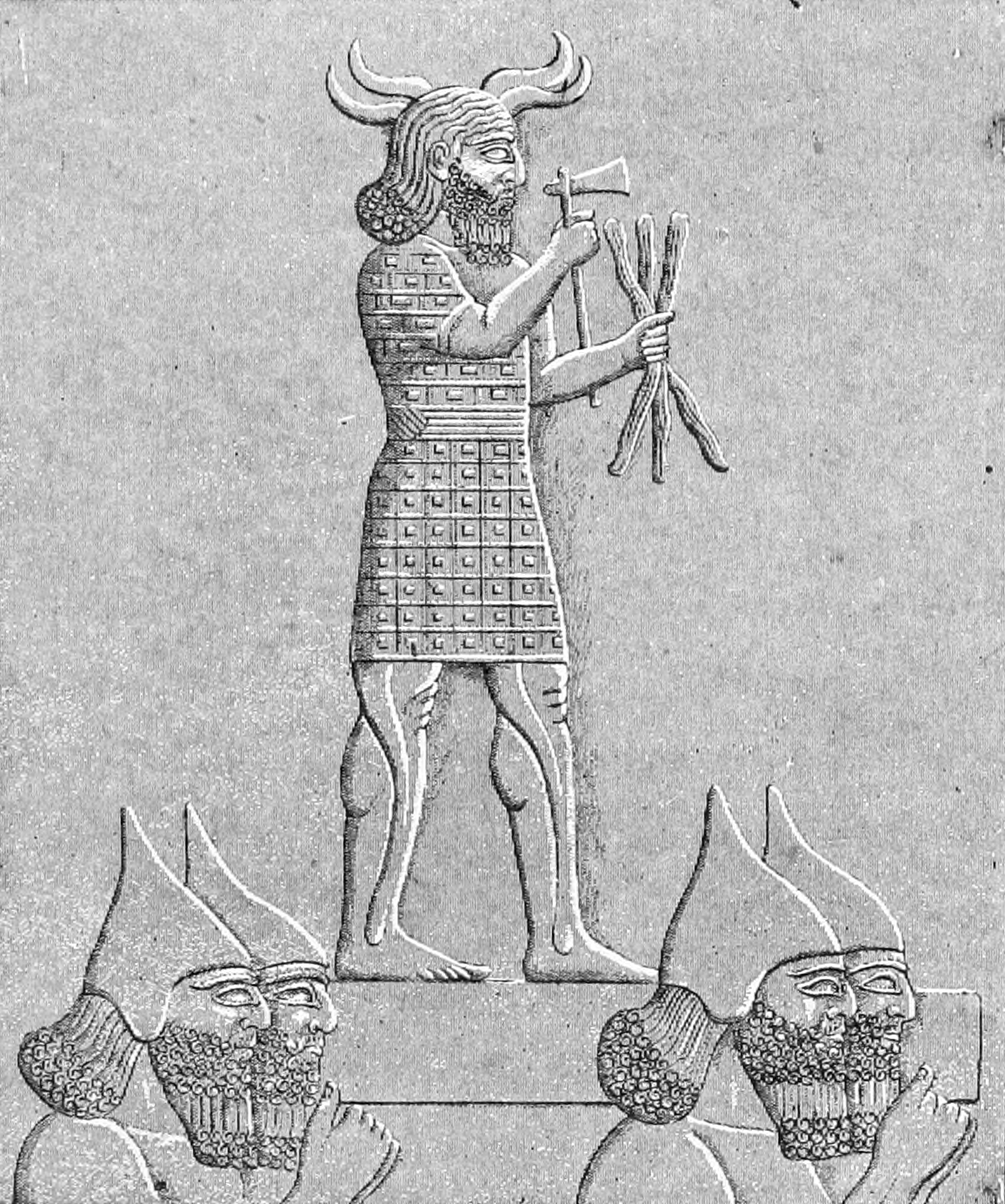
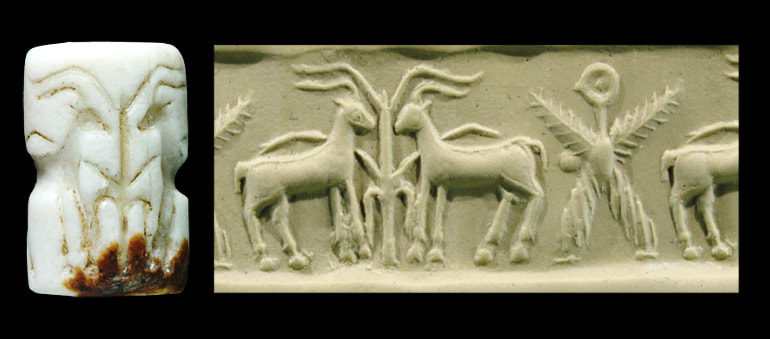
And is it possible that this is also linked to the the "bundle" with unknown meaning held by Hadad
Don't they all look like the original, double broom Donderbezem?
Also just remembered this. Serbian Folk song from Bosnia collected by Kosta H. Ristić in 1873.
It talks about quarrel between Sun and Vila. Vila is mostly translated as Fairy or Mountain Nymph. The problem is that the word Vila literally means trident, pitchfork, fork...
Pitchfork being one of the ancient weapons of the thunder gods means that Vila is actually lightning personified...The best discussion about Vila's identity and her identification with the thunderstorms and lightning can be found in "Stara vjera Srba i Hrvata" by Nodilo...
The song describes the two competing forces, sun and thunderstorms during summers, when sun wins over thunderstorms, skies dry out and droughts arrive...
Original in Serbian can be found here...
And here is another Serbian ritual song which talks about a (disastrous) marriage between Vila (literally "pitchfork"), a mountain fairy (but really personification of lightning) and Davor (Dabog), Serbian (Slavic) sun and rain (sky) god...I wrote about this in my post "When bride dies soon after the wedding"...
Is it possible that this is somehow linked to the the "pitchfork/broom" weapon of Ningirsu?
Or the त्रिशूल (trishula) pitchfork of Shiva
Doesn't this look like single broom Donderbezem?
Anyway...