Showing posts with label irish archaeology. Show all posts

Sunday, 3 March 2024

Halberds

One of many Bronze Age halberds found in Ireland...

You know when you were a kid, and you were told that you can't play until you finish your homework? 

This must have been how Ronan O'Flaherty felt when he started work on his archaeology PhD in UCD, Ireland...

The title of his thesis was "The Early Bronze Age Halberd in Ireland - Function and Context" and in it he tried to see if he could disprove this:

"Irish halberds have traditionally been regarded as non functional, ceremonial artefacts. In particular, the mode of hafting and the slightness of the haft head have been cited as reasons why this artefact could not have been put to any practical use"...

I know that all he wanted to do was: 

1. Cast replicas (Left) of the Bronze Age halberds from the National museum (Right), using the same copper with a very low arsenic level of 0.2%, and without cold-hammering or sharpening of the blades...


2. Haft the halberd replica (Left) based on rock carvings from Mt. Bego, Italy (Right), showing people using (well at least holding high above their heads) the original Bronze Age halberds...

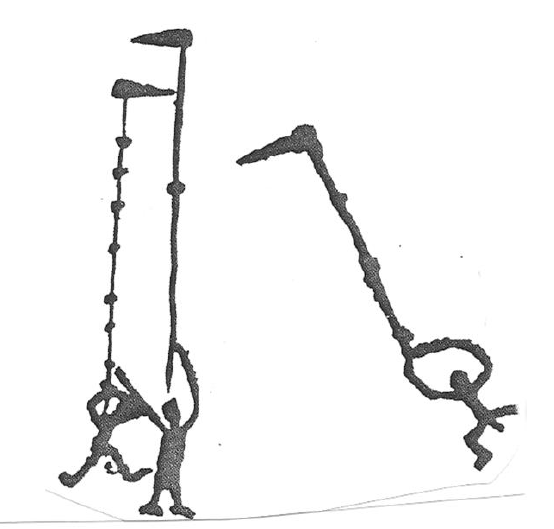


3. Whack some sculls, of the same strength as human sculls, like sheep ones, repeatedly, with the replica halberds, to see what happens...

But before Ronan could do all this fun stuff, he had to do the homework...He collected all the available data about all the so far discovered European Bronze Age halberds...


He then investigated the Early Bronze Age mining and metalworking industry in Ireland and the type of metal and metal artefacts produced during that time, so that he could try to replicate the material and the production of the Bronze Age halberds as closely as possible...
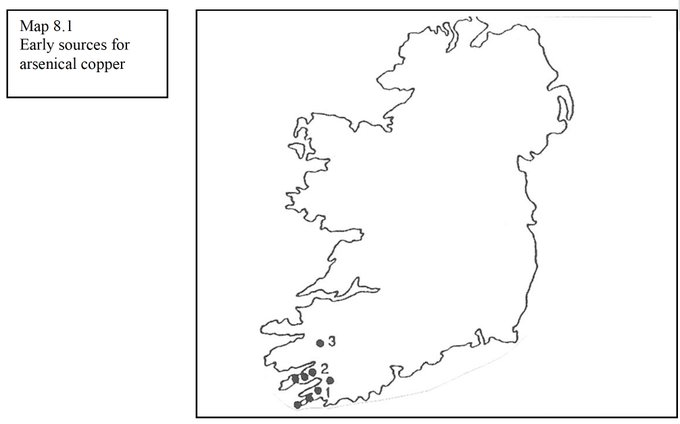
Then he investigated the hafting of Bronze Age halberds...


And finally the use of halberds in battle (from available medieval sources)...

Once he did his homework, Ronan went out to play...

And this is his report:

The replica halberd...revealed itself to be a frighteningly effective weapon, slicing skulls open with disturbing ease and proving very comfortable to handle. A short (couple of feet) chopping blow, was sufficient to pierce the skull, often very deeply indeed...

[The weapon would have been even more efficient] "if it was used by an expert", and "if it wasn't for a certain 21st century distaste of committing such violence in the first place"...Love this 🙂

Repeated blows against twenty sheep skulls, of similar strength to a human skull, failed to inflict all but the most minor damage to the halberd and there was no indication that it could not continue in such use for a prolonged period of time.

The small rounded end of the blade ensured that the full force of the blow is administered to a tiny area of the skull first, virtually guaranteeing a puncture each time.

The fact that the end of the blade was rounded rather than brought to a sharp point added strength to this area, which otherwise might have bent or even snapped on first impact.

This suggests that the blade was designed for impact on bone rather than muscle, where a sharp pointed weapon would seem more appropriate than a blunt-nosed one.

Ronan conclusion: There is no doubt in my mind that the Irish halberd is very carefully designed as a most effective weapon. [Maybe not all] Irish halberds were used in this way, but they certainly could have been and it certainly appears to be the basis for their design.

In addition, the replica halberd survives in a condition which I would categorise as "perfect" in a museum example, suggesting that even these perfect halberds could have seen some use.

Ronan's papers:

"The Early Bronze Age Halberd in Ireland - Function and Context"

"Up close and personal - impact damage on Irish helberds"

To me, most interesting bit of his work is found in boring homework section: the distribution of high concentration halberds sites  indicates that they were connected by a well established maritime trading route...
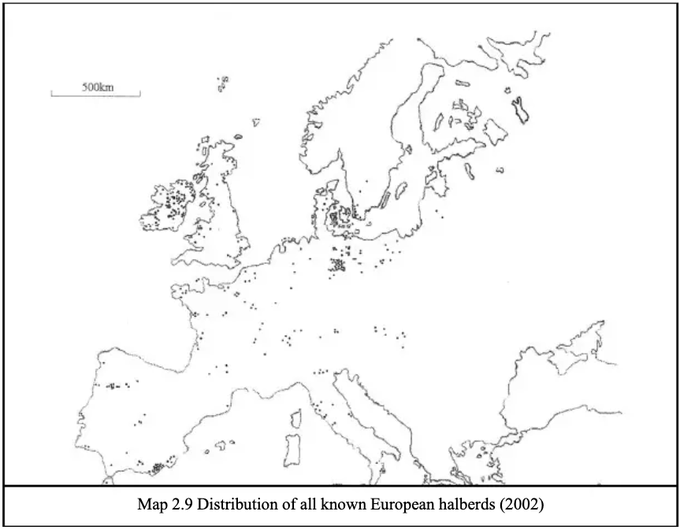
Central European Unetice culture was built around navigable rivers which empty into Baltic sea...From there you can navigate around Scotland to Ireland, Wales and England and along the French coast to Brittany, and then to Iberia, Italy, Greece...

I can bet that all the other inland sites with halberds lie on navigable rivers which empty into the seas along this route...

The existence of maritime trading routes along Mediterranean and Atlantic coast has been attested since Neolithic. 

And it was always linked with mining, first for material for stone tools and weapons and then metal for metal tools and weapons...I talked about this in my post "Neolithic seafarers"...

These maritime routes probably facilitated extremely fast spread of Megalithic culture throughout Europe. I talked about this in my post "Childe was right"...

I think this is very very interesting...Particularly when we look at the Irish oral histories, first time recorded in Medieval time, which talk about the existence of such maritime routes along Mediterranean and Atlantic coast during Bronze Age...

I talked about the Irish oral histories and archaeology which seems to support them in the posts linked from this jump page "Montenegrian tumuluses"...

That's it for today...

Sunday, 19 February 2023

Obsessed with butter

Buttering toast, the Irish way...

In 2015 an article entitled "Milking the megafauna: Using organic residue analysis to understand early farming practice" was published in the Journal of Environmental Archaeology by Jessica Smyth and Richard P. Evershed... 

The authors of the paper analysed residues found in nearly 500 cooking pots from Neolithic Ireland dated to the period 4,000 to 2,500 BC...

Ninety per cent of the residues tested for fat origin were found to be dairy fats, with ten per cent found to be meat fats (beef or mutton) or a mixture of milk and meat...

Dr Smyth, who led the study, said: "We know from previous research that dairying was an important part of many early farming economies, but what was a big surprise was the prevalence of dairy residues in Irish pots.  It looks to have been a very important food source".

Dr Smyth also said: "We know that settlements were small in the Irish Neolithic, usually one or two houses, so it’s likely that early farming groups had just one or two animals supporting the household with their products, which were perhaps part of a wider community herd"...

"Such results are even more significant given the fact that domesticated animals such as cattle, sheep and goats had to be physically shipped to Ireland as part of the process, as these animals were not native to the island"...

It just so happened that when this paper got published, I read an article in Irish Times about a paper written by UCD professor of archaeology Liam Downey and environmental archaeologist Dr Ingelise Stuijts about the history of "banbidh" (Irish for white foods) in Ireland...

They collated and analysed the data about food consumed in Ireland from the time of the earliest documentary sources up to the late 17th century...

They concluded that despite "extraordinarily high number of cattle in Ireland and an abundance of fish in the Irish waters, ordinary Irish people ate very little beef or fish".

Research had found that people lived primarily on dairy products. The Irish favourite food was butter. But there was also drinking milk, and buttermilk, and fresh curds, and old curds, and something called “real curds,” and whey mixed with water to make a refreshing sour drink...

In 1690, one British visitor to Ireland noted that the natives ate and drank milk "above twenty several sorts of ways and what is strangest for the most part love it best when sourest". 

He was referring to bainne clabair (thick milk), something between old milk and sour cream.

In the 12th c. vision of MacConglinne, he traveled to "the Land of Food" where he saw a delicious drink made up of "very thick milk, of milk not too thick, of milk of long thickness, of milk of medium thickness, of yellow bubbling milk, the swallowing of which needs chewing"...

Medieval British military advisors proposed that the best way to suppress Irish rebellions "would be just to kill all the cows because the majority of the population lived all summer on their cows’ milk"...

The second most important food were cereal products. The ordinary Irish people "ate tons of bread and porridge".

As for meet, it seems that "beef was most commonly consumed by the higher ranks of society, while pork was eaten by the common people..."

It is not surprising then that people so obsessed with butter, cheese and milk valued cattle above all else, to the point of being completely obsessed with them...

Fergus Kelly in his books "A Guide to Early Irish Law" and "Early Irish Farming" talks about cattle as currency in the early medieval Ireland. He gives the list of types of cattle used for payment and their relative value...

The basic unit was a milking cow, usually with her calf.  Different ancient texts give different exchange rates for different types, but they were all given as a fraction of the value of the milking cow. Example:

In-calf cow = two-thirds of a milking cow

Three-year-old heifer = half of milking cow

Two-year-old heifer = one third of milking cow

Yearling heifer = one quarter of milking cow

Yearling bullock = one eighth of milking cow

In one law text, there is an equal value given for a milking cow, a cumal (female slave), an ounce of silver and 2 sét (jewels)...

Cattle was so valued by the Irish, that Cattle raiding and plundering was an intrinsic part of the Old Irish (Scotish) way of life. To the extent that the most important old Irish epic is called TĂĄin BĂł CĂșailnge which means "the driving-off , stealing, of cows of Cooley".

This epic which is more commonly known as "The cattle raid of Cooley" is a masterpiece of the early Irish literature. And as its name tells us it is a story about a cattle raid. A cattle raid ordered by the Queen Medb of Connacht who wanted to steal the champion bull of Ulster.

This lead to a bloody war between Ulster and Connacht which caused terrible devastation and many casualties on both sides. The most famous of these casualties was the Ulster hero CĂș Chulainn, who died defending Ulster from the Connacht forces...

TĂĄin BĂł CĂșailnge is traditionally set in the 1st century AD in an essentially pre-Christian "age of heroes". I think that the much better name for this period of the Irish history is the "age of armed shepherds"...

Shepherds had to be armed and skilled in battle if they wanted to protect their cattle from other armed shepherd who wanted to steal it. Eventually this must have lead to a formation of a warrior shepherd caste...

That this is probably what happened during the Irish Iron age can be seen from the emergence of the so called "cattle lords" or "cow lords" or "bĂłaire" in Irish. BĂłaire was a freeman ranked below the noble grades but above the unfree...

He would own a share of land, which he inherited from members of his kin and which he could not sell without his kin's approval. He would normally have cattle given to him by a lord (the head of his clan) in exchange for entering into a clientship relationship...

The today Irish are still equally obsessed with milk and milk products...Especially butter...

Anyway, while I was reading all this, one question popped into my mind: is there anything special about the Irish, genetically, that makes them love milk so much?

After all, milk tolerance is not that common...Here is today's lactose tolerance distribution map. See how the maximum is in North Western Europe...Look how dark Ireland is...

So then I looked at the genetic maps and I noticed a strange correlation between R1b haplogroup distribution and the lactose tolerance distribution...I mean, look at Ireland...It's black...So I thought that these two things could be linked...

But then, while researching butter churns and cheese strains from Neolithic and Chalcholitic Central Europe, I came across the data that seems to point to the link between I2a and G2a haplogroups and the earliest cattle herding and milk processing cultures. I talked about this in my post "Milk, butter, cheese"...

Neolithic butter churn


Neolithic cheese strainer


I finished my above article still unsure whether it was I2a or R1b people who were the original milkmen...Well...Today I remembered this article about milk residues in Neolithic Irish cooking vessels...

All the vessels date to 4000-2500BC...Very very important...Why is this important? Because according to the latest genetic data, R1b people most likely didn't arrive to Ireland until mid 3rd millennium BC...

So who were the milking cow obsessed Neolithic Irish...I2a...Neolithic megalith builders...And milk drinkers...So is it possible that this is another indicator that the original lactose tolerance genes developed among the I2a people?

Did the Bronze, Iron, Medieval and Modern age R1b Irish get their love of milk and all things milky (and get the ability to process lactose) through mixing with the Neolithic I2a Irish? I think so...

Distribution of I2a and I2b haplogroups in Europe...


Sunday, 23 January 2022

Market Cross at Kells

This Sunday started quite well...

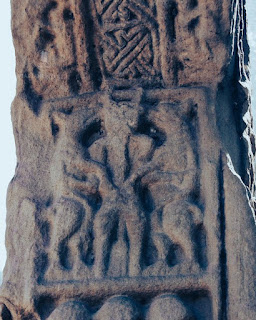
Archaeologist Neil Jackman @JackmanNeil posted this very interesting picture on his twitter account:


With these comments:

An unusual, and a little unsettling, depiction on the c.9/10th century Market Cross at Kells, County Meath.

It features a human-like bearded figure with horns, flanked by two beasts (wolves or lions?) on their hind legs. Could it be a rare depiction of the devil?

Early Irish high crosses usually (though not exclusively) depict religious scenes, along with the beautiful ornamentation.

Dr Francis Young @DrFrancisYoung, Historian of religion & beliefs then commented that:

The iconography of Satan hadn't yet settled down by that point; I don't think there are c9th representations of Satan with horns. If I had to guess, I'd say this is a Classical reference and the figure is most likely Pan/Faunus, representing wild untamed nature. As a rule of thumb, if in doubt about early medieval iconography, it's usually a garbled Classical reference...

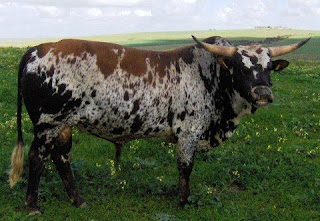
Eeee wasn't there some fella called Crom Dubh, whom pretty much all early Irish saints defeated at some point or another, who was linked to bulls, and who could even turn to a bull himself? Particularly a speckled one...

The horns on the "devil" from the Market Cross at Kells look very much like bull horns to me...

I talked about Crom Dubh bull folklore in my post "Bull of Crom Dubh"...

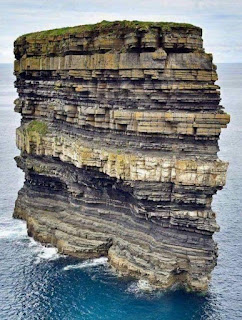
Crom Dubh apparently lived all over Ireland...Including Dun Briste. 

And guess what: "Crom Dubh (also) had two hounds of dogs...and if ever there were [wicked] mastiffs these two dogs were they..." 

I talked about this legend in my post "Dun Briste"...

So here we have a "bull god flanked by two hounds"...Is this enough to identify this image as a depiction of Crom Dubh? Of course not. But it is a possibility that we can't ignore...Especially because this would be the only known depiction of Crom Dubh ever found that matches the folklore depictions of this old Irish god...

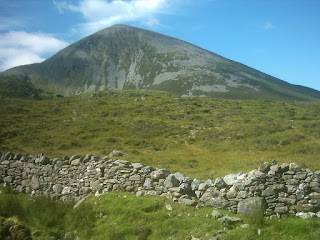
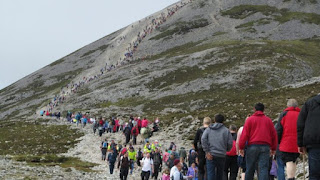
Croagh Patrick, the Irish "Holy mountain". 


Once "the holy mountain of Crom Dubh" the old Irish Sun/Sky god and god of agriculture, it became "the holy mountain of St Patrick", after he "defeated" Crom Dubh... The day of the annual pilgrimage to the top of the mountain is still known locally as "Domhnach Crom Dubh" which means "Crom Dubh's Sunday"... 


Sunday, 23 May 2021

Torine katun

Transhumance is the seasonal movement of people with their livestock between fixed summer and winter pastures. In mountainous regions like Montenegro, it implies movement between higher pastures in summer and lower valleys in winter. 


In many languages there are words for the higher summer pastures, and shepherds summer camps built on them, and frequently these words have been used as place names. In the Balkans these words are Katun, Stan, Bačija, Torine...I talked about them in my article "Katun"...


In this article I would like to talk about one of these transhumance shepherds summer camps, Torine, which could just be one of the most important archaeological sites in Montenegro, and possibly one of the most important archaeological sites in Europe...

The archaeological site covers a small plateau 150X50 meters which was on the lower side fortified with a stone wall. 


The plateau is located in the Radman gorge 


The archaeological site was discovered by chance, when local villagers tried to widen the road that passed by the plateau, and in process bulldozing away half of the site


Luckily, while pushing through the site, the bulldozers unearthed several skeletons, and the locals thought they better call the police. 


Who called the archaeologists. The archaeologist who came to examine the site was Predrag Lutovac from Polimlje museum.


Archaeologists determined that the skeletons belonged to the people buried on the site during medieval time. 

Then they started opening exploratory trenches and what they discovered was pretty astonishing. One and a half meters of soil contained occupational layers from the end of the 5th millennium BC to medieval time...


The fact that the cultural layers were very thin and very rich in mobile artifacts, indicates that it was a seasonal shepherds summer settlement, Torine... 

According to Predrag Lutovac, the earliest layer located at the depth of only one meter and twenty centimeters, is Vinča cultural layer, from the Vinča-Pločnik phase, dated to the second half of the 5th millennium BC...This is where archaeologists discovered this figurine of a nude woman with a realistically represented torso and a pentagonal head characteristic of the Vinča culture. 


Trnje near the village of Bijedići which contained few dozen houses...
Beran-krĆĄ near Berane, which consisted of about twenty houses. 

Both settlements are believed to have existed from Late Neolithic through Copper Age and into Early Bronze Age period, from 4,500 to 3,000 BC.

Now the above figurine from Torine is similar in shape to the late Vinča culture figurines found in Kosovo, at Fatos and Predionica sites. But while the Vinča culture figurines found in Kosovo are dressed and or have painted decorations, the figurine from Torine is naked and has no decorations at all much like later Bubanj-Hum culture figurines...


This earliest Neolithic Vinča layer is followed by a mixed layer of late Neolithic Vinča culture mixed with the early Copper and Bronze Age Bubanj-Hum culture from Serbia and Mediterranean Copper and Bronze Age cultures, like Nakovana culture

These three cultures seem to have peacefully coexisted and merged into a new South Balkan Bronze Age cultural group, that covered huge area of Eastern and Southern Serbia, Kosovo, Montenegro, Croatia and Albania... 


This culture must have had a stronghold in northern Montenegro, because the area is full of Early and Middle Bronze Age fortifications: Tumbarice in Donja RĆŸanica, Gradac in Budimlja, Pećina grad in Radmanska klisura near Petnjica, gradina Bihor, Samograd in the village of Brzava near Bijelo Polje, Gradac above Godočelj near Petnjica, Gradac in Crnčia near Bijelo Polje, Jerinin grad in Plav, Gradina above the village of Ć abotići, Gradina in Korita and Gradina above the village of Muslić.

It is in this Bronze Age layer of the Torine site, at the depth of half a meter, that archaeologists had unearthed a base of a Bronze Age house dated to mid 2nd millennium BC. 

Inside of this Bronze Age house, archaeologists discovered a large number of fully intact ceramic dishes, bone tools, pickaxes made of deer’s antlers, needles, bradawls, studs...All located around a central fireplace. 


A wolf’s teeth necklace was also discovered, showing that here already we have the some form of the wolf cult, not surprising considering that wolves are shepherds main worry in the mountains. After the weather.


Extremely interesting discovery at Torine was a mold for making bronze daggers of the type discovered in MomiĆĄići and other Copper and Early Bronze Age tumulus graves, located in the lowlands of the souther Montenegro. 


According to Lutovac this is another proof that Torine was a seasonal summer camp used by people who spent winters in Momiơići....


Soooo why is Torine so important? You mean apart from the fact that this is a site used pretty much continuously as a summer camp by transhumance shepherds for 5000 years? Transhumance shepherds which were descended from Vinča people...

Torine site shows that when Vinča culture collapsed at the end of the 5th millennium BC, Vinčans didn't disappear into thin air. We know that some of them contributed to the development of Late Neolithic early Copper Age cultures in the Danube catchment area to the north of the old Vinča territory....

But it seems that at least some of them moved into the highlands to the south of the old Vinča territory and continued living there...And they mixed...And they got influenced and they influenced the seafaring cultures of the Eastern Adriatic coast...

I talked about them in my post about Nakovana cave in Croatia and the Neolithic seafarers...

These are the guys who sailed and traded all along the northern coast of the Mediterranean sea. All the way to Iberia...And beyond? To the Atlantic coast...Ireland???

All of which resulted in the development of some very very interesting Late Neolithic, Early Copper Age links between Montenegro and Ireland...

In my series of articles about Montenegrine tumuli, I showed that archaeological finds from both Montenegro (just south of PeljeĆĄac peninsula where Nakovana cave is located) and Ireland, point at a strange link between Copper age Montenegro and Ireland, and indicate that the copper age could have been brought to Ireland by people who arrived there from Montenegro...


And guess what: the Irish legends, which were first time written down during early medieval time, say that the first farmers, miners and metalworkers arrived to Ireland by sea from the Balkans, via Sicily and Iberia...

This voyage, according to the Irish Annals, took place during the 3rd millennium BC...Of course every historian and archaeologist in the world dismissed these legends as "pseudo history"...No one was able for such maritime voyage at that time...Hmmm.....


But, some of these cultural similarities between Ireland and the Balkans predate the Copper Age, and fall right into the Late Neolithic period between disappearance of Vinča culture and the appearance of the Yamna people in the Balkans...And they have a very strange "Vinča" undertone...Which I couldn't explain, because of the time gap of a 1000 years between the disappearance of Vinča culture and the appearance of Vinča like artifacts in Ireland...Until now...


This is Newgrange, a prehistoric monument in County Meath, Ireland, located about one kilometre north of the River Boyne. It was built about 3200 BC. 

This is Newgrange entrance before excavation and renovation. You can clearly see the carved stone standing in front of the entrance. 


This is what Newgrange entrance looks like now. The carved stone is still standing in front of the entrance into the tumulus. 


Why is this stone placed in front of the entrance and what does this stone represent?

I believe that this stone is a huge votive bread. It is placed in front of the entrance of the tumulus, because this entrance represents vulva and vaginal opening of the mother earth. As I said I believe that Newgrange was designed to represent pregnant mother earth in a shape of a pregnant woman's belly together with reproductive organs. And as pregnant women give birth to babies through the vaginal opening, to continue with the symbolism, this votive bread was placed in front of the entrance (which is in this case viewed as exit) to symbolise mother earth giving birth to bread. And to give mother earth a hint how much bread we want her to give birth to. A lot.

Why do I think that this stone represents votive bread. Well have a look at these two pictures:

Entrance stone, with carved diamond and spiral ornaments, Newgrange, Ireland, 4th millennium BC:


Ritual clay votive bread with carved diamond and spiral ornaments, Potporanj - Kremenjak, Serbia, Vinča culture, 5th millennium BC, currently in VrĆĄac museum. Quite a few of these ritual clay breads were found in Vinča sites, and they all have these types of decorations: 


From my post "Newgrange" and "Can you see me

Also this

Here are some examples of the so called "carved stone balls" from Scotland, dated to the beginning of the 4th millennium BC:


At least 1000 years earlier, in Serbia, people from Vinča culture made very very very similar objects from burned clay which they wore as amulets.

This one is from Vinča Beli Breg settlement near Belgrade


And then we have this: Knowth tumulus complex, in the Boyne Valley, also dated to the beginning of the 4th millennium BC...


And this one of the two miniature carved stone ball bead found under the Mound 1 at Knowth...


They were published in 1986 (Eogan 1986, fig. 21) but their significance has not been appreciated until 2011 when professor Alison Sheridan, during her visit to Dublin, saw them and realized that they were miniature versions of a very distinctive type of artefact well known from Neolithic Scotland – the carved stone ball...And a copy of Vinča objects...

I wrote about these objects in my post "Clay balls - stone balls"...

As I said I couldn't explain the almost 1000 years between the Balkan objects and Irish objects mentioned above...But now that we know about the Montenegrin settlements which span period 4500-3000BC and link between Vinča culture and the Late Neolithic and Copper Age cultures of the Mediterranean....