Showing posts with label Hromi Daba. Show all posts

Thursday, 1 April 2021

Zodiac killer

Elamite seal. Iran. From "The Elamite Cylinder Seal Corpus, c. 3500–1000 BC" by Karen Jane Gardon.

Soooo What's this all about?

Top row:

Autumn (symbolised by a lion) follows summer (symbolised by a bull)...This is the moment in time that this seal marks. This is why we have a lion chasing bull and  the cross in the upper panel...I talked about the symbols of the seasons in this post...

So what about the bottom row with two bulls facing each other? 

Based on the horn shape and no hump, these are bulls of the Eurasian wild cattle, aurochs...

Beginning of August, the end of summer, beginning of autumn, is also when Eurasian wild cattle, aurochs used to mate...During this time auroch bulls fought (faced) each other for females...I talked about the reproductive cycle of aurochs in my post "Ram and bull"....

By the way, this is also the time when Eurasian lions main mating season started too...I talked about this in my post "Musth"...

This is the hottest part of the year in the northern hemisphere, which is why this is the day of Helios...In the Balkans this is the day of St Elijah the Thunderer, the Thundering Sun...

Why Thundering Sun? I talked about the "weird" link between the sun and thunder god in my post about Croesus and Apollo, The thundering Sun...

The reason why we have Thundering Sun God is easy to see from this chart of thunderstorm frequency in Europe...

Interestingly, in Bosnia, on the day of Thundering Sun, the day that marks the end of summer beginning of autumn, the day when aurochs used to fight, people sacrifice bulls and hold bull fights...I talk about this in my post "Alidjun"

So it seems that both the upper and the lower panel of this seal point at the same moment in the Solar year...The moment when the lion (autumn) catches up with the bull (summer) and when bulls fight...

What does this have to do with Europe? Well the key for deciphering images like this one is found in, of all places, Balkan Slavic folklore, remnants of mythologies and religions of ancient people which mixed in the Balkans, and which are preserved to this day by Slavic peasants.

It was the parallels between the bull cult found in Serbia and the bull cult found in Ireland that made me think: "we are dealing with something ancient here"... and led me to deciphering of the first animal calendar marker: bull...

After that I started looking at other well known animal calendar markers, collectively known as Zodiac...And what I found was that they all mark mating or birthing seasons of animals in question...In Europe...I talked about this in the articles linked to this page about "Zodiac"....

After this I started looking at Ancient Eurasian and North African mythologies which were full of animal images...All the ones I touched so far, turn out to also be calendar markers derived from the behavior of animals in question...

It seems that mythologies were built around ancient agricultural calendar, which probably has the common root in the fertile crescent, 15,000-10,000 BC...And which used animal calendar markers to mark different parts of the solar year, important for early farmers...

This same symbolic system was then used throughout the ancient world as the agriculture spread...The mythologies developed around it are full of "monsters made up of different animal parts", "gods with animal heads or bodies", "masters of animals" and "mysterious animal images"...

Which no one understands any more...Well...Maybe we can now understand these crazy bits of our common heritage a bit better...

There is just one problem...

The problem is that "there is nothing mysterious or holy or enlightening or mind blowing" at the bottom of the rabbit hole...

There is no all powerful wizard behind the curtain holding a magic wand looking up at the stars and constellations...Just a sweaty peasant holding a plough and looking up at the sky wandering if the Sky God will be cruel or merciful this year...

Not something you can make a career of "speculating what mystery lies behind"...

I was already told by some people that "when they see that my article is about calendar they just skip it"...

Because it's boring...

The best comment I got so far was that I was a "Zodiac killer"...Cause I killed the mystery that zodiac held for so many people and turned it into an agricultural calendar...

To read more about ancient animal and plant calendar markers, start here…then check the rest of the blog posts related to animal calendar markers I still didn't add to this page, and finally check my twitter threads I still didn't convert to blog post...I am 9 months behind now...

Tuesday, 29 December 2020

Harvest in Scotland


Harvesting in Scotland by a Scottish painter Joseph Farquharson (1846-1935). 

Scottish harvest customs. From "Carmina Gadelica - Hymns and Incantations, Ortha Nan Gaidheal, Volume I" by Alexander Carmichael [1900]


Reaping blessing. From "Carmina Gadelica - Hymns and Incantations, Ortha Nan Gaidheal, Volume I" by Alexander Carmichael [1900]


The Sun god to whom Scots gave thanks for their grain and their wellbeing is Crom Dubh of the Irish (Scots). The deity to whom the Irish prayed in the Early Bronze Age "Grange Circle" on the first day of the harvest. 


The biggest and the only square stone in the circle is still known as the Crom Dubh stone. And next to it is the pile of flat bread like stones known as the Grain Child...


I talked about this amazing ancient monument in my post "Grange circle

He was the good whose holy mountain was and is the holiest place in Ireland. Except it is now called St Patrick's mountain...


I talked about this in my post "Sun mountain"...

They prayed to him on the last Sun-day in July, which is still known in the area around the holy mountain as the "Domhnach Crom Dubh" which means "Crom Dubh's Sunday"...

People prayed to Crom Dubh because they believed that "It was he who was giving them the light of the day, the darkness of the night, and the change of seasons"...Basically The Sun...I talked about this in my post "Dun Briste"...

Crom Dubh was said to be another name for Dagda, the Giving God of the Irish... 
Hromi Daba was another name for Dabog, the Giving God of the Serbs...

Both of these gods had a bull cult associated with them...

I talked about this in my posts "Bull of Crom Dubh" and "Bull of Grom Div (Hromi Daba)"...

And Dabog (Hromi Daba), The Sun God, is the god to whom Slavs still "raised stones" until very recently "for the weather". 


Just like the Early Bronze Age Irish raised stones and built stone circles to Dagda (Crom Dubh)??? 

I talked about these weather manipulation rituals involving stones in "The last megalithic ritual in Europe" and "Weather stones"...

The Sun God of the Pagan Serbs, Dabog, Hromi Daba, became the Devil of the Christian Serbs. 
The Sun God of the Pagan Irish, Dagda, Crom Dubh became the Devil of the Christian Irish. 

But after all these years, in Ireland "By Crom" still means "By God" 🙂 


Monday, 21 September 2015

The power of the Thunder Giant

In Serbian the expression "On vedri i oblači" means "he rules", "he has absolute control, absolute power". Literally this expression means "he makes the sky clear and cloudy"...

This expression was obviously originally applied to the sky god, The God, The Lord of the early agricultural societies and the peasants, particularly the wheat farmers, whose lives depend on the climate...

Having the right weather at the right time is most important during the vegetative season from May to November. Having the right weather at the right time is in the north of Europe most critical right in the middle of the vegetative season. This is the period around the beginning of August. The period from just before the end of the ripening season to just after the beginning of the harvest season.


At this time, too much clear sunny sky and the wheat will burn. 

 
Too much cloudy rainy sky and the wheat will not ripen properly or it will fall down and rot. 


Either one of these extremes will result in the destruction of the harvest and famine. 

And so the wheat farmers, the world over, have since the time immemorial been turning their eyes to heaven (sky) at this time of the year, and praying to the same Sky God. They would pray to the one who "vedri i oblači", the one who can make the sky clear and cloudy, The Lord in heaven (sky). They would pray to him, the Giving God (Dabog in Serbian) to give them just the right amount of sunshine and rain, and by doing so to give them the good harvest.

And interestingly right there, on the 2nd of August, on the day that marks the border between the summer and autumn, growing and harvesting, we find In Ireland the day of Crom Dubh. I believe, as I said many times before, that this god is the same god which is in Serbia known as Hromi Daba, Dabog. And that both Chorm Dubh and Hromi Daba are just corruptions of Grom Div, The Thunder Giant, The Thunder God. That this is indeed so can be seen from the fact that the 2nd of August is in Serbia known as the day of Perun, the Thunder God, the one who "vedri i oblači", the one who can make the sky clear and cloudy, the Lord....


PS:

All weather-related French phrases also imply the action of God. 
Il fait beau = He makes beautiful (weather)
Il pleut = He rains
Il vente = He winds
Il neige = He snows
etc. 
Similarly, "Il fait la pluie et le bau temps" (he makes rain and sunshine) defines an all-mighty person.

Thursday, 11 September 2014

Grange circle

In several of my previous posts I have been talking about sun circles. I talked about their origin in my post about Henges - rondel enclosures. I talked about how they were used as solar observatories for determining the beginning of the lunisolar calendar in my post about Calendars. In my post about Stone circles on mountain Devica, I talked about the solar observatory called Bogovo Gumno from Serbia, and I said that this sun circle can help us understand the purpose of the stone circle complex known as Grange circles from Ireland and the meaning and significance of the term Grange itself. In this post I will finally talk about Grange circle.

Grange stone circle (Lios na Gráinsí or Fort of the Grange) 300m west of Lough Gur in County Limerick, Ireland, is situated beside the Limerick-Kilmallock road, 4 km north of Bruff. Composed of 113 standing stones, the Grange Stone Circle is the largest and finest in Ireland. Seán P. Ó Ríordáin excavated the Grange Stone Circle in 1939. During the excavations he found more than 4,000 shards of pottery, dating from the Early Neolithic to the Late Bronze Age, spanning a period of some 2,600 years.


Photo by David Hogwood
Seán P. Ó Ríordáin concluded that the Grange circle was a site of great importance, most likely of a ritual nature, from possibly as far back as the Early Neolithic period.


I believe that Grange circle was originally a threshing floor. I also believe the Grange circle is an example of a threshing floor which was eventually turned into a temple dedicated to the Thundering Sun, the god of weather, god of grain, Crom Dubh, Hromi Daba, Grom Div, the Thunder Giant. 

Threshing floor is a flat, smooth and hard surface used for threshing, a process of separating the grain from the straw and husksThe process of threshing is performed generally by spreading the sheaves on the threshing floor and causing oxen, cattle or horses to tread repeatedly over them. The animals are made to walk in a circle. In order to make the animals walk in circles, a man needs to stand in the center of the pile of grain which is being threshed and restrict and direct the movement of the oxen, cattle or horses using reins or rope. Alternatively a central pole can be erected, to which the animals are tied and then they are urged to walk in circles by a man walking behind them.The threshing floors also usually have walls built around them to prevent the grain from being blown off the threshing surface by the wind. This is done to mark the edge of the threshing circle and to prevent the grain being blown away. This creates a flat shallow pan like circular enclosure with a compacted hard surface and a central pole.


The Grange stone circle comprises a ring of continuous upright stones up to 2.8m high, with a diameter of 45m and backed by an earthen bank 9m wide and about 1.2m tall (the wall). The entrance on the eastern side is paved and flanked by upright stones. Clay has been packed down to a depth of 60 cm across the whole area of the enclosure (compacted hard surface). Its near perfect shape and the discovery of a post hole in the very centre of the enclosure, indicates that the circle was measured out from a central stake with a rope (central pole). Here is the picture of the Grange circle.


This creates a flat shallow pan like circular enclosure with a compacted hard surface and a central pole, a threshing floor, a grange. 


In my post called Bogovo Gumno - God's threshing floor I explained how in the Balkans the threshing floors are linked to solar cereal farming agricultural cults. I explained how they were until very recently used not only for threshing grain but also as solar observatories and as religious ceremonial grounds. 

Agriculture is shaped around the weather. At certain times of the year, certain things had to be done by peasant farmers or crops would not have grown. Farming, in this sense, is  controlled by the weather and the weather is controlled by the Sun and its cycle.

In order to know when certain activity needed to be done, the farmers needed to know the exact date. To determine the exact date, the farmers used threshing floors as a solar observatories.

Grange circle in Ireland was also used as a solar observatory. The stone circle is aligned with the rising sun at the Summer Solstice on the morning of which the sun shines on top of the largest stone in the stone circle known as Crom Dubh's stone casting the shadow directly into the centre of the circle. 


These two amazing pictures are taken from a great photo article about Grange circle by Tom Nelligan, which you can find on "The Standing Stone" blog.

If you are able to determine the exact date of the summer solstice, you are able to determine the beginning of the solar year. And that allows you to use 12 months lunar calendar for calculating time and determining the exact date repeatedly and accurately. Being able to determine the exact date, gives you the power to predict the weather, to predict "the will" of the Sun god. 


And this is why it is important for the cereal farmers to determine the exact date. The cereals can only be sown after the soil thaws and the temperature of the soil reaches certain temperature. The minimum germination soil temperature for wheat, barley and oats is about 5 degrees Celsius but the optimal germination temperature is about 20 degrees Celsius. So the sowing has to be done at the time of the year when the temperature is rising between 5 degrees and 20 degrees Celsius. This is the temperature of the period between the end of March and the end of April. After the cereal germinates, it then takes, depending on the temperature,  approximately 103 days for spring wheat to grow and ripen. This is why the harvest time is the end of July beginning of August.

And this is why it is "the will" of the Sun that people plow and harrow in March, sow in April, and harvest in August.  

Here is the list of the main agricultural activities per month. The dates are most appropriate to central and northern Europe. In southern Europe the growing season is going to be longer and drier and the winter not as harsh. 

Month work that needed to be done weather the farmer expected (wanted)

January
mending and making tools, repairing fences showers, snow

February
carting manure and marl
showers, snow

March
plowing and spreading manure dry, no severe frosts

April
spring sowing of seeds, harrowing showers and sunshine

May
digging ditches, first plowing of fallow fields showers and sunshine

June
hay making, second plowing of fallow field, sheep-shearing dry weather

July
hay making, sheep-shearing, weeding of crops dry early, showers later

August
cereal harvesting, threshing warm, dry weather

September
legumes harvesting and threshing, plowing and pruning fruit trees showers

October
last plowing of the year dry, no severe frosts

November
collecting acorns showers,snow and sunshine

December
mending and making tools, killing animals showers, show and sunshine

In the above list you can see the list of the agricultural activities and the weather that the farmer expected, wanted. But we all know that the weather we expect and want is not always the weather that we get. Agriculture is extremely sensitive to climatic oscillations. Particularly sensitive to weather changes is grain farming. Grain farming is a long drawn out process which spans over four months from plowing to threshing. During that time the weather can turn bad and the late frost can kill the seeds, the heavy rain or hail in late summer can break the stalks, the drought during the growing season can burn the plants and the crops will be ruined. This means that even if you are able to determine the day of the year and even if you know what needs to be done and when it needs to be done, and even if you do it all right, you are still not guaranteed the bountiful harvest.

If you are a cereal farmer, and if your life depends on grain yield, and if grain yield in turn depends on the weather, and if the weather depends on the Sun, then sun very quickly becomes your God, the God of weather, the God of grain.

In Serbian tradition, Sun is called the "Višnji Bog", the High God, and is perceived as a living being. Sun is born every year in the winter on the winter solstice day. He then grows into a young man Jarilo on the 6th of May. The 6th of May is the day of the strongest vegetative, reproductive power of the sun. This day marks the middle of the growing season. This day also marks the beginning of the summer. Sun then becomes the powerful ruler Vid on the day of the summer solstice, the 21st of June the longest day of the year. This is the end of the growing season and the beginning of the ripening season. The sun then becomes the old man and terrible warrior Perun on the 2nd of August the hottest day of the year. This day marks the end of the summer, the beginning of autumn and the beginning of the harvest season.


These three gods are just different ages, faces of one god, the Sun god, the god of weather, the god of Grain, Dabog, the God that gives. He has three faces (Jarilo, Svarog (fire), Svetovid (light), Perun (thunder)) and this is why he is also Triglav, Trojan, Trinity, Trimurti. 


In his most powerful incarnation, at the end of summer and beginning of autumn, in the middle of the light part of the year, at the beginning of the harvest season, he is becomes the Thundering Sun Ilios, Hromi Daba, Crom Dubh, Grom Div, the Thunder Giant. This thunder giant has many names in many cultures. He is Slavic Perun and Celtic Lugh, Breton luc'h and Cornish lughes, Serbian Luč meaning spark, lightning. The proof that the thunder good represents the cumulative power of the sun, that he is Triglav, Trojan, can be seen from the representations of the Celtic god Lugh. He is represented as three headed, Triglav:


And from the Irish tradition and the fact that Lughnasad and Domhnach Crom Dubh are one and the same, we can conclude that Lugh and Crom Dubh are also one and the same. Lugh is the lightning face of the Thundering Sun, Thunder Giant, Grom Div, Crom Dubh

It is to this Three Headed Thunder Giant that the final, the most important prayer is uttered on the threshing floor just before the harvest, on the first (second) of August, Lughnasad, Domhnach Crom Dubh

"Please god give us enough grain so that we can survive through the winter".

Then the grain is harvested and threshing starts. The threshing is the moment when the months of hard work and fervent pray are finally supposed to turn into food. Threshing time is the moment when the people will find out whether they will feast or whether they will starve through the winter. The threshing time is also the time of truth. The threshing floor is the place where every year the relationship between the farmers and their God of Grain is tested. If the harvest was bountiful, the Thunder Giant, the God of Weather and the God of Grain did hear the prayers and did receive the sacrifices and was pleased with both and that is why the threshing floor is full of grain. But if the threshing floor is empty, that means that the Thunder Giant, the God of Weather and the God of Grain is angry and displeased and that more prayers and more sacrifices are needed to please him, and maybe next year he will give good weather and the threshing floor will be full of grain. 

The harsher the climate is the and more unpredictable and volatile the weather is, the more and more uncertain the outcome of the harvest becomes and more and more likely are people to starve. This makes people more and more dependent on the apparent "will of the weather god" and more and more desperate. In Europe this eventually lead to the creation of the God of Weather, the God of Grain. And to the conversion of a threshing floors into temples of Grom Div, Crom Dubh, Hromi Daba.

The largest stone in the Grange stone circle is known as Rannach Cruim Duibh which suggests that the circle was associated with the festival of Domhnach Crom Dubh, Lughnassa. Cruim Duibh, Crom Dubh is according to the Irish annals credited with bringing grain to Ireland. The stone is estimated to weigh more than 40 tons and was transported over a distance of three miles. It is very significant that the Crom Dubh stone is cuboid, an obelisk with orthogonal sides. I will talk about that more in one of my next posts.


Next to the massive Crom Dubh stone is a smaller stack of stones said to represent the grain child. I would suggest that the small stack of stones represents a stack of breads like this one:


Bread is the grain child. It is bread that Crom Dubh brought with him. It is bread that people are praying for. It is bread that will be made from the grain threshed on this holy ground, the threshing floor. This is why a representation of a stack of breads was placed next to the Crom Dubh stone.

Here I have to ask a question: What does "Rannach Cruim Duibh" actually mean? The Irish dictionary says that the word "rannach" means apportioning, sharing; open-handed, departmental. Put together with Cruim Duibh, this name is both ungrammatical and 
meaningless. But what if these are just the names for the small stack of stones representing breads and for the big stone representing Crom Dubh? The word "gráinne" in Irish means corn, grain. In Serbian word for food is "hrana" but it is often pronounced as "rana". I believe that the word was originally "grana" and that it comes from times of the first neolithic farmers and which is based on the ancient root "gra" meaning something small round. Word gra is still used in Serbian as a word for legume seeds. I will talk about this in detail in one of my next posts. So "Rannach Cruim Duibh" should really be "Rannach, Hrana, Grana", "Cruim Duibh" meaning "grain, food", "grom div, god". 

Professor Ó Ríordáin postulated that the circle dated from the Late Neolithic and that it was built c. 2,200 B.C. Archaeologist Helen Roche, however, has suggested that the Grange stone circle was constructed in the Late Bronze Age (c. 1000 BCE) on a site that may have been sacred for thousands of years.

I believe that the building date proposed by Seán P. Ó Ríordáin (2200 bc) is much closer to the actual building date. I believe that the Grange circle was contemporary with the Newgrange and that was certainly built between 3200 bc and 2200 bc. However, additions and changes were probably made in the following millenniums as the worship of Crom Dubh persisted in Ireland up until the arrival of Christianity. 

The worship of Crom Dubh or Crom Cruiach, the old Irish god of agriculture, is most closely associated with Tigernmas, sometimes called Tiernmas, the Irish high king who is said to have perished while worshiping this god. Tigernmas is sometimes referred to as the “culture king”, because it is said that he was the one who brought aspects of civilisation to Ireland including the cereal farming, smithing of gold and silver, the dyeing of fabrics, and the making of music and art.

Grain farming arrived in Ireland in the fourth or third millennium bc. The Grange circle, the temple of Crom Dubh, the god of grain was built in the third millennium bc. Metallurgy was brought to Ireland in the third millennium bc. 

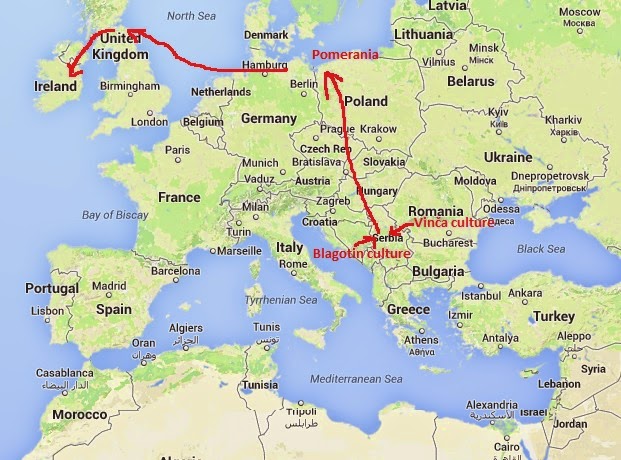
There is a well established cultural distribution path Balkans - South Baltic (Pomorje, Pomerania) - Ireland which has been in operation since at least fifth millennium bc. I wrote about this in my posts about henges and in my post about tochars.  

In the 6th millennium bc, in Serbia, mixed together we find highly developed metallurgical Vinča culture and highly developed grain farming Blagotin culture. These two cultures had to be in contact with each other. Vinca houses had grinding stones and bread baking ovens. Is it possible that from the 6th millennium bc, metallurgy and grain farming spread together into Europe from Serbia? And if so did they reach Ireland together, brought by the same people, Fomorians, people from Pomorje, the land by the sea, South Baltic, known today as Pomerania?


If this is the case, then Tigernmas lived in the 3rd or 4th millennium bc. Is it possible that the Irish oral tradition has preserved records of events that happened 5000, 6000 years ago? Is it possible that metallurgy arrived in Ireland earlier than we think, at the same time when grain farming arrived? Or did grain farming arrive in Ireland later than we think, at the same time with metallurgy? Is Crom Dubh 5000 thousand years old deity and is Crom Dubh, Hromi Daba, Grom Div the oldest European God who is still celebrated in Ireland and Serbia? Did Grom Div arrive to Ireland from the Balkans with the first metallurgists to reach Ireland? Did he then in Ireland turn into Crom Dubh over the following milleniums as the meaning of the name was lost? And did he then arrive back to the Balkans with Celts where he finally became Hromi Daba?

Appart from the biggest stone in the circle being called Cruim Duibh, we have another clue that the Grange circle functioned as a temple of Crom Dubh. The Grange circle has a ceremonial entrance. 


This ceremonial entrance is lined with stones in the same way as the Grange circle itself. The very entrance of the circle is marked with two large stones. This great pic is taken from http://irishantiquities.bravehost.com article about Grange circle. 


Originally, I thought that the ceremonial entrance was aligned with the sunrise on Lughnasadh, but I was wrong. 

The ceremonial entrance was made in such a way that it is aligned with the sunrise on Beltine and the sunset on Samhain, the actual Celtic New Year (in Celtic calendar, days start with sunset). Here is a great pic of that sunset by Ken Williams.


This day also marks the end of the harvest. Which means that on that evening, both the people and the God would enter the threshing floor together so that people can pray in the presence of the God and offer him their thanksgiving sacrifices... 

Like bulls. During excavations no structures were found but two hearths; a few un-burnt human bones, some animal bones (mainly cattle), some bronze materials and numerous Neolithic pottery pieces were discovered.


According to an Irish dinsenchas ("place-lore") poem in the 12th century Book of Leinster, Crom Dubh's, Crom Cruach's cult image, consisting of a gold figure surrounded by twelve stone figures, stood on Magh Slécht ("the plain of prostration") in County Cavan. In the 9th century Tripartite Life of Saint Patrick the deity is called Cenn Cruach, and his cult image consists of a central figure covered with gold and silver, surrounded by twelve bronze figures. Jocelin's 12th century Life and Acts of St. Patrick tells much the same story. Here the god is called Cenncroithi, interpreted as "the head of all gods". 

In the Grange circle, twelve large stones have been placed at intervals around the stone ring, each standing directly opposite one of the other 'axial' stones. This corresponds to the 12 lunar months of the solar year. Are these the 12 stones which eventually became 12 stone idols from the Irish legends? In central Serbia, on the first day of threshing, the first sheaf of grain is stuck on top of the stožer, the central pole of the threshing floor, and it stays there until the end of threshing. As I said in my post about threshing floors, I believe that originally the god of grain lived in the stožer, the central pole of the threshing floor. I believe that the cuboid obelisk representation of Crom Dubh is a later development. The sheaf of wheat stuck on top of the stožer central pole is Crom Dubh carrying a sheaf of grain, which eventually became the golden idol of Crom Cruach from the Irish legends. Cruach means a sheaf, a stack of corn, a heap of grain. In Serbian "kruh" mean heap of grain, bread.


Is the Grange circle the temple of Crom Dubh (Cruach) that the Irish annals talk about? Or Is Grange circle just one of many similar holy threshing floors strewn across pre-Christian Ireland?

Grange circle was a threshing floor which was at the same time also a solar observatory and a temple dedicated to Crom Dubh. Crom Dubh was the main god of pre-Christian Ireland and it is not a surprise to find many Grange place names around Ireland. Here is the map showing the distribution of place names with the root gráinsí, gráinsigh, gráinseach, Ghráinseach in Ireland:


What does the word grange mean and where does it come from? Official etymology says that the word grange comes from Irish gráinsí, gráinsigh, gráinseach, Ghráinseach. It is said that it means "granary, monastic farm"). Is there a reason why "grange" means a monastic farm and just a farm? Is it possible that many Monasteries were built on the grounds of old Granges, holy threshing floors dedicated to Crom Dubh, the god of grain? I believe that the word "gráinseach" originally meant threshing floor.  Gráinne in Irish means corn, grain. In my post about the people of the blade i talked about the ancient "sk, sek" root meaning to cut. In Irish it survived as a small cluster represented with the word "scean" (pronounced shkian) means knife but also to crack, split, sever. Is it possible that "gráinseach" is "gran" + "sek" = grain + cut = harvest, the place where cut grain was brought to be threshed, threshing floor, granary?

In the end, the dual use of Granges as both threshing floors and solar observatories, and the link between the Sun and Granin is embedded in the Irish language. In Irish "grian"  means sun and "gráinne" means corn, grain. But I will talk about that in my next Post. Until then stay happy.