Many years ago, one cold winter evening, in a smoke filled kafana (restaurant), in the middle of a long dinner, a friend of mine drunkenly exclaimed that, like all great nations, Serbs too have a mythical animal: "Pragnje", half a "prase" (piglet), half a "jagnje" (lamb).
And, like all great nations, Serbs too celebrate their mythical animal, in kafanas (restaurants), where they gather to (reverently) consume "pola kila prasetine, pola kila jagnjetine" (half a kilo of spit roast pork, half a kilo of spit roast lamb).
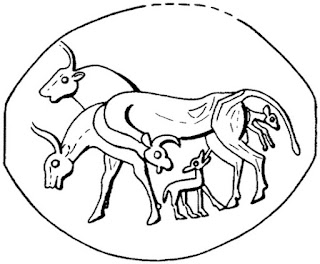
We all raised our glasses to that, and continued munching the roast meat on our plates. The animal from the first tweet in this thread is not Pragnje, but the next best thing: Mangalitsa, a breed of pigs from southern Europe, with one of the best tasting meats in the pig universe.
Mangulica pigs are descended directly from wild boar populations through Serbian "Šumadinka" pig.
In Serbian the main word for forest is "šuma". I love this word. Serbian word "šum" means rustling, which is the sound of deciduous forests. This makes forest "the shushing place"🙂...
Up until the 19th century, the whole area of the central Serbia was covered with giant oak and beach forests....which gave it its name "Šumadija", meaning the land of forests. So "Šumadinka" pig literally means "Pig from the land of forests"...
Millions of them roamed Serbian oak forests before the first world war, munching on acorns, making Serbia the biggest pig exporter in Europe at that time.
In the 1830s, the Archduke of the Austro-Hungarian Empire Joseph Anton Johann, received some Šumadinka pigs from a Serbian prince, and crossed them with Bakony and Szalonta pigs.
The resulting Mangalitsa “curly-hair hog” was initially reserved for the Habsburg Royalty only (they knew what's good), but became so popular because of its great taste that by the end of the 19th century it was the main breed in Austro-Hungarian Empire.
And so, I am raising this glass of red wine🍷to my friend and the Serbian mythical animal, Pragnje! 🙂
Today I will talk about willow in Slavic spring fertility rituals, gardening and Cricket the cat 🙂
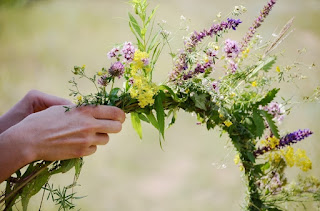
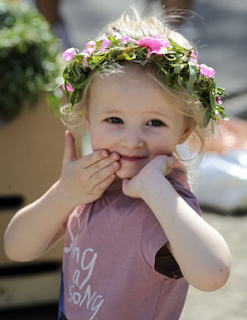
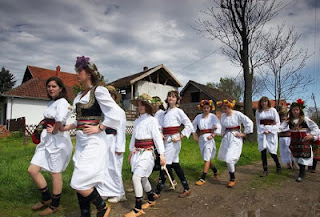
Here we go: Saturday before Palm Sunday is in Serbia known as Vrbica (Willow day). On that day kids and young women make and wear wreaths made of willow twigs and flowers
On that day, willow twigs with young leaves and flowers, like these, known in English as Pussy Willow are brought to the church where they are blessed the next day, Palm Sunday, which is in Serbia known as Cveti (Flowers day)...
According to the church, this whole willow business is the consequence of the fact that there are no palms in Serbia, and people replaced palm branches with willow branches...Move on, nothing so see here...
There are few problems with this explanation...Vrbopuc (Willow burst) is an expression which in Serbia means "part of spring during which willow starts growing new green shoots"...
In Serbia in the past people believed that during this time of the year women become very horny and very fertile...So this was the best time to make babies...🙂
Vrbopuc is also a term used in Serbia for the period of sudden surge of sexual hormones in teenage boys and girls...
Basically willow was directly linked with human fertility...Which is why in the past in Serbia, girls used to make belts from willow twigs (wrap willow twigs around their bellies), and wear them going to the rivers to perform ritual baths...
This ritual bathing was performed on Cveti (Flowers day) but also on Djurdjevdan (St George's day), the old Yarilo day, the old day of the young sun, the old celebration of the beginning of summer...Known also as Beltane...I talked about this in my post "Aries must die"...
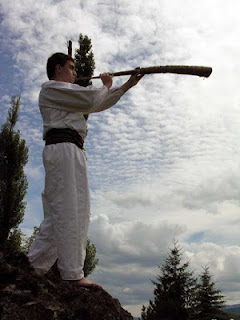
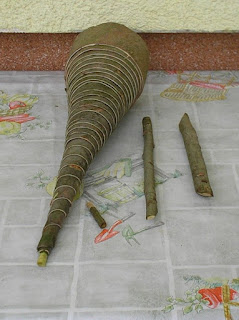
At the same time on St Georges day, while girls were wearing willow belts and bathing, boys and men were blowing into willow horns to "scare the witches away"...I talked about this in my post "May horns"...
It is interesting that this ritual bathing was done before sunrise and willow belt had to be taken off as soon as the sun rose...And that blowing into the willow horns was also done during the night....
I didn't pay much attention to this until I remembered that willow was directly linked with water, water divination....Dodole, young women which took part in rain bringing magic rituals performed during hot summers also wore willow twig belts...
Father Sun (Sky) = Yang = Summer, Hot, Dry, Day, Up = Male fertility
Which is why rain, water magic is female magic...
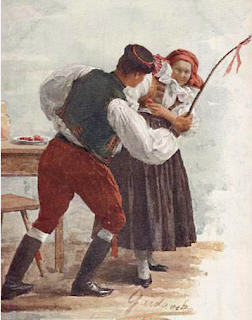
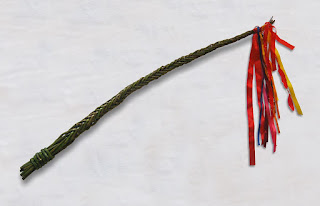
And which is why willow, the tree which grows next to water, is associated with rain, water and female fertility, female sexuality...Hence ritual whipping of teenage girls by teenage boys using willow whips, performed in the Czech Republic, Slovakia on Easter Sunday...
If men arrive at women's houses after 12 o'clock, women throw a bucket of cold water on them. In some regions the men also douse girls with water...
The man first sings a a ritual song about spring, bountifulness and fertility, and the young woman then turns around and gets few whacks on her backside with the willow whip...This was done "so girl would be healthy, beautiful and fertile throughout the following year"...
In Serbia willow was also linked with female coming of age rituals, also performed on Willow day...On that day, young unmarried girls, wearing willow twig belts and willow and flower wreaths walked around the village land and blessed the nature... I talked about this in my post "Flower girls"...
They would first go to a spring where they would sing and dance and would then wish good morning to the spring water. Spring water is in Serbia called "živa voda" (live water, water of life) and is believed to have magic properties...
Spring is seen as a place where fertile Mother Earth releases her "water of life" in the same way that a fertile woman releases her menstrual blood, female "water of life". In this way the spring water is magically linked with the menstrual blood...
So no wonder that the spring is the first stop of the Lazarice group, the group of girls whose "water of life has started to run" (who got their period). BTW they are called Lazarice "because Willow day is by Christians also known as Lazarus day"...
After this ritual, the girls would go to meadows to pick wild flowers. They would use these flowers to make wreaths which they would wear on their heads during their procession through the village land and the village...
They would then walk through the fields, forests, meadows belonging to the village, and would sing fertility songs wishing nature to be fertile and bountiful....
Young girls, Spring Earth, Female fertility, Earth fertility, water...Willow...
Remember the Pussy Willow 🙂 branches blessed in churches in Serbia the day after Willow day? They are brought home. Some of them are made into a wreath which is placed in the corner with the icon...The rest are used to decorate the house gate, door and windows...
This is done "to protect the home from thunder" because "thunder doesn't hit willow". Willow also "protects against hail"...So willow twigs are used to "threaten the clouds during hail storms"...
That the belief in the link between willow and fertility was once probably Europe wide, can be seen from this English belief: "Striking an animal or a child with a willow twig will stunt their growth!" This is a great example of Christianity at work...
In Serbia it is actually the opposite...On Willow day, children and animals are whipped with willow twigs so they grow like willow and are healthy and fertile...Which is what you would expect after everything I have presented so far...
Willow twigs, particularly the ones cut around St George's day are considered to be most potent when it comes to growing magic...They were cut into bits and mixed with animal food, particularly food given to bulls...
Remember St George's day is the old Beginning of summer celebration, and summer begins in Taurus...Taurus which marks beginning of the calving season of the wild Eurasian cattle...
Willow was in the mind of the Slavs definitely linked to growth and fertility...So imagine my surprise when I came across this information: Willow contains two very interesting chemicals: indolebutyric acid (IBA) and salicylic acid (SA)...
Indolebutyric acid (IBA) is a plant hormone that stimulates root growth. It is present in high concentrations in the growing tips of willow branches...
Salicylic acid (SA) is a plant hormone which is involved in the process of “systemic acquired resistance” (SAR) – where an attack on one part of the plant induces a resistance response to pathogens (triggers the plant’s internal defences) in other parts of the plant...
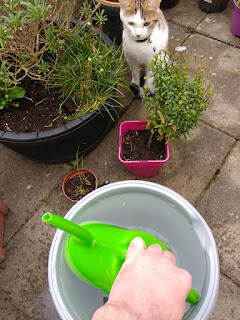
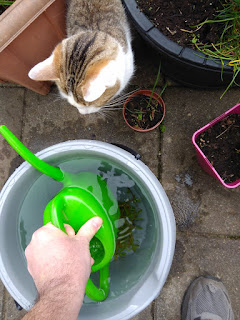
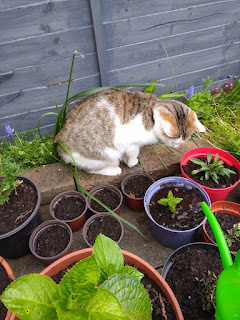
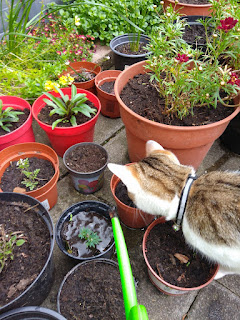
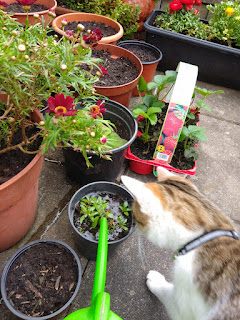
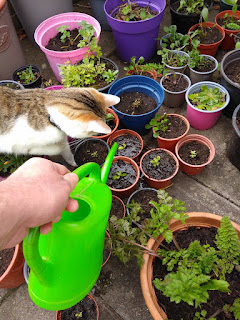
So...I went to the nearest willow, cut some green willow shoots, chop them into small pieces, put them in a bucket of water (under the close supervision of Cricket the cat) and soaked them for a day or two...
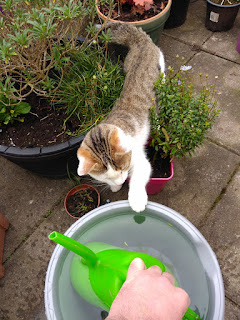
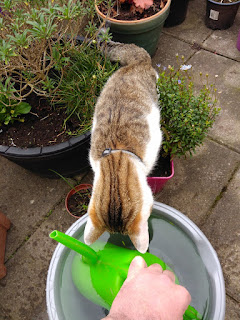
This is me trying to water my plants with my willow water (under the close supervision of Cricket the cat of course)
You missed this pot human...
So after successfully making willow water, and all the fun I had watering my plants with Cricket the cat, hopefully my plants will grow like mad and be healthy and fertile...
So if you ever wondered why willow was linked with fertility and health...
By the way, did I mention that Cricket the cat is not my cat? It officially belongs to our neighbours who live few houses up behind the wall, but it has recently decided that this is his garden so...
When I was a little kid, this was "the rude gesture" before I learned the other ruder gestures 🙂.
It turns out this gesture has been used at least since the Roman time...Apparently in Roman times it was known as "manu fica" (fig sign) "for the resemblance to female genitalia" (???) Does this remind you of a female genitalia?
Also, this sign "was made by the pater familias to ward off the evil spirits of the evil dead" (???) during Lemuria, the festival of "cleansing the home from the evil dead" (???)
Are the dead really afraid of the female genitalia?
I actually think that the Romans had actually forgotten the original meaning of this sign. This sign represents male genitalia. Which is why it is pater familias (the father of the family) who is making it.
Here is the origin of the sign
So not a female genitalia, right? That this is actually a sign represented male genitalia, can be seen from the fact that in Poland this gesture, also called figa, means "nothing" as in "you will get nothing (from me)", while in Serbia, the expression "dobićeš kurac" (literally you will get dick) means you will get nothing...
Also the whole "evil spirits of the dead" is another sign that the Romans had forgotten the "old ways"...The dead, the ancestors, were not god or bad...They were good to the living if they respected them, remembered them, and bad if they didn't...
It is the dead, the ancestors who brought all the good things to the living...In return for regular mention, food and drink...I talked about this in my posts "Diduch", "Thirst", "Blood red wine" and "Wolf feast"...
And originally this sign was probably not made "to ward off the evil spirits of the dead"...The pater familias was making it to remind the ancestors that they are all part of the the same family...Paternal family...Symbolised by the...
Or I wonder, was pater familias actually telling the ancestors that they will get dick if they don't behave? Risky, very risky...Look what happened to the Hittites when they forgot their ancestors "House of the bones"...
Here is, at first glance, a very strange Serbian superstition about dogs: A place where a dog has scratched the ground is in Serbian called "sugreb". It is believed that stepping on this place can cause person to get sick "and even to go mad"!
This is why when you see that the dog has scratched the soil, you should spit on that spot, and that would "cure it"...
This is very interesting. Why would people believe this?
Well Serbs also believed that "dogs are unclean" and that "god's breath can reach 100 cubits into the earth"...What does this mean? Why did people believe this?
Maybe this is the clue: "The first puppies are thrown into a river because they can get rabies"...Now this is very interesting...
"Furious rabies occurs when the rabid dog becomes aggressive, highly excitable, and displays evidence of a depraved appetite, eating and chewing stones, earth..."
I presume after furiously scratching the earth...
This is why "you can get mad" if you step on the place scratched by the dog" and why "dog's breath is so poisonous" and why "spitting on the place scratched by the dog cures the place of the disease"...
A lot of Serbian wolf folklore is also directly linked to rabies...I talked about this in my post "Goropad"...
People were so afraid of wolves and the "great disease that they carry" that Serbs believed that even other diseases are scared of wolves too. And so wolves feature prominently in spells used for protection of diseases...
Like this: Serbian ritual practice recorded in Serbia, Montenegro, and East Bosnia, performed to ensure lasting health and strength of children, involved pulling the newborn baby through "vučiji zev" (wolf's yawn), the skin cut from around a wolf’s jaws...
According to ethnographic data from the late 19th, early 20th century, there once was a custom in Carpathian mountains of Serbia and in Dinaric mountains of Montenegro for children to kill their parents when they got too old...First a ritual bread was baked ad dawn...
The old man or a woman would get up, dress in their best clothes, have breakfast and say goodby to the family. They would then leave the family house carrying the sacrificial bread, accompanied by one of their sons, usually the eldest who carried a stick...
The elderly was then taken to some isolated wild place, where he would kneel down and say his prayer...
His/her son would then place the ceremonial bread on their head...
The son would then strike the bread with the stick saying: "It is not me killing you, it is bread killing you"...
In some parts of Serbia the whole village was invited to witness the ceremonial killing of the elderly and to partake in the ceremonial feast afterwards...And in some parts the whole village actually killed the elderly...
The custom was in Serbia known as "Lapot" and the pictures are stills from a film "Lapot, real custom or myth"
In Montenegro this custom was slightly different. There the elderly was taken to the mountain accompanied by the whole village. The elderly lied down on a platform made from compressed dirt. and clump of wool was placed on his head...
The elderly was then either stoned to death or killed with an axe, stick, mallet strike to the head...
These last two pictures are stills from the film "Legend about Lapot" about Montenegrin "Lapot" which was there known as "Postevovanje"...
Ethnographers today (last 20-30 years) doubt whether this ritual killing once really existed and if it did, when was the last time it was performed. But in the past there was no such doubt. All 19th,20th century ethnographers and historians believed that Lapot indeed once existed
They based their conviction on the huge amount of available ethnographic material confirming that ritual killing of old people was once a common practice...
For instance a saying from southern Serbia, that when someone is old "they are ready for an axe" (one of "Lapot" weapons)
In Eastern Serbia in the 20th c. there was still a custom to have all burial rituals performed for still living old people when they reach certain old age "as if they died". During the ritual the old people "were hiding". Then when they actually died, no rituals were performed...
Ethnographers who collected the data about this custom, believed that this was a remnant of the actual "Lapot", custom killing the elderly when they reach the certain age, now performed symbolically....
Lapot was a ritual killing performed to end life in a "proper way". The rituals were all strictly observed "so as to insure the safe passage of the elder's soul to the otherworld" and "to avoid the soul's revenge"...
There are three possible reasons why the elderly were killed.
1. The elderly wanted to go to the otherworld before they became incapacitated and unable to care for themselves and before they became a burden to their families...These customs were recorded in areas where transhumance was practiced. And in order to go up and down the mountains after flocks, everyone had to be able bodied...
2. The elderly wanted to go to the otherworld before their children and grandchildren. In proper order, as they say in Serbia...During famine years, when there was not enough food for everyone, the elderly would chose to die to help the young to survive...Is this why the bread was placed on the old person's head before he was killed? And is this what is behind the ritual explanation: "It is not me killing you, it is bread killing you"???
3. The elderly would want to go to the otherworld before they became incapacitated comes from the belief that we will spend the eternity in the otherworld the way we entered it...So if we enter it incapacitated and suffering we would suffer for eternity...
I honestly think that all three reasons were behind this ritual...
Now many people (in Serbia) believe that this is only a custom found among Serbs in Serbia (and Montenegro). Some people believe that this is a "slanderous lie made up to make Serbs look bad"...Neither is true...
That Lapot really was a custom practiced by Serbs in the past is supported by the fact that there are legends from South Baltic which tell us that Sorbs there also practiced the same custom:
"During heathen times the Sorbian Wends of Lužice practiced the shameful and gruesome custom of ridding themselves of their old people who were no longer able to contribute. A son would strike his own father dead when he became old and incompetent, or he would throw him into water, or he would push him over a high cliff. Indeed, there are many examples of this, even after the advent of Christianity. In olden times many heathens lived around here, and it is still told how they put to death old people who were over sixty years of age..."
The "over 60 years of age being too old" is very interesting. In "Old Age in the Roman World: A Cultural and Social History" by Tim G. Parkin we read that in Rome old men over the age of 60 were relieved of their duties...
The case of institutionalized senicide occurring in Rome comes from a proverb stating that "60-year-olds were to be thrown from the bridge"...But that was "disputed as a slander" by the Romans...🙂
The "magic 60" is also found among Greeks. The famous Greek athlete Grillus is told at the age of 60 to die and become ashes, as stated by Greek poet Herondas. According to Lucian, philosopher Peregrinus strangled his father to death at the age of 60, because he lived enough....
In Ancient Greece, Athenian law, required that children care for their aging parents, and the punishment was loss of citizenship (the second most severe punishment for Athenians, besides execution)...The law was known as "Pelargonia" (after the Greek word for stork "pelargos"). Ancient Greeks believed that when the old storks lose strength to hunt and feathers to warm them, then the young storks would hunt to feed the elders and pluck their own feathers to cover up and warm their parents...
If people normally did care for their old parents, why would Athenians need such draconian punishments for the ones who didn't?
According to Hellanicus, Hyperboreans took old people who reached 60 years of age outside of their city gate and killed them...
According to Pomponius Mela, Hyperboreans, on achieving full life, quite cheerfully leapt from a certain rock into the ocean. Pindar notes that because of this practice no age related debilities and diseases affect Hyperboreans...
Diodorus Siculus says that on the legendary island in the south, people live very long. But that if they become ill or disabled, they are forced to die. They also have the law that prescribes what is the longest anyone can live...
So whether Romans practiced senicide, and whether the Greeks practiced it before them as a custom, is debatable. But there is actually a legend in Serbia that blames the custom of Lapot squarely on the Romans...
"On the right bank of the river Mlava, near the village of Krepoljin, is situated a very high hill, Gradator (Fort) by name, on which one can see the ruins of an old disabled and deserted fort. The popular tradition says that it was once a Roman or Latin fort. The Romans who occupied this fort were very bellicose people. Their leader ordered all the holders of the fort up to forty years of age to be active fighters, from forty to fifty to be guards of the fort, and after fifty to be killed, because they have no military value. Since that period the old men were killed..."
But it wasn't just Romans, Greeks and Serbs who practiced this custom...This is a 6th c. BC Punic death mask, displaying the sardonic smile: a scornful grin.
Apparently, this grin was one of the side effects of the poison administered by Phoenicians to the elderly during euthanasia (senicide, killing of the old people), and it was later translated onto the death masks.
Interestingly, killing of the suffering terminally ill people was still practiced in Sardinia until the first half of the 20th century. The killing was done by Accabadora, a woman called in by the family of the ill person to help him die quickly. She would either strangle the person or kill him/her by striking the head with a special wooden mallet made from olive wood, called Malteddhu.
"When I started doing research on this topic it was 1981. - explains Piergiacomo Pala, author of Anthology of Femina Agabbadòra and director of the Galluras Ethnographic Museum - Nobody wanted to talk about it. It was a real taboo. Then, over time I was able to collect material and get to the truth". It must be said that, Accabadora was not considered a murderer, but only a priestess who put an end to a long and terrible suffering, in the agro-pastoral societies of Sardinia, where there were no medicines to relieve pain. And where a dying person brought great economic hardship and great suffering for the whole family. Curiously, Accabadora, the person who "helped people to die", was often also the village midwife, the person who helped people to be born..."
Women dressed as Accabadores with wooden mallets...
Alessandro Bucarelli, criminal anthropologist at the University of Sassari, investigated accabadoras extensively. "...people talk about accabadoras everywhere, it cannot be a myth...The last two known mercy killings by accabadoras are recorded in Luras in 1929 and in Orgosolo in 1952. In Luras, in Gallura, the town's midwife killed a 70-year-old man. The woman, however, was not sentenced, the case was closed. The carabinieri, the Procurator and the Church agreed that it was a humanitarian gesture..."
Aelian writes that: "It was a custom in Sardinia that the children of aged parents beat them to death with clubs and buried them, in the belief that it was wrong for the excessively old to continue living, since the body, suffering through age, had many failings..."
Aelian also writes that: "There is a law at Ceos that those who are extremely elderly invite each as if going to a party or to a festival with sacrifices, meet, put on garlands and drink hemlock. This they do when they become aware that they are incapable of performing tasks useful to their country, and that their judgment is by now rather feeble owing to the passing of time..."
In southern France, the Ligurians threw their parents off a cliff, when they were no longer useful because of old age.
Julius Ceasar tells of Gallic chieftain Critognatus who during the siege of Alesia, when the defenders ran out of food, suggested to his compatriots that they should eat the bodies of the elderly who are "useless for war". They eventually didn't eat their elderly, but instead just threw them out of the city, presumably to be killed by the Romans or to die from starvation...
Also, apparently "The Derbiccae (a tribe, apparently of Scythian origin, settled in Margiana, on the left bank of the Oxus) kill those who are seventy years of age. They sacrifice the men and strangle the women...
Procopius states in his work "The Wars", that the Heruli, a Germanic tribe, placed the sick and elderly on a tall stack of wood and stabbed them to death before setting the pyre alight.
Herodotus tells us about the Massagetae (Eastern Iranian nomadic tribal confederation) that: "Though they fix no certain term to life, yet when a man is very old all his family meet together and kill him, with beasts of the flock besides, then boil the flesh and feast on it..."
According to Silius Italicus, in Spain people when they get old kill themselves rather than suffer through old age. He says that Cantabrians "...when found disabled by white old age, find strange pleasure in cutting short the years of weakness by instant death..."
In Nordic folklore, the ättestupa is a cliff, from where elderly people were said to leap, or be thrown, to death. According to legend, this was done when the old people were unable to support themselves or assist in a household.
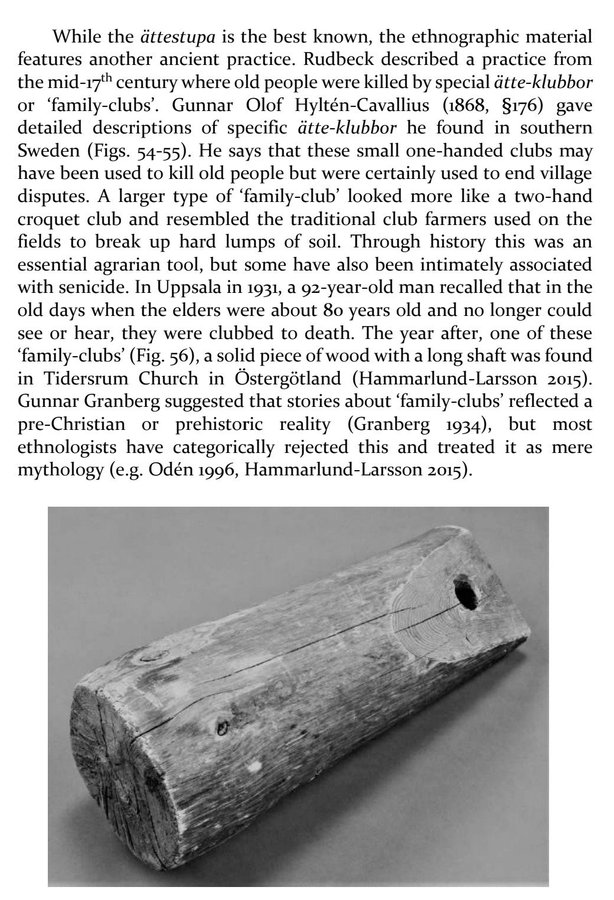
It seems that Scandinavians used clubs to kill the elderly too. Excerpt from "Werewolves, warriors and winter sacrifices" by Anders Kaliff
A Makedonian story tells us that old people were killed "to prevent famine and starvation, and those children who did not do it were killed by the people".
A Romanian story tells us that "in olden times it was the custom to kill the old people because they were considered useless...Young people did not want their wisdom and their advice, for they were just as clever. They had lived their lives, and that was an end of it".
There are may Serbian stories which talk about how Lapot was abandoned "when people realized that old people were wise and that this wisdom was useful...". Or that Lapot was abandoned "when young people who were about to kill an elderly person realized that they will be old once and that the same thing will then happen to them too..."
There is no point me going on and on and on...We know that this was once a widespread practice...But it was believed that it disappeared long time ago...It seems that it survived among the Serbs (Sorbs) of Central Europe, longer than anywhere else...
When it was finally abandoned is still an open question. Also why it was abandoned...Many legends tell us that "at some stage the young people finally realised that old = wise and that wisdom is useful" as a reason why this custom was abandoned...
Some other stories say Christianity is what put an end to this custom...Well ultimately I would point my finger at the Pythagoreans...
Their doctrine held that all creatures were being punished by the gods who imprisoned the creatures' souls in a body. Thus, any attempt to alter this punishment would be seen as a direct violation of the gods' wills...
Hence our today's outlook on senicide and eutanasia...I am not advocating either by the way. I am just showing your where yours (and mine) deepest held belief that killing the elderly is wrong, even if they want to be killed, actually comes from...
It comes from the belief that this is hell where we are all supposed to suffer to the end...
And there is no place where young handsome warriors will spend the rest of eternity prancing around in their best armour after dying a glorious death in battle...
And there is no place where young beautiful maidens will spend the rest of eternity partying in their best clothes and jewelry...
So we all cling to life for as long as we can...Me included...
Except....This old belief that the dead will continue living in the otherworld "exactly as they left this world", and which I believe was behind Lapot and similar customs, is the reason we still dress our dead "in their best" and put makeup on them "to make them look good"...When they enter eternity...
Sources for Serbian custom:
The exclamation "It's not me (us) killing you it's this bread that's killing you" can be found in the paper by Vojislav Radovanovic: "Народна предања о убијању старих људи, географско етнографска поређења" page 311. This paper compares ethnographic data about killing of old people from different parts of the Serbian ethnic area.
Also:
The best work on this subject
"Lapot i prokletije u Srba" from Sima Trojanović
Also:
"Лапот и проклетија код Црнотраваца" by Branko Dimić
"Time With or Without Death" by Pavićević Aleksandra
"Les signes du vieillissement" by Kovač Senka
"Lapot: naučni mit ili stvarnost" by Trebješanin Zarko