Showing posts with label Elam. Show all posts

Saturday, 7 December 2024

Dedicated to Inshushinak

3200 years old Elamite silver pouring vessel with handle and double spout in the form of two bulls. Found in Kalmakareh Cave in Lorestan province, Iran, currently in a private gallery in Kuwait...
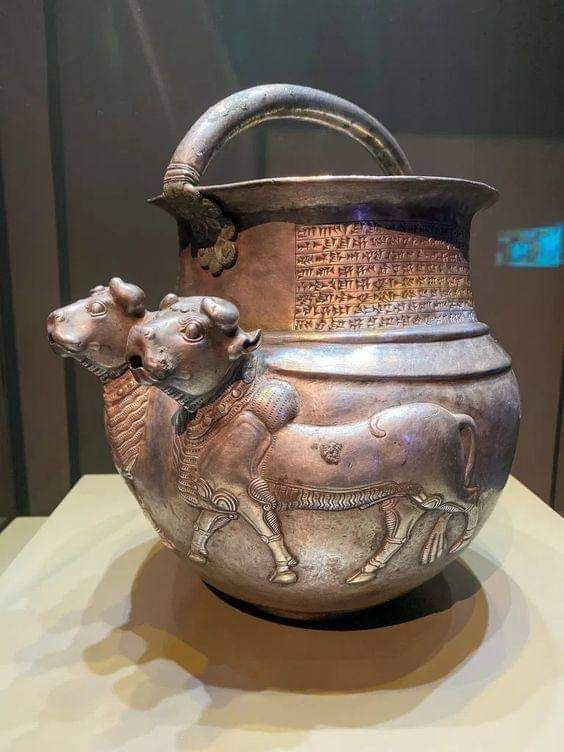
Elamite inscription engraved on the vessel states that the vessel is an offering by the King Shutruk Nakhunte to Inshushinak, the Lord is the protector of his city Susa...

The god Inshushinak is believed to be the Elamite equivalent of the Sumeran/Akkadian god Ea/Enki, the god of fresh water...Enki who is (in) Abzu, the source of water in Tigris and Euphrates...This dude... 

I talked about this in my posts "Problems with Abzu", "Shamash young and old", "When Utu steps up into heaven"

Ea/Enki who was also the god of the annual flood. Flood whose symbol was "Ea's/Enki's boat". 

The annual flood which was also known as "The Carp flood". Why? Cause during the flood, giant Mesopotamian carp migrate upstream for spawning. 

This is why Ea/Enki was often depicted with streams full of fish swimming towards him, toward Abzu. I talked about this in my post "Goatfish"...

Which is why we find carp (men), Apkallu, as Ea's/Enki's henchmen...
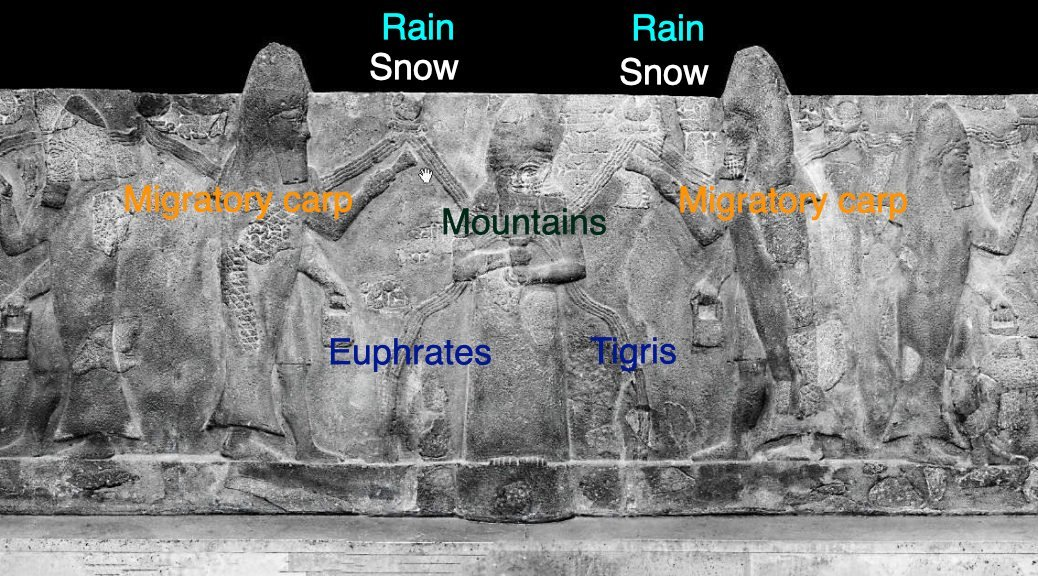
I talked about this in my posts "Apkallu", "Basalt water basin from Assur", "Kassite seal with Apkallu"...

Ok...What the hell any of this has to do with our Elamite silver pouring vessel with spouts in the form of two bulls? Guess when Tigris and Euphrates flood? In Apr/May, Taurus...
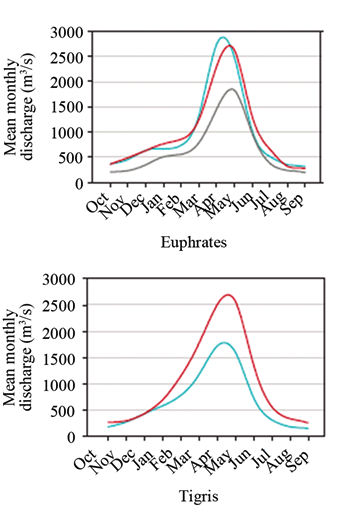
Now as you could have seen on the above map, Susa lies east of Tigris, between two rivers, 

Karkheh (Flow chart article)
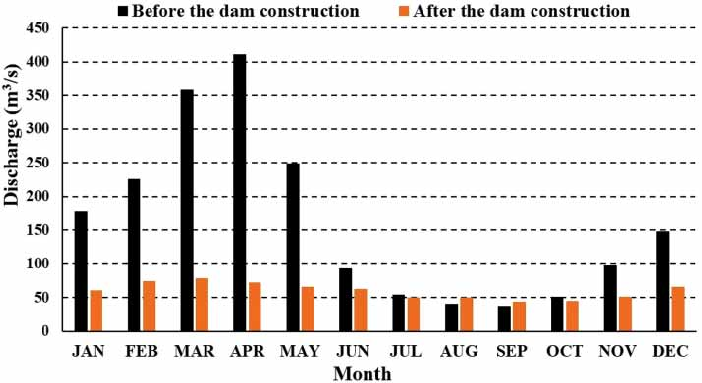
Daz (Flow chart article)

whose flows also peak in Apr/May, Taurus

In "Enki and the world order" we read:  "...Father (Ea)/Enki...he stood up full of lust like a rampant bull, lifted his penis, ejaculated and filled the Tigris [and Euphrates] with flowing water. He was like a wild cow mooing for its young in the wild grass..." Some scene 🙂

Why "like a wild cow mooing for its young"?  Cause Apr/May, Taurus, the peak of the Bull Enki's ejaculation (annual flood), is an animal calendar marker, not a constellation...

Apr/May, Taurus, Bull (it really should be Calf), the beginning of the calving season of the wild eurasian cattle. 

Talked about it in many of my posts...

And to tie all together: Why Ea/Enki, the god of fresh water and the annual "carp flood" standing on a bull? Cause Tigris and Euphrates and their tributaries, like Karkheh and Daz flood in Apr/May, in Taurus, when big carp swim upstream for spawning...
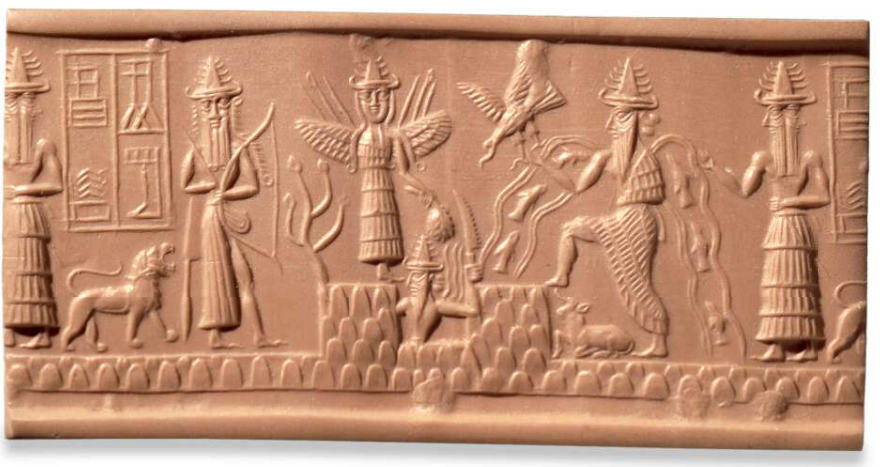
I talked about this in my post "Adda seal"...

So, I think that this could explain why a ceremonial Elamite "silver [water] pouring vessel" dedicated to the Elamite god Inshushinak who was the equivalent of Ea/Enki, god of water and annual flood, would have "double spout in the form of two bulls"...What do you think?

Here is another, older (3000BC), ceremonial Elamite water pouring vessel with the same symbolism...And the same meaning...I talked about it in my post "Elamite water bull"...
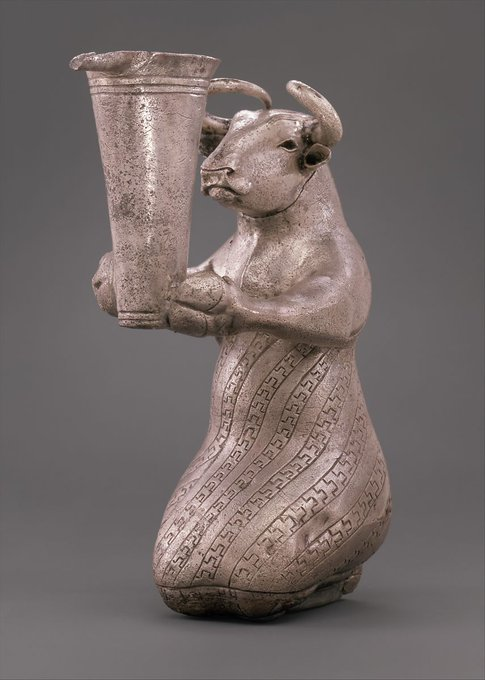

BTW, Do you see that vessel that the bull man is holding? 

Spouted silver bowl decorated with entwined serpents. Southeastern Iran Mid 3rd millennium BC. From Al-Sabah collection. 


I talk about it in my post "Snake water bowl" in which I try to answer the question: Why were water gods in Mesopotamia (Enki) and Elam (Napiriša, Inshushinak) linked to snakes?

To read more about ancient animal and plant calendar markers, start here…Then check my twitter threads I still didn't convert to blog post...I am way way behind...

Friday, 17 May 2024

Origin of griffins

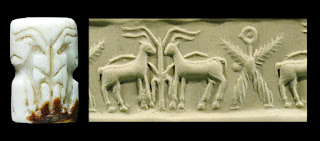
Proto-Elamite seal, 3000 BC. A griffin, followed by ibex goat, or goitered gazelle...


From "The Elamite Cylinder Seal Corpus, c.3500 - 1000 BC" volume II part I

Finally a proof (at least to me 🙂) that griffin is a complex animal calendar marker...

If you look up "griffin", this is what you get: "The griffin, griffon, or gryphon is a legendary creature with the body, tail, and back legs of a lion; the head and wings of an eagle; and sometimes an eagle's talons as its front feet"...

Legendary creature? Nah...It's a complex animal calendar marker for autumn (Jul/Aug - Oct/Nov)...

Eeee, why, how?

If you wanted to depict this time period, using animal calendar markers how would you do it?

Well you could find an animal whose mating or birthing takes place in Jul/Aug and mark the beginning of autumn. And then you could find an animal whose mating or birthing takes place in Oct/Nov and mark the end of autumn...

Like for instance, you could take eurasian lions, whose main mating season starts in Jul/Aug...

In the "THE ASIATIC LION: A study of ecology and behaviour" by Paul Joslin we can read that based on the observation of the large number of wild lions, the mating season of the Asiatic lions starts in August and lasts until October. 


Which is why lion is the symbol of the hottest, driest part (Jul/Aug) of the hot, dry half of the year (Apr/May - Oct/Nov)...I talked about this in many of my posts. For instance in my post "Angra Mainyu", about this amazing Middle Assyrian Cylinder Seal with a "Lion-Dragon", 1300-1200 BC. 

Eurasian lion main mating season marks the beginning of autumn and spans the whole of autumn (Aug,Sep,Oct)...

Which is why lion is also the symbol for autumn. I talked about this in my post "Symbols of the seasons"... 

Oh by the way, the symbol for summer (Apr/May - Jul/Aug) is bull, because summer starts with the calving of wild Eurasian cattle. Which is why "lion killing bull" symbol found all over the place means "the end of summer, BEGINNING OF AUTUMN"

I talked about this in many of my posts. For instance "Cypriot stamp seal with cow and calf", about this amazing conoid stamp seal, Late Cypriot III. Cyprus (?), ca. 13th–12th c. BC. 


So, I guess, you could use lion as the symbol marking the beginning of autumn...What about the symbol for the end of autumn?

Well, you could take old world vultures, whose mating season starts in Oct/Nov, with synchronized flying mating dances...

Which is why Vulture (Eagle) is the symbol of for the END OF AUTUMN, beginning of winter...

I talked about this in many of my posts. For instance "Eagle dance", about this interesting cylinder seal from North Mesopotamia-Syria, 1800–1500 BC, from the Leroy Golf collection.

So now put these two symbols together, lion-eagle...And you get griffin...Symbol of autumn...Here they are on another amazing Proto Elamite seal from "The Elamite Cylinder Seal Corpus, c.3500 - 1000 BC" volume II part I

That I am right about the meaning of the griffin, can be seen from the fact that on the original seal griffin, symbol of autumn is followed by ibex goat (or goitered gazelle), both symbols of winter...


I wrote many posts about ibex goat as symbol of winter, because ibex mating season coincides with the beginning of winter (Oct/Nov). For instance "Goats with tree of life from Alalakh", about "rampant goats flanking tree of life" images discovered in Bronze Age city of Alalakh/Tell Atchana, located 20 km from Antakya (Antioch) in what is now Turkey's Hatay Province. 

I wrote many posts about about gazelle as symbol of winter, because gazelle mating season coincides with the beginning of winter (Oct/Nov). For instance "Mysterious creature", about this Akkadian Cylinder Seal dated to 2300-2200 BC. 

Oh, by the way, do you see the green branch between the griffin and the goat/gazelle? 

In Elam, the climatic year is divided into hot, dry half (Apr/May - Oct/Nov) and cool, wet half (Oct/Nov - Apr/May)...

It is the rain that arrives in Oct/Nov, at the end of autumn (griffin), beginning of winter (goat/gazelle) that made life in Elam possible...

To read more about ancient animal and plant calendar markers, start here…then check the rest of the blog posts related to animal calendar markers I still didn't add to this page, and finally check my twitter threads I still didn't convert to blog post...I am 9 months behind now...


Wednesday, 10 April 2024

Snake water bowl

Spouted silver bowl decorated with entwined serpents. Southeastern Iran Mid 3rd millennium BC. From Al-Sabah collection.

Why was this vessel decorated with entwined serpents? Here's what I think:

I already talked about this type of vessels in my post "Elamite water bull" about this Proto-Elamite silver figurine of a clothed anthropomophised kneeling bull...holding a spouted [water] vessel. c. 3000BC. Currently in the Met Museum...

My guess that this figure is either Enki (Sumerian god of sweet water) or Utu (Sumerian sun god)...Or their unnamed Elamite equivalent who possibly combines both of them in one...

They were both described as bulls. Why?

These are yearly charts of the water levels in Tigris and Euphrates. You can see that they both peak in Apr/May, Taurus, Bull...

BTW, Taurus here is The Old Taurus, the animal calendar marker for the beginning of the calving season of wild eurasian cattle...

This rise in water levels in Tigris and Euphrates is the result of the sun heating up of the mountains which are the source of the two great rivers: Anatolian highlands and the Zagros mountains...Which causes the snow to melt, which causes the rivers to swell...

Snowmelt, Zagros


Hence the humanoid bull holding a spouted water vessel...Which looks just like the vessel from the  Al-Sabah collection...

I talked about another water carrier figurine from Iran in my post "Water carrier equid", about this "Spouted Anthropomorphic Vessel", Western Iran, circa 1000-650 BCE. Currently in Los Angeles County Museum of Art...


Here the anthropomorphised animal water carrier is not a bull but an equid, horse or a donkey. Why? Cause equid mating season, starts in Apr/May, right when the water discharge peaks in the rivers in Mesopotamia/Iran...

But why was the vessel from the Al-Sabah collection decorated with entwined serpents?

First, snake is a solar animal, pretty much a universal symbol of the sun's heat. Snakes follow sun everywhere. They are in our world when sun is in our world (day, summer) and in the underworld when the sun is in the underworld (night, winter)...I talked about this in many of my posts. For instance "Snake god from Hatra"...

And it is the sun's heat that melts the snow...

Second, snake mating season, when snakes intertwine, starts in Apr/May, the time of the peak snowmelt runoff in Iranian mountains, and the peak discharge of the rivers in the Tigris/Euphrates system...

Which is why in the Deliver Me from Evil: Mesopotamian Incantations, 2500-1500 BC, By Graham Cunningham, we can read that in the Earliest Sumerian texts, Enki, the god of sweet flowing water and the source of Tigris and Euphrates, was associated with poisonous snakes...

Hence Enki (Or at least Elamite equivalent of Enki) sitting on a snake throne....

And which is why I think the [water] vessel from the Al-Sabah collection is decorated with entwined serpents...

Great info can be found in this X thread by @dalaygiz

“Twenty different officiants are attested in connection with Napiriša. Their designations vary from simple šatin (4) and makuš (7) to (makuš) pirramadda (3) and (makuš) haturmakša; their names are all Iranian except for two.”

“Elsewhere, the same individuals are associated with a range of other sacrifices, including sacrifices for or at various mountains, for Adad, Auramazdā, Išpandaramattiš, and (the) Mišebaka.”

(‘The Heartland Pantheon’, Henkleman, pg 1229)

“The syllabic spellings of the name (AN na‐pír‐šá‐ra, AN na‐pír‐ir‐šá‐ir‐ra) follow the development riša > irša, “great,” suggesting that the name of the god was still understood as a compound (logographic spellings: AN dingir.gal MEŠ, AN gal MEŠ).”

The origins of Napiriša, attested since the early second millennium BCE, may lie in the eastern highlands of Elam. This may also account for his popularity in the PFA*. 

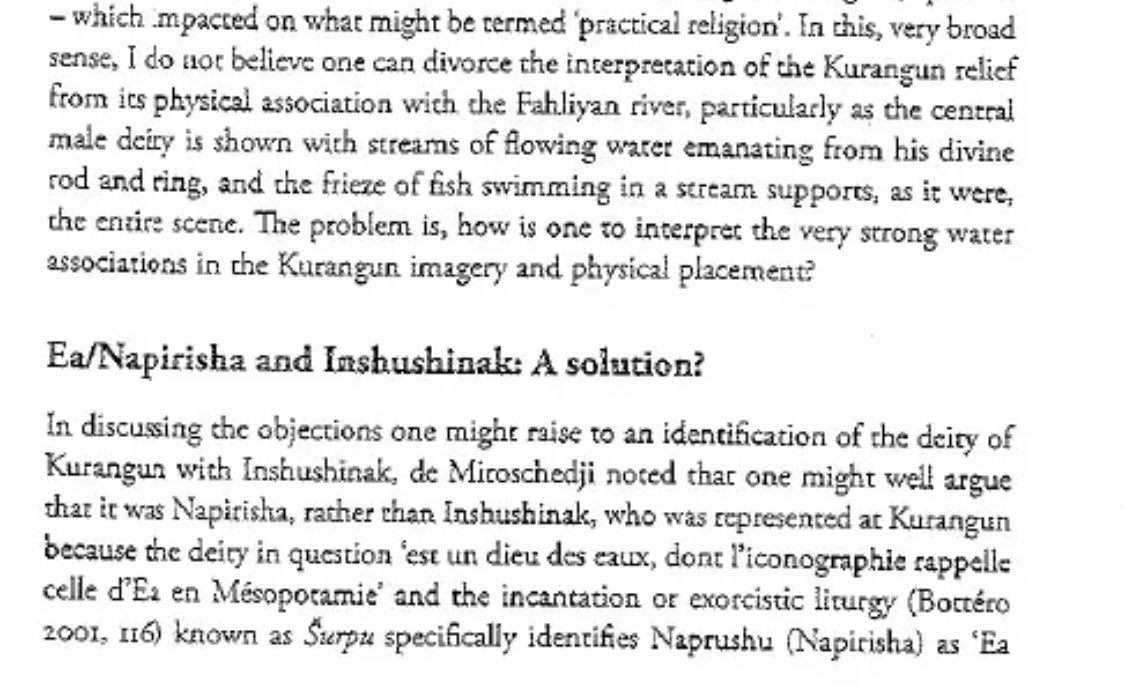
The water‐giving god and his wife are shown here at the open‐air sanctuary of Kūrāngūn:

It’s majorly held for the figures above that they are Napiriša (or Napiriša‐Inšušinak) and his spouse Kiririša, the ‘Great Goddess’ of Liyan/Būšehr. 

Also, Mesopotamians identified “Naprušu/Napriš” as their own Ea/Enki.  

(‘The Heartland Pantheon’, Henkleman, pg 1228)

*Persepolis Fortification Tablets 

This deity is attested for 26 times and given Iranian epithets.

Here’s the Kurangun relief, which depicts a horned Elamite deity seated upon a snake-coiled throne. 17th century BCE. It’s in Fars, Iran. 

“He is seated on a throne formed by the body of a snake, coiled back upon itself over and over again, and he grasps the tail of the snake in his left hand. In his right he holds the divine rod and ring [my comment, he is not holding rod and ring, he is holding a cup, just like Enki/Ea] from which two streams of water flow [...]” 

(D.T Potts, From Handaxe to Khan, 1990, pg.146) 

You can read more here: The numinous and the immanent

Snakes did appear a lot in Elamite art...

"In terms of identification, he has been called Inshushinak, who was the patron of Susa anyways. Enki/Ea/Napirisha are mentioned as well; the author deduces that these names/figures are all in fact related, with the former being used as epithets, besides the shared identity"...


That's it. To read more about ancient animal and plant calendar markers, start here…then check the rest of the blog posts related to animal calendar markers I still didn't add to this page, and finally check my X threads I still didn't convert to blog post...I am 9 months behind now...

Wednesday, 16 November 2022

Green stone cylinder seal

Green stone cylinder seal; A walking bull, below which is a smaller horned animal (Ibex goat btw) and above the bull is a branch. Jemdet Nasr or Old Elamite period (3100 to 2900 BC). Currently in the British Museum.

Meaning? Apparently, according to the museum experts: "we have no idea"...

Let me try:

Remember this post, "Problems of Abzu"? I completely forgot about it 🙂 This post tries to answer the question: Why was Enki, Sumerian god of fresh water and annual flood, called both "Goat of Abzu" and "Bull of Abzu"? Abzu being source of fresh water in Mesopotamia...In short: Because the rains season in Mesopotamia starts when wild goats start to mate and ends when wild cattle start to calve 🙂

Rain that falls during the rain season is what makes Mesopotamia and Iran green and fertile...So maybe this is what is depicted on this green cylinder seal with goat, bull and branch???

But maybe the "branch" isn't just a branch. Maybe it is the symbol for grain...

Grain harvest in Mesopotamia and Elam started in Apr/May, Taurus...Hence the "bull and grain" symbolism found all over the place...I talked about it in my post "Bull carrying granary"...

Oh, and guess when the grain was sown? At the end of autumn, Oct/Nov, is when the first rains arrive, brought by the goat of rain. Here is rain god Ninurta/Ningirsu, who was, in the earliest records, also agriculture god, giving plough to the people...I talked about this in my post "Black basalt stone of Esarhaddon"...

So is this what this seal depicts? Small goat (grain seeds are sown). Big bull (grain ears are harvested)...

I don't know if either of these two "potential interpretations" are correct, but to me they are definitely better than "" we get from British Museum...

To read more about ancient animal and plant calendar markers, start here…then check the rest of the blog posts related to animal calendar markers I still didn't add to this page, and finally check my twitter threads I still didn't convert to blog post...I am 9 months behind now...