Showing posts with label Irish folklore. Show all posts

Monday, 6 February 2023

Well of the mad

In County Kerry, Ireland, there is a holly well known as Tobar na nGealt, (Well of the mad), also known as the Gall's well, whose water can cure madness. The well is located in the Gleann-na-nGealt (Valley of the Mad), also known as "Gall's valley"...

According to a legend, the name "Gall's well" comes from the fact that Gall, the king of Ulster, was cured of madness when he drank from the well and ate the watercress growing in its waters...

For centuries, mentally ill people have travelled to the well in search of a cure, with some of the earliest written references to Tobar na nGealt dating back to the 16th century...

The chemical analysis of the well water has shown up high levels of lithium, which may in some way explain the supposed beneficial effects of the water...

Lithium is used as a psychiatric medication to treat bipolar disorder and treat major depressive disorder that does not improve following the use of antidepressants...


Sources:

"Recovering well"

"Fáilte Romhat (Welcome) to West Kerry"

Sunday, 24 April 2022

Sunwise

Q: "Which way to turn myself I know not?" 

A: "If you worship the gods, right-hand wise, I apprehend."

Ever wondered why "clockwise" means "circle to the right" and "anti clockwise" means "circle to the left"? 

Cause the original clocks were sundials

You can make a sundial by sticking a stick in the ground, and drawing a circle around it. As the sun moves from east to west, which is in the northern hemisphere "to the right" the shadow made by the sundial stick will move in the opposite direction, to the left...

But by doing that it will draw "rightward" circle around the sundial stick, with the stick, and the sun, always "on the right" side...This movement eventually became known as clockwise, but really it is "sunwise"...

Now for the Gaels (The Irish), doing thing "sunwise" was super important...

According to the 19th century ethnographers, no ceremony "religious or superstitious" could be performed without who ever performed it "turning sunwise" (from left to right)...

Turning to the left, counterclockwise, against the sun...was considered unlucky, evil and believe or not pagan, by the Christian church🙂 who completely adopted the "sunwise" turning as their own...And turning to the left became associated with curses, magic and witches...

In "Traces of the elder faiths in Ireland..." (1901) we can read that: "Camden relates that, in his day, when an Irishman happened to fall, he immediately, upon rising, turned three times to the right..."

In "The origin and history of Irish names of places" (1875) we can read that "Even at this day the Irish peasantry when they are burying their dead, walk at least once, sometimes three times, round the grave yard with the coffin from left to right"...

Also "To the south of the old church of Carran, county Clare, Ireland, there is a small cairn, around which the corpse is carried before burial in the churchyard"...and "whilst on the way to the cemetery, corpse is carried sunwise around the cross at Monkstown, county Dublin"...

Even today in Ireland when holy wells are visited at Gaelic festivals of Imbolc, Beltane and Lughnasa, people would pray for health while walking "sunwise" around the wells...

Also processions around the churches are also performed "sunwise"...

The same belief is found among the Gaels in Scotland. In Scottish folklore, Sunwise or Sunward (clockwise), turning from east to west in the direction of the sun, was considered the "prosperous course"...

In "A Description of the Western Islands of Scotland" (1703) we can read that: "Some of the poorer sort of people in the Western Isles retain the custom of performing these circles "sunwise" about the persons of their benefactors three times, when they bless them"...

"Some are very careful when they set out to sea, that the boat be first rowed "sunwise", and if this be neglected, they are afraid their voyage may prove unfortunate"...

Also people avoided turning boats anti-clockwise at all if possible, cause it was bad luck to do so...

"When a Gael goes to drink out of a consecrated fountain, he approaches it by going round the place from east to west, and at funerals, the procession observes the same direction in drawing near the grave"...

"Hence also is derived the old custom of describing "sunwise" a circle, with a burning brand, about houses, cattle, corn and corn-fields, to prevent their being burnt or in any way injured by evil spirits, or by witchcraft"...

In Carmina Gadelica (1900) we find this prayer song performed on the Feast day of Mary, which says: 

"I went sunways round my dwelling,

In name of the Mary Mother,

Who promised to preserve me,

Who did preserve me,

And who will preserve me..."

In "The silver bough" (1959) we read that "The Caledonians paid a superstitious reverence to the sun"...

"Practically every religious festival began with the ceremony of walking thrice deiseil, that is, in the sunwise direction, round the circle, cairn, altar or bonfire that marked the site, the object of the rite being to aid the sun by virtue of mimetic magic"...

"Until recent times...at a wedding, the company went trice round the house before entering...expectant mothers went thrice round a church in order to ensure an easy delivery...fire was carried thrice round an infant before baptism to save it from the fate of changling"...

In " Waverley" Sir Walter Scott describes how the old Highlander, called in to attend the wounded Edward, walked round the patient three times, from east to west, "sunwise", and this ceremony was considered a matter of the utmost importance towards effecting a cure...

In "A smaller social history of ancient Ireland..." we can read that: "When a king of any grade ascended the throne, he usually made a visitation or royal progress through his kingdom, to receive allegiance and hostages from his sub-kings"...

"He moved leisurely in a round-about, "sunwise", from left to right; and during the whole journey, he was to be entertained, with all his retinue, free of charge, by those sub-chiefs through whose territories he passed: so that these visitations were called Free Circuits"🙂...

The arrival of Christianity changed nothing in this respect. Actually church adopted this custom wholeheartedly. "For instance, St. Patrick consecrated Armagh, as St. Senan did Scattery Island, each by walking sunwise with his followers in solemn procession round the site"...

But not all saints liked this right turning business. "At the battle of Cooldrumman, fought near Drumcliff, county Sligo, in the year 561, St. Columbkille, in his prayer before the contest, denounces his adversaries for employing pagan rites to assure victory"...

He anathematizes them as: "the host which has taken judgment from us, a host that marches round a earn" i.e. performs the desiul, walks "sunwise"...

"By the strange irony of fate the saint's manuscript of portion of the Holy Scriptures the origin of the conflict, hence styled the Cathach, or 'the book of the battle' became the battle-standard of his tribe, the Cinel Conaill"...

"And an old Irish manuscript recounts that before a fight 'it was proper the Cathach should be carried three times to the right round the army of the Cinel Conaill at going to battle...If that was done, 'it was certain they would return victorious'"...

And so the custom survived and the 10th c. Cormac's Glossary says that: "when the spirit of poetry met Chief poet in Ireland in the time of Guaire Aidhne king of Connaught in the 7th c. it went sunwise round poet and his people"...

And in the 12th c. Vision of Mac Conglinne we read that the hero when parting from his tutor went right-hand wise round the cemetery...

Dr. P. W. Joyce states that Tempo, a little village in Fermanagh is called in Irish An tIompú Deiseal (the right-hand turn) and that the place received its name, "no doubt, from the ancient custom of turning sunways, i.e. from left to right, in worship"...

It is also possible that the name refers to a bend in the Tempo River near the village. But there is also a local legend that Saint Patrick left a manuscript here on his way to Enniskillen and that he told his servant to "turn right" to go back and retrieve it...So...

The belief in the magical power of "sunwise turn" existed in England too...It was considered unlucky to travel in an anticlockwise (not sunwise) direction around a church...

19th c. antiquarian Mr. F. T. Elworthy recounts that: "in Somerset, quite recently, and within his own knowledge, a number of children were brought to be baptized, and, of course, were ranged in a group round the font"...

"The officiating minister, not being accustomed to such a number, or not knowing the custom, began with the child on his right hand, of course following on in order, and going round to the child on his left"...

"This action caused great indignation: parents, who had never before seen the importance of having their children baptized at all, were quite sure that now they had not been done properly"...

"...and that they must be taken to another church, 'to be done over again'. Thus it was held of far greater moment that the parson should proceed from left to right than it was that the children should be baptized or not"...

I don't know if this "superstition" once existed in other parts of Europe...If you have any info about it please post it in this thread... 

But it turns out, references to the "sunwise" turn in religious rituals exist in Roman and Greek culture...

And so in "On the Ceremonial Turn, Called Desiul" we find that in the comedy by Plautus, one of his characters says: "Which way to turn myself I know not"; the other jestingly replies, "If you worship the gods, right-hand wise, I apprehend;" Was Plautus here mocking "peasants"?

Anyway, I will stop here...

Sources:

"A smaller social history of ancient Ireland"

"Traces of the elder faiths in Ireland"

"The origin and history of Irish names of places"

"A description of the Western Islands of Scotland"

"Sanas Chormaic. Cormac's glossary"

"Carmina Gadelica"

"Silver bough"

"On the Ceremonial Turn, Called 'Desiul'"

"Meeting the sun"

Sunday, 23 January 2022

Market Cross at Kells

This Sunday started quite well...

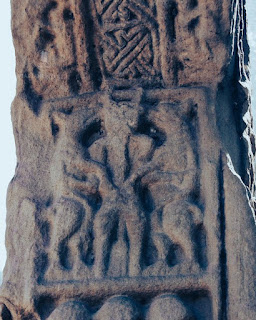
Archaeologist Neil Jackman @JackmanNeil posted this very interesting picture on his twitter account:


With these comments:

An unusual, and a little unsettling, depiction on the c.9/10th century Market Cross at Kells, County Meath.

It features a human-like bearded figure with horns, flanked by two beasts (wolves or lions?) on their hind legs. Could it be a rare depiction of the devil?

Early Irish high crosses usually (though not exclusively) depict religious scenes, along with the beautiful ornamentation.

Dr Francis Young @DrFrancisYoung, Historian of religion & beliefs then commented that:

The iconography of Satan hadn't yet settled down by that point; I don't think there are c9th representations of Satan with horns. If I had to guess, I'd say this is a Classical reference and the figure is most likely Pan/Faunus, representing wild untamed nature. As a rule of thumb, if in doubt about early medieval iconography, it's usually a garbled Classical reference...

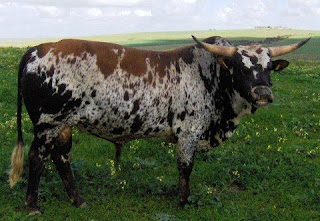
Eeee wasn't there some fella called Crom Dubh, whom pretty much all early Irish saints defeated at some point or another, who was linked to bulls, and who could even turn to a bull himself? Particularly a speckled one...

The horns on the "devil" from the Market Cross at Kells look very much like bull horns to me...

I talked about Crom Dubh bull folklore in my post "Bull of Crom Dubh"...

Crom Dubh apparently lived all over Ireland...Including Dun Briste. 

And guess what: "Crom Dubh (also) had two hounds of dogs...and if ever there were [wicked] mastiffs these two dogs were they..." 

I talked about this legend in my post "Dun Briste"...

So here we have a "bull god flanked by two hounds"...Is this enough to identify this image as a depiction of Crom Dubh? Of course not. But it is a possibility that we can't ignore...Especially because this would be the only known depiction of Crom Dubh ever found that matches the folklore depictions of this old Irish god...

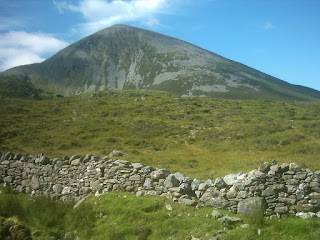
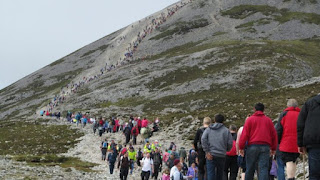
Croagh Patrick, the Irish "Holy mountain". 


Once "the holy mountain of Crom Dubh" the old Irish Sun/Sky god and god of agriculture, it became "the holy mountain of St Patrick", after he "defeated" Crom Dubh... The day of the annual pilgrimage to the top of the mountain is still known locally as "Domhnach Crom Dubh" which means "Crom Dubh's Sunday"... 


Wednesday, 24 February 2021

Living stone

Shepherds chapel, Velebit, Croatia dedicated to Holy Mary. The altar is actually bedrock, around which the church was built, indicating that this a Christianised pagan holy place. I talked about this in my post "Shepherds chapels from Velebit"... 

Bedrock is in the Balkans known as "kamen živac, živi kamen, živa stena" (living stone, living rock), called so, because it is believed to be still part of the living body of the Mother Earth.  And is venerated as sacred...


Transhumance shepherds used to bring offerings to these lumps of exposed bedrock before they took their flocks to the highlands, to ensure good weather. People believed that "Mother Earth, known as Baba, controls the bad, cold, rainy, snowy weather". I talked about this in my post "Weather stones"...

In my post "The City", I talked about an ancient enclosure in Co Kerry, Ireland which was linked with the veneration of the (D)Anu, the Irish version of Baba, The Mother Goddess. 

The enclosure was built around an exposed piece of bedrock, which served as an altar.

The City was the place where annual rituals were perform on Bealtaine, 1t of May, the middle of Taurus, at the beginning of the cattle drive into the highland pastures, "for the protection of the cattle"...

From the bedrock standing in the centre of the enclosure, both people and cattle looked towards the two round breast like hills, made even more breast like by giant stone cairns built on their tops. The hills are known as the Paps of Anu (Boobs of the Mother Earth)...

So here in Ireland, just like in the Balkans, we have association between bedrock, Mother Earth and shepherds...Mountain tops, and bedrock crags called Baba (Grandmother, Mother, Mother Earth) from the Balkans Pic: Velika Baba (Great Grandmother) peak, Slovenia. From the post "Baba, mountains and crags


Tuesday, 29 December 2020

Harvest in Scotland


Harvesting in Scotland by a Scottish painter Joseph Farquharson (1846-1935). 

Scottish harvest customs. From "Carmina Gadelica - Hymns and Incantations, Ortha Nan Gaidheal, Volume I" by Alexander Carmichael [1900]


Reaping blessing. From "Carmina Gadelica - Hymns and Incantations, Ortha Nan Gaidheal, Volume I" by Alexander Carmichael [1900]


The Sun god to whom Scots gave thanks for their grain and their wellbeing is Crom Dubh of the Irish (Scots). The deity to whom the Irish prayed in the Early Bronze Age "Grange Circle" on the first day of the harvest. 


The biggest and the only square stone in the circle is still known as the Crom Dubh stone. And next to it is the pile of flat bread like stones known as the Grain Child...


I talked about this amazing ancient monument in my post "Grange circle

He was the good whose holy mountain was and is the holiest place in Ireland. Except it is now called St Patrick's mountain...


I talked about this in my post "Sun mountain"...

They prayed to him on the last Sun-day in July, which is still known in the area around the holy mountain as the "Domhnach Crom Dubh" which means "Crom Dubh's Sunday"...

People prayed to Crom Dubh because they believed that "It was he who was giving them the light of the day, the darkness of the night, and the change of seasons"...Basically The Sun...I talked about this in my post "Dun Briste"...

Crom Dubh was said to be another name for Dagda, the Giving God of the Irish... 
Hromi Daba was another name for Dabog, the Giving God of the Serbs...

Both of these gods had a bull cult associated with them...

I talked about this in my posts "Bull of Crom Dubh" and "Bull of Grom Div (Hromi Daba)"...

And Dabog (Hromi Daba), The Sun God, is the god to whom Slavs still "raised stones" until very recently "for the weather". 


Just like the Early Bronze Age Irish raised stones and built stone circles to Dagda (Crom Dubh)??? 

I talked about these weather manipulation rituals involving stones in "The last megalithic ritual in Europe" and "Weather stones"...

The Sun God of the Pagan Serbs, Dabog, Hromi Daba, became the Devil of the Christian Serbs. 
The Sun God of the Pagan Irish, Dagda, Crom Dubh became the Devil of the Christian Irish. 

But after all these years, in Ireland "By Crom" still means "By God" 🙂 


Tuesday, 10 November 2020

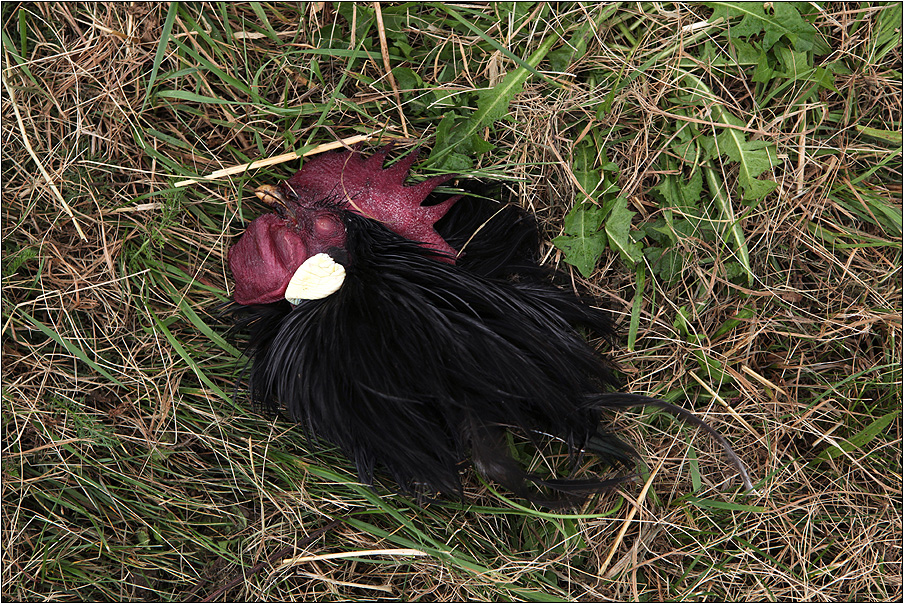
Bleeding for Martin

Cockerel standing on top of the sun gate, on the border between the darkness and light, between the land of the dead (where sun spends night) and the land of the living (where sun spends day). Medieval (?) standing stone, Bosnia...


In the old Irish calendar, the solar year was divided into two parts: the dark part (Nov-Apr) and the light part (May-Oct). The day that marked the end of the light part of the year and the beginning of the dark part of the year was the first of November. Samhain...


But because in the Irish calendar the day started at sunset, Samhain is celebrated  at the sunset of the October 31, on Halloween...And just like the day started with the evening, in the Irish calendar, year started with the beginning of the dark period, on Samhain...

Now until very recently, in Ireland, the practice in many places was to kill a cockerel on "Ould Halloweve" night, the night prior to St. Martin ’s feast day on the 11th of November.

The date for "Ould Halloweve", or old Halloween, came about as a result of the removal of ten days from the calendar when the Gregorian calendar replaced the Julian in 1582...

Here is the interesting bit. The killing of the cockerel was known as "the bleeding". The bleeding was done by cutting the neck, or more usually by slitting the head of the bird along the comb and then hanging it to allow the blood to fall on the ground or to be gathered in a jar...

The blood was then sprinkled in all four corners of the house (kitchen if house had more than one room) and across the main threshold, in the belief that this protected the home from evil or "bad luck".

When the blood was not sprinkled in this manner it was daubed in the shape of a cross on the front and back doors while saying, "I shed this blood in honour of God and St. Martin to bring us safe from all illnesses and disease during the year"...

The rest of the blood was collected and used to make a Sign of the Cross on the residents foreheads, again as a protective talisman.

So this was not just "killing of a cockerel to make dinner". This was a blood sacrifice. That this is the case can be seen from the ethnographic data collected around Ireland in the 1930's. I particularly love this story from county Kerry:

So it seems that "the bleeding" was an obligatory blood sacrifice. It was strictly observed that bleeding must be done between Nov. 1st and the eve of the feast, or on the Vigil, as it was said: Martin will accept before his feast but not after it".

But blood sacrifice to whom? To St Martin? Well, no, of course not. To the dead? Samhain eve, Halloweve, Halloween, was in the Irish tradition the day of the dead...

Irish believed that on that night, the barrier between our world and the world of the dead became so thin, that the dead could come back to our world.

And the dead looooove blood. It's their favourite drink, because it makes them feel alive again...I wrote about this in my post "Blood red vine" in which I talked about why red vine is used in mortuary rituals... 

That this is indeed the case can be seen from the identical ritual which is performed on St Mrata's day in Serbia. In Serbia Samhain was replaced by two Holy Days: Mitrovdan (St Martin's day) and Mratindan (St Mrata's) day.

Both days mark the beginning of winter and the beginning of the dark part of the year, as the Old Serbian calendar, just like the old Irish calendar, divided the solar year into the dark part (Nov - Apr) and the light part (May - Nov). 


More about this in my post "Two Crosses".

And on the day of St Mrata, Serbs used to slaughter a cockerel on the house doorstep. 

After the cockerel is slaughtered, a hair from every animal in the household is placed in its beak.

The beak is then tied with a red thread and is hanged over the door or is buried under the doorstep to protect the house and its animals from the evil spirits. The wings and sometimes the head were hanged on the cauldron chain over the fire. I talked about this in my post "Verige".

Both the door and particularly the doorstep and the fire place are in Serbian tradition closely linked with the cult of the dead and are places believed to be inhabited by the spirits of the dead ancestors.

So slaughtering the cockerel on the doorstep is literal blood sacrifice to the dead on their altar. This is the equivalent of the Irish custom of marking the doors with sacrificed cockerel's blood.

Burying the cockerel's head under the doorstep with the hairs of all the animals from the household is clearly a panspermia (mixed sacrifice), a type of sacrifice which was in Serbia offered to family ancestors and to the ancestor of all Serbs, Giving God, Dabog...

The fact that the sacrifice was given to the hearth is the equivalent to the Irish sprinkling cockerels blood only in the room with the hearth. But what about the Irish custom of sprinkling the cockerel's blood in the corners?

Well in Serbian mythology, corners are also seen as places where ancestors gather. During Christmas dinner, which was in Serbia seen as "meal eaten together with the ancestors", walnuts, symbol of fertility was thrown into each corner of the house, for the dead...

Now here is something very interesting. Serbian ancestral deity Dabog has another name: Hromi Daba. In several of my posts I talked about the similarities between the Serbian Hromi Daba and the Irish Chrom Dubh...

One of the similarities is that both gods were in the past offered Human Sacrifices...On Samhain...As thanksgiving for the bountiful harvest which had just finished...

Now remember that in Serbian mythology, cockerel sacrifice is a replacement for a human sacrifice...Particularly when it comes to agricultural rituals. I talked about this in my post "Cock bashing"...


And knowing that St Martin's day is just another Christianised Samhain, when we "bleed cockerel for Martin" who are we sacrificing really and to whom?

Thursday, 5 November 2020

Long ears

There is a very unusual story about a king with long (goat's or donkey's or horse's or ox's) ears and his barber. This story has only been preserved as a folk tale in a few places. Are these places connected with each other in some way? 
Midas, Greece


Bacchus, on a certain occasion, found his old schoolmaster and foster-father, Silenus, missing. The old man had been drinking, and in that state wandered away, and was found by some peasants, who carried him to their king, Midas. Midas recognized him, and treated him hospitably, entertaining him for ten days and nights with an unceasing round of jollity. On the eleventh day he brought Silenus back, and restored him in safety to his pupil. Whereupon Bacchus offered Midas his choice of a reward, whatever he might wish. He asked that whatever he might touch should be changed into gold. Bacchus consented, though sorry that he had not made a better choice.

Midas went his way, rejoicing in his new-acquired power, which he hastened to put to the test. He could scarce believe his eyes when he found a twig of an oak, which he plucked from the branch, become gold in his hand. He took up a stone; it changed to gold. He touched a sod; it did the same. He took up an apple from the tree; you would have thought he had robbed the garden of the Hesperides. His joy knew no bounds, and as soon as he got home, he ordered the servants to set a splendid repast on the table. Then he found to his dismay that whether he touched bread, it hardened in his hand; or put a morsel to his lip, it defied his teeth. He took a glass of wine, but it flowed down his throat like melted gold.

In consternation at the unprecedented affliction, he strove to divest himself of his power; he hated the gift he had lately coveted. But all in vain; starvation seemed to await him. He raised his arms, all shining with gold, in prayer to Bacchus, begging to be delivered from his glittering destruction. Bacchus, merciful deity, heard and consented. "Go," said he, "to River Pactolus, trace its fountain-head, there plunge yourself and body in, and wash away your fault and its punishment." He did so, and scarce had he touched the waters before the gold-creating power passed into them, and the river sands became changed into gold, as they remain to this day.

Thenceforth Midas, hating wealth and splendor, dwelt in the country, and became a worshipper of Pan, the god of the fields. On a certain occasion Pan had the temerity to compare his music with that of Apollo, and to challenge the god of the lyre to a trial of skill. The challenge was accepted, and Tmolus, the mountain god, was chosen umpire. The senior took his seat, and cleared away the trees from his ears to listen.

At a given signal Pan blew on his pipes, and with his rustic melody gave great satisfaction to himself and his faithful follower Midas, who happened to be present. Then Tmolus turned his head toward the Sun-god, and all his trees turned with him. Apollo rose, his brow wreathed with Parnassian laurel, while his robe of Tyrian purple swept the ground. In his left hand he held the lyre, and with his right hand struck the strings. Ravished with the harmony, Tmolus at once awarded the victory to the god of the lyre, and all but Midas acquiesced in the judgment. He dissented, and questioned the justice of the award. Apollo would not suffer such a depraved pair of ears any longer to wear the human form, but caused them to increase in length, grow hairy, within and without, and movable on their roots; in short, to be on the perfect pattern of those of an ass.

Mortified enough was King Midas at this mishap: but he consoled himself with the thought that it was possible to hide his misfortune, which he attempted to do by means of an ample turban or head-dress. But his hairdresser of course knew the secret. He was charged not to mention it, and threatened with dire punishment if he presumed to disobey. But he found it too much for his discretion to keep such a secret; so he went out into the meadow, dug a hole in the ground, and stooping down, whispered the story, and covered it up. Before long a thick bed of reeds sprang up in the meadow, and as soon as it had gained its growth, began whispering the story, and has continued to do so, from that day to this, every time a breeze passes over the place.

Source: Thomas Bulfinch, The Age of Fable (1855), chapter 6.

Bulfinch's source: Ovid, Metamorphoses, book 11, and other classical writers.


The Goat's Ears of the Emperor Trojan, Serbia

Once upon a time there lived an emperor whose name was Trojan, and he had ears like a goat. Every morning, when he was shaved, he asked if the man saw anything odd about him, and as each fresh barber always replied that the emperor had goat's ears, he was at once ordered to be put to death.

Now after this state of things had lasted a good while, there was hardly a barber left in the town that could shave the emperor, and it came to be the turn of the Master of the Company of Barbers to go up to the palace. But, unluckily, at the very moment that he should have set out, the master fell suddenly ill, and told one of his apprentices that he must go in his stead.

When the youth was taken to the emperor's bedroom, he was asked why he had come and not his master. The young man replied that the master was ill, and there was no one but himself who could be trusted with the honor. The emperor was satisfied with the answer, and sat down, and let a sheet of fine linen be put round him.

Directly the young barber began his work, he, like the rest, remarked the goat's ears of the emperor, but when he had finished and the emperor asked his usual question as to whether the youth had noticed anything odd about him, the young man replied calmly, "No, nothing at all."

This pleased the emperor so much that he gave him twelve ducats, and said, "Henceforth you shall come every day to shave me."

So when the apprentice returned home, and the master inquired how he had got on with the emperor, the young man answered, "Oh, very well, and he says I am to shave him every day, and he has given me these twelve ducats"; but he said nothing about the goat's ears of the emperor.

From this time the apprentice went regularly up to the palace, receiving each morning twelve ducats in payment. But after a while, his secret, which he had carefully kept, burnt within him, and he longed to tell it to somebody. His master saw there was something on his mind, and asked what it was. The youth replied that he had been tormenting himself for some months, and should never feel easy until some one shared his secret.

"Well, trust me," said the master, "I will keep it to myself; or, if you do not like to do that, confess it to your pastor, or go into some field outside the town and dig a hole, and, after you have dug it, kneel down and whisper your secret three times into the hole. Then put back the earth and come away."

The apprentice thought that this seemed the best plan, and that very afternoon went to a meadow outside the town, dug a deep hole, then knelt and whispered to it three times over, "The Emperor Trojan has goat's ears." And as he said so a great burden seemed to roll off him, and he shoveled the earth carefully back and ran lightly home.

Weeks passed away, and there sprang up in the hole an elder tree which had three stems, all as straight as poplars. Some shepherds, tending their flocks near by, noticed the tree growing there, and one of them cut down a stem to make flutes of; but, directly he began to play, the flute would do nothing but sing: "The Emperor Trojan has goat's ears." Of course, it was not long before the whole town knew of this wonderful flute and what it said; and, at last, the news reached the emperor in his palace.

He instantly sent for the apprentice and said to him, "What have you been saying about me to all my people?"

The culprit tried to defend himself by saying that he had never told anyone what he had noticed; but the emperor, instead of listening, only drew his sword from its sheath, which so frightened the poor fellow that he confessed exactly what he had done, and how he had whispered the truth three times to the earth, and how in that very place an elder tree had sprung up, and flutes had been cut from it, which would only repeat the words he had said. Then the emperor commanded his coach to be made ready, and he took the youth with him, and they drove to the spot, for he wished to see for himself whether the young man's confession was true; but when they reached the place only one stem was left. So the emperor desired his attendants to cut him a flute from the remaining stem, and, when it was ready, he ordered his chamberlain to play on it. But no tune could the chamberlain play, though he was the best flute player about the court -- nothing came but the words, "The Emperor Trojan has goat's ears."

Then the emperor knew that even the earth gave up its secrets, and he granted the young man his life, but he never allowed him to be his barber any more.

Source: Andrew Lang, The Violet Fairy Book (London: Longmans, Green, and Company, 1901), pp. 52-54.

Lang's source: Volksmärchen der Serben.


The King with the Horse's Ears, Ireland
The story I'm going to tell you is not to be met every day. I heard little Tom Kennedy, the great schoolmaster of Rossard, say that he read it in the history of Ireland, and that it happened before the people were Christian. It is about a king who had his hair cut only once a year. He lived in some old city on the borders of Carlow and Kilkenny, and his name was a queer one: Lora Lonshach it was.

So, as I said, he got his hair cut only once a year, and afterward nothing more was ever heard of the barber who did it. This happened to about seven unlucky fellows, and then no barber would come close the castle for love or money. So the king proclaimed that all the barbers in the country were to draw lots, and if the one who got the short straw would dare to refuse, he would be put to death.

The short straw was drawn by a poor widow's son named Thigueen. Fearing that she would never again see her son, the mother ran to the castle and beseeched the king to spare him the fate of the previous barbers.

"You'll get your boy back safe and sound," promised the king.

The next day the frightened barber reported for duty.

"My good fellow," said the king, "you'll be at liberty to go wherever you please after cutting my hair, but you must swear Dar lamh an Righ (by the king's hand) that you'll never tell anything that has ears and tongue what you see here today."

The king sat down on his throne and took off his hood, revealing two brown horse's ears, quite as long as those of an ass.

"Pick up your scissors and do your job!" he ordered.

The poor lad did as best he could, taking special care not to nick the king's ears.

When the job was finished, the king paid him, saying, "Now, my lad, if I ever hear word of this, I'll make you wish that you had never been born."

The boy returned to his mother, only to fall into bed, deathly ill. She asked him what ailed him, but he gave no answer.

Two days later the doctor came.

"I have a secret," said poor Thigueen. If I cannot tell it, I'll die, and if I do tell it, I'll not be allowed to live."

When the doctor heard that the secret was not to be told to anyone with a tongue or ears, he said, "Go into the woods, make a split in the bark of one of the trees, tell your secret into the cut."

The doctor was hardly out of the house when Thigueen got up and went into the woods, not stopping until he reached the middle, a place where two paths crossed one another. At this spot he found a healthy tree, cut a gash in its bark, and then whispered into it, "Da Chluais Chapail ar Labhradh Loingseach," which means, "The two ears of a horse has Lora Lonshach."

The poor fellow had hardly whispered these words when he felt as if a mountain had been lifted off his back.

Before a year passed, when again it would be time for the king's haircut, a great harp-playing match was announced, a contest between Craftine, the king's harper, and anyone who dared play against him. The other four kings of Ireland were invited, as well as all the lords and ladies who chose to travel so far. One week before the appointed day, Craftine found a crack in his harp, so he went into the forest to look for wood for a new one.

Where should bad luck send him but to the very tree that Thigueen had told his secret to! Craftine cut it down and fashioned it into the finest harp you have ever seen, and when he tried it, he himself was enchanted with its beautiful music.

The great day came at last, and the big hall in the palace was crammed. The king was on his high throne, with the four other kings before him. On either side were all the great lords and ladies, around the open place in the center where the harpers were sitting.

Craftine began. He first played so mournfully that all who heard him were grief-stricken. Then he played a merry jig, and because there was no room to dance, everyone shouted out for joy. Next came a war-like march, and everyone who had room drew his sword and waved it over his head, each one crying out the war-cry of his own chief or king. Finally he played a beautiful heavenly tune, and they all closed their eyes, hoping that the beautiful music would never come to an end.

When Craftine finally ceased playing, gold and silver were thrown in showers to him. Then the harpers of Leinster, Munster, Connaught, and Ulster tried their hands, and, sure enough, they played very well, but not nearly as well as Craftine.

When they were finished, the king said to Craftine, "Give us one more tune to finish decently, and put all that we invited in good humor for their dinner."

"I am afraid of my harp," answered Craftine. "It wasn't my fingers that struck out the music, but the music that stirred my fingers. There is magic in that harp, and I fear it will play us some trick."

"Trick be hanged!" said the king. "Play away!"

The harper had to obey his king, and he took up his harp, but he had hardly touched the strings, when a loud voice came from them, shouting, "Da Chluais Chapail ar Labhradh Loingseach!"

The startled king put his hands to his head, not knowing what he was doing, and in his fumbling he loosened the bands of his hood, revealing the two long hairy ears. What a roar came from the crowd! King Lora was not able to stand it, and in a trance he fell down from his throne. In a few minutes he had the hall to himself, except for his harper and some of his old servants.

They say that when he came to himself, he was very sorry for all the poor barbers that he had put out of the way, and that he pensioned their wives and mothers. From then on Thigueen was no more concerned about giving the king a haircut than he would have been about giving one to you or to me.

Source: Abstracted from Patrick Kennedy, Legendary Fictions of the Irish Celts, 2nd edition (London and New York: Macmillan and Company, 1891, pp. 219-225.


March's Ears (1), Wales (Llyn peninsula inhabited by the Irish)

One of Arthur's warriors, whose name was March (or Parch) Amheirchion, was lord of Castellmarch in Lleyn. This man had horse's ears (resembling Midas), and lest anybody should know it, he used to kill every man he sought to shave his beard, for fear lest he should not be able to keep the secret; and on the spot where he was wont to bury the bodies there grew reeds, one of which somebody cut to make a pipe.

The pipe would give no other sound than "March Amheirchion has horse's ears."

When the warrior heard this, he would probably have killed the innocent man on that account, if he had not himself failed to make the pipe produce any other sound. But after hearing where the reed had grown, he made no further effort to conceal either the murders or his ears.

Source: John Rhys, Celtic Folklore: Welsh and Manx (Oxford: Oxford University Press, 1901), v. 1, pp. 233-234.

March's Ears (2), Wales (Llyn peninsula inhabited by the Irish)

March ab Meirchion was lord of Castellmarch, in Lleyn. He ruled over leagues of rich land, tilled by hundreds of willing and obedient vassals. He had great possessions, fleet horses, greyhounds, hawks, countless black cattle and sheep, and a great herd of swine. (But few possessed pigs at that time, and their flesh was esteemed better than the flesh of oxen. Arthur himself sought to have one of March's sows.) In his palace he had much treasure of gold, silver, and Conway pearls, and all men envied him.

But March was not happy. He had a secret, and day and night he was torn with dread lest it should be discovered. He had horse's ears!

To no one was the secret known except his barber. This man he compelled to take a solemn oath that he would not reveal his deformity to any living soul. If he wittingly or unwittingly should let anyone know that March's ears were other than human, March swore that he would cut his head off.

The barber became as unhappy as March. Indeed his wretchedness was greater, because his fate would be worse if the secret were revealed. March would undergo ridicule, which is certainly a serious thing, but the barber would undergo decapitation, which is much more serious.

The secret disagreed with his constitution so violently that he lost his appetite and his color, and began to fall into a decline.

So ill did he become that he had to call in a physician. This man was skilled in his craft, and he said to the barber, "You are being killed by a suppressed secret. Unless you communicate it to someone you will soon be in your grave."

This announcement did not give the barber much consolation. He explained to the physician that if he did as he was directed he would lose his head. If in any event he had to come to the end of his earthly career, he preferred being interred with his head joined to, rather than separated from, his trunk.

The physician then suggested that he should tell his secret to the ground.

The barber thought there was not much danger to his cervical vertebrae (this is the learned name for neck bones) if he did this, and adopted the suggestion. He was at once relieved. His color and appetite gradually came back, and before long he was as strong and well as he had ever been.

Now it happened that a fine crop of reeds grew on the spot where the barber whispered his secret to the ground.

March prepared a great feast, and sent for one of Maelgwn Gwynedd's pipers, who was the best piper in the word, to make music for his guests.

On his way to Castellmarch, the piper observed these fine reeds, and as his old pipe was getting worn out, he cut them and made an excellent new pipe. When his guests had eaten and drunk, March ordered the piper to play.

What was the surprise of all when the pipe gave out no music, but only the words, "Horse's ears for March ab Meirchion, horse's ears for March ab Meirchion," over and over again.

March drew his sword and would have slain the piper, but the hapless musician begged for mercy. He was not to blame, he said. He had tried to play his wonted music, but the pipe was charmed, and do what he would, he could get nothing out of it but the words, "Horse's ears for March ab Meirchion."

March tried the pipe himself, but even he could not elicit any strains from it, but only the words, "Horse's ears for March ab Meirchion."

So he forgave the piper and made no further effort to conceal his deformity.

Source: W. Jenkyn Thomas, The Welsh Fairy Book (London: T. Fisher Unwin, Ltd., [1908], pp. 93-95.

          The horse's ears of King Mark of Cornwall  

The myth is also known in Brittany where the king Mark of Cornwall is believed to have ruled the south-western region of Cornouaille. Chasing a white doe, he loses his best horse Morvarc'h (Seahorse) when the doe kills it with an arrow thrown by Mark. Trying to kill the doe, he is cursed by Dahut, a magician who lives under the sea. She gives life to Morvarc'h back but switches his ears and mane with Mark's ears and hair. 
Worried that the word might get out, Mark hides in his castle and kills every barber that comes to cut his hair until his milk brother Yeun is the last barber alive in Cornouaille. He promises to let him live if Yeun keeps the secret and Yeun cuts his hairs with a magical pair of scissors. The secret is too heavy for Yeun though and he goes to a beach to dig a hole and tell his secret in it. When he leaves, three reeds appear. 
Years later, when Mark's sister marries, the musicians are unable to play for the reeds of their bagpipes and bombards have been stolen by brigands. They find three reeds on the beach and use them to make new ones, but the instruments, instead of playing music, only sing "The King Mark has the ears and the mane of his horse Morvarc'h on his head" and Mark departs never to be seen again.  
Source: Larvol, Gwenole. Ar Roue Marc'h a zo gantañ war e benn moue ha divskouarn e varc'h Morvarc'h   


          The Child with the Ears of an Ox, India


Once upon a time a son was born to a certain raja, and the child had the ears of an ox. The raja was very much ashamed and let no one know. But the secret could not be kept from the barber who had to perform the ceremony of shaving the child's head. However, the raja made the barber vow not to tell anyone of what he had seen.

So the barber went away, but the secret which he might not tell had an unfortunate effect. It made his stomach swell to an enormous size. As the barber went along in this unhappy condition he met a Dom [member of a low caste, comprising scavangers, basketmakers, and drummers] who asked why his stomach was so swollen. The barber said that it was because he had shaved the raja's child and had seen that it had the ears of an ox. Directly he had broken his vow and blurted out the secret, his stomach returned to its usual size.

The Dom went his way and cut down a tree and made a drum out of the wood, and went about playing on the drum and begging. He came to the raja's palace, and there he drummed and sang: "The son of the raja has the ears of an ox."

When the raja heard this, he was very angry, and swore to punish the barber who must have broken his vow. But the Dom assured the raja that he knew nothing about the matter, that it was the drum that sang the words and not he, and that he had no idea what they meant. So the raja was pacified, and the barber was not punished.

Source: Cecil Henry Bompas Bompas, Folklore of the Santal Parganas (London: David Nutt, 1909), no. 53, p. 171.

King of Ossounes with donkey's ears

In pre-Islamic legend of Central Asia, the king of the Ossounes of the Yenisei basin had donkey's ears. He would hide them, and order each of his barbers killed to hide his secret. The last barber among his people was counselled to whisper the heavy secret into a well after sundown, but he didn't cover the well afterwards. The well water rose and flooded the kingdom, creating the waters of Lake Issyk-Kul. 
This is such an obscure story, that there is no way that all these people could have come up with it independently. Accepted opinion is that this story was invented by Phrygians in Anatolia, it was then recorded by the Ancient Greeks who then passed it to Indians, Central Asians, and Romans, who then passed it on to the Irish and the Serbs...

Few questions:

How was this story transmitted? Through written texts? By learned men? The stories recorded in Ireland and Serbia were recorded among illiterate peasants...How did they learn the story in the first place?

Also do the Serb, Irish, Breton, Indian and Central Asian peasants and shepherds have a weird taste in legends, that no one else has, considering that it was only them who preserved this mad story as a folk legend, but not Greeks, Turks, Italians...And they didn't preserve the actual Phrygian story about the actual Phrygian king Midas. Which you would expect if all these people learned the story from the same Greco-Roman source. No. They actually have their own story with their own king and their own ears (horse, ox, goat)...Cultural appropriation?

Don't really know what to think about all this.... 

Anyway, you can read abut why I don't think that the choice of ears given to King Midas by Apollo was random in my post "Onager".

Friday, 21 August 2020

Dun Briste

This is Dún Briste (literally Broken Fort) in Co. Mayo, Ireland. This 50 metres tall sea-stack stands just off Downpatrick Head, in the townland of Knockaun, east of the quiet village of Ballycastle. The stack is crowned by an old ruined fort...

There is a local legend that explains the name "Broken Fort". It was collected by Douglas Hyde and published in 1914 book "Legends of Saints & Sinners"...It is called "St Patrick and Crom Dubh" and I will here give a short version...With interpretation 🙂

...Before St. Patrick came to Ireland there lived a chieftain...in Co. Mayo, and his name was Crom Dubh. Crom Dubh lived beside the sea in a place...which is now called Dún Briste, or Broken Fort. My story will tell why it is called Dún Briste...

...Crom Dubh was one of the worst men that could be found, but as he was a chieftain over the people of that country he had everything his own way; and that was the bad way, for he was an evil-intentioned...man, with desire to be avenged on every one who did not please him...

...He had two sons... (who were) were worse than himself, and that leaves them bad enough! Crom Dubh (also) had two hounds of dogs...and if ever there were [wicked] mastiffs these two dogs were they....

...And, to go further, Crom Dubh had a big fire kindled...Anyone who displeased him, used to be brought before Crom Dubh, as he sat beside the fire, and Crom used to pass judgment upon him, and after the judgment the man used to be thrown into the fire...

...It is said that a fairy sweetheart walked with Crom Dubh, and giving him knowledge according as he used to require it. And every scheme hatched against Crom Dubh to put him out of the world, he overcame them all, for he had too much wizardry from the fairy sweetheart...

...The fame of Crom Dubh and his two sons, and his two mastiffs, went far and wide, for their evil-doing; and the people were so terrified at his name, not to speak of himself, that they used to hide their faces in their bosoms when they used to hear it mentioned in their ears...

...Crom Dubh was continuing his evil deeds for many years...and every year it was getting worse...Some say that he was a native of hell...But people had no knowledge of God or Mary...and for that reason they could not put trust in any person beyond Crom Dubh...

Here is the interesting bit 🙂 

...because they thought, bad as he was, that it was he who was giving them the light of the day, the darkness of the night, and the change of seasons... 

Who gives light and darkness and seasons? The sun god of course...The god for whom the Bronze Age Grange stone circle was built. 

The stone circle aligned to Crom Dubh's day, the day that marks the moment of maximum heat and to summer solstice, the day of maximum daylight...

It is Crom Dubh that St Patrick had to defeat to Christianise the Irish...After which Patrick took over Crom Dubh's holy mountain

And became "the one who decides the faith of the Irish"... 

And so enters Patrick:

...During this time St. Patrick was going throughout Ireland, working diligently and baptising many people....

...St. Patrick began explaining to the Pagans about the light and glory of the heavens. Some gave ear to him, but the most of them paid him no attention...Patrick took all those who listened...to be baptised to the well which is now called Tobar Phadraig or Patrick's Well...

...When these Pagans got the seal of Christ on their forehead...they began telling St. Patrick about the doings of Crom Dubh and his evil ways, and they besought him...to chastise Crom Dubh, rightly or wrongly, or to give him the Christian faith if it were possible...

Interesting right? The pagans get baptised and the Old God becomes Devil. Actually not even Devil, as that would give the Old God too much importance. The Old God becomes an Evil Chieftain...Much easier to deal with...

To cut the long story short, St Patrick arrives to Crom Dubh's house "...with his defensive company with him..."

Now does this imply that St Patrick used force during his conversion of the Irish?

...Crom Dubh set his dogs on St Patrick, with coals of fire coming out of their mouths, and a blue venomous light burning in their eyes...But Patrick tamed Crom Dubh's hounds and they become Patrick's hounds. Then Patrick extinguished Crom Dubh's fire. Then Patrick tried to "put the seal of Christ on Crom Dubh's forehead, but Crom Dubh did not give any ear to St. Patrick's words"...

...Then Crom Dubh tried "deviltry, druidism, witchcraft and  black art" trying to gain the victory over St. Patrick. But it was all no use for him, for the words of God were more powerful than the deviltry of the fairy sweetheart...

Finally:

...St. Patrick gave a blow of his crozier to the cliff under the base of the gable of the house, and he separated that much of the cliff from the cliffs on the mainland, and that is to be seen there today...and that is the cliff that is called Dún Briste or Broken Fort...

...Crom Dubh had to remain on top of the cliff "until the midges and the scald crows had eaten the flesh off his bones". And that is the death that Crom Dubh got...

...The people gathered in multitudes from every side doing honourable homage to St. Patrick, and the pride of the world on them that an end had been made of Crom Dubh...There was a well near and handy, and he baptised them all...

...There is not a year from that out that the people used not to make a pilgrimage to the well, on the anniversary of that day; and that day is the last Sunday of the seventh month, and the name of the Sunday is Crom Dubh's Sunday...

And so the people, on whose foreheads Patrick put the sign of the cross, after he banished their Sun God Crom Dubh, continued celebrating Crom Dubh's day...🙂 Under the pretext that they celebrated the victory of Patrick over Crom Dubh...I mean the day is still today known as "Domhnach Crom Dubh" which means "Crom Dubh's Sunday"...

Being a proper Sun God, Crom Dubh's day is Sunday. But not any Sunday. Sunday marking the middle of the hottest part of the year, the time when Sun's fire burns the strongest (like Crom Dubh's fire). Which accidentally falls in the middle of the Dog Days (like the Crom Dubh's ones which breathe fire and have light flashing out of their eyes)...

Oh by the way, did you know that right about the time when Patrick killed the Sun God and extinguished his fire, there was a major drop in temperature in Europe? You see the sudden drop in the second part of the 5th century AD?

How cool is this story? 

It is a historical account of the forceful conversion of the Irish and turning of their Sun god into Devil basically, by "The Patron Saint" of the Irish St Patrick "and his defensive company"...Oh and of the beginning of the medieval ice age...

Saturday, 18 July 2020

Bannock

In the past, at Imbolc, the first day of Spring according to Gaelic calendar, St Bride's "bannock" or "bonnach" was baked and given to the young girls as a blessing. One was also left outside as a gift for St Bride when she passed in the night to bless all the homes...


In Scotland bannocks were made for Bannock Nicht (aka Shrove Tuesday) from oatmeal, egg, and salt, with the liquid for the mixture being either beef broth or milk. They were called Sautie Bannocks because of the fact that they were baked in the fire and were covered in soot...

Sautie Bannock was made by a single girl who was not allowed to speak. The other girls would try to tease her into speaking. A silver ring was worked into the dough. The cooked bannock was shared amongst the unmarried women and the one who found the ring would get married next...

Bannock or pan bread (pan cake) is the oldest type of bread. The first bread was probably a result of a lucky accident in which a thick porridge dripped on hot hearth stone and was transformed into tasty crispy crust...


Irish and Scottish bannocks are made by virgin unmarried girls. At the beginning of Spring...To mark the arrival of Bride (Biddy), virgin Spring Earth...And these round pan breads, pan cakes when cut into slices look like a shining sun...Interesting...


Even more interesting is that in Scotland bannocks are made not on Imbolc, the first day of Spring according to the Gaelic calendar, but on Pancake Tuesday....At the same time when Slavs celebrate their ancient pan cake (pan bread) festival Maslenitsa (the original Pancake Tuesday)...When they bake and eat round yellow pancakes. Which symbolise the sun...


O yeah and Slavs like eating these sun shaped cakes while burning the effigies of Morena, Marzana (Winter Hag)...


I talked abut this in my article "Gryla"...

This is what these pancakes symbolise: the return of the Sun God Jarilo from the Otherworld which transforms the Ugly Old Barren Hag Winter Earth (Cailleach in Ireland and Morana or Marzana in Slavic countries) into a Beautiful Young Fertile Maiden Spring Earth (Brigid, Bride, Biddy in Ireland and Vesna in Slavic countries)...By warming her up...

Ever wandered why Brigid, who is celebrated at the beginning of spring, is "the fire maiden"?