Showing posts with label zodiac. Show all posts

Friday, 16 August 2024

Kay Khosrow

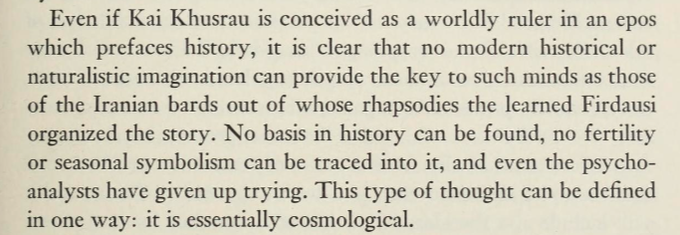
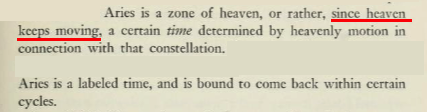
"Hamlet's mill; an essay on myth and the frame of time", 1969, Page 44.

These are the final words spoken by Kay Khosrow, a legendary king of Iran at the end of  Shahnameh, The Iranian Book of Kings:

This basically means "in Aries" (between Pisces and Taurus)...

The author of the Hamlet's mill then goes to say:

The author of the Hamlet's mill then goes on to say that Kay Khosrow is not an earthly king, but a heavenly king, and then he says:

I would like to disagree with the bit that "no fertility or seasonal symbolism can be traced into it". Actually we can, if we assume that originally zodiac was a collection of calendar markers derived from fixed, annual events...As I explained in my article "Zodiac"...

This removes the problem of "heaven keeps moving" and fixes Aries into Mar/Apr. 


The end of the lambing, and the beginning of the milking season...And the start of the transhumance ascend to the mountain pastures. Which happens every year at the same time...

I talked about this in my posts "April" and "Aries must die"...

Another thing that happens in Western Iran in Aries is this: The river discharges suddenly start to increase, as a result of spring rains and snowmelt.


Hence Ram depicted lying in water from the "Zodiac from Isfahan". I talked about it in my post "Sagittarius from Isfahan"...

Which is why, I think, on this late 6th or early 7th c. AD Sasanian silver bowl, we see a king (Kay Khosrow) sitting on a ram (Aries?) throne, feasting, surrounded by musicians and servants. 


Which is what I proposed in my post "Eyeballs platter"...Except when I wrote that post, I didn't now the identity of the King...

Sooooo....See Aries as constellation, and "no fertility or seasonal symbolism can be traced into it". See Aries as animal calendar marker and it all suddenly starts making sense...

That's it. To read more about ancient animal and plant calendar markers, start here…Then check my twitter threads I still didn't convert to blog post...I am way way behind...

Monday, 21 August 2023

Holy water

@another_barbara:

I've read that our ancestors believed that on the evening of January 18th and January 19th until noon water is sacred and has healing and protective powers. People sprinkled this holy water in their homes. Bathing in this water was a cleansing ritual.


There are many legends about healing or holy springs in Slovenija. One of them is spring “Gospodična” (Maiden, Young woman) on Gorjanci hills. The story tells that an ill old countess became healthy and young again after drinking this water and washing her hands and face with it. 

Why this specific date?

The Christian explanation was this: John the Baptist baptised Christ on the 27th day after winter solstice. But this is most likely just s substitute tale for an older ritual.

So...What could be that "older ritual"???

Check this out:

This is winter zodiac...I talked about it in my post "Trentar"...


In one of my favourite zodiac related legends, the Slovenian legend about Zlatorog, the Ibex goat with gold horns, it is the "hunter from Trenta valley" that hunts and fatally wounds the magic goat, from whose blood springs magic Triglav rose...Which dying magic goat eats and gets healed (magically)...

So hunter, pursues Ibex goat, shoots it, it bleeds, from it's blood grow flowers...What does this mean?

Well, what you are looking at is the winter zodiac: Sagittarius (end of autumn, start of winter), Capricorn (mid winter), Aquarius (end of winter, start of spring)...

Spring starts in Aquarius...Which represents the snowmelt...This is where frigid old hag, winter earth, turns into hot young maiden, spring earth...Who then gets her first "period"...Becomes fertile again...


BTW, the same transformation of winter into spring is contained in a Slovenia ritual calld "Bablji mlin", meaning "Granny's mill" scene. An old hag is being milled, and thus transformed, into a young maiden. Winter being transformed into Spring...I talked about this in my post "Babji mlin"...


The same story of rejuvenation, rebirth (of the mother earth) is preserved in the Scots Gaelic ritual song "The old woman of the mill-dust":

Will you give me your daughter old lady of the mill dust?
Will you give me your daughter 
I will be happy with her
I will dance with her

From Carmina Gadelica, 19th c. Gaelic Scotland

In Gaelic, the word Cailleach means both an old woman and the last sheaf of wheat and the corn dolly made from it. Corn dolly which represents Mother Earth, the life (grain) giving mother...

I talked about this in my post "The old woman of the mill-dust"...

Interestingly Cailleach, or Cailleach Beira, is the Scottish "Queen (Goddess) of Winter". She appears as a blue-skinned hag carrying a magical staff that freezes the ground and a hammer for shaping hills and valleys. At the end of her seasonal reign, she drinks from the Well of Youth to become young again...


Spring of youth being of course the snowmelt, which begins in February, in Aquarius (!!!) 🙂, which marks the beginning of spring...And the arrival of the "Bride" (Brigid), the spring earth maiden, snowmelt being her first "period"...

Effigy of St Brigid taken from house to house to collect money while saying these rhymes

"Here's St Bridget dressed in white,

Give us some money to honour her night,

She is deaf, and she is dumb,

And she can't talk without a tongue"


St Brigid, The Bride, Gaelic Mother Goddess turned Saint is associated with wells (running water)...

Slavic equivalent is the effigy of Marzana (winter) which is made and paraded around in Slavic countries at the same time. The effigy is then burned or drowned to symbolise the end of winter. This can give us the clue who Brigid originally was.


Also, The Witch of Winter, The Old Hag, has to be burned (and drowned) or spring will not come...Burning is heating up of the earth and drowning is the snowmelt...Burning and drowning of Marzana, Slavic name for Winter Earth...I talked about this in my posts "Gryla", "Living stone", "To kill a which", "Babele"

Oh and don't forget The Snow-White...From the article:

"What we have here is the story of Earth going through seasons: Spring, Summer, Autumn, Winter, Spring...

Beautiful young Spring Earth becomes bountiful Summer and Autumn Earth. Still beautiful, but in no way as beautiful as the Young Spring Earth...

Because of the cyclical nature of the solar year, Autumn Earth is the mother of Spring Earth of the next solar year. As Autumn ends, and the crab apples are the last fruit left on the trees, Autumn Earth turn into Old Hag Winter Earth, who "kills" her own younger self...

Dead Earth lies in her icy coffin until Young Spring Sun arrives. He sees beautiful Spring Earth under the ice, falls in love with her and revives her. Spring Earth, marries Spring Sun...

But seasons pass, Spring Earth turns into Summer Earth and then into Autumn Earth and then into Winter Earth...And the story repeats itself...Luckily, every spring, Young Sun arrives to save the day 🙂"

All these stories, beliefs and rituals basically describe the same thing: End of winter, beginning of spring...

Oh, including of course Christ's baptism ("in living", flowing water) and Mary's purification (first period after giving birth)...


@another_barbara
:

After @serbiaireland explained to me what a tale (I teach to kids for 15 years) really means, I had to add that the old countess was barren and she and her husband were sad because of that. After drinking/washing with sacred water she knew she will be able to have children now.


Saturday, 18 September 2021

Bull god from Dusheti

Standard from the Treasure of Kazbek, Dusheti, Georgia 600-400 BC, Kremlin Museum...

The artifact was made at the time when thunder gods in the region loved riding on bulls while wielding axes...


I talked about this in my post "Kataibates"...But why?

This is climate graph for the Dusheti region. You can see that the maximum thunderstorm activity and the maximum rainfall for the Dusheti region is in Taurus...

An axe wielding thunder god arriving on a bull (in Taurus) brings rain which brings fertility...

Oh, btw, this Taurus has nothing to do with stars. It is an ancient animal calendar marker which marks the beginning of the calving season of the wild Eurasian cattle, Aurochs, which used to start in Apr/May...I talked about this in my post "Ram and bull", "Thunder poppies", "Dairy farming seas", "Butt chewing", "Killing of the bull of heaven", "Sacred fig goddess", "Calydonian boar", "Palla fish", "Holly cow"...

This symbol always means "Apr/May", no matter what age it is and at what location it is found in Eurasia and North Africa...

Oh and why bells? May, Taurus, is the time when people in the Dusheti region drive their flocks and herds up to the highland pastures...

One last thing? Ever thought why are lambs sacrificed at the end of April, beginning of May? Cause Aries has to end so Taurus can begin...I talked about this in my post "Aries must die"...

To read more about ancient animal and plant calendar markers, start here…then check the rest of the blog posts related to animal calendar markers I still didn't add to this page, and finally check my twitter threads I still didn't convert to blog post...I am 9 months behind now...

Monday, 3 May 2021

Killing of the bull of heaven

Assyrian cylinder impression, MS 1989, Schøyen Collection, Norway, depicting Enkidu and Gilgamesh killing the Heavenly Bull...


The interesting bit is here: Epic of Gilgamesh, Table VI, 140-149.

Enkidu stalked and hunted down the Bull of Heaven.
He grasped it by the thick of its tail
and held onto it with both his hands,
while Gilgamesh, like an expert butcher,
boldly and surely approached the Bull of Heaven.
Between the nape, the horns, and... he thrust his sword.
After they had killed the Bull of Heaven,
they ripped out its heart and presented it to Shamash.
They withdrew bowing down humbly to Shamash.
 
This is actually very interesting. 

Bull is the ancient symbol of summer (May, Jun, Jul), the period which starts in Taurus...


I talked about this in my post "Symbols of the seasons"...

By the way, summer is symbolised by a bull, because both calving (begins in Apr/May) and mating (begins in Jul/Aug) of Wild Eurasian cattle takes place during the summer, May to August...I talked about this in my post "Ram and bull"...

Taurus (Apr/May), the period when wild Eurasian cattle start their calving season, was extremely important time of the year for the people of Ancient Mesopotamia. This is when the water levels of Tigris and Euphrates peaked...

Tigris


Euphrates

So to the people of the Ancient Mesopotamia, it sure looked like it was the sun, Shamash, who released Enki, the sweet water, at the beginning of summer, in Taurus...

I talked about this in my post "Shamash young and old"...

Which is why Shamash is depicted as a golden bull with long flowing "lapis lazuli" (water) beard...

And why, in "Enki and the world order" we read: "...Father Enki...he stood up full of lust like a rampant bull, lifted his penis, ejaculated and filled the Tigris with flowing water. He was like a wild cow mooing for its young in the wild grass..."

The moment of Enki's ejaculation, the moment of his climax, the moment of the peak water levels in the rivers he fills with his heavenly semen, is also the moment when "wild cows moo for their young in the wild grass"...In Taurus...

Taurus was also the beginning of the grain harvest in Mesopotamia...

Which is why Shamash/Utu is also depicted as a bull with a tail made of wheat...


Both the flood and the grain harvest end with the summer, in Jul/Aug. So killing of the bull symbolically represent end of summer symbolised by a bull...As well as the end of the harvest and the end of the period of water abundance. And the beginning of drought...

This killing of the bull is usually done by a lion...


This is a symbolic depiction of the end of summer, which begins in Taurus (Apr/May) and ends in Leo (Jul/Aug)

And, Leo is a solar year calendar marker which marks the beginning of the main mating season of the Eurasian lions. 

Leo is the hottest and driest part of the year in Mesopotamia. The time of maximum heat, maximum drought. 


The throne of Shamash, the sun god. When he is the most powerful...Here is Shamash standing "between the lions" (in Leo), in an empty irrigation canal, at the moment of maximum heat and drought, when he is most powerful...


But here the killing is done by Gilgamesh and Enkidu. On behalf of the Shamash in Leo...

So our two "heroes" kill the bull of heaven (season), rip its heart (water, grain???) and present it to Shamash...Summer, the season of the bull ends. Autumn, the season of the lion begins...

Oh and guess who is there too, "standing on a lion" (in Leo): Ishtar, who started the whole thing


Sirius starts rising with the sun (is a "morning star") in Leo...

Thursday, 1 April 2021

Zodiac killer

Elamite seal. Iran. From "The Elamite Cylinder Seal Corpus, c. 3500–1000 BC" by Karen Jane Gardon.

Soooo What's this all about?

Top row:

Autumn (symbolised by a lion) follows summer (symbolised by a bull)...This is the moment in time that this seal marks. This is why we have a lion chasing bull and  the cross in the upper panel...I talked about the symbols of the seasons in this post...

So what about the bottom row with two bulls facing each other? 

Based on the horn shape and no hump, these are bulls of the Eurasian wild cattle, aurochs...

Beginning of August, the end of summer, beginning of autumn, is also when Eurasian wild cattle, aurochs used to mate...During this time auroch bulls fought (faced) each other for females...I talked about the reproductive cycle of aurochs in my post "Ram and bull"....

By the way, this is also the time when Eurasian lions main mating season started too...I talked about this in my post "Musth"...

This is the hottest part of the year in the northern hemisphere, which is why this is the day of Helios...In the Balkans this is the day of St Elijah the Thunderer, the Thundering Sun...

Why Thundering Sun? I talked about the "weird" link between the sun and thunder god in my post about Croesus and Apollo, The thundering Sun...

The reason why we have Thundering Sun God is easy to see from this chart of thunderstorm frequency in Europe...

Interestingly, in Bosnia, on the day of Thundering Sun, the day that marks the end of summer beginning of autumn, the day when aurochs used to fight, people sacrifice bulls and hold bull fights...I talk about this in my post "Alidjun"

So it seems that both the upper and the lower panel of this seal point at the same moment in the Solar year...The moment when the lion (autumn) catches up with the bull (summer) and when bulls fight...

What does this have to do with Europe? Well the key for deciphering images like this one is found in, of all places, Balkan Slavic folklore, remnants of mythologies and religions of ancient people which mixed in the Balkans, and which are preserved to this day by Slavic peasants.

It was the parallels between the bull cult found in Serbia and the bull cult found in Ireland that made me think: "we are dealing with something ancient here"... and led me to deciphering of the first animal calendar marker: bull...

After that I started looking at other well known animal calendar markers, collectively known as Zodiac...And what I found was that they all mark mating or birthing seasons of animals in question...In Europe...I talked about this in the articles linked to this page about "Zodiac"....

After this I started looking at Ancient Eurasian and North African mythologies which were full of animal images...All the ones I touched so far, turn out to also be calendar markers derived from the behavior of animals in question...

It seems that mythologies were built around ancient agricultural calendar, which probably has the common root in the fertile crescent, 15,000-10,000 BC...And which used animal calendar markers to mark different parts of the solar year, important for early farmers...

This same symbolic system was then used throughout the ancient world as the agriculture spread...The mythologies developed around it are full of "monsters made up of different animal parts", "gods with animal heads or bodies", "masters of animals" and "mysterious animal images"...

Which no one understands any more...Well...Maybe we can now understand these crazy bits of our common heritage a bit better...

There is just one problem...

The problem is that "there is nothing mysterious or holy or enlightening or mind blowing" at the bottom of the rabbit hole...

There is no all powerful wizard behind the curtain holding a magic wand looking up at the stars and constellations...Just a sweaty peasant holding a plough and looking up at the sky wandering if the Sky God will be cruel or merciful this year...

Not something you can make a career of "speculating what mystery lies behind"...

I was already told by some people that "when they see that my article is about calendar they just skip it"...

Because it's boring...

The best comment I got so far was that I was a "Zodiac killer"...Cause I killed the mystery that zodiac held for so many people and turned it into an agricultural calendar...

To read more about ancient animal and plant calendar markers, start here…then check the rest of the blog posts related to animal calendar markers I still didn't add to this page, and finally check my twitter threads I still didn't convert to blog post...I am 9 months behind now...

Wednesday, 22 July 2020

Nakovana

This is the abandoned Nakovana village located near the tip of the Pelješac Peninsula in Southern Dalmatia, Croatia...


The name Nakovana is related to the Slavic word "nakovanj", meaning "anvil", most likely because of the shape of this nearby hill. It is known today locally as Grad (City), because of the ruins of a huge Illyrian fortress which once stood on its top...


The fortress was destroyed during the Octavian's Illyrian campaign which lasted 8 years, from 35 to 27 BC, and encompassed almost the entire eastern Adriatic and much of its hinterland...

During the first year of operations, the Roman army massacred the native populations of the islands of Korčula and Mljet. Historical sources do not say whether the Illyrians on the Pelješac peninsula met the same faith...

But the archaeological survey of the region found virtually no traces of occupation during the Early Imperial or Late Roman periods. This is an unusual situation in Dalmatia, where those periods often account for the bulk of archaeological remains...

Most likely, the conquering Romans could not tolerate a native stronghold at such a key strategic position and they most likely destroyed it and turned the surrounding area into a wasteland. The local population was either exterminated or expelled...

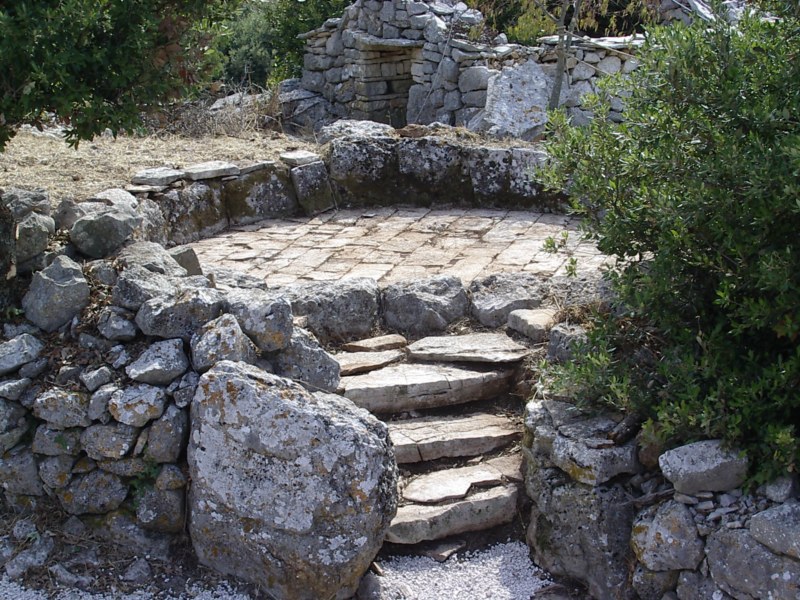
How important Nakovana fort was during the Illyrian times can be seen from the fact that over 50 stone tumuli (cairns) are strewn over the fields surrounding the fort. Like the one on this picture shown with the Grad fortress in the background...


These are burials of important people, most likely the aristocracy of the era and the time - the people who built and lived in the Grad fortress. None of the tumuli have been excavated so far...

You have probably never heard of Nakovana before...Unless you are an archaeologist with an interest in Dalmatian prehistory...But you should have. And the fact that Nakovana is not famous world wide beggars belief...

The reason why Nakovana should be famous is not because of its Illyrian fortress and its tumuli...It is because of this cave that lies near the fortress. 


It is the same cave I talked about in my article about the Neolithic maritime trade...


The reason why Nakovana should be famous is not (just) because the lithics found in the cave's front chamber are the proof of the maritime trade network which existed for thousands of years in the South of the Adriatic Sea...

The reason why Nakovana should be famous was discovered in the cave's second chamber which was deliberately sealed, probably immediately before or after the Illyrian fortress Grad was destroyed by the Romans...


This is how the archaeologists who discovered this hidden chamber described the event:


And what they discovered in the hidden chamber is this: A large gleaming white stalagmite in a shape of a phallus...


The stalagmite sits on top of a series of superimposed prehistoric layers, the earliest being from Early Copper Age and dated to the mid-fourth millennium BC. A direct radiocarbon date on the base of the stalagmite suggests that it began to grow about 3600 years ago...


The floor of the chamber was strewn with broken high quality pottery, mostly drinking cups, mostly imported and mostly Greek, broken and deposited there as sacrifice...


The fact that the pottery was Greek made, doesn't mean that Greeks deposited there. Some of the cairns surrounding the Grad fortress, were looted in the past. What remains in and around them shows that the character of the funerary rite is unquestionably Illyrian...

The people were buried with locally made Iron Age jewellery, handmade pottery, and fairly often, fragments of fine Hellenistic ceramic vessels, identical to those from the cave...

Illyrians were famous maritime traders and pirates and they pretty much controlled the southern Adriatic for hundreds of years...

And the Nakovana Grad fortress controlled one of the most strategically important points, the entrance into the Neretva river which was the entrance into the Balkan hinterland...


Which is the reason why the Romans eventually wiped them out...

By the way, were Illyrians the descendants of the people who controlled the Southern Adriatic since Neolithic??? Just putting this out there for people to think about it...

The broken pottery was deposited around the stalagmite, showing that it was the centre of the cultic activities in the cave. The earliest pottery shards deposited next to the stalagmite date to the 4th century BC, around the time of the Alexander the Great...

Now this is very very interesting...

If I didn't tell you where this cave was, you would be forgiven to think that this was a Siva lingam cave temple located somewhere in India...

I wonder if this Illyrian sanctuary predates or postdates Alexander's Indian campaign and who was celebrated in a shape of a lingam in this cave???

The archaeologists who excavated the cave say Silvanus, Pan...

Hmm...Possibly...

Believe or not, as impressive as this phallus looks like :)  this is not the most amazing thing found in the hidden chamber of the Nakovana cave...The most amazing thing was found among the rubble deposited around it...

Among hundreds of pottery shards, archaeologists have also found several pieces of ivory with engraved astrological signs, which once formed part of an astrologer's horoscope board...The oldest so far found horoscope in the world...


I am here talking about Greek horoscopic astrology, which is believed to have been invented in late Ptolemaic Egypt, in the 2nd or early 1st c. BC...

Now we know that the Nakovana cave was sealed around 35BC. So the horoscope board deposited next to the stalagmite must have been made before that. Radiocarbon dating actually points to much earlier date...

The age obtained by the accelerator mass spectrometry is 2217±21 B.P. The calibrated range of two standard deviations is the period between 375 and 204 BC, with an asymmetrical probability distribution leaning towards the 3rd c. BC...

In plain English, the animal from which the ivory was obtained was killed in the 3rd century BC...

Archaeologists who discovered this amazing artefact say: "It is believed horoscope was invented in Egypt, late 2nd, early 1st c. BC. Therefore, the Nakovana zodiac could not have been made before the 2nd c. BC (probably not much before 100 BC), meaning that the ivory used to make it was at least hundred years old"...

Now I don't know for how long a piece of ivory is usually left lying around before it is cut and carved into sellable objects, but I don't think it was left to "age" for over 100 years...

Why playing it down? "It is believed (!!!) that horoscope was invented in Egypt in late 2nd, early 1st c. BC"...What if it wasn't? What if it was invented somewhere else? Earlier? And brought to Egypt from there?


I have been writing about zodiac for a while...One of the things that I have discovered is that zodiac signs, as they are positioned in this "Ptolemaic Greek zodiac" mark the annual lifecycle events of the depicted animals in Europe. You can read about this in this series of articles about Zodiac signs (work in progress)...

As if someone observed the significant annual behavior (mating and birthing) of the animals in Europe, and derived the zodiac signs from that behavior: Pisces - mating season of Europan salmon, Cancer - mating season of Atlantic crabs and European crayfish, Taurus - calving season of European Aurochs...

By the way, I am here talking about the horoscope zodiac circle the way we know it today. Not animal solar calendar markers found in many cultures in Eurasia and North Africa over last 10,000 years. I wrote about those extensively too. You can read about this in this series of articles about Solar calendar markers (work in progress)...

Do you see now why I think that it is completely unbelievable that Nakovana is not a famous archaeological site? 

Sources

Text and images: