Showing posts with label Symbols of the seasons. Show all posts

Sunday, 12 November 2023

Tuna boats

This is the amazing fortified Bronze Age settlement of Kastri, located on the Greek island of Syros and dated to the Early Cycladic II period (Keros-Syros culture, 2600–2300 BC)... 

Near this settlement, archaeologists have discovered a cemetery, with more than 700 graves excavated to date. The graves are of the subterranean corbelled type, which is exclusive to Syros...

This is the grave XI with some of the grave goods found in it...You can read more about it in "Figurines in context at the Chalandriani cemetery on Syros".

For this article, the most interesting thing found in this grave is the so called "frying pan"...

Curious objects, which do resemble frying pans, but no one really knows what they are or what they were used for... 


Here is what these objects look like from both sides...

One proposal is that they were used as liquid mirrors. You fill the vessel with a liquid and...Pics of the reflection in four liquid mirrors with: (a) water, (b) olive oil, (c) ‘black’ water (d) ‘black’ olive oil...

You can read more about it in "The ‘frying pans’ of the Early Bronze Age Aegean: an experimental approach to their possible use as liquid mirrors"...

Another proposal is that these were vessels used for salt extraction through natural solar evaporation...Structures, which until recently were used for solar brine evaporation in Greece...

You can read more about it in "Neolithic flat-based pots from the Carnac Mounds in the light of Cycladic ‘frying pans’". Those interested in ancient salt extraction techniques might like this post "Fulacht fiadh salt extraction facility"...

Now quite a lot of these Cycladic frying pens have depictions of boats as part of the decoration...Like this one...A boat depicted among the swirling spirals representing waves, or moving, running water...And right above the bow of the boat there is always a depiction of a fish...Which would suggest that Cycladic boatsmen were fishermen...

Here are some examples of the the boat-fish designs from the Cycladic frying pans...

The fish depicted has a very big dorsal and tail fins...To me the look the most like tunas...

Which would suggest that Cycladic boatsmen were not just fishermen, but tuna fishermen...

Now in my post about the "Tuna coin from Akanthos" I talked about different native types of tuna fish that live in Mediterranean, their mating seasons and their fishing season...

Basically, the tuna fishing season in Mediterranean, including Cycladic islands is from Apr to Nov...With the peak in Jul/Aug...Basically when summer (which starts in Taurus) ends (gets killed) by autumn (which starts in Leo)...


Ram, marks lambing of Eurasian wild sheep

Bull, marks calving of Eurasian wild cattle

Lion, marks mating of Eurasian lions

Goat, marks mating of Eurasian wild goats

You can read more about it in my post "Symbols of the seasons"...

This time when lion kills bull (Jul/Aug) is also "the best time to go to the sea" according to Hesiod... 

I talked about this in my post "Tetradrachm from Byblos"...

So after this lengthy intro 🙂 let me get to the interesting bit: This is a silver belt found in one of the Cycladic graves on Syros. This is an amazing object...Which no one knows how to interpret...

I would propose that this is a calendar...No surprises there, if you have been following me for a while🙂 

But why calendar? 

And calendar depicting what?

The answer to the second question, "calendar depicting what?" is "calendar depicting tuna fishing season"...

The answer to the first question "why calendar?" is "because birds and dogs are well known animal calendar markers which when depicted the way they are depicted on the diadem, mark the beginning the end and the peak of the tuna fishing season in the Cyclades area"...

Let me explain what I mean: The Cyclades are on the major bird migration route between Europe and Africa. 

The spring migration from Africa to Europe suddenly peaks in Apr/May...

Sudden appearance of millions of migrating birds above the Cycladic islands coincides with the onset of the sailing (and tuna fishing) season in the Eastern Mediterranean...

Birds announcing the time to go to the sea...Interesting...I talked about the sailing season in the Eastern Mediterranean and how birds were used as animal calendar markers for the beginning of the sailing season in my post "Three sacrifices" made for "good winds" by the Greeks at the beginning and the end of the Trojan war...

The birds migrate from Europe to Africa between Sep and Oct...

When the last migrating flock disappears in the southern skies, it is time to pull the boats on the beach, as this marks the end of the seafaring (and tuna fishing) season in Eastern Mediterranean...

So that could explain the birds depicted on the Cycladic silver belt...What about the dogs?

Remember this? 

When our mythologies were made out of animal calendar markers, Sirius, the Dog Star rose with the sun in Jul/Aug, when mating season of the old primitive dog breeds began...


I talked about this in my posts "Dog days" Egypt, "TishtryaMesopotamia, "The bitch of the godsIndia...

The middle point between the beginning of the spring bird migration and the end of the autumn bird migration...

And "the best time to go to the sea in Cyclades in search of tuna"...

Apr/May - Jul/Aug - Oct/Nov

Oh, and these "discs" between the animal calendar markers are suns...Apr/May - Jul/Aug - Oct/Nov is the sunny, hot, dry half of the year in Syros...

So to recapitulate, I believe that this belt is a kind of calendar, which using animal calendar markers depicts the sunny, dry half of the year, which is also the time when you can go to the sea in search of tuna fish...
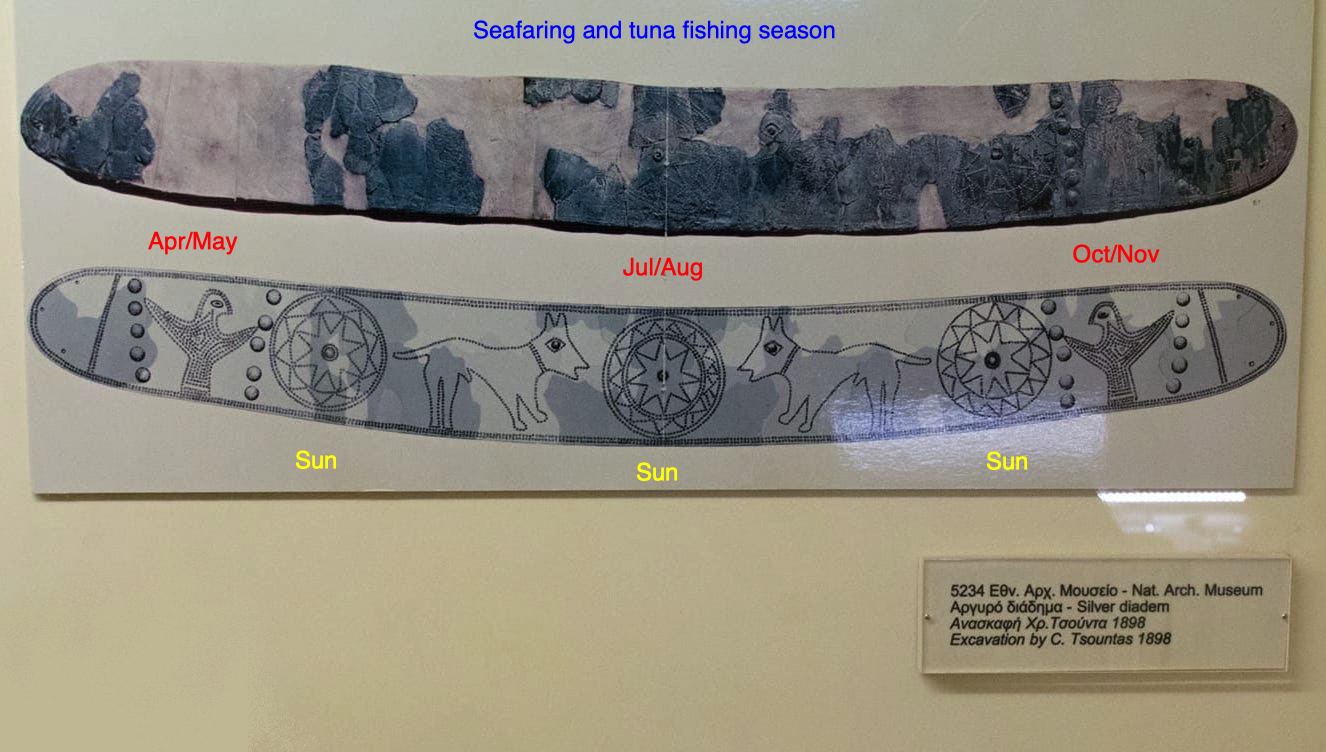
I could be wrong, but I can't see any other reason why someone would depict birds, suns and dogs on such a precious object...And I refuse to accept that the choice of the depicted symbols was random...

To read more about ancient animal and plant calendar markers, start here…then check the rest of the blog posts related to animal calendar markers I still didn't add to this page, and finally check my twitter threads I still didn't convert to blog post...I am 9 months behind now...

Friday, 10 November 2023

Tetradrachm from Byblos

Silver Tetradrachm from Byblos, Phonecia, apparently, minted during the reign of Adramelek, 315 BC-...and currently in the British Museum...

A hippocampus swims below a Phonecian galley with 3 hoplites aboard...Why?

On the reverse, a lion attacks a bull...Why?

Well, the sailing season in the Eastern Mediterranean starts when wild horses start to mate, in Apr/May...And lasts until the end of the horse's mating season, Sep/Oct...This is why horse was the symbol of Eastern Mediterranean sea gods...They are basically an animal calendar marker for the sailing season...

I talked about this in my posts "Trojan horse" and "Three sacrifices"...

Some people will say that the horses associated with Eastern Mediterranean sea gods are actually seahorses.... 

Believe or not sea horses have the same mating season in Mediterranean...Making them the equivalent animal calendar marker for the sailing season to terrestrial horses...

I talked about this in my post "Seahorse ring"...

As for the lion killing bull, according to Hesiod

"Fifty days after the solstice, 

when the season of wearisome heat is come to an end, 

is the right (best) time for men to go sailing". 

These are most common symbols of the seasons:

Ram (marks lambing of Eurasian wild sheep) - spring

Bull (marks calving of Eurasian wild cattle) - summer

Lion (marks mating of Eurasian lions) - autumn

Goat (marks mating of Eurasian wild goats) - winter

And on the coin, we see lion killing bull from behind...

Summer, which starts in Taurus (Apr/May) is followed by autumn, which starts in Leo (Jul/Aug)...

I talked about this in my posts "Mystery seal", "Cypriot stamp seal with cow and calf", "Angra mainyu" and many others...

So...I hope the scenes depicted on Adramelek's coin make a bit more sense now...

To read more about ancient animal and plant calendar markers, start here…then check the rest of the blog posts related to animal calendar markers I still didn't add to this page, and finally check my twitter threads I still didn't convert to blog post...I am 9 months behind now... 

Sunday, 8 May 2022

Suovetaurilia

On this picture you see "badnjak", Serbian Yule log, a young oak sapling which was ritually cut on Christmas Eve and "pečenica", Serbian Yule roast, a pig on a spit, which was ritually slaughtered and roasted on Christmas Eve...

I talked about Serbian Yule log and the rituals surrounding its cutting, bringing into the house and burning in the heath in my posts "Badnjak" and "First footer"

And I talked about the Serbian Christmas roast in my post "Sacrificial animals", which is about the sacrificial animals (boar, ram, bull) in Serbian tradition and their Indo-European root... 

Serbs were not the only people who had this triple animal sacrifice:

Lusitanians sacrificed a sheep, a pig and a bull to some local gods. Indians sacrificed a ram, a bull and a goat to Indra. Iranians sacrificed sheep, cattle and stallions to Anahita.

Greeks sacrificed ram, bull, and boar to Poseidon. And the Umbrians ram, bull, and boar to their main Grabovian Triad of gods...And Romans sacrificed boar, ram and bull to Mars...

We can see that this "triple" animal sacrifice was quite widespread...

But I don't think it was well understood...Even by me 🙂 at the time when I wrote my article about the Serbian sacrificial animals...

In that post I mentioned that the order in which animals are sacrificed in Serbian tradition was identical to the order of animals in suovetaurilia, one of the most sacred and traditional rites of Roman religion: the sacrifice of a pig (sus), a sheep (ovis) and a bull (taurus)...

This ceremony was performed "to purify and protect the land". The first step was to lead the three animals, in precise order, boar, ram, bull, around the boundaries of the land, and then sacrifice them to the god...

During public, state sacrifices, which could be held at any time of the year, the animals were dedicated to the god Mars...But during private, family sacrifices, which were held in May, the animals were dedicated to the Goddess Ceres...Goddess of grain harvest...

The significance of this completely escaped me at the time when I wrote my original post, cause at that time I was only beginning to discover animal calendar markers and still didn't understand their significance and their link with grain agricultural calendar...

I did notice the strange correlation between the order in which animal were sacrificed by the Romans (boar, ram, bull) and the order of months in which the same animals were sacrificed by the Serbs:

Boar - Dec

Ram - Apr

Bull - August

I also noticed that if you replace Serbian and Roman sacrificial animals (boar, ram, bull) with Indian sacrificial animals (goat, ram, bull), and if you place them on the zodiac circle you get this...

I thought this was interesting, not known how interesting...

Cause, for instance, at that time I didn't know that there was such a thing as animal symbols for seasons...

Goat - winter, followed by Ram - spring, followed by Bull - summer

I also didn't know that these animal calendar markers were derived from the mating and birthing seasons of depicted animals.

Goat - Oct/Nov - mating season of wild goats

Ram - Mar/Apr - lambing season of wild sheep

Bull - Apr/May - calving season of wild cattle

My main problem was with the fact that our European Zodiac uses animal calendar markers derived from the behaviour of animals in Europe...I talked about this in the articles lined to this page about Zodiac...

In Europe, Alpine ibex goats mate later than everywhere else...Hence Goat in the middle of winter...Not beginning...

So when I was looking at goat as the sacrificial animal, I made the same mistake interpreting this animal symbol, which lead me to misinterpret the meaning of Chimera

This is wrong...

I corrected my interpretation of Chimera in my post about Pegasus and Chimera...

The correct interpretation of Chimera is that it is a complex animal calendar marker for the hot, dry half of the year in Eastern Mediterranean, Levant and Mesopotamia...

Knowing what I know now, I would like in this post to correct my interpretation of the triple animal sacrifice...

First, goat and boar are mutually interchangeable as animal calendar markers. Both point to Oct/Nov, beginning of the mating season of wild goats and wild pigs...


Second, ram is an animal calendar marker for Mar/Apr, which is when the Eurasian wild sheep lambing season took place...


Third, bull and horse are mutually interchangeable as animal calendar markers. Both point to Apr/May, beginning of the mating season of wild horses and beginning of calving season of wild cattle...


Third Boar-Ram-Bull as animal calendar markers mark the period between Oct/Nov and Apr/May...

Very important period in grain agricultural calendar:

Oct/Nov - beginning of the grain planting season

Apr/May - beginning of the grain harvest season

Which becomes very important for understanding of this sacrifice when we realise that Roman peasants performed Suovetaurilia dedicated it to Ceres, Goddess of grain harvest in May, at the beginning of the grain harvest...

The meaning of Suovetaurilia then becomes: We will harvest when boar (Oct/Nov), ram (Mar/Apr) and bull (Apr/May) have passed (remember they are taken around the fields in that order)...

That's it...Most people think that Roman mythology is just recycled dumbed down Greek mythology...But actually, Roman peasants have preserved in their village rituals some very very ancient stuff indeed...

To read more about ancient animal and plant calendar markers, start here…then check the rest of the blog posts related to animal calendar markers I still didn't add to this page, and finally check my twitter threads I still didn't convert to blog post...I am 9 months behind now...

That's it...I hope you enjoyed this...Have a nice evening...