Showing posts with label Domhnach Crom Dubh. Show all posts

Sunday, 23 January 2022

Market Cross at Kells

This Sunday started quite well...

Archaeologist Neil Jackman @JackmanNeil posted this very interesting picture on his twitter account:
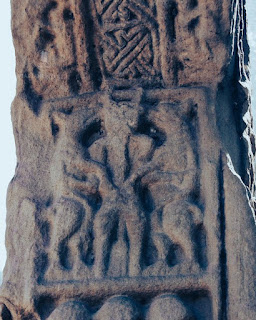

With these comments:

An unusual, and a little unsettling, depiction on the c.9/10th century Market Cross at Kells, County Meath.

It features a human-like bearded figure with horns, flanked by two beasts (wolves or lions?) on their hind legs. Could it be a rare depiction of the devil?

Early Irish high crosses usually (though not exclusively) depict religious scenes, along with the beautiful ornamentation.

Dr Francis Young @DrFrancisYoung, Historian of religion & beliefs then commented that:

The iconography of Satan hadn't yet settled down by that point; I don't think there are c9th representations of Satan with horns. If I had to guess, I'd say this is a Classical reference and the figure is most likely Pan/Faunus, representing wild untamed nature. As a rule of thumb, if in doubt about early medieval iconography, it's usually a garbled Classical reference...

Eeee wasn't there some fella called Crom Dubh, whom pretty much all early Irish saints defeated at some point or another, who was linked to bulls, and who could even turn to a bull himself? Particularly a speckled one...
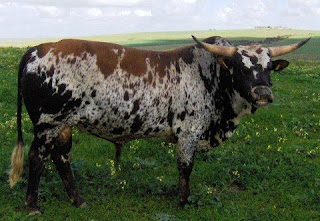
The horns on the "devil" from the Market Cross at Kells look very much like bull horns to me...

I talked about Crom Dubh bull folklore in my post "Bull of Crom Dubh"...

Crom Dubh apparently lived all over Ireland...Including Dun Briste. 
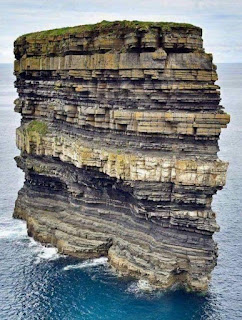
And guess what: "Crom Dubh (also) had two hounds of dogs...and if ever there were [wicked] mastiffs these two dogs were they..." 

I talked about this legend in my post "Dun Briste"...

So here we have a "bull god flanked by two hounds"...Is this enough to identify this image as a depiction of Crom Dubh? Of course not. But it is a possibility that we can't ignore...Especially because this would be the only known depiction of Crom Dubh ever found that matches the folklore depictions of this old Irish god...

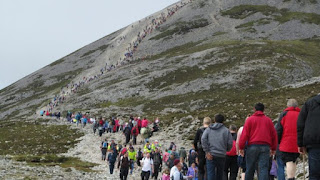
Croagh Patrick, the Irish "Holy mountain". 
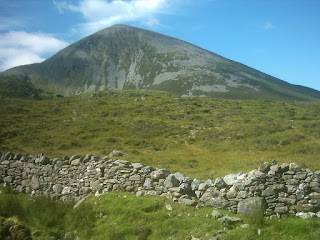

Once "the holy mountain of Crom Dubh" the old Irish Sun/Sky god and god of agriculture, it became "the holy mountain of St Patrick", after he "defeated" Crom Dubh... The day of the annual pilgrimage to the top of the mountain is still known locally as "Domhnach Crom Dubh" which means "Crom Dubh's Sunday"... 


Sunday, 5 November 2017

Sun mountain

This is Croagh Patrick, the holy mountain of Ireland. This 764 metres mountain is located in County Mayo, 8 kilometres from Westport, above the villages of Murrisk and Lecanvey.


This great pic of the Reek taken from http://thereek.com/tag/pilgrimage/
There is a pilgrimage route running from Ballintober Abbey to the summit of Croagh Patrick.


Originally it was the processional road that went from Rathcroghan (Irish: Ráth Cruachan), the seat of the Kings and Queens of Connacht, to Cruachan Aille, as Croagh Patrick was called in Pre-Christian times. Cruachan Aille was at that time the holy mountain of Crom Dubh, old Irish Solar and Agricultural deity. I wrote about Crom Dubh in the article "How old is Crom Dubh" and in many other posts.

After St Patrick defeated Crom Dubh and Christianized his holy mountain Cruachan Aille, the mountain was renamed to Croagh Patrick, Patrick's mountain. The old pre-Christian ceremonial road leading to the holy mountain became Christian pilgrimage route and over time it became known as Tóchar Phádraig or St Patrick’s Causeway. But interestingly, even today, the time of the year when Christian pilgrims walk the Tóchar Phádraig and climb Croagh Patrick, the last Sunday in July, is still called "Domhnach Crom Dubh" which means "Crom Dubh's Sunday"...

The Tóchar Phádraig is dotted with holy places such as holy stones, holy wells, chapels and churches. 

The most unusual, and the most important holy place found along Tóchar Phádraig is the so called Boheh Stone, an outcrop of bedrock from which there is a full view of Croagh Patrick.


The stone is covered in cup and ring marks, and is the only known example in Connaught, and one of the finest examples of neolithic rock art in Ireland and Britain. Official archaeology believes that the stone had been carved as early as 3800 BC. 

Official archaeology "does not know the meaning of the markings found on this stone"...

What is very interesting is that on two days in the year, the 18th of April and the 24th of August, the setting sun, when viewed from this spot, touches the summit of the Mountain, then proceeds to 'roll' down the northern slope. The angle of the Mountain's side matches the declination (setting angle) of the sun at this time and place.

This "rolling sun" phenomenon was rediscovered in 1989–92 by Gerry Bracken.

The extraordinary phenomenon of the rolling sun down the slope of Croagh Patrick was perfectly captured in this animated gif made from still images by one of my favorite Irish photographers, Ken Williams.


You can see a very good video of the event here on YouTube.

Interestingly, the dates on which the rolling sun phenomenon can be observed from the Boheh stone, together with the winter solstice divide the year into three equal parts.

Now remember my post "Rebirth"? In it I talked about the megalithic "tomb", known as the Giant’s Grave, which is situated in the valley of Loch an Dúin on the eastern side of the Conor Pass. Now this "tomb" has a cup and ring mark carved into the large stone near the head of the "tomb". And this cup and ring mark is illuminated twice a year, on the days of spring and autumn equinoxes...I suggested that the cup and ring mark represents the solar year, sun and it's endless cycle of life death and rebirth. 

Now that is interesting. Because there are hundreds of these cup and ring marks carved into the stone which served as a solar observatory from which the amazing rolling sun phenomenon was observed, twice a year...

Is it possible that the cup and ring marks found on the Boheh stone also represent solar year, sun and it's endless cycle of life death and rebirth? But why so many cup and ring marks were carved into the Boheh stone? Well one possible reason is that the Boheh stone was an important Irish wide solar cult ceremonial site, where people from many clans, tribes gathered to worship the sun god. And maybe each one of these cup and ring marks was carved by a different clan or a tribe...Or maybe each one of the cup and ring marks represents one year of pilgrimage. 

The existence of Boheh stone is a proof that Cruachan Aille was venerated as a holy mountain millenniums before St Patrick walked the old pre-Christian ceremonial route, climbed the old holy mountain of Crom Dubh on Crom Dubh Sunday and claimed it all for the Christian faith. As the old Crom Dubh pilgrimage route was renamed to St Patrick’s Causeway, and as Crom Dubh's mountain was renamed to St Patrick's mountain, the Boheh stone was also renamed to St Patrick’s Chair.

In my post "Fasting against god" I talked about how "The life of Patrick" talks about how Patrick climbed the holy mountain of Crom Dubh on the Crom Dubh Sunday, fasted there for 40 days and 40 nights and made God give him the rule over Ireland and the Irish. And I asked which god did Patrick win Ireland and the Irish from for himself?

So what do you think about all this?

Sunday, 30 July 2017

Reek Sunday


This is Croagh Patrick, Ireland's holiest mountain. The mountain is known locally as "Reek". The word "reek" comes from  Proto-Germanic "*hraukaz" which means "sheaf, stack of corn, pile of grain, mountain". 

Today is Reek Sunday. Reek Sunday is the name for the last Sunday in July. The reason why the last Sunday in July is called "Reek Sunday" is because on this day, every year, pilgrims climb Reek (Croagh Patrick). 

Interestingly, around the Reek (Irish: Cruach which also means sheaf, stack of corn, pile of grain, mountain), people call Reek Sunday "Domhnach Crom Dubh" which means "Crom Dubh's Sunday". Crom Dubh was the old Irish Solar and Agricultural deity which was "defeated" by St Patrick. And even more interestingly, it is believed that Crom Dubh could have been another name for yet another old Irish deity: Crom Cruach...

I wrote about Crom Dubh in the article "How old is Crom Dubh" and in many other posts.

Now "Croagh Patrick" comes from the Irish "Cruach Phádraig" meaning "Patrick's stack (of corn), Patrick's mountain". 

I wander if Crom Cruach was not another name for Crom Dubh, but if instead it was the old Irish name for the holy mountain dedicated to Crom Dubh. In which case Crom Cruach would mean "Crom's stack (of corn), Crom's mountain", "Crom Dubh's stack (of corn), Crom Dubh's mountain". 

This would explain why, after Patrick defeated Crom Dubh, Crom's Stack, Crom's Mountain (Crom Cruach) was renamed into Cruach Phádraig...

Before you say: "If Crom Cruach really meant Crom's Stack, Crom's Mountain, it would have had to be written Cruach Crom, because the Irish grammar says that when making compound words, you should always put adjectives after nouns", you should know this: 

There are lots of place names in Ireland that do not confirm to this rule. Place names such as Dubh Linn ("black pool" = Dublin) and Leixlip ("salmon leap") for instance. These place names were attributed to the Norse settlers who learned Irish had trouble with putting adjectives after nouns, so they often put them before the noun. This is exactly what happens when you force the new language on subjected population. They pick up the words but keep their own grammar. But this "incorrect" use of Irish grammar is present in all old Irish texts, which shows that it predates the Norse arrival to Ireland. For instance Táin Bó Cúailnge, is filled with epithets like finnbennach "white-horned", dóeltenga "beetle-tongued", echbél "horse-lipped", rúadruca "red-blushing", and the like. 

Funnily enough most toponymes and hydronymes of Celtic origin in central Europe follow this "incorrect grammar" and have adjective before the noun.

Here is an example:

Gaelic word for “big” is Mór. (Pronounced as the English word more)
Gaelic word for “river” is Abhainn . (Pronounced “awon” similar to the English word award). Proto celtic word is awa. 

In central Europe there are numerous rivers called Morava.

Morava = mor + ava = Mór Abhainn = Mor Awa= big river 

Morava is the biggest river in Serbia and also in Czech republic, territories which were considered Celtic heartland. These rivers gave the name to the territory upper and lower Moravia. 

In Ireland there is a river named the Avonmore River (Irish: Abhainn Mhor, meaning "big river") which is the same as Mor Ava just using Gaelic grammar.

So it is quite possible that Crom Cruach really meant "Crom's Stack (of corn), Crom's Mountan".

What do you think?