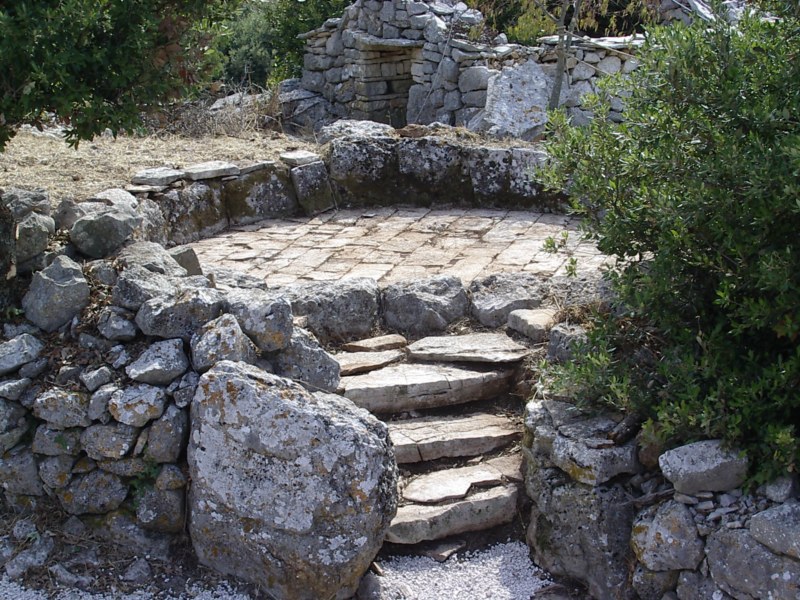
This is the abandoned Nakovana village located near the tip of the Pelješac Peninsula in Southern Dalmatia, Croatia...
The name Nakovana is related to the Slavic word "nakovanj", meaning "anvil", most likely because of the shape of this nearby hill. It is known today locally as Grad (City), because of the ruins of a huge Illyrian fortress which once stood on its top...
The fortress was destroyed during the Octavian's Illyrian campaign which lasted 8 years, from 35 to 27 BC, and encompassed almost the entire eastern Adriatic and much of its hinterland...
During the first year of operations, the Roman army massacred the native populations of the islands of Korčula and Mljet. Historical sources do not say whether the Illyrians on the Pelješac peninsula met the same faith...
But the archaeological survey of the region found virtually no traces of occupation during the Early Imperial or Late Roman periods. This is an unusual situation in Dalmatia, where those periods often account for the bulk of archaeological remains...
Most likely, the conquering Romans could not tolerate a native stronghold at such a key strategic position and they most likely destroyed it and turned the surrounding area into a wasteland. The local population was either exterminated or expelled...
How important Nakovana fort was during the Illyrian times can be seen from the fact that over 50 stone tumuli (cairns) are strewn over the fields surrounding the fort. Like the one on this picture shown with the Grad fortress in the background...
These are burials of important people, most likely the aristocracy of the era and the time - the people who built and lived in the Grad fortress. None of the tumuli have been excavated so far...
You have probably never heard of Nakovana before...Unless you are an archaeologist with an interest in Dalmatian prehistory...But you should have. And the fact that Nakovana is not famous world wide beggars belief...
The reason why Nakovana should be famous is not because of its Illyrian fortress and its tumuli...It is because of this cave that lies near the fortress.
The reason why Nakovana should be famous is not (just) because the lithics found in the cave's front chamber are the proof of the maritime trade network which existed for thousands of years in the South of the Adriatic Sea...
The reason why Nakovana should be famous was discovered in the cave's second chamber which was deliberately sealed, probably immediately before or after the Illyrian fortress Grad was destroyed by the Romans...
This is how the archaeologists who discovered this hidden chamber described the event:
And what they discovered in the hidden chamber is this: A large gleaming white stalagmite in a shape of a phallus...
The stalagmite sits on top of a series of superimposed prehistoric layers, the earliest being from Early Copper Age and dated to the mid-fourth millennium BC. A direct radiocarbon date on the base of the stalagmite suggests that it began to grow about 3600 years ago...
The floor of the chamber was strewn with broken high quality pottery, mostly drinking cups, mostly imported and mostly Greek, broken and deposited there as sacrifice...
The fact that the pottery was Greek made, doesn't mean that Greeks deposited there. Some of the cairns surrounding the Grad fortress, were looted in the past. What remains in and around them shows that the character of the funerary rite is unquestionably Illyrian...
The people were buried with locally made Iron Age jewellery, handmade pottery, and fairly often, fragments of fine Hellenistic ceramic vessels, identical to those from the cave...
Illyrians were famous maritime traders and pirates and they pretty much controlled the southern Adriatic for hundreds of years...
And the Nakovana Grad fortress controlled one of the most strategically important points, the entrance into the Neretva river which was the entrance into the Balkan hinterland...
Which is the reason why the Romans eventually wiped them out...
By the way, were Illyrians the descendants of the people who controlled the Southern Adriatic since Neolithic??? Just putting this out there for people to think about it...
The broken pottery was deposited around the stalagmite, showing that it was the centre of the cultic activities in the cave. The earliest pottery shards deposited next to the stalagmite date to the 4th century BC, around the time of the Alexander the Great...
Now this is very very interesting...
If I didn't tell you where this cave was, you would be forgiven to think that this was a Siva lingam cave temple located somewhere in India...
I wonder if this Illyrian sanctuary predates or postdates Alexander's Indian campaign and who was celebrated in a shape of a lingam in this cave???
The archaeologists who excavated the cave say Silvanus, Pan...
Hmm...Possibly...
Believe or not, as impressive as this phallus looks like :) this is not the most amazing thing found in the hidden chamber of the Nakovana cave...The most amazing thing was found among the rubble deposited around it...
Among hundreds of pottery shards, archaeologists have also found several pieces of ivory with engraved astrological signs, which once formed part of an astrologer's horoscope board...The oldest so far found horoscope in the world...
I am here talking about Greek horoscopic astrology, which is believed to have been invented in late Ptolemaic Egypt, in the 2nd or early 1st c. BC...
Now we know that the Nakovana cave was sealed around 35BC. So the horoscope board deposited next to the stalagmite must have been made before that. Radiocarbon dating actually points to much earlier date...
The age obtained by the accelerator mass spectrometry is 2217±21 B.P. The calibrated range of two standard deviations is the period between 375 and 204 BC, with an asymmetrical probability distribution leaning towards the 3rd c. BC...
In plain English, the animal from which the ivory was obtained was killed in the 3rd century BC...
Archaeologists who discovered this amazing artefact say: "It is believed horoscope was invented in Egypt, late 2nd, early 1st c. BC. Therefore, the Nakovana zodiac could not have been made before the 2nd c. BC (probably not much before 100 BC), meaning that the ivory used to make it was at least hundred years old"...
Now I don't know for how long a piece of ivory is usually left lying around before it is cut and carved into sellable objects, but I don't think it was left to "age" for over 100 years...
Why playing it down? "It is believed (!!!) that horoscope was invented in Egypt in late 2nd, early 1st c. BC"...What if it wasn't? What if it was invented somewhere else? Earlier? And brought to Egypt from there?
I have been writing about zodiac for a while...One of the things that I have discovered is that zodiac signs, as they are positioned in this "Ptolemaic Greek zodiac" mark the annual lifecycle events of the depicted animals in Europe. You can read about this in this series of articles about Zodiac signs (work in progress)...
As if someone observed the significant annual behavior (mating and birthing) of the animals in Europe, and derived the zodiac signs from that behavior: Pisces - mating season of Europan salmon, Cancer - mating season of Atlantic crabs and European crayfish, Taurus - calving season of European Aurochs...
By the way, I am here talking about the horoscope zodiac circle the way we know it today. Not animal solar calendar markers found in many cultures in Eurasia and North Africa over last 10,000 years. I wrote about those extensively too. You can read about this in this series of articles about Solar calendar markers (work in progress)...
Do you see now why I think that it is completely unbelievable that Nakovana is not a famous archaeological site?
Sources
Text and images: