Showing posts with label Slovenian mythology. Show all posts

Monday, 21 August 2023

Holy water

@another_barbara:

I've read that our ancestors believed that on the evening of January 18th and January 19th until noon water is sacred and has healing and protective powers. People sprinkled this holy water in their homes. Bathing in this water was a cleansing ritual.


There are many legends about healing or holy springs in Slovenija. One of them is spring “Gospodična” (Maiden, Young woman) on Gorjanci hills. The story tells that an ill old countess became healthy and young again after drinking this water and washing her hands and face with it. 

Why this specific date?

The Christian explanation was this: John the Baptist baptised Christ on the 27th day after winter solstice. But this is most likely just s substitute tale for an older ritual.

So...What could be that "older ritual"???

Check this out:

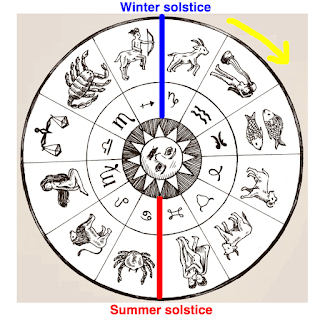
This is winter zodiac...I talked about it in my post "Trentar"...


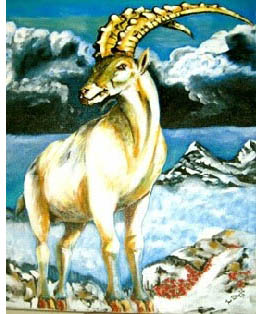
In one of my favourite zodiac related legends, the Slovenian legend about Zlatorog, the Ibex goat with gold horns, it is the "hunter from Trenta valley" that hunts and fatally wounds the magic goat, from whose blood springs magic Triglav rose...Which dying magic goat eats and gets healed (magically)...

So hunter, pursues Ibex goat, shoots it, it bleeds, from it's blood grow flowers...What does this mean?

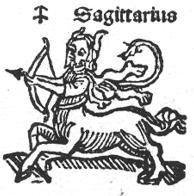
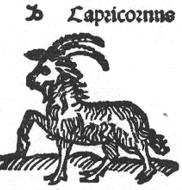
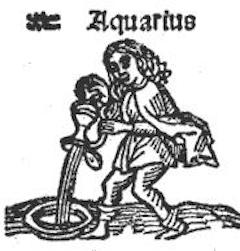
Well, what you are looking at is the winter zodiac: Sagittarius (end of autumn, start of winter), Capricorn (mid winter), Aquarius (end of winter, start of spring)...

Spring starts in Aquarius...Which represents the snowmelt...This is where frigid old hag, winter earth, turns into hot young maiden, spring earth...Who then gets her first "period"...Becomes fertile again...


BTW, the same transformation of winter into spring is contained in a Slovenia ritual calld "Bablji mlin", meaning "Granny's mill" scene. An old hag is being milled, and thus transformed, into a young maiden. Winter being transformed into Spring...I talked about this in my post "Babji mlin"...


The same story of rejuvenation, rebirth (of the mother earth) is preserved in the Scots Gaelic ritual song "The old woman of the mill-dust":

Will you give me your daughter old lady of the mill dust?
Will you give me your daughter 
I will be happy with her
I will dance with her

From Carmina Gadelica, 19th c. Gaelic Scotland

In Gaelic, the word Cailleach means both an old woman and the last sheaf of wheat and the corn dolly made from it. Corn dolly which represents Mother Earth, the life (grain) giving mother...

I talked about this in my post "The old woman of the mill-dust"...

Interestingly Cailleach, or Cailleach Beira, is the Scottish "Queen (Goddess) of Winter". She appears as a blue-skinned hag carrying a magical staff that freezes the ground and a hammer for shaping hills and valleys. At the end of her seasonal reign, she drinks from the Well of Youth to become young again...


Spring of youth being of course the snowmelt, which begins in February, in Aquarius (!!!) 🙂, which marks the beginning of spring...And the arrival of the "Bride" (Brigid), the spring earth maiden, snowmelt being her first "period"...

Effigy of St Brigid taken from house to house to collect money while saying these rhymes

"Here's St Bridget dressed in white,

Give us some money to honour her night,

She is deaf, and she is dumb,

And she can't talk without a tongue"


St Brigid, The Bride, Gaelic Mother Goddess turned Saint is associated with wells (running water)...

Slavic equivalent is the effigy of Marzana (winter) which is made and paraded around in Slavic countries at the same time. The effigy is then burned or drowned to symbolise the end of winter. This can give us the clue who Brigid originally was.


Also, The Witch of Winter, The Old Hag, has to be burned (and drowned) or spring will not come...Burning is heating up of the earth and drowning is the snowmelt...Burning and drowning of Marzana, Slavic name for Winter Earth...I talked about this in my posts "Gryla", "Living stone", "To kill a which", "Babele"

Oh and don't forget The Snow-White...From the article:

"What we have here is the story of Earth going through seasons: Spring, Summer, Autumn, Winter, Spring...

Beautiful young Spring Earth becomes bountiful Summer and Autumn Earth. Still beautiful, but in no way as beautiful as the Young Spring Earth...

Because of the cyclical nature of the solar year, Autumn Earth is the mother of Spring Earth of the next solar year. As Autumn ends, and the crab apples are the last fruit left on the trees, Autumn Earth turn into Old Hag Winter Earth, who "kills" her own younger self...

Dead Earth lies in her icy coffin until Young Spring Sun arrives. He sees beautiful Spring Earth under the ice, falls in love with her and revives her. Spring Earth, marries Spring Sun...

But seasons pass, Spring Earth turns into Summer Earth and then into Autumn Earth and then into Winter Earth...And the story repeats itself...Luckily, every spring, Young Sun arrives to save the day 🙂"

All these stories, beliefs and rituals basically describe the same thing: End of winter, beginning of spring...

Oh, including of course Christ's baptism ("in living", flowing water) and Mary's purification (first period after giving birth)...


@another_barbara
:

After @serbiaireland explained to me what a tale (I teach to kids for 15 years) really means, I had to add that the old countess was barren and she and her husband were sad because of that. After drinking/washing with sacred water she knew she will be able to have children now.


Wednesday, 17 August 2022

White Cross

This is the reconstruction of the Beli križ (White Cross) shrine which was once located in the valley southeast of the village of Prelože, Slovenia...

The shrine was destroyed during the First World War. But the locals preserved a vivid memory of it and of the rituals performed around it. These were collected by ethnographers during the middle of the 20th century...

As you can see, it was "a cross in a circle" made of stones, with four stones in each quarter of the circle and four pointy rocks on the ends of cross hands...

Basically this is a so called "sun cross", which symbolises a solar year with four season. Ever spinning solar wheel. This is confirmed by the fact that a bonfire was lit in the field near the shrine on Kresovanje (Bonfire night, Midsummer night)...


In the center of the "shrine" was a stick on which young green tree branches were attached, symbolising a young green tree. Or maybe this cross was rebuilt every year around a real young tree. This is not clear from the original text...This tree symbolically grew during the fertility ceremony which was performed around the cross in the spring "when the foliage turned green", which in the Prelože area happens in April...The carpet of crocus flowers across the slopes of Velika Planina in Slovenia, April...


It is quite possible that this ceremony took place on Jurjevo (St. George’s Day), the old Jarilo (Slavic Young Sun God) day...The field where the White Cross shrine once stood is linked to St George...I talked about him and why he is "The Dragon Killer" in this article "Letnitsa treasure"...

A very interesting metal plaque from the so called "Let­nit­sa Treas­ure", a 4th c. BC Thracian hoard discovered near Let­nit­sa, Bulgaria...This one depicts one of the most common themes from Balkan fairytales: a princess being kidnapped by a dragon...

Jarilo (Jura), whose name means both "the brightly burning one" (sun) and "the young one, the green one" (bringer of spring, summer, The Green Man) was in other Jurjevo rituals from Slovenia represented by a living walking tree.

Zeleni Jura (Green Yura) walking the earth. Part of Jurjevanje, celebration of the return of Jarilo, Jura, The  Young Sun God who brings spring...Today performed on St George's day...Tells you a lot about the true Identity of St George...


This ritual is performed Bela Krajina, area inhabited by descendants of Serbians who migrated here during Turkish invasions of the Balkans. Today split between Croatia/Slovenia...This is the original Green Man...

The Sun God's name Jarilo (pronounced Yareelo) comes from the root "jar" (yar) meaning: young, green (Life giving warm sun of green spring), but also brightly burning and raging, furious (Life destroying burning sun of yellow summer)...

Interestingly, in Sanskrit, har (cognate of jar, yar) can also mean green and yellow... 

So the fact that a (symbolic) young green tree, symbol of the sun god Jarilo, was "growing" in the middle of the shrine shaped like a sun cross, points at the symbolic meaning of this shrine: solar year and the climate which it creates...

And it is this climate which people of Prelože were trying to control...As part of the ceremony at the White Cross, four young girls span around the circle interconnected by ivy branches, singing prayers for "sun, rain and abundant crops"...

They prayed to "Dajbogec" (Giving god), another name for Dabog, the old Slavic Sky God...

In Serbian the expression "On vedri i oblači" means "he rules", "he has absolute control, absolute power". Literally this expression means "he makes the sky clear and cloudy"...I talked about this in my post "The power of the thunder giant"...

Dabog, Dajbog was also another name for Triglav, Trimurti, the Supreme god...I talked about Triglav in several of my posts: "Lugus or Triglav", "When the bride dies soon after the wedding", "Sun thunder fire", "Riddle", "Krkava Triglav stone", "Triglav, Trojan, Trinity, Trimurti, Agni"...

This is what Triglav is, one God with three faces: Sun, Thunder, Fire...

It is very interesting that the "shrine" contained pointy upward stones and that at this shrine girls (women) prayed to Dabog for good weather (just enough rain and sunshine) so that their crops would yield abundantly...

Because this is not the only place where we find large stones used in weather rituals involving Dabog and performed by women...

In his 1925 paper "The Ring of Nestor", Sir Arthur Evans, the excavator of Knossos, mentions a curious rain-making ritual which was performed in Ibrahimovci, near Skoplje, Macedonia, during droughts. 

Pic: Altar dedicated to Jupiter, Juno und Minerva, Macedonia


This is 1925 we are talking about. At least 1500 years since Jupiter was officially a god of rain...And yet, uneducated, illiterate SLAVIC villagers in Macedonia still remembered him in times of desperation...

What is very interesting is that this altar "was lying face down normally but was lifted when the rain was needed". Compare this with this Slavic rain making ritual from Belarus in which Dabog's stone is ceremonially lifted...I talked about this in my post "The last megalithic ritual in Europe"...

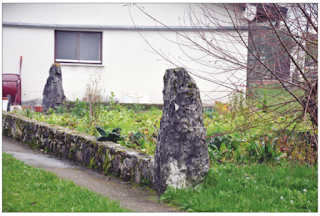
And compare this with other weather controlling Slavic rituals involving sky pointing "weather stones"...See, these weather stones have the same shape as the stones from the White Cross...I talked about them in my post "Weather stones"...


Source of info about the shrine and related rituals:

Pleterski, A. 2015, Preplet 3 in 4, preloška "Beli Križ in Triglavca ter Zbruški idol", in: Nesnovna krajina Krasa

Saturday, 4 December 2021

Trentar

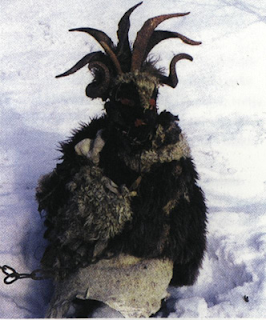
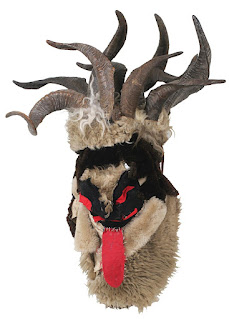
"Trentar", the winter demon from Trenta valley, Slovenija. He´s got 12 horns for 12 months of the year. I want to thank Not Just Another Barbara @another_barbara, great twitter account that tweets about Slovenian folklore, for these pics.


Eeee very very very interesting...

12 "goat" horns, one for each of the 12 months of the solar year which starts in Capricorn (goat)...

In one of my favourite zodiac related legends, the Slovenian legend about Zlatorog, the Ibex goat with gold horns, it is the "hunter from Trenta valley" that hunts and fatally wounds the magic goat, from whose blood springs magic Triglav rose...Which dying magic goat eats and gets healed (magically)...

So hunter, pursues Ibex goat, shoots it, it bleeds, from it's blood grow flowers...What does this mean?

Well, what you are looking at is the winter zodiac: Sagittarius (start of winter), Capricorn (mid winter), Aquarius (end of winter)...

I talked about this in my post "Zlatorog"...


But these are not constellations we are talking about...

Sagittarius marks the fur hunting season in Central Europe...


Capricorn marks the mating season of Alpine ibex goats of Central Europe...


Aquarius marks the snowmelt in Central Europe...

I talked about this in my article about the origin of western zodiac...

Wednesday, 24 February 2021

Living stone

Shepherds chapel, Velebit, Croatia dedicated to Holy Mary. The altar is actually bedrock, around which the church was built, indicating that this a Christianised pagan holy place. I talked about this in my post "Shepherds chapels from Velebit"... 

Bedrock is in the Balkans known as "kamen živac, živi kamen, živa stena" (living stone, living rock), called so, because it is believed to be still part of the living body of the Mother Earth.  And is venerated as sacred...


Transhumance shepherds used to bring offerings to these lumps of exposed bedrock before they took their flocks to the highlands, to ensure good weather. People believed that "Mother Earth, known as Baba, controls the bad, cold, rainy, snowy weather". I talked about this in my post "Weather stones"...

In my post "The City", I talked about an ancient enclosure in Co Kerry, Ireland which was linked with the veneration of the (D)Anu, the Irish version of Baba, The Mother Goddess. 

The enclosure was built around an exposed piece of bedrock, which served as an altar.

The City was the place where annual rituals were perform on Bealtaine, 1t of May, the middle of Taurus, at the beginning of the cattle drive into the highland pastures, "for the protection of the cattle"...

From the bedrock standing in the centre of the enclosure, both people and cattle looked towards the two round breast like hills, made even more breast like by giant stone cairns built on their tops. The hills are known as the Paps of Anu (Boobs of the Mother Earth)...

So here in Ireland, just like in the Balkans, we have association between bedrock, Mother Earth and shepherds...Mountain tops, and bedrock crags called Baba (Grandmother, Mother, Mother Earth) from the Balkans Pic: Velika Baba (Great Grandmother) peak, Slovenia. From the post "Baba, mountains and crags


Saturday, 18 July 2020

Blessed fire from the tinder fungus

There is an interesting Easter Friday custom in Slovenia called "strašenje Boga" (scaring God). It involves people piling up old wooden objects in front of the church, and beating them with poles making as much noise as possible, until the objects are broken to bits... 


The wood was then used on Easter Saturday morning for lighting the sacred Need fire. In some parts of Slovenia, every house would bring their own log which was placed in the pile. In Carinthia, the priest collected old, removed wooden crosses and wreaths from graves and carried them in a pile. 

The once all the wood was piled up, fire was kindled using iron and flint. The priest would then bless the fire and this, now sacred new fire, was used to light up the new fire in all the village house hearths. 


The house hearth fire was considered sacred in Slovenia and was always kept burning by the housewife. In the evening it was not extinguished. In the evening, the housewife covered the embers with ashes, and in the morning she blew into the embers and started the fire again. The only time the fire was extinguished was on Good Friday, when the hearth was cleaned and prepared for the arrival of the new fire which was brought from the sacred blessed fire lit up in front of the church... 


Now the fire was brought from the church to each house by one of the boys from the house using tinder fungus. 


It is so called because in the past people used it to "cary fire" from one place to the other. Once lit, it will not burn but smoulder for a long time allowing fire to be preserved and transported over long distances...


As soon as the fire was blessed, boys would rush towards the fire with a tinder fungus stuck on a long stick. They all wanted to be the first to catch the fire and the first to bring it to their house...The kids had to be careful not to let the fire be extinguished nor to let it flare up, as either would prevent them from actually reaching the house with a fire still burning in the fungus. If any burning bit fell off the fungus, it had to be thrown into a green wheat or barley field. 


Once the boys reached their houses, they had to give the burning tinder to their mothers, so that they can start the new yearly house fire. 


Last year's Palm Sunday spring greenery bundle called "butarica" was ceremonially placed on the new fire and burned. Pic: people bringing "butarice" to the church to be blessed...


It was believed that starting a house fire with the blessed fire from the communal bonfire would protect the house from fire...

After their house fire was rekindled, the boys would run through the village announcing this to everyone else... 

Not all of the tinder fungus was used for lighting the house fire. A piece of burning tinder fungus had to be thrown into every field and meadow so it will be blessed too and would yield well that year. This ceremony was also performed by children...

This is very very interesting. 

Ethnographer dr. Niko Kuret says that "The blessing of the fire ceremony was probably the remnant of some pagan spring ritual dedicated to fire"...

Ha!

I wonder what ceremony could that be? Does this has anything to do with Jarilo, Slavic young sun god, whose name means "The Brightly Burning one"? 

Is the new sacred fire, lit on Easter Saturday, symbolic representation of Jarilo's fire, young sun's fire? 

I think so...

It is Jarilo's return from "the Otherworld" (winter) which brings spring and makes the land green again. Jarilo's name also means "The Green one". It is his brightly burning "sacred fire" that melts the snow, ends infertile white winter and starts fertile green spring...

I think that this is why the bits of sacred fire are thrown into fields. Fields are symbolically blessed, by Jarilo, The Brightly Burning One, The Young Sun god, who is represented by the "sacred bonfire"...

Finally two questions:

Which god is being frightened by banging wood in front of the church? Jarilo? Or...? 
And why are crosses burned in the so obviously pagan sacred fire ceremony?

Illustrations: Maxim Gaspari. Text describing the ceremony from "Blessed fire from the tinder fungus" and "Easter customs in Slovenia"

PS: This is of course just one of many similar fire rituals performed at the end of winter beginning of spring or at the beginning of summer throughout Europe...All basically celebrating the return of the sun and the rebirth of nature...

Tuesday, 23 July 2019

Weather stones

During the periods of severe droughts, in a small Belarusian village, 9 windows would go to the Dabog (Giving God) stone, lift it using the stakes as leavers, and would perform a special prayer to the stone asking it to send down the rain. 


You can read more about this in my post "The last megalithic ritual in Europe". 

This is Velika Baba (Great grandmother) peak in Jezersko region, Slovenia.


This crag in Slovenia is called "Poljanska baba" and is located on slopes of Mt. Mežakla. 


In Serbian, the word baba means "birth giver" and is used for mother, grandmother, midwife. It also means stone, rock, crag, bedrock, mountain and Mother Earth (Birth Giver 🙂). 

Stones, rocks, particularly bedrock, crags, rocky mountain peaks are seen as bones of Mother Marth. 

In my post "Yin and Yang" I talked about the Mother Earth and Father Sun and their life creating interplay. 

Chines divided all the natural phenomena into Yin and Yang ones:

Yin is characterized as slow, soft, yielding, diffuse, cold, wet, dark, and passive; and is associated with water, winter, north, earth, the moon, femininity, and nighttime.

Yang, by contrast, is fast, hard, solid, focused, hot, dry, bright, and active; and is associated with fire, sky, summer, the sun, masculinity and daytime. 

People in the Balkans too clearly linked wet, cold weather with "Baba", Mother Earth. 

Shepherd's in Slovenia believed that "baba" stones were linked to weather, water, humidity, mud, soil and fertility and pasture abundance. 


This bedrock outcrop near the village of Rodik in Slovenia is known locally as "Baba" (Grandmother)... Locals believed that "Baba" controls the (bad) weather: Baba’s urine turns to rain, her fart to wind, and when she raises her skirt, the weather gets nice...🙂


The same veneration of stones related to weather is found on Mt Velebit in Croatia. This is "Malo Rujno" highland plateau on Mt Velebit. 


On it there is a stone block which local shepherds called "Baba" (Grandmother). Every spring, on the arrival of flocks to the highlands, shepherd women used to bring food offerings and leave them on the stone, to placate Mother Earth, and ensure the cold and wet weather doesn't come back. 

You can read more about this in my post "Shepherds chapels from Velebit". 

Now here is something very very interesting. In the article "Nesnovna krajina Krasa" we can read this: 

In Slovenia people used to cut special types of stones called "špičneki" or "špičniki" meaning "spikes". These were pointed stones which were placed on the houses or at the garden gate to "word off hail and storm"


In the village Spiczki (spikes) in Podlasie, Poland, there were stones which people believed controlled the weather. During storms, people would raise the stones to point to the sky for protection. 

The same custom was recorded in the village of Turow in Poland. A stone called "śpiczek" (spike) was tilted for rain and straightened to point to the sky for sun...


Is this one of the reasons why people erected standing stones permanently pointing to the sky? Did that happen during one of the catastrophic climate changes that happened during Bronze and Iron Age? Culnagrew Standing Stone. Picture by Ciaran McGuckin


Catastrophic weather event like the early Bronze Age "Flood of Patholon", memory of which was preserved in the Irish oral tradition written down in medieval times. You can read more about this in my my post "Flood of Partholon".

Sunday, 15 January 2017

Zlatorog - Goldhorn

In my post "Goat" I showed that the beginning of the Capricorn zodiac sigh falls right in the middle of the mating season of the Alpine ibex wild goats. Alpine ibex mating season starts in December, and ends in January typically lasting around six weeks. Winter Solstice, 21st of December falls right in the middle of this period and the day after the Winter solstice is the beginning of the Capricorn (goat) period, which last from December 22 – January 20...

This information is the key that allows us to finally unlock the true meaning of one of the most interesting legends preserved in Europe. The legend of Zlatorog, the Goldhorn. 

This is Triglav. With an elevation of 2,864 metres, height is the highest mountain in Slovenia and the highest peak of the Julian Alps.


Just below Triglav mountain lies The valley of Triglav Lakes.

The Valley of Triglav Lakes is a karstic, high mountain valley in the heart of Julian Alps with many small lakes dotted among the rocks. The lowest lake is Black Lake (Črno jezero) at an elevation of 1,294 metres above sea level. The highest is Podstenje Lake (Jezero v Podstenju), which is located at an elevation of 1,993 m.

The valley and the surrounding peaks are incredibly rugged and rough and incredibly beautiful. Here are some pictures of the valley that might give you better idea of what kind of place this is. 


The valley is located under the mount Triglav. In Serbian mythology we have two main deities: 

Triglav (Three headed god) also known as Dabog (giving god) and Djed (Grandfather), the sky father. Troglava (Three head goddess), Dajbaba (giving goddess), Baba (Grandmother), the earth mother. 

It is their constant interplay that produces all life on earth. 

This valley is the location of the story of Zlatorog (Goldhorn), magic Ibex goat with golden horns. 


Here is the full text of the legend of Zlatorog:

"The Valley of Triglav lakes and Komna plateau were once a green heaven. It was inhabited by White women, good fairies who kept the mountain pastures green. They also visited the lower valleys and helped humans whenever they found them in need. They also helped women at childbirth. A child who was delivered into the world by them, was protected by the White Ladies for the rest of his life. They never asked for thanks or payment. But they didn't allow anyone to enter their Lake Valey. If anyone accidentally or because of arrogance got close to their homes, they would hurl down rocks and stones and avalanches, or cause terrible storms of snow and hail and would force people to return to the valley. The Lake valley was also home to a heard of white goats whose leader was Zlatorog (Goldhorn). He was indestructible. If it got hurt, from his blood a miraculous flower, called Triglav rose would spring. 

Triglav rose, Latin name "Potentilla nitida", is a species of cinquefoil in the Rosaceae family that is endemic to the Alps where it grows on elevation of 3,200 metres


If Goldhorn ate a single leaf or petal from this flower, he would instantly recover.  His golden horns were the key to unlocking a big treasure, which was hidden on Bogatin (Rich) mountain. The treasure was guarded by a multi-headed snake, dragon. 

The only mortal, who was allowed to climb on the highest summits of the Lake Valley, was the son of a beautiful widow – the Trenta Hunter. He was delivered by the White women, so he was under their special protection. 

The Trenta Hunter had a girlfriend, a daughter of an inn keeper who owned a tavern on the confluence of Koritnica and Soča river. One day innkeeper’s daughter caught an eye of a rich Venetian merchant. He gave her lots of expensive jewelry and promised her life in great luxury if she married him. When Trenta Hunter came next time to the tavern to see his girlfriend, the girl’s mother demanded from him to produce a treasure that will match the wealth of the Venetian merchant, or he will never be allowed to see her daughter again. Alternatively he could bring back a bunch of Triglav roses in mid-winter to prove his fidelity – an impossible task.

The young hunter, desperate and hurt left the tavern. On his way out, he was joined by the Green Hunter, who was known in the valley to bring into troubles many decent young guys. It was the Green hunter, who proposed to the Trenta Hunter to kill Goldhorn, take his golden horns and with their help take all the treasures of Bogatin (Rich) mountain. Once he brings Bogatin treasure to his girlfriend's mother, she was surely going to let him have his sweetheart back. 

They started climbing the mountain the very same night, and in the morning as the sun rose they spotted the Goldhorn. Trenta Hunter took aim and pulled the trigger. The bullet hit Goldhorn. The blood gushing from Zlatorog’s wound melted the snow and up sprang a magical Triglav rose. The dying Goldhorn nibbled on a few petals and was instantly healed. It jumped up and leaped away. Wherever he touched the ground, snow melted and Triglav roses sprang up from under his hooves, luring the Trienta hunter onto higher and higher ground. But as they climbed, the sun caught Zlatorog’s shiny horns. The hunter was blinded, lost his footing and plunged into a gorge.

The once kind and trusting Goldhorn was enraged that he was treated in such a manner. In his fury he gored his way through the Triglav Lakes Valley, leaving it much as it looks today. He left the area with the White Ladies, never to return.

The innkeeper’s daughter waited in vain for her lover to return home. As spring approached, the snow began to melt, swelling the Soca River. One day it brought her a sad gift: the body of Trienta hunter, his lifeless hand still clutching a Triglav rose.

That's it. 

Now how are we to understand this story? 

Well this story has several levels. 

Firstly it is a story about how greed can destroy people. And this is the level most people stop at. 

Secondly it is a great environmental warning. The destruction of the Lake Valley and its transformation from the lush green paradise to barren karst plateau was caused by Goldhorn, who disappeared afterwords. The Alpine ibex historically ranged through France, Italy, Switzerland, Liechtenstein, Bavaria, Austria and Slovenia. Starting in the early 16th century and with firearms becoming common, the overall population declined due to over-exploitation and poaching. The ibex became extinct in Switzerland and Germany by the 18th century, and was extinct in Austria and northeastern Italy by the 19th century. This is why in most versions of the Legend, Goldhorn is legendary white chamois buck. Only in some Slovenian versions, which I believe are the older ones, he is an Ibex buck. Basically by he time the story was recorded, Alpine ibex was extinct and local people replaced the now gone ibex with still present chamois. The fact that the story says that Goldhorn disappeared after the destruction of its habitat, proves that originally Goldhorn was Alpine ibex.

It is also interesting that when alpine ibex left, the "white ladies" also left never to return. Who were these mysterious "white ladies" who kept the mountain pastures green and who also helped women at childbirth?

In my series of articles about Baba, the Mother Goddess, I explained that in Serbian the word "baba" means mother, grandmother and midwife, basically anyone who gave birth or helped giving birth. It also means stone, rock, mountain and mother Earth, the Great Mother who gave birth to us all. The word baba also has many meanings in Slovenian: an old woman, hag, demon spirit or witch, dry, barren river bed or ravine, rock or a crag.

Many stony mountain peaks in the Balkans have the name whose root is the word "baba" and there are quite a few of these in Slovenia. This is one of them, Velika Baba in Jezersko region


Also many isolated stone crags in the Balkans also have names whose root is the word baba. This one from Slovenia is called "Poljanska baba" and is located on the eastern slope of Mt. Mežakla.


Shepherd's in Slovenia still believe today that these "baba" stones are linked to weather, water, humidity, mud, soil and fertility and pasture abundance. Until recently, during their spring ascend to Great Mountain above Kamnik, shepherds would leave a few coins or a loaf of bread at a place called "Babji trebuh" meaning "Baba's belly". The offering was left for "baba" so that she doesn't "walk around the mountain bringing cold and hail". It is interesting that in the Balkan folklore a dark cloud that brings the storm with hail or sleet is also called "baba" and that the direction from which the storm clouds usually arrive over the hill or a mountain is called "babja" meaning baba's domain. 

Now "baba", grandmother, hag, an old lady has a white hair so an old lady is also a "white lady". As I already explained in my post "Baba's day", baba is also a word for midwife, the one who delivers babies. And she is also the one who controls earth, water, darkness and cold, the domains of the Mother Goddess. So I believe that the white ladies are memories of the old Earth Goddess, Baba, the Great Mother Goddess. My research shows that the reverence of the Great Mother was only very recently suppressed in the Balkans. I believe that the departure of the "white ladies" and the turning of the lush green pastures into desolate rocky desert, describes the belief of the local people that the abandonment of the old beliefs and the respect for the Great Mother Earth is what has brought the destruction of the environment...

But there is another, and to me the most interesting layer to this story. The astrological one. And this is the layer which only becomes accessible when we know the link between the ibex goat and the Capricorn sign. The Zlatorog story describes the succession of three winter astrological signs, Sagittarius, Capricorn and Aquarius. 

Sagittarius 23 November – 21 December
Capricorn 22 December – 20 January
Aquarius 21 January – 19 February


The story shows the inevitability of the passing of winter and the arrival of spring.

Here is the story again with the translation of the used symbols:

The only mortal, who is allowed to climb on the highest summits of the Lake Valley, is the Trenta Hunter. 

This hunter is Sagittarius. Sagittarius is the time of the year when all farm work is finished and all animals have already finished growing their winter fur. It is the time of the first snow and the beginning of the winter fur hunting season. This is why this is where we find Sagittarius, the hunter.

He is the son of a beautiful widow. He was delivered by the White women, so he is under their special protection. 

Sagittarius is the son of Virgo. Virgo is the lady who stands on the lion (Leo), the sign that comes after Leo. Virgo is the sign when Baba, the Mother Earth, starts taking over from the Father Sky. This is the time when weather starts getting cooler and wetter. By the time Sagittarius is born, Mother Earth is a widow. The agricultural year is over, the killing of the bull is finished and Scorpio has already cut his balls off (I will explain what this means exactly in on of my future posts). And the winter, the season in which Mother goddess is the sole ruler, has began on the 8th of November. 

The young hunter is joined by the Green Hunter, who is known in the valley to bring into troubles many decent young guys. It was the Green hunter, who proposes to the Trenta Hunter to kill Goldhorn. His golden horns were the key to unlocking a big treasure, which was hidden on Bogatin (Rich) mountain. 

Green Hunter is Jarilo, the young sun. Jar in Slavic languages means both hot, young and green. Jarilo is the the representation of young male passion. Considered a bad thing in Christianity. He is the mysterious "Green Man" who brings new vegetative cycle. In Celtic and Serbian calendar, the year is divided into two parts: summer which starts with Celtic Beltane (1st of May) or Serbian Jarilo day, St Georges day (5th of May) and Celtic Samhain (31st of October) or Serbian Mitrov dan (8th of November). I wrote about this in detail in my post "Two crosses". In Serbian mythology Mitar and Jarilo are represented as mounted hunters. Jarilo encourages Mitar to go after the goat of Winter solstice, which is mid point between them and so speed up the passing of winter.  Only if Mitar, The Hunter, Sagittarius catches the Goat, Capricorn, will the new solar year start.  

The treasure was guarded by a multi-headed snake. 

The treasure is plentiful of food during summer and autumn. The beginning of summer is marked by Jarilo day, which in Christianity became St Georges day. Jarilo, the fire head of Triglav, is the Snake king, the multi-headed snake, the Dragon, the fire and heat of the sun. Christian missionaries showed a great sense of humor when they turned Jarilo, the dragon into St George - the dragon killer...But this was time and time again used recipe of destroying old religious beliefs: turn them into their opposites...

The hunters start climbing the mountain in the evening.

This is the evening of the winter solstice. 

In the morning as the sun rose the Hunter spots the Goldhorn. He takes aim and pulls the trigger. The bullet hits Goldhorn. 

The moment when the hunter hits the goat, when Sagittarius meets the Capricorn, is the Winter solstice day. The day when the new sun, the new solar year is born, when the days start getting longer again. The Capricorn is the true Goldhorn, who brings the new sun between his horns. This sun is the key to the great treasure, the new vegetative year which will start soon when Capricorn dies...

But the hunter gets blinded by the sunlight reflecting from Zlatorog's golden horns, slips on a cliff and falls to his death. 

The hunter dies on Winter Solstice day, the last day of Sagittarius. The day when the new sun is born and the sun's blazing fire is rekindled. This is the end of Sagittarius and beginning of Capricorn. 

The blood gushing from dying Zlatorog’s wound melts the snow. 


The dying Capricorn's blood which melts the snow is the first snow melt which occurs in Aquarius, after Capricorn ends. The water which Aquarius pours is this first snow melt which swells the rivers and breaks the ice. It is during Aquarius that we find Celtic Imbolc (1st of February) and St Sava (27th of January, but originally probably 4th of February), the beginning of Spring. 

From the place where snow has melted springs a magical Triglav rose. The dying Goldhorn nibbles on a few petals and is instantly healed. 

The death and resurrection of a goat is a common scene reenacted during Coleda ceremonies in Slavic countries. These ceremonies are, I believe, the origin of Christmas carols. I will talk about this more in one of my future posts. 

The once kind and trusting Goldhorn, enraged that he was treated in such a manner, leaves with the White Ladies, never to return.

Well until next winter and the next big Goldhorn hunt...

This legend once and for all confirms that zodiac signs were markers used to describe important natural events in Europe. This means that zodiac signs had to be invented in Europe, not in Babilonia. The fact that the true meaning of this story had stayed hidden for so long is solely because no one saw the link between the ibex goat and the Capricorn before.