Showing posts with label Illyrian archaeology. Show all posts

Sunday, 28 November 2021

Gazelle mystery

I am flicking through the great paper "Podobe zivljenja in mita" This is an Illyrian situla from Novo Mesto, Slovenia dated to 5th century BC...


And there is something really really weird abut it...

This is the drawing of the decorative frieze from the situla...A row of horned animals...Which ones?


If you look at the horns, you will see that these are undoubtedly gazelles. 

Either Goitered gazelles...Which is found in Georgia, Azerbaijan, Iran, parts of Iraq and Pakistan, Afghanistan, Tajikistan, Kyrgyzstan, Uzbekistan, Turkmenistan, Kazakhstan, China and Mongolia...Not in Slovenia...


Or mountain gazelles...Which are found in Levant and Anatolia...Not in Slovenia...


I can't believe that no one before me saw this and wandered: how the fuck did this animal from Central Asia end up on an a ritual vessel buried in an Iron Age grave in Slovenia???

Was this situla an import? In which case were all Illyrian situlas imports? And if so from where?

Belenos?

Another puzzle from the Vače Situla, an ornamented Early Iron Age (5th c. BC) Illyrian ritual vessel (situla) found in Slovenia. 

Here we see the "dude dressed in white" being driven in a "bird chariot" with one bird pointing forward and the other backward...


Who is this "dude dressed in white"? Why is he driven in "bird chariots"? What is the symbol under the chariots? The Sun? 

Have a look at the drawings of the Vače Situla decorations. 


The same dude we see being driven in the bird chariot, is also depicted sitting on a throne holding a scepter with two bird heads facing away from each-other...

Why?

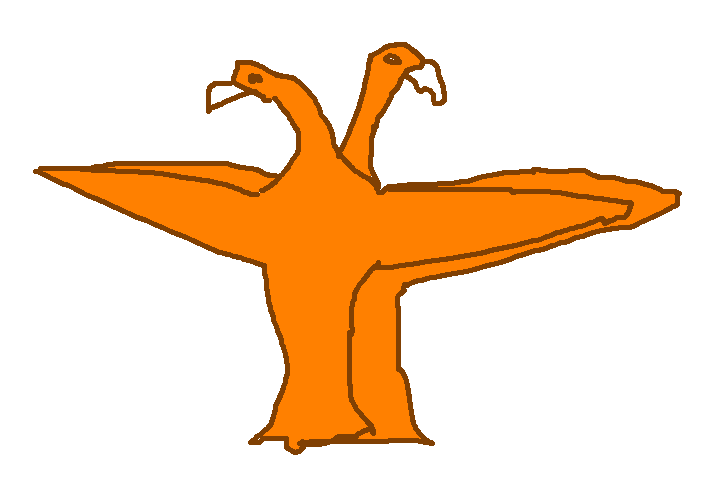
Originally I thought that maybe this is somehow related to the two headed eagle dude found in Central Asia...This guy:


I talked about him in my post "Double headed eagle"...This dude is the thunder god, personification of the rain cloud. 


I talked about this in my post "Fluffy"?

Basically he is a deified vulture which has two heads because the local vultures perform synchronized flying mating routines at the beginning of the rain season...


Which from the ground look like two headed eagles

But maybe this Illyrian bird iconography has nothing to do with vultures. The bird definitely doesn't look like a vulture. It is a raptor though. But which one...

Enters this cool dude: The short-toed snake eagle (Circaetus gallicus), a medium-sized bird of prey, found throughout the Mediterranean basin, into Russia and the Middle East, and parts of Western Asia, and in the Indian Subcontinent and also in some Indonesian islands...

This eagle, as its name says has short toes 🙂 And eats snakes. I talked about this eagle in my post "Eagle calendar marker"...

And in Europe, it is a migratory bird, arriving into Europe from Africa in Apr/May and leaving Europe for Africa in Sep/Oct...

Remember that snakes are solar animals. They are in our world when sun is in our world (hot part of the year) and they are in the underworld when sun is in the underworld (cold part of the year)


I talked about this in my posts "Enemy of the sun", "The chthonic animal" and "Bactrian snakes and dragons"...

Not just that, but mating season of European snakes take place at the beginning of summer, in Apr/May...

Which makes snake animal calendar marker for the beginning of summer...

In Slavic mythology, dragon is "an old snake"...What this means is that dragon is the animal calendar marker for the late summer, the hottest part of the year...Which is by South Slavs called "Kresovi" (fires)...

Which is why in Slavic mythology, dragon, always breathes fire. 

He is the symbol of destructive sun's heat. I talked about this in my post "Dragon who stole rain"...

This is also why in Slavic languages, the word for dragon "zmaj" is masculine form of "zmija", snake. 

And why the oldest dragons, Mesopotamian ones, have snake heads. 7 snake head, for 7 hot, dry summer months...And the body of a lion...Cause Leo, Jul/Aug, is the hottest part of the year. The time of the fire breathing dragons..


I talked about this in my post "Seven headed dragon"...

Anyway, back to the snake eating eagle...This eagle disappears from Europe when the the sun goes to the underworld, followed by snakes...And this eagle reappears in Europe when the sun returns from the underworld followed by snakes...

And the only time you can see this amazing scene of eagle fighting snake is during summer and autumn... 

Now remember my pos "Leto", about migratory birds and their significance in Slavic mythology? 


And how they are directly linked with the departure of Jarilo (pronounced Yarilo), the sun god to the land of the dead in the autumn, and his return from the land of the dead in the spring?

To the point where the word leto (summer, year) can be derived from let (flight) of the migratory birds...

Is it possible that the raptors depicted looking into opposite directions are migratory snake eagles? If only there was an Illyrian artefact, from the same area and the same time period, showing a raptor with a snake in it's beak...

Now have a look at this: a (ritual) boxing match over a helmet depicted on the Vače Situla.


Now have a look at this: Belt buckle (Illyrian or Etruscan or...) from Magdalenska gora. From this amazing paper "Podobe zivljenja in mita"... It depicts the same (ritual) boxing match over a helmet depicted on the Vače Situla. But, in the top left corner, there is a bird of pray with a snake in its beak...
So I think I am right about the identity of the raptor from the Vače Situla...

So who is this dude dressed in white, on an Illyrian situla, being driven in the chariot with two birds pointing in two opposite directions and holding a scepter with with two birds pointing in two opposite directions (departure and return of migratory birds)??? I wonder...

No suggestions? 

Well Belenus (Belinus and Bellenus), a sun god from "Celtic" mythology, whose name can be derived from "bel", Slavic word for white, making him the equivalent of the Slavic Belbog (White god)???

"The historically favoured interpretation of the name is a "bright/shining one," from a Proto-Indo-European root *bhel (to shine)"

Belenus was associate with horses...Just like Svetovid, Slavic sun god who was also associated with horses. White horses, which were kept in his temples...I talked about this in my post "Horseman"...

The reason why solar deities are linked to horses is because mating of wild horses begins in Apr/May...At the beginning of summer. And it peaks during summer solstice...Which is why horse was used as animal calendar marker for the beginning of summer and for summer solstice...I talked about this in my posts "Unicorn" and "Trojan horse"...

This is also why horses usually pull sun chariots...

So is the guy in white, driven in a horse pulled chariot, Belenus (Belbog) = White god, Sun...

Sunday, 7 November 2021

Beer making on Vače Situla

Here's something funny. The Vače Situla is an ornamented Early Iron Age (5th c. BC) Illyrian ritual vessel (situla) found in the 19th century at the Vače Archaeological Site in central Slovenia...Thanks @another_barbara for reminding me of it.


The vessel has three rows of relief that show what look like scenes from some complex religious ceremony...A lot of stuff depicted on this vessel is very very strange and definitely deserves further investigation. Like all the animals in the bottom row...

But for now, the funny part: "The middle one shows the main happening: at first a sacrifice of grain..." Why is the guy on the right blocking his nose if this is a sacrifice of grain? What exactly is going on here?

I want to thank @JuraPijandura for pointing me at the right direction. What we are looking at is the depiction of beer making...

In "A toast with bear for eternity" that talks about beer making techniques from Ancient Egypt, we can read that:

The most common interpretation of brewing in ancient Egypt is based on the use of bread. Beer loaves or the so-called beer bread were made from dough rich in yeast and lightly baked so that the yeast would not be killed by heat. Those loaves were then crumbled and rinsed with water through sieves into vats (additional ingredients such as dates or extra yeast might have been added at this point). Fermentation occurred inside the vats and the resulting liquid was decanted into jars which were sealed for storage or transport.

The described process is similar to the one used for making a Nubian beverage bouza even today:

First, cereal, generally wheat, but also barley, millet and sorghum is ground and lightly baked as leavened bread, with a moist, yeasty center. The bread is broken, diluted with water, and combined with malt. The resulting mash is moderately heated for several hours and more water added, and, sometimes after a filtration step, the beverage is primed with some old bouza and set aside to ferment for several days.

The above article continues with this statement: "Archaeological data has provided a different view on ancient Egyptian brewing methods" and explains that most beer was not made with bread but with malt...

But malt could have also been turned into "malt loaves" which could then have been crumbled into water...I talked about this in my post "Fulacht fiadh, primitive ale brewery" about Bronze Age Irish brewing...

The important thing here is not whether the starter was a yeast bread loaf or malt loaf...The important thing is that the starter loaf was then crumbled into vats full of water for fermentation...A smelly process...

PS:

Stone slab depicting two Illyrian warriors from the Iapodes tribe sharing a drink from the same vat (most likely beer) using drinking horns. Una National Park, Village of Ripač, Bihać, Bosnia.

Friday, 25 September 2020

Calydonian boar

Illyrian silver stater 300-275 BC. Cow suckling her calf. Jawbone above. So what's the meaning of all of this?

Of first the cow suckling the calf. 

The calving season of the wild Eurasian cattle starts in Taurus, beginning of summer. This is also the beginning of the milking season...I wrote about the link between wild Eurasian cattle and Taurus in my article "Ram and Bull" and about bull as the symbol of summer in my article "Symbols of the seasons"...


Now we have to identify the jawbone. Officially this is a wild boar jawbone...Is it? 

Jawbone from the coin. 

Wild boar jawbone

It seems to match...

In my article about the double headed eagle axe, I talked about the symbolism of the wild boar and its link to winter. Mating season of the wild boar across Eurasia starts in November, beginning of winter...

Both cattle and wild boar were used in Eurasia as solar year calendar markers. Bull marking end of April, beginning of May, beginning of summer, and wild boar marking end of October beginning of November, beginning of winter...

In old Celtic calendar, which closely corresponds to the Anatolian and Middle Eastern Agricultural calendar, the year is divided into only two parts: Dark Nov-Apr (wet season in Anatolia and Middle East) and Light May-Oct (dry season in Anatolia and Middle East)


The Dark part starts with Boar (November) and the Light part starts with Bull (May). Is it possible that the boar jawbone represents the death (end) of the the dark part of the year and the cow and calf represent birth (start) of the light part of the year? 

A century after the above Illyrian coin was minted, we find a jawbone on the coins of the Aitolian league. This one was minted in 211 BC. 


Officially "Spear, Jawbone, Calydonian Boar, commemorates killing of the Calydonian boar". Why would this be Calydonian Boar jawbone? What is the significance of the killing of this boar? Political? Religious?

Let's have a look at the Calydonian boar myth...

Hmmm"...King Oeneus of Calydon held annual harvest sacrifices to the gods...

Harvest in Ancient Greece began in Taurus...I talked about the link between the Taurus and grain in Greek culture in my post "Hesiod on grain"...

"...One year the king forgot to include Great Artemis...in his offerings. Insulted, Artemis...loosed the biggest, most ferocious wild boar imaginable on the countryside of Calydon. It rampaged throughout the countryside, destroying vineyards and crops...People began to starve..."

If boar represents winter, then "most ferocious wild boar" "destroying vineyards and crops" and "causing people to starve" could be a sudden catastrophic climate change, sudden cooling...Like the one which happened during Bronze age collapse...1200BC

So I think that the legend about the Calydonian boar just confirm the link between the wild boar and winter...And that it can actually only be understood properly through this link...

I personally that the jawbone on the Illyrian coin is a calendar marker marking the end of the dark part of the year and the beginning of the light part of the year.

What do you think?

Wednesday, 22 July 2020

Nakovana

This is the abandoned Nakovana village located near the tip of the Pelješac Peninsula in Southern Dalmatia, Croatia...


The name Nakovana is related to the Slavic word "nakovanj", meaning "anvil", most likely because of the shape of this nearby hill. It is known today locally as Grad (City), because of the ruins of a huge Illyrian fortress which once stood on its top...


The fortress was destroyed during the Octavian's Illyrian campaign which lasted 8 years, from 35 to 27 BC, and encompassed almost the entire eastern Adriatic and much of its hinterland...

During the first year of operations, the Roman army massacred the native populations of the islands of Korčula and Mljet. Historical sources do not say whether the Illyrians on the Pelješac peninsula met the same faith...

But the archaeological survey of the region found virtually no traces of occupation during the Early Imperial or Late Roman periods. This is an unusual situation in Dalmatia, where those periods often account for the bulk of archaeological remains...

Most likely, the conquering Romans could not tolerate a native stronghold at such a key strategic position and they most likely destroyed it and turned the surrounding area into a wasteland. The local population was either exterminated or expelled...

How important Nakovana fort was during the Illyrian times can be seen from the fact that over 50 stone tumuli (cairns) are strewn over the fields surrounding the fort. Like the one on this picture shown with the Grad fortress in the background...


These are burials of important people, most likely the aristocracy of the era and the time - the people who built and lived in the Grad fortress. None of the tumuli have been excavated so far...

You have probably never heard of Nakovana before...Unless you are an archaeologist with an interest in Dalmatian prehistory...But you should have. And the fact that Nakovana is not famous world wide beggars belief...

The reason why Nakovana should be famous is not because of its Illyrian fortress and its tumuli...It is because of this cave that lies near the fortress. 


It is the same cave I talked about in my article about the Neolithic maritime trade...


The reason why Nakovana should be famous is not (just) because the lithics found in the cave's front chamber are the proof of the maritime trade network which existed for thousands of years in the South of the Adriatic Sea...

The reason why Nakovana should be famous was discovered in the cave's second chamber which was deliberately sealed, probably immediately before or after the Illyrian fortress Grad was destroyed by the Romans...


This is how the archaeologists who discovered this hidden chamber described the event:


And what they discovered in the hidden chamber is this: A large gleaming white stalagmite in a shape of a phallus...


The stalagmite sits on top of a series of superimposed prehistoric layers, the earliest being from Early Copper Age and dated to the mid-fourth millennium BC. A direct radiocarbon date on the base of the stalagmite suggests that it began to grow about 3600 years ago...


The floor of the chamber was strewn with broken high quality pottery, mostly drinking cups, mostly imported and mostly Greek, broken and deposited there as sacrifice...


The fact that the pottery was Greek made, doesn't mean that Greeks deposited there. Some of the cairns surrounding the Grad fortress, were looted in the past. What remains in and around them shows that the character of the funerary rite is unquestionably Illyrian...

The people were buried with locally made Iron Age jewellery, handmade pottery, and fairly often, fragments of fine Hellenistic ceramic vessels, identical to those from the cave...

Illyrians were famous maritime traders and pirates and they pretty much controlled the southern Adriatic for hundreds of years...

And the Nakovana Grad fortress controlled one of the most strategically important points, the entrance into the Neretva river which was the entrance into the Balkan hinterland...


Which is the reason why the Romans eventually wiped them out...

By the way, were Illyrians the descendants of the people who controlled the Southern Adriatic since Neolithic??? Just putting this out there for people to think about it...

The broken pottery was deposited around the stalagmite, showing that it was the centre of the cultic activities in the cave. The earliest pottery shards deposited next to the stalagmite date to the 4th century BC, around the time of the Alexander the Great...

Now this is very very interesting...

If I didn't tell you where this cave was, you would be forgiven to think that this was a Siva lingam cave temple located somewhere in India...

I wonder if this Illyrian sanctuary predates or postdates Alexander's Indian campaign and who was celebrated in a shape of a lingam in this cave???

The archaeologists who excavated the cave say Silvanus, Pan...

Hmm...Possibly...

Believe or not, as impressive as this phallus looks like :)  this is not the most amazing thing found in the hidden chamber of the Nakovana cave...The most amazing thing was found among the rubble deposited around it...

Among hundreds of pottery shards, archaeologists have also found several pieces of ivory with engraved astrological signs, which once formed part of an astrologer's horoscope board...The oldest so far found horoscope in the world...


I am here talking about Greek horoscopic astrology, which is believed to have been invented in late Ptolemaic Egypt, in the 2nd or early 1st c. BC...

Now we know that the Nakovana cave was sealed around 35BC. So the horoscope board deposited next to the stalagmite must have been made before that. Radiocarbon dating actually points to much earlier date...

The age obtained by the accelerator mass spectrometry is 2217±21 B.P. The calibrated range of two standard deviations is the period between 375 and 204 BC, with an asymmetrical probability distribution leaning towards the 3rd c. BC...

In plain English, the animal from which the ivory was obtained was killed in the 3rd century BC...

Archaeologists who discovered this amazing artefact say: "It is believed horoscope was invented in Egypt, late 2nd, early 1st c. BC. Therefore, the Nakovana zodiac could not have been made before the 2nd c. BC (probably not much before 100 BC), meaning that the ivory used to make it was at least hundred years old"...

Now I don't know for how long a piece of ivory is usually left lying around before it is cut and carved into sellable objects, but I don't think it was left to "age" for over 100 years...

Why playing it down? "It is believed (!!!) that horoscope was invented in Egypt in late 2nd, early 1st c. BC"...What if it wasn't? What if it was invented somewhere else? Earlier? And brought to Egypt from there?


I have been writing about zodiac for a while...One of the things that I have discovered is that zodiac signs, as they are positioned in this "Ptolemaic Greek zodiac" mark the annual lifecycle events of the depicted animals in Europe. You can read about this in this series of articles about Zodiac signs (work in progress)...

As if someone observed the significant annual behavior (mating and birthing) of the animals in Europe, and derived the zodiac signs from that behavior: Pisces - mating season of Europan salmon, Cancer - mating season of Atlantic crabs and European crayfish, Taurus - calving season of European Aurochs...

By the way, I am here talking about the horoscope zodiac circle the way we know it today. Not animal solar calendar markers found in many cultures in Eurasia and North Africa over last 10,000 years. I wrote about those extensively too. You can read about this in this series of articles about Solar calendar markers (work in progress)...

Do you see now why I think that it is completely unbelievable that Nakovana is not a famous archaeological site? 

Sources

Text and images: