Showing posts with label Animal sacrifice. Show all posts

Sunday, 8 May 2022

Suovetaurilia

On this picture you see "badnjak", Serbian Yule log, a young oak sapling which was ritually cut on Christmas Eve and "pečenica", Serbian Yule roast, a pig on a spit, which was ritually slaughtered and roasted on Christmas Eve...

I talked about Serbian Yule log and the rituals surrounding its cutting, bringing into the house and burning in the heath in my posts "Badnjak" and "First footer"

And I talked about the Serbian Christmas roast in my post "Sacrificial animals", which is about the sacrificial animals (boar, ram, bull) in Serbian tradition and their Indo-European root... 

Serbs were not the only people who had this triple animal sacrifice:

Lusitanians sacrificed a sheep, a pig and a bull to some local gods. Indians sacrificed a ram, a bull and a goat to Indra. Iranians sacrificed sheep, cattle and stallions to Anahita.

Greeks sacrificed ram, bull, and boar to Poseidon. And the Umbrians ram, bull, and boar to their main Grabovian Triad of gods...And Romans sacrificed boar, ram and bull to Mars...

We can see that this "triple" animal sacrifice was quite widespread...

But I don't think it was well understood...Even by me 🙂 at the time when I wrote my article about the Serbian sacrificial animals...

In that post I mentioned that the order in which animals are sacrificed in Serbian tradition was identical to the order of animals in suovetaurilia, one of the most sacred and traditional rites of Roman religion: the sacrifice of a pig (sus), a sheep (ovis) and a bull (taurus)...

This ceremony was performed "to purify and protect the land". The first step was to lead the three animals, in precise order, boar, ram, bull, around the boundaries of the land, and then sacrifice them to the god...

During public, state sacrifices, which could be held at any time of the year, the animals were dedicated to the god Mars...But during private, family sacrifices, which were held in May, the animals were dedicated to the Goddess Ceres...Goddess of grain harvest...

The significance of this completely escaped me at the time when I wrote my original post, cause at that time I was only beginning to discover animal calendar markers and still didn't understand their significance and their link with grain agricultural calendar...

I did notice the strange correlation between the order in which animal were sacrificed by the Romans (boar, ram, bull) and the order of months in which the same animals were sacrificed by the Serbs:

Boar - Dec

Ram - Apr

Bull - August

I also noticed that if you replace Serbian and Roman sacrificial animals (boar, ram, bull) with Indian sacrificial animals (goat, ram, bull), and if you place them on the zodiac circle you get this...

I thought this was interesting, not known how interesting...

Cause, for instance, at that time I didn't know that there was such a thing as animal symbols for seasons...

Goat - winter, followed by Ram - spring, followed by Bull - summer

I also didn't know that these animal calendar markers were derived from the mating and birthing seasons of depicted animals.

Goat - Oct/Nov - mating season of wild goats

Ram - Mar/Apr - lambing season of wild sheep

Bull - Apr/May - calving season of wild cattle

My main problem was with the fact that our European Zodiac uses animal calendar markers derived from the behaviour of animals in Europe...I talked about this in the articles lined to this page about Zodiac...

In Europe, Alpine ibex goats mate later than everywhere else...Hence Goat in the middle of winter...Not beginning...

So when I was looking at goat as the sacrificial animal, I made the same mistake interpreting this animal symbol, which lead me to misinterpret the meaning of Chimera. 

This is wrong...

I corrected my interpretation of Chimera in my post about Pegasus and Chimera...

The correct interpretation of Chimera is that it is a complex animal calendar marker for the hot, dry half of the year in Eastern Mediterranean, Levant and Mesopotamia...

Knowing what I know now, I would like in this post to correct my interpretation of the triple animal sacrifice...

First, goat and boar are mutually interchangeable as animal calendar markers. Both point to Oct/Nov, beginning of the mating season of wild goats and wild pigs...


Second, ram is an animal calendar marker for Mar/Apr, which is when the Eurasian wild sheep lambing season took place...


Third, bull and horse are mutually interchangeable as animal calendar markers. Both point to Apr/May, beginning of the mating season of wild horses and beginning of calving season of wild cattle...


Third Boar-Ram-Bull as animal calendar markers mark the period between Oct/Nov and Apr/May...

Very important period in grain agricultural calendar:

Oct/Nov - beginning of the grain planting season

Apr/May - beginning of the grain harvest season

Which becomes very important for understanding of this sacrifice when we realise that Roman peasants performed Suovetaurilia dedicated it to Ceres, Goddess of grain harvest in May, at the beginning of the grain harvest...

The meaning of Suovetaurilia then becomes: We will harvest when boar (Oct/Nov), ram (Mar/Apr) and bull (Apr/May) have passed (remember they are taken around the fields in that order)...

That's it...Most people think that Roman mythology is just recycled dumbed down Greek mythology...But actually, Roman peasants have preserved in their village rituals some very very ancient stuff indeed...

To read more about ancient animal and plant calendar markers, start here…then check the rest of the blog posts related to animal calendar markers I still didn't add to this page, and finally check my twitter threads I still didn't convert to blog post...I am 9 months behind now...

That's it...I hope you enjoyed this...Have a nice evening...

Saturday, 23 October 2021

Group portrait

Group portrait!!! Smile!!! Zoomorphic figurines, Copper Age Central European Baden culture...


These guys were farmers who grew wheat and millet, but they also heavily relied on keeping farm animals, like pigs, sheep, goats, horses and cattle...

One curious thing we find in Baden culture are animal "graves" with whole cattle, horses, sheep, goats, pigs and dogs. As well as pits with partial animal remains, and whole and parts of animals buried together with humans. 

You can read more about it in the paper "Transcendent phenomena in the Late Copper Age Boleráz/ Baden settlement uncovered at Balatonőszöd- Temetői dűlő: human and animal depositions"

The authors of the papers interpret these animal burials like this: 

"...the celestial deities were invited to a joint feast during the offering, and certain parts of the sacrificed animal were offered to them...Celestial deities are the lords of the courses of stars and being the guardians of the fixed laws that rule this sphere, they were also the lords of justice, customs and ethics in the earthly world...Their predominance over the earthly deities evolved in societies where “knightly culture” flourished, meaning that charismatic social/military/religious leaders played a major role and a weaponry and social classes matching this role developed...The situation was different with the chthonic deities. They could not be invited to a joint feast, so the entire animal had to be offered to them...Accordingly, the complete skeletons uncovered at a site could have been offered to the chthonic deities, the partial ones to the celestial deities..."

My comment: That's kind of random??? Why???

"...The sacrificial pits dug into the earth are associated with the cult of chthonic deities and consequently the fertility cult and the cult of the dead: they are the lords of wealth, abundance and fate in the otherworld..."

My comment: this belief still exists among Slavs...

"...By means of offering sacrifices, these pits create a connection to the earthly and chthonic deities, who willingly accept the offering placed in the pits. In certain cases the pit itself is a chthonic altar..."

But then the authors backtrack on Celestial-Chthonic thingy:

"...As pits are the most common phenomena in a prehistoric settlement excavation...the sacrifices were always uncovered in pits. This, however, does not mean that all of them were offered to the chthonic deities! After all: what feature type could be associated in a prehistoric settlement with offering types intended for the celestial deities if not a pit?..."

My comment: Eeee exactly...

The authors then continue with this:

"...In the following we try to categorize in a simple and combined way the above described ritual rules of diverse origins as it can be adapted to the Boleráz / Baden cultures...Female animal skeletons could be funeral sacrifices relating to female fertility symbols in fertility rites...Mature male animals could be votive offerings, the symbols of male power in fertility ceremonies, and appeasing offerings to the chthonic deities...Immature skeletons could be firstling offerings, the young animals could be offered to prominent heroes and ancestors...The large communal sacrifices could be peace offerings..."

My comment: Based on what exactly???

They finish with: 

"...An interpretation according to the above stated ritual rules almost frighteningly simplifies the animal burials, which seem extremely complex and variegated at first glance..."

My comment: Except this is all just a complete speculation, based on what???

The paper authors also try to address placing of whole animals in human graves:

"...There could be various reasons why animal skeletons were placed beside human corpses...The choice of the species of the “accompanying animal” could be connected with animal species that possessed death “aspects” in the cults of the dead (like dogs and horses)..." 

My comment: how do we know that these animals had "death aspect"? And what is "death aspect"???

"...It is also possible that a former pet was placed beside the dead or an animal that marked something for the community or the individual (totem animal) or one that reflected the person’s social status: a symbol of power, status or occupation...Still, one circumstance remains inexplicable: no religious historical work mentions an offering type in which pregnant women and female animals (sheep) or foetuses (newborn babies, calves, lambs, piglets) were used, a phenomena, which was observed in Baden burials..."

So confusing...

There is actually one simple explanation for all of this. I believe these whole animals buried with humans or in graves next to human graves, were not sacrifices. These animals were killed and buried to accompany their deceased owners to the otherworld...

Remember: As above, so below...How old is this belief? The dead will awake in the otherworld exactly as they were buried. Which is why all these ancient cultures buried their dead with their chariots, weapons, tools, jewelry, food, drink...And their cattle, sheep, goats, dogs...

This also explains why pregnant women and animals and newborn animals and children were "sacrificed" (killed and sent to the otherworld to accompany a deceased man so he can have a ready made family when he wakes in the otherworld)...

This old belief, is the reason we still dress our dead "in their best" and put makeup on them "to make them look their best"...When they enter eternity...

What is very interesting is that cattle and other domestic animal burials were during Copper Age period found all in Central Europe, in the connected territories of Baden (I2a, G2a), Funnel-Beaker (I2a, G2a), Globular Amphorae (I2a, G2a) and Corded Ware (R1a, I2a) cultures...

Do you think that maybe this belief system was in some way linked to a particular tribe connected through paternal lineage... 🙂 Just an idea...

BTW, these cattle, sheep and goat herders were also butter and cheese makers. Just like their other Central European I2a and G2a cousins...

I talked about the early dairy farmers in my post "Milk butter cheese"...

Saturday, 18 September 2021

Bull god from Dusheti

Standard from the Treasure of Kazbek, Dusheti, Georgia 600-400 BC, Kremlin Museum...

The artifact was made at the time when thunder gods in the region loved riding on bulls while wielding axes...


I talked about this in my post "Kataibates"...But why?

This is climate graph for the Dusheti region. You can see that the maximum thunderstorm activity and the maximum rainfall for the Dusheti region is in Taurus...

An axe wielding thunder god arriving on a bull (in Taurus) brings rain which brings fertility...

Oh, btw, this Taurus has nothing to do with stars. It is an ancient animal calendar marker which marks the beginning of the calving season of the wild Eurasian cattle, Aurochs, which used to start in Apr/May...I talked about this in my post "Ram and bull", "Thunder poppies", "Dairy farming seas", "Butt chewing", "Killing of the bull of heaven", "Sacred fig goddess", "Calydonian boar", "Palla fish", "Holly cow"...

This symbol always means "Apr/May", no matter what age it is and at what location it is found in Eurasia and North Africa...

Oh and why bells? May, Taurus, is the time when people in the Dusheti region drive their flocks and herds up to the highland pastures...

One last thing? Ever thought why are lambs sacrificed at the end of April, beginning of May? Cause Aries has to end so Taurus can begin...I talked about this in my post "Aries must die"...

To read more about ancient animal and plant calendar markers, start here…then check the rest of the blog posts related to animal calendar markers I still didn't add to this page, and finally check my twitter threads I still didn't convert to blog post...I am 9 months behind now...

Saturday, 24 April 2021

Roast pig for Christmas

Jasper gem engraved with the scene of a wild boar hunt set in a gold frame with pearls and glass. Roman Empire II-III c AD. Metropolitan Museum. 

Wild boar is another symbol (animal calendar marker) for winter...

I talked about this in my post about the locating the exact moment in time when the Abduction of Persephone happened (the taking of Persephone, the fertility of nature, from our world into the otherworld)...

Persephone was abducted while "Eubouleus was pasturing his pigs". I believe that this means that she was abducted during "pannage".

Pannage is the practice of releasing livestock-pigs in a forest, so that they can feed on fallen acorns, beechmast, chestnuts or other nuts. Pannage coincides with the acorn shedding season of whatever oak variety grows in the area.

The acorn shedding season of the Eastern Mediterranean oaks, like Holm Oak or Valonian Oak, starts from October-November and lasts until December-January...I love Valonian oaks...They look like brightly burning suns: 

I talked about this in my post "Christmas trees from the garden of Eden"

The pannage season overlaps with the the main wild boar mating season which in most areas lasts from November to January (Winter). And there are indications that in the past this was also the main mating season of the domesticated pigs too...

Winter was also the time to go wild pig hunting, as this is when they are the fattest...Which is why killing of wild pigs became synonym with killing of winter. But not only winter. The dark, cold part of the year (Nov-Apr)...


Which is why the wild boar jawbone is the symbol of summer. But not only summer, the bright, warm part of the year (May-Nov). I talked about this in my post about Calydonian boar 


Interestingly, pig  is the animal sacrificed as part of the mid winter (now Christmas) rituals in Serbia. 

I talked about this in my post about Sacrificial animals in Serbian tradition 


The same correlation between the time of the year and the sacrificial animal was also found in the archaic Roman tradition. Here is a Roman fresco from Pompeii, which probably depicts sacrificing of a pig during Saturnalia, archaic Roman mid winter festival...


To read more about ancient animal and plant calendar markers, start here…then check the rest of the blog posts related to animal calendar markers I still didn't add to this page, and finally check my twitter threads I still didn't convert to blog post...I am 9 months behind now...

Tuesday, 10 November 2020

Bleeding for Martin

Cockerel standing on top of the sun gate, on the border between the darkness and light, between the land of the dead (where sun spends night) and the land of the living (where sun spends day). Medieval (?) standing stone, Bosnia...


In the old Irish calendar, the solar year was divided into two parts: the dark part (Nov-Apr) and the light part (May-Oct). The day that marked the end of the light part of the year and the beginning of the dark part of the year was the first of November. Samhain...


But because in the Irish calendar the day started at sunset, Samhain is celebrated  at the sunset of the October 31, on Halloween...And just like the day started with the evening, in the Irish calendar, year started with the beginning of the dark period, on Samhain...

Now until very recently, in Ireland, the practice in many places was to kill a cockerel on "Ould Halloweve" night, the night prior to St. Martin ’s feast day on the 11th of November.

The date for "Ould Halloweve", or old Halloween, came about as a result of the removal of ten days from the calendar when the Gregorian calendar replaced the Julian in 1582...

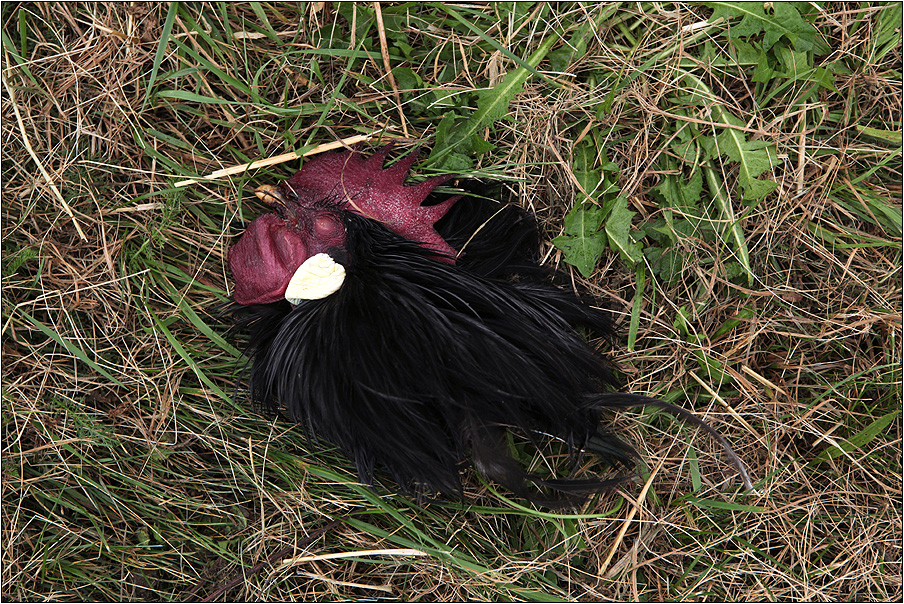
Here is the interesting bit. The killing of the cockerel was known as "the bleeding". The bleeding was done by cutting the neck, or more usually by slitting the head of the bird along the comb and then hanging it to allow the blood to fall on the ground or to be gathered in a jar...

The blood was then sprinkled in all four corners of the house (kitchen if house had more than one room) and across the main threshold, in the belief that this protected the home from evil or "bad luck".

When the blood was not sprinkled in this manner it was daubed in the shape of a cross on the front and back doors while saying, "I shed this blood in honour of God and St. Martin to bring us safe from all illnesses and disease during the year"...

The rest of the blood was collected and used to make a Sign of the Cross on the residents foreheads, again as a protective talisman.

So this was not just "killing of a cockerel to make dinner". This was a blood sacrifice. That this is the case can be seen from the ethnographic data collected around Ireland in the 1930's. I particularly love this story from county Kerry:

So it seems that "the bleeding" was an obligatory blood sacrifice. It was strictly observed that bleeding must be done between Nov. 1st and the eve of the feast, or on the Vigil, as it was said: Martin will accept before his feast but not after it".

But blood sacrifice to whom? To St Martin? Well, no, of course not. To the dead? Samhain eve, Halloweve, Halloween, was in the Irish tradition the day of the dead...

Irish believed that on that night, the barrier between our world and the world of the dead became so thin, that the dead could come back to our world.

And the dead looooove blood. It's their favourite drink, because it makes them feel alive again...I wrote about this in my post "Blood red vine" in which I talked about why red vine is used in mortuary rituals... 

That this is indeed the case can be seen from the identical ritual which is performed on St Mrata's day in Serbia. In Serbia Samhain was replaced by two Holy Days: Mitrovdan (St Martin's day) and Mratindan (St Mrata's) day.

Both days mark the beginning of winter and the beginning of the dark part of the year, as the Old Serbian calendar, just like the old Irish calendar, divided the solar year into the dark part (Nov - Apr) and the light part (May - Nov). 


More about this in my post "Two Crosses".

And on the day of St Mrata, Serbs used to slaughter a cockerel on the house doorstep. 

After the cockerel is slaughtered, a hair from every animal in the household is placed in its beak.

The beak is then tied with a red thread and is hanged over the door or is buried under the doorstep to protect the house and its animals from the evil spirits. The wings and sometimes the head were hanged on the cauldron chain over the fire. I talked about this in my post "Verige".

Both the door and particularly the doorstep and the fire place are in Serbian tradition closely linked with the cult of the dead and are places believed to be inhabited by the spirits of the dead ancestors.

So slaughtering the cockerel on the doorstep is literal blood sacrifice to the dead on their altar. This is the equivalent of the Irish custom of marking the doors with sacrificed cockerel's blood.

Burying the cockerel's head under the doorstep with the hairs of all the animals from the household is clearly a panspermia (mixed sacrifice), a type of sacrifice which was in Serbia offered to family ancestors and to the ancestor of all Serbs, Giving God, Dabog...

The fact that the sacrifice was given to the hearth is the equivalent to the Irish sprinkling cockerels blood only in the room with the hearth. But what about the Irish custom of sprinkling the cockerel's blood in the corners?

Well in Serbian mythology, corners are also seen as places where ancestors gather. During Christmas dinner, which was in Serbia seen as "meal eaten together with the ancestors", walnuts, symbol of fertility was thrown into each corner of the house, for the dead...

Now here is something very interesting. Serbian ancestral deity Dabog has another name: Hromi Daba. In several of my posts I talked about the similarities between the Serbian Hromi Daba and the Irish Chrom Dubh...

One of the similarities is that both gods were in the past offered Human Sacrifices...On Samhain...As thanksgiving for the bountiful harvest which had just finished...

Now remember that in Serbian mythology, cockerel sacrifice is a replacement for a human sacrifice...Particularly when it comes to agricultural rituals. I talked about this in my post "Cock bashing"...


And knowing that St Martin's day is just another Christianised Samhain, when we "bleed cockerel for Martin" who are we sacrificing really and to whom?