Showing posts with label Spring folklore. Show all posts

Wednesday, 23 April 2025

Whipping fresco

5th c. BC Etruscan fresco, Tarquinia, Tomb of the whipping...Depicting...Well you can all see the obvious bit that it is depicting...

I will not talk about that. I will talk about the things "hidden in plain view", that most people who look at this fresco don't see 🙂

Do you see the guy on the left who is ... the woman from behind and also whipping her?

What's with the green branches (growing out of) on his head? Are these willow branches? They look like willow twigs to me...

This insignificant detail 🙂 indicates, at least to me, that this is not just a depiction of an ordinary "fun with friends"...I think this is a ritual, a fertility ritual...

Whose traces, a believe, we can still find among Slavs...As part of willow related spring, rebirth (resurrection) of nature, fertility folklore...

Here is why I think that:

Saturday before Palm Sunday is in Serbia known as Vrbica (Willow day). On that day kids and young women make and wear wreaths made of willow twigs and flowers...

On that day, willow twigs with young leaves and flowers, like these, known in English as Pussy Willow are brought to the church where they are blessed the next day, Palm Sunday, which is in Serbia known as Cveti (Flowers day)...

According to the church, this whole willow business is the consequence of the fact that there are no palms in Serbia, and people replaced palm branches with willow branches...Move on, nothing so see here...

There are few problems with this explanation...

Vrbopuc (Willow burst) is an expression which in Serbia means "part of spring during which willow starts growing new green shoots"...

Vrbopuc is also a term used in Serbia for the period of sudden surge of sexual hormones in teenage boys and girls...

Basically willow was directly linked with human fertility...Which is why in the past in Serbia, girls used to make belts from willow twigs (wrap willow twigs around their bellies), and wear them going to the rivers to perform ritual baths performed during this time...

Among Slavs, willow was directly linked with water, water divination....Dodole, young women which took part in rain bringing magic rituals performed during hot summers also wore willow twig belts...

Mother Earth = Yin = Winter, Cold, Wet, Night, Down = Female fertility

Father Sun (Sky) = Yang = Summer, Hot, Dry, Day, Up = Male fertility

Which is why rain, water magic is female magic...

And which is why willow, the tree which grows next to water, is associated with rain, water and female fertility, female sexuality...

Hence ritual whipping of teenage girls by teenage boys using willow whips, performed in the Czech Republic, Slovakia on Easter Sunday...

The teenage boy first sang a a ritual song about spring, bountifulness and fertility, and "the young woman then turned around and got few whacks on her backside with the willow whip"...

Sounds familiar?

This was done "so girl would be healthy, beautiful and fertile throughout the following year"...They would also splash each other with water...

Cause it is water that makes land fertile...And Slavs directly linked female and land fertility...

I talked about Slavic willow folklore in my post "Willow in Slavic folklore"...

Sooooooooo...What do you think? Just a casual threesome or a fertility ritual?

For those who ask if there is a link to Lupercalia?

These are symbolically similar rituals. During Lupercalia, young men whipped women with sacrificial goat skin thongs. Dead goat was, and still is in Europe, symbol of spring...Goat being the symbol of winter. I talked about this in my posts "The birth of Romulus and Remus", "Goat in European culture"...

That's that. Interesting? I think so. 

To read more about ancient animal and plant calendar markers, start here…Then check my twitter threads I still didn't convert to blog post...I am way way behind... 

Monday, 21 August 2023

Holy water

@another_barbara:

I've read that our ancestors believed that on the evening of January 18th and January 19th until noon water is sacred and has healing and protective powers. People sprinkled this holy water in their homes. Bathing in this water was a cleansing ritual.


There are many legends about healing or holy springs in Slovenija. One of them is spring “Gospodična” (Maiden, Young woman) on Gorjanci hills. The story tells that an ill old countess became healthy and young again after drinking this water and washing her hands and face with it. 

Why this specific date?

The Christian explanation was this: John the Baptist baptised Christ on the 27th day after winter solstice. But this is most likely just s substitute tale for an older ritual.

So...What could be that "older ritual"???

Check this out:

This is winter zodiac...I talked about it in my post "Trentar"...


In one of my favourite zodiac related legends, the Slovenian legend about Zlatorog, the Ibex goat with gold horns, it is the "hunter from Trenta valley" that hunts and fatally wounds the magic goat, from whose blood springs magic Triglav rose...Which dying magic goat eats and gets healed (magically)...

So hunter, pursues Ibex goat, shoots it, it bleeds, from it's blood grow flowers...What does this mean?

Well, what you are looking at is the winter zodiac: Sagittarius (end of autumn, start of winter), Capricorn (mid winter), Aquarius (end of winter, start of spring)...

Spring starts in Aquarius...Which represents the snowmelt...This is where frigid old hag, winter earth, turns into hot young maiden, spring earth...Who then gets her first "period"...Becomes fertile again...


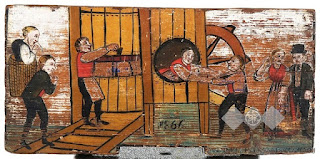
BTW, the same transformation of winter into spring is contained in a Slovenia ritual calld "Bablji mlin", meaning "Granny's mill" scene. An old hag is being milled, and thus transformed, into a young maiden. Winter being transformed into Spring...I talked about this in my post "Babji mlin"...


The same story of rejuvenation, rebirth (of the mother earth) is preserved in the Scots Gaelic ritual song "The old woman of the mill-dust":

Will you give me your daughter old lady of the mill dust?
Will you give me your daughter 
I will be happy with her
I will dance with her

From Carmina Gadelica, 19th c. Gaelic Scotland

In Gaelic, the word Cailleach means both an old woman and the last sheaf of wheat and the corn dolly made from it. Corn dolly which represents Mother Earth, the life (grain) giving mother...

I talked about this in my post "The old woman of the mill-dust"...

Interestingly Cailleach, or Cailleach Beira, is the Scottish "Queen (Goddess) of Winter". She appears as a blue-skinned hag carrying a magical staff that freezes the ground and a hammer for shaping hills and valleys. At the end of her seasonal reign, she drinks from the Well of Youth to become young again...


Spring of youth being of course the snowmelt, which begins in February, in Aquarius (!!!) 🙂, which marks the beginning of spring...And the arrival of the "Bride" (Brigid), the spring earth maiden, snowmelt being her first "period"...

Effigy of St Brigid taken from house to house to collect money while saying these rhymes: 

"Here's St Bridget dressed in white,

Give us some money to honour her night,

She is deaf, and she is dumb,

And she can't talk without a tongue"


St Brigid, The Bride, Gaelic Mother Goddess turned Saint is associated with wells (running water)...

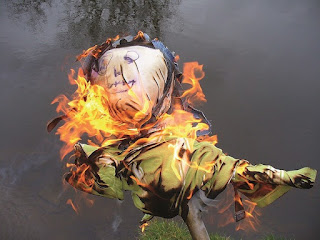
Slavic equivalent is the effigy of Marzana (winter) which is made and paraded around in Slavic countries at the same time. The effigy is then burned or drowned to symbolise the end of winter. This can give us the clue who Brigid originally was.


Also, The Witch of Winter, The Old Hag, has to be burned (and drowned) or spring will not come...Burning is heating up of the earth and drowning is the snowmelt...Burning and drowning of Marzana, Slavic name for Winter Earth...I talked about this in my posts "Gryla", "Living stone", "To kill a which", "Babele"

Oh and don't forget The Snow-White...From the article:

"What we have here is the story of Earth going through seasons: Spring, Summer, Autumn, Winter, Spring...

Beautiful young Spring Earth becomes bountiful Summer and Autumn Earth. Still beautiful, but in no way as beautiful as the Young Spring Earth...

Because of the cyclical nature of the solar year, Autumn Earth is the mother of Spring Earth of the next solar year. As Autumn ends, and the crab apples are the last fruit left on the trees, Autumn Earth turn into Old Hag Winter Earth, who "kills" her own younger self...

Dead Earth lies in her icy coffin until Young Spring Sun arrives. He sees beautiful Spring Earth under the ice, falls in love with her and revives her. Spring Earth, marries Spring Sun...

But seasons pass, Spring Earth turns into Summer Earth and then into Autumn Earth and then into Winter Earth...And the story repeats itself...Luckily, every spring, Young Sun arrives to save the day 🙂"

All these stories, beliefs and rituals basically describe the same thing: End of winter, beginning of spring...

Oh, including of course Christ's baptism ("in living", flowing water) and Mary's purification (first period after giving birth)...


@another_barbara
:

After @serbiaireland explained to me what a tale (I teach to kids for 15 years) really means, I had to add that the old countess was barren and she and her husband were sad because of that. After drinking/washing with sacred water she knew she will be able to have children now.


Thursday, 23 December 2021

Inviting spring

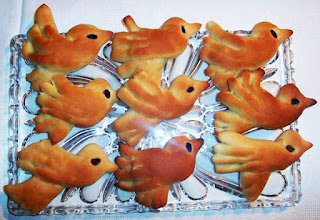
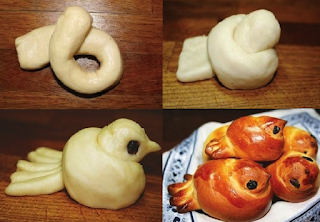
There are special kind of bird shaped buns baked by Eastern Slavs as part of the "inviting spring" rituals which were traditionally performed in March every year.  They are called "жаворонки, zhavoronki" (larks) or "кулики/kuliki" (sandpipers) ...

These cookies were baked in March for the first (1st of March), second (9th of March) and third (March 22 or 25th) calling (inviting) of spring...I guess one can get pretty impatient waiting for spring to arrive...🙂

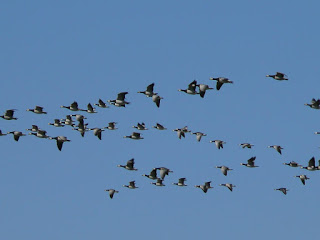
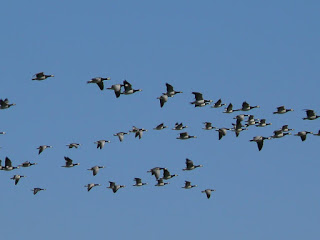
People believed that larks and sandpipers arrived “carrying spring on their wings” and “leading other migratory birds behind them”. And the arrival of migratory birds was a sure sign of coming spring. And an extremely important event in Slavic tradition...I talked about this in my post "Leto"...


Remember, Slavs believed that every autumn, migratory birds took away the sun to Iriy, Slavic Otherworld, World of the Dead, where he spent winter. And that every spring, migratory birds brought the sun back into our world...

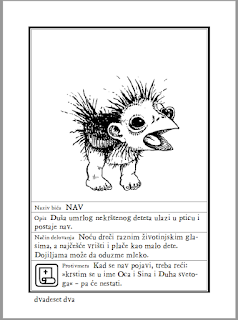
But Slavs also believed that migratory birds also brought souls from Iriy. Souls which were ready to be reborn...I talked about this in my post "Nav"...

Here is how you can make two main types of bird buns, the flying one and the sitting one...


Anyway, once made, the "larks" and "sandpipers" buns were placed on the windowsill, but most were given to children who ran around with them pretending that the birds were flying, all along shouting and calling spring to come...

Some children stuck their "bird" bun on long rods and waved them high in the air pretending that the birds were flying. Some other children threw the "bird" buns in the air trying to make them “fly” as high as possible. Some carried the "bird" buns on their heads...

The kids tried to bring their "bird" buns to "the high places": tops of hills, trees, rooftops, haystacks, fences...Children played with their "larks" all day and ate them in the evening, but some bird buns were left on the high places as offerings...

In some areas the kids would eat the bodies of their bird buns, but the heads were fed to the cattle "before they were taken out to graze in the fields for the first time"...This again seems to have been a ritual offering, a sacrifice of sorts "for good weather"...

Some bird buns were left on a patch where all snow melted. And some were thrown into a river...Remember snow melt is another sure sign of the departing winter (Morana/Marzana, the Old Hag Earth) and arriving spring (Vesna, the Young Maiden Earth)...

Which is why Slavs burn the effigies of winter or drown them or both...To be sure to be sure...But also heating of the earth causes snow to melt and the rivers to swell with the snowmelt...I talked about this in my posts "Gryla", "Baba's day"...

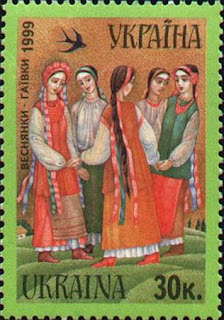
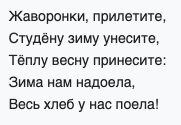
Apart from children, young unmarried women also played a major role in "calling of spring" rituals. They were the ones who sang "Веснянки / Vesnyanki" (Spring songs)...

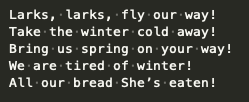
Like this one. And do you see how the end of bread (flour) is linked with the departure of winter and the arrival of spring?


That's interesting...Because it explains the "magical transformation of an old woman into a young maiden through milling" images from Slovenia...

I talked about this in my post "Grandmother's mill"


And in my post "Old woman of the mill dust" about a very similar folk tradition from Ireland...

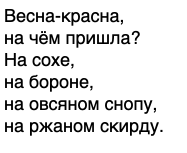
Here is another Vesnyanka (Spring song). This one directly linked with grain agriculture too...


I don't get this Red Spring thing though...Was this once Весна Красивая (beautiful spring)??? Or is red = hot?

Anyway, in some areas, women baked rye bread and then went out of the village, to the fields, orchards, meadows... There they bowed to earth, threw the bread on the ground and exclaimed: "Here is, Mother Spring, some rye bread for you"...

Again, this is a ritual sacrifice of bread to the mother of bread...And it is performed by a woman...In Slavic tradition (and not just Slavic) Earth fertility and female fertility was directly linked...I talked about this in my post "Walking sheafs of wheat", "Wheat wreath", "Corn dolly"...

This pre Christian Slavic celebration of the end of winter and the beginning of spring was later incorporated into Christianity and is now seen as part of "Сороки / Soroki" (Forty Martyrs of Sebaste)  for some weird reason... 

Here you can find the recipe and the instructional video for these beautiful bird buns (with English subtitle)... 

More about spring and birds in Slavic folklore can be found in these posts: "Partridge",  "Tetjorki", "Swallows", "Bird wedding", "Leto", "Radegast", "Cock bashing"...