Showing posts with label Celtic calendar. Show all posts

Sunday, 27 July 2025

Walpurgis Night

Illustration by Bernard Zuber for Maurice Garçon’s La Vie Execrable de Guillemette Babin, Sorciere, 1926. 

May Day Eve (April 30) is across Northern and Central Europe known as Walpurgis Night, the night when everyone is trying to "ward off, scare, witches"...

Why?

Maybe this has something to do with the old Celtic calendar which divided the year into two halves:


Winter (Samhain, 1st of Nov - Beltane, 1st of May)

Summer (Beltane, 1st of May - Samhain, 1st of Nov)

I talked about this in my post "Two crosses"...

This division of the year, is btw based on the old transhumance shepherd calendar:

Lowland grazing and lambing Oct/Nov - Apr/May

Highland grazing and milking Apr/May - Oct/Nov

I talked about this in my post "April"...

In Serbian Orthodox calendar, the beginning and the end of the "Time of Dragons", the hot sunny half of the year, is marked (guarded) by Two Georges, Summer and Winter St George('s day)...I talked about this in my post "Two Georges"...

This is important to know as a lot of old traditions linked to Beltane were migrated to the Summer St George day...

Where do witches come into the picture here?

Remember this: Hey, you Halloween witches, dressing up in black on the first day of winter...You know that The Witch here is The Hag, Winter Earth, Baba, Cailleach, The Dark, Veiled One...Here she is, all in black, with bare branch, on the four seasons Roman mosaic from the Bignor

The witch here is the Old (Winter) Mother Earth. 

In the Polish Carpathians we find this saying:

"Baba (Grandmother) is already frozen" meaning "The mountain tops are covered with frost or the first snow". 

I talked about this in my post "Gryla" about Winter Hag, Winter Earth...

Baba Dochia was an old woman who insulted the month of March. So, while she was going up the mountain with a herd of goats (symbols of winter), March borrowed frosty days from February and froze her to death...
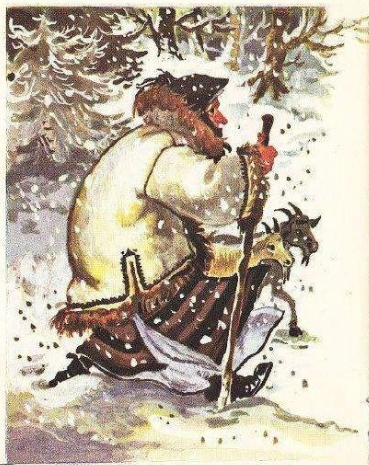
I talked about this legend from Romania in my post "Baba, cold, winter"...

Slovenian folk play called "Baba (grandmother) and Ded (grandfather)": "As they get older he gets weaker and she gets stronger. At one point she takes over him and rules until spring".  

This makes a lot of sense if Baba (Earth, Yin, Cold) and Ded (Sun, Yang, Heat)...


Ever changing Yin-Yang symbol is most likely description of the ever changing daily amount of light and darkness and the effect this change has on Earth's temperature...

More about it in my post "Yin and Yang"...

The winter earth is actually depicted as a witch in the Snow White. 

Crab apples are the last fruit to stay on the branches in Continental Europe, well into winter. 

Winter, which was imagined by our ancestors as "an old hag, and old witch" veiled in black, the bringer of death...

The one Slavs called Morana (the goddess of death) and Marzana (the goddess of cold). From my post "Snow-White"...

Some Slavs performed burning of the witch of winter/goddess of death at the beginning of spring (Jan/Feb)...

"Maslenitsa" by Simon Kozhin. 

As I said, Slavs equated The Goddess of Death, Morana (mor=death) with The Winter Earth, Marzana (marz=frost). She is ceremonially burned (warmed) or drowned (thawed) or both (to de sure to be sure 🙂) during Slavic spring festivals...

Here are some posts in which I talk about this ritual and related customs: "Gryla", "Party" "Bannock", "To kill a witch", "Baba's day", "Living stone"...

And some Slavs performed burning of the witch of winter/goddess of death at the beginning of summer (Apr/May)...

Like Sorbs (Slavs) from Germany, who at the end of April perform "Chodojtypalenje" (the witch burning). A large stack of branches is piled and a straw witch effigy is placed on top. The whole thing is then set ablaze symbolically "killing winter" (witch=hag=winter) 
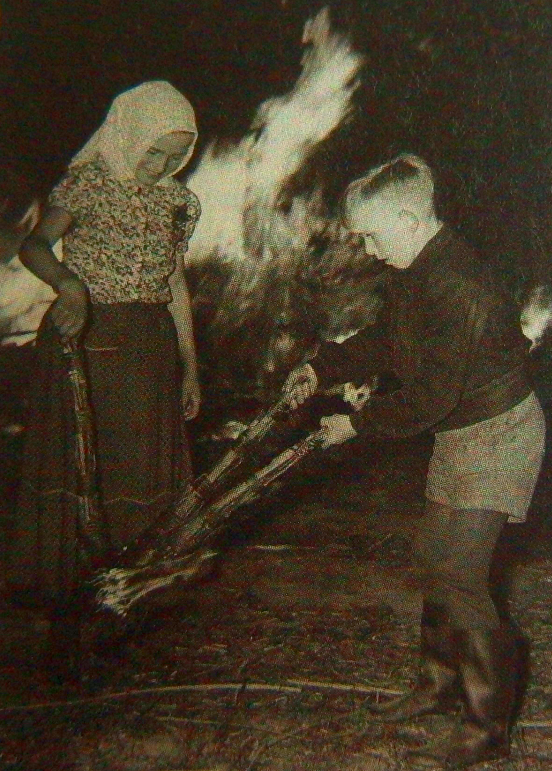
As I said above, in Serbian and Celtic calendar, year had two seasons: winter Samhain (start of November) to Bealtaine (start of May), and summer Bealtaine to Samhain. Hence Sorbian witch burning at the end of April, just before the start of summer...  

Here is a picture of one of these "witches" (hags) being burned. 

Christianised version of this custom is Walpurgis Night. "As a result of Saint Walpurga's evangelism in Germany, the people there converted to Christianity from heathenism. Saint Walpurga was also known to repel the effects of witchcraft..." 😉

I think that by now you can all see that what was burned on these bonfires was not a witch but the Hag, Ugly, Evil, Winter earth, The Goddess of Death. Who is transformed, every spring, by the fire of the sun into Beautiful, Good, Summer Earth, The Goddess of Life...This "burning" is not destruction but transformation by fire...

The fire lit at these ceremonies is supposed to ignite the reproductive fire of the mother earth. We don't want frigid winter hag, we want hot spring maiden 🙂 burning with desire for her young sun lover. Without this fire there is no life...

In the Balkans they also performed the scaring of the witch of winter

As part of end of winter, beginning of summer rituals, men and boys in Bosnia blew willow horns to scare the witch (winter) away...As I said, the old Serbian year, just like the old Celtic year, was divided into summer (Apr/May-Oct/Nov) and winter (Oct/Nov-Apr/May)...

I talked about this in my post "May horns"...

This link between Mother earth and Yin, dark, wet, cold weather, resulted in the women being the ones who in Slavic tradition performed Yin, dark, wet, cold magic. 

I talked about this in two posts, "Weather stones", about the use of "weather stones" among Slavs and "The last megalithic ritual in Europe", which talks about a ritual from Belarus, where women (Yin, dark, wet, cold) raise Dabog's (sun and rain god) stone during drought to get cool and wet weather...

And in the post "Thunder book" where we read about the prosecution of female witches in medieval Serbia for performing weather magic...

The association between (Yin, dark, wet, cold) magic and women seems to have been common in the past in the rest of Europe too. 

Two witches conjuring a hailstorm, an illustration from the 1489 book "De Lamiis et Pythonicis Mulieribus" by Ulrich Molitor which talks about weather altering magic (witchcraft) performed by women...


Did you know that the sudden climate change which resulted in the medieval mini ice age was blamed on the weather controlling witches and was the excuse for the subsequent witch-hunt? I talked about this in my post "De Lamiis et Pythonicis Mulieribus"...

Now that we know who witches were, I think it is interesting that witches seem to have liked riding on two things which are both associated with storms and winter: brooms and goats...

Broom...Remeber my post "Donderbezem" about Donderbezem (thunder broom), a protective symbol used in Holland and northern Germany as a protection from lightning strikes and evil spirits.

Goat...Goat is universally associated with dark, cold, wet half of the year (Oct/Nov - Apr/May) in Europe, Eastern Mediterranean, Western Asia, Mesopotamia, Central Asia, Iran...This is because ibex goat mating season starts in Oct/Nov and the ibex goat birthing season finishes in Apr/May...


I talked about symbolism of ibex goats in many of my posts, like 

Europe:

"Pitys", "Goat in European culture", "Patera of Rennes", "Gotland sun stone with horses and ibexes"... 

Levant:

"The tree of life/light", "Lachish animal calendar"...

Mesopotamia:

"Feast plaque from Louvre", "Green pastures", "Problems with Abzu", "Relief from Dur Sharrukin", "Goatfish"...

Iran: 

"Flamingos from Susa", "Goat carrier", "Iranian goat of rain", "Strider", "A vessel from Tepe Hissar", "Rhubarb and ibex"...

Interesting, right?

Anyway, don't just sit there. Go burn a witch. We all had enough of winter...

To read more about ancient animal and plant calendar markers, which were the key to deciphering all this, start here…then check the rest of the blog posts related to animal calendar markers I still didn't add to this page, and finally check my twitter threads I still didn't convert to blog post...I am 9 months behind now...

Saturday, 4 March 2023

Parilia

Happy Parilia (or Palilia) - This Roman festival, held on 21st April, cleansed shepherds & sheep, honouring the god of shepherds & sheep, Pales. A bonfire was built, with the shepherd and sheep jumping through the flames to be cleansed. The painting by Joseph-Benoît Suvée reimagines the festival

I find it interesting that the Romans didn't know who or what Pales was...But, considering that Ovid says that Parilia predates the founding of Rome, Pales and related rituals are of Pre Roman and most likely of Non Roman origin...

I don't know who or what Pales was either. But I would like here to add few bits of information that might help someone, some day, solve this mystery 🙂 First let's have a look at the Parilia ceremony:

"...After the sheep pen had been decorated with green branches and a wreath draped on the gate, the remainder of the ceremony took place in this sequence..."

"...At the first sign of daylight, the shepherd would purify the sheep: by sweeping the pen and then constructing a bonfire...the shepherd would jump through this flame, dragging his sheep along with him...Offerings of bread and milk were then presented to Pales..."

"...After these offerings, the shepherd would wet his hands with dew, face the east, and repeat a prayer four times...requesting Pales’s protection of the shepherd and the flock..."

"...The final portion of the rural festival made use of the beverage burranica, a combination of milk and sapa (boiled wine). After consumption of this beverage, the shepherd would leap through the fire three times, bringing an end to the ceremony..."

So...21st of April is very close to the 1st of May...Which was in some parts of the world known as Beltane (Bealtaine)...The day that marked the beginning of the Celtic summer (May-Oct), half of the year dominated by the sun...


On Beltane, in Scotland, they purified the sheep and cattle by walking them between two fires derived from single ritually kindled fire...I talked about this in my post "Beltane purification ceremony"...

And they did the same thing in Ireland on the same day...I talked about this in my post "The City"...

21st of April is very close to the 23rd of April, St George's day...And in the past in the Balkans, at the dawn of the St George's day, two fires were lit between which people and domestic animals (sheep and cattle) walked "for protection from diseases and snakes"...

St George being Christianised old Slavic sun god Jarilo (The Brightly Burning one), and snake being the solar animal which follows sun everywhere, it is obvious why people performed snake protection rituals on the day of the sun...

But there is something really interesting about when we celebrate St George and St Michael...The dragon killers...They mark the beginning and the end of the "Old Summer", the domain of the sun, the domain of the dragon...I talked about that in my post "Dragon always gets killed"...


BTW, in the old Serbian calendar, solar year is also divided into summer and autumn...Where summer starts with summer St Georges day, and winter starts with Winter St Georges day...

Summer George icon. 

Winter George icon.

So the fire purification on the day (around) the beginning of the summer...The season ruled by the Jarilo, the "Brightly Burning One"...The one who "pali" (lights up fires)...

It is interesting that in the past, in the Balkans, on the morning of St George's day kids were woken up by being swished with nettles, "to be healthy"...

Nettle sting feels like burning, and the expression in Serbian for being stung by nettles is "ožariti se" (to be burned)...

In the past, in Skopska Crna Gora region of Macedonia, women swept their houses with nettles early in the morning on St George's day, "to sweep all bad things out of the house, because everything runs away from nettles"...From: Ѓурѓовденски обичаи (1956) which sadly isn't available on Youtube any more...

There is an expression in Serbian "on žari i pali" which means "he burns and lights up fires"...Jarilo, Žarilo, Palilo...The Burning Sun of summer...

Shepherd kids making flower wreaths in the spring, most likely for Djurdjevdan (St George's day)...


From the description of the Parilia ritual:

"...After the sheep pen had been decorated with green branches and a wreath draped on the gate..."

In Serbia, on the St George's day people put wild flower and medicinal herbs wreaths on house gates for good luck and health...

I talked about St George (Jarilo) as the sheep and shepherds god in my posts "April" and "Aries must die"...

From the description of the Parilia ritual: "...Offerings of bread and milk were then presented to Pales..."

St George's day rituals involving bread and milk from Serbia: 

This is "kravaj" (pronounced kravay), a ritual bread made in Serbia. It was in the past used during "premlaz", the ritual first milking of the year which is always done the day before St George's day and which marks the beginning of the milking season...I talked about this in my post "Aries must die"...

From the description of the Parilia ritual: "...After these offerings, the shepherd would wet his hands with dew, face the east...pray..."

Just in case you wondered who the shepherd was praying to facing east at dawn...The sun...god..who "pali" (burns)...

Oh, and why would he "wet his hands with dew" before praying?

Well in places where people believed in purification by fire at the beginning of summer, they also believed in purification by dew at the beginning of summer...

This is one custom that I only read about before. On the morning of St George's day, girls would go to fields to wash their faces in dew, so that they are beautiful all year round. Recorded in Skopska Crna Gora region of Macedonia. From: Ѓурѓовденски обичаи (1956) which sadly isn't available on Youtube any more...


But this ritual was widespread among Serbs too, where dew bathing was done on the so called "herb Friday", the last Friday before St George's day. And the Irish did it too, on Beltane morning...Just another indication what St George's day is...I talked about this in my post "Morning dew"...

Interestingly, the same ritual is performed in Latvia on Jāņi day (summer solstice). Girls wash their faces with the morning dew, so their face will always be white and beautiful"...Great example how ritual dates change because of climate...I talked about this in my post "Jani"...

And that's it from me for today...After all this, I still don't know who Pales was...But I could guess...🙂 Especially after I recently found out that one of the names of the Mesopotamian god of death, Nergal, the personification of the destructive, burning sun of the late summer, was "Palil"...I talked about this in my post "Palil"...

To read more about ancient animal and plant calendar markers, start here…then check the rest of the blog posts related to animal calendar markers I still didn't add to this page, and finally check my twitter threads I still didn't convert to blog post...I am 9 months behind now...

Beltane purification ceremony

Walter Gregor’s "Folklore of the North-East of Scotland" published in 1881 gives this description of the sacrifice herdsmen performed during Beltane fire ceremony...

The first written reference to Beltane dates from the year 900 CE and can be found in the Sanus Chormaic (Cormac's glossary codex)...


Description of Beltane rituals from "Carmina Gadelica - Hymns and Incantations, Ortha Nan Gaidheal, Volume I" by Alexander Carmichael [1900]... 

Beltane blessing. From "Carmina Gadelica - Hymns and Incantations, Ortha Nan Gaidheal, Volume I" by Alexander Carmichael [1900] 


Tuesday, 10 November 2020

Bleeding for Martin

Cockerel standing on top of the sun gate, on the border between the darkness and light, between the land of the dead (where sun spends night) and the land of the living (where sun spends day). Medieval (?) standing stone, Bosnia...


In the old Irish calendar, the solar year was divided into two parts: the dark part (Nov-Apr) and the light part (May-Oct). The day that marked the end of the light part of the year and the beginning of the dark part of the year was the first of November. Samhain...


But because in the Irish calendar the day started at sunset, Samhain is celebrated  at the sunset of the October 31, on Halloween...And just like the day started with the evening, in the Irish calendar, year started with the beginning of the dark period, on Samhain...

Now until very recently, in Ireland, the practice in many places was to kill a cockerel on "Ould Halloweve" night, the night prior to St. Martin ’s feast day on the 11th of November.

The date for "Ould Halloweve", or old Halloween, came about as a result of the removal of ten days from the calendar when the Gregorian calendar replaced the Julian in 1582...

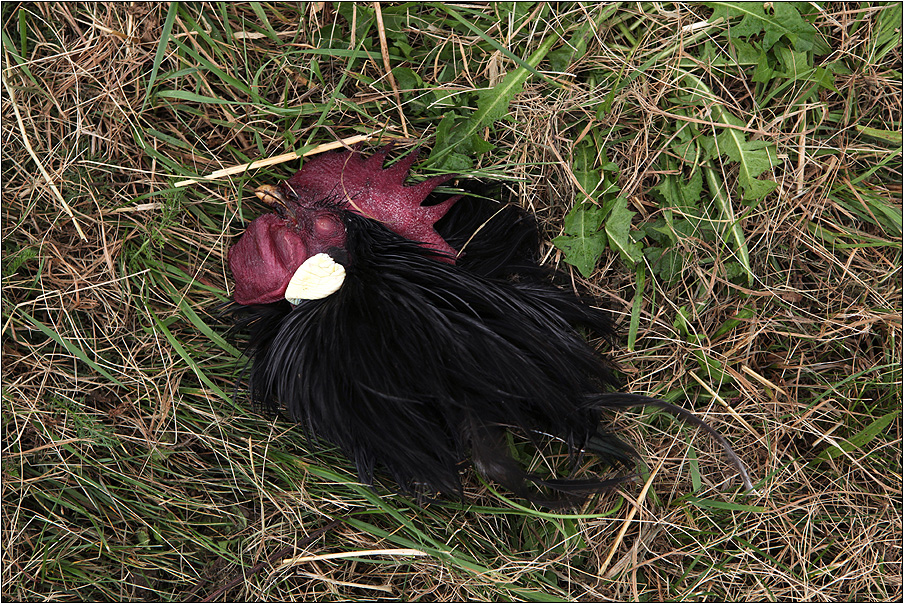
Here is the interesting bit. The killing of the cockerel was known as "the bleeding". The bleeding was done by cutting the neck, or more usually by slitting the head of the bird along the comb and then hanging it to allow the blood to fall on the ground or to be gathered in a jar...

The blood was then sprinkled in all four corners of the house (kitchen if house had more than one room) and across the main threshold, in the belief that this protected the home from evil or "bad luck".

When the blood was not sprinkled in this manner it was daubed in the shape of a cross on the front and back doors while saying, "I shed this blood in honour of God and St. Martin to bring us safe from all illnesses and disease during the year"...

The rest of the blood was collected and used to make a Sign of the Cross on the residents foreheads, again as a protective talisman.

So this was not just "killing of a cockerel to make dinner". This was a blood sacrifice. That this is the case can be seen from the ethnographic data collected around Ireland in the 1930's. I particularly love this story from county Kerry:

So it seems that "the bleeding" was an obligatory blood sacrifice. It was strictly observed that bleeding must be done between Nov. 1st and the eve of the feast, or on the Vigil, as it was said: Martin will accept before his feast but not after it".

But blood sacrifice to whom? To St Martin? Well, no, of course not. To the dead? Samhain eve, Halloweve, Halloween, was in the Irish tradition the day of the dead...

Irish believed that on that night, the barrier between our world and the world of the dead became so thin, that the dead could come back to our world.

And the dead looooove blood. It's their favourite drink, because it makes them feel alive again...I wrote about this in my post "Blood red vine" in which I talked about why red vine is used in mortuary rituals... 

That this is indeed the case can be seen from the identical ritual which is performed on St Mrata's day in Serbia. In Serbia Samhain was replaced by two Holy Days: Mitrovdan (St Martin's day) and Mratindan (St Mrata's) day.

Both days mark the beginning of winter and the beginning of the dark part of the year, as the Old Serbian calendar, just like the old Irish calendar, divided the solar year into the dark part (Nov - Apr) and the light part (May - Nov). 


More about this in my post "Two Crosses".

And on the day of St Mrata, Serbs used to slaughter a cockerel on the house doorstep. 

After the cockerel is slaughtered, a hair from every animal in the household is placed in its beak.

The beak is then tied with a red thread and is hanged over the door or is buried under the doorstep to protect the house and its animals from the evil spirits. The wings and sometimes the head were hanged on the cauldron chain over the fire. I talked about this in my post "Verige".

Both the door and particularly the doorstep and the fire place are in Serbian tradition closely linked with the cult of the dead and are places believed to be inhabited by the spirits of the dead ancestors.

So slaughtering the cockerel on the doorstep is literal blood sacrifice to the dead on their altar. This is the equivalent of the Irish custom of marking the doors with sacrificed cockerel's blood.

Burying the cockerel's head under the doorstep with the hairs of all the animals from the household is clearly a panspermia (mixed sacrifice), a type of sacrifice which was in Serbia offered to family ancestors and to the ancestor of all Serbs, Giving God, Dabog...

The fact that the sacrifice was given to the hearth is the equivalent to the Irish sprinkling cockerels blood only in the room with the hearth. But what about the Irish custom of sprinkling the cockerel's blood in the corners?

Well in Serbian mythology, corners are also seen as places where ancestors gather. During Christmas dinner, which was in Serbia seen as "meal eaten together with the ancestors", walnuts, symbol of fertility was thrown into each corner of the house, for the dead...

Now here is something very interesting. Serbian ancestral deity Dabog has another name: Hromi Daba. In several of my posts I talked about the similarities between the Serbian Hromi Daba and the Irish Chrom Dubh...

One of the similarities is that both gods were in the past offered Human Sacrifices...On Samhain...As thanksgiving for the bountiful harvest which had just finished...

Now remember that in Serbian mythology, cockerel sacrifice is a replacement for a human sacrifice...Particularly when it comes to agricultural rituals. I talked about this in my post "Cock bashing"...


And knowing that St Martin's day is just another Christianised Samhain, when we "bleed cockerel for Martin" who are we sacrificing really and to whom?