Showing posts with label Agriculture. Show all posts

Saturday, 13 June 2020

Sun god in a boat


Another interesting seal. Akkadian, Tell Asmar. Description: "Sun god in a boat. On prow long-haired crowned figure with punting pole and human-headed lion, snake's head for stern, plow, vase and two objects above, fertility goddess beside boat, fish below" 

That's it???

Well no obviously...There are a lot of interesting details on this seal that definitely deserve some explanation...

I will start with the "fertility goddess beside boat". 


Well she has grain growing out of her and she is holding poppies...


Why?

Opium poppies were cultivated in Ancient Mesopotamia where they were known as "hul gil", meaning "joy plant" 🙂 So poppy harvest was an important annual event in Mesopotamia...Poppy harvest in Iraq starts in Apr-May. More in my article "Poppies and thunder gods"  

But why is "the fertility goddess", basically mother earth from which protrude ripe ears of grain, holding ripe poppies? Well because the poppy and grain harvests coincide in Mesopotamia. You can see that both barley (main Mesopotamian grain) and poppies harvests start in Apr-May...


The poppy and grain harvest season also coincides with the annual flooding in Mesopotamia which peaks in late April early May...Hence the reed boat...Here is the Euphrates flow table. The water levels suddenly peak in April and May, due to snow melt in Iran...


The reed boat represents summer, hence Sun god as the main passenger. Summer starts in Taurus, end of April, beginning of May, harvest time in Mesopotamia...

What about "snake stern"? 


Summer is the time of snakes, which is why snakes became symbols of sun's heat and summer. You can read more about the snake solar symbolism in my article "Enemy of the sun"...

So the boat of snakes, the boat of sun's heat, sun boat, summer...

Where is Sun god stirring the boat of summer towards? Well towards autumn...Which starts in Leo and is symbolised by a lion...Lion kills snake, summer ends, autumn begins... 


Hence the Sun god ferrying the lion in his boat. 


Towards autumn...

Which is when the first ploughing starts. 


At the end of the lion mating season, which starts in Leo and spans the whole of autumn 


Hence the Sun god is ferrying the plough with the lion. Is this a water jug? The fields are ploughed only after they are flooded to soften the soil...Also summer is the time of drought, the time without rain, the time when fresh drinking water becomes very precious...

That's all I have to say about that...Here is the link to the museum page for this seal

Friday, 25 March 2016

Klas

An ear is the grain-bearing tip part of the stem of a cereal plant, such as wheat or maize. 


If you look at the wheat plant, you can see that ear looks like a head standing on a long neck (stem). 


This is the part of the cereal plant which is collected during harvest. Harvesting cereal literally means cutting off the long necks of the wheat plants and collecting the heads of the wheat plants, the ears. 

The wheat is basically "slaughtered". 

In the past this was done by hand using sickle, and the wheat plant necks (stems) were cut quite close to the wheat head (ear). This was done to make the transport and storage of the ears of wheat easier. You can see what I mean from the next few pictures which depict grain harvest during medieval time.


Basically, the harvesting of the grain was in the past done in the same way people or animals were slaughtered: you pick the head (ears of wheat) and you slice across the neck (stalks of wheat). 

There is even a Cornish ritual of "cutting the neck of the grain spirit"...

Guldize. Guldize is Cornish language for "The feast of ricks" (i.e. grain stacks). The festival itself was held at the end of the wheat harvest and took the form of a vast feast. 

The festival started with the ceremony called "Crying The Neck".

In "The Story of Cornwall", by Kenneth Hamilton Jenkin, the ceremony is described like this:

"In those days the whole of the reaping had to be done either with the hook or scythe. The harvest, in consequence, often lasted for many weeks. When the time came to cut the last handful of standing corn, one of the reapers would lift up the bunch high above his head and call out in a loud voice.....,

"I 'ave 'un! I 'ave 'un! I 'ave 'un!"

The rest would then shout,

"What 'ave 'ee? What 'ave 'ee? What 'ave 'ee?"

and the reply would be:

"A neck! A neck! A neck!"

Everyone then joined in shouting:

"Hurrah! Hurrah for the neck! Hurrah for Mr. So-and-So" (calling the farmer by name.)"


This shows clearly that harvesting of the corn was seen as cutting of the neck of the corn plant to collect the corn heads making the corn head that which is obtained by slaughter...

The cutting of the last handful of standing corn was also symbolically seen as cutting of the head of the corn spirit. Our ancestors believed that the spirit resided in this last cut head of grain...

And this is why after the ceremony of Crying The Neck, the neck was used to make a corn effigy which was then believed to contain, preserve, the corn spirit.

In Cornwall this corn effigy, presided over the Guldize feast which later took place in the farmhouse kitchen...

Sunday, 10 January 2016

Babji mlin - Grandmother's mill

Panjska končnica is the name used for the painted front panel of "kranji" beehives (Carniolan beehives).


This type of folk art, characteristic of Slovenia originally appeared in the Gorenjska and Slovenian Carinthia, and from there it spread to the entire territory of Slovenia. The oldest painted beehive panels date back to the middle of the 18th century and the last ones were painted just before the First World War. During this period, approximately 150 years, more than 50,000 of these painted beehive panels were made. The painting was usually done by self-taught naive painters who used mostly natural pigments and linseed oil, which made the colours more durable. There are more than 600 different known motifs which were painted on the beehive panels of which about half are religious.

One of the most interesting motifs found on the beehive panels is called "Babji mlin" meaning "Grandmother's mill". It depicts an old, ugly woman, being thrown into a grain mill by either a man or a devil. She comes out of the mill transformed into a beautiful young woman.


The history of this motif was explored by Niko Kuret in his work "Babji mlin, Prispevek k motiviki Slovenskih panjskih končnic". In it we can read that the earlier depiction of the "Babji mill" scene is the 1600 Dutch woodcut, depicting the scene taking place in a windmill. The copper engraving from Augsburg which dates to around 1630 and also depicts the scene in a windmill. In 1672 we have the first depiction of the "Babji mlin" in England in the book entitled "The merry Dutch miller and new invented windmill". The Munich museum has an engraving from 1800 depicting the "Babji mlin" scene entitled "The art of turning an old woman into a young one in a mill". There is also an engraving from Nürnberg dated to 1810 depicting the same scene and another engraving from 1810 from Berlin, which is the first known depiction of this scene taking place in the water mill. The color lithographs by Gustav Kühn from Neuruppin made around 1820-1830, in addition to rejuvenation of women also show the rejuvenation of men in a mill. This is also the period to which the oldest depictions of the "Babji mlin" from Slovenija were dated, the oldest being the one on a beehive panel currently kept in an ethnographic museum in Ljubljana, dated to 1861.

The "Babji mlin" motif is not only found depicted as a painting. It is also found in the form of dramatic performances, games, as part of carnival customs. The earliest surviving description of the "Babji mlin" dramatic performance is from the Cologne carnival from from 1850. The same scene was part of carnival procession in Swizerland until 1900, and in Brixlegg in Tirol the "Babji mill" was part of the carnival procession until 1862. The same tradition was recorded in Wipptal, Glurns, Innsbruck and many other parts of Switzerland. In the mid 19th century, "Babji mlin" was also described as being part of the carnival processions in many parts of lower Austria: Salzburg, Leibniz, Štajerska, Gradišće and Frohnleiten, a town in the district of Graz. In Slovenija "Babji mlin" was part of the carnival processions in many areas. Here is a depiction of the "Babji mlin" from Dobropolje, drawn based on the description of an eyewitness from the beginning of the 20th century.


This is a modern version of  the "Babji mlin" carnival scene from Radovljica Slovenija.


What is interesting is that there is actually a folk story about the magic mill which would "turn old women into young and grind (destroy) the evil ones". The same type of story was recorded in Slovenija, Germany, Austria, Switzerland and Czech republic.

I believe that the story depicting the "Babji mlin" scene existed first. The story was then enacted as part of the carnival and it was then depicted as a "curio" on engravings and paintings. But what does this strange scene represent?

As I said already in my posts "Baba - earthen bread oven", in Serbian and other Slavic languages, the word "baba" means baby, mother, grandmother, midwife, birth demon and eventually great goddess, Mother earth the mother of all of us.

I believe that the "Babji mlin" is a depiction of a transformation of the ugly, barren, cold, old hag (winter earth) into a beautiful, fertile, hot, young woman (summer earth). This transformation, the end of winter and beginning of summer according to the old Celtic and Serbian calendar, happens on the St George's day, the day of Jarilo, Beltane, which falls on the 6th of May. I wrote about the significance of this date in my post about the Beltany stone circle. The celebration of the first day of summer was in Christianity replaced with Easter which falls right after the carnival during which the old woman is transformed into a young one in "Babji mlin". The carnival falls into the period just before the first crops are about to arrive. This is the time when the last winter reserves are being eaten and it is an imperative that the earth is rejuvenated, married, impregnated and that she starts giving birth to crops. So when the mother Earth is transformed into a fertile young earth in the the Babji mlin,  it is married to a young sun, Jarilo. This is the sacred marriage between the sun and earth which produces all life and is enacted during carnivals in Serbia and Croatia as the scene knows as "Baba i Djedi" (Grandmother and Grandfathers). 

Baba (Grandmother) and Djedovi (Grandfathers) Dalmatinska zagora mid 20th Century


Baba (Grandmother) and Djedovi (Grandfathers) Serbia mid 20th Century


But why is the regeneration of Baba, Mother Goddess, Mother Earth taking place in the mill?

In Serbia a mill is considered to be a magic place. Mill is said to have been invented by the devil himself. The devil is also believed to be permanently present in mills and that he sometimes takes shape of a miller. During famines and hungry days, like carnival, it is believed that the devils and vampires and ghosts (spirits of ancestors) congregate around mills and granaries. So as a seat of the devil (old god Dabog, the giving god, The Sky Father), a mill is an ideal place to rejuvenate Mother Earth and make her young and beautiful again. In Serbia there is a belief that rainbow draws its water and its beauty from the pool beneath the water mill wheel. The water which drips from the water mill wheel and the water from the pool below the water mill wheel is believed to have special properties. Girls wash themselves in this water which is called "omaja, omaha" because it is believed that it will make them beautiful and irresistible to men. Young people bath in the pool next to the water mill wheel on St George's day, Jarilo's day, the first day of Summer, the day when winter turns into summer, to gain health, fertility and beauty. If a woman can't have children, she goes to the water mill with her husband, he grabs some water from the pool below water mill wheel with rakes, and gives it to her to drink it. It is believed that this will make woman fertile. 

So mill is in South Slavic folklore considered to be the place which contains special powers particularly when it comes to rejuvenating and ensuring fertility. So there is no wander that the mill was chosen as the place where the scene of the the rejuvenation of the Mother Earth takes place. But there is another reason why the rejuvenation scene takes place in a mill. Mill is the place where grain is turned into flour. It is therefore directly linked with the grain fertility magic, and the Mother Earth is in agricultural societies directly linked to grain and bread. She is the Mother of Grain, the Spirit of Grain and the grain and ultimately bread itself.

This link is preserved in Slavic traditions and languages.

bа̏bičiti - to make, to tie grain sheaves
baba - sheaf of grain, wheat


To me a sheaf of wheat even looks like a woman. And if we know that in South Slavic languages baba is a fertile woman, a woman who had children, a mother then there is no wonder why a sheaf full of grain is called baba.

Czech: baba - last sheaf brought from the field
Lower Lusatian: baba - sheafs of linnen
Slovenian: babica - stack of sheafs left on the field
Russian: babka - stack of sheafs, sheaf
Bulgarian: babka - stack of 5,10,15 sheafs
Croatian: baba - top most sheaf on the sheaf stack


In Slovenija in the old times, during the harvest all the neighbors helped each other. First the reapers would come to the field and would begin to reap. The first sheaf of wheat was always raised to the sky, which is a remnant of the old sacrificial ritual of thanksgiving. The last sheaf, called baba, was believed to be the residence of the grain spirit. After the harvest this grain spirit had to be killed. The grain spirit was killed by hitting the baba sheaf with a hand. Men would then load the sheaves on to the cart. The ears of grain left on the field were considered to be sacrificial offerings to the grain spirit.

Harvested grain was then dried on hay-racks called kozolec meaning goat. Sometimes a carved image of a goat made of wood, called God's goat, was affixed on the front of the  hay-rack. Bundles of wheat were hanged on its horns, and were left there until the new harvest. It was believed that such decorated hay-rack would not be struck by lightning. A goat was in fact an animal dedicated to Perun, Slavic god of thunder and lightning.

The last cart was usually loaded higher at the back and lower in front. A tall straw doll called Baba was placed with rakes at the rear of the cart. The cart driver would cup with a whip and cry out: "We brought the baba, give us drink for her."

I will talk more about the significance of the last sheaf in European tradition in one of my next posts. But it is important to note that in South Slavic languages the sheaf, the top sheaf, the last sheaf and the effigy, doll, made from the last harvested grain are all called baba.

I already wrote that baba is also the name for the traditional earthen bread ovenIt is baba (married woman, mother) that carries the baby in her belly (the bread oven). Baby (bread) needs to spend just right amount of time in the belly (oven) of the baba (mother, oven) in order to grow and develop properly. It is baba (mother in law, or any other older woman who has previous experience with birth, later professional midwife, bread making) that deliver the baby (bread). 

In Slavic countries baba is also name used for various ritual breads linked to ancestor worship. 

In Eastern Serbia baba is the name of the second smaller cake baked for Slava, the main ancestor celebration. Babica, Baburica is the cake baked for the soul of the deceased during Zadušnice, a ritual feast organized for the dead ancestors. In some parts of Serbia baba is a cake baked for Christmas, the day dedicated to the father Sun. In some other parts of Serbia baba is any ritual cake (bread)....In Czech republic baba, bapka is "a type of pastry", in Poland baba, babka (Baba wielkanocna), babica is "ritual pastry, round small bread", in Ukraine baba is also "ritual pastry". The fact that ritual breads are called baba shows direct link between the human and agricultural fertility magic and the ancestor worship, in which Mother Earth is the Great mother, Great Goddess, Baba. 

So far we have seen that in Slavic countries baba is the name used for sheaf of wheat, for bread oven and for ritual breads. Baba is also the name used for great goddess, Great Mother, Mother Eearth. Mother Earth who gives birth to wheat, year after year after year. But even Mother earth can get barren and infertile after years of giving birth to harvest after harvest after harvest. Just like an old woman who has given birth to many children eventually becomes exhausted, infertile and barren.

But there are two ways in which an old exhausted barren land can be rejuvenated, made young and fertile again: by water and fire. 

Floods bring and deposit nutrients which have been depleted by crops. Regular yearly floods ensure that the Mother Earth is rejuvenated every year and is fertile and fruitful as if she was a virgin land. It is no wonder then that it was in the alluvial and flood plains that grain agriculture developed and flourished in the early Neolithic times. The soil is sandy and therefore easy to work, it is rich and gives high yields, and it is regularly enriched with new flood deposits preventing soil depletion, which was the main problem for early farmers. I wrote about this in my post about Blagotin archaeological site. 

The vegetation burning is the other way to return the nutrients drawn out by the plants into the soil. By regularly burning of the plants in the autumn returns the nutrients back into the soil and makes it rich again. 

What is interesting is that the "Babji mlin", the scene in which an old woman is thrown into a mill only to emerge as a young woman on the other side, is not the only depiction of the rejuvenation scene. There are, according to Niko Kuret, two more depictions of the rejuvenation scene. In the first an old woman walks into a well only to emerge as a young girl on the other side. Is this a depiction of the floods rejuvenating Mother Earth? In the second, an old woman walks into a forge or an oven only to walk out as a young girl. Is this a depiction of the fire rejuvenating Mother Earth? 

So I believe that here we have discovered something very interesting. I believe that the the scene called "Babji mlin" is a remnant of the ancient fertility ritual related to the annual rejuvenation of the Mother Earth, Great Goddess. Every 4th of February, at the beginning of spring, she is transformed from the old, ugly, cold, barren winter Earth into the young, beautiful, hot, fertile Spring Earth. This transformation happens under the influence of her husband, Father Sky, Great God to whom she is then married on the 6th of May, at the beginning of summer. 

What do you think? 

Thursday, 16 April 2015

How old is Crom Dubh

The worship of Crom Dubh or Crom Cruiach, the old Irish god of agriculture, is most closely associated with Tigernmas, sometimes called Tiernmas, the Irish high king who is said to have perished while worshiping this god. But where and when did the worship of Crom Cruach, Crom Dubh originate? 

The old Irish annals tell us that the first race that lived in Ireland were Fomorians. Then, after the flood, came the people of Partholón who are credited with introducing cattle husbandry, ploughing, cooking, dwellings, trade, and dividing the island in four. But then Partholon and all his people later died of plague leaving Fomorians as the single inhabitants of Ireland. Then The people of Nemed came, the descendants of the brother of Partholon, and they found Fomorians living in Ireland. They fought the Fomorians under Nemed and won. But after Nemed's death, Fomorians enslaved Nemed's people and demanded a heavy tribute: two thirds of their children, grain and cattle. The tribute that Nemedians had to give to Fomorians was exactly the same as the tribute Tigernmas had to give to Crom Dubh. Nemed's son gathered an army of sixty thousand, rose up against them. After a great slaughter on both sides, only thirty of Nemed's people escaped in a single ship, scattering to the other parts of the world, leaving again only Fomorians in Ireland. Well actually the Lebor Gabála Érenn says that when the next invaders, the Fir bolg, came then found Ireland empty. But Lebor Gabála Érenn also seems to suggest that Fir bolg and Fomorians were one and the same people. At least Macalister, the translator and editor of the Lebor Gabála Érenn thought that this could be so when he says that:

"The line between the Fir Bolg and the Fomorians is not clearly drawn…"

What is also very interesting is that Fir Bolg are also said to have been the descendants of Nemed who was the descendant of Partholon's brother. This makes Fomorians and the people of Partholon one and the same people. 

We have to ask ourselves why are the Fomori most directly linked to Fir Bolg. The Lebor Gabála Érenn states:

"Partholon took Ireland: he dwelt there five hundred and fifty years, till the  Cynocephali (dog headed, wolf headed) drave him out, and there escaped [survived] not one of his children alive."

Who were these wolf people?  Macalister suggests that “the Cynocephali introduced into the subsequent Partholon story have no place in the orthodox narrative, unless we are to equate them to the Fomoraig. What is the old Irish word for wolf? It is "faolchú". In Slavic it is Vuk, Volk, Vlk. Slavs have long tradition of ware wolfs. Slavic warriors wore wolf skins. These are the berserkers from the Norse legends, people wearing wolf skins as part of their war attire. 

The Úlfhéðnar (singular Úlfheðinn), another term associated with berserkers, mentioned in the Vatnsdœla saga, Haraldskvæði and the Völsunga saga, were said to wear the pelt of a wolf when they entered battle. Úlfhéðnar are sometimes described as Odin's special warriors: "[Odin’s] men went without their mailcoats and were mad as hounds or wolves, bit their shields...they slew men, but neither fire nor iron had effect upon them. This is called 'going berserk.'" In addition, the helm-plate press from Torslunda depicts (below) a scene of Odin with a berserker—"a wolf skinned warrior with the apparently one-eyed dancer in the bird-horned helm, which is generally interpreted as showing a scene indicative of a relationship between berserkgang... and the god Odin"—with a wolf pelt and a spear as distinguishing features.

This is Vendel era bronze plate found on Öland, Sweden, thought to represent Odin, Vodan with wolf warriors. 


In my post about Odin I wrote about the the fact that the etymology of the name Odin, Vodan comes from Slavic languages. Are these the same wolf people, Fir Volk from Irish legends?


Serbs in particular believe that they descend from Van, the man who could shift into a white wolf, who was the son of Dabog, Hromi Daba who I believe is the the same as Crom Dubh. Dabog was also known as a wolf shepherd. Appropriate god for Fomorians who according to The Lebor Gabála Érenn: 

"made a sheep-land of Ireland". 

And the Biggest Slavic tribe which is mentioned in relation to the Samhain human sacrifices are called Volci, Vilci, wolf people...Could it be that Fir Bolg are Fir faolchú actually Fir volk, Fir voulk, wolf people, wolf head people? We have seen already that when words cross from irish into serbian the b turns into v and g turns into k. We have a general hardening of sounds from Slavic to Celtic. That this is the case suggests the fact that the Fir Bolg are first mentioned in the 9th century Historia Brittonum, where they are referred to as the Builc...

Then came the Tuatha Dé Danann, another group of descendants of Nemed who was descendant of Partholon's Brother. They defeated the Fir Bolg in the first Battle of Magh Tuiredh and took possession of Ireland. But then they had to defeat the Fir Bolg again, this time under the name of Fomorians at the Second Battle of Magh Tuireadh. Interestingly the Annals of Loch Cé call Magh Tuiredh "Magh-Tuiredh-na-Fomorach" and explain that Magh-Tuiredh what the place "where the Fomorians were imposing their tributes on the men of Erinn..." The name Mag Tuired (modern spelling: Magh Tuireadh) means "plain of pillars" or "plain of towers". Crom Cruach was represented by a large idol, made completely of gold, which stood on the plain of Mag Sleact, which is in Cavan County in Ulster , Ireland . Twelve smaller idols, these of stone, formed a ring around the Crom Cruach. Were pillars which were standing on this plain the same pillars representing Crom Dubh, Crom Cruach???

At the end of the Second Battle of Magh Tuireadh, Bres, the leader of the Fomorians was found unprotected on the battlefield by Lugh, the leader of the Tuatha Dé Danann. Bres pleaded for his life with him. Lugh spared Bres because he promised to teach the Tuatha Dé Danann agriculture. Bres is said to have possessed the the secret knowledge of "How shall the men plough?  How shall they sow?  How shall they reap?". He gave that secret to Lugh, the leader of the Tuatha Dé Danann and his life was spared. 

What is interesting about this story is that both Bres, the leader of the Fomorians and Lugh the leader of Tuatha Dé Danann at the Second Battle of Magh Tuireadh were half Fomorian and half Tuatha Dé Danann.

Lugh's father was Cian of the Tuatha Dé Danann, and his mother was Ethniu, daughter of Balor, of the Fomorians.
Bres's father was Elatha of the Fomorians and Eri, daughter of Delbaith of the Tuatha Dé Danann.

This means that the Tuatha Dé Danann, who are said to have replaced Fomorians as the rulers of Ireland actually claim descent from or at least close kinship with the Fomorians. Actually the line between the Fomorians and the Tuatha 
Dé Danann is so blurred, that in the "lebor gabála Érenn" we read:  

At the end of three days and three nights thereafter the Sons of Míl broke the battle of Sliab Mis against demons and Fomoraig, that is, against the Túatha Dé Danann"...

This line literally equates the Fomorians and the Tuatha Dé Danann.

From the above story we see that if Fomorians were indeed related to Partholon, then it was the Fomorians who brought the secret of the grain agriculture to Ireland and preserved it until the time of Tuatha Dé Danann. We also see that when the Milesians came to Irleand, the Fomorians were still there. Lebor Gabála Érenn tells us that the Irial Fáid father of Ethriel and grandfather of Tigernmas:

"...cleared twelve plains, dug seven royal forts, and fought four battles against the Fomorians..."

The Fomorians were apparently still in Ireland at the time of  Cú Chulainn. In the medieval Irish tale entitled "The Training of Cú Chulainn", preserved as a copy by Richard Tipper in British Library, we read:

"Cúchulainn came to the place and saluted them. 'What is this sorrow or the misery upon you?' says Cúchulainn. The damsel answered and this she said: ‘A royal tribute which the tribe of Fomorians carry out of this country every seventh year, namely, the first-born of the king's children. And at this time it has come to me to go as that tribute, for to the king I am the dearest of his children.’‘What number comes to lift that tribute?’ asks Cúchulainn. ‘Three sons of Alatrom of the Fomorians,’ she answers, ‘and Dub, Mell and Dubros are their names.’"

Did Fomorians brought with them their god of grain agriculture, Crom Cruach, Crom Dubh and is this why the both Crom Dubh and Fomorians demanded the first born sacrifices? And if Tigernmas was worshiping Crom Dubh, was he worshiping Fomorian god? And if so, was Tigernmas a Fomorian king? I believe so. 

If the Fomorians were the people who possessed the secret of the grain agriculture and Tigernmas was the king who introduced the agricultural cult to Ireland which included the same types of sacrifices which were also demanded by Fomorians, that would certainly suggest that Tigernmas was a Fomorian king. James Bonwick thought so too. In the book "Irish Druids and Old Irish Religions" he identified Tigernmas, the king who perished while worhiping Crom Cruach, Crom Dubh, the god of agriculture, with Balor, the King of Fomorians. This is based on the fact that the ancestry of the god Lugh is usually given as Lugh son of Eithliu daughter of Balor but in the text Baile in Scáil it is given as Lugh son of Eithliu son of Tigernmas, thus equating Tigernmas and Balor, the king of Fomorians.

In the comments in the translation of the annals of the four masters by Owen Connellan we reed that in Ireland the sun was worshiped under the names of Bel, Beal, and Baal. Belenus (also Belenos) was a deity worshiped in Gaul, Britain, and Celtic areas of Austria and Spain. He was the god who brought light, who brought whiteness. The name comes from bel + nos = white, light + brings. Beltane was the Irish beginning of Summer festival, celebrating the beginning of the white, bel, part of the year. According to 17th century historian Geoffrey Keating, there was a great gathering at the hill of Uisneach each Beltane in medieval Ireland, where a sacrifice was made to a god named Beil which was again the same sun god Bel, Beal, Baal.

At the time of the writing of the Irish medieval manuscripts, the word Baal was commonly accepted to mean lord. This word is said to come from the Hebrew בעל (ba‘al, “lord, master, owner”), from Proto-Semitic *baʿl- (“lord, master, owner”). Baal was also the enemy of Yahweh, the Christian god, so the term was well known to the christian monks, and would have been used to describe the old gods, the enemies of the Christian god. 

So if a Christian monk wanted to write "a lord who brough gold into Ireland" he could have written this as baal + or = lord + gold. So we have the manuscript "Baile in Scáil" equating Tigernmas who is "the beautiful lord who brought gold to Ireland" with Balor whose name means "the lord of gold, or golden lord". Coincidence? If we know that Bel, Beal, Beil, Beli, Baal were all the names of the Sun god, the name Balor could also mean a "golden sun"...A fitting name for a sun god with a "blazing" eye... One last thing. Both Tigernmas and Bres mean beautiful. 

Tigernmas is sometimes referred to as the “culture king”, because it is said that he was the one who brought aspects of civilisation to Ireland including the smithing of gold and silver, the dyeing of fabrics, and the making of music and art. It seems that he could have brought the agriculture too. This would mean that it was the Fomorians who brought both agriculture and the metalwork to Ireland. 

According to the archaeological records, the grain farming arrived in Ireland in the fourth or third millennium bc. As for metallurgy, according to the archaeological records the copper metallurgy was brought to Ireland in the third millennium bc.

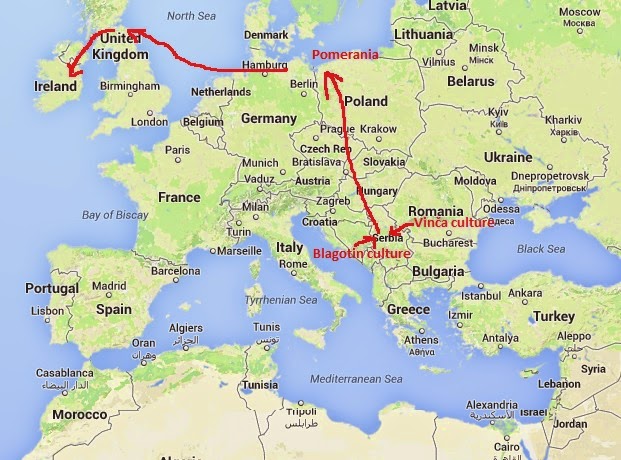
At the end of the 7th millennium bc, we find in the Balkans, in Serbia, a highly developed grain farming Blagotin culture, which was part of the early Starčevo culture.There are strong indications that this culture was a direct precursor of one of the direct precursors of the Vinča culture. Vinča houses had grinding stones and bread baking ovens indicating that the Vinča culture was both an advanced metallurgical and an advanced grain farming culture. It is quite possible that from the 6th millennium bc, metallurgy and grain farming spread together into Europe from Serbia? And if so then the metallurgy and grain farming really could have reached Ireland together, brought by the same people, the first inhabitants of Ireland, the Fomorians. 

So who were these Fomorians then and where did they come from? Irish historians agree that the name Fomorians means probably people of the sea, or people who came from across the sea, or sea pirates. Where could have been that land across the sea famous for its sea pirates whose name sounds like Fomori?

There is a country like that. It is south Baltic part of Germany, called Pomerania or Pomorje.

Pomerania, Pomorje is a Slavic word meaning the land by the sea. The word comes from po + more = by, along + sea. The people living by, along the sea are in Slavic languages called pomori, pomorci, pomorjani, meaning the sea people, coast people. 

This is the territory of Pomerania, Pomorje:


Pomerania (German: Pommern, Latin: Pomerania, Polish: Pomorze) is a historical region on the south shore of the Baltic Sea. The name Pomerania comes from Slavic po more, which means Land at the Sea. The adjective for the region is Pomeranian (Polish: pomorski, German: pommersch), inhabitants are called Pomeranians (Polish: Pomorzanie, German: Pommern).
This land was indeed famous for its sea pirates and traders. Pomerania is where we find Sorbs, northern Serbs who also worship Dabog (Dazdbog). These Baltic Slavs, Sorbs made human sacrifices in medieval time to their gods at the end of harvest at the beginning of November, at Samhain. Lebor Gabála Érenn says that "Tigernmas died in Mag Slecht, with three fourths of the men of Ireland in his company, on Samhain night to be particular, while worshiping of Crom Cruaich; for he was the king-idol of Ireland." During these Samhain ceremonies, human sacrifices were offered to Crom Cruaich, Crom Dubh.  Tigernmas is said to have been the first king to give drinking-horns to his follower. The god to whom Pomeranian Slavs sacrificed people on Samhain was Svetovid. He is sometimes referred to as Beli (or Byali) Vid (Beli = white, bright, shining), and is often depicted with a sword or bow in one hand and a drinking horn in the other. Drinking horn was used for divination during the Slavic ceremonies. In Slavic mythology, the "horn of plenty" is the equivalent of Dagda's "cauldron of plenty". Dagda is then in turn believed to be another name of Crom Dubh, Crom Cruach

There is a well established cultural distribution path Balkans - South Baltic (Pomorje, Pomerania) - Ireland which has been in operation since at least fifth millennium bc. I wrote about this in my posts about henges, in my post about wooden trackways, tochars and in my post about baba stone statues. I believe that the agriculture and metalwork probably followed the same distribution route, which means that the people who brought agriculture and metalwork could have been referred to as Fomori, Pomori.


It seems that the old Irish legends about Tigernmas the king of Fomorians bringing agriculture and metal work to Ireland could be true. Except that if they are true, then Tigernmas lived in the 3rd or 4th millennium bc. Is it possible that the Irish oral tradition has preserved records of events that happened 5000, 6000 years ago? Is it possible that metallurgy arrived in Ireland earlier than we think, at the same time when grain farming arrived? Or did grain farming arrive in Ireland later than we think, at the same time with metallurgy? 

Crom Cruach also known as Crom Dubh who was the Sun God,Thunder god but also the god of agriculture. One of the most important early Bronze Age monuments in Ireland, The Grange circle, was built as a temple dedicated to Crom Cruach, Crom Dubh.


When was the Grange circle built? If we knew when the Grange circle, the temple of Crom Cruach, Crom Dubh was built, that could help us determine how old Crom Dubh as a deity was. In my post about the Grange circle you can read that professor Ó Ríordáin postulated that the circle dated from the Late Neolithic and that it was built c. 2,200 B.C. Archaeologist Helen Roche, however, has suggested that the Grange stone circle was constructed in the Late Bronze Age (c. 1000 BCE) on a site that may have been sacred for thousands of years.

I believe that the building date proposed by Seán P. Ó Ríordáin (2200 bc) is much closer to the actual building date. I believe that the Grange circle was contemporary with the Newgrange and that was certainly built between 3200 bc and 2200 bc. However, additions and changes were probably made in the following millenniums as the worship of Crom Dubh persisted in Ireland up until the arrival of Christianity.

If the Grange circle was built in the 3rd millennium bc, then it would fall into the "pre flood" period which would make Crom Dubh a deity of Fomorians.

Grange circle was built as a giant threshing floor. Threshing floors were in the past used not only for threshing wheat but also as solar observatories and as ceremonial grounds used for agricultural cult practices. I wrote about this in my post about threshing floors. So it is only to be expected that the temple dedicated to Crom Cruach, Crom Dubh, the Sun God and Harvest god of Fomorians, the people who brought agriculture to Ireland, was built to resemble a giant threshing floor.


So is it possible that Crom Dubh is really 5000 years old deity? I believe so. We find aditional proof of the antiquity and the importance of Crom Dubh in the Serbian tradition where Crom Dubh is known as Hromi Daba. This is what Serbian tradition tells us about Hromi Daba:

According to the Serbian folk tradition, Hromi Daba was another name for the old god Dabog, Dajbog, Dažbog, Daždbog, the Giving God, the ancestral deity of the Serbs. Serbs believe that they descend from Dabog. 

Hromi Daba, Dabog was also said to be "the oldest devil and this is why he is also called "djed" meaning the elder, the ancestor". This means that the Serbian tradition claims that Hromi Daba is the the oldest god. With the arrival of Christianity the main old God of the pagan Serbs became the main Devil of the Christians. 

Hromi Daba is also "the devil from which all the other devils come from". This identifies Hromi Daba as the origin of all the other pagan gods. If Hromi Daba, Crom Dubh, Grom Div is really 5000 or 6000 thousand years old, that would make him at least a contemporary with the oldest deities in Evroasia and north Africa if not their origin. The fact that Crom Dubh is directly linked with the Bull cult makes it possible that Crom Dubh descends from much earlier bull cults which originated in Catalhuyuk and which were later found in Vinča. I will dedicate a whole post to this link bewteen the Crom Dubh and the Bull worship.

Hromi Daba was "the main enemy of god", "as powerful as the god in heaven" but aslo that he was "the king of earth". This identifies Hromi Daba as the main god of the pagan Serbs. Hromi Daba is said to "carry the sun on top of his spear" which identifies Hromi Daba as a sky god. Crom Dubh is in Ireland associated with solar circles and with the Croagh Patrick, the holy sun mountain. We know from the archaeological records that Croagh Patrick and the area around it was regarded as a holy place in the 4th millennium bc.

Hromi Daba, Dabog is also identified as Triglav, Trimurti, the three headed Sun, Thunder and Fire deity. Triglav is also identified as the main god of the Serbs. The three headed idols found in Ireland are identified as representations of Crom Dubh. This confirms that Triglav and Dabog, Hromi Daba are one and the same deity. According to the Serbian folk tradition, "god gave thunder and ligthning to St Ilija, to kill all the devils and he did so. Only Hromi Daba managed to escape". St Ilija is the Christian replacement of Perun, the thunder god of the pagan Slavs. As I already wrote in my post about Triglav, Perun is the third head of Triglav, the sun at its most powerful and dangerous, at the end of the summer. You can read more about this in my posts about Ognjena Marija and Threshing Floors. The day of Perun and St Ilija is the 2nd of August, which is in Ireland the day of Crom Dubh. In Indian tradition both Trimurti, Shiva and Agni are represented as three headed deities. In Europe Lugh, the thunder god was also represented as three headed. I believe that cruciform tumuluses which were built in Ireland in the 4th millennium bc were built as temples of the three headed god Triglav, Crom Dubh, Hromi Daba, Grom Div. But I will talk about this in a separate post in detail. 

 Another Serbian folk tale identifies the hill in eastern Serbia which was the home of the "Silver king", the demon of the mines, as Dajbog hill. This means that Dajbog, Hromi Daba was also a god of metalurgy. Serbian word "hrom" means lame and lameness was a common mallady aflicting the first metalurgists working with arsenic copper. This is why Serbian historian Veselin Čajkanović thought that Dabog was among other things the Smith god. Croagh Patrick, the holy mountain of Crom Dubh is also a gold mountain, as its top is very rich in gold. The 12th century "Book of Leinster", talks about the god called Crom Cruach, whose cult image, consisted of a gold figure surrounded by twelve stone figures. This deity was "propitiated with first-born sacrifice in exchange for good yields of milk and grain" and it is said that "High King, Tigernmas, along with three quarters of his army, have died while worshipping Crom on Samhain eve". The 9th century "Tripartite Life of Saint Patrick" talks about the deity called Cenn Cruach, which is another name of the Crom Cruach, Crom Dubh. The book says that Crom had a cult image which consisted of a central figure covered with gold and silver, surrounded by twelve bronze figures. This i believe identifies Crom Dubh as a deity linked with metalurgy as well as with agriculture, but also as a solar deity. 

In the biographies of the Bishop Otto fon Bramburg, who converted Western Slavs (Sorbs) in the South Baltic, in Pomerania we can find more information about the god Triglav (Dabog, Hromi Daba). All three biographers ( Ebo , Herbord and an unnamed monk from the monastery of Priflinger ) have witnessed the existence of a three-headed idol in Wolin and Szczecin. Ebo said that the city of Wolin is situated on the slopes of three hills, and that it has a temple dedicated to a deity with three heads, which was called God Triglav („...deo Triglavo dicitus, tricapitum habebat...“). The same author says that Otto von Bamberg destroyed the idols, by chopping the heads off with an axe. He then sent the three silver coated heads to the pope Calixto II in Rome, as evidence that his mission of converting Polabian Slavs (Sorbs) was successful. According to Ebo, Triglav is the highest Slavic God ( " summus Deus " ), the ruler of the three worlds (heaven , earth and the underworld). The statue was made of wood, that it's three heads were encrusted in silver, and that it's heads were covered with the "tiara" or some kind of a hat made of gold, which covered the idol's eyes.

In the town of Stettin were three hills, the central one being dedicated to Triglav, the chief local deity. This idol was of gold and had three heads, while its eyes and lips were covered with a golden veil. The pagan priests declared that Triglav ("Three-Heads") was tricephalous because he wished to make it known that he ruled over three realms, i. e., heaven, earth, and the underworld; and he covered his face because he would not see the sins of men. The temple of Triglav was built with wonderful skill. On the inner and outer sides of the walls were various embossed figures of men, birds, and animals, so well made that they seemed to live and breathe. Their colour was always fresh and durable, and could be damaged neither by rain nor by snow. According to the custom of the ancestors one tenth of all booty was stored in the treasury of the temple, and there was, moreover, an abundance of gold and silver vessels used by the chieftains on festive occasions, as well as daggers, knives, and other rare, costly, and beautiful objects. In honour of and in homage to the gods colossal horns of wild bulls, gilded and adorned with precious stones, were kept there, some serving for drinking vessels, and some for musical instruments.

The fact that Crom Dubh, Hromi Daba is both the Solar Agricultural god and Smith god is understandable if we remember that Farming and Agriculture spread together from the Balkans.


In Serbia Hromi Daba, Dabog was finally "killed" by St Sava, who became the patron saint of Serbia. In Ireland Crom Dubh was finally "killed" by St Patrick, who became the patron saint of Ireland.

So how old is Crom Dubh? Is Crom Dubh, Hromi Daba, Grom Div realy a 5000 or even 6000 thousand years old Deity? Did Crom Dubh, Hromi Daba, Grom Div arrive to Ireland from the Balkans with the  the first farmers and metallurgists to reach Ireland in the 4th or 3rd millennium bc?  What do you think?

And if Crom Dubh really is 5000 or even 6000 thousand years old, isn't it amazing that his cult managed to survive in Ireland and Serbia and only in Ireland and Serbia, until medieval time?

The Irish word "dar" means by, in a sense "i swear by". This word is used in swears and oaths and invokes the god as a witness. There are several versions of this swear all with the same meaning "by God": "Dar Dia", "Dar Duach" and "Dar Crom".

"Dar Dia". Dia is the Irish word for God which comes from Old Irish día (“god”), from Proto-Celtic *dēwos (compare Welsh duw), from Proto-Indo-European *deywós. So no surprises here. 


"Dar Duach". Duach is the Irish word with an interesting etymology. In Irish it is said that it comes from du- , do- prefix which denoting badness of quality, Irish, Old Irish du-. In Welsh we find the word duach as comparative form of du which comes from Proto-Celtic *dubus (“black”) (compare Old Irish dub, Irish/Scottish Gaelic dubh), from Proto-Indo-European *dʰewbʰ meaning black. So this would make "Dar Duach" mean By Dark Lord, By Evil Lord...Interesting don't you think? Were people really swearing by the Dark Lord? I don't think so. I don't think that this is the true meaning of the word Duach in this phrase. In Slavic languages the word Duh means spirit, ghost and it comes from the Proto-Indo-European root *dʰeus meaning breath or the root *deywós meaning god. So no surprises here about the meaning. 


In the end we have "Dar Crom". That Crom is still used in Irish to mean God is a big surprise. After all the attempts to eradicate the belief in Crom Dubh from Ireland and to turn the oldest sky god of Evroasia into the Dark Lord, the Devil, the Evil king of the Earth, the Irish languages still managed to preserve the true meaning of Crom Dubh in this one little phrase: Dar Crom = By Jove...
Crom is not the Devil, he is the God, and not just any God, but Jove, the Sky god, the god in Heaven, the Thundering Sun Giant.