Showing posts with label Threshing floor. Show all posts

Saturday, 7 September 2024

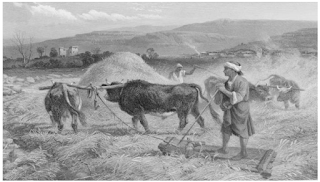
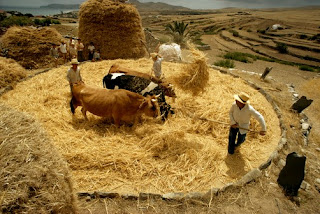
Threshing floor of Apollo

Threshing floor, Naxos, Greece...
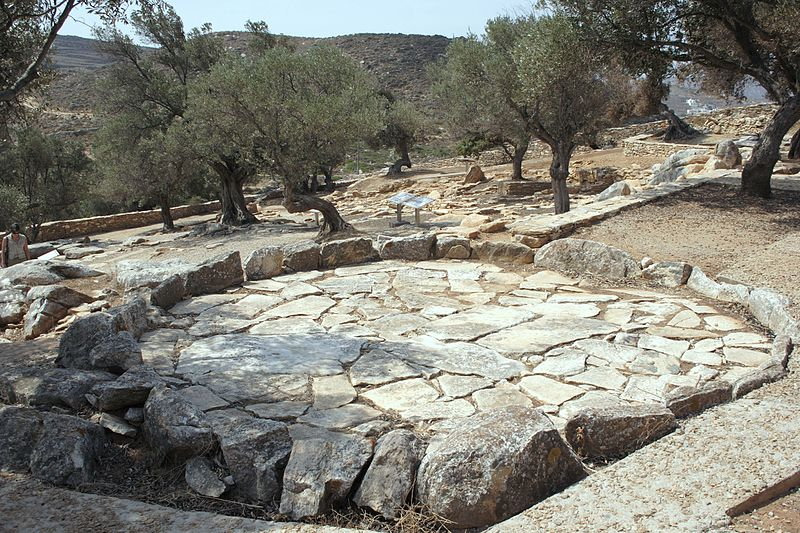
Today, while reading "Delphi and Cosmovision: Apollo's Absence At the Land of the Hyperboreans and the Time for Consulting the Oracle", I discovered that Delphic calendar started with the month of Apellaios, the month dedicated to Apollo. As you would expect it to be in Delphi, The Apollo Central...

But what I didn't expect to see is that in Delphi, Apellaios started with the first new moon after summer solstice, which means that this month of Apollo basically covered Jul/Aug, Leo...Why? Cause this is another confirmation that Apollo was indeed, like I suggested, Nergal...

Who's Nergal? This dude:

Nergal, the deified destructive "burning" sun, was depicted as a lion man, because Jul/Aug, Leo, is the hottest and driest part of the year in Mesopotamia...


Talked abut him in my post "Winged superhuman hero", "Palil", "Lord of flies", "Angra Mainyu"...and many other...

In Greece, the "terrible" sun, Shamash as Nergal,  became Apollo. The "terrible" sun god Apollo..."As he [Apollo] goes through the house of Zeus, the gods tremble before him and all spring up from their seats when he draws near, as he bends his bright bow". This is an excerpt from the Homeric "Hymn to Delian Apollo"... 

I explained why Apollo was so terrible, and why everyone was so scared shitless when he was around, in my post "Lions of Delos" about the lions from the 600 BC Temple of Apollo from Delos. 

No wonder then that this month of the terrible Apollo was also the main time to perform Hekatomb, the sacrifice of 100 bulls to Apollo, the (Lion/Dragon) god...
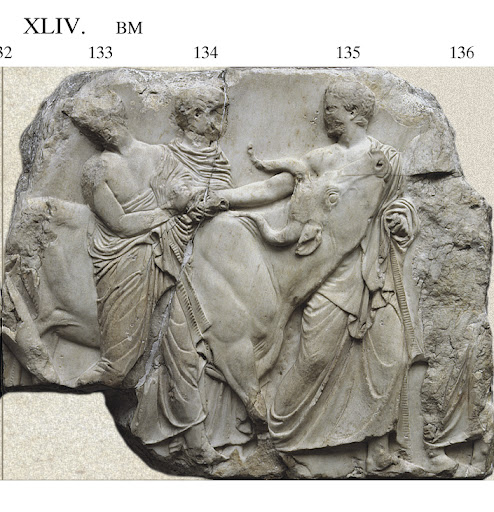
Lion killing bull...The scene we see depicted all over the Old World, with no explanation...Like on this coin from Cilicia, Tarsos Mazaios Satrap 361-334BC...Autumn (starts in Leo) ends (kills) summer (starts in Taurus)...

The animal calendar marker marking Jul/Aug, Nergal time.

Some posts that talk about the meaning of the "Lion killing bull" scene:  "Mystery seal", "Cypriot stamp seal with cow and calf", "Black basalt stone of Esarhaddon", "Angra Mainyu", "Bull leaping in Syria", "Adda seal", "Lion killing bull under date palm", "Butt chewing"...

Those wondering why Apollo, the Dragon god...Check my post "Marble throne of Apollo" out. 

Marble Throne of Apollo, Roman, late 1st c. AD. Currently in the Los Angeles County Museum of Art 

Whoever made this, knew who Apollo really was and wanted to show Apollo in his true shape (serpent, dragon), sitting on his throne. 

Anyway, why did I start this post with a picture of a threshing floor? Because the word Apellaios is derived from the Doric word apella (ἀπέλλα) which originally meant wall, enclosure of stones, and later assembly of people within the limits of this enclosure...

Threshing floors (circular walled enclosures) were used as communal gathering places until recently. So I wonder if the original "apellas" took place on threshing floors? I talked about it in my posts "Shield of Achilles", "Oro", "Bogovo gumno, God's threshing floor"...

Threshing floors were also used as solar observatories, and The First Temple in Jerusalem, which later, according to the Jewish sources, turned out to be a solar temple, most likely dedicated to Shamash, was built on a threshing floor.

If you wanted to make a (First) Temple on a Threshing Floor, and "orient" it (make it to face east), if you wanted to make a "House of God" to face the "House of (Sun) God", how would you do it?


I taled about this in my posts "Sun god from the first temple", "Boaz and Jachin", "The tree of life/light", "Menorah from Nipur"...

Threshing floors were also used as ceremonial platforms. I talked about this in my post "Sacred marriage on the threshing floor" and "Jerusalem of gold".


 And so it is not surprising that in Delphi we also find a sacred threshing floor.

This threshing floor (Halos), marks the spot where Apollo killed Python. Did Apollo (sun god) kill Python (solar snake) on a threshing floor (solar observatory)? Anyways, this threshing floor was the place where plays honouring Apollo were staged.


This threshing floor was also the place where Septerion, the ritual re-enactment of the murder of Python by Apollo, took place once every nine years (using Ancient Greek inclusive counting which counts both the first and the last year).


"According to Plutarch’s testimony, the Septerion was celebrated not long before the Pythian Games, and if we take into account that the koros that performed Apollo had to travel from Delphi to Tempe, and then return with the laurel of the crowns that were awarded to the victors, it is most likely that it began on a date close to the summer solstice. At this time of the year, the solar alignment could have been used as part of the staging, something that is particularly noticeable in the ritual episodes that were celebrated in the Threshing Floor (ἅλως)...  

This place, which at the beginning of the Grande Fouille was erroneously associated with the circular space under the terrace of the Temple of Apollo («l’Aire»), has recently been located some five hundred meters further west..."


"...Its conditions seem to indicate that the Delphians actually used it for threshing and winnowing grain, which reinforces the festival’s connection with the rites of harvest propitiation and grain purification. 

Here, a young man or koros representing Apollo arrived at dawn from a road that probably came from the Castalian spring, escorted by a group of torchbearers, just at the moment when the sun was rising behind him from the top of the hills of the Phaedriades. The road crossed the Sanctuary, the altar and the Temple of Apollo, went through the SD 435 entrance, passed by the place where in the second half of the 4th century BCE the West Portico was built, and finally led to the great terrace of the Threshing Floor. 

Our sources do not clarify what was the origin of this road (called the Dolonia), but there are many reasons to believe that it came from the Castalian Spring, where the ritual would have begun with a staging of the combat of Apollo against the Serpent. Once on the Threshing Floor, the young man and his escort of torchbearers burned a hut, overturned a ritual table, and fled from the Sanctuary towards the Valley of Tempe. It was here that the young man, following in the footsteps of Apollo, celebrated the rites of purification, crowned himself with laurel, and began his triumphal return to Delphi, carrying with him the laurel of the crowns that were given to the victors of the Pythian Games... "

Hmmm...According to Hesiod threshing in Greece took place around the time of the summer solstice. I talked about this in my post "Hesiod on grain". Which is why the new year started right after that, during the month of Apollo...

Apellaios, Jul/Aug, Leo, when, according to "Pindar's Paeans: A Reading of the Fragments with a Survey of the Genre", Septerion ritual took place, right before the start of the Pythian games, which took place in August...
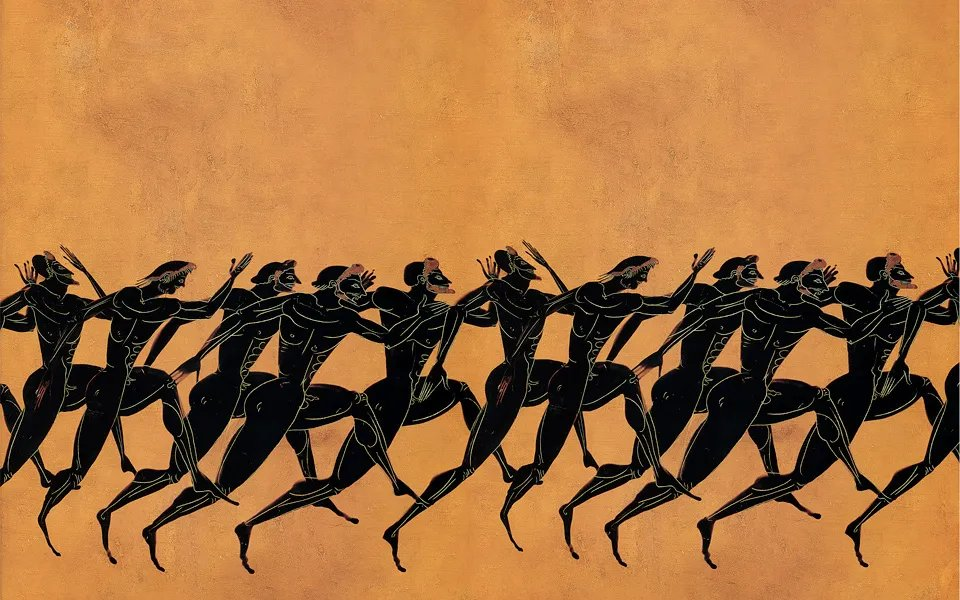
BTW, what did that hut, that was supposed to represent Python's lair, look like? No one knows...Like this I presume? 

Like a bonfire...

Like bonfires still lit all over Europe around Summer Solstice...

Sometimes with the solar wheel placed on top of it...Talked about it in my post "Burning rolling wheel

So, in Jul/Aug, the hottest time of the year in Greece, Greeks celebrated the victory of the (destructive) Sun God Apollo over a dragon (symbol of the destructive sun's heat) by lighting a bonfire 🙂, on a threshing floor (solar observatory) using torches...🙂 Funny that...

You might also like my post about the black and white ravens of Apollo, another strange Apollo legend which has its parallel in Nergal legends and which can only be explained through animal calendar markers. 

In this post you will find that "the gates of hell" in Mesopotamia were guarded by twins, linked to Gemini constellation, and "closely related to Nergal"...

Just like Dioskuri who guard Summer Solstice, the gates of Apellaios, Jul/Aug, Time of Apollo, the Scary God of art and music and healing...Apparently...


That's it. To read more about ancient animal and plant calendar markers, start here…Then check my twitter threads I still didn't convert to blog post...I am way way behind...

Saturday, 13 May 2023

Inanna and dove

A pottery cup, Syria, dated to 1800-1600 BC. The rounded body tapering to a flat base, with 26 bird heads. Christies auction... 


Doves??? Similar objects were interpreted as votive objects dedicated to Ishtar/Inanna, whose sacred bird was dove...

And Demeter...

I explained why dove was sacred to Demeter in my post "Demeter with dove"... 

Demeter was the goddess of grain (harvest)...And European doves nesting season overlaps with the grain harvest season in Europe...So...

Interestingly, Inanna/Ishtar, was in "A song of Inanna and Dumuzid" described as: "Maiden, glossy mane, lovely beauty...colourful as a pile of grain, fit for the king, fit for Dumuzid! Maiden...a stack of...barley, fully developed in loveliness"...

I talked about this in my post "Demeter riding a panther"...

Remember this thread about the grain symbol? See all these female bodies with grain symbol on their bellies?

This is Inanna/Ishtar speaking: 

"...Before my lord, Dumuzi,

I poured out plants from my womb.

I placed plants before him,

I poured out plants before him.

I placed grain before him,

I poured out grain before him,

I poured out grain before my womb..."

I talked bout this in my post "Mother of grain"...The symbolic link between women and earth depicted on this Early Vinča Culture terracotta figurine from Jela, Iron Gate region of the Danube, Serbia, c. 5200 BC, H. 5.3 cm, which has a branching plant (grain?) growing out of the womb...

This is Inanna again:

...

As for me, Inanna,

Who will plow my vulva?

Who will plow my high field?

Who will plow my wet ground?

...

I talked about this in my post "Mother of grain from Yarim Tepe". Figurine of a nude woman form Yarim Tepe, 5000-4000 BC. Iraq Museum...

This is threshing floor, somewhere in Mesopotamia, recently...

This is threshing floor, in upper Mesopotamia, Arslantepe, Turkey, 4th millennium BC

If it works...🙂

From "Insights from a tribological analysis of the tribulum"...

In "Threshing floor in reality and metaphor", we can read that "The annual sacred marriage reenactment between Ea/Enki and Ishtar/Inanna was performed on a threshing floor"...

Fitting for the goddess that "pours grain out of her womb"...And is as lovely as as ripe barley...

Homer says this about Demeter, the goddess of grain harvest, and threshing floors:

"And even as the wind carries chaff about the sacred threshing-floors / of men that are winnowing, when fair-haired Demeter / amid the driving blasts of wind separates the grain from the chaff"...

Which is why Eugene Vanderpool in "ΕΠΙ ΠΡΟϒΧΟΝΤΙ ΚΟΛΩΝΩΙ: The Sacred Threshing Floor at Eleusis" proposes that threshing floors were sacred to Demeter and were in fact her temples...

I talked about this in my post "Sacred marriage on the threshing floor"...

And here I come back to doves...


The breeding season of most common Eurasian doves, collared dove (top) and turtle dove (bottom) starts in Apr and lasts until Sep. So it overlaps with the grain harvest season in Europe and Western Asia...Which is why, I think, this bird is associated with Demeter...Goddess of grain harvest...

Is this why dove was also sacred to Inanna, who is as lovely as ripe barley and who pours barley out of her womb and who marries the god of water on a threshing floor?

I think so...

To read more about ancient animal and plant calendar markers, start here…then check the rest of the blog posts related to animal calendar markers I still didn't add to this page, and finally check my twitter threads I still didn't convert to blog post...I am 9 months behind now...

Sunday, 20 February 2022

Jerusalem of Gold

The Babylonian Talmud (Nedarim 50a) relates that one of the greatest sages, Rabbi ’Akkiva (2nd century AD), who started out as a poor, ignorant shepherd, slept with his beloved wife on the threshing floor...

He is described as pulling straw out of her hair and saying that if he could afford it, he would crown her with a "Jerusalem of Gold" – a "headgear shaped like the battlements or towers of a city", which was worn by "women of high status"...

Is this just a random innocent love scene? Or is there something more here, hidden in plain sight? I think the latter...

In my post about the sacred marriage on the threshing floor, I mentioned this:

"Threshing floors were used for religious ceremonies in Mesopotamia too. The annual sacred marriage reenactment between Ea and Ishtar (Asherah) was performed on a threshing floor".

You know how Asherah was associated with "High places"...Were these originally threshing floors?

As you can see from this article, the choice of the two protagonists of the scared marriage ceremony (sex) is not random. They mark the beginning (Ea- Apr/May) and the end (Ishtar - Jul/Aug) of the grain harvest in Mesopotamia...

Interestingly, the main consort of Ishtar (Inanna) was Tamuz (Dumuzid, Dumuzi), Mesopotamian god associated with shepherds...Whose sister Geshtinanna, was conveniently, the goddess of agriculture...

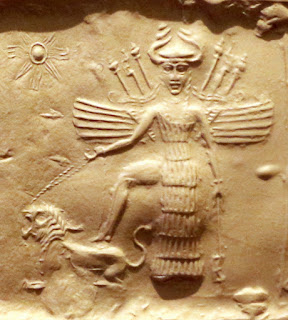
Ishtar, the queen of heaven, the morning star, is often depicted standing on a lion with the sun above it...

Why? Cause Jul/Aug, Leo, is the time when Sirius rises in the morning with the sun...

Anyway, Ishtar was not the only goddess that that stands on a lion, stands between lions, is driven in a chariot pulled by lions, or sits on a throne between two lions (all meaning "in Leo")...There is one for everyone in the audience, and I listed most of them in my post "Assumption of Mary"...

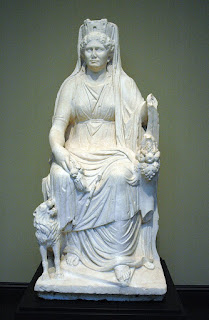
One of these lion goddesses was Cybele. Here she is, enthroned, with her pet lion, holding cornucopia, and wearing a "crown depicting city walls"!!!. This is a Roman marble made c. 50 AD...

Now Cybele was in turn associated with Greek Demeter, the Grain goddess. The main ceremony of her festivals called Haloa (from "halōs", "threshing floor"), took place in Eleusis, at the threshing floor of Triptolemus, Demeter's first priest and inventor of grain agriculture...

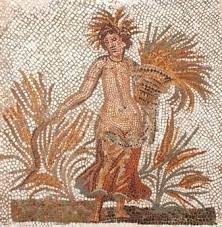
Romans knew Demeter as Ceres, Roman goddess of grain and grain harvest. Here she is, holding a sickle, with ears of grain in her hair and a grain sheaf in her hands...3rd century AD, Roman from Uthina, Tunisia...

Sooooo...After having sex with his wife on a threshing floor, Akkiva, the shepherd, picks the grain out of her hair and promises that he will buy her a golden crown in a shape of city walls...Scene depicting an Ordinary Marriage or a Sacred Marriage? What's going on here?

It's a mess, right?

Saturday, 30 October 2021

Sacred marriage on the threshing floor

Vital to an agrarian community’s survival, threshing floors are agricultural spaces where crops are threshed and winnowed.


"...But the Hebrew Bible rarely refers to such agricultural activities taking place at such sites...

Instead, biblical narratives repeatedly depict threshing floors in ancient Israel as sites for mourning rites, divination rituals, cultic processions, and sacrifices...Kings consult prophets there; even the Solomonic temple was built on a threshing floor...

These originally agricultural sites were also considered sacred spaces connected to Yahweh, under his control, and subject to his power to bless, curse, and save and that Israel had a special ritual access to Yahweh in these powerfully symbolic sites..."

This is an intro to "Threshing Floors in Ancient Israel: Their Ritual and Symbolic Significance" by Jaime L. Waters... 

Now, we know that goddess Asherah was linked to "high places" where she was worshiped...These were holy grounds of sort, raised platforms where religious ceremonies were performed...Pic: High Place, Megiddo...

And you know how every "high place" had an "Asherah pole" made of wood..."which marked the place as sacred and was itself an object of worship"...And no one is really sure what this pole was or what it looked like...

Is it possible that originally these high places with a sacred wooden pole were just threshing floors with a central pole to which threshing animals were tied? 

Like this traditional threshing floor from Ithaka, Greece...Definitely a "High place" with a "Central Pole"...

BTW, this is what Homer says about Demeter, the goddess of grain harvest, and threshing floors:

"And even as the wind carries chaff about the sacred threshing-floors / of men that are winnowing, when fair-haired Demeter / amid the driving blasts of wind separates the grain from the chaff"...

You can find this quote in "A Compendium of Similes in the Iliad and Odyssey"...Which is why Eugene Vanderpool in "ΕΠΙ ΠΡΟϒΧΟΝΤΙ ΚΟΛΩΝΩΙ: The Sacred Threshing Floor at Eleusis" proposes that threshing floors were sacred to Demeter and were in fact her temples...

Here is another traditional threshing floor, this time from Croatia?

In the Balkans, among the Slavs, threshing floors were considered sacred until recently. They were platform where many religious ceremonies from the agricultural cult were performed...And sacrifices were made to the central pole until very recently...

I talked about this in my post "Bogovo gumno (God's threshing floor)"...

Including blood sacrifices...Serbs actually sacrificed a cock to the central threshing floor column at the end of the harvest, most likely as a replacement for a human sacrifice...Based on ritual tying of girls to the central threshing floor column...

I talked about it in my post "Cock bashing"...

In "The Threshing Floor as Sacred Space in the Hebrew Bible A Spatial and Anthropological Perspective" Tamara Prosic asks: "Is the building of the Yahweh’s temple on the Jebusite threshing floor just a Yahwehisation of the holy threshing floor?"

Considering that there are many indications that the First Temple was built by solar worshippers, and that threshing floors were used, among other things, as solar observatories, it is kind of obvious why the First Temple was built on the threshing floor...Right?

I talked about this in my post "Boaz and Jachin"...

Why would you care where the true east is? Well, if Sun is your god you'd want to face your lord properly, right? The royal seal of the Kingdom of Judah from the time of the King Hezekiah (739 - 687 BC) with the winged sun. Abut First Temple solar cult: 


I talked about this in my post "Sun god from the first temple"...

In the Balkans, threshing floors were not just centers of religious life, but also of communal life. People met there, celebrated weddings and funerals there. Cilipi, Dubrovnik.  Circular dance "kolo" danced on a threshing floor. 


Zetsko kolo, circular dance with a couple dancing in the middle of the circle imitating mating eagles, from Montenegro, danced on a threshing floor 

Dancing Linđo on an threshing floor in the village of Mrčevo, Croatia...High Places...In mountain villages threshing floors were usually the only flat platforms suitable for social gatherings...


The birthplace of Greek circular dance "horos" is said to be the island of Crete, were Rhea, the Mother of Zeus, taught the Curetes how to dance...Minoan "Dancers from Kamilari" dancing "horos" (most likely) on a threshing floor...


I talked about this in my post "Shield of Achilles"...

Threshing floors were used for religious ceremonies in Mesopotamia too. In the "Threshing floor in reality and metaphor" we can read that "The annual sacred marriage reenactment between Ea and Ishtar (Asherah) was performed on a threshing floor"... 

Ea, Enki was the god of water who every year ejaculated Tigris and Euphrates. It was his semen (water) that enabled grain agriculture in Mesopotamia...The water level in both rivers peaks in Apr/May...


Right when the sacred marriage ceremony was performed on the threshing floor, in the month of Iyyar (Apr/May)...Now look at this. Sumerian agricultural calendar. 

Interestingly, Inanna/Ishtar, was in "A song of Inanna and Dumuzid" described as: "Maiden, glossy mane, lovely beauty...colourful as a pile of grain, fit for the king, fit for Dumuzid! Maiden...a stack of...barley, fully developed in loveliness"...

This is Inanna/Ishtar speaking: 

"...Before my lord, Dumuzi,

I poured out plants from my womb.

I placed plants before him,

I poured out plants before him.

I placed grain before him,

I poured out grain before him,

I poured out grain before my womb..."

I talked bout this in my post "Mother of grain"...

This is Inanna again:

"...

As for me, Inanna,

Who will plow my vulva?

Who will plow my high field?

Who will plow my wet ground?

..."

Grain harvest starts in Apr/May (time of the year dominated by Enki/Ea), and ends in Jul/Aug (time of the year dominated by Ishtar/Inanna)...

Hence the sacred marriage between Ea/Enki and Ishtar/Inanna performed on the threshing floor...At the beginning of the harvest...

How do we know that Jul/Aug is the time of the year dominated by Ishtar/Inanna? Well she is the girl that loved posing on lions...Why?

Well...standing on a lion means "In Leo"...

And you know how everyone thinks that Inanna/Ishtar "The queen of heaven", "The morning star" is Venus...Well, when this "mythology" was developed, Sirius rose before the sun, in Leo (Jul/Aug), pretending to be "the morning star"...I talked about this in my post "Ninshubur"...

In "A hymn to Inana as Ninegala" we can read "Inana, great light, lioness of heaven..." Why? 

Well, this, combined with Inanna's obsession with standing on lions only makes sense if she is Sirius, rising with the sun in Leo...

And Jul/Aug is when Sirius starts rising with the sun in the morning...The real "Morning star"...Ishtar, Inanna...

Oh, and by the way, Leo marks the beginning of the main mating season of Eurasian lions, (Jul/Aug)...


By the way, this "Lady standing on a lion", "Lady sitting on a lion", "Lady standing between lions", "Lady sitting between lions", "Lady riding in chariots pulled by lions"...I surprisingly popular...I talked about her in my post "Assumption of Mary"...

Soo...Interesting...Right? Does this get us anywhere near to understanding why threshing floors were so important to Bronze and Iron Age Canaanites? And does this help us understand the link between "High Places", Asherah, Asherah Poles and Threshing Floors?


After everything I wrote in this article...What does "this" tell us about Mycenaeans? A pole between two lions (means in Leo)...Anything interesting?