 |
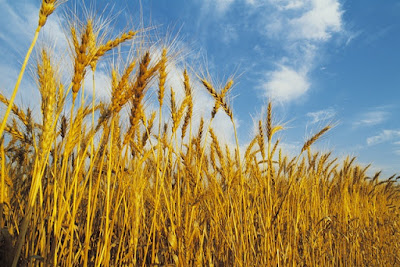
| Ripening wheat, Serbia. Photographer: Branko Pantić |
Showing posts with label Wheat. Show all posts
Showing posts with label Wheat. Show all posts
Tuesday, 14 June 2016
Wheat
Who gets slaughtered at the end of summer, gets buried at the end of autumn, gets resurrected, reborn at the end of winter, becomes young and fertile at the end of spring, becomes mature at the end of summer just to be slaughtered again...so that the cycle can be repeated again, year after year after year...???

Friday, 25 March 2016
Klas
An ear is the grain-bearing tip part of the stem of a cereal plant, such as wheat or maize.

If you look at the wheat plant, you can see that ear looks like a head standing on a long neck (stem).
This is the part of the cereal plant which is collected during harvest. Harvesting cereal literally means cutting off the long necks of the wheat plants and collecting the heads of the wheat plants, the ears.
The wheat is basically "slaughtered".
In the past this was done by hand using sickle, and the wheat plant necks (stems) were cut quite close to the wheat head (ear). This was done to make the transport and storage of the ears of wheat easier. You can see what I mean from the next few pictures which depict grain harvest during medieval time.

Guldize. Guldize is Cornish language for "The feast of ricks" (i.e. grain stacks). The festival itself was held at the end of the wheat harvest and took the form of a vast feast.
The festival started with the ceremony called "Crying The Neck".
In "The Story of Cornwall", by Kenneth Hamilton Jenkin, the ceremony is described like this:
"In those days the whole of the reaping had to be done either with the hook or scythe. The harvest, in consequence, often lasted for many weeks. When the time came to cut the last handful of standing corn, one of the reapers would lift up the bunch high above his head and call out in a loud voice.....,
"I 'ave 'un! I 'ave 'un! I 'ave 'un!"
The rest would then shout,
"What 'ave 'ee? What 'ave 'ee? What 'ave 'ee?"
and the reply would be:
"A neck! A neck! A neck!"
Everyone then joined in shouting:
"Hurrah! Hurrah for the neck! Hurrah for Mr. So-and-So" (calling the farmer by name.)"


If you look at the wheat plant, you can see that ear looks like a head standing on a long neck (stem).

This is the part of the cereal plant which is collected during harvest. Harvesting cereal literally means cutting off the long necks of the wheat plants and collecting the heads of the wheat plants, the ears.
The wheat is basically "slaughtered".

Basically, the harvesting of the grain was in the past done in the same way people or animals were slaughtered: you pick the head (ears of wheat) and you slice across the neck (stalks of wheat).
There is even a Cornish ritual of "cutting the neck of the grain spirit"...
The festival started with the ceremony called "Crying The Neck".
In "The Story of Cornwall", by Kenneth Hamilton Jenkin, the ceremony is described like this:
"In those days the whole of the reaping had to be done either with the hook or scythe. The harvest, in consequence, often lasted for many weeks. When the time came to cut the last handful of standing corn, one of the reapers would lift up the bunch high above his head and call out in a loud voice.....,
"I 'ave 'un! I 'ave 'un! I 'ave 'un!"
The rest would then shout,
"What 'ave 'ee? What 'ave 'ee? What 'ave 'ee?"
and the reply would be:
"A neck! A neck! A neck!"
Everyone then joined in shouting:
"Hurrah! Hurrah for the neck! Hurrah for Mr. So-and-So" (calling the farmer by name.)"

This shows clearly that harvesting of the corn was seen as cutting of the neck of the corn plant to collect the corn heads making the corn head that which is obtained by slaughter...
The cutting of the last handful of standing corn was also symbolically seen as cutting of the head of the corn spirit. Our ancestors believed that the spirit resided in this last cut head of grain...
And this is why after the ceremony of Crying The Neck, the neck was used to make a corn effigy which was then believed to contain, preserve, the corn spirit.
In Cornwall this corn effigy, presided over the Guldize feast which later took place in the farmhouse kitchen...
Monday, 21 September 2015
The power of the Thunder Giant
In Serbian the expression "On vedri i oblači" means "he rules", "he has absolute control, absolute power". Literally this expression means "he makes the sky clear and cloudy"...
This expression was obviously originally applied to the sky god, The God, The Lord of the early agricultural societies and the peasants, particularly the wheat farmers, whose lives depend on the climate...
Having the right weather at the right time is most important during the vegetative season from May to November. Having the right weather at the right time is in the north of Europe most critical right in the middle of the vegetative season. This is the period around the beginning of August. The period from just before the end of the ripening season to just after the beginning of the harvest season.


At this time, too much clear sunny sky and the wheat will burn.

Too much cloudy rainy sky and the wheat will not ripen properly or it will fall down and rot.

And interestingly right there, on the 2nd of August, on the day that marks the border between the summer and autumn, growing and harvesting, we find In Ireland the day of Crom Dubh. I believe, as I said many times before, that this god is the same god which is in Serbia known as Hromi Daba, Dabog. And that both Chorm Dubh and Hromi Daba are just corruptions of Grom Div, The Thunder Giant, The Thunder God. That this is indeed so can be seen from the fact that the 2nd of August is in Serbia known as the day of Perun, the Thunder God, the one who "vedri i oblači", the one who can make the sky clear and cloudy, the Lord....

This expression was obviously originally applied to the sky god, The God, The Lord of the early agricultural societies and the peasants, particularly the wheat farmers, whose lives depend on the climate...
Having the right weather at the right time is most important during the vegetative season from May to November. Having the right weather at the right time is in the north of Europe most critical right in the middle of the vegetative season. This is the period around the beginning of August. The period from just before the end of the ripening season to just after the beginning of the harvest season.


At this time, too much clear sunny sky and the wheat will burn.

Too much cloudy rainy sky and the wheat will not ripen properly or it will fall down and rot.

Either one of
these extremes will result in the destruction of the harvest and famine.
And so the wheat
farmers, the world over, have since the time immemorial been turning their eyes
to heaven (sky) at this time of the year, and praying to the same Sky God. They would pray to the one who "vedri i
oblači", the one who can make the sky clear and cloudy, The Lord in heaven (sky). They would pray to him, the Giving God (Dabog in Serbian) to give them just the right
amount of sunshine and rain, and by doing so to give them the good harvest.
And interestingly right there, on the 2nd of August, on the day that marks the border between the summer and autumn, growing and harvesting, we find In Ireland the day of Crom Dubh. I believe, as I said many times before, that this god is the same god which is in Serbia known as Hromi Daba, Dabog. And that both Chorm Dubh and Hromi Daba are just corruptions of Grom Div, The Thunder Giant, The Thunder God. That this is indeed so can be seen from the fact that the 2nd of August is in Serbia known as the day of Perun, the Thunder God, the one who "vedri i oblači", the one who can make the sky clear and cloudy, the Lord....

PS:
All weather-related French phrases also imply the action of God.
Il fait beau = He makes beautiful (weather)
Il pleut = He rains
Il vente = He winds
Il neige = He snows
etc.
Similarly, "Il fait la pluie et le bau temps" (he makes rain and sunshine) defines an all-mighty person.
Subscribe to:
Posts (Atom)