Showing posts with label Harvest rituals. Show all posts

Monday, 17 March 2025

Baba - Last sheaf of wheat

Among Slavs, the last sheaf of wheat was commonly called Baba. This word means grandmother, mother, midwife, birth giver...In some places the woman binding the last sheaf the last sheaf of wheat is also called Baba...

In the Balkans bаbičiti means to make, to tie grain sheaves. I wonder this is symbolically linked with the swaddling babies cause bаbičiti also means to deliver babies...From the meaning of the word Baba in diminutive form Babica which means midwife...

All kinds of rites and beliefs are connected to the Baba, the last sheaf of wheat, including the  dance of the oldest female reaper, accompanied by banter and jokes...

In Prussia, the woman binding the last sheaf represented the Corn-Mother; After she bound the last sheaf, she would lie down in the field and cry like a woman in labour, while an old woman acted as the midwife. Finally, the "midwife" would announce that a child was born...

In Northern Germany, the woman binding the last sheaf was told: "You are getting the child!" In Bohemia, people believed that the woman binding the last sheaf will have a child in the next year...

The Swabs called the one binding the last sheaf "the Old Woman" (basically Baba, Grandmother) and she was said to be married in the next year...

In East Prussia, the female reapers strove to be the one tying the last sheaf, called "the Grandmother". Whoever  got it, would be married in the next year, but her spouse would be old...

Baba (Grandmother) here is Mother Earth in her role as The Mother Of Grain...Talked about this originally in my post "Mother of grain"...

Mor articles about the Mother of grain in Neolithic Europe, Central Asia, Mesopotamia, Iran, Levant: "Altyn Tepe mother of grain", "Mother of grain from Yarim Tepe",  "A person in a little boat", "Sabi Abyad venus", "Hathor grain pendants"...

Sumerians knew here as Inanna. 

Inanna/Ishtar, was in "A song of Inanna and Dumuzid" described as: "Maiden, glossy mane, lovely beauty...colourful as a pile of grain, fit for the king, fit for Dumuzid! Maiden...a stack of...barley, fully developed in loveliness"...

This is Inanna speaking:

"Before my lord, Dumuzi,

I placed grain before him,

I poured out grain before him,

I poured out grain before my womb..."

I talked about this in my post "Inanna and dove"...

Greeks knew her as Demeter...

I talk about Demeter in my posts "Demeter with dove", "Demeter riding panther", "Sacred marriage on the threshing floor"...

Demeter, the goddess with beautiful golden hair...Here she is as Ceres emerging from the ground holding grain, opium poppies and snakes... 


I explain why in my post "Who are Persephone's parents"...

Hippolytus says that during Eleusinian harvest rituals, the priest raised a freshly cut ear of wheat with the loud cry: "The exalted goddess bore a holy boy, the strong one bore a strong child!" Sounds familiar? 🙂 I talked about this in my post "Iacchos"...

The reason why the last sheaf of wheat is called Grandmother is because all these people believed that last sheaf of wheat contained the "grain spirit", basically the spirit of The Mother of Grain...

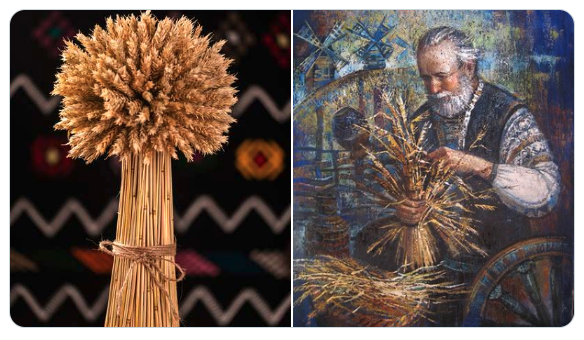
The "grain spirit" is in European folklore usually preserved as female "corn dolly" made from the last harvested sheaf of wheat...I talked about this in my post "Corn dolly"...

In Romania the grain from the last sheaf of wheat was used to make the wreath that was then used to crown the most beautiful maiden reaper...

A living corn dolly from Romania. From my post "Wheat cross" about grain harvest rituals from Romania...

In Poland and Ukraine too...

Wheat wreath, worn by the "corn maidens" and made from the last sheaf of wheat, was the first batch of grain to be threshed on the threshing floor. This grain was then set aside for next year's sowing and was the fist grain to be sawn. 

I talked about this in my post "Wheat wreath"...

The same symbolic link between Old Woman (Grandmother), Last sheaf of wheat and mother earth is preserved in the Gaelic culture...

In Gaelic, the word Cailleach means both an old woman and the last sheaf of wheat and the corn dolly made from it. Corn dolly which represents Mother Earth, the life (grain) giving mother...

I talked about this in my post "The old woman of the mill dust"...

The symbolic linking of female reapers with The Mother of Grain and of tying the last sheaf of wheat with delivering and swaddling a baby is just another example of the believed link between female and earth fertility...Which we find in Europe since Neolithic...

A gynomorphic (woman like) figurine made of "soil mixed with chaff and grain seeds" from Grčac, Serbia. Proto-Starčevo culture, 6200-5500 BC. Direct symbolic link between earth, grain and female fertility. Basically, "Mother of Grain"... 

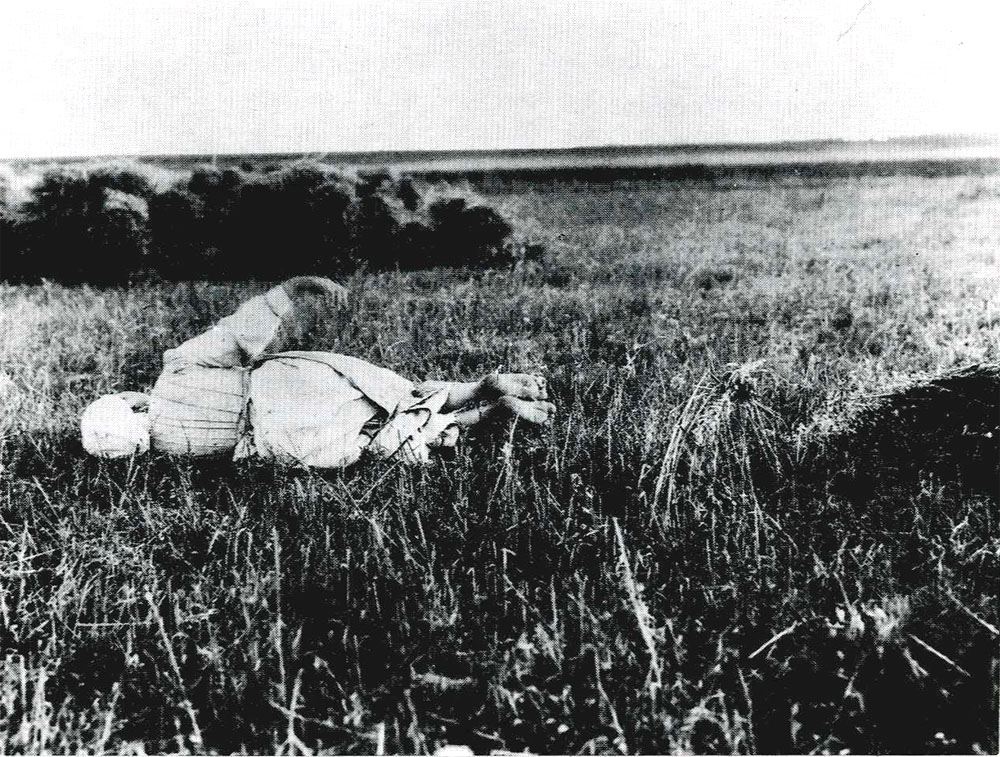
This symbolic link was still at the core of Slavic agricultural magic in the 20th century. As is shown by this Russian harvest custom:

In the past in Russia, after the last sheaf of grain was cut, women harvesters would lie down on the ground and roll around the field "to return the strength to the earth"...

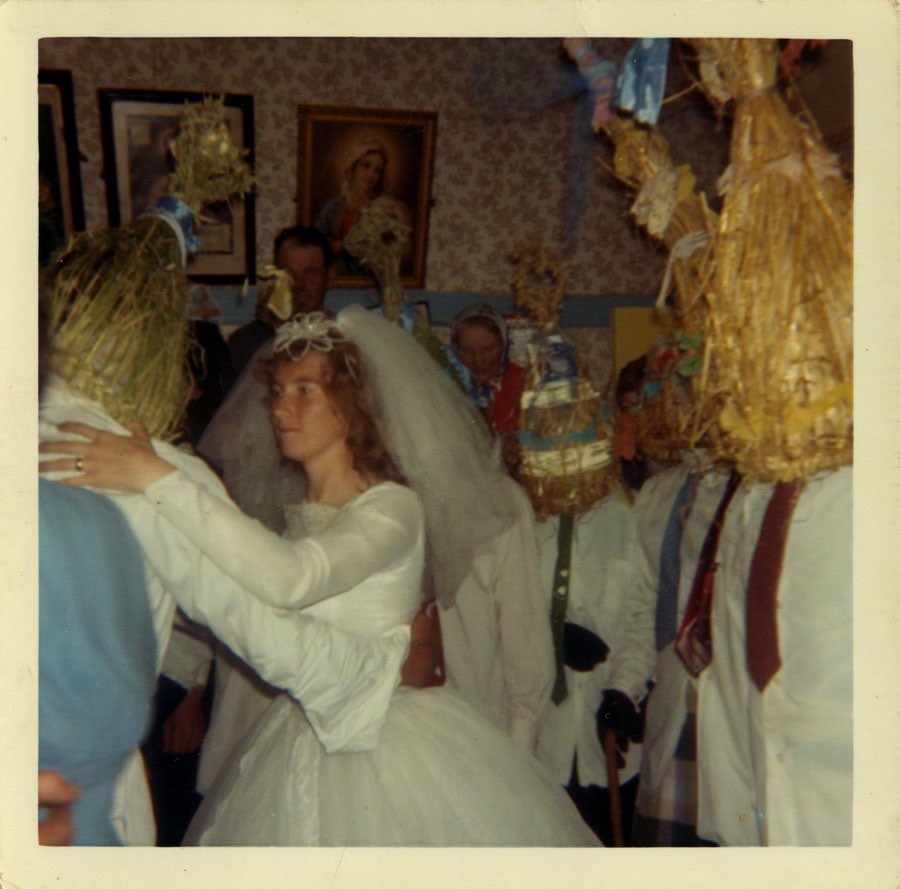
In Ireland too we find this symbolic linking of land (grain sheaves) and female fertility (bride). These are Strawboys who used to call at the home of the bride on her wedding day. Co Sligo. Ireland. Early 1900s. (National Museums of Northern Ireland).


I talked about this in my post "Walking sheafs of wheat"...

This belief in the direct link between female and land fertility might have had some pretty dark implications in the past. There is an indication that in the past Serbs sacrificed girls to the Corn Spirit in exchange for good harvest...

At the end of the harvest, when only the last sheaf of wheat was left standing in the field, Sorbs would sacrifice a rooster by killing it with a flail...
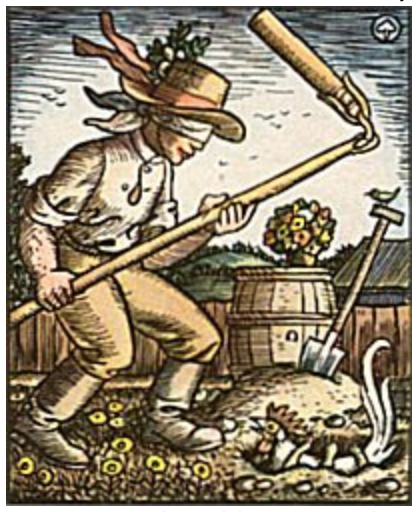
I talked about this in my post "Cock bashing"...

There are actually many indications that sacrificing a cockerel was among Serbs a replacement for a human sacrifice...I talked about this in my post "Third death"...

Add to that that in some parts of the Balkans Serbs ritually "tied the housewife to the central pole of the threshing floor until she promised them roast cockerel for the end of harvest dinner"...Or the next harvest would be bad...

And you have to ask yourself a question: is this a ritual replacement for the real human sacrifice which once used to take place?

Sunday, 5 March 2023

Wheat cross

A ceremonial "wheat cross" from Romania. It was made on the last day of the wheat harvest to carry the "wheat wreath" from the fields to the village. Pic from this great paper about crosses from the Alba county in Romania, "Crucea in patrimoniul spiritual al judetului Alba" (In Romanian)...

The wheat wreath was the most important part of the Romanian end of harvest ceremonies. It was made from the last sheaf of wheat...

It was normally then used to "crown" the "most beautiful unmarried girl" that participated in the harvest, who then carried it back to the village on her head...Love these pics of the reenactment of this ceremony by Vasile Sarb


The same Wheat wreath ceremony was performed by the Slavs. Wheat wreath, worn by the "corn maidens" and made from the last sheaf of wheat, was the first batch of grain to be threshed on the threshing floor. This grain was then set aside for next year's sowing and was the fist grain to be sawn. I talked about this in my post "Wheat wreath"...

BTW, a lot of Slavs once lived in Romania, which is attested by huge number of Slavic toponyms and hydronyms and by the amount of Slavic words still present in Romanian language...

Romanians, like many other Europeans, believed that the last sheaf of wheat, from which the wreath was made, contained the "spirit of grain"...This spirit was preserved in a "Corn dolly" made from the last sheaf instead or together with the wreath. I talked about this in my post "Corn dolly"...


Who corn dolly represents can be seen from the fact that in Gaelic, the word Cailleach means both an old woman and the last sheaf of wheat and the corn dolly made from it. Corn dolly which represents Mother Earth, the life (grain) giving mother...

I talked about this in my post "The old woman of the mill dust"...

And in Slovenia we find this: Men bringing an old woman in a grain basket into the mill, where she gets transformed through milling into a young girl. An old story about the rebirth (sowing/sprouting) of the Mother Earth (Mother of grain) over winter? I talked about this in my post "Bablji mlin"...

What is very interesting about the "wheat wreath" was placed on the head of the most beautiful unmarried (fertile!!!) girl which participated in harvesting, who then carried it to the village "while everyone else sang wedding songs and performed various wedding rituals"...

This seems to be directly linking female fertility and land fertility, again something found also in Slavic and Gaelic folklore (remnants of old religions)...

In Ireland "grain sheafs appear at weddings and dance with a bride"...

More about walking sheaves of wheat in European folklore can be found in my post "Walking sheafs of wheat"...

In Russia, in the past, after the last sheaf of grain was cut, women harvesters would lie down on the ground and roll around the field "to return the strength to the earth". 

The Wheat wreath was in Romania always made by women standing in a circle, and originally was made "the way you would plait women's hair"...


Which (thank you @another_barbara) looks like ear of wheat...The girl carrying the wheat wreath was the embodiment of the Corn Maiden...

BTW, this link between female fertility and land, and especially grain field fertility is ancient, and can be traced back to Neolithic Fertile Crescent, from where it spread to Europe...

As I said, all over Europe, The last sheaf of grain represents the living "sprit of grain"...But in Eastern Slavic countries, it also represents The Ancestors...This is Diduch (Grandfather) Christmas sheaf from Ukraine... I talked about this in my post "Diduch"...

And interestingly, the girl carrying the wheat wreath, is sprinkled with water all along her journey from the field to the village...Why? Slavs believed that thirsty ancestors can cause droughts which destroys wheat...I talked about this in my post "White feast"...

Sunday, 7 August 2022

Julenek

"On Christmas morning in Norway every gable, gateway, or barn-door, is decorated with a sheaf of grain, called 'Julenek', fixed on the top of a tall pole, wherefrom it is intended that the birds should make their Christmas dinner"...Julenek, Karl Uchermann 1855-1940...

On Christmas Eve, the Swedes hang out the last sheaf of grain from the harvest, known as the Julkarve, as an offering to the birds. And they believe that the more birds come to feed, the better the next year's grain harvest will be...Bird sheaf, Siegwald Dahl 1827-1902...

The usual explanation for this custom is that that the birds were fed to stop them eating grain from grain stores...But the belief that feeding the birds has influence on the next year's harvest points at another explanation for this custom...Preserved in Slavic folklore...

All over Europe, it was believed that the last harvested sheaf of grain contained the living "sprit of grain"...This last sheaf was turned into a "Corn dolly", which was preserved until the next sowing season,. The seeds from the Corn dolly were then mixed with the seeds about to be sown, and were sometimes the first to be sown into the ground...I talked about this in my post "Corn dolly" 


A hint who this "Corn spirit", preserved in the "Corn dolly", really was, can be found in the Gaelic language and tradition. In Gaelic, the word Cailleach means at the same time An Old Woman, Mother Earth, The Last Sheaf of Wheat and the Corn Dolly made from it. So the Corn Spirit was really the fertility of the Mother Earth, of the life (grain) giving mother of us all...I talked about this in my post "The old woman of the mill dust"...

In Eastern Slavic tradition the identity of the "Grain spirit" is spelled out. The Last Sheaf of Wheat is turned into a Corn Dolly called Diduch (Grandfather, The Ancestor)...I talked about this in my post "Diduch"...

Now Slavs believed that all the good comes from the ancestors...Including grain...Which is why it was so important to keep ancestors happy, well fed and well watered, particularly during winter...

In some parts of Serbia, on Christmas Eve people used to take a table laid with food on the doorstep of the house and would then ask wolves to come to the feast. In other parts of Serbia they would invite the dead to the feast in the same way...I talked about this in my post "Wolf feast"...

Finally, in pre-Christian times, Slavs believed that souls of their dead entered birds and through birds entered otherworld, heaven, Iriy. And through birds returned back to our world to be reborn. I talked about this in my posts "Nav" and "Bird wedding"...

So feeding birds with grain from the last sheaf during winter was basically a form of feeding the ancestors, sacrificing to the ancestors...

Anyway, I wonder if any of this was preserved in Nordic and Finish folklore? 

I will finish this article with the link to my articles "Walking sheafs of wheat" which roam the roads of Europe during the winter...


Tuesday, 29 December 2020

Harvest in Scotland


Harvesting in Scotland by a Scottish painter Joseph Farquharson (1846-1935). 

Scottish harvest customs. From "Carmina Gadelica - Hymns and Incantations, Ortha Nan Gaidheal, Volume I" by Alexander Carmichael [1900]


Reaping blessing. From "Carmina Gadelica - Hymns and Incantations, Ortha Nan Gaidheal, Volume I" by Alexander Carmichael [1900]


The Sun god to whom Scots gave thanks for their grain and their wellbeing is Crom Dubh of the Irish (Scots). The deity to whom the Irish prayed in the Early Bronze Age "Grange Circle" on the first day of the harvest. 


The biggest and the only square stone in the circle is still known as the Crom Dubh stone. And next to it is the pile of flat bread like stones known as the Grain Child...


I talked about this amazing ancient monument in my post "Grange circle" 

He was the good whose holy mountain was and is the holiest place in Ireland. Except it is now called St Patrick's mountain...


I talked about this in my post "Sun mountain"...

They prayed to him on the last Sun-day in July, which is still known in the area around the holy mountain as the "Domhnach Crom Dubh" which means "Crom Dubh's Sunday"...

People prayed to Crom Dubh because they believed that "It was he who was giving them the light of the day, the darkness of the night, and the change of seasons"...Basically The Sun...I talked about this in my post "Dun Briste"...

Crom Dubh was said to be another name for Dagda, the Giving God of the Irish... 
Hromi Daba was another name for Dabog, the Giving God of the Serbs...

Both of these gods had a bull cult associated with them...

I talked about this in my posts "Bull of Crom Dubh" and "Bull of Grom Div (Hromi Daba)"...

And Dabog (Hromi Daba), The Sun God, is the god to whom Slavs still "raised stones" until very recently "for the weather". 


Just like the Early Bronze Age Irish raised stones and built stone circles to Dagda (Crom Dubh)??? 

I talked about these weather manipulation rituals involving stones in "The last megalithic ritual in Europe" and "Weather stones"...

The Sun God of the Pagan Serbs, Dabog, Hromi Daba, became the Devil of the Christian Serbs. 
The Sun God of the Pagan Irish, Dagda, Crom Dubh became the Devil of the Christian Irish. 

But after all these years, in Ireland "By Crom" still means "By God" 🙂 


Saturday, 20 June 2020

Hesiod on grain

Hesiod declares: "When the Pleiades, daughters of Atlas, are rising, begin the harvest". At the mid 8th century BCE in Bœotia, the heliacal rising of the Pleiades occurred about 47 days after spring equinox, which corresponds approximately to the first week of May...


He also declares: "Set your slaves to winnow Demeter's holy grain, when strong Orion first appears". At the mid 8th century BCE in Bœotia, the heliacal rising of Orion, occurred about 85 days after spring equinox, which correspond approximately to mid June, 40 days after harvest...

Threshing


Winnowing


The harvesting time of grain in the same region with the same climate never changes. It happens always at the same time with minimal variations depending on the amount of sun and rain around the harvest date...

So when James George Frazer visited Greece at the end of the 19th century, he noted, and then wrote in "The Golden Bough" that the grain harvest in lowland areas took place between the end of April (barley) and beginning of May (wheat)...

So the grain harvest at the time of Hesiod and at the time of James George Frazer happened at the same time, in Taurus...

Coin from Bithynia (340 - 320 B.C) KAΛX Bull standing left on ear of grain...Symbol of harvest in Taurus?


The other interesting thing is that threshing and winnowing, things performed on threshing floord, took place around summer solstice...No wonder threshing floors became centres of solar-agricultural cults. 

This picture shows sacrificing to the threshing floor pole, Serbia. From my article "Shield of Achilles" 


Now I have already talked about how and why bull is the symbol of summer. 


Summer starts in Taurus, when wild Eurasian cattle are calving and ends in Leo, when wild Eurasian cattle are mating...So grain harvest, threshing, winnowing and storing of grain all take place in the season symbolised by the Bull...


I wonder if Greeks, and other people from the areas with similar climate and agricultural calendar, equated "killing of grain" (harvest and all that goes with it) with "killing of the bull"? That would have interesting mythological connotations. I will leave it at this for now...

BTW, Hesiod also said this about Pleiades:

The Pleiades would "flee mighty Orion and plunge into the misty deep" just before dawn during Oct/Nov, a good time of the year to lay up your ship after the fine summer weather and "remember to work the land". Meaning to plough and sow grain...


I will finish this article with this: 

Cyprus. The pic of the "του δρεπανιού", a solo male dance with a sickle imitating harvest movements. Photo: A. Ververis 1955. from the book of Lefteris Drandakis "Ο αυτοσχεδιασμός στον ελληνικό δημοτικό χορό" (Improvisation in Greek folk dance).


And here you can see this amazing weird (looks very much like martial arts to me) dance performed live. Enjoy...