This is one of many "Baubo" figurines which were found in the Sanctuary of Demeter and Kore at Priene and dated to the 2nd c. BC.

Who was Baubo? One of the most misunderstood figures from Ancient Greek mythology. Here is why:
Apparently, Baubo is one of the "minor figures" featuring in the story about the abduction of Persephone, depicted on this fresco from, Vergina, 340 BC, Macedonia, Greece.

If you have no idea what I am talking about, here is the story in short:
Hades, the god of the underworld fell in love with beautiful Persephone, daughter of Zeus and Demeter. He asked his brother Zeus for permission to marry her and Zeus agreed. But knowing that Demeter would not agree to the marriage, Zeus permitted Hades to abduct Persephone...
So one day while she was gathering flowers with her friends, Hades burst out of the ground in his chariot, snatched Persephone and took her into the underworld...
Demeter, when she found her daughter had disappeared, disguised herself as an old woman and with lighted torches in her hands roamed the Earth looking for her daughter...
In the depth of her despair, she forbade the earth to produce fruit (or she neglects the earth which results in nothing growing)...
Finally, Demeter met Hekate, the old Witch. Hekate took pity on Demeter and told her to seek help from the all seeing Helios, the sun god. She did and Helios told Demeter all about how Hades had dragged Persephone into the underworld...
Persephone’s mother, Demeter, then begged her brother Hades to allow Persephone to come back to the world of the living, saying that the young Persephone was not supposed to live in the world of the dead. Hades first ignored her pleadings...
But finally Zeus intervened and forced Hades to let Persephone leave. He did that because he was pressed by the cries of the hungry people and by the complaints of other deities, who because of the famine, weren't getting their sacrifices...
Hades complied with Zeus's order. But first he tricked Persephone, giving her some pomegranate seeds to eat. And because she had tasted food in the underworld, she was obliged to spend a third of each year (the winter months) there...

Based on all the animal and plant calendar markers contained in the legend about the Abduction of Persephone, she was abducted at the beginning of winter, Oct/Nov...You can find full discussion in my article "Abduction of Persephone"...
This would explain why Demeter is looking for Persephone "disguised as an old woman". In continental Europe, the beginning of winter is the time when fertile earth (Demeter) turns into infertile old earth (Old Demeter)...
And why "in the depth of her despair, she forbade the earth to produce fruit (or she neglects the earth which results in nothing growing)". In continental Europe, winter is the time of the year when nothing grows and no fruit of land is produced...
So where is Baubo in all this? While wandering the earth looking for her daughter, Demeter, disguised as an old woman, eventually came to the city of Eleusis. The disheartened old woman, who no one suspected to be Demeter, was welcomed into the home of the king...
Everyone in the king's household tried to console and lift the spirits of the severely depressed woman, but to no avail, until Baubo showed up. Baubo, offered Demeter red wine, but Demeter refused...
Clement of Alexandria in his "Exhortation to the Greeks" says that Demeter declines to drink wine, being unwilling to drink on account of her mourning. But maybe she refused the red wine because of its link with the dead...
Considering the context, it is interesting that Ancient Greeks believed that blood was the favourite drink of the dead...
Undiluted red wine was the closest thing to blood, which is why eventually blood letting (blood libation) was replaced with the red wine libation...I talked about this in my article "Blood red wine"...


In Serbia, during funerals, and during annual visits to the graves, undiluted red wine is poured on the graves of the dead. During the communions, the living drink diluted red wine...
So maybe this is the reason why Demeter refused red wine...
And why in the Homeric Hymn to Demeter Demeter refused red wine, cause "it was divinely ordained that she not drink red wine".
Then she ordered that they prepare a special drink for her by mixing some barley water with pennyroyal, and to give her that potion to drink...

Barley water seems fitting choice of drink for Demeter considering that she was the "Mother of grain" and barley being the most important grain in Ancient Greece...
Grain sheaf (Demeter) is the mother of grain seed (Persephone) which in turn produces grain sheaf...
I Talked about Mother Earth in her role as The Mother Of Grain first in my article "Mother of grain"...

Articles about the Mother of grain in Europe, Central Asia, Mesopotamia, Iran, Levant: "Mother of grain", "Altyn Tepe mother of grain", "A person in a little boat", "Sabi Abyad venus", "Arjoune venus", "Mother of grain from Yarim Tepe", "Hathor grain pendants", "Cup of Nestor", "Sacred marriage on the threshing floor", "Mother of grain from Mari", "Baba, last sheaf of wheat"...

Anyway, Demeter refuses the drink, and then according to Clement of Alexandria, Baubo "thereupon uncovers her secret parts and exhibits them to the goddess. Demeter is pleased at the sight, and now at least receives the draught, delighted by the spectacle!"...
So based on this, it is widely accepted that Baubo was "the sacred fool of Demeter...who mocked Demeter out of her sorrow".
Seriously?
Clement of Alexandria, who wrote about Baubo to depict the "shamelessness" of the secret mysteries of the Athenians, actually quotes lines from Orphic poem which pretty explicitly state that the "shameless" act of Baubo was not mocking at all:
Baubo "drew aside her robes, and showed a sight of shame; child Iacchus was there, and laughing, plunged his hand below her breasts. Then smiled the goddess, in her heart she smiled, and drank the draught from out the glancing cup"...
Who was Iacchus? He was "the Strong child" (freshly cut ear of grain) of "the Strong mother" (Demeter)...I talked about him in my article "Iacchos"...

So Baubo reveals her vulva and who's there? An ear of grain (barler/wheat)...Remember, Demeter, "in the depth of her despair, she forbade the earth to produce fruit (or she neglects the earth which results in nothing growing)"...
Demeter is the mother of grain, so the fruit that she is (supposed to be) producing (giving birth to), is grain. And Baubo, who was btw a midwife, reveals her vulva, the part of female body that gives birth, to the Mother of Grain, who is supposed to give birth to grain...
And Demeter's son, ear of grain, was there before Baubo's vulva, smiling at Demeter. And that cheered Demeter up and she drank the drought made of Barley water...
And people think that Baubo was mocking Demeter???
Baubo is not mocking Demeter. She is just reminding Demeter: You are the Mother of Grain. The dark winter will pass and you will give birth to grain again...Cheer up...And Demeter did...
Baubo, the (holy) midwife, was reminding Demeter that she is the (holy) birth giver...
M-a-m-a
Ohoden, Bulgaria, 7th mill BC.

Natural birthing position since forever

Some articles about it: "Birth Giver", "Birth giver from Luristan", "Mama", "Mistress of the house"
That this is indeed what Baubo was doing can be seen from the fact that the second most common Baubo figurine looks like this: A female figure in the natural birthing position, with an exaggerated vulva filling the space between the legs...

What is really interesting (to me) is that Baubo's "obscene" gesture, which made Demeter laugh, symbolically equates to "pouring out grain (Iacchus) before (Baubo's) womb"...
Which is what another Mother of Grain, Inanna, said she did. In "The Courtship of Inanna and Dumuzi" we find these verses:
As for me, Inanna
Who will plow my vulva?
Who will plow my high field?
Before my lord, Dumuzi ...
I poured out grain before him
I poured out grain before my womb...
I talked about this in my article "Baba, last sheaf of wheat"...
BTW, there is another version of Baubo figurines. This one of a (pregnant) woman with her legs held apart, in a natural birthing position again, gesturing to her exposed vulva (womb)...

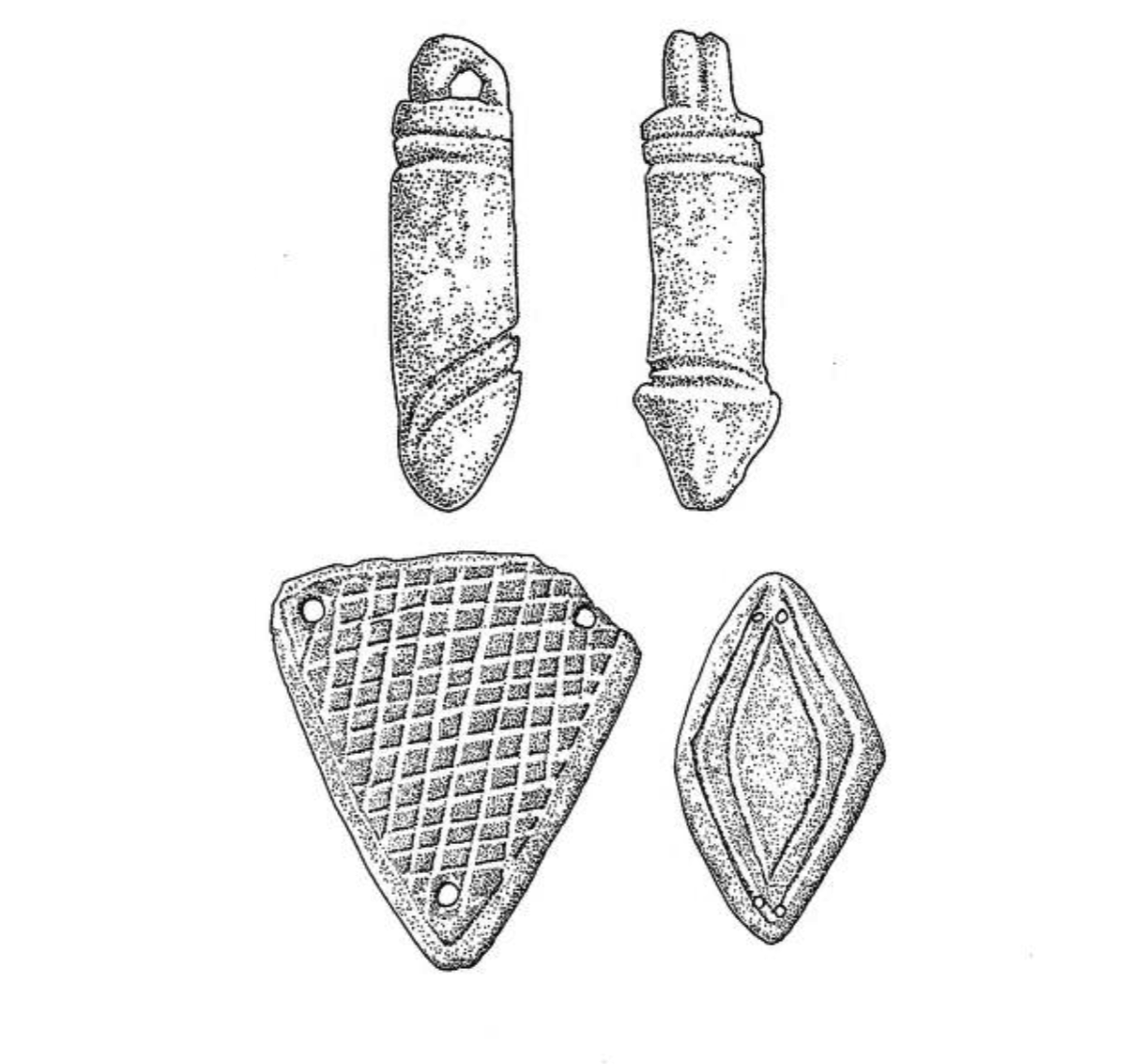
I talked about the symbolic depictions of vulva linked to Ishtar/Inanna in my article "Rhomb", in which I talked about some items of a sexual nature from the Middle Assyrian temple of Ishtar at Ashur. Models of human sexual organs, with holes for attachment and suspension: phalli of stone, and a pubic triangle and vulva of baked clay...
I talked about (some other) parallels between Ishtar/Inanna and Demeter in these articles, "Inanna and dove", "Demeter and dove", about why dove was the holy bird of Inanna and Demeter, goddesses of grain (harvest). Spoiler: Harvest starts when doves start nesting...Terracotta statuette of Demeter enthroned with a turtle-dove. Sicily, 5th c. BC.

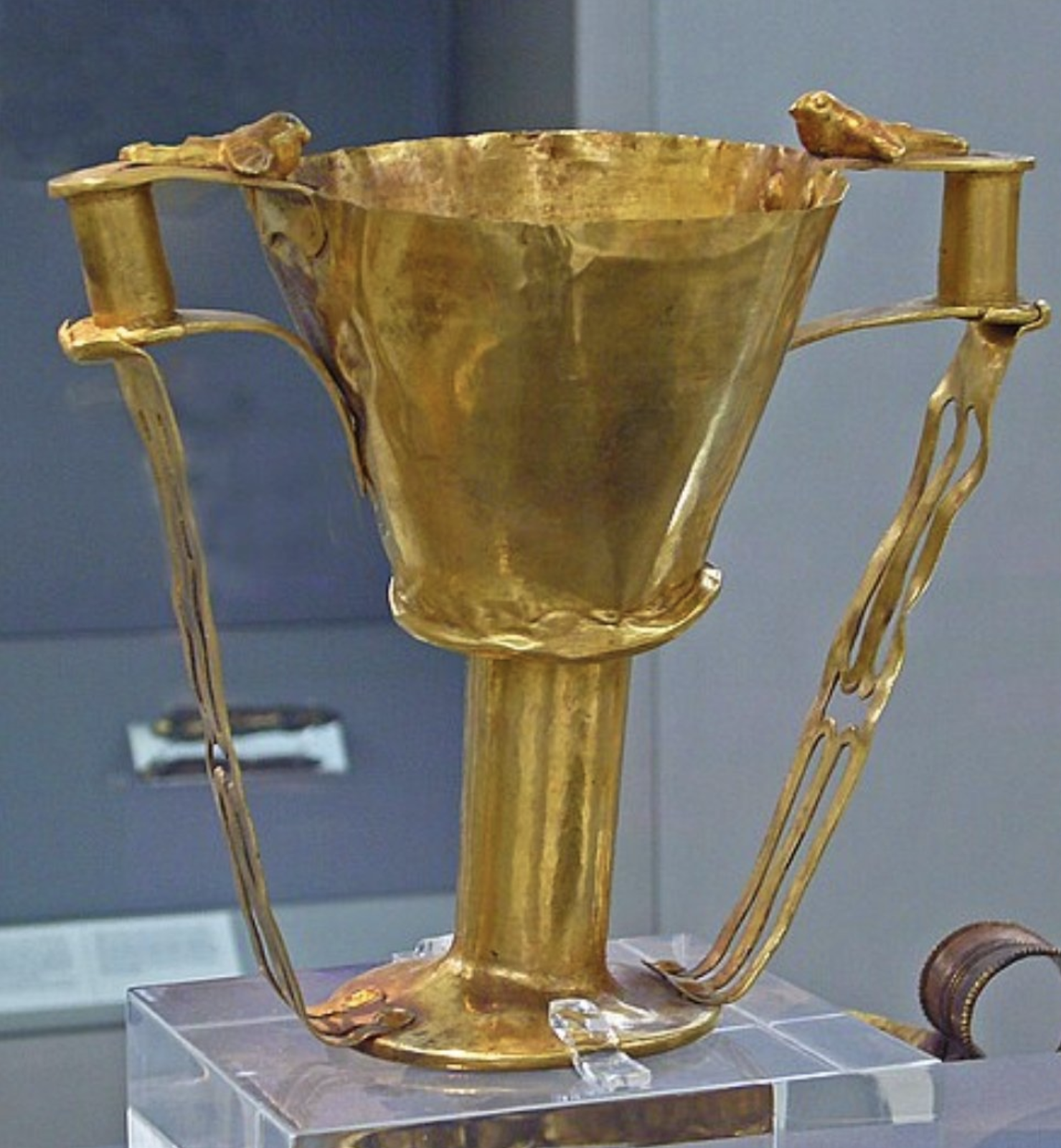
I also talked about this in my article "Cup of Nestor", in which I proposed that maybe Demeter is just Asherah, Ashtarte, Ishtar, Inanna in disguise...Pic: Cup of Nestor from Mycenae...
The last type of Baubo figurines depicts a woman sitting with again in the natural birthing position, this time on a pig(let).

The meaning of this figurine becomes obvious when you know about the link between Persephone and pig(lets)...I discuss this in my article "Pigging around"...Pic: Terracotta figurine of a female wearing a polos and holding a piglet in her right hand and a torch in her left hand. From the Sanctuary of Demeter and Kore (Persephone) at Ancient Corinth. Around 320-200 BC. Corinth Archaeological Museum...

One thing that I didn't talk about is the fact that according to the Latin writer, M. Terentius Varro: "...For our women...identify the female vulva of virgins with piglet, Latin porcum and Greek choiros..."
This word play with porcus/choiros referring both to piglet and to the vulva of virgins indicates that the pigs offered in the Thesmophoria could have been substitutes for (and symbolic of) the sacrifice of a young girl, just as Kore had been sacrificed (abducted)...
Or maybe what was sacrificed was virginity. You need to kill the piglet (rapture the hymen) in order to conceive, to produce life...In order to become the birth giver...
Thesmophoria, the festival commemorating the abduction of Persephone, was celebrated by married women only. And every one of them "had to sacrifice a piglet" to be allowed to participate...
Just like (Virgin) Earth (Persephone) has to be ploughed (raptured) so the grain seeds can be sown into it, and so she can become (Mother) Earth...More precisely Mother of Grain...Demeter...
And so, Baubo, sitting in the natural birthing position, on a pig(let), sometimes touching her vulva, as if to emphasise that the pig(let) and the vulva of the virgins were symbolically, at least from the point of view of the Eleusinian mysteries, one and the same...
Sooo far so interesting. But here comes the most interesting bit...We still haven't answered the question: Who is Baubo actually?
And I think that to answer this question we fist have to answer this question: What does Baubo mean?
Empedocles who wrote in the 5th c. BC proposed that Baubo means belly...Some understand this as "the place where babies (fruit) are before birth". And some understand this as "association to the belly laughter that she provoked in Demeter"...
But M. Olender in her "Aspects of Baubo" noted that the root word "bau", which was used in a few words associated with nursing an infant – "to lull to sleep, to rock, a cradle, a pacifier", was not common to Greek and may have been a foreign import...
For this and several other reasons she thinks Baubo was a foreign goddess – possibly arising from the Sumerian goddess Bau...Who was also a divine midwife...
Interesting...Even more interesting is that others interpret Baubo's name to mean "old crone"...
Old crone, Old woman...In Slavic languages the word for an old woman is Baba...Which is also the original reading of the name of the goddess Bau, before the reading was (controversially) changed for some strange reason...Baubo was also an old woman...
The Slavic word Baba, apart from meaning Old woman, also means Grandmother, Mother, Birth Giver, anyone who gave birth...And Midwife...The Sumerian Bau/Baba was the holy midwife...And so was Baubo...Or should we call here by her original, old name, Baba...
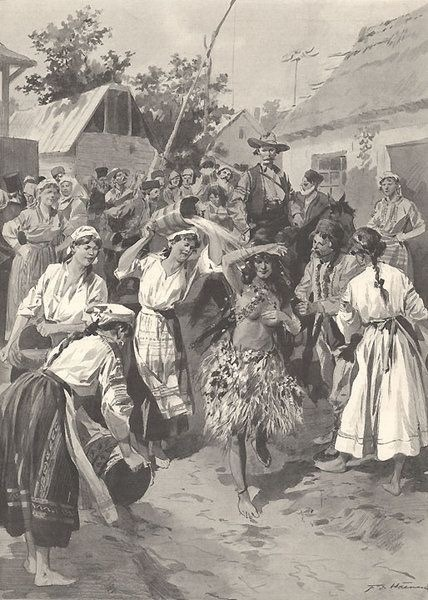
In Bulgaria, Old Thrace, people still celebrate the day of Baba (Midwife), every January with wild "women only" parties full of "obscene" jesting...
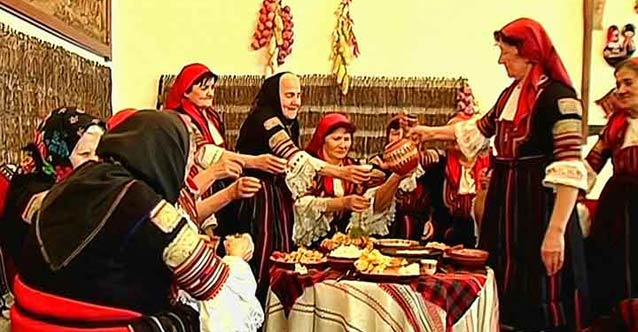
Proverb/riddle from the Balkans:
Q: Who is more important than the king?
A: Any child.
This is why women who helped deliver children were so highly respected.
From my article "Baba's day" about Babinden (Midwife day) celebration from Bulgaria:
In "Iambe and Baubo: A Study in Ritual Laughter", Olga Arans presumes that these are remnants of the Baubo cult...
I would suggest that they are indeed remnants of the original Baba cult before Greeks adopted her and started calling her Baubo...
In the Balkans, Baba is also a name used for rocks, crags, rocky mountains...basically the bedrock that gives birth to all life...Mother Earth...
Great pic by @another_barbara

Bedrock is in the Balkans known as "živi kamen, živa stena" (living stone, living rock) because it is believed to be still part of the living body of the Mother Earth which gives birth to all life...I talked about this in my article "Living stone"...
In the Balkans, and in general among the Slavs, Baba is also linked to grain. The last harvested sheaf of wheat which contained the Spirit of Wheat, was commonly called Baba and sometimes the woman that cut the last sheaf of wheat was also called Baba...
Olga Arans in "Iambe and Baubo: A Study in Ritual Laughter" again points at a possible link between Slavic Baba (The Mother of Grain) and Baubo...And I agree that there is a definite link. Baubo is an echo of Baba...
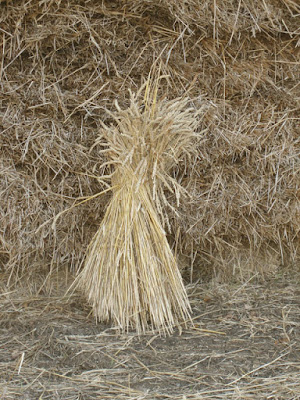
This link between Baba (birth giver) and Baba (Mother of Grain) is also found in Germanic and Gaelic folklore.
I talked about this in my article "Baba, last sheaf of wheat"...
In my article "Baba, last sheaf of wheat" I also mentioned that Balkan Slavs called making, tying grain sheaves "bаbičenje" which also means to perform midwife duties, like swaddling babies...
This can help us understand another [strange] part of the Baubo myth...
In most versions of the story, Demeter meets Baubo in the home of the Eleusian King. After Baubo gets Demeter out of her depression, the queen Metaneira gives her son Demophon to Demeter to nurse him...
Demeter then decides to make the child "immortal" by putting him on fire every night. Until one night Demeter is interrupted by suspicious Metaneira, who screams when she sees her son in the flames...
Her scream breaks the magic ritual and her son burns in fire to death. It is generally accepted that this child nursed (baked) by Demeter is "The Grain Child", bread...
What is interesting is that Clement of Alexandria says that according to the Orphic sources it was Baubo who received Demeter in her house, made her laugh, offered her the kykeon and then gave "the child" (her child?) to Demeter to nurse...
In one of the "Orphic" texts (Orph. fr. 49 ed Kern) we read the same again. We are not told the identity of "the child", but remember, when Baubo exposed her private parts to Demeter, Iacchus, the Grain Child was there "before he womb"...
So Baubo's child can be no one else by "The grain child"...Bread...
I just remembered something I wrote about years and years ago in my post "Grange stone circle", about the biggest Neolithic stone circle from Ireland, whose name "Grange" actually means threshing floor...

The biggest and the only rectangular stone from Bronze Age "Grange Circle", Ireland, is called Crom Dubh, old Irish sun and grain god. The small stack of flat stones on the left is called "grain child"...


Oh and this is very interesting...Remember the expression "to have one in the oven"? Another link between Baba and grain found among Balkan Slavs...
This is a traditional earthen bread oven from Serbia. Identical ovens were found in excavated Neolithic settlements in Serbia.

It looks like pregnant woman's belly, and it is in (some parts of) Serbia called "Baba" (Grandmother, Mother, Birth giver). I talked about this in my post "Baba, earthen bread oven"...
Again, symbolically Baubo, the "birth giver", is Dememeter, The Mother of grain...This is again kind of hinted in "Iambe and Baubo: A Study in Ritual Laughter". Great article...I think it is pretty clear now who Baubo (Baba) was. Right?
For the end: Some of the original Baubo figurines of the Priene type have Baubo holding a lyre...

This makes very little sense unless you know that the original lyre, the lyre which Hermes made for Apollo, is a complex animal calendar marker for Apr/May
I talked about this in my post "Lyre of Apollo", about animal and plant calendar markers embedded into the story about the birth of Hermes, particularly the part related to him making the first lyre, which he later swapped with Apollo for the caduceus...
Animal calendar markers: tortoise, bull, ram, snake...

Apr/May is the month in which grain harvest started in Ancient Greece...I talked about this in my post "Hesiod on grain"...

According to the Orphic theogony, when Rhea (Earth goddess), gave birth to Zeus (storm god), she became Demeter (Grain goddess). Demeter and Zeus then had sex as snakes and fathered Persephone.
Apparently "no one knows what this means"...If only anyone bothered looking at the climatic and agricultural calendar...Grain harvest in Ancient Greece started in Apr/May, which is also the start of the thunderstorm season, and the start of the snake mating season...


I talked about this in my post "Who are Persephone's parents"...
Those Orphic dudes preserved some really ancient knowledge indeed.
So I wonder if Baubo (deified birth giver, deified vulva/womb) in her role as the Mother of Grain is holding a lyre to indicate that Demeter is out of her depression and that the birth giving to grain (harvest) is beginning???
PS:
South Slavs are descendants of pretty much anyone who ever lived in the Balkans. Look at their genes...
Because of that, South Slavs are also inheritors and preservers of (partial remnants) of the cultures of all these ancient people too...
PPS:
Sculpture from the hearth of house No. 51, Lepenski Vir (9500–6000 BC, Serbia). It shows a vulva in a specific physiological state, just before giving birth, with all its anatomical details...Pic from this site...

PPPS:
Birth giver, a figurine made from a single large Danube river pebble. Lepenski Vir culture, 10000BC-4000BC, Serbia. The precursor of Baubo...

PPPPS:
Neolithic Mother of Grain...The symbolic link between women and earth depicted on this Early Vinča Culture terracotta figurine from Jela, Iron Gate region of the Danube, Serbia, c. 5200 BC, H. 5.3 cm, which has grain growing out of the womb...

PPPPPS: To understand why I wasn't surprised at all to find Baba as the name of the divine midwife in Sumerian mythology check this out:
Sumerian is a language isolate, without any known descendants or related languages...but...Interestingly, in it we find some very important words which (look like they) are direct cognates with Words from Balto-Slavic branch of IE languages...
Like words for:
King, Scribe and Tablet, Mind, Breath, Life, Grain, Weevil (Grain eating insect), Teeth, Sickle, Fly, Set alight
BTW, Akkadian, a Semitic language, also has some very interesting words with (what look like direct) cognates in Balto-Slavic languages...
Like words for:
Axe, Balance (This could actually be a Sumerian word, we don't know), Gown, Acorn and Oak, Blood and Sacrifice, Scorching heat
There is no explanation for how these words can be found in Sumerian and Akkadian, some of the oldest known Non IE languages, and in Balto-Slavic languages, allegedly "the youngest branch of IE languages"...
That's it. To read more about ancient animal and plant calendar markers, start here…Then check my twitter threads I still didn't convert to blog post...I am way way behind...