Showing posts with label Irish mythology. Show all posts

Sunday, 26 July 2026

Goibniu

This map shows surnames in different languages which mean "smith". 

Look at Ireland (Mac Gabhain) and Scotland (Mc Gowan)...

Both the Irish and Scotish surnames mean son of a smith (Gaelic gobha, gabha, pronounced gova which comes from Old Irish gobae, gobann meaning smith, cognate with Middle Welsh gof, Middle Breton goff, Old Cornish gof, Gaulish gobedbi, "Of disputed PIE origin possibly only found in Celtic languages and coming from Proto-Celtic stem *goben-, meaning smith"...

Hmmm...

Now look at all the Slavic countries...

Slavic languages have a whole cluster of words based on the root "kov" meaning metal:

        kov(ina) - metal/iron

        kovati - to forge, to strike hot metal to perform metal work

        nakovanj - anvil, that on which forging is done

        kovačnica, kovnica - forge

        kovanica - something forcefully stack together like being forged

        kovač - smith

From Proto-Slavic "kovati", from Proto-Balto-Slavic "*kauˀ-", from Proto-Indo-European "*kowh₂-", from the root "*kewh₂-" meaning to strike, to hit... 

But for some weird reason, Celtic words for smith can in no way be cognates with Slavic words for metal and smith...God forbid...

Now, in Celtic lands we find several gods, Irish deity Goibniu, Welsh deity Govannon, Gaulish deity Gobannos, whose names have a hypothetical Proto-Celtic root "*goben-", smith...

I will here like to talk about the Irish smithy, Goibniu (pronounced gov-nu), cause he will also help you understand what I am going to say about Lugh...

In Irish mythology Goibniu was the smith of the Tuatha Dé Danann. He is believed to have been a smithing god and was also associated with feasting.

According to Lebor Gabála Érenn, his father was Tuirenn...Who is basically, Taranis, The Celtic Sky/Thunder god in disguise. 

At the same time, in Irish mythology and folklore, his father was also named "Esarg" and "Tuirbe Trágmar".

"Esarg", meaning "striker", is derived Old Irish root esorcon, meaning "smiting," "striking," "beating," or "a blow dealt to a foe in battle". 

So far so normal and expected. Sky/Thunder gods were after all "Mighty Smiters"...

"Tuirbe Trágmar" which means "the axe-thrower" is a character which appears in Irish mythological texts as a warrior ancestor or father of Goibniu. 

In the Metrical Dindshenchas (Lore of Places) he is described as a "man of skill" and the father of Gobbán Saor "a highly skilled smith or architect". The text describes his feat of hurling his magical battle-axe from Tulach Bela (the Hill of the Axe) into the face of the incoming flood-tide to order the sea to stop rising. 

In the Lebor Gabála Érenn (The Book of the Taking of Ireland) Tuirbe Trágmar appears as an alternate name or epithet for Esarg (Striker, The thrower of axes), listing him directly as the father of Goibniu the smith-god. 

In the Oidheadh Chloinne Tuireann (The Tragedy of the Sons of Tuireann) he is mentioned as Tuirenn Tuirbe Trágmar, (Taranis, The thrower of axes) and is identified as the father of the divine smiths.

Tuirenn, Striker, Thrower of Axes, the father of the Smith God...

Remember the PIE root "*kewh₂-" means to strike, to hit. Striking, hitting is an integral part of axe making process since the Palaeolithic. 

Stone axes are made by striking a large flint nodule in such a way that small chips of stone are gradually removed until a sharp axe shaped blade is produced. 

Bronze axes are first cast, then the edge is cold hammered to harden it and then it is wet sand polished to sharpen it. 

Iron axes are first wrought (hot melted bloom, mix of ore and charcoal, folded, hammered, folded, hammered...) and then forged (reheated wrought iron hammered) to desired shape, then the edge is wet stone polished to sharpen it.

So striking = making axes...

That's "Maker of Axes"...This doesn't explain why  Goibniu's father was called "Thrower of Axes"???

Striking, hitting is also what sky gods did a lot. With thunderbolts. Which were imagined by people all over the place as stones...

A 15th-century engraving depicts the town of Ensisheim in present-day France being struck by a thunderbolt (stone)...I talked about this in my post "Jack and magic beans", about giants who lived on a stone sky and who hurled giants rocks down on earth...The original sky (stone) thunder gods...

What is also interesting is that people thought that these thunder stones were actually (shaped like) stone axes...This belief existed in Europe until well into the Middle Ages...Which is why ancient stone axes were believed to be petrified lightnings and were kept as talismans as a protection against lightning strikes...

I talked about this in my posts "Thunder axe" and "Kataibates"...

Which is why a lot of thunder gods wielded axes...Like Hadad...Whose name has no known etymology, possibly from Northwest Semitic root hdd meaning "to thunder," "to crash," "to make a loud noise"...

Now look at the smith surname map again. In Semitic languages we have word for smith "haddad", which apparently comes from the Proto-Semitic root *ḥdd = "to be sharp, pointed" 

So we have:

Hadad → the divine striker (lightnings, thunderbolts which were imagined as being made of stone)

ḥaddād → the one who makes sharp edges by striking metal

But apparently, linguists currently keep ḥdd ("sharp") and the proposed root of Hadad separate because they begin with different Proto-Semitic consonants (ḥ vs. h).

As I already said, in Stone, Bronze and Iron Age, striking was the universal method by which cutting tools were produced or improved, whether in stone, bronze, or iron. That makes "striker" and "maker of sharp edges" naturally adjacent concepts in many ancient cultures, even if they are not always etymologically identical.

As I said already, stone axes are made by striking a large flint nodule in such a way that small chips of stone are gradually removed until a sharp axe shaped blade is produced. 

Now if, while making a stone axe, you strike, hit a flint nodule with a pyrite nodule, cause you just happened to have picked this particular shiny stone to use as knapping stone, you will generate a spark, a mini lightning, strong enough to light combustable dry material and start fire...


Here is a video showing how this is done

In several of my posts I asked the question: How old is the connection between stone axes and thunder gods?

In my 2019 post "Sun stones", about ceremonies with exploding flint axes performed in Late Neolithic Vasagård site located on the southern side of the island of Bornholm, Denmark, I suggested that this link between a stone, more specifically flint axes, and thunder gods, already existed in the 4th millennium BC Europe...

In my post "Oldest symbolic monument" which I wrote last year, I suggested that the link between flint axes and lightning could be 40,000 to 160,000 old. At least based on "the oldest symbolic monument, that is to say, one with no obvious practical use and probably responding to a belief", which, according to this article is this pile of stones piled up next to a spring at El Guettar (Southern Tunisia) which has flint nodules placed on top of a pile of other round stones...

Round stones (like sling stones), falling (being thrown) from the sky...Where did I hear about this before? All over the place actually. I talked about this in my post "Cetus",  "Mithras", "Rudra"...

In Ireland, that was the speciality of Lugh...

But the latest archaeological discovery indicates that it is possible that this link already existed 400,000 years ago. According to this paper Neandertals struck chunks of iron pyrite against flint to light campfires - the oldest evidence of humans intentionally making fire. And the flint pieces found were actually flint axes...


Did Neanderthals link stone axes with lightning? Anyway...

Remember this:

A blacksmith has to strike his anvil with his hammer on every Christmas morning before sunrise. If he doesn't do it, his hammer and anvil should be broken and he and his family should be expelled from the tribe (medieval Vasojevići tribe law cannon, Montenegro)...

Striking anvil with hammer produces sparks and sparks create fire. And Christmas Day is the day when the fire of the sun gets rekindled (the old winter solstice, the rebirth of the sun and solar year)...

This is what Yule log rituals are all about...

A toast to yule log, Dalmatia, 1893. South Slavs believed that yule log was the earthly seat of god,  addressed it with utmost respect and made sacrifices to it, during cutting, bringing in, burning...

I talked about this in my posts "Badnjak", about Yule log customs in the Balkans, "La buche de Noel", about Yule log customs in France and "Yule log in English tradition", about Yule log customs in England. 

BTW, you need an axe to cut a Yule log...

Everything indicates that the Yule log ceremonies are solar ceremonies. But why was Oak, the holy tree of Perun, The Thunder God, used as Badnyak (Yule Log)? 

To understand the link between the heart fire, yule log, thunder god and the sun, you need to check this out:

"It is a great secret how Svarog (heavenly and earthly fire) is at the same time Perun (thunder) and Svetovid (Sun)"...

Mathis (Matthias) Gerung, The Mighty Angel with the Little Book (Revelation 10), illuminated miniature on parchment in the Ottheinrich Bible, vol. 8, fol. 293r, c. 1530–1532 AD. Collection: Bayerische Staatsbibliothek, Munich...

Apparently, no one knows what this image really represents. I think it represents this:

Modern science has confirmed that it is indeed (heavenly) fire of the Sun which through Lightning descends to earth and becomes (earthly) Fire. I talked about this in my post "Sun Thunder Fire"...

So this is why the Yule Log is an Oak Log.

An Oak Yule Log (The Holy Tree of the Thunder Gods) is placed in the house hearth, the seat of the Earthly Fire on Christmas (Winter Solstice) eve to (symbolically) link it to the Sun's Fire...As long the Yule Log is burning, these two fires are (symbolically) connected and on Christmas (Winter Solstice) morning, the earth fire will (symbolically) ascend from the hearth to the sun and will restart the sun's fire...

BTW, this is how Ancient Greeks symbolically depicted the same thing:

"Hestia, you who tend the holy house of the lord Apollo...come now into this house...having one mind with Zeus the all-wise..." (Homeric Hymn To Hestia)...  

What does this mean? Sun (Apollo, Helios) creates Fire (Hestia) through lightning (Zeus)...

I talked about this in my post "Having one mind with Zeus"...

Back to sparks:

In Serbia, one of the most important part of the Yule log ceremony was the sparks divination performed by the first footer, the luck bringer...I talked about this in my post "First Footer"...

The First Footer repeatedly "strikes" the fire to produce sparks. After each strike, he exclaims:

As many sparks, as much luck!
As many sparks, as much love!
As many sparks, as much health!
As many sparks, as much money!

This "creation of sparks by striking burning Oak (the sacred tree of the thunder gods) Yule log" seems to me to be symbolic enactment of the creation of lightning by the thunder god...

Smith "creating sparks by striking hot iron with a hammer" seems to me to have the same symbolic meaning and directly links smiths with thunder gods...

Which is why, I suppose, Thor wields a hammer...Like here on the 11th century Altuna Runestone...


But is Thor holding a hammer or a double axe?

You might find my post "Axe or hammer" interesting. It explors the origin of Thor's hammer (axe?) Mjǫllnir and its relation with Perun's axe: 

Anyway, this is all important to know if you want to understand the following:

So the father of the Irish smith god Goibniu was the sky god, Tuirenn, the Thrower of Axes (thunderbolts)...

Guess whose father was Goibniu? Lugh's...

According to an Irish legend, Balor hears a prophecy that he would be killed by his grandson. 

To avoid his fate, he locks his only daughter, Ethnea (Eithne), in a tower to keep her from becoming pregnant. 

Balor goes to the mainland and steals the magical cow of abundance Glas Gaibhnenn belonging to Cian. 

Cian learns he can only get the cow back when Balor is dead, so he manages to secretly enter the tower, finds Ethnea and impregnates her. 

When she gives birth to three sons, Balor orders the three to be drowned, but one survives without Balor's knowledge. 

The kid, Lugh, is fostered by a smith who is also Lugh's uncle. 

Balor eventually encounters his grandson by chance and is killed by him.

That magical cow of abundance Glas Gaibhnenn, was in other Irish legends said to have belonged to one of several figures variously named Gavida, Gavigan, Gaibhlen, identified as smiths, and believed to be Goibniu in disguise and who were in some way involved in the conception of Lugh.

BTW, the name of the magic cow Glas Gaibhnenn means "grey cow of the smith (god)", basically a rain cloud of the sky god...


Heavenly cows (rain clouds) are a common mythological image found all over Eurasia. 

In Indian mythology we find story about Indra's cows (rain clouds) being stolen by Panis demons who also steal sunlight (it is the sun that creates the wet summer monsoon) and hidden "inside the mountain" (Himalayas create up-drift which pulls the moist air from the sea). 

I talked about the Indian monsoon mechanism in these posts: "Vayu", "Maruts", "Mahishasuramardini"...

The cows are found by Indra's hound (the wet summer monsoon peaks during the Dog Days, Jul/Aug)...

Why are dog days in Jul/Aug?

When our mythologies were made out of animal calendar markers, Sirius, the Dog Star rose with the sun in Jul/Aug, when mating season of the old dog breeds began...

We find this embedded into myths in:

Egypt: Article about "Dog days"...

Mesopotamia: Article about "Tishtrya"...

India: Article about "The bitch of the gods"...

Anyway...

In Slavic mythology we find Perun (thunder) who every year fights Veles (dragon, burning sun) who steals heavenly cows (rain clouds) from Perun...And every year Perun triumphs over Veles and rescues his heavenly cows... 

In Ireland we find Balor (dragon, burning sun) who steals "grey cow of the smith (god)", from a smith or someone related to a smith (god) so the smith (god) impregnates Balor's daughter, whose son, Balor's grandson, eventually kills Balor by striking his burning eye with a shiny (sling) stone, after which the cow of abundance is returned to the smith (god)...And this also happens in...Jul/Aug...Which is the peak thunderstorm season in Ireland... 

Soo....

What do you think, cool?

If you are interested in reading more about ancient animal and plant calendar markers, which are at the root of all our mythologies, start here…Then check my twitter threads I still didn't convert to blog post...I am way way behind...

Sunday, 15 September 2024

Cygnus

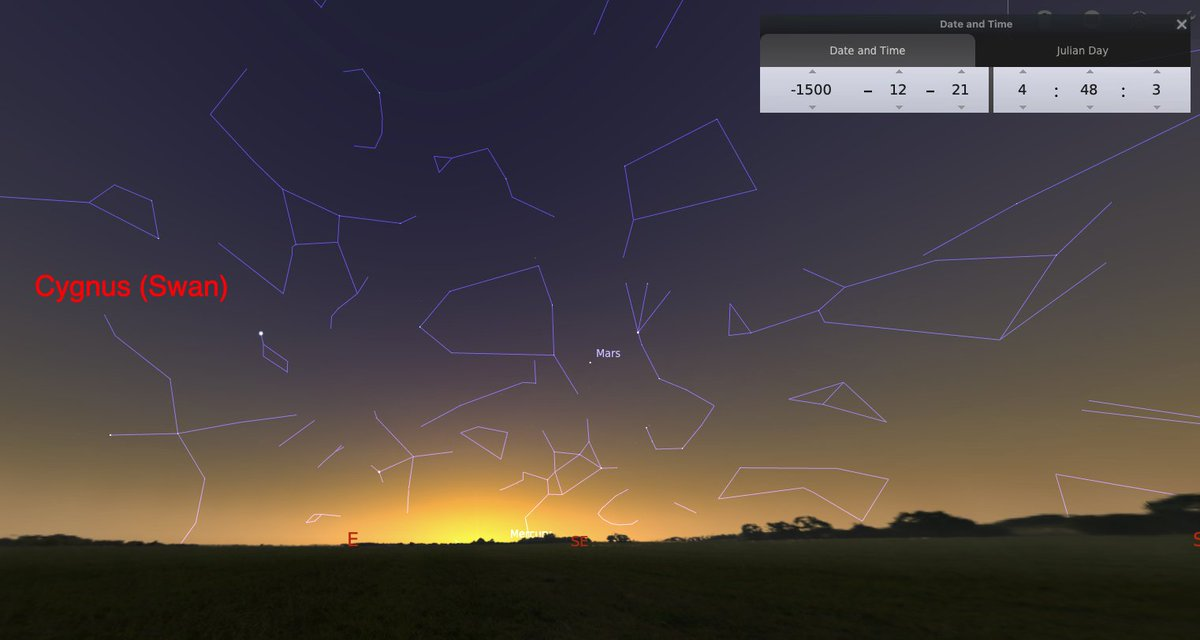
When Apollo was born, "swans circled Delos seven times"...Young Sun God is born on winter solstice...And during second millennium BC, the formative period of the Greek mythology, Cygnus (Swan) constellation rose with the sun around winter solstice. Source: Stellarium app


The Swans of Apollo were "Singing swans" which "when the singers would sing hymns to Apollo, would join the chant in unison"...The only swans that "sing" are whooper swans...

These are migratory birds, which spend warm, sunny half of the year (Mar/Apr/May-Oct/Nov) in the northern regions of Eurasia, and cold, dark half of the year (Oct/Nov-Mar/Apr/May) in the southern (Greece) and western (Ireland) regions of Eurasia...

Which is why in Greece we find "Singing swans" linked to the birth of the Young Sun God Apollo at winter solstice...I talked about this in my post "The singers of Apollo"...

And why "swans always hovered over the head of Aengus", The Young God, who is said to reside "for one night and one day" inside Newgrange, Neolithic temple built in Ireland to capture the rising sun on day of the Winter Solstice. I talked about this in my post "The young one"...

This is also why the Old Sun God (which became The Devil) from Neolithic Karelia (North of Russia) was depicted standing between swans arriving from the land of the dead in the Spring and departing to the land of the dead in the autumn...

Land of the dead, according to the local folklore, being "somewhere south-west"...Where migratory whooper swans spend winters...I talked about this in my post "Bes"...

That's it. To read more about ancient animal and plant calendar markers, start here…Then check my twitter threads I still didn't convert to blog post...I am way way behind...

Monday, 20 June 2022

Gilgamesh and hurling

Article about Gilgamesh. And hurling...

Pic: "Hurlers appearing through the icy mist" by John McIlwaine...

Hurling, Gaelic "game" described as a "cross between hockey and murder". Probably developed to train warriors in hand to hand combat, it could be thousands of years old...

Excerpt from "Gilgameš, Enkidu and the nether world": 

"...The tree [of life], he [Gilgamesh] uprooted it and stripped its branches...He gave it [wood] to his sister holy Inana for her chair. He gave it to her for her bed..."

So far so Mesopotamian...Now it turns very very Irish 🙂 Anyone from Ireland who ever played Hurling will know what I am talking about...For those not from Ireland, and not familiar with Hurling, check these articles about "Gaelic sports"...

"...As for himself, from its roots, he [Gilgamesh] manufactured his ball and, from its branches, he manufactured his mallet [or hurley stick?]..."

"...He played with the ball in the broad square, never wanting to stop playing it, and he praised himself in the broad square, never wanting to stop praising himself [🙂 see]..."

"...The young men of his city were playing with the ball. For him who made the team of the widows' children [basically they played the game so much their mothers never saw them], they lamented: "O my neck! O my hips!" [it's a tough game]..."

"...For those that had a mother, the mother brought bread for her son; for those that had a sister, the sister poured water for her brother..."

"...As the evening came, he marked the spot where the ball had been placed, and he picked up his ball from in front of him and took it home. But early in the morning as he …… the place marked..."

"...the widows' accusation and the young girls' complaint caused his ball and his mallet [hurley stick???] to fall down to the bottom of the nether world..."

"...He could not reach them...He tried with his hand but could not reach them, tried with his foot but could not reach them..."

"...At the gate of the nether world, he sat down. Gilgamesh wept, crying bitterly: "O my ball! O my mallet [hurley stick???]!...I am still not satiated with its charms, the game with it has not yet palled for me!..."

"...My ball has fallen down to the nether world -- who will retrieve it for me? My mallet [hurley stick???] has fallen down to the nether world -- who will retrieve it for me?..."

Oh, Enkidu, I see you have nothing better to do...Would you mind popping down to the nether world and getting my ball and mallet for me? Good lad...

Of course I am not saying that Sumerians played hurling...

Sunday, 23 January 2022

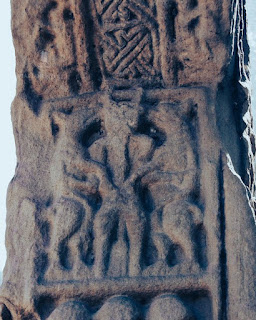
Market Cross at Kells

This Sunday started quite well...

Archaeologist Neil Jackman @JackmanNeil posted this very interesting picture on his twitter account:


With these comments:

An unusual, and a little unsettling, depiction on the c.9/10th century Market Cross at Kells, County Meath.

It features a human-like bearded figure with horns, flanked by two beasts (wolves or lions?) on their hind legs. Could it be a rare depiction of the devil?

Early Irish high crosses usually (though not exclusively) depict religious scenes, along with the beautiful ornamentation.

Dr Francis Young @DrFrancisYoung, Historian of religion & beliefs then commented that:

The iconography of Satan hadn't yet settled down by that point; I don't think there are c9th representations of Satan with horns. If I had to guess, I'd say this is a Classical reference and the figure is most likely Pan/Faunus, representing wild untamed nature. As a rule of thumb, if in doubt about early medieval iconography, it's usually a garbled Classical reference...

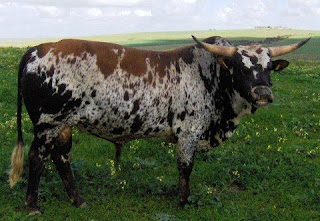
Eeee wasn't there some fella called Crom Dubh, whom pretty much all early Irish saints defeated at some point or another, who was linked to bulls, and who could even turn to a bull himself? Particularly a speckled one...

The horns on the "devil" from the Market Cross at Kells look very much like bull horns to me...

I talked about Crom Dubh bull folklore in my post "Bull of Crom Dubh"...

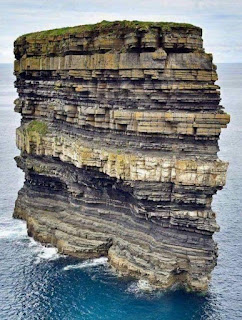
Crom Dubh apparently lived all over Ireland...Including Dun Briste. 

And guess what: "Crom Dubh (also) had two hounds of dogs...and if ever there were [wicked] mastiffs these two dogs were they..." 

I talked about this legend in my post "Dun Briste"...

So here we have a "bull god flanked by two hounds"...Is this enough to identify this image as a depiction of Crom Dubh? Of course not. But it is a possibility that we can't ignore...Especially because this would be the only known depiction of Crom Dubh ever found that matches the folklore depictions of this old Irish god...

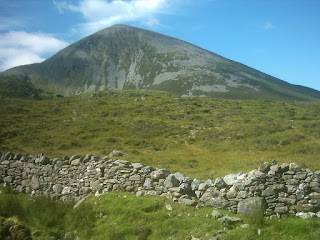
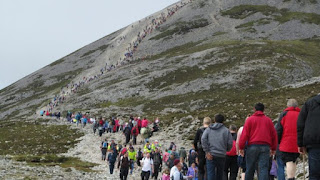
Croagh Patrick, the Irish "Holy mountain". 


Once "the holy mountain of Crom Dubh" the old Irish Sun/Sky god and god of agriculture, it became "the holy mountain of St Patrick", after he "defeated" Crom Dubh... The day of the annual pilgrimage to the top of the mountain is still known locally as "Domhnach Crom Dubh" which means "Crom Dubh's Sunday"... 


Wednesday, 24 February 2021

Living stone

Shepherds chapel, Velebit, Croatia dedicated to Holy Mary. The altar is actually bedrock, around which the church was built, indicating that this a Christianised pagan holy place. I talked about this in my post "Shepherds chapels from Velebit"... 

Bedrock is in the Balkans known as "kamen živac, živi kamen, živa stena" (living stone, living rock), called so, because it is believed to be still part of the living body of the Mother Earth.  And is venerated as sacred...


Transhumance shepherds used to bring offerings to these lumps of exposed bedrock before they took their flocks to the highlands, to ensure good weather. People believed that "Mother Earth, known as Baba, controls the bad, cold, rainy, snowy weather". I talked about this in my post "Weather stones"...

In my post "The City", I talked about an ancient enclosure in Co Kerry, Ireland which was linked with the veneration of the (D)Anu, the Irish version of Baba, The Mother Goddess. 

The enclosure was built around an exposed piece of bedrock, which served as an altar.

The City was the place where annual rituals were perform on Bealtaine, 1t of May, the middle of Taurus, at the beginning of the cattle drive into the highland pastures, "for the protection of the cattle"...

From the bedrock standing in the centre of the enclosure, both people and cattle looked towards the two round breast like hills, made even more breast like by giant stone cairns built on their tops. The hills are known as the Paps of Anu (Boobs of the Mother Earth)...

So here in Ireland, just like in the Balkans, we have association between bedrock, Mother Earth and shepherds...Mountain tops, and bedrock crags called Baba (Grandmother, Mother, Mother Earth) from the Balkans Pic: Velika Baba (Great Grandmother) peak, Slovenia. From the post "Baba, mountains and crags


Saturday, 6 February 2021

The City

Yesterday I came across an interesting paper by Frédéric Armao: "Cathair Crobh Dearg: From Ancient Beliefs to the Rounds 2017". It is an ethnographic study of the stone enclosure of Cathair Crobh Dearg, Co. Kerry (also referred to as the City). You can find it on Google maps here.

A 12th century source claims that "The city" was "the mansion of Credhe, fairy lover of Cael (a Fenian hero) and daughter of the king of Kerry", which was situated "against the mountain’s breast in the northeast"...

The mountains being explicitly referred to as the Paps of Anu. And Cathair Crobh Dearg indeed lies on the northeast of the Paps and is the only remarkable structure of its kind there...

Later tradition ascribes the building of the Cathair Crobh Dearg to the Saint Crobh Dearg(h) 🙂 face Who apparently had two sisters, Saint Latiaran and Saint Gobnait. This triad of Saints was a Christian equivalent of the original triad of goddesses Ana/Macha/Badb.

All three sisters had a holly well associated with them: 

Saint Gobnait, holy well in Ballyvourney, visited for Imbolc (Feb)

Saint Crobh Dearg, holly well in "Cathair Crobh Dearg, visited at Bealtaine (May) 

Saint Latiaran, holy well in Cullen, visited for Lughnasa (Aug)

The only Irish cross quarter day which was not holy to the Three Saintly Sisters was Samhain, the day of the dead (Nov)...I talked about the Irish cross quarter days in my post "Two crosses"


Bealtaine, 1st of May, mid Taurus, marked the start of the active, white part of the year, which lasted until Samhain (1st of Nov). Cattle was taken into the highland pastures after Bealtaine and was taken down from the highland pastures by Samhain ...

Which is why Bealtaine was the time when many rituals related to cattle protection and health were performed. The main being lighting two huge fires and driving the cattle between them. And another being driving cattle to holy wells where they were given holy water to drink...

Interestingly, all three wells associated with the Three Holy Sisters, had the reputation to heal cattle. Particularly the well at Cathair Crobh Dearg (The City) has been linked with the protection and/or purification of cattle for centuries. Maybe millenniums...

Cattle was driven, until the early 20th century, inside the enclosure of The City so they could drink the water of the well on Bealtaine morning. Sometimes the cattle were left in the enclosure during the night before Bealtaine...

It was believed that "The City could hold an almost infinite number of cows at Bealtaine: no matter how numerous the farmers and cattle would be, it was impossible to fill the enclosure of Cathair Crobh Dearg"...🙂

The spiritual and traditional significance of The City cannot be fully understood without knowing that from this enclosure you have an unobstructed view of two mountains (often qualified as holy by researchers and informants alike), Dá Chích Anann or the Paps of Anu.

The two twin mountains have been associated with the goddess (D)Ana/(D)Anu/(D)Anann both in folklore and mythology. 

Each of the Paps is topped with a large cairn, clearly visible from The City. This just emphasises the distinctive breast shape of the two twin mounds.


According to Frank Coyne, who performed detailed study of the area, "among many Neolithic and Bronze age structures found on the Paps, the most...distinctive are...the summit cairns...which are believed to be the earliest monuments to have been constructed on or around the peaks"

Coyne says that it is obvious that "...the builders wanted to shape and enhance the form of the mountains. The cairns, which...have a complex construction which must have taken a considerable amount of planning, evidently bear the shape of nipples..."

Excavation of the western cairn in 2001 failed to prove the presence of a burial under the cairn. This makes it clear that the cairns were built to anthropomorphise the landscape, and strengthens the sacred symbolism of the breasts...

Who was this Anu whose boobs Bronze Age Irish liked to stare at from the "The City"? She was one of the Three Goddesses Ana/Macha/Badb collectively known as the three Morrígna...

The 12th c. Lebor Gabála Érenn, says that : "...It is from the additional name of Morrigu, 'Danann' the Paps of Ana in Luachair are called, as well as the Tuatha De Danann..." Three goddesses, Three faces, Three names, Three phases of the same goddess, Dana...

D(Ana) was the goddess of fertility, basically Fertile Mother Eearth. The name Dana comes from the Irish "dán" meaning gift, which in turn comes from PIE "da" which means "to give" making her "the Giving One, the Giving Mother, Mother Earth"...

Munster, where according to the medieval sources "she is adored", owes its fertility to the "Mother-goddess of Ireland". The 10th century Cormac’s Glossary states: "Ana, the "mater deorum hibernensium" (the holy mother of Ireland)" and associates her with the Paps of Anu...

So if the "nipple cairns" date to Neolithic or Bronze Age, how old is The City? Coyne says: "placing of the cairns was deliberate as neither sits directly on top of the mountain but...slightly to the north, making them more clearly visible from the direction of The City”...

Which would then mean that something, some observation platform, point, must have existed in the place where The City stands now, at the time when the nipple cairns were built. Observation point from which the Paps of Anu could have been seen in all their glory 🙂

Coyne however ways that The City is "not dissimilar in size to the phase 2 enclosure at Uisneach" which dates to the Iron Age. And because both enclosures were the focus of the Bealtine celebrations, it would seam that The City is also an Iron Age construction...

That is possible. But, I would still argue that there is reason to believe that something existed on the site of the City at the time when the two "nipple cairns" were built on the Paps of Anu. Something later covered by the Iron Age enclosure. Here is why I think so:

Two large rocks (or “megaliths”) are located at the centre of The City enclosure. The stones are mentioned in the 1841 Ordnance Survey maps, which indicate that the “Cromlech” was occasionally referred to as a “memorial stone”.

Charcoal was discovered during the excavation and dated to 60BC-420AD. This demonstrates past activity on the site...And from this stone we have clear view of the boobs of the Mother Earth. But we have the same from any other stone lying around the Paps of Anu...

But there is a reason, I think, to suspect that it was from these stones, that the builders of the nipple cairns marvelled at their creation. And that The City was specifically built around this outcrop, to be "aligned" to the view of the Holy Cleavage.

At the northeast end of the City, inside the enclosure, a modern statue of the Virgin Mary was erected, according to the local records, in the 1930's. At her feet are half a dozen flat stones with Celtic crosses. How old they are is hard to tell.

Some ethnographic records state that an earlier altar of "Our Lady of the Wayside" stood there before and was built in the 13th or even 10th century...

Frédéric Armao, says that "the claim seems highly doubtful...and...indicates a wish on the part of the informants to inscribe this Christian tradition in the distant past of the island..." I would like to disagree with him on this.

I think that these stories are probably true, and that they describe early attempts at Christianisation of the site. Originally pagan sanctuary, dedicated to the Goddess (D)Ana, was turned into a Christian sanctuary dedicated to the Holy Mary. Mother Earth became Holy Mary.

The Christianisation of the site occurred gradually and peacefully, as often in an Irish context. 

Many priests preached sermons at the City in May as late as the 1920s. A very interesting statement was recorded in 1925, made by a certain Father William Ferris:

This doesn't mean that the Bealtaine gatherings at The City stopped in 1920's. During his ethnographic survey in 2017, Frédéric Armao noted that:

So local people, including the local clergy, preserved the memory of the original use of the site as the temple of the goddess (D)Anu. I believe that this original use of the City, was physically preserved in the positioning of the statue of the Holy Mary.

If the site was dedicated to the Holy Mary, why was the statue of "Our Lady of the Wayside" erected at the Wayside of The City enclosure and not at its centre? And why was it positioned right there where it is standing today?

I believe that the statue was erected on top of (or in place of) the old altar stone, which was aligned with the central stone, to point exactly at The Cleavage, the gap between the two Paps of Anu. 

Have a look at this:

1. The view of The City with the statue of the Holy Mary and the Central stone marked and connected with the arrow pointing to the Paps of Anu.

2. The view of The City with the statue of the Holy Mary and the Central stone marked and connected with the arrow pointing to the Paps of Anu. The arrow overlaps (for a short while) with the country lane which goes in the direction of the Paps of Anu.

3. The view of The City with the statue of the Holy Mary and the Central stone marked and connected with the arrow pointing to the Paps of Anu. Also marked are two observation points, one in front of the country lane and one behind the Holy Mary statue.

4. The view of the Paps of Anu from the front observation point at the beginning of the country lane.

5. The view of the Paps of Anu from the back observation point behind the Holy Mary statue.

6. The view of The City with the arrow pointing to the Paps of Anu

Interesting right?

My observation is based on map analysis and might not 100% precise. It would be cool if someone could actually perform the observation inside The City to confirm this...But it seems that Holy Mary is standing inside her City looking at her (perkier) younger self 🙂 (D)Anu...

The end: What are you looking at? 

Apart from Holy Mary, the only other current resident of The City. Pic by John Foley. All the other pictures are from the original article by Frédéric Armao...Apart from the maps and views related to the alignment of the Holy Mary statue...