Showing posts with label Greek mythology. Show all posts

Saturday, 10 May 2025

Partridge and mirror

Two mosaics done by the same craftsman, or a proof of the existence of a Roman "fashionable mosaics copy book"? I will leave this to others to ponder...

This one is from Empuries, Spain. 
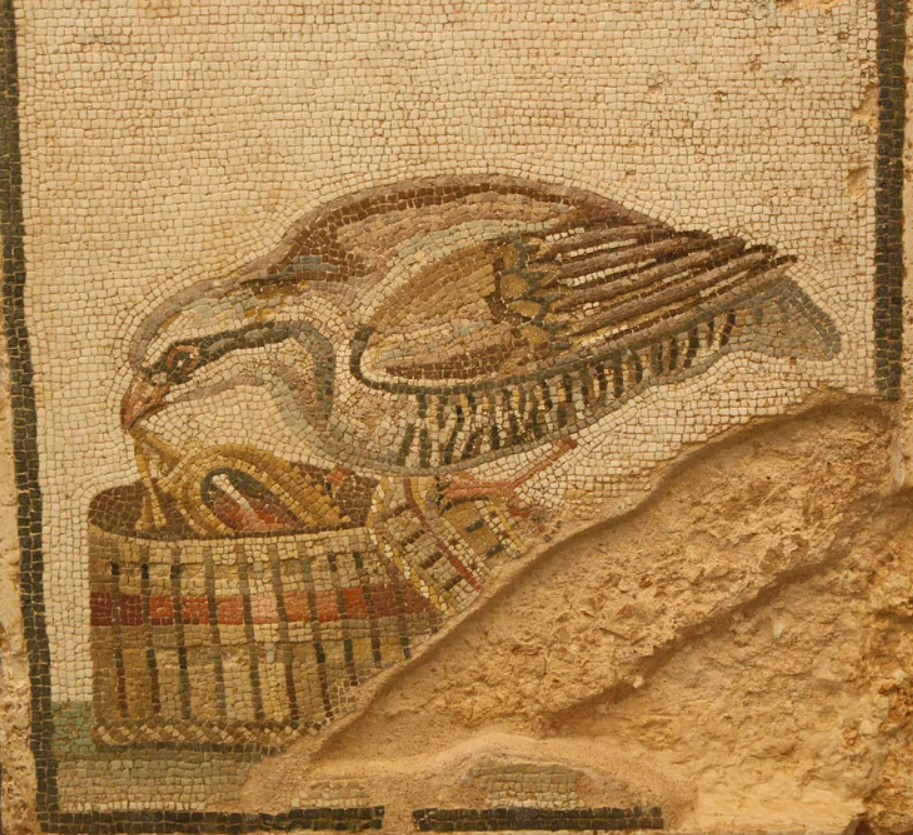
This one is from Pompeii, Italy.

The bird, red legged partridge, is depicted picking a mirror from jewellery basket...Why? Let's talk about partridges...

Partridge is known for its mad passionate mating. It starts at the beginning of spring, in February with loud love songs. It culminates in March with mad fighting for females. The shagging continues into April. So it basically spans the whole of spring...

This is what made partridge the symbol of spring...And one of the calendar markers meaning spring. Like on this Levantine water vessel which depicts the rain season: winter  (Nov-Jan, Ibex mating season), spring (Feb-Apr, Partridge mating season)

I talked about this vessel in my post "Goats and partridges"...

The result of partridge's spring sex madness is the biggest clutch of eggs that any bird in Europe lays...This all made partridge and its eggs a symbol of fertility...Here are partridges with their eggs (painted!!!) on Minoan frescoes from Knossos...


I talked about this in my post "Painted eggs from Knossos"...

The above depictions are of one of three very similar types of partridges: "Rock partridge", "Chukar partridge", "Red legged partridge"...

Now, in Serbian the name for partridge is "jarebica", a word without official etymology, but which most likely comes from "jar" (spring, youth) + "jebica" (fucker 🙂)...Fitting, right? This is the kind of partridge most common in Serbia and the rest of Balkans including Greece, grey partridge...


I talked about this in my post "Partridge"...

That this etymology is most likely right, can be seen from the fact that Serbian name for chukar partridge is "kamenjarka" (stone bird, due to it living in the coastal rocky areas)...This is also an euphemism for a whore...Fitting again I think...

There is someone else who goes through the same passionate courtship at the same time as partridges. Young spring earth. She is born at the beginning of February, the first day of spring. She gets more and more beautiful as the spring progresses...

She is courted by the young sun, who is born on winter solstice "in the land of the dead" (winter). He arrives from the land of the dead with the returning migratory birds...

He is welcomed by a beautiful young spring earth...Their courtship during the spring is nothing else but "jarjeb" meaning "spring fucking", the "union" of the young sun and young earth. It is this union that produces all life and all the bounty of summer and autumn...

This is why in South Slavic folklore, partridge is found in wedding rituals...There is a Croatian ceremonial wedding "play" called "traženje jarebice" (looking for partridge) which was first recorded in 17th century...

The ritual was performed like this: 

When groom's retinue arrived at the bride's house to take her away, bride's father would ask them who they were and what they came for. The leader of the groom's party would answer that they were looking for a partridge...

The bride's father would then say that he hasn't seen any partridge. The groom's party would then insist on checking for themselves that the bride's father was telling the truth. The bride's father then lets the groom's party in...

The bride's father then brings out the oldest woman in the house who is holding a flour sieve on her head and asks the groom's party if that is the partridge they were looking for?

When the groom's party say that it wasn't, the bride is brought out and the groom's party exclaim that it is her they were looking for...The groom's party then takes the bride to the church to get married...

You can see that this ritual directly links partridge to female fertility. The groom is looking for a fertile young wife, and this is what partridge represents....

But the partridge is also a symbol for a fertile young earth. The fact that the old woman, which was brought out first, holds a flour sieve on her head, shows that women in this play also represent the Mother Earth, the mother of grain...

The bride is the spring earth, young and fertile, bearing young grain and ready to give birth to it...

The old woman is the winter earth, the old hag, the earth who has already bore her fruit and is about to die and be reborn...Into spring earth, the bride...

Which is what the Snow-white fairytale talks about: 

In the original story about the Snow-White, it is the mother and not the step mother who is jealous of the girl and who, disguised as an old woman, kills her with a poisoned apple...That is very interesting...

Every year, a beautiful mother, disguised as an old woman, kills her even more beautiful daughter with an apple. The dead daughter then lies dead in a "crystal coffin" until a young prince comes by and revives her. Two of them then get married. Except this is not a happy end...

The beautiful daughter becomes a beautiful woman and has even more beautiful daughter, who she kills out of jealousy, with an apple, disguised as an old woman...And so on and so forth...Endlessly, year after year...

What we have here is the story of Earth going through seasons: Spring, Summer, Autumn, Winter, Spring...

Beautiful young Spring Earth becomes bountiful Summer and Autumn Earth. Still beautiful, but in no way as beautiful as the Young Spring Earth...

Because of the cyclical nature of the solar year, Autumn Earth is the mother of Spring Earth of the next solar year. As Autumn ends, and the crab apples are the last fruit left on the trees, Autumn Earth turn into Old Hag Winter Earth, who "kills" her own younger self...

Dead Earth lies in her icy coffin until Young Spring Sun arrives. He sees beautiful Spring Earth under the ice, falls in love with her and revives her. Spring Earth, marries Spring Sun...

But seasons pass, Spring Earth turns into Summer Earth and then into Autumn Earth and then into Winter Earth...And the story repeats itself...Luckily, every spring, Young Sun arrives to save the day 🙂...

I talked about this in my post "Snow White"...

This same thing is also found in Scottish folklore:

In Gaelic, the word Cailleach means both an old woman and the last sheaf of wheat and the corn dolly made from it. Corn dolly (maiden) which represents Mother Earth, the life (grain) giving mother...

I talked about this in my post "Old woman of the mill dust"

And the same theme is found in Slovenian folk play in which and old woman is transformed through milling into a young maiden...

I talked about this in my post "Babji mlin"...

Remember the flour sieve from the Croatian wedding ritual?

My favorite example of the link between female and earth (grain) fertility comes from Russia. In the past, after the last sheaf of grain was cut, women harvesters would lie down on the ground and roll around the field "to return the strength to the earth". 

Fallowed by this ritual from Ireland which symbolically links the land (grain sheaves) and female fertility (bride). These are Strawboys who used to call at the home of the bride on her wedding day. Co Sligo. Ireland. Early 1900s. (National Museums of Northern Ireland).

I talked about this in my posts "Walking sheafs of wheat"... 

The link between female and earth fertility and partridges can be seen in these two "funny" (actually ritual) songs from Croatia and Macedonia:

This is the beginning of a wedding song, recorded in Poljci in Croatia, which describes the wedding feast:

I brought my bride home and gave her dinner.

First evening she ate a partridge

Second evening she ate two pigeons and a quail

Third evening she ate three doves, two pigeons and a quail

Fourth evening she ate four ducks, three doves, two pigeons and a quail...

This is obviously a ritual song performed during a ritual feast. The marriage was supposed to result in many children. Which is why a partridge, symbol of sex and fertility, is the first thing given to the bride to eat...

Basically through this act, the fertility of partridge is supposed to be passed onto the bride. The fact that the bride then keeps eating all the animals that a fertile land might give birth to shows that this is about earth fertility too...

This is a beginning of a song from Macedonia: 

A grandmother sat down to eat.

She first ate a partridge but was still hungry. 

Then she ate a partridge and two pigeons, but was still hungry. 

Then a partridge, two pigeons and three fried chicken - still not full....

You can find the full songs in my post "Partridge"...

The word for grandmother in South Slavic languages is "Baba". This word means mother, grandmother, midwife...but also Mother Goddess, Mother Earth...I talked about this in my post "Baba's day"...

In South Slavic folklore, the young earth is represented by the goddess Vesna. Her name means Spring. She is the goddess of youth and female fertility. And the twin sister and lover of Jarilo, the young sun, whose name means Spring too (among other things)...

I believe that partridge was once in the Balkans associated with Vesna, the lover and bride of Jarilo. 

Finally...These are tетёрки (pronounced tetyorki), large ceremonial cookies baked for spring equinox in the northern part of Russia. They were given to children who were supposed to look through them at the spring sun...

In Arkhangelsk region, where "тетёрка" cookies are made, the word "тетёрка" means partridge...Partridge, the symbol of spring, spring earth, fertility...Both earth and female fertility...

This is one of the reasons why "тетёрка" cookies were also made as part of wedding rituals. They were made by the bride's mother and were given to groom's family as presents. 

Fitting right?

I talked about this in my post "Tetyorki"...

So next time you sing "partridge in a pear tree" just remember that partridge (symbol of female fertility in Slavic folklore) is sitting on a pear tree (a female tree in Slavic folklore)...

Interestingly, in all the above songs, partridge (the sacred bird of Artemis, the twin sister of Apollo) is followed by dove/pigeon (the sacred bird of Aphrodite, the lover of Ares)...

This is why I think this is very interesting. Check this out:

Native Balkan dove

Native Balkan partridge

See how they can be very easily confused?

Now remember: 

Vesna, the young earth, was twin sister of Jarilo, the young sun. Just like Artemis was the twin sister of Apollo...whose sacred bird was partridge...BTW, I find it funny that they gave partridge, the uber sex bird, as a sacred bird to the goddess of chastity...

Vesna was also the lover of Jarilo...

Jarilo whose name as I said comes from the root "jar" which means spring, green...But also, brightly burning...and raging...Jarilo was also war god...Just like Ares, the raging Greek war god whose lover was Aphrodite...whose sacred bird was dove...

Slavic Vesna = Artemis + Aphrodite = partridge + dove

Slavic Jarilo = Apollo + Ares

Which brings me back to the original partridge mosaics. Why are partridges picking mirrors out of the boxes? Is it because mirrors were sacred to Aphrodite???

And so, finally, a question: How old are "Ancient Greek" myths? And are they "Greek" in origin? Like the myth about Hephaestus, the lame Smith God and his unfaithful wife, the goddess of love and beauty, Aphrodite? Why do I ask? Cause of this: "Vučedol dove/partridge" figurine found in a blacksmith workshop of lame smith from Bronze Age Balkan Vučedol culture...


From my post "Hephaestus and partridge"...

That's it. To read more about ancient animal and plant calendar markers, start here…Then check my twitter threads I still didn't convert to blog post...I am way way behind...

Thursday, 24 April 2025

Pretas

In Buddhism, Pretas, the "Hungry ghosts" are pitiable creatures with huge, empty stomachs which suffer constant hunger...

Buddhists believe that beings are reborn as hungry ghosts because of their greed, envy, addiction, obsession, and compulsion and jealousy...

And yet, in the summer there are hungry ghost festivals throughout Asia that feature food and entertainment for the hungry ghosts...

The origin of Buddhist "hungry ghosts" is in Hinduism, where originally Preta was understood as the ghost of any deceased individual. The Sanskrit word "preta" (प्रेत) literally means "departed, deceased, a dead person" derived from "pra-ita" meaning "gone forth, departed"...

Today, the dead are burned and the food is given to them "for a year, until they reincarnate"...But I wonder if this belief about the hungry dead originates from the time before Hindus started to be burn their dead and before Hindus started believing in reincarnation?

Here is why.  Today the Hindu families ritually feed the deceased "whose spirit is often symbolised by a clay mound somewhere in the house"...Why? Is this a remnant of the memory of the the time when the dead were buried under the mounds of clay (earth), under tumuli?

Is it possible that this belief and ritual came to India from the steppe with the Indo-Europeans? Who did bury their dead under the tumuli. And is it possible that these are actually remnants of the ancient Ancestor Cult?

The same ancestral cult featuring ever hungry and thirsty ancestors found among the Slavs for instance? I talked about this in many of my posts, like "Soul breads", "Dead man loaf" and , in which I talked about the breads made for the hungry dead...

It is interesting that Hindus feed their "hungry dead" rice balls, "which are said to symbolise the body of the deceased"...Just like in the Slavic ancestor cult where ancestors are believed to be the source of grain. 

I talked about this in my post "Diduch", about Diduch (grandfather), symbolic representation of the the dead ancestors who govern the lives of the living... 

Romans too saw direct link between the dead and the grain. I talked about this in my article "Lapis Manalis", about the sacred water stone which covered the entrance into the underworld/grain storage pit...

BTW, while I was looking for a suitable illustration for "lapis manalis" (we don't know what it actually looked like), the sacred stone used as part of a Roman "aquaelicium" (calling of the waters), rain making ceremony performed during droughts, I suddenly realised what cup and ring marks look like...

We find the same link between the dead, the god of the dead, Osiris and grain in Egyptian religion too. I talked about this in these articles where I talk about why Egyptians believed that grain grows from the body of Osiris...I talked about this in my post "The beard of Osiris" and "Braided beard"...


It is this life giving power of the dead, which Pluto (Hades), the giver of wealth, appropriated for himself. And this is why Hades and Persephone are depicted sitting on their throne in the land of the dead, with sheafs of wheat and flowers...I talked about this in my post "Pluto"...

In the Mesopotamian and Hittite ancestor cult, we also find hangry and thirsty ancestors who are also linked to rain and grain. Talked about this in my article "Care of the dead" about the care of the dead in Mesopotamia and Anatolia...

"...humiliation of the Hittite kingdom is the result of the fact that the Hittites have forgotten to respect the sacred bond with their dead..." - Last Hittite king Suppiluliuma II.

Statue of Suppiluliuma II, Hatay Archeology Museum

The last thing that I will say about the "hungry ghosts" is that in China the hungry ghost festival is held on the 15th day of the 7th lunar month which corresponds to Jul/Aug in Gregorian calendar...

During the festivals, people give food to the hungry ghosts and hope for blessings from their ancestors in return...This is the old contract between the dead and the living. The living feed the dead so that the dead will feed the living...The contract the Hittites broke...

The Chinese seventh lunar month, is actually known as the "Ghost Month" or "Hungry Ghost Month," and is believed to be a time of the year when the gates of the underworld open, allowing spirits to roam the earth...

Very interesting, considering that in Mesopotamia, July, or month of Ab, was dedicated to the dead and the dead god, Tammuz, who died and went to the underworld...You can read more about this here...

The rituals of this month, consisted in eating bread in the funeral feasts for the dead god of life, who now reposed in hell, and in carrying torches by night for the souls of the dead who during this month ascended from the underworld to the world of the living...

Interesting, right?


Sunday, 14 November 2021

Eagle-Snake struggle

Eagle-Snake struggle mosaic from the palace of the Emperor Justinian I  (527-565), Istambul...

Ever wondered why this is the symbol of Zeus/Jupiter? It is all to do with annual distribution of thunderstorms in Europe, and annual lifecycle of snakes, and snake eagles...

The short-toed snake eagle (Circaetus gallicus) is a medium-sized bird of prey, found throughout the Mediterranean basin, into Russia and the Middle East, and parts of Western Asia, and in the Indian Subcontinent.

This eagle, as its name says has short toes 🙂 And eats snakes...

And in Europe, it is a migratory bird, leaving for Africa in Sep/Oct and returning in Apr/May...So this eagle disappears with snakes (goes to the underworld 🙂) and reappears with snakes (returns from the underworld)...

The only time you can see this scene is during summer and autumn...Beginning from Apr-May...Beginning of summer...Which is interesting, because in Europe, Apr-May is also the beginning of the Thunderstorm season...

Snake is the symbol of sun's heat...The only true solar animal. Snakes are in our world when sun is in our world (day and hot part of the year) and in the underworld when sun is in the underworld (night and cold part of the year). Sun god with snakes from my article "Nude winged hero dominating snakes"...

For the same reason, the earliest depictions of dragons found in Mesopotamia had bodies of lions and heads of snakes...I talked about this in my post "Seven headed dragon"...

The Mesopotamian dragon had the body of a lion, because Leo (Jul/Aug) is the hottest and driest part of the year...The seat of Nergal, the god of death, personification of the sun's destructive heat...Who was depicted with lion body...I talked about this in my post "Winged super human hero"...

Snakes are solar symbols in Slavic folklore. I talked about this in my posts "Enemy of the sun" and "Chthonic animal"...

And fire breathing dragon is the personification of the sun's destructive heat that "steals water" and brings drought...I talked about this in my post "Dragon who stole rain"...

Pic: "Victory over Gorynych the Serpent". Gorynych was the name of a dragon from Russian mythology which means "the burning one", from gori (burns). As in burning summer sun...

So while snake is pretty universal symbol of the sun, and sun's heat, eagle is pretty universal symbol of rain...I talked about this in my post "Mysterious creature", "The judgement of the birdman", "Eagle dance", "Griffin killing lizard", "Summer and winter BMAC seals", "Pero"...

Hence Eagle (Thunder god) fighting Snake (Sun's heat)...

In Fertile Crescent, where these animal calendar markers developed, the climatic year is divided into hot, dry summer (Apr/May-Oct/Nov) and cool wet winter (Oct/Nov-Apr/May)...

Because the hot dry half of the year starts with mating of snakes (Apr/May) and because the cool wet half of the year starts with mating of vultures (Oct/Nov), the struggle between the eagle and snake in Mesopotamia is short, and eagle's victory is never in doubt...


But in Europe where the hottest part of the year is also the part of the year with most thunderstorms, the struggle between eagle (rain) and snake (sun) is long and hard...

This fight intensifies as the summer goes on, reaching crescendo at the end of Jul, the hottest and most thunderous part of the year in Europe...

But in the end eagle always wins...And at the beginning of Aug, Slavs celebrate the victory of their thunder god Perun (Eagle) over his enemy, the great serpent (Veles) who stole heavenly cows (clouds)...

Right at the time when the Northern hemisphere starts cooling, and when the Thunderstorm activity in Europe starts to diminish...

Eagle kills snake, the world is saved...Again...

Cool, right?

To read more about ancient animal and plant calendar markers, start here…then check the rest of the blog posts related to animal calendar markers I still didn't add to this page, and finally check my twitter threads I still didn't convert to blog post...I am 9 months behind now...

Monday, 2 August 2021

Woman and pitcher

"Woman-and-pitcher" vase with ivy and olive wreaths, in white and white flowers on neck. Cyprus, 400–323 B.C Currently in the Met museum...


Ivy is an evergreen plant so leaves can be seen at any time of the year. Which is why Dionysus wears a wreath made of ivy. You know, Dionysus, the god of rebirth of nature, whose original celebration, the Rural Dionisia, took place in mid winter...

Do you see how the ivy wreath that Dionysus wears around his head has darker dots, which represent ivy fruit...

Interestingly, Ivy flowers in September to November, after the grapes are harvested, and its fruits ripen in November to January, are fully ripe in February and remain on the vine until April...So the ivy fruit season spans the whole of winter. The time of Dionysus...

Interestingly again, olives ripen and are picked from November to January too. Again spanning the whole of winter...I talked about this in my post "Abduction of Persephone"...


Winter which is the rain season in Cyprus. You know the time when your water jugs and your water cisterns get refilled...When ivy and olives fruit ripens. And when Dionysus brings the rebirth of nature...


Cool...

To read more about ancient animal and plant calendar markers, start here…then check the rest of the blog posts related to animal calendar markers I still didn't add to this page, and finally check my twitter threads I still didn't convert to blog post...I am 9 months behind now...

Monday, 5 July 2021

Kassandra

Scene from the trojan war: Cassandra clings to the Xoanon, the wooden cult image of Athene, while Ajax the Lesser is about to drag her away in front of her father Priam (standing on the left) and rape her. Roman fresco from the atrium of the Casa del Menandro, Pompeii.

Cassandra was a Trojan priestess of Apollo. According to the legend, Apollo fell in love with her, and sought to win her by giving Cassandra the gift of prophecy...

Some sources say that she promised Apollo her favors, some say that she promised nothing. Regardless, after receiving the gift, she refused the god, which as you can imagine pissed him off...A lot...

The enraged Apollo could not revoke a divine power, so he added to it the curse that though she would see the future, nobody would believe her prophecies...

Her cursed gift from Apollo became an endless pain and frustration to her. She was seen as a liar and a madwoman by her family and by the Trojan people...

Cassandra foresaw the destruction of Troy, she warned the Trojans about the Greeks hiding inside the Trojan Horse, Agamemnon's death, her own demise at the hands of Aegisthus and Clytemnestra, her mother Hecuba's fate...Everything...However, her warnings were all disregarded...

So far, a classic Greek tragedy...But here is the interesting bit (for me):

In some versions of the myth, it wasn't Apollo who gave her the prophetic powers directly. She was asleep in the Apollo's temple, where the snakes licked (or whispered in) her ears so that she could hear the future...

You know snakes, the only true solar animals, working on behalf of the sun god and following him everywhere. They are in our world when the sun is in it too (day, and hot, dry part of the year), and in the underworld when the sun is there too (night, and wet, cold part of the year) 

I talked about this in my posts "Enemy of the sun", "The chthonic animal", "Bactrian snakes and dragons", "Dragon who stole rain"... 

And this is even better. In some versions of the myth, Apollo curses her by spitting into her mouth...

Well well well...

This is really interesting. Why? Because this is the third case of "spitting into someone's mouth" was used to either transmit sacred knowledge, ability to see (know) things others don't, or to revoke this knowledge or to mess it up...And that snakes are somehow involved...

The other two examples of this story can be found in my post "Glaucos"...

Oh, and wasn't Delphi, the most famous prophetic centre of the old world, originally the place where a giant snake (symbol of sun's heat) / dragon (symbol of extreme sun's heat) lived, until it was killed and replaced by....Sun god Apollo...

It is believed that snakes are linked to prophecy because they can travel between our world and the underworld, the world of the dead...And it is the dead that posses the knowledge of the future...But as I already said, snakes follow sun to the underworld...Hence Apollo and the snake at the centre of Delphi...

Glaucos

This is a white-ground kylix (drinking-cup), made in Attica in the mid 5th c. BC by The Sotades Painter (Potter)...Currently in the British Museum...

The scene depicts Glaucos, a young son of the king Minos of Crete, on the right, and Polyeidos, a famous seer from Corinth, on the left. They are inside what looks like a beehive shaped tumulus tomb. Or a wine-cellar???

As Glaucos watches, Polyeidos raises himself on his knees, uplifting in his right hand a spear, with which he thrusts downwards at one of two snakes which lie at the bottom of the scene below the centre of the tumulus (wine-cellar)...

The snake on the left appears to be moving towards its companion, which lies extended with its body in two loops as if dead...

The reason why I think this is a wine-cellar is this. This is a visual depiction of part of the legend which talks about the resurrection of Glaucos by Polyidus. Legend which goes like this:

One day, while playing with a ball Glaucus wondered into a wine-cellar, fell into a jar of honey and died. After a long search, Polyidus (whose name means the one who sees many things) finally discovered Glaucus's body...

Minos demanded that Polyidus brings Glaucus back to life, as the Delphic Oracle had promised. But when Polyidus objected to that, Minos shut Polyidus in the wine-cellar with the dead boy until he brings him back to life...

After a while a snake crawled into the cellar, and Polyidus killed it with the spear. Another snake came looking for the first, and after seeing it dead, it left and brought back a herb which brought the first snake back to life. Polyidus used the same herb to resurrect Glaucus..

King Minos then refused to let Polyidus leave Crete until he taught Glaucus the art of divination. Polyidus did so, but then, at the last second before leaving, he asked Glaucus to spit in his mouth. Glaucus did so and forgot everything he had been taught...

Interesting. Snakes which poses secret knowledge. Taking of the ability to see (know) things through taking someone's spit...Looks very familiar indeed. 

Just like this:

"Nemušti jezik" from Serbian and Bulgarian folk tales is a language that a man can use to communicate with all living creatures in the world. You can't learn this language. You can only get the knowledge of this language if a Snake king spits (or blows) into your mouth...


Are there other stories that have snakes, spit and sacred knowledge, ability to see (know) all in one?

Friday, 12 March 2021

Leda and the swan

 (Probably) Leda and the Swan (Gold signet ring from Thessaly, 2nd c. BC. Benaki Museum, Athens)

Hmmm...Most definitely "Leda and the swan" scene...Which raises a lot of questions...

Seriously sexy Leda...Sitting on a bed being raped by Zeus in a shape of a swan...So far so good :)

Now strange stuff (for me at least):

1. While a satyr is...Watching, wanking, giving running commentary, instructions???...

2. With a hand on a helmet...Whose helmet? 

3. Which is located in front of a temple, tomb...If temple, whose temple? If tomb, whose tomb? Why?

4. What's with the shields and spears under the bed? 

5. What's with the column with a lion on it?

6. What's with the tree? What tree is it?

I can, I think, answer few of these questions. 

Some people thought the tree was a Holly. I believe that the tree is an oak. Oak was the holy tree of Zeus...And Some Mediterranean oaks have leaves which look like Holly leaves. 

Have a look this: Holly


"Holy Oak" (Kermes oak)

I talked about this in my post "Christmas trees from garden of Eden"... 

Most oaks flower between March and May and acorns mature in Summer and Early Autumn. Including most common Mediterranean oaks. You can read about this in "Acorn production and growth in Mediterranean oaks: Trade-offs and the role of climate, modular organization and phenology".  

Now the end of summer beginning of autumn is marked by Leo (end of Jul, early Aug)...Because this is when the main mating season of Eurasian lions starts...


And the 2nd of August, Middle of Leo, the day that marks the end of summer beginning of autumn, is the day when in the Balkans, Serbs celebrate the day of Perun (Slavic thunder god). Today he is known as St Elijah The Thunderer...The thundering sun...And the end of burning summer heat...Symbolised by a Triumph of Perun (Thunder god, Thunderstorm) over Veles (Fire breathing dragon, Drought caused by the burning summer sun)...I talked about thy Dragon symbolism in my post "Dragon who stole rain"...

Oh by the way, did you know that the latest scientific data shows direct correlation between sun and thunder and lightning? Basically it is the sun which powers the lightning...

Which is why Thunder god and Sun god are fused in Sky god, Elijah the thundering sun...Kind of obvious really if you look at these pictures depicting the number of thunderstorms per month in Europe. May - September with peak in June/July...


Swans mate and lay eggs at the beginning of summer, between late April and early May...So in a way their mating season signals the beginning of summer and the beginning of the thunderstorm season in the Balkans...

Thunderstorm season which ends when Lions start to mate, in August...By the way, you know that lions still lived in the Balkans at the time when Greek mythology was created...

So we have Zeus the thunder god, in a shape of a swan (beginning of summer) raping Leda under a lion (the end of summer). During the main thunderstorm season...At the end of summer...When oak, tree of thunder gods, is full of acorns...

Oh yeah, what's with the horse tailed voyeur? Did you know that wild horse mating season starts in Apr and lasts until September? And that it is governed by the sunlight...Which is why it peaks in midsummer...

Which is also the peak of the thunderstorm season...I talked about this in my post "Trojan horse"...

By the way, did I mention that Leda sounds very much like the name of the Slavic goddess of Beauty and Fertility, Lada...And like Slavic word for summer "Leto"...Which is by the way, the name of the goddess, Leto, also impregnated by Zeus, who gave birth to Apollo, the sun god...Who is associated with swans...

And did you know that: 

"In 20th-century sources Leto is traditionally derived from Lycian lada, "wife", as her earliest cult was centered in Lycia. Lycian lada may also be the origin of the Greek name Λήδα Leda. Other scholars (Paul Kretschmer, Erich Bethe, Pierre Chantraine and R. S. P. Beekes) have suggested a Pre-Greek origin"

All very strange...

Anyone has any ideas about any of the other details?