Showing posts with label bird folklore. Show all posts

Sunday, 30 August 2026

Bird hills

A map from "Tičnice iz naravoverja: zanesljivi kažipoti v slovensko prazgodovino" [Bird-hills from Natural Religion: Reliable Waymarks of Slovene Prehistory] self published book by Leopold Sever in 2013. 

It is showing "gradišča" [hill-forts] (blue circles) and "tičnice" [bird-hills] (red circles) in the historical  Slovene regions in Slovenia and southern Austria...

In Slovenia, there are currently more than 200 hill-forts known as (gradišče) and more than 200 bird-hills known under various names (Tičnica, Tičn’ca, Tičistan,  Tičerca, Tičnik, Tičevo, Na tičnici, Tičjak, Tičjek, Križ na tičnici, Ptičjek, Za tičnico, etc).

According to local lore, these were the hills where people once performed religious ceremonies (???), fed birds (???) and "exposed their dead to the birds so that the birds could carry the soul of the  deceased into the sky" (???) before burials...Oh and they believed that these hills were haunted and should be avoided after dark...

Thanks to @another_barbara for alerting me to this.  The book is mentioned in this paper:

Staroverstvo - the Old Religion - the Slovene Pre-Christian Religion

In several parts of Eastern Bosnia and Hercegovina, at the end of the wheat harvest, a patch of wheat is left unharvested "for God's birds". 

In pre-Christian times, Slavs believed that souls of their dead entered birds and through birds entered heaven, Iriy. So feeding birds with grain was basically a form of feeding the ancestors, sacrificing to the ancestors...

Scandinavians did the same, although they don't seem to remember why...

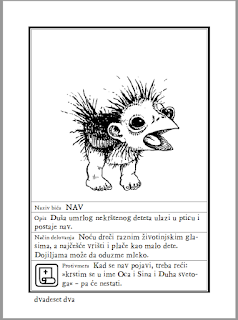
I talked about this in several of my posts: Nav, Bird wedding, Julenek...

Slavs also believed that the bountiful grain harvest was direct result of the good will of the dead ancestors...

And that good will was the result of their descendants remembering them and providing them with food (grain, bread) and drink (water, milk, red wine).

So...

I talked about the importantce of feeding the dead with bread in several of my posts like "Soul breads" "Dead man loaf"... 

According to the Serbian folklore, it is important that the food served to the dead contains "a bit of everything that land gives birth to". It was believed that the dead are the source of life and that they give back manyfold what we give to them...

It is important that the food for the dead contain especially "a bit of all the grains" again because the dead will give us back manyfold of what we give them... 

This is the root of "Koljivo" the meal made from boiled grains, nuts, raisins and sugar used in the Eastern Orthodox Church for commemorations of the dead...


The origins of koliva predate Christianity. In the Ancient Greece, panspermia, a mixture of cooked seeds and nuts, was offered during the pagan festival of the Anthesteria, which was primarily concerned with placating ancestral spirits...  

So when a priest tells you that you should not bring food to the grave for your dead, because that is a pagan custom, and that instead you should make koljivo, which is Orthodox Christians custom...

Serbian ethnographer Veselin Čajkanović believed that originally the sacrifice offered to the dead included blood sacrifice as well. The meal contained not just plant food, but also one of each type of farmed animal, ritually slaughtered, drained of blood, and roasted...

Blood was given to the dead, as it was their favourite drink...I talked about blood sacrifices in many of my posts...
 And the meat was eaten by the living...

Again all of this was done because people believed that their dead are the ones who "make the crops (and especially grain) grow"...

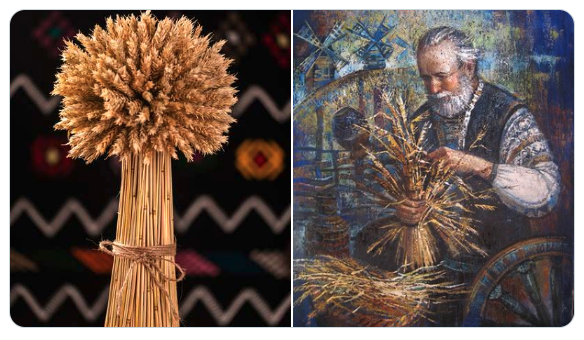
Depiction of Diduch (grandfather), symbolic representation of the ancestral spirit which governs the lives of the living (and most importantly determines how good grain harvest will be). From Central European Slavic mythology / folklore. 


I talk about Diduch and it's symbolic representation in my post "Diduch"...

Sunday, 7 August 2022

Julenek

"On Christmas morning in Norway every gable, gateway, or barn-door, is decorated with a sheaf of grain, called 'Julenek', fixed on the top of a tall pole, wherefrom it is intended that the birds should make their Christmas dinner"...Julenek, Karl Uchermann 1855-1940...

On Christmas Eve, the Swedes hang out the last sheaf of grain from the harvest, known as the Julkarve, as an offering to the birds. And they believe that the more birds come to feed, the better the next year's grain harvest will be...Bird sheaf, Siegwald Dahl 1827-1902...

The usual explanation for this custom is that that the birds were fed to stop them eating grain from grain stores...But the belief that feeding the birds has influence on the next year's harvest points at another explanation for this custom...Preserved in Slavic folklore...

All over Europe, it was believed that the last harvested sheaf of grain contained the living "sprit of grain"...This last sheaf was turned into a "Corn dolly", which was preserved until the next sowing season,. The seeds from the Corn dolly were then mixed with the seeds about to be sown, and were sometimes the first to be sown into the ground...I talked about this in my post "Corn dolly" 


A hint who this "Corn spirit", preserved in the "Corn dolly", really was, can be found in the Gaelic language and tradition. In Gaelic, the word Cailleach means at the same time An Old Woman, Mother Earth, The Last Sheaf of Wheat and the Corn Dolly made from it. So the Corn Spirit was really the fertility of the Mother Earth, of the life (grain) giving mother of us all...I talked about this in my post "The old woman of the mill dust"...

In Eastern Slavic tradition the identity of the "Grain spirit" is spelled out. The Last Sheaf of Wheat is turned into a Corn Dolly called Diduch (Grandfather, The Ancestor)...I talked about this in my post "Diduch"...

Now Slavs believed that all the good comes from the ancestors...Including grain...Which is why it was so important to keep ancestors happy, well fed and well watered, particularly during winter...

In some parts of Serbia, on Christmas Eve people used to take a table laid with food on the doorstep of the house and would then ask wolves to come to the feast. In other parts of Serbia they would invite the dead to the feast in the same way...I talked about this in my post "Wolf feast"...

Finally, in pre-Christian times, Slavs believed that souls of their dead entered birds and through birds entered otherworld, heaven, Iriy. And through birds returned back to our world to be reborn. I talked about this in my posts "Nav" and "Bird wedding"...

So feeding birds with grain from the last sheaf during winter was basically a form of feeding the ancestors, sacrificing to the ancestors...

Anyway, I wonder if any of this was preserved in Nordic and Finish folklore? 

I will finish this article with the link to my articles "Walking sheafs of wheat" which roam the roads of Europe during the winter...


Thursday, 23 December 2021

Inviting spring

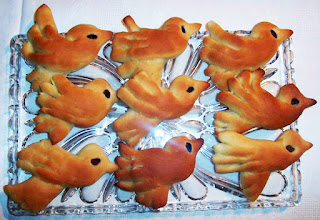
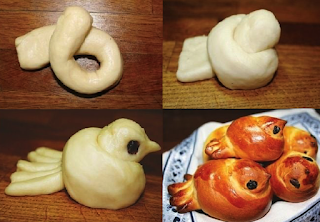
There are special kind of bird shaped buns baked by Eastern Slavs as part of the "inviting spring" rituals which were traditionally performed in March every year.  They are called "жаворонки, zhavoronki" (larks) or "кулики/kuliki" (sandpipers) ...

These cookies were baked in March for the first (1st of March), second (9th of March) and third (March 22 or 25th) calling (inviting) of spring...I guess one can get pretty impatient waiting for spring to arrive...🙂

People believed that larks and sandpipers arrived “carrying spring on their wings” and “leading other migratory birds behind them”. And the arrival of migratory birds was a sure sign of coming spring. And an extremely important event in Slavic tradition...I talked about this in my post "Leto"...


Remember, Slavs believed that every autumn, migratory birds took away the sun to Iriy, Slavic Otherworld, World of the Dead, where he spent winter. And that every spring, migratory birds brought the sun back into our world...

But Slavs also believed that migratory birds also brought souls from Iriy. Souls which were ready to be reborn...I talked about this in my post "Nav"...

Here is how you can make two main types of bird buns, the flying one and the sitting one...


Anyway, once made, the "larks" and "sandpipers" buns were placed on the windowsill, but most were given to children who ran around with them pretending that the birds were flying, all along shouting and calling spring to come...

Some children stuck their "bird" bun on long rods and waved them high in the air pretending that the birds were flying. Some other children threw the "bird" buns in the air trying to make them “fly” as high as possible. Some carried the "bird" buns on their heads...

The kids tried to bring their "bird" buns to "the high places": tops of hills, trees, rooftops, haystacks, fences...Children played with their "larks" all day and ate them in the evening, but some bird buns were left on the high places as offerings...

In some areas the kids would eat the bodies of their bird buns, but the heads were fed to the cattle "before they were taken out to graze in the fields for the first time"...This again seems to have been a ritual offering, a sacrifice of sorts "for good weather"...

Some bird buns were left on a patch where all snow melted. And some were thrown into a river...Remember snow melt is another sure sign of the departing winter (Morana/Marzana, the Old Hag Earth) and arriving spring (Vesna, the Young Maiden Earth)...

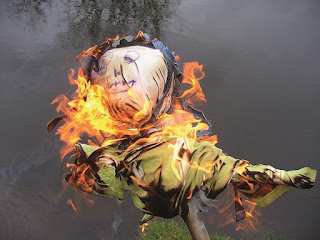
Which is why Slavs burn the effigies of winter or drown them or both...To be sure to be sure...But also heating of the earth causes snow to melt and the rivers to swell with the snowmelt...I talked about this in my posts "Gryla", "Baba's day"...

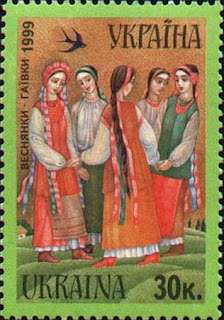
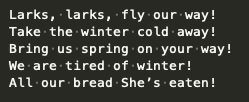
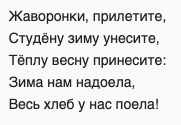
Apart from children, young unmarried women also played a major role in "calling of spring" rituals. They were the ones who sang "Веснянки / Vesnyanki" (Spring songs)...

Like this one. And do you see how the end of bread (flour) is linked with the departure of winter and the arrival of spring?


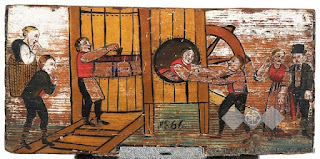
That's interesting...Because it explains the "magical transformation of an old woman into a young maiden through milling" images from Slovenia...

I talked about this in my post "Grandmother's mill"


And in my post "Old woman of the mill dust" about a very similar folk tradition from Ireland...

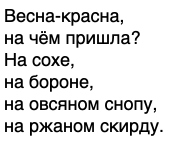
Here is another Vesnyanka (Spring song). This one directly linked with grain agriculture too...


I don't get this Red Spring thing though...Was this once Весна Красивая (beautiful spring)??? Or is red = hot?

Anyway, in some areas, women baked rye bread and then went out of the village, to the fields, orchards, meadows... There they bowed to earth, threw the bread on the ground and exclaimed: "Here is, Mother Spring, some rye bread for you"...

Again, this is a ritual sacrifice of bread to the mother of bread...And it is performed by a woman...In Slavic tradition (and not just Slavic) Earth fertility and female fertility was directly linked...I talked about this in my post "Walking sheafs of wheat", "Wheat wreath", "Corn dolly"...

This pre Christian Slavic celebration of the end of winter and the beginning of spring was later incorporated into Christianity and is now seen as part of "Сороки / Soroki" (Forty Martyrs of Sebaste)  for some weird reason... 

Here you can find the recipe and the instructional video for these beautiful bird buns (with English subtitle)... 

More about spring and birds in Slavic folklore can be found in these posts: "Partridge",  "Tetjorki", "Swallows", "Bird wedding", "Leto", "Radegast", "Cock bashing"...