Showing posts with label Badnjak. Show all posts

Sunday, 8 January 2023

Zapis

Excerpt from "Srpski mitološki rečnik" (Serbian mythological dictionary) 

"Holy oak - In the recent past, Kuči (Tribe from Montenegro) did not have a single whole church. The people had no place to gather or perform religious rites..."

"...Feeling the need for a consecrated place they turned to oaks, a practice common among other Serbs and which, in all likelihood, has its origins in a very ancient, pre-Christian veneration of oaks, and trees in general, among the Slavs..."

"...Any large oak growing in a conspicuous place in or near the village became the village temple. The priest performed church rites under it. People gathered around it for village assemblies and celebrations... "

"...The ground around these holy oaks was considered consecrated too, so people buried their dead around some of these holy oaks too...

Cemetery from Gornja Morača region in Montenegro inhabited by Serbs, with an ancient oak growing in its centre. I talked about this in my post "Mountain Serbs from Montenegro"...

"...Even now, very old oaks can be seen growing in many old Kuči cemeteries. And in Kuči villages that do not have their own churches, in the middle of the village there is a consecrated oak, around which stone slabs are arranged for sitting..."

These holy trees were once indeed found in every Serbian village. A large cross, often made of stone, may be erected beside the holy tree, and the surrounding area may be fenced...


The most common name people use for these holy trees, is "zapis" literally "inscription", the name most likely derived from the fact that all these sacred trees were at some stage Christianised by a cross "inscribed", cut into, the tree trunk...

People believed that these trees protected the village on whose land they grew. In settlements without a church, ceremonies such as weddings and baptisms were once conducted under the tree...

Even in villages which had churches, the village church ceremonies, like celebrations of the village Saint, the protector of the village, were held under these holy trees...

Particularly prayers to God for protection against destructive weather conditions were always held under the village holy tree. Interestingly, most of these trees were large oaks, the holy trees of the Slavic Thunder God Perun...

An old oak struck by lightning burning from the inside. For Pomeranian, South Baltic, Slavs, trees struck by lightning have a special status, believed to guard off demonic forces and possess purifying power. This was probably because "Perun, The thunder god, now resided in them"
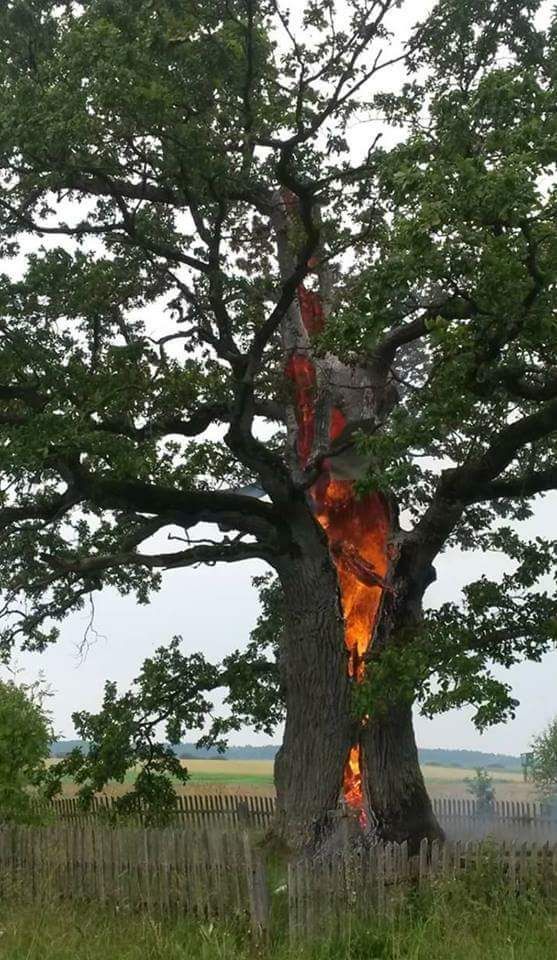

Some of these hollow oaks were converted to chapels...I talked about this in my post "Oak chapel"...

People firmly believed that a great misfortune will befall anyone that dares fell a zapis (sacred tree). Climbing it, sleeping under it, and picking its fruits and twigs, were also forbidden. Even the branches and fruits that fell from the tree were never collected...

A village may have had more than one zapis: the main one in the settlement or near it, and several others in the village's fields, usually chosen so that they mark the village boundaries...

This was done both to insure magical protection of the village land, but also to protect the village land boundaries from being changed, as there was a taboo about cutting these trees...Hence they preserved borders between villages and peace...

In that way holy trees played the role similar to ancient boundary stakes, which eventually became standing stones and totems. I talked about them in my posts "Stake" and "Colossus"

According to Serbian scholar Veselin Čajkanović, the veneration of the "zapis" holy trees is inherited from the pre-Christian religion of the Serbs, in which it had been used as a temple...

The proof for that can be found in reports left by Christian missionaries in all Slavic land. One of the main accusations against Slavs found in all of them was that "Slavs venerated trees, stones and wells (springs), to which they prayed and sacrificed"...

How the Pagan Slavs saw and respected trees, particularly oak, can be seen from Serbian Yule log rituals, during which an oak tree is addressed as god, prayed to and sacrificed to. In Serbia, when a young oak tree is about to be cut for a Yule log, it is addressed in the way you would address a living god: "Good morning and happy Christmas Eve to you o Holy Badnjak. I have come to take you to my home..."  I talked about this in my post "Badnjak"...

You can find these church reports accusing Slavs of tree worship listed in this article (Serbo-Croatian): "Pogled u Slovensku botaničku mitologiju" (A look at Slavic botanical mythology) 

These church reports also state the measures undertaken to "Christianise" Slavic peasant population, which involved cutting holy trees and groves, with the intention to eradicate the vile tree worship...

This was obviously only partially successful, as you can see from this article... 🙂

Anyway, you might find this article, "The shushing place", interesting...It talks about the most common words for forest in Slavic languages...

You also might find this article, "Lesnik", interesting too. It is discussing how old this tree worship could be. 


You also might find this post, "Hazel", interesting too. It talks about veneration of hazel trees among the Slavs...In some places, they were considered even more sacred than oaks..

And this article, "Willow in Slavic folklore", could be of interest too...

Sunday, 8 May 2022

Suovetaurilia

On this picture you see "badnjak", Serbian Yule log, a young oak sapling which was ritually cut on Christmas Eve and "pečenica", Serbian Yule roast, a pig on a spit, which was ritually slaughtered and roasted on Christmas Eve...

I talked about Serbian Yule log and the rituals surrounding its cutting, bringing into the house and burning in the heath in my posts "Badnjak" and "First footer"

And I talked about the Serbian Christmas roast in my post "Sacrificial animals", which is about the sacrificial animals (boar, ram, bull) in Serbian tradition and their Indo-European root... 

Serbs were not the only people who had this triple animal sacrifice:

Lusitanians sacrificed a sheep, a pig and a bull to some local gods. Indians sacrificed a ram, a bull and a goat to Indra. Iranians sacrificed sheep, cattle and stallions to Anahita.

Greeks sacrificed ram, bull, and boar to Poseidon. And the Umbrians ram, bull, and boar to their main Grabovian Triad of gods...And Romans sacrificed boar, ram and bull to Mars...

We can see that this "triple" animal sacrifice was quite widespread...

But I don't think it was well understood...Even by me 🙂 at the time when I wrote my article about the Serbian sacrificial animals...

In that post I mentioned that the order in which animals are sacrificed in Serbian tradition was identical to the order of animals in suovetaurilia, one of the most sacred and traditional rites of Roman religion: the sacrifice of a pig (sus), a sheep (ovis) and a bull (taurus)...

This ceremony was performed "to purify and protect the land". The first step was to lead the three animals, in precise order, boar, ram, bull, around the boundaries of the land, and then sacrifice them to the god...

During public, state sacrifices, which could be held at any time of the year, the animals were dedicated to the god Mars...But during private, family sacrifices, which were held in May, the animals were dedicated to the Goddess Ceres...Goddess of grain harvest...

The significance of this completely escaped me at the time when I wrote my original post, cause at that time I was only beginning to discover animal calendar markers and still didn't understand their significance and their link with grain agricultural calendar...

I did notice the strange correlation between the order in which animal were sacrificed by the Romans (boar, ram, bull) and the order of months in which the same animals were sacrificed by the Serbs:

Boar - Dec

Ram - Apr

Bull - August

I also noticed that if you replace Serbian and Roman sacrificial animals (boar, ram, bull) with Indian sacrificial animals (goat, ram, bull), and if you place them on the zodiac circle you get this...

I thought this was interesting, not known how interesting...

Cause, for instance, at that time I didn't know that there was such a thing as animal symbols for seasons...

Goat - winter, followed by Ram - spring, followed by Bull - summer

I also didn't know that these animal calendar markers were derived from the mating and birthing seasons of depicted animals.

Goat - Oct/Nov - mating season of wild goats

Ram - Mar/Apr - lambing season of wild sheep

Bull - Apr/May - calving season of wild cattle

My main problem was with the fact that our European Zodiac uses animal calendar markers derived from the behaviour of animals in Europe...I talked about this in the articles lined to this page about Zodiac...

In Europe, Alpine ibex goats mate later than everywhere else...Hence Goat in the middle of winter...Not beginning...

So when I was looking at goat as the sacrificial animal, I made the same mistake interpreting this animal symbol, which lead me to misinterpret the meaning of Chimera

This is wrong...

I corrected my interpretation of Chimera in my post about Pegasus and Chimera...

The correct interpretation of Chimera is that it is a complex animal calendar marker for the hot, dry half of the year in Eastern Mediterranean, Levant and Mesopotamia...

Knowing what I know now, I would like in this post to correct my interpretation of the triple animal sacrifice...

First, goat and boar are mutually interchangeable as animal calendar markers. Both point to Oct/Nov, beginning of the mating season of wild goats and wild pigs...


Second, ram is an animal calendar marker for Mar/Apr, which is when the Eurasian wild sheep lambing season took place...


Third, bull and horse are mutually interchangeable as animal calendar markers. Both point to Apr/May, beginning of the mating season of wild horses and beginning of calving season of wild cattle...


Third Boar-Ram-Bull as animal calendar markers mark the period between Oct/Nov and Apr/May...

Very important period in grain agricultural calendar:

Oct/Nov - beginning of the grain planting season

Apr/May - beginning of the grain harvest season

Which becomes very important for understanding of this sacrifice when we realise that Roman peasants performed Suovetaurilia dedicated it to Ceres, Goddess of grain harvest in May, at the beginning of the grain harvest...

The meaning of Suovetaurilia then becomes: We will harvest when boar (Oct/Nov), ram (Mar/Apr) and bull (Apr/May) have passed (remember they are taken around the fields in that order)...

That's it...Most people think that Roman mythology is just recycled dumbed down Greek mythology...But actually, Roman peasants have preserved in their village rituals some very very ancient stuff indeed...

To read more about ancient animal and plant calendar markers, start here…then check the rest of the blog posts related to animal calendar markers I still didn't add to this page, and finally check my twitter threads I still didn't convert to blog post...I am 9 months behind now...

That's it...I hope you enjoyed this...Have a nice evening...

Saturday, 21 December 2019

Young god

Solar rider from a Celtic coin...


In Slavic mythology, Svetovid was associated with a white horse, which was kept in his temples and used for divination...In this article I will talk about a Serbian ritual song which talks about solar rider and Christmas...

"Dodaj meni hladne vode, Koledo Koledo, Da kupamo, okupamo mladog boga, tog Božića Svarožića… Konjic mu je jarko sunce, bojni doro ognjeviti"

"Pass me cold water, o Koledo, to bath the young god, Božića Svarožić... His horse is the bright sun, a flaming war steed"

This is a Serbian ritual "Christmas song" recorded in Bosnia by Milojević in 1869. In it the narrator asks Koledo for water. Koledo is winter solstice. The end of the old Kolo (wheel, Solar wheel, solar year) and the beginning of the new Kolo (wheel, Solar wheel, solar year)...

The water is needed to bath "the young god" who is called Božić. In Serbian the word "Bog" means god and the ending "ić" means small, young.  So Božić literally means young god, but also it means Christmas...So far so Christian...🙂

But the young god Božić is also called Svarožić (young Svarog). Triglav (Dabog), Serbian supreme deity, consisted of Svetovid, Perun, Svarog. Svetovid represented Sun, Perun represented Thunder and Svarog represented Fire. I talked about Triglav in my post "Triglav, Trojan, Trinity, Trimurti, Agni"

So Svarožić (the other name of the young god) means "young fire". This "young fire" is the fire of the sun, which is rekindled on the day of the winter solstice, the day when the new sun is born and the new solar year, new "kolo" starts...

The main ritual performed over Christmas (Solstice) is "lighting the Yule log in the evening, keeping it burning through the longest night, and then making it spark in the morning". 

Watching over Christmas (Solstice) fire, Serbia


I talked about this in my posts "Badnjak" and "First footer"

In this way people helped "preserving sun's fire", "rekindling of the fire of the new sun"...This was not just symbolic action. People believed that "all fire is one" and that if their fire was kept burning, the sun's fire would be kept burning through the longest night...


This equates Svarožić (young fire) with Jarilo (young sun) who is born during the longest night...Svarožić is Jarilo's fire. Jarilo's name comes from "jar' which means both young and fiery, raging...It is his fire which grows ever stronger and warmer which brings spring...

That Svarožić (young fire) is Jarilo (young sun) can be seen from the second verse which says that Svarožić rides on the bright sun, which is his flaming war horse...He is the Solar rider... 

Depiction of the solar rider from Bosnia from my post "The horseman"


Christmas is coming, get your Badnjaks (Yule logs) ready...🙂

Sunday, 6 January 2019

Badnjak

A young oak covered in golden leaves is the traditional Christmas tree in Serbia. Felling, bringing in, and burning of "badnjak" (as Christmas tree is called in Serbian) are surrounded by elaborate rituals and are the central part of the Serbian Christmas


The cutting of "badnjak", young oak tree used as a Christmas tree in Serbia, was accompanied by elaborate rituals which directly linked the oak with the sun and fertility and identify the oak tree as the earthly seat of the sky god.


"Good morning and happy Christmas Eve to you, o Holy Badnjak. I have come to take you to my home, to be my faithful helper to every progress and improvement, in the house, i the pen, in the field, and in every place" Part of the Oak cutting ceremony.

According to the old tradition, Badnjak (Yule log) is cut early on Christmas Eve, before sunrise. When the head of the household finds a suitable tree, a young straight oak full of golden leaves, he stands in front of it facing east. This shows that the Badnjak oak is directly connected with the sun and the solar cult. The head of the household then throws some wheat at the Badnjak as a sacrifice. This shows that the Badnjak oak is also directly linked to the grain agriculture which is directly dependent on the sun...After throwing grain at the tree, the head of the household greets it with the words "Good morning and happy Christmas Eve to you". He then says the prayer, makes the sign of the cross and kisses the tree. The tree is sometimes addressed as "Holy Badnjak". The head of the household may also explain to the tree why it will be cut: "I have come to you to take you to my home, to be my faithful helper to every progress and improvement, in the house, i the pen, in the field, and in every place". The fact that the Badnjak Oak is directly addressed, and it is addressed as a being of power, shows that the oak tree was itself regarded as sacred or even as a deity in its own right. The head of the household then cuts the tree slantwise on its eastern side, using an axe. Some men put their gloves on before they cut the tree, and from that moment on, never touch Badnjak with their bare hands. The tree once cut should fall to the east, unhindered by surrounding trees. It must not be left half-cut as then it will curse the house and the man who cut it. In some regions, if the tree is not cut down after the third blow of the axe, then it must be pulled and twisted until its trunk breaks. The resulting Badnjak has a so called "beard", the part of the trunk at which it broke off from the base of the tree. This is considered a good luck. In Šumadija, half of the circular loaf of bread, which is especially made for this purpose, is left on the stump, the other half being eaten on the way home...This is the second wheat sacrifice made to the Badnjak, and another indication of the direct link between Badnjak and grain agriculture...In some regions, the stump is covered with moss and dry leaves, and it is visited again in the spring. The stump sprouting through the cover is an omen of good luck and prosperity...

Series of pictures showing the ritual cutting of Badnjak in Leskovac, southern Serbia. Source Youtube video

1. Finding young oak


2. Saying prayer


3. Sharing bread with the oak


4. Sharing brandy with the oak


5. Addressing oak: "O Badnjak, Dadnjak our happy (lucky) cousin"


6. Kissing of the oak


7. Cutting of the oak


 8. Carrying


Once in the home, the badnjak (Serbian Yule log) is leaned vertically against the house where it spends the day. In parts of eastern Serbia and Kosovo the badnjak is wrapped in a man's or a boy's shirt swaddled like a baby. 


The Badnjak (Serbian Yule log) is brought into the house after dark on Christmas Eve.


Generally each family cuts only one Badnjak (Yule log). But in some areas one Badnjak is cut per male member of the family and in some areas one Badnjak is cut for men one for women and one for children..


Immediately after the badnjak has been brought in, or immediately before in some places, an armful of straw is spread over the floor. A handful of nuts and dried fruit is strewn over the straw for the children and one nut is put in every corner for the dead.


At the same time, all sharp metal objects are removed from the house, probably because they attract lightning. Bringing oak into the house probably means that Perun the thunder god is also invited into the house, oak being the holy tree of the thunder good Perun.


The Christmas eve dinner in Serbia was in the past always eaten on the floor. It was not a meal eaten only by the living members of the family, but by all the dead ancestors as well.


The culmination of the Badnjak (Yule log) ceremonies is its ceremonial placing on the fireplace and its burning. 


After the Badnjak (Serbian Yule log, usually a young oak log) is placed on the fireplace, it is kissed and offered various food sacrifices


The head of the household pours some wine and throws some wheat grains on the burning Badnjak (Serbian Yule log) while saying "Hail Badnjak! I give you wheat and wine, and you give me every good thing and peace!" 


Once placed on the fireplace, it is imperative that Yule logs burn all through the Christmas Night, or bad luck would befall the family. Watching over Yule logs (Badnjaks), 1937 village Stragari, Jasenica, Central Serbia.


The Badnjak (Serbian Yule log) ceremonies finish on the Christmas Morning, when "Položajnik" (The first footer) visits the house and performs fire striking divination ritual. 


 You can read more about the first footer tradition in Serbia (and other parts of Europe) in my post "First footer".