Showing posts with label Hazel folklore. Show all posts

Sunday, 8 January 2023

Zapis

Excerpt from "Srpski mitološki rečnik" (Serbian mythological dictionary) 

"Holy oak - In the recent past, Kuči (Tribe from Montenegro) did not have a single whole church. The people had no place to gather or perform religious rites..."

"...Feeling the need for a consecrated place they turned to oaks, a practice common among other Serbs and which, in all likelihood, has its origins in a very ancient, pre-Christian veneration of oaks, and trees in general, among the Slavs..."

"...Any large oak growing in a conspicuous place in or near the village became the village temple. The priest performed church rites under it. People gathered around it for village assemblies and celebrations... "

"...The ground around these holy oaks was considered consecrated too, so people buried their dead around some of these holy oaks too...

Cemetery from Gornja Morača region in Montenegro inhabited by Serbs, with an ancient oak growing in its centre. I talked about this in my post "Mountain Serbs from Montenegro"...

"...Even now, very old oaks can be seen growing in many old Kuči cemeteries. And in Kuči villages that do not have their own churches, in the middle of the village there is a consecrated oak, around which stone slabs are arranged for sitting..."

These holy trees were once indeed found in every Serbian village. A large cross, often made of stone, may be erected beside the holy tree, and the surrounding area may be fenced...


The most common name people use for these holy trees, is "zapis" literally "inscription", the name most likely derived from the fact that all these sacred trees were at some stage Christianised by a cross "inscribed", cut into, the tree trunk...

People believed that these trees protected the village on whose land they grew. In settlements without a church, ceremonies such as weddings and baptisms were once conducted under the tree...

Even in villages which had churches, the village church ceremonies, like celebrations of the village Saint, the protector of the village, were held under these holy trees...

Particularly prayers to God for protection against destructive weather conditions were always held under the village holy tree. Interestingly, most of these trees were large oaks, the holy trees of the Slavic Thunder God Perun...

An old oak struck by lightning burning from the inside. For Pomeranian, South Baltic, Slavs, trees struck by lightning have a special status, believed to guard off demonic forces and possess purifying power. This was probably because "Perun, The thunder god, now resided in them"
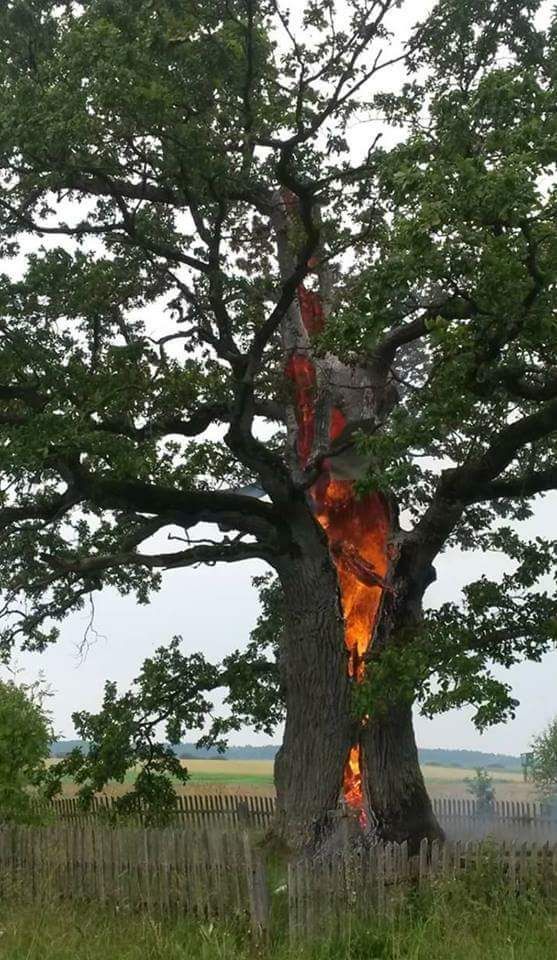

Some of these hollow oaks were converted to chapels...I talked about this in my post "Oak chapel"...

People firmly believed that a great misfortune will befall anyone that dares fell a zapis (sacred tree). Climbing it, sleeping under it, and picking its fruits and twigs, were also forbidden. Even the branches and fruits that fell from the tree were never collected...

A village may have had more than one zapis: the main one in the settlement or near it, and several others in the village's fields, usually chosen so that they mark the village boundaries...

This was done both to insure magical protection of the village land, but also to protect the village land boundaries from being changed, as there was a taboo about cutting these trees...Hence they preserved borders between villages and peace...

In that way holy trees played the role similar to ancient boundary stakes, which eventually became standing stones and totems. I talked about them in my posts "Stake" and "Colossus"

According to Serbian scholar Veselin Čajkanović, the veneration of the "zapis" holy trees is inherited from the pre-Christian religion of the Serbs, in which it had been used as a temple...

The proof for that can be found in reports left by Christian missionaries in all Slavic land. One of the main accusations against Slavs found in all of them was that "Slavs venerated trees, stones and wells (springs), to which they prayed and sacrificed"...

How the Pagan Slavs saw and respected trees, particularly oak, can be seen from Serbian Yule log rituals, during which an oak tree is addressed as god, prayed to and sacrificed to. In Serbia, when a young oak tree is about to be cut for a Yule log, it is addressed in the way you would address a living god: "Good morning and happy Christmas Eve to you o Holy Badnjak. I have come to take you to my home..."  I talked about this in my post "Badnjak"...

You can find these church reports accusing Slavs of tree worship listed in this article (Serbo-Croatian): "Pogled u Slovensku botaničku mitologiju" (A look at Slavic botanical mythology) 

These church reports also state the measures undertaken to "Christianise" Slavic peasant population, which involved cutting holy trees and groves, with the intention to eradicate the vile tree worship...

This was obviously only partially successful, as you can see from this article... 🙂

Anyway, you might find this article, "The shushing place", interesting...It talks about the most common words for forest in Slavic languages...

You also might find this article, "Lesnik", interesting too. It is discussing how old this tree worship could be. 


You also might find this post, "Hazel", interesting too. It talks about veneration of hazel trees among the Slavs...In some places, they were considered even more sacred than oaks..

And this article, "Willow in Slavic folklore", could be of interest too...

Saturday, 25 April 2020

Hazel

Serbs believed that hazel was a "blessed tree". An old hazel tree was particularly "holy". A person could even confess to it, like he would to a priest...


The most interesting Serbian Easter custom is "hazel communion". In the morning people went to the nearest hazel tree, where the communion was taken by eating a hazel bush blossom instead of communion bread. After that people went to the church to do the confession...


The same was done on Christmas Eve, except then people ate a hazelnut instead of communion bread...


An old man from Smoljani (Bosnia) described this ritual like this:


Also in Bosnia, if some evil befell the house, the family would go to the nearest hazel tree and would walk three times around it praying to god for help...Instead of going to the church...

In Eastern Serbia, if a local "zapis" (holy oak marked with cross where village mass was held), suddenly dried, which was the sign of an impending doom, people would stick a hazel twig into the ground and would then kneel around it and pray to it for protection from evil...


Hazel twig is used to "pull out living fire" (to ritually make fire using fire drill) and this fire was used to light up the first fire in the new house...


Unless people were moving from the old house to the new house, in which case the fire was brought from the old house hearth and used to light the fire in the new house hearth. 


I talked about Serbian rituals linked with the building of a new house in my article "New house"

Christmas bread "česnica" baked on an open fireplace, was covered with charcoal using hazel twigs. These charred twigs were then placed into grain storage...


In some parts of Serbia, "položajnik" (first footer) walked around the house holding hazel branch before entering the house on Christmas morning, to ensure the house is protected from evil...

These hazel twigs were used to poke the Yule log during Christmas Eve fertility rituals...


You can read more about these rituals in my article "First footer".

In parts of Bosnia a hazel log, not oak, was used as the Yule log. After bringing the hazel Yule Log into the house, the househusband would first scrape a bit of soot from the sealing with it, and would then use the Yule Log to draw a soot cross on the wall to bless the house...

Hazel was also linked to the otherworld. On Christmas eve, the old winter solstice night, the longest night, when the dead come into the land of living, hazelnuts (and walnuts) were thrown into corners, where the souls of the dead congregated, as the food for the dead...

If a mistletoe was found growing on a hazel bush, people believed that a snake king can be found curled up under the bush, with a shining jewel on its forehead, or some other treasure next to it ...


Snakes that live under a hazel bush have special powers. If one eats the meet of a snake killed under a hazel bush, he will understand the language of animals. And if one eats the snake's heart, he will also understand the language of plants, particularly medicinal plants...


Hazel was believed to be the tree of wisdom, knowledge. The expression “Nije tri puta oko leske sastavljen” (he wasn't three times carried around a hazel tree) depicts a silly, stupid, mad person, who wasn't brought into wisdom, smartness giving contact with a hazel tree...

Which is maybe why Serbian schools kids who didn't know something were beaten with hazel twigs, to "beat wisdom into them" :)...

Hazel twigs were believed to be able to kill or at least ward off devil. It was believed that devil will never be able to cross the circle drawn on the ground with a hazel twig. 

Hazel was a favourite tree of "vilas" (fairies, but more precisely personification of lightning). They liked resting on hazel branches "because devils were afraid of hazel"...

Lightning was in Serbian mythology the weapon used by Ilija Gromovnik (Elijah the Thunderer, Christianised Perun) to kill devils. 


You can read more about Ilija Gromovnik in my post "Thundering sun god".

And hazel features prominently in Serbian thunder and lightning magic...


According to the Serbian tradition "Hazel tree is the best protection from thunder and hailstone. Thunder never strikes into hazel tree because it was blessed by god and god only strikes devil's trees"...Like oaks, the tree of the old God, Perun...


This is why in mountains of Serbia shepherds decorate themselves with hazel branches or tied hazel twigs around their waists during thunderstorms or run under a hazel tree for protection...


The connection between the hazel tree and thunder can be seen from the folk belief that hazel trees will lose all the nuts if there is a thunderstorm on St Elijah the Thunderer day (Perun day, 2nd of August)... 

On St George day, the beginning of the summer, green hazel twigs were used to decorate houses, sheds, pens, fields, gardens as a protection from thunder and hailstone. In some parts of Serbia people made hazel crosses and hang them around their property instead of hazel twigs...

This is also why hazel was often planted next to houses, to protect them from lightning. And why a hazel stick (wand) was kept in houses, because it was a weapon which could break lightning storms, particularly hail storm...

Remember, it is lightning which was the original source of fire. This is how gods made fire. Then people stole the fire from the gods. Figured out how to make it themselves by using (hazel) sticks...Hence the relation between hazel sticks, live fire and lightning...

Serbs also believed that sometimes, a petrified lightning can be found under a hazel tree. It looked like a black or grey egg, and and it smelled like gun powder. It was believed that this stone lightning would bring luck to its finder...


Hazel is particularly linked with fertility. A young hazel or a hazel twig is in Serbian folklore actually known the "tree of life"....

In Bosnia there is a custom that on St George's day every animal in the household is touched with a hazel twig to insure its health and fertility. Hazel leaves were put under chicken nests so that chicken would have lots of chicks...


A flower wreath which is used for ritual sheep milking on St George's day is hang on hazel branch. I talked about St George's day shepherd's rituals in my post "Aries must die". 


Serbs also believed, that if you count sheep on their return from the highland pastures using hazel twig, by touching each sheep as it enters the sheep pen, sheep will multiply...


New bee swarm should be caught in a new basket beehive made from hazel twigs, to ensure that the new beehive will produce lots of honey...More about Slavic bee folklore can be found in my post "Bee". 

"When bees don't want to swarm, pick three hazel twigs before sunrise, and use them to let the sheep flock out of the sheepfold. Then touch the beehive with the twigs. The bees will start swarming after that"...


Serbs believed that the most magically powerful were the hazel twigs which were brought to the church on the "Cveti" (Flowers) day. This is the ancient spring celebration linked to female fertility. 


More about this in my post "Flower girls".

Hazel played special role in Serbian female love and fertility magic. People believed that if a girl hits a boy three times with a hazel twig, he will never look at any other girl...

Serbian girls who wanted to get married used to saw a hazelnut into their clothes, next to their heart, to ensure they found love...

Bits of hazel wood were placed in the clothes of the newly wed and bows were braided from hazel twigs and placed on their heads to ensure they have lots of children...

A woman who eats a worm from a hazel tree or a hazel bud would certainly get pregnant...It was also believed that in the year when hazels have many nuts, there will be many children too...

In Homolje, Eastern Serbia, women used to put a hazelnut under their "tkanica" belt "to give birth to male children". 


More about these beautiful belts in my post "Crios-Tkanica".

A pregnant woman should cary a hazelnut in her blouse near her breasts. When she gives birth, she should put this hazelnut into the water used to bath the baby for the first time, so it would be healthy...

Even healthy people bathed in water with hazel twigs and leaves "for health" because it was believed that hazel had magical power over sickness and even death. Which is why it was believed that a hazel stick can be even used to raise the dead...

That's it for today folks...Hope you enjoyed it...Have a nice evening...

Sources:

"Rečnik srpskih narodnih verovanja o biljkama" by Veselin Čajkanović
"Srpski mitološki rečnik" by Grupa Autora