Showing posts with label Ceres. Show all posts

Friday, 15 July 2022

Kubaba with grain and poppies

Very interesting: A drawing of a relief from the great staircase from the Luwian city of Carchemish. It depicts the storm god Tarhunt, holding an axe and vajra (lightning trident), leading the earth goddess Kubaba, holding grain and poppies...🙂 Sounds familiar?

The drawing is from this great article: "Building Inscriptions of Carchemish: The Long Wall of Sculpture and Great Staircase" by J. D. Hawkins

So why is this drawing interesting?

Here's Demeter holding grain and poppies

The reason why Kubaba and Demeter hold grain and poppies is that in Europe and Middle East, opium poppies harvest coincides with the beginning of the grain harvest...I talked about poppies harvest and poppies as a plant calendar marker in my article "Poppies"... 

Now check these articles about Demeter and Middle Eastern grain goddesses: "Demeter riding a panther", "Fertility goddess with poppies", "Sacred marriage on a threshing floor", "Jerusalem of gold"...Then have a look at this: 

The grain goddess follows the storm god...Why? Because in the area where Carchemish is located, without rain, the land ends up looking like this...No grains (or poppies)...


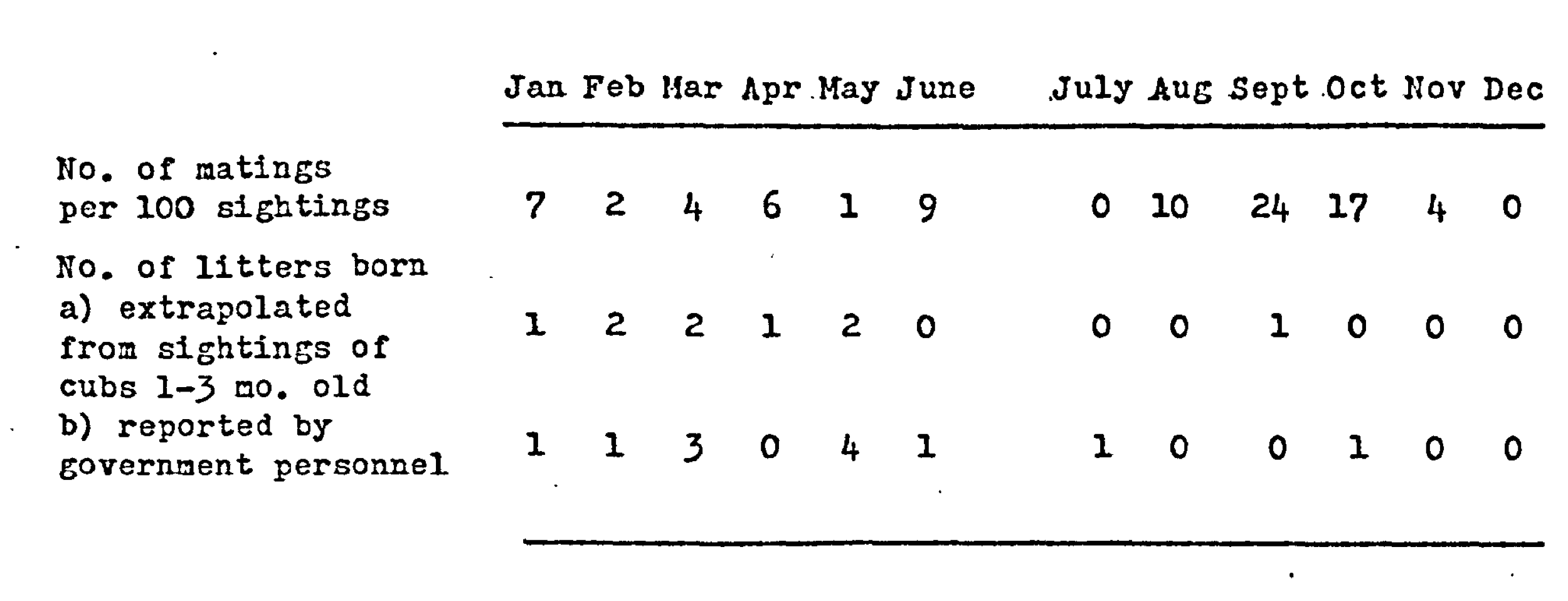
This is the climatic year in the area of Carchemish. You can see that the year is clearly divided into hot/dry half and and cool/wet half...


The hottest and driest part of the year is the end of Jul beginning of Aug. Leo...The time of death...Ruled by the god of death...Mot...Nergal...Another name for the destructive burning sun...I talked about this in my post "The oldest Arabic poem"...

The hottest, driest part of the year is marked by the lion animal calendar marker...Leo...The reason for this is that this is when the Eurasian lions main mating season starts...


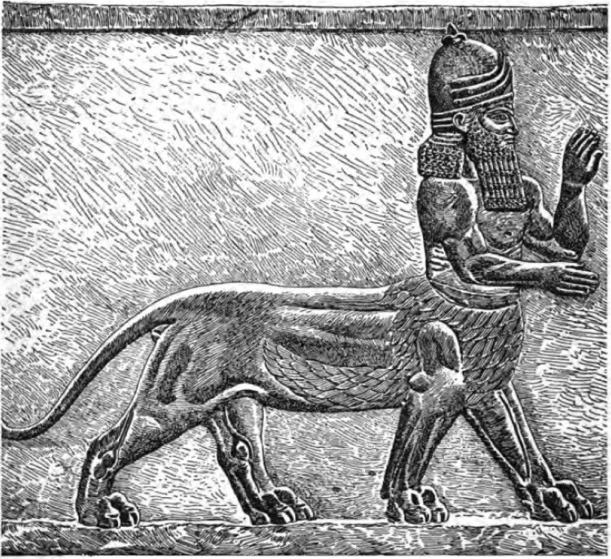
Which is why Nergal, the deified destructive burning sun, was depicted as a lion (man)...I talked about this in my post "Winged superhuman hero"...

This is the reason why in Carchemish we also find this relief depicting the above mentioned storm god killing a lion. The image is from this great article "Carchemish ša kišad puratti" by Irene J. Winter 

The other guy helping the storm god is probably the local king, not another god...The role which later became the main role of local kings, who were "(storm) god's incarnation on earth"...I talked about this in my post "The king killing Angra Mainyu"...


Hope you enjoyed this...

To read more about ancient animal and plant calendar markers, start here…then check the rest of the blog posts related to animal calendar markers I still didn't add to this page, and finally check my twitter threads I still didn't convert to blog post...I am 9 months behind now...

Sunday, 8 May 2022

Suovetaurilia

On this picture you see "badnjak", Serbian Yule log, a young oak sapling which was ritually cut on Christmas Eve and "pečenica", Serbian Yule roast, a pig on a spit, which was ritually slaughtered and roasted on Christmas Eve...

I talked about Serbian Yule log and the rituals surrounding its cutting, bringing into the house and burning in the heath in my posts "Badnjak" and "First footer"

And I talked about the Serbian Christmas roast in my post "Sacrificial animals", which is about the sacrificial animals (boar, ram, bull) in Serbian tradition and their Indo-European root... 

Serbs were not the only people who had this triple animal sacrifice:

Lusitanians sacrificed a sheep, a pig and a bull to some local gods. Indians sacrificed a ram, a bull and a goat to Indra. Iranians sacrificed sheep, cattle and stallions to Anahita.

Greeks sacrificed ram, bull, and boar to Poseidon. And the Umbrians ram, bull, and boar to their main Grabovian Triad of gods...And Romans sacrificed boar, ram and bull to Mars...

We can see that this "triple" animal sacrifice was quite widespread...

But I don't think it was well understood...Even by me 🙂 at the time when I wrote my article about the Serbian sacrificial animals...

In that post I mentioned that the order in which animals are sacrificed in Serbian tradition was identical to the order of animals in suovetaurilia, one of the most sacred and traditional rites of Roman religion: the sacrifice of a pig (sus), a sheep (ovis) and a bull (taurus)...

This ceremony was performed "to purify and protect the land". The first step was to lead the three animals, in precise order, boar, ram, bull, around the boundaries of the land, and then sacrifice them to the god...

During public, state sacrifices, which could be held at any time of the year, the animals were dedicated to the god Mars...But during private, family sacrifices, which were held in May, the animals were dedicated to the Goddess Ceres...Goddess of grain harvest...

The significance of this completely escaped me at the time when I wrote my original post, cause at that time I was only beginning to discover animal calendar markers and still didn't understand their significance and their link with grain agricultural calendar...

I did notice the strange correlation between the order in which animal were sacrificed by the Romans (boar, ram, bull) and the order of months in which the same animals were sacrificed by the Serbs:

Boar - Dec

Ram - Apr

Bull - August

I also noticed that if you replace Serbian and Roman sacrificial animals (boar, ram, bull) with Indian sacrificial animals (goat, ram, bull), and if you place them on the zodiac circle you get this...

I thought this was interesting, not known how interesting...

Cause, for instance, at that time I didn't know that there was such a thing as animal symbols for seasons...

Goat - winter, followed by Ram - spring, followed by Bull - summer

I also didn't know that these animal calendar markers were derived from the mating and birthing seasons of depicted animals.

Goat - Oct/Nov - mating season of wild goats

Ram - Mar/Apr - lambing season of wild sheep

Bull - Apr/May - calving season of wild cattle

My main problem was with the fact that our European Zodiac uses animal calendar markers derived from the behaviour of animals in Europe...I talked about this in the articles lined to this page about Zodiac...

In Europe, Alpine ibex goats mate later than everywhere else...Hence Goat in the middle of winter...Not beginning...

So when I was looking at goat as the sacrificial animal, I made the same mistake interpreting this animal symbol, which lead me to misinterpret the meaning of Chimera

This is wrong...

I corrected my interpretation of Chimera in my post about Pegasus and Chimera...

The correct interpretation of Chimera is that it is a complex animal calendar marker for the hot, dry half of the year in Eastern Mediterranean, Levant and Mesopotamia...

Knowing what I know now, I would like in this post to correct my interpretation of the triple animal sacrifice...

First, goat and boar are mutually interchangeable as animal calendar markers. Both point to Oct/Nov, beginning of the mating season of wild goats and wild pigs...


Second, ram is an animal calendar marker for Mar/Apr, which is when the Eurasian wild sheep lambing season took place...


Third, bull and horse are mutually interchangeable as animal calendar markers. Both point to Apr/May, beginning of the mating season of wild horses and beginning of calving season of wild cattle...


Third Boar-Ram-Bull as animal calendar markers mark the period between Oct/Nov and Apr/May...

Very important period in grain agricultural calendar:

Oct/Nov - beginning of the grain planting season

Apr/May - beginning of the grain harvest season

Which becomes very important for understanding of this sacrifice when we realise that Roman peasants performed Suovetaurilia dedicated it to Ceres, Goddess of grain harvest in May, at the beginning of the grain harvest...

The meaning of Suovetaurilia then becomes: We will harvest when boar (Oct/Nov), ram (Mar/Apr) and bull (Apr/May) have passed (remember they are taken around the fields in that order)...

That's it...Most people think that Roman mythology is just recycled dumbed down Greek mythology...But actually, Roman peasants have preserved in their village rituals some very very ancient stuff indeed...

To read more about ancient animal and plant calendar markers, start here…then check the rest of the blog posts related to animal calendar markers I still didn't add to this page, and finally check my twitter threads I still didn't convert to blog post...I am 9 months behind now...

That's it...I hope you enjoyed this...Have a nice evening...

Sunday, 20 February 2022

Jerusalem of Gold

The Babylonian Talmud (Nedarim 50a) relates that one of the greatest sages, Rabbi ’Akkiva (2nd century AD), who started out as a poor, ignorant shepherd, slept with his beloved wife on the threshing floor...

He is described as pulling straw out of her hair and saying that if he could afford it, he would crown her with a "Jerusalem of Gold" – a "headgear shaped like the battlements or towers of a city", which was worn by "women of high status"...

Is this just a random innocent love scene? Or is there something more here, hidden in plain sight? I think the latter...

In my post about the sacred marriage on the threshing floor, I mentioned this:

"Threshing floors were used for religious ceremonies in Mesopotamia too. The annual sacred marriage reenactment between Ea and Ishtar (Asherah) was performed on a threshing floor".

You know how Asherah was associated with "High places"...Were these originally threshing floors?

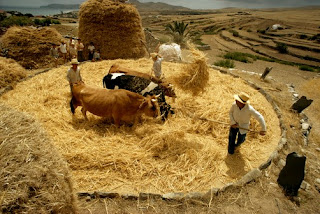
As you can see from this article, the choice of the two protagonists of the scared marriage ceremony (sex) is not random. They mark the beginning (Ea- Apr/May) and the end (Ishtar - Jul/Aug) of the grain harvest in Mesopotamia...

Interestingly, the main consort of Ishtar (Inanna) was Tamuz (Dumuzid, Dumuzi), Mesopotamian god associated with shepherds...Whose sister Geshtinanna, was conveniently, the goddess of agriculture...

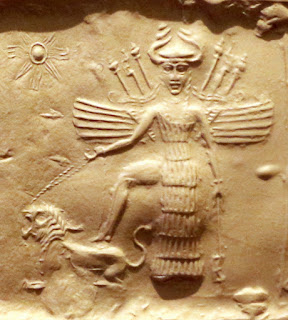
Ishtar, the queen of heaven, the morning star, is often depicted standing on a lion with the sun above it...

Why? Cause Jul/Aug, Leo, is the time when Sirius rises in the morning with the sun...

Anyway, Ishtar was not the only goddess that that stands on a lion, stands between lions, is driven in a chariot pulled by lions, or sits on a throne between two lions (all meaning "in Leo")...There is one for everyone in the audience, and I listed most of them in my post "Assumption of Mary"...

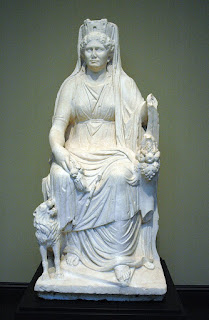
One of these lion goddesses was Cybele. Here she is, enthroned, with her pet lion, holding cornucopia, and wearing a "crown depicting city walls"!!!. This is a Roman marble made c. 50 AD...

Now Cybele was in turn associated with Greek Demeter, the Grain goddess. The main ceremony of her festivals called Haloa (from "halōs", "threshing floor"), took place in Eleusis, at the threshing floor of Triptolemus, Demeter's first priest and inventor of grain agriculture...

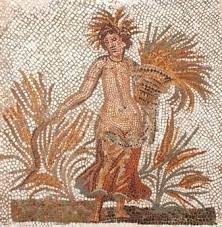
Romans knew Demeter as Ceres, Roman goddess of grain and grain harvest. Here she is, holding a sickle, with ears of grain in her hair and a grain sheaf in her hands...3rd century AD, Roman from Uthina, Tunisia...

Sooooo...After having sex with his wife on a threshing floor, Akkiva, the shepherd, picks the grain out of her hair and promises that he will buy her a golden crown in a shape of city walls...Scene depicting an Ordinary Marriage or a Sacred Marriage? What's going on here?

It's a mess, right?