Showing posts with label Slavic customs. Show all posts

Monday, 17 March 2025

Baba - Last sheaf of wheat

Among Slavs, the last sheaf of wheat was commonly called Baba. This word means grandmother, mother, midwife, birth giver...In some places the woman binding the last sheaf the last sheaf of wheat is also called Baba...

In the Balkans bаbičiti means to make, to tie grain sheaves. I wonder this is symbolically linked with the swaddling babies cause bаbičiti also means to deliver babies...From the meaning of the word Baba in diminutive form Babica which means midwife...

All kinds of rites and beliefs are connected to the Baba, the last sheaf of wheat, including the  dance of the oldest female reaper, accompanied by banter and jokes...

In Prussia, the woman binding the last sheaf represented the Corn-Mother; After she bound the last sheaf, she would lie down in the field and cry like a woman in labour, while an old woman acted as the midwife. Finally, the "midwife" would announce that a child was born...

In Northern Germany, the woman binding the last sheaf was told: "You are getting the child!" In Bohemia, people believed that the woman binding the last sheaf will have a child in the next year...

The Swabs called the one binding the last sheaf "the Old Woman" (basically Baba, Grandmother) and she was said to be married in the next year...

In East Prussia, the female reapers strove to be the one tying the last sheaf, called "the Grandmother". Whoever  got it, would be married in the next year, but her spouse would be old...

Baba (Grandmother) here is Mother Earth in her role as The Mother Of Grain...Talked about this originally in my post "Mother of grain"...

Mor articles about the Mother of grain in Neolithic Europe, Central Asia, Mesopotamia, Iran, Levant: "Altyn Tepe mother of grain", "Mother of grain from Yarim Tepe",  "A person in a little boat", "Sabi Abyad venus", "Hathor grain pendants"...

Sumerians knew here as Inanna. 

Inanna/Ishtar, was in "A song of Inanna and Dumuzid" described as: "Maiden, glossy mane, lovely beauty...colourful as a pile of grain, fit for the king, fit for Dumuzid! Maiden...a stack of...barley, fully developed in loveliness"...

This is Inanna speaking:

"Before my lord, Dumuzi,

I placed grain before him,

I poured out grain before him,

I poured out grain before my womb..."

I talked about this in my post "Inanna and dove"...

Greeks knew her as Demeter...

I talk about Demeter in my posts "Demeter with dove", "Demeter riding panther", "Sacred marriage on the threshing floor"...

Demeter, the goddess with beautiful golden hair...Here she is as Ceres emerging from the ground holding grain, opium poppies and snakes... 


I explain why in my post "Who are Persephone's parents"...

Hippolytus says that during Eleusinian harvest rituals, the priest raised a freshly cut ear of wheat with the loud cry: "The exalted goddess bore a holy boy, the strong one bore a strong child!" Sounds familiar? 🙂 I talked about this in my post "Iacchos"...

The reason why the last sheaf of wheat is called Grandmother is because all these people believed that last sheaf of wheat contained the "grain spirit", basically the spirit of The Mother of Grain...

The "grain spirit" is in European folklore usually preserved as female "corn dolly" made from the last harvested sheaf of wheat...I talked about this in my post "Corn dolly"...

In Romania the grain from the last sheaf of wheat was used to make the wreath that was then used to crown the most beautiful maiden reaper...

A living corn dolly from Romania. From my post "Wheat cross" about grain harvest rituals from Romania...

In Poland and Ukraine too...

Wheat wreath, worn by the "corn maidens" and made from the last sheaf of wheat, was the first batch of grain to be threshed on the threshing floor. This grain was then set aside for next year's sowing and was the fist grain to be sawn. 

I talked about this in my post "Wheat wreath"...

The same symbolic link between Old Woman (Grandmother), Last sheaf of wheat and mother earth is preserved in the Gaelic culture...

In Gaelic, the word Cailleach means both an old woman and the last sheaf of wheat and the corn dolly made from it. Corn dolly which represents Mother Earth, the life (grain) giving mother...

I talked about this in my post "The old woman of the mill dust"...

The symbolic linking of female reapers with The Mother of Grain and of tying the last sheaf of wheat with delivering and swaddling a baby is just another example of the believed link between female and earth fertility...Which we find in Europe since Neolithic...

A gynomorphic (woman like) figurine made of "soil mixed with chaff and grain seeds" from Grčac, Serbia. Proto-Starčevo culture, 6200-5500 BC. Direct symbolic link between earth, grain and female fertility. Basically, "Mother of Grain"... 

This symbolic link was still at the core of Slavic agricultural magic in the 20th century. As is shown by this Russian harvest custom:

In the past in Russia, after the last sheaf of grain was cut, women harvesters would lie down on the ground and roll around the field "to return the strength to the earth"...

In Ireland too we find this symbolic linking of land (grain sheaves) and female fertility (bride). These are Strawboys who used to call at the home of the bride on her wedding day. Co Sligo. Ireland. Early 1900s. (National Museums of Northern Ireland).


I talked about this in my post "Walking sheafs of wheat"...

This belief in the direct link between female and land fertility might have had some pretty dark implications in the past. There is an indication that in the past Serbs sacrificed girls to the Corn Spirit in exchange for good harvest...

At the end of the harvest, when only the last sheaf of wheat was left standing in the field, Sorbs would sacrifice a rooster by killing it with a flail...
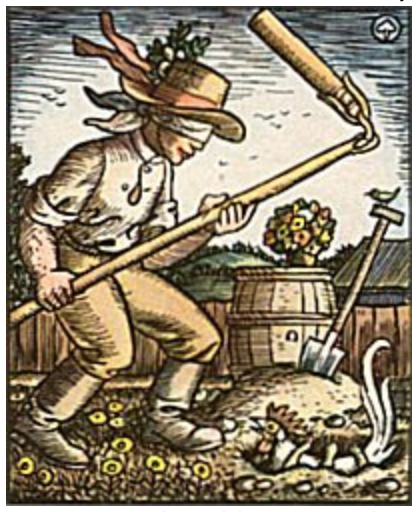
I talked about this in my post "Cock bashing"...

There are actually many indications that sacrificing a cockerel was among Serbs a replacement for a human sacrifice...I talked about this in my post "Third death"...

Add to that that in some parts of the Balkans Serbs ritually "tied the housewife to the central pole of the threshing floor until she promised them roast cockerel for the end of harvest dinner"...Or the next harvest would be bad...

And you have to ask yourself a question: is this a ritual replacement for the real human sacrifice which once used to take place?

Saturday, 2 March 2024

Dancing with deer and birds

Medieval "stećak" standing stone, Bosnia, with the depiction of the ritual circular solar dance "kolo", meaning wheel, solar wheel, solar year. There are also depictions of birds and deer...

I talked about "kolo", also known as "oro", in my post "Kolo-vrt". 

Kolo is a common motif on these standing stones. But, it is interesting that on this stone there are 9 dancers in both groups...

I wonder if this is deliberate? Here's why:
Deer are depicted during rut, Sep/Oct/Nov, the only time when bucks can be seen with fully grown antlers and their harems of does...

These are Croatian Slavic month names...Number 9 is...

So the birds could then depict migratory birds, which leave Bosnia in Sep/Oct/Nov...

All very interesting...


Kolo-vrt

Good morning! The sun is shining, time to get up and have some fun!

Ancient (officially medieval???) stećak standing stone, Bosnia. Depicting solar wheel (swastika) and solar dance (kolo)... Pic by Kemal Čolak...

The swastika represents spinning motion...Of what? Big Dipper around the Northern Star? Possibly...But also the ever spinning solar year, as one spin of the Big Dipper around the Northern Star marks one solar year...

These are Neujährchen (New Year sweet breads) from Rheinland. They are baked fresh on New Year's Eve and are given as presents to friends and family on New Year's morning. Apparently they represent solar year with 4 seasons...

Same curly swastika was found on solar bread from the Balkans. I talked about them in my post "Solar breads from Croatia"...

I talked about solar bread representing solar wheel in my article about Koloocheh, Persian ceremonial New Year cakes. In the article I talk about the origin of the name Koloocheh and about Slavic kolač (kolach) ceremonial wheel shaped cakes and breads...

The spiral on the Koloocheh also represents a spinning motion...

The word "kolač" comes "kolo" (wheel, spinning circle). Hence "kolo" also being the name for the Slavic ceremonial circular dance...

The depiction or the Serbian circular dance "kolo" or "oro" from the 14th century Serbian monastery Lesnovo which is located in today's Republic of Makedonija...It is danced "under the sun"...Or god...  

I talked about this in my posts "Oro" and "Shield of Achilles"...


Sunday, 28 January 2024

Dead man loaf

In Bulgaria, a special loaf of bread was made immediately after a person died, during the washing of the body. It was a simple round loaf, sometimes with a cross. In northeastern Bulgaria it was baked from dough which was made with the water used to bathe the deceased...

Sources:

"Glasnik Etnografskog muzeja u Beogradu knjiga 19 godina 1956"

"Bread in the folk culture of the Serbs in its pan Slavic context"

The dough for the bread was kneaded in a wooden throw. Before the kneading of the bread started, a candle was lit and put next to the through. And the dough was kneaded until the candle burned out...

In some parts of Bulgaria, this bread had to be made by a "clean" woman who had no sexual intercourses, either a virgin girl, a widow or a grandmother...

The name of this bread was пътнина (patnina), meaning "(bread for the) journey". In some parts of Bulgaria, this bread was placed in the coffin with a bottle of water and a bottle of wine, so the deceased would have enough food and drink for his journey to the other world...

This is very interesting. Remember my articles about the pots and pans found in Neolithic, Bronze and Iron Age graves all over the world. Like these Ghandara culture graves from Pakistan, dated to 1200-800BC...Were the drinking vessels placed in graves with drink "for the other world"...

 I talked about this in my post "One for the road"...Why would the living bother with making sure the dead had enough food and drink in the otherworld? 

Our ancestors believed that it was the dead ancestors that directly affected the life of the living and in particular the land/grain fertility. 

I talked about this in many of my posts like my post about Diduch (grandfather), symbolic representation of the ancestral spirit which governs the lives of the living.


The dead had to be remembered, and fed and watered by giving them regular food and drink (mostly water) sacrifices. Cause forgotten, hungry and thirsty dead ancestors will take revenge on their living descendants. And one of the ways they would do that is by causing droughts, storms, floods and other natural disasters that would cause grain crops to fail, and would result in famine and the death of the living...

I talked about this in my posts "Thirst", "White feast", "Soul breads". I talked about the link between the dead and rain and grain fertility in Roman mythology in my post "Lapis Manalis"....

Also, remember this? 

"...humiliation of the Hittite kingdom is the result of the fact that the Hittites have forgotten to respect the sacred bond with their dead..." - Last Hittite king Suppiluliuma II.  From my post "House of bones"...  

Statue of Suppiluliuma II, Hatay Archeology Museum with a pretty depressed expression on his face...

This is why people not just buried their dead with food and water, but also regularly feasted with the dead. 

Starting from the funeral feast. 

In some other parts of Bulgaria, the bread was, while still warm, broken over the deceased person's head, making sure that steam, representing the deceased person's soul, rose the broken bread...The bread was then ritually eaten by the people attending the bathing of the body...

BTW, in Herodotus 4:73 we read that when a Scythian man died his family would put the body on a cart and take it to all his friends houses. They would bring the body into each house where they would eat and drink together with the corpse...

Through the quarterly remembrance feasts. 

There is a custom among Serbs of "feasting with the dead". Four times a year, once per season, on a day called "Zadušnice" (Souls day) a family goes to the graveyard, spreads the tablecloth on the grave, lays food and drink on the grave and has a feast with the dead. 

And literally any other feast.

Serbs actually always feasted with the dead. Every family feast was symbolically eaten with the dead. This prompted some Serbian ethnographers to propose that the whole Serbian belief system was based around the cult of the dead...

Soul breads

As late as the mid 20th century, there was a custom in Poland to bake small loaves of bread for the dead on the All Souls day. Because the All Souls day is in Polish known as Dzien Zaduszki (the day for the souls), the bread was also called zaduszki, bread (for) souls...

Originally these were just a plain sourdough flatbreads...But the recipe gradually evolved into this:

Lublin All Souls' Day breads (powałki)

1 kg of cooked flour potatoes

2 eggs

400 g of wheat flour

100g of fresh yeast

1 teaspoon of sugar

2 flat teaspoons of salt

Press the previously cooked and cooled potatoes through a press, add eggs, flour, salt and yeast grated with sugar. Knead the mixture into a loose dough. Tear off pieces of dough, form thick flat patties and place them on oiled baking tray.

Decorate each patty with a grid pattern using a fork, and leave them to rise for 30 minutes. Bake for 20-30 minutes in an oven preheated to 160°C. 

That's the traditional recipe. If you want, you can add cheese, ham, spices or any other topping of filling to suit your taste...

The origin of this ritual in the old Slavic feast called Dziady, which in Polish means Grandfathers, Forefathers, when the souls of Forefathers would come back to our world to visit their descendants. And the little (soul) breads were made as food for the visiting ancestors.

The soul breads had to be prepared a few days in advance, as people did not want to light the fire on the hearth on All Saints' Day, as they believed that the visiting souls gathered around the house hearth, and they didn't want to disturb them...

Two interesting things here.

First: Slavs believed that it was the (happy) ancestors (satisfied with the way their descendants treated them) who were the source of all good that their descendants enjoyed. Including (and especially) good grain harvest...I talked about this in my post "Diduch" (grandfather), about the East Slavic symbolic representation of the ancestral spirit which governs the lives of the living. 

So a bread for the dead now makes a lot of sense, right? I talked about the ancestral cult root of Slavic agricultural rituals in many of my blog posts and twitter threads. This post, "Wheat cross", is a good jumping point for exploring this subject further. It talks about the ceremonial "wheat cross" from Romania, which was made on the last day of the wheat harvest to carry the "wheat wreath" from the fields to the village. And about the related Slavic harvest traditions and ritual.

Second: Hearth as the place where the dead gather when they visit the house of their descendants. I talked about the link between the dead and the hearth in my post about "Verige" (hearth chain). 

As you can see from the above picture, in the past, the hearth was the focal point of every house. So it is easy to imagine that the souls of the dead ancestors would also gather around the hearth to warm themselves up on the cold November night...

This is confirmed by the fact that in the past in Poland, on All Souls eve, people used to set up bonfires on the crossroads, in order to help the souls of the ancestors warm up a bit...Why on crossroads? Allegedly to show wandering souls their way home...

But interestingly:

In some parts of Serbia, on Christmas eve, a single man from a village would go to a crossroads and lay down a feast for wolves. He would then run home without turning...I talked about this in my post "Wolf feast", about the link between wolves and the ancestors in Serbian folklore. 

And also:

Diduch (Grandfather), the grain effigy representing "The Ancestor" made in Ukraine for Christmas, was in some areas, burned on New Year's eve, on crossroads, "one of the favorite hangouts of evil spirits and vampires"...

See how the souls of the ancestors ended up becoming evil spirits and vampires...With a little help of Christian priests...

Finally, some Serbian ethnographers proposed that the belief that the dead gather around the house hearth might also be a remnant of the ancient (really really ancient) practice of burying the dead under and around the hearth...

I am very important! 

Love this little guy 🙂 Neolithic Vinča culture anthropomorphic terracotta figurine, 5000 BC, Serbia.

"These figurines were found in houses, often near fireplace, sometimes carefully arranged, which indicates that they had ritual, cult value".

Did they represent the deceased, the ancestors?

Sunday, 5 March 2023

House snake

In Belarus, when storytellers want to emphasise that something happened long time ago, they would say "in the old days, when people kept snakes in their houses"...

In the records from the 16th century, Yan Lasitsky says this about house snakes in Belarus: 

"...In Belarusian lands, many people kept pet snakes in their homes and fed them...In large families, during meals, children were fed separately from adults, sitting on the floor around a large bowl of food. When the food was served, the house snake would crawl out of its hiding place and would eat together with the children...Children often pushed the snake away, hit it on the forehead with spoons 🙂, but the snake never got angry nor did it bite them. Belarusian peasants put an uncovered jug of milk on the ground of the house, so that the house snake could feed freely when it wanted...If the house snake lived in a barn, it sucked milk directly from the cows. The house snake was the guardian of the household both magically, and practically, by killing rodents that disturbed animals and brought disease...Therefore, it was forbidden to kill or chase away the house snake..."

The house snake, the protector of the house and the family, was also the thing among Balkan Slavs and the Balts...

That comes directly from the belief that the house snake contains the spirit of the first ancestor that died in the house. The protective spirit...That belief was preserved among South Slavs...

I talked about this in my posts "Stones with narrow bottom bowls" and "New house"...

One other interesting thing. Dabog, old Serbian supreme god, was the sun god. Dabog is also found in Belorussian folklore where they also equate him with the sun...I talked about this in my post about the last megalithic ritual in Europe from Belarus...

Serbian ethnographer Cajkanovic, believed Dabog was also the god of the underworld, god of the dead...Later he was replaced by St Sava, Serbian Patron Saint...

And snakes, being solar animals, follow Sun (Dabog) wherever he goes...It is in our world when sun is here (day, hot half of the year) and it is in the underworld when sun is there (night, cold half of the year)...I talked about it in my posts "The Chthonic animal", "Enemy of the sun", "Letnitsa treasure"...

Which is why snakes are also "Chthonic" animals, and why Slavs believed that house snake contains the spirit of their ancestors...

And why the house snake lived under the hearth/stove...Where the dead gathered too... How old is this belief in the Balkans? Very old...

In Mesolithic - Neolithic Lepenski Vir culture (9000-6000BC) from Serbia, the dead were buried under the floor of the houses, near or under the hearth. The people from Lepenski Vir culture literally "lived with their dead"...


Monday, 25 April 2022

Кривий танець


Girls dancing "Кривий танець"  (Wavy, Curvy dance), a ritual dance which was in the past performed at the beginning and the end of the Easter celebrations in the Kyiv region of Ukraine...

Anatoly Bogorod, from the Museum of Ivan Gonchar says that "According to most researchers..."Wavy, Curvy Dance", due to the imitation of wave-like movement, was intended to magically influence the filling of rivers and streams with the water released by the spring snowmelt...

The dancing choir was formed from the young girls who already had their first period, young maidens. This links the young girls period with the young (spring) earth period, snowmelt...

Another Pre Christian spring custom, which was added to the Easter celebrations. 

Interesting thing here is the wavy line symbolising flowing water...

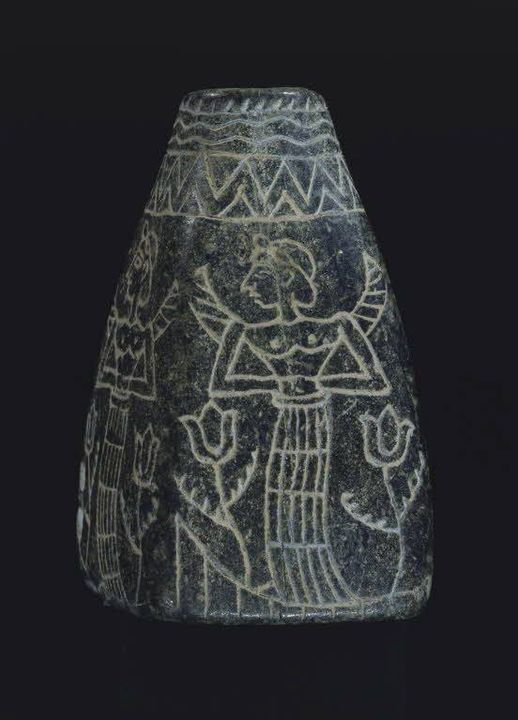
Like on this, the end of the 3rd, beginning of the 2nd millennium BC, Bactrian, perfume or cosmetic bottle, depicting winged goddess among flowering tulips. Bactrian, the end of the 3rd, beginning of the 2nd millennium BC, Louvre Museum...

I talked about this object in my post "Tulip goddess"...

Or on these Neolithic pottery shards found in Iran, depicting leopard, animal which mates when the snowmelt starts...


I talked about this in my post "Spots and stripes"...

Or on this Sumerian seal depicting Enki in his flood boat...

I talked about this in my post "Rain and flood"...

Saturday, 25 December 2021

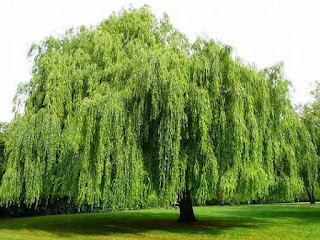
Willow in Slavic folklore

Today I will talk about willow in Slavic spring fertility rituals, gardening and Cricket the cat 🙂 

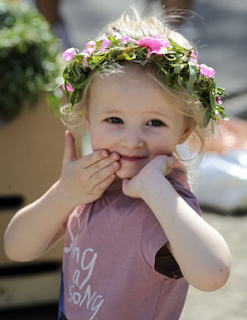
Here we go: Saturday before Palm Sunday is in Serbia known as Vrbica (Willow day). On that day kids and young women make and wear wreaths made of willow twigs and flowers


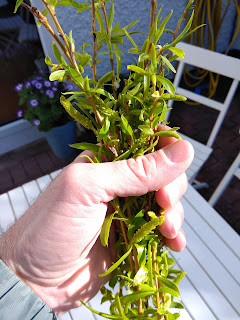
On that day, willow twigs with young leaves and flowers, like these, known in English as Pussy Willow are brought to the church where they are blessed the next day, Palm Sunday, which is in Serbia known as Cveti (Flowers day)...

According to the church, this whole willow business is the consequence of the fact that there are no palms in Serbia, and people replaced palm branches with willow branches...Move on, nothing so see here...

There are few problems with this explanation...Vrbopuc (Willow burst) is an expression which in Serbia means "part of spring during which willow starts growing new green shoots"...

In Serbia in the past people believed that during this time of the year women become very horny and very fertile...So this was the best time to make babies...🙂

Vrbopuc is also a term used in Serbia for the period of sudden surge of sexual hormones in teenage boys and girls...

Basically willow was directly linked with human fertility...Which is why in the past in Serbia, girls used to make belts from willow twigs (wrap willow twigs around their bellies), and wear them going to the rivers to perform ritual baths...

This ritual bathing was performed on Cveti (Flowers day) but also on Djurdjevdan (St George's day), the old Yarilo day, the old day of the young sun, the old celebration of the beginning of summer...Known also as Beltane...I talked about this in my post "Aries must die"...

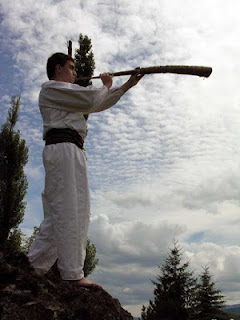
At the same time on St Georges day, while girls were wearing willow belts and bathing, boys and men were blowing into willow horns to "scare the witches away"...I talked about this in my post "May horns"...


It is interesting that this ritual bathing was done before sunrise and willow belt had to be taken off as soon as the sun rose...And that blowing into the willow horns was also done during the night....

I didn't pay much attention to this until I remembered that willow was directly linked with water, water divination....Dodole, young women which took part in rain bringing magic rituals performed during hot summers also wore willow twig belts...

Mother Earth = Yin = Winter, Cold, Wet, Night, Down = Female fertility

Father Sun (Sky) = Yang = Summer, Hot, Dry, Day, Up = Male fertility 

Which is why rain, water magic is female magic...

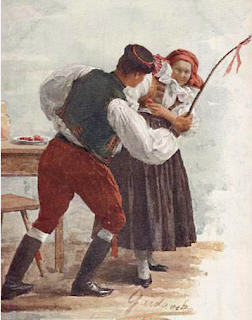
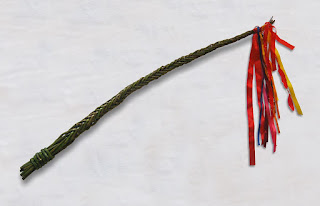
And which is why willow, the tree which grows next to water, is associated with rain, water and female fertility, female sexuality...Hence ritual whipping of teenage girls by teenage boys using willow whips, performed in the Czech Republic, Slovakia on Easter Sunday...


If men arrive at women's houses after 12 o'clock, women throw a bucket of cold water on them. In some regions the men also douse girls with water...

The man first sings a a ritual song about spring, bountifulness and fertility, and the young woman then turns around and gets few whacks on her backside with the willow whip...This was done "so girl would be healthy, beautiful and fertile throughout the following year"...

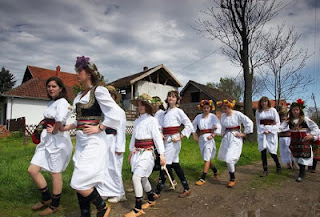
In Serbia willow was also linked with female coming of age rituals, also performed on Willow day...On that day, young unmarried girls, wearing willow twig belts and willow and flower wreaths walked around the village land and blessed the nature... I talked about this in my post "Flower girls"...


They would first go to a spring where they would sing and dance and would then wish good morning to the spring water. Spring water is in Serbia called "živa voda" (live water, water of life) and is believed to have magic properties...

Spring is seen as a place where fertile Mother Earth releases her "water of life" in the same way that a fertile woman releases her menstrual blood, female "water of life". In this way the spring water is magically linked with the menstrual blood...

So no wonder that the spring is the first stop of the Lazarice group, the group of girls whose "water of life has started to run" (who got their period).  BTW they are called Lazarice "because Willow day is by Christians also known as Lazarus day"...

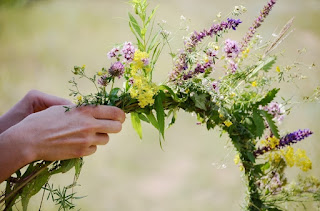
After this ritual, the girls would go to meadows to pick wild flowers. They would use these flowers to make wreaths which they would wear on their heads during their procession through the village land and the village...

They would then walk through the fields, forests, meadows belonging to the village, and would sing fertility songs wishing nature to be fertile and bountiful....

Young girls, Spring Earth, Female fertility, Earth fertility, water...Willow...

Remember the Pussy Willow 🙂 branches blessed in churches in Serbia the day after Willow day? They are brought home. Some of them are made into a wreath which is placed in the corner with the icon...The rest are used to decorate the house gate, door and windows...

This is done "to protect the home from thunder" because "thunder doesn't hit willow". Willow also "protects against hail"...So willow twigs are used to "threaten the clouds during hail storms"...

That the belief in the link between willow and fertility was once probably Europe wide, can be seen from this English belief: "Striking an animal or a child with a willow twig will stunt their growth!" This is a great example of Christianity at work...

In Serbia it is actually the opposite...On Willow day, children and animals are whipped with willow twigs so they grow like willow and are healthy and fertile...Which is what you would expect after everything I have presented so far...

Willow twigs, particularly the ones cut around St George's day are considered to be most potent when it comes to growing magic...They were cut into bits and mixed with animal food, particularly food given to bulls...

Remember St George's day is the old Beginning of summer celebration, and summer begins in Taurus...Taurus which marks beginning of the calving season of the wild Eurasian cattle...

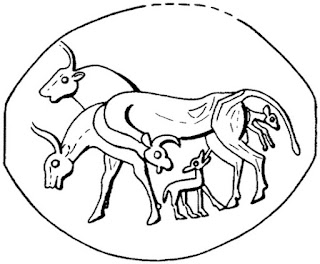
I talked about this in my posts "Ram and bull", "Symbols of seasons", "Zodiac", "Animal calendar markers", "Seal with narrative scene", "Rain and flood", "Holy cow", "Calydonian boar"

Willow was in the mind of the Slavs definitely linked to growth and fertility...So imagine my surprise when I came across this information: Willow contains two very interesting chemicals: indolebutyric acid (IBA) and salicylic acid (SA)...

Indolebutyric acid (IBA) is a plant hormone that stimulates root growth. It is present in high concentrations in the growing tips of willow branches...

Salicylic acid (SA) is a plant hormone which is involved in the process of “systemic acquired resistance” (SAR) – where an attack on one part of the plant induces a resistance response to pathogens (triggers the plant’s internal defences) in other parts of the plant...

Soooo...The first hormone makes the plant grow...The second hormone makes the the plant healthy...And these hormones can be extracted from the willow shoots and used to help your plants grow and be healthy...

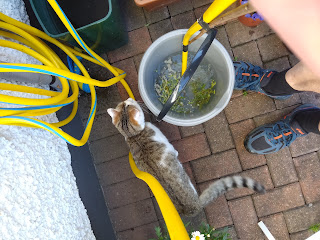
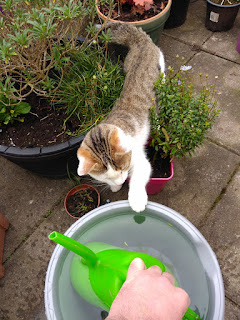
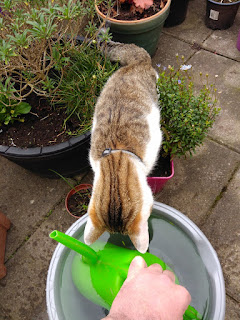
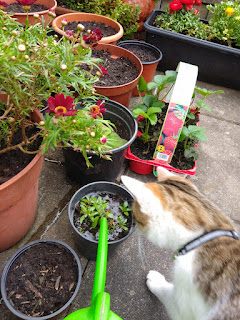
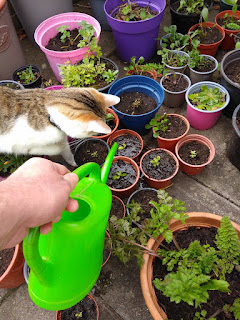
So...I went to the nearest willow, cut some green willow shoots, chop them into small pieces, put them in a bucket of water (under the close supervision of Cricket the cat) and soaked them for a day or two...

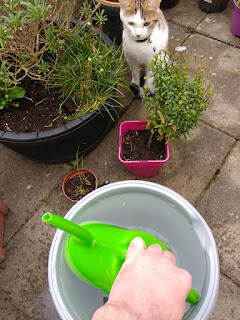
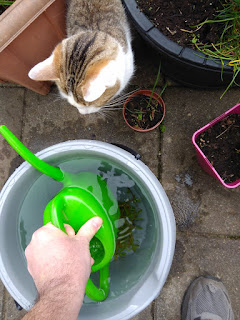
This is me trying to water my plants with my willow water (under the close supervision of Cricket the cat of course)


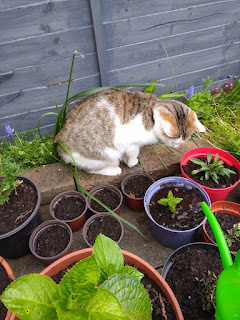
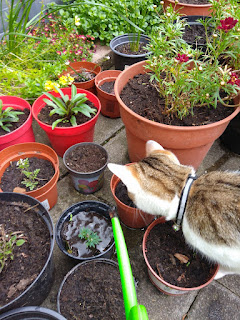
You missed this pot human...

So after successfully making willow water, and all the fun I had watering my plants with Cricket the cat, hopefully my plants will grow like mad and be healthy and fertile...

So if you ever wondered why willow was linked with fertility and health...

By the way, did I mention that Cricket the cat is not my cat? It officially belongs to our neighbours who live few houses up behind the wall, but it has recently decided that this is his garden so...