Showing posts with label Chimera. Show all posts

Sunday, 8 May 2022

Suovetaurilia

On this picture you see "badnjak", Serbian Yule log, a young oak sapling which was ritually cut on Christmas Eve and "pečenica", Serbian Yule roast, a pig on a spit, which was ritually slaughtered and roasted on Christmas Eve...

I talked about Serbian Yule log and the rituals surrounding its cutting, bringing into the house and burning in the heath in my posts "Badnjak" and "First footer"

And I talked about the Serbian Christmas roast in my post "Sacrificial animals", which is about the sacrificial animals (boar, ram, bull) in Serbian tradition and their Indo-European root... 

Serbs were not the only people who had this triple animal sacrifice:

Lusitanians sacrificed a sheep, a pig and a bull to some local gods. Indians sacrificed a ram, a bull and a goat to Indra. Iranians sacrificed sheep, cattle and stallions to Anahita.

Greeks sacrificed ram, bull, and boar to Poseidon. And the Umbrians ram, bull, and boar to their main Grabovian Triad of gods...And Romans sacrificed boar, ram and bull to Mars...

We can see that this "triple" animal sacrifice was quite widespread...

But I don't think it was well understood...Even by me 🙂 at the time when I wrote my article about the Serbian sacrificial animals...

In that post I mentioned that the order in which animals are sacrificed in Serbian tradition was identical to the order of animals in suovetaurilia, one of the most sacred and traditional rites of Roman religion: the sacrifice of a pig (sus), a sheep (ovis) and a bull (taurus)...

This ceremony was performed "to purify and protect the land". The first step was to lead the three animals, in precise order, boar, ram, bull, around the boundaries of the land, and then sacrifice them to the god...

During public, state sacrifices, which could be held at any time of the year, the animals were dedicated to the god Mars...But during private, family sacrifices, which were held in May, the animals were dedicated to the Goddess Ceres...Goddess of grain harvest...

The significance of this completely escaped me at the time when I wrote my original post, cause at that time I was only beginning to discover animal calendar markers and still didn't understand their significance and their link with grain agricultural calendar...

I did notice the strange correlation between the order in which animal were sacrificed by the Romans (boar, ram, bull) and the order of months in which the same animals were sacrificed by the Serbs:

Boar - Dec

Ram - Apr

Bull - August

I also noticed that if you replace Serbian and Roman sacrificial animals (boar, ram, bull) with Indian sacrificial animals (goat, ram, bull), and if you place them on the zodiac circle you get this...

I thought this was interesting, not known how interesting...

Cause, for instance, at that time I didn't know that there was such a thing as animal symbols for seasons...

Goat - winter, followed by Ram - spring, followed by Bull - summer

I also didn't know that these animal calendar markers were derived from the mating and birthing seasons of depicted animals.

Goat - Oct/Nov - mating season of wild goats

Ram - Mar/Apr - lambing season of wild sheep

Bull - Apr/May - calving season of wild cattle

My main problem was with the fact that our European Zodiac uses animal calendar markers derived from the behaviour of animals in Europe...I talked about this in the articles lined to this page about Zodiac...

In Europe, Alpine ibex goats mate later than everywhere else...Hence Goat in the middle of winter...Not beginning...

So when I was looking at goat as the sacrificial animal, I made the same mistake interpreting this animal symbol, which lead me to misinterpret the meaning of Chimera

This is wrong...

I corrected my interpretation of Chimera in my post about Pegasus and Chimera...

The correct interpretation of Chimera is that it is a complex animal calendar marker for the hot, dry half of the year in Eastern Mediterranean, Levant and Mesopotamia...

Knowing what I know now, I would like in this post to correct my interpretation of the triple animal sacrifice...

First, goat and boar are mutually interchangeable as animal calendar markers. Both point to Oct/Nov, beginning of the mating season of wild goats and wild pigs...


Second, ram is an animal calendar marker for Mar/Apr, which is when the Eurasian wild sheep lambing season took place...


Third, bull and horse are mutually interchangeable as animal calendar markers. Both point to Apr/May, beginning of the mating season of wild horses and beginning of calving season of wild cattle...


Third Boar-Ram-Bull as animal calendar markers mark the period between Oct/Nov and Apr/May...

Very important period in grain agricultural calendar:

Oct/Nov - beginning of the grain planting season

Apr/May - beginning of the grain harvest season

Which becomes very important for understanding of this sacrifice when we realise that Roman peasants performed Suovetaurilia dedicated it to Ceres, Goddess of grain harvest in May, at the beginning of the grain harvest...

The meaning of Suovetaurilia then becomes: We will harvest when boar (Oct/Nov), ram (Mar/Apr) and bull (Apr/May) have passed (remember they are taken around the fields in that order)...

That's it...Most people think that Roman mythology is just recycled dumbed down Greek mythology...But actually, Roman peasants have preserved in their village rituals some very very ancient stuff indeed...

To read more about ancient animal and plant calendar markers, start here…then check the rest of the blog posts related to animal calendar markers I still didn't add to this page, and finally check my twitter threads I still didn't convert to blog post...I am 9 months behind now...

That's it...I hope you enjoyed this...Have a nice evening...

Sunday, 30 January 2022

Pegasus and Chimera

Pin head in form of a winged horse, ca. 8th–7th century B.C. Luristan, western Iran in the Zagros Mountains. Currently in the Met Museum...

Cool right? For so many reasons. 

First: How old is the oldest depiction of Pegasus in Europe?

Second: Please note sun symbol on the horses side. Did you know that horse mating season is governed by the sun and it peaks on summer solstice. 


I talked about this in my post "Unicorn"...

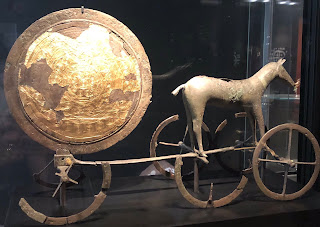
The link between horses reproductive cycle and the sun is why we see things like these: Bronze Age "Sun Chariot" pulled by a horse, Denmark 1400 BC...


And why Greek sun god rides in a chariots pulled by white horses...


And why when Ezekiel accuses the builders of the First Temple of being Sun worshippers, he says that they kept horse pulled chariot in the temple...I talked about this in my post "Sun god from the first temple"....

And why "Solar horse" is such a common motif on Celtic coins...

And why white horse is the sacred animal of the Slavic sun god Svetovid, and was kept in his temples...


I talked about this in my post "Svetovid"...

And so on and so forth...

BTW, I discovered this link between horses and sun while I was researching the reason why Eastern Mediterranean is why local Sea gods were so obsessed with horses...


It turns out the horse mating season overlaps with the sailing season in the region...I talked about this in my posts "Trojan horse"...

Anyway, here is a very interesting thing I discovered the other day:

the link between horse and sun can be seen from the fact that in some parts of Croatia people believed that dragon is "a winged horse"...

Eeeee, what?

To understand the importance of this belief, we need to understand that snakes are solar animals. They are in our world when sun is in our world (hot part of the year) and they are in the underworld when sun is in the underworld (cold part of the year)...I talked about this in my post "The chthonic animal"...

This makes them a perfect solar symbol...Symbol of the sun and the sun's heat...Slavs actually believed that snakes feed off the sun's heat...And that when snakes get old, they turn into dragons...

And dragons, old snakes, are symbol of the old sun, destructive summer sun which burns the land and causes drought. Steals and guards water...Which is why in Slavic mythology, dragon, always breathes fire...


There is actually a Serbian belief that "a snake got wings when it lived over 100 years, after which it flew away to live in lakes and waters"...Just like a Dragon...

This is in addition to the belief from Ukraine and Poland that snakes once had wings and flew in the sky. But the sun burned their wings and they fell on the ground....

I talked about snakes and dragons in my post "Letnitsa treasure" (and many others)...

And now we see that Serbs also saw a dragon, solar symbol, as a winged horse...

This link between dragons and winged horses doesn't end here...

Slavs also believed that when a hero kills a dragon by cutting his head(s) off (the only way to kill a dragon by the way), "rivers (of fertility) flow from each of dragon's necks"...

Did you know that, "according to legend, everywhere the winged horse Pegasus struck his hoof to the earth, a water spring burst forth...Without proper explanation...Very very interesting...

Pegasus which allowed Bellerophon to ride him in order to defeat the monstrous Chimera...


Is that The Chimera, whom Homer, in his Iliad, depicts like: "a thing of immortal make, not human, lion front and snake behind, a goat in the middle, snorting out breath of terrible flame, of bright fire". 

But was Chimera a monster or a complex solar symbol? I asked this question in my post "Chimera" and I explained why I thought so...But I now think that, even though I was on the right track in interpreting Chimera as a complex solar symbol, I originally misinterpreted part of its meaning. Because at the time when I wrote the original article about Chimera I was still not aware of the Animal Calendar markers...

I correctly interpreted the meaning of 

The snake (Apr/May, beginning of summer, because this is when the most common snake species in Eurasia start to mate)


The lion (Jul/Aug, beginning of autumn, because this is when the Eurasian lions main mating season starts)

Well, I know this now...At that time I was just guessing...All I knew at that time was the mating season of Ibex goats...Which in the Alps does peak around winter solstice...I cared too much about solstices at that time, which lead me astray...

So I misinterpreted the meaning of the goat head in Chimera as the symbol of the winter solstice...I was wrong...

Cause what I didn't know then was the link between Ibex goats, their mating season and the beginning of the rain season in Eastern Mediterranean, Levant, Middle East, Central Asia, Iran...I didn't know about the Goat of Rain...

You can read more about this in my posts "Dancing goat men from Luristan", "Green pastures" and "Pan, goat of rain"...and many others...

And in this climatic area where we find roots of all the Greek myths, the mating season of Ibex goats starts in Oct/Nov, the beginning of winter...

Now in the past, people in that part of the world divided the solar year into two seasons:

1. Winter, cool, wet, season of life (Nov-Apr)

2. Summer, hot, dry, season of death (May-Oct)

Summer in Mesopotamia was dominated by Utu/Shamahs, the sun god...The Dragon...Seven headed dragon to be more precise...With seven snake heads...One for each hot month of the summer...And lion's body...

I talked about this in my post "Seven headed dragon", "Winged superhuman hero", "Ninshubur"...

Sounds familiar??? Snake, solar animal, the symbol of the sun, sun's heat...Lion, solar animal, the symbol of the destructive sun, sun's heat...We find the same symbolism in Bactria...You can read more about this in my post "Winged superhuman hero dominating snakes"...


Amazing...It points us towards the fact that lion-snake composite animal is actually dragon, symbol of the hot dry half of the year...

But what about the goat? To understand where goat fits into all this, we need to plot the beginnings of the mating seasons of snake, lion and goat on the climatic solar year in Eastern Mediterranean, Levant, Mesopotamia, Central Asia, Iran...


This is what I wasn't aware of when I wrote my article about Chimera...The tree animals that it consists of mark the beginning, the middle and the end of the "old" summer, the hot, dry part of the year dominated by the sun...The season of death...

The season of the Dragon...I think Chimera makes a lot more sense now...Particularly that it "snorts out the breath of the terrible flame of bright fire"...Just like a dragon...

And the guy who kills this terrible beast rides on a winged horse...A symbol of the sun and another Dragon...Funny...Just like St George (Old Sun God Jarilo, the Scorcher) kills the Dragon (Symbol of sun's fire) while riding on a white horse (Solar animal and symbol of summer)...

Ok...That's it for tonight. If you want to know more about ancient animal and plant calendar markers, start here then check the rest of the blog posts I still didn't add to this page, and finally to to @serbiaireland and check my twitter threads I still didn't convert to blog post...I am 9 months behind now...

Sunday, 25 June 2017

Chimera

This is an electrum stater from the ancient city of Kyzikos, Mysia, circa 550-500 BC. It has a chimera above a tuna fish which was the civic badge of Kyzikos. The reverse is a quadripartite incuse square, an abstract representation of swastika, the symbol of sun's fire. 


Chimera is a monster of which a brief description in Homer’s Iliad is the earliest surviving literary reference. Homer, who wrote during late 8th, early 7th century BC, depicts it as "a thing of immortal make, not human, lion-fronted and snake behind, a goat in the middle, and snorting out the breath of the terrible flame of bright fire". It was the offspring of Typhon (last son of Gaia, fathered by Tartarus)

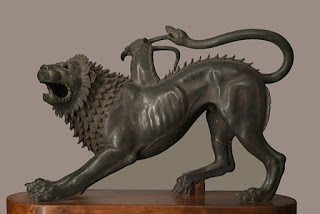
This Etruscan (Rascian) bronze, dated to 400 BC, is known as "Chimera of Arezzo". 


You can find high resolution image here.

The sculpture has an inscription reading "Tinia" on its front right leg. Tinia (also Tin, Tinh, Tins or Tina) was the god of the sky and the highest god in Etruscan mythology, equivalent to the Roman Jupiter and the Greek Zeus.

Interestingly in Irish the word "tine" means "fire", and in Serbian the word "tinja" means "smoldering"...

What does this have to do with Chimera? Well Chimera "snorts out the breath of the terrible flame of bright fire". And she does it through the mouth of a lion. Now, as I already explained in my post "Two crosses",  the hottest part of the year in the northern Europe falls at the end of Summer and the Beginning of Autumn. In South Slavic tradition this period is called Kresovi meaning Fires. These are the days of wild fires and droughts. And interestingly this period is on the Zodiac circle represented by the symbol Leo, Lion. Lion which "snorts out the breath of the terrible flame of bright fire". 

Now in my last post "You will trample the great lion and the serpent" I talked about the solar symbolism hidden in Psalm 91 (Greek numbering: Psalm 90), also known as the Psalm of Protection, and the image known as "Christ treading on the beasts" which is based on this psalm. In this post I explained why snake is a symbol of the beginning of the summer and why lion is the symbol of the end of the summer. 

Summer starts on the 6th of May, Day of Jarilo, Beltine. Jarilo represents the sun's heat, symbolized by the snake and the dragon. Funnily Jarilo was Christianized into St George, the Dragon killer :) In Serbia, St Jeremija who is celebrated at the beginning of May is known as the Snake Saint. His day (1st of May according to the Julian calendar, 14th of May according to the Gregorian calendar) is the time when people perform magic ceremonies for protection from snakes...Interesting both names Jarilo and J(a)eremija have the root "jar" meaning "bright heat".

Summer ends on the 2nd of August, Day of Perun, Lughnasadh. Day of Perun falls in the middle of the Leo (Lion) zodiac sign


Knowing this it is easy to understand why Chimera has a snake tail and a fire breathing lion head. Summer starts in the sign of Snake and ends in the sign of Lion. The heat increases during this period until it turns into "terrible flame of bright fire". 

What is interesting is that in Serbian mythology the 2nd of August, the point on the solar circle which marks the end of Summer and the beginning of Autumn, the hottest part of the year, is also the day of Perun, the Slavic Thunder god. In Irish mythology this day is known as Lughnasadh, the day of Lugh, the Celtic thunder god. Why is the day of the thunder god in the middle of the hottest period of the year? Because right after the 2nd of August, the day of the maximum heat, the sun starts cooling down. The first Autumn thunderstorms arrive. Thunder god defeats the dragon. As I already explained in my post "Three suns", dragon is in Slavic mythology, with snake, symbol of sun's heat. The sun's heat which causes drought. The sun's heat that steals the "waters of heaven", rain. Once the Thunder god kills the dragon, once the sun's heat starts dissipating, the waters of heaven which the dragon stole are released, and the rains return...This is why the name of the sky god is inscribed on the Chimera's front right leg. 

But what about the goat's head that protrudes from the lion's back?

In my post "Goat" I talked about the symbolism of ibex goat and why is the Capricorn zodiac sign where it is on the solar circle. 

Now here is the important bit:

Alpine ibex mating season starts in December, and ends in January typically lasting around six weeks. 

Bezoar Ibex mating season starts in November and ends in January. 

Right in the middle of the mating periods of both Alpine and Bezoar ibex is Winter Solstice, 21st of December. And the day after the winter solstice is the beginning of the Capricorn (goat) period, which last from December 22 – January 20...


Have a look at this image. This is solar circle, with the beginning (snake), the middle (summer solstice) and the end (lion) of summer marked at the bottom of the Zodiac circle, and the middle of winter (winter solstice) marked at the top of the circle.


This is our Chimera. 


Chimera with the body with snake tail (beginning of summer), lion head (the end of summer) which all together represents summer. And with the ibex goat head on it's back, which represents the winter solstice.

And so it turns out that Chimera is not a monster, but a symbol of the sun. More precisely Chimera is the symbol of the solar yearly cycle. 

Interesting don't you think?