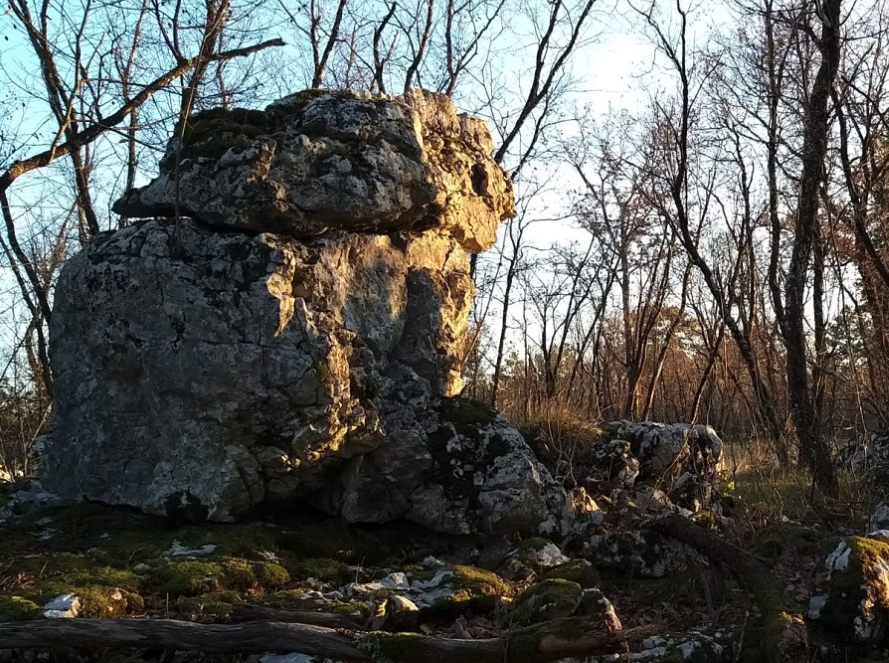
Ogham stones are found mainly in burial grounds, and churchyards. But some ogham stones are found outside of these areas. Here the stones may have been boundary or territorial markers, or perhaps memorials, marking where someone died, or fell in battle, or indeed was buried...
In "A smaller social history of ancient Ireland", published by Joyce Patrick Weston in 1906, we can read that "when tribe-chief had taken possession of a district, he "erected pillar-stones there...in order that his share there may be known"...

Joice then goes to say "But pillar-stones were erected for other purposes, of which the most usual was as a monument over a grave...Battles were (also) often commemorated by pillar-stones..."
And finally he says that "...pillar-stones were sometimes erected as idols..." and "...that a stone set up to mark a boundary was sometimes called a 'stone of worship'..."
In Serbia, people also erected boundary stones between villages until recently. Erecting of the boundary stones was witnessed by both sides accompanied by many religious rituals aimed at consecrating the stone. Consequently the boundary stone was considered sacred...
Any damage to the stone, falling the stone or moving the stone and even touching the stone was prohibited. These stones were always visited by the village processions from both villages during religious festivals, reaffirming the holiness of the stones and the sacredness of the border they represented...
The use of stones as border markers is very old. But I believe, that before people used stones, to mark the land as theirs, they used stakes...

This ancient tradition was preserved again by culturally super conservative Balkan Serbs...
In Serbia every unclaimed or uninhabited land was considered a wasteland, no man's land, unclean land. In the old times it was enough to stick a stake into such land to clean the land from demons and to claim the ownership of that land...
Interestingly, in Serbia when people wanted to insure that the dead stay dead :) and don't turn into a vampires, they stuck a stake through the dead body lying in the grave to "tie it down". I talked about this in my post "Vampires"...
It seems that the land, earth was similarly subdued and "tied down" by sticking the stake into it...
The english expression "stake a claim to the land" actually describes this ancient custom. I have tried to find any explanation how this custom and expression entered the English language. I found this explanation in the English Etymological Dictionary: "From early 14c. as 'divide or lay off and mark (land) with stakes or posts'".
When claiming the land, the stake was usually stuck in the middle of the claimed land where future clan village would be erected. Old clan histories still remember who was the first to stick the stake into the land and therefore claim the land for the clan...
In villages on mountain Rudnik, there was a custom to first stick a stake in the place where a new house was going to be built to purify the land, to clean it of bad spirits, and only then the house was built on "clean land"...
That stake was a tabu, and was never removed or in any way spoiled. People believed that doing so would bring bad luck to the family...
Once few clans moved into the same territory, clan lands would be merged into a village land. At that stage a new communal stake would be stuck into the ground to mark the communal village land...
These communal stakes were usually stuck on crossroads, near wells, in the centre of the future village and that stake would become the cult centre of the whole village. These village stakes would later be the places where churches and or graveyards would be placed...
Until recently in some parts of Serbia stake was also used as grave marker. Archaeologists have discovered remains of wooden stakes, always one stake per grave stuck at the head of the grave where today we find tombstones and crosses...
Stakes were used to mark the borders between private and communal land and also to mark the border between two village or clan lands...
Just like the border stones I talked about earlier, these border stakes were considered holy. And it was their holiness which made moving of the borders a tabu, and therefore prevented expansionist wars between the neighbouring tribes and clans...
In the Balkans, Slavs used the word "stup" (stake) to also denote "arable land, agricultural land, village land, cleared land which wholly belongs to one person"...
The ethnographic data from Montenegro and Stari Ras (Hercegovina), shows that when the new land was claimed, a wooden or stone "stake" was stuck into the land to mark the clan, tribe ownership over the land "until the end of time"...Which is why stake came to mean "owned land"...
Stup is mentioned as the word for arable land is found in 1321-1331 "Dečani charter", signed by Stefan Uroš III Dečanski of Serbia, the Serbian King, which contains a detailed list of households and villages in what is today Metohija and northwestern Albania...

One last thing.
In both Ireland and Serbia, people lived in kin-groups, based on a belief that there was common male ancestor.
The closest kin group that was specifically defined consisted of the descendants of a common grandfather. In Ireland this group was called "gelfine" and in Serbia this group was called "zadruga".
This kin-group, consisting of grandparents, their sons and their families, could sometimes have over 100 individuals. All the property was owned by the family and the only personal property was what was on ones person.
The leader of this kin-group was the grandfather, and he was known either as "the head of the family", "cenn fine" in Irish and "glava porodice" in Serbian or "the pillar (stake) of the family", "ágae fine" in Irish and "stub porodice" in Serbian.
Serbian sources:
Душан Бандић–"Народна религија Срба у 100 појмова"
Бранислав Русић–"Старији обичаји код одређивања земљишних међа и око пољских радова у Кичевији, Гласник етнографског музеја у Београду XIX"
Група аутора-"Српски митолошки речник"