Showing posts with label European mythology. Show all posts

Saturday, 19 September 2026

Beard pulling

Muiredach's cross is a high cross from the 10th or possibly 9th century, located at the ruined monastic site of Monasterboice, in County Louth, Ireland. On one of the lowest panels of the cross there is a relief depicting two men pulling each other's beards.


Expression "Pulling someone's beard" means "Challenging someone's authority". Does anyone know how old this expression is?

Pulling someone's beard out was an act of insult. In Isaiah 50:6 we read: "I let them beat my back and pull out my beard. I didn't turn aside when they insulted me and spit in my face". This is because beard was a sign of manhood so pulling the beard out was a symbolic castration...

Romanesque sculpted stone capital from the Church of Notre-Dame-de-l'Assomption in Thiviers (Dordogne, France), likely dating from the 12th century.


The link between beard and penis is symbolically represented in this late 15th century polychrome stone stature of Adam from Albi cathedral, showing Adam covering his penis with fig leaf with one hand and touching his beard with the other...


Earlier romanesque depictions of the same symbolic scene are much more explicit :) Like this one from the church of San Martín de Elines (dated to 8th-10th century AD). Basically Beard = Penis = Fertility = Fatherhood 


Serbian expression "He acts like he had pulled god's beard" which means "he acts like god gave him power". 

Apparently, this stems from the fact that in the Ancient Near East, grabbing someone by the beard (to kiss them) was a customary gesture of intense affection, respect, and familial intimacy...

So "He acts like he had pulled god's beard" means "Him and God are best palls"...

But the Serbian expression "He acts like he had pulled god's beard" has another version: "He acts like he had pulled god's penis". 

I talked about the link between penis and sceptre (symbol of power) in my post "Sceptre"...

For instance, in Sumerian:  ñišuš-bar: ruler's staff; sceptre, literally means 'penis' + 'to see, show'...

So are beard stroking penis wielding figures like this one from Mansilla de la Sierra depictions of god?


Like this Ithyphallic Norse statue of the male fertility god Freyr Holding his beard and his penis...


Remember god is god the creator, god the father. Beard = Penis = Procreation = Fatherhood...

I talk about all this in my posts "Beard of Osiris" "Braided beard"...


Saturday, 14 March 2026

Milk for the dead

After Vespers on the eve of All Saints' Day, Bretons would commonly visit the cemeteries to kneel at the graves of their loved ones; to pray and anoint the hollow of the gravestones with holy water or milk...


A very interesting custom indeed...Here we have pretty explicit water/milk libation sacrifice to the dead...

I first talked about the "thirsty" dead first in my posts "Thirst" and "White feast" about South Slavic beliefs that the dead are linked to rain and grain fertility...And that thirsty ancestors will "drink rain from the clouds and will cause drought"...

I then talked about "thirsty dead" in my post "Lapis Manalis" about Roman belief that the dead are linked to rain and grain fertility...BTW, do you see the similarity between cup and ring marked stones and rain caused ripples on water? Or is it just me?

I finally talked about "thirsty dead" in my post "Care of the dead" about Hittite and Sumerian belief that the dead are linked to rain and grain fertility...And if you forget to respect the sacred bond with the dead...

It is interesting that in Brittany, the libation was poured into what looks like a stone mortar (quern) hole...

These are knocking stones from Scotland...


They were used as mortars for husking and pounding barley and other cereals...I talked about them in my post "Knocking stones"...

Interestingly, some of them were locally known as "fonts"...Confusion? Well, no, not really. From: 

In Baltic countries, quern stones were once buried as "corner stones", the most important stones in the house foundation...


And milk libations were poured into the hollow "for the house snake", which was believed to contain the spirit of the ancestors...I talked about this in my post "Stones with narrow bottom bowls"...

Meanwhile in Scotland: in the Highlands, knocking stones were occasionally used as the receptacle into which a daily offering of milk for the Gruagach was poured. Gruagach, a domestic spirit which looked after the cattle/household...

The above is copied from historian, Stuart McHardy's essay, "Gruagach; a wee remnant of something much bigger?"...

That's the same house snake I talked about in my post "House snake"...

In Belarus, when storytellers want to emphasise that something happened long time ago, they would say "in the old days, when people kept snakes in their houses"...And fed them milk...Again because they believed that these snakes contained the spirits of their ancestors and were protecting the family...

Interesting, right? 

Monday, 21 August 2023

Holy water

@another_barbara:

I've read that our ancestors believed that on the evening of January 18th and January 19th until noon water is sacred and has healing and protective powers. People sprinkled this holy water in their homes. Bathing in this water was a cleansing ritual.


There are many legends about healing or holy springs in Slovenija. One of them is spring “Gospodična” (Maiden, Young woman) on Gorjanci hills. The story tells that an ill old countess became healthy and young again after drinking this water and washing her hands and face with it. 

Why this specific date?

The Christian explanation was this: John the Baptist baptised Christ on the 27th day after winter solstice. But this is most likely just s substitute tale for an older ritual.

So...What could be that "older ritual"???

Check this out:

This is winter zodiac...I talked about it in my post "Trentar"...


In one of my favourite zodiac related legends, the Slovenian legend about Zlatorog, the Ibex goat with gold horns, it is the "hunter from Trenta valley" that hunts and fatally wounds the magic goat, from whose blood springs magic Triglav rose...Which dying magic goat eats and gets healed (magically)...

So hunter, pursues Ibex goat, shoots it, it bleeds, from it's blood grow flowers...What does this mean?

Well, what you are looking at is the winter zodiac: Sagittarius (end of autumn, start of winter), Capricorn (mid winter), Aquarius (end of winter, start of spring)...

Spring starts in Aquarius...Which represents the snowmelt...This is where frigid old hag, winter earth, turns into hot young maiden, spring earth...Who then gets her first "period"...Becomes fertile again...


BTW, the same transformation of winter into spring is contained in a Slovenia ritual calld "Bablji mlin", meaning "Granny's mill" scene. An old hag is being milled, and thus transformed, into a young maiden. Winter being transformed into Spring...I talked about this in my post "Babji mlin"...


The same story of rejuvenation, rebirth (of the mother earth) is preserved in the Scots Gaelic ritual song "The old woman of the mill-dust":

Will you give me your daughter old lady of the mill dust?
Will you give me your daughter 
I will be happy with her
I will dance with her

From Carmina Gadelica, 19th c. Gaelic Scotland

In Gaelic, the word Cailleach means both an old woman and the last sheaf of wheat and the corn dolly made from it. Corn dolly which represents Mother Earth, the life (grain) giving mother...

I talked about this in my post "The old woman of the mill-dust"...

Interestingly Cailleach, or Cailleach Beira, is the Scottish "Queen (Goddess) of Winter". She appears as a blue-skinned hag carrying a magical staff that freezes the ground and a hammer for shaping hills and valleys. At the end of her seasonal reign, she drinks from the Well of Youth to become young again...


Spring of youth being of course the snowmelt, which begins in February, in Aquarius (!!!) 🙂, which marks the beginning of spring...And the arrival of the "Bride" (Brigid), the spring earth maiden, snowmelt being her first "period"...

Effigy of St Brigid taken from house to house to collect money while saying these rhymes: 

"Here's St Bridget dressed in white,

Give us some money to honour her night,

She is deaf, and she is dumb,

And she can't talk without a tongue"


St Brigid, The Bride, Gaelic Mother Goddess turned Saint is associated with wells (running water)...

Slavic equivalent is the effigy of Marzana (winter) which is made and paraded around in Slavic countries at the same time. The effigy is then burned or drowned to symbolise the end of winter. This can give us the clue who Brigid originally was.


Also, The Witch of Winter, The Old Hag, has to be burned (and drowned) or spring will not come...Burning is heating up of the earth and drowning is the snowmelt...Burning and drowning of Marzana, Slavic name for Winter Earth...I talked about this in my posts "Gryla", "Living stone", "To kill a which", "Babele"

Oh and don't forget The Snow-White...From the article:

"What we have here is the story of Earth going through seasons: Spring, Summer, Autumn, Winter, Spring...

Beautiful young Spring Earth becomes bountiful Summer and Autumn Earth. Still beautiful, but in no way as beautiful as the Young Spring Earth...

Because of the cyclical nature of the solar year, Autumn Earth is the mother of Spring Earth of the next solar year. As Autumn ends, and the crab apples are the last fruit left on the trees, Autumn Earth turn into Old Hag Winter Earth, who "kills" her own younger self...

Dead Earth lies in her icy coffin until Young Spring Sun arrives. He sees beautiful Spring Earth under the ice, falls in love with her and revives her. Spring Earth, marries Spring Sun...

But seasons pass, Spring Earth turns into Summer Earth and then into Autumn Earth and then into Winter Earth...And the story repeats itself...Luckily, every spring, Young Sun arrives to save the day 🙂"

All these stories, beliefs and rituals basically describe the same thing: End of winter, beginning of spring...

Oh, including of course Christ's baptism ("in living", flowing water) and Mary's purification (first period after giving birth)...


@another_barbara
:

After @serbiaireland explained to me what a tale (I teach to kids for 15 years) really means, I had to add that the old countess was barren and she and her husband were sad because of that. After drinking/washing with sacred water she knew she will be able to have children now.


Sunday, 27 November 2022

Snake eagles from Inner Mongolia

A gold plaque in a bird and snake pattern excavated from the Majiayuan cemetery in Zhangjiachuan, Gansu Province, China and dated to 5th-3rd century BC. Pic from: "Archaeometallurgical Studies in China: Some Recent Developments and Challenging Issues"

There is something very interesting about this image: how much it looks like this image:

Eagle-Snake struggle mosaic from the Emperor Justinian's palace, Istanbul...

This is actually a complex animal calendar marker for the thunderstorm season in Europe Apr/May -  Sep/Oct, when migratory snake eagles can be seen in Europe...I talked about this in my post "Eagle snake struggle"...

In the article about the mosaic from Istanbul, I postulate that this is the depiction of the fact that the hottest season in the Balkans (snake = sun's heat) is also the season of the thunderstorms (eagle = thunder)

This is depicted through the struggle between a Short-toed Snake Eagle (who is summer breeding visitor to Europe) and a snake (which is out during the summer)...

Is it possible that the above Plaque from Gansu also depicts he same thing: the hottest time of the year is also the time of the year with most thunderstorms, and, this is also the time of the year when Short-toed Snake Eagles can be seen fighting snakes?

Well...This is the climate in the Gansu region...

The climate (hottest time of the year is the rainiest, most thundery, time of the year) is the same in Inner Mongolia...Here is the climate chart for Xian...

I talked about it here in my article about the "Mythical Beast from Xian"...

And its the same climate (hottest time of the year is the rainiest, most thundery, time of the year) in Mongolia proper...

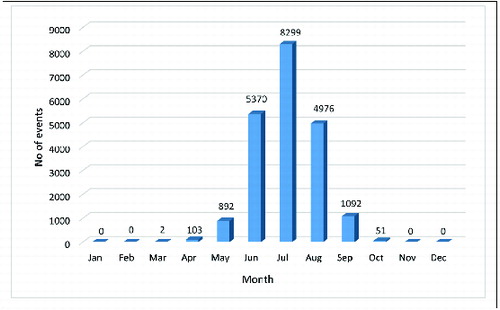
Now have a look at this picture. This is a distribution of thunderstorm frequency in China per month...From "Decreasing trend in severe weather occurrence over China during the past 50 years"...

You can see that the main thunderstorm season, with over 80% of all thunderstorms, starts in Apr/May...

I talked about this in my posts about Chinese thunder gods and thunder dragons: "Dragon gate", "The minister of thunder", "The son of thunder", "Lei Kung", "White thundercloud", "The gourd that saved humanity", "Blue boy"...

Guess what...This is annual distribution of thunderstorms in Mongolia...From "Lightning incidents in Mongolia"

Ok, so climate in the area where the eagle snake plaque was made fits: hottest time of the year (snake) is also the thunderiest 🙂 time of the year (eagle)...

What about snakes? And Short-toed Snake Eagles?

Well, snakes are cold blooded, so they are out only during the part of the year when the temperatures are above zero...So Mar/Apr/May - Sep/Oct/Nov...depending where you are, Northern China, Inner Mongolia, or Mongolia proper...

Which is exactly when migratory Short-toed Snake Eagles arrive to this part of Northern China, Inner Mongolia, Southern Mongolia to breed... 

Sources:

And so, just like in Southern Europe, the only time of the year when you can see the (mythical) battle between the rain (eagle) and sun (snake) is during the hottest (and rainiest) time of the year, Apr/May - Sep/Oct...

http://birdingmongolia.mn

https://birdingbeijing.com

I think this is kind of cool...

To read more about ancient animal and plant calendar markers, start here…then check the rest of the blog posts related to animal calendar markers I still didn't add to this page, and finally check my twitter threads I still didn't convert to blog post...I am 9 months behind now...

Monday, 7 November 2022

Living stone

Stone Quarry, painted c. 1919, by Czech painter Josef Ullmann...

In Slovenia in the past, a piece of stone that was cut from the wall of a quarry, had "to calm down", because it had been torn off the "mother's body" and was perceived as still alive for a certain time...

This belief was recorded by an published by Boris Čok in  "Kamnoseško izročilo o znamenjih na portalih in kolonah po Krasu" (p: 106)

But this is not an isolated belief...

Bedrock is in the Balkans known as "živi kamen, živa stena" (living stone, living rock) and is called so, because it is believed to be still part of the living body of the Mother Earth which gives birth to all life (plant, animal, human)...

These types of stones are also known as "Baba" (Grandmother, Mother) stones...

There are many "Baba" rocks and rocky mountain peaks all over Slavic Balkans. This is one of my favourites: Babin zub (Grandmother's tooth) peak, Mt. Stara Planina (Old Mountain), Serbia...

I list a lot of them in my article "Baba, mountains and crags"...If you know of any more, please post name and link to the map location in the comments...

These Baba stones were once venerated by the local transhumance shepherds communities...

For instance on Velebit mountain in Croatia, on arriving to the summer pastures, shepherd women used to bring food offerings and leave them on the "Baba" stone.  They also used to lite candles on the stone on various holy days. The stone was also known as "the altar"...

Many of these old "Baba" stones were later Christianised, by having chapels dedicated to Mother Mary built on top of them...Same thing, different name...Like this one on Veliko Rujno, Velebit, Croatia...

I talked about this in my post "Shepherd's chapels from Velebit"...

This was done because people believed that it was "Baba" (Mother Earth) that controls cold and damp weather...While her husband, Father Sun (Sky) controlled hot and dry weather...

Father above, Mother below...

Looks familiar? I talked about this in my post "Square and compasses"...

Srbska zagonetka: 

Pitanje: Visok otac, široka majka

Odgovor: nebo i zemlja

Serbian riddle: 

Question: Tall (high) father, wide mother

Answer: sky and earth

I talked about this in my post "Riddle"...

Shepherd's in Slovenia also believed that "baba" stones were linked to weather, water, humidity, mud, soil and fertility and pasture abundance...

This bedrock outcrop near the village of Rodik in Slovenia is known locally as "Baba" (Grandmother)... 

Locals believed that "Baba" controls the (bad) weather: Baba’s urine turns to rain, her fart to wind, and when she raises her skirt, the weather gets nice...🙂

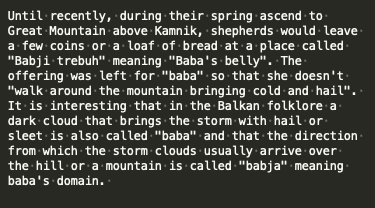
And also used to leave offerings on "Baba" stones during their spring ascent to the summer pastures...I talked about this in my post "Gryla"...

I came across this interesting article in Italian, "La leggenda dell’auricorno e la mitologia delle Alpi slovene" about "Baba" folklore from the Alps. 

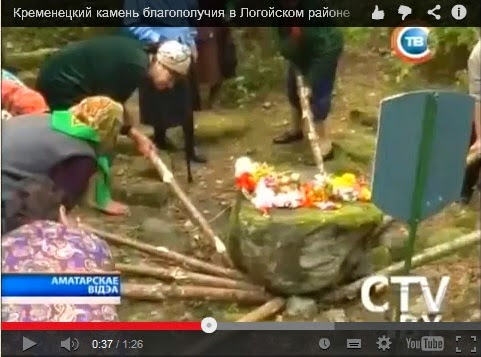
This is why stones are so prominently used in Slavic weather magic...Like here, where women raise "Dabog's stone" during drought to get cool and wet weather...

I talked about this in my posts "Weather stones", "The last megalithic ritual in Europe", "Jupiter from Ibrahimovci", "White cross"...

In South Slavic mythology, it is "Baba", meaning Grandmother, Hag, personification of the winter earth, which causes cold weather...I wrote several blog articles about this character...

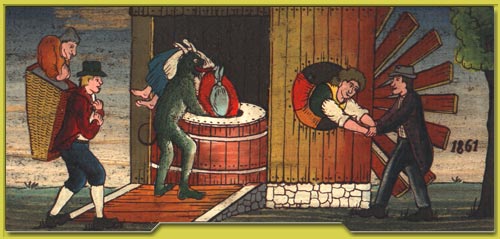
"Bablji mlin", meaning "Granny's mill" scene, Slovenia. An old hag is being milled, and thus transformed, into a young maiden. Winter being transformed into Spring...I talked about this in my post "Bablji mlin"...

Interestingly, in this version, it's Krampus that does the milling...Krampus, Goat man, an animal calendar marker for winter...


Why? Because Ibex goats mate and fight during the winter...

I talked about this in my post "Krampus"...

"Bablje Leto" (Grandmother's summer), one of the names for Indian summer (warm dry autumn weather), is another remnant of the Mother Earth cult in European Christianity and European folklore...I talked about this in my post "Bablje leto"...

"Everyone knows that an ordinary bullet can't kill a witch. If you want to kill a witch, load the rifle with 3 grains of wheat and a bit of Easter beeswax candle" - Serbian saying. 

To understand why, replace witch with winter...

I gave the analysis of this proverb in my post "How to kill a witch"...

Slavs equated The Goddess of Death, Morana (mor=death) with The Old Hag, The Winter Earth, Marzana (marz=frost). She is ceremonially burned (warmed) or drowned (thawed) or both (to de sure to be sure 🙂) during Slavic spring festivals...I talked about this in my post "Gryla"...

As part of end of winter, beginning of summer rituals, men and boys blew willow horns  to scare the witch (winter) away...I talked about this custom in my post "May horns"...

Willow being symbol of spring...I talked about this in my post "Willow in Slavic folklore"...

In Cornwall we find the character called "The Old Sky Woman" who controls the snowfall across North Cornwall and children were told when the snowflakes began to fall, the Old Woman was up in the sky plucking her Goose....


Baba, The Old Hag, The Spirit of Winter Earth...Is also found in Romanian folklore...Just like in Serbian and Slovenian folklore she is associated with goats, calendar markers for winter (🙂)...

I talked about this in my post "Babele"...

In Iceland we find Gryla, who originally was "really a personification of the winter and the darkness and the snow getting closer and taking over the land again"...


Among Kashubians in the Carpathian mountains we find saying: "the old baba (grandmother) went to dance" - when the weather suddenly changes and it starts to snow...

In the Polish Carpathians we find saying: "the baba (grandmother) is already frozen" - the mountain tops are covered with frost or the first snow...

In Gaelic lands of Ireland and Scotland she is Cailleach...

In Italy she is Befana...

In the mountains of Central Europe she is Perchta to Germans or Peruehty to Slavs...

In the North of Germany and in Scandinavia she is "Mother Holle (Hulda) or "Old Mother Frost"...

Interesting, right?

I think so...