Showing posts with label European archaeology. Show all posts

Saturday, 14 March 2026

Milk for the dead

After Vespers on the eve of All Saints' Day, Bretons would commonly visit the cemeteries to kneel at the graves of their loved ones; to pray and anoint the hollow of the gravestones with holy water or milk...


A very interesting custom indeed...Here we have pretty explicit water/milk libation sacrifice to the dead...

I first talked about the "thirsty" dead first in my posts "Thirst" and "White feast" about South Slavic beliefs that the dead are linked to rain and grain fertility...And that thirsty ancestors will "drink rain from the clouds and will cause drought"...

I then talked about "thirsty dead" in my post "Lapis Manalis" about Roman belief that the dead are linked to rain and grain fertility...BTW, do you see the similarity between cup and ring marked stones and rain caused ripples on water? Or is it just me?

I finally talked about "thirsty dead" in my post "Care of the dead" about Hittite and Sumerian belief that the dead are linked to rain and grain fertility...And if you forget to respect the sacred bond with the dead...

It is interesting that in Brittany, the libation was poured into what looks like a stone mortar (quern) hole...

These are knocking stones from Scotland...


They were used as mortars for husking and pounding barley and other cereals...I talked about them in my post "Knocking stones"...

Interestingly, some of them were locally known as "fonts"...Confusion? Well, no, not really. From: 

In Baltic countries, quern stones were once buried as "corner stones", the most important stones in the house foundation...


And milk libations were poured into the hollow "for the house snake", which was believed to contain the spirit of the ancestors...I talked about this in my post "Stones with narrow bottom bowls"...

Meanwhile in Scotland: in the Highlands, knocking stones were occasionally used as the receptacle into which a daily offering of milk for the Gruagach was poured. Gruagach, a domestic spirit which looked after the cattle/household...

The above is copied from historian, Stuart McHardy's essay, "Gruagach; a wee remnant of something much bigger?"...

That's the same house snake I talked about in my post "House snake"...

In Belarus, when storytellers want to emphasise that something happened long time ago, they would say "in the old days, when people kept snakes in their houses"...And fed them milk...Again because they believed that these snakes contained the spirits of their ancestors and were protecting the family...

Interesting, right? 

Monday, 24 April 2023

Eyes

What is the best way to symbolically depict "Mother Earth"? 

Well, place mountains, plants and animals between wide open eyes and vulva...Simple...

Decorated bone depicting slightly bewildered "Mother Earth", 6th - 5th millennium BC, Hagoshrim, Southern Levant.

Decorated bone depicting Mother Earth with a stern "I am watching you!" expression, 6th - 5th millennium BC, Neve Yam, Southern Levant...

Reconstruction of a stone palette depicting Mother Earth who...well...had enough and is ready for bed...6th - 5th millennium BC, Ein Zippori, Southern Levant...

This symbolic depiction of the Mother Earth later found its way to Upper Euphrates. Stele of Mari, found in a pit at the temple of Ninhursag...

Now remember this? 6th mil BC, Balkans. No eyes, but the "important" bit, plants growing out of the vulva, is there...Early Vinča Culture terracotta figurine from Jela, Iron Gate region of the Danube, Serbia, c. 5200 BC...

The oldest European one from Lepenski Vir is from c. 8000BC. Anyone knows of any Levantine examples from before 8000BC?

These Levantine Mother Goddess depictions are from this article:  "Iconographic motifs from the 6th–5th millennia BC in the Levant and Mesopotamia: Clues for cultural connections and existence of an interaction sphere"...

BTW, these guys were farmers, grain farmers...This is very important...So this Mother Earth is Mother of Grain...This girl

Left: Anthropomorphic vessel with breasts, Neolithic Lengyel culture (5000-3400 BC)

Right: Anthropomorphic vessel with breasts and grain ears (?) instead of hands, Chalcholitic Baden culture (3600–2800 BC) which developed from Lengyel culture.

Both from Central Europe...


I talked about this in my post "Femal pots from Europe"...

Saturday, 14 January 2023

The Blood Run stone

This is a cup marked granite boulder located on the "The Blood Run" archaeological site in Iowa, USA. The site once contained an extensive complex of burial mounds, stone circles, village areas, and an enclosure...

According to "The Cupmarked Boulders of Blood Run, Iowa" and "Ethnographic Analogy and the Folklore of Cup and Ring Rock Art" by Kevin L. Callahan, Department of Anthropology, University of Minnesota, this stone is one of the so called "death stones"...Death stones? Could this be in any way related to what I wrote about the in this post, "Lapis manalis", about "Blessed dead stone"? 

Of course it is 🙂

Here is what Kevin says (paraphrased):  "We examined the pitted boulders and nearby burial mounds at Blood Run, Iowa and Fort Ransom, North Dakota and we reviewed the ethnohistoric sources of historic period Plains Indians, and Indians from the Far West"...

"The data suggests the possibility that the primary social function of these cup marked boulders may have been as “death stones” to mark each new death or burial"... 

Very very interesting, right?

Kevin then says: "Such sacred stones were not considered inanimate objects, but the occasional dwelling place of spirits, and may have had related functions as a place for contacting the spirit world, vision questing, and as “baby rocks” for couples wishing to conceive"...

Ahh, so they believed that spirits lived in stones...Interesting...But what does this have to do with Old European culture? Well, a lot. In my post, "Lapis manalis", I wrote that Slavs believed that stones can "capture" souls of the deceased, who then continued to live in them...

Today, I came across this paper: "Portals to Other Realms: Cup-Marked Stones & Prehistoric Rock Carvings" by Gary Varner. And in it I found this being said about cup marked stones and the dead:

"The link to the dead is illustrated also in Swedish folklore which refers to cup-marked stones as “elfstenar.” Elfs are believed to be the souls of the dead who frequent, if not live in or below the stones"...

"The cups are often used for offerings to ensure that the elfs are not offended or their peace disturbed...Some of these gifts were rag-dolls left by women who wished to become pregnant"...🙂

"One cup-marked stone on Seil island...Scotland, has been used into contemporary times to appease the “wee folk”. Each spring the cup is filled with milk in the belief that if it wasn’t, the Little People would ensure that the cows did not produce any milk in the summer"...

Drought causing spirits who live in stones? Interesting, really interesting...In Finland these cup marked "sacrificial stones" were used to pour the first cows milk or first grain harvested as an offering to the spirits living in the stone...And they were offered first fruits? 🙂

"In Estonia as well 'offering stones' were used to mark the passing of people: "a close relative of each dead person had an obligation to bore a hole in the offering stone"...

"A large number of ancient cup-marked stone sites in the UK are associated with cremations, tombs and burials...Like Witton Gilbert cist burials near Durham City in the UK"...


"One of these cists, which dates to the Early Bronze Age (2300 BCE to 1500BCE), was covered by a slab of sandstone which was decorated on one side with cups and rings and on the other with only cups"...

"The current theory is that cup-marked stones, often associated with burials, resulted from the introduction of farming in Europe and the UK and may have been part of fertility rites and sacrificial offerings to the dead as a part of ancestor worship"...

But also with fertility...Interesting, and not at all surprising, considering the ancient belief that the fertility of the people, animals and the land is the gift of the dead...I wrote about this in my post, "Lapis manalis"...

Anyway, very interesting indeed...

PS: In this old article, "Rebirth", I proposed that the cup and ring mark cut into this Bronze Age tomb in Ireland, and illuminated every equinox, represented rebirth of the sun, solar year, which was then linked to the rebirth of the people buried in the tomb...


Tuesday, 16 August 2022

Goose Salmon Stone

In "The Reliquary & Illustrated Archaeologist, July 1895", in the chapter entitled "Discovery of an Ancient Burial Place and a Symbol-Bearing Slab at Easterton of Roseisle" (page 142), we can read this: 

At the end of April, 1895, a still further discovery was made, for, on removing the symbol -bearing slab from the grave, we observed that it was a square sea-beach stone much water worn, and without mark of any tool on it. On the outer side or back of the stone were cut two figures, viz., a bird, either a goose or duck, with webbed feet, and a salmon...


Here is the illustration from the book showing the stone...


And here is a photo of the stone, now in National Museum of Scotland...

A very interesting stone indeed...Why is it decorated with a depiction of a goose and a salmon? 

Ever heard of animal calendar markers? 

Well, this is one, marking Oct/Nov...

Here is why...

In Oct/Nov, huge flocks of pink-footed geese arrive to Scotland from Northern Europe...They spend winter in Scotland and leave in Mar/Apr...More about pink-footed gees in Scotland can be found here...

In Oct/Nov, huge shoals of salmon arrive to Scotland and run up the Scottish rivers to their spawning grounds. This is the best time to see salmon leaping in Scotland...Mora about salmon in Scotland can be found here...

Both are hugely important annual events which happen at the same time, every year, and are not easily missed, if you are a hunter gatherer whose survival over winter depends on these birds and fishes as food sources... 

So, Oct/Nov, the time when gees and salmon arrive to Scotland...Rejoice, the food is here...🙂

To read more about ancient animal and plant calendar markers, start here…then check the rest of the blog posts related to animal calendar markers I still didn't add to this page, and finally check my twitter threads I still didn't convert to blog post...I am 9 months behind now...

Thursday, 10 March 2022

Bronze Age money

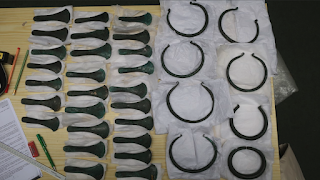
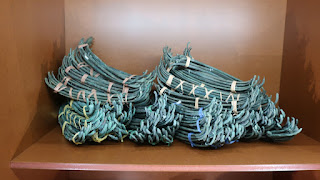
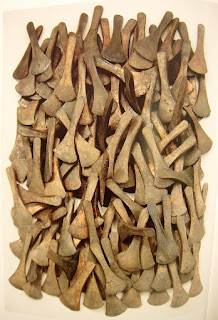
Very interesting. Just came across this paper "The origins of money: Calculation of similarity indexes demonstrates the earliest development of commodity money in prehistoric Central Europe" which proposes that 5,000 years ago, in Central Europe, rings, bangles and axe blades, standardized by shape and weight, were used as an early form of money... 


According to authors, huge hoards of identical bronze objects, like these bronze ribs found in bundles in Oberdingen, Germany, can only be explained if these objects were used as exchange barter tokens...Basically money...

The same goes for bronze axes, which although had practical value, were also status symbols and could have been used as a value token, which could be exchanged for other goods...Basically money...Over 250 bronze axes, found in a pot, most virtually identical in terms of weight.

Of course this can all be explained in another way...The axes are the same weight and size because that is functionally the best weight and size for an average Joe Bronze Age guy...Most axe heads made today are also very much standard in size...For the same reason...

The general rule is that there's three sizes of standard axes. Handaxe / hatchet (usually about 1.25-1.5lb). Boy's axe / house axe (usually 2-3lb). Felling axe (usually 3.5-6lb)...

Maybe the 250 axe heads were stored together in a pot by the guy who made them...Hidden "until this shit blows over"...I wrote about similar hoard found all over Balkans and date to the time of the Bronze Age collapse in this post...

Maybe torcs are all the same (actually very similar) size and weight because human necks are also very similar...And so is the amount of bling a Bronze Age Joe and Jane Blogs would feel comfortable carrying around said necks of theirs...

Maybe the bronze ribs were all standard in size because they were used for making something standard in size...I have no idea what, but that is not really the point...We can explain the existence of all these identical objects in other ways, and just as money...

The best bit is that just because axe head is standard size because it is practically the best size for an axe head, doesn't mean that it wasn't also used as money...These two things are not mutually exclusive...

In fact, the manufacture of many identical (for practical reasons) highly sought after objects would naturally turn them into money...Well valuable barter exchange tokens...Which is what money is...

Sunday, 19 September 2021

Spots and stripes

Asian Leopard. The real thing...


And depicted on  Neolithic pottery found in Iran, standing over the zig zag design depicting flowing water..


Leopard is the second most popular animal depicted on Neolithic Iranian pottery. The most popular being of course, Ibex. The Goat of Rain. I talked about the depictions of Ibexes on Iranian Neolithic pottery in my post "Iranian goat of rain"...

I Iran and Mesopotamia, Leopards and Ibexes are often depicted together, leopard chasing ibex...Like on this Late Uruk/Jemdet Nasr Period seal, dated to 3200-3000 BC. I talked about it in my post "Leopard and Ibex"


This could be because leopards naturally hunt ibexes. 

But also because they both have mating seasons during the local winter and rain season. 


Ibex at the beginning (Oct/Nov) and leopard at the end (Jan/Feb) of winter. Leopard naturally follows Ibex as the animal calendar marker.

Both animals are thus linked to rain and fertility...Their mating, semen, brings rain, heavenly semen, which fertilises the land...I talked about this in my post "Vessel from Tepe Hissar"...

This link between leopards, goats winter and fertility was in Europe preserved in Dionysus cult...I talked about this in my posts "Leopard", "Furious maenad", "Maenads with hare", "Thyrsus", "Woman and pitcher"...

Another animal which Dionysus uses as his mount (in later depictions) is Tiger. Another animal symbol for winter, because it too mates during the winter...I talked about this in my post "Leopard and tiger"...


Which is why tiger is found as symbol of winter from Europe to China. The earliest known depiction of Dragon - Tiger symbol, Yangshao culture burial...

I talked about tiger as a calendar marker in Neolithic China in my post "Tiger and dragon"...


Caspian/Siberian Tiger. The real thing

And depicted on Neolithic Iranian pottery. I just love how tiger has disappeared in the zig zag of the flowing water. And only its tail is still "realistic"...

Finally: "His face is that of a lion. When he looks at someone, it is the look of death. Humbaba's roar is a flood, his mouth is death and his breath is fire! He can hear a hundred leagues away any [rustling?] in his forest! Who would go down into his forest!"...

I wrote about this in my post "Humbaba"...

To read more about ancient animal and plant calendar markers, start here…then check the rest of the blog posts related to animal calendar markers I still didn't add to this page, and finally check my twitter threads I still didn't convert to blog post...I am 9 months behind now...