Showing posts with label Morana. Show all posts

Wednesday, 5 June 2024

Sawing the old hag

A while back @another_barbara posted this 1865 beehive panel image with this description: An interesting Shrovetide tradition from Slovenija "babo žagajo" (sawing of an old woman). 

The other day wanted to write an article about this custom, and while looking around the net for more info on the subject, I came across 1960 paper by Niko Kuret "BABO ŽAGAJO, Slovenske oblike pozabljenega obredja in njegove Evropske paralele".

In which he presents all the different versions (he knew of) of the "SAWING OF THE OLD WOMAN" ritual found in Slovenian lands, and its European parallels...

Here I will translate the most interesting bits from this paper, and will then give my interpretation of the ritual.

Here we go:

In 1791, Anton Tomaž Linhart, in his "Attempt at a history of Corniola and the other southern Slavs of Austria, vol 2" mentioned a "ridiculous legend", which in the middle of Lent circulates among the people, and especially among the children: 

In the past, during Lent, people used to lead an old woman out of the village and cut her in half. Considering that this legend was widely known and was everywhere the same, Linhart concluded that this was a "rituals" which was once really performed.

Ethnographic data collected in Slovenian villages in the second half of the 19th century confirmed that this ritual indeed still took place every Lent. And Niko Kuret states that the ritual was still performed in some villages in the second half of the 20th century.

Except "the old woman" was not really an old woman, but an effigy of an old woman made of wood and straw and dressed in old women's clothes, that was cut in half, often on bridges, over running water, or next to running water, and the parts were then thrown into the water...

In the area between Bohinj and the eastern half of the Karavanke mountains, a log or a board with a drawing of a old woman was sawn instead of a wood and straw effigy. 

In Carinthia, the hag was represented by a rope/thread which was cut in half...

Finally, in many places in Slovenia, the ritual cutting of the old woman eventually turned into a prank that people played with kids. They would send them somewhere to watch the cutting of the old woman which never actually took place. And they would miss lunch 🙂.

That's Slovenia covered. You can find a lot more details in the paper. The rest are examples of the same custom recorded in Italy, France, Spain, Portugal and Switzerland, organised by the specific subtype of the ritual and then the country.

As we can read in the 1983 book "I giorni del sacro" by Franco Cardini, "The burnings and/or sawings of "Vecchie" or "La Bianca" or "La Monaca" occurred almost everywhere in Italy"...
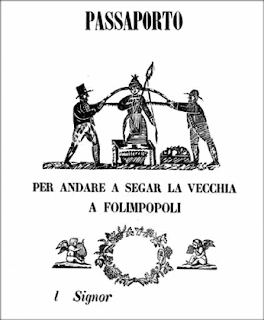
In some places, like in Florence, or in Reggio Emilia, the people first accused the old woman of everything that was wrong in the city, then she was put on a trial, condemned and then sawed in half. In some other places, like in Feltre, after she "made a will".

In some other parts of Italy, like in Campagna and Sicily, they hid a blood-filled bladder inside the doll and secretly cut it open during the sawing action. In the Ampezzan area, the effigy was stuffed with sawdust which represented blood of the wooden effigy.

A special form of the "Saw the old woman" custom, recorded in Tuscany in the 15th century. There they filled the old woman effigy with dried fruit, sweets and other goodies, which are removed from it during sawing and children, sometimes even adults, fought for them.

In Faenza, the old woman effigy, was decorated with necklaces and earrings made of dried figs, dried plums and chestnuts. The local children made rag dolls, stuffed them with dried fruit, carried them through the streets and shouted: "Sega la vecia!" (Saw the old woman).

Sawing of an effigy of an old woman (La Vieille) was also found in France. In the south, in Labastide-du-Vert, they dressed an effigy in a woman's dress and put an apron on her. They put it on a woodcutter's horse and sawed it. 

Everyone around was cheering and singing along: "Pauvre grand'mère! On scie grand'mère ! Adieu, grand'mère" (Poor old woman! We're sawing old woman! Farewell, old woman)... 

Around Quercy in the South of France, group of boys masked as "woodcutters" dressed a thin log in old female clothes and drove the "old woman" through the village streets. Finally they would stop on the village square and would start sawing the old woman in half. 

While sawing they sang: 

Resseguen la vielha, la vielha. Resseguen la vielha, aneit. Adiu paura minina, tu morés recegada, quai malur ! Tant milhor ! éra sorciera, zo méritava ben (Ocitan)

We saw the old woman, the old woman. We're sawing the old lady today! Goodbye poor grandmother, you die sawn, what a misfortune! So much the better ! She was a witch, she deserved it (English)

The same rituals are found in Switzerland where the straw effigy of an old woman being sawn is called "la bagorda" (the ugly one). In Oberland they keep old, useless lumberjack saws in some places and bring them out once a year, for "raz'g'a la vela" (sawing of the old woman). 

On the evening before Shrove Wednesday, when it gets dark, two boys would take this saw and would go through the village and would slide it back and forth across corner stones of several houses (sometimes specifically houses with young girls), with lots of noise and sparks... 

During the middle of the Lent, a hostile mood is unleashed towards old women in general, and sometimes especially towards a certain old woman in the locality in particular. 

Thus, in Marche, Italy, groups of boys noisily knock on the door of an elderly woman who has been chosen as the target of folk satire, calling her by name and shaming her. 

They carry a doll with them, dressed in such a way that it resembles the unfortunate victim. The doll is then sawn in half in front of the victim's house "amidst the revelry and jokes".

In Berry, France, on Mid-Lent Wednesday, 10 to 12 year old children roam the streets. With wooden sabers in their hands, they chase old women if they meet them and even try to break into houses where they know an old woman lives. 

Then they knead the image of the old woman out of clay and cut it into pieces with their wooden sabers, which they then throw into the nearby river. 

In the Gers region of Southern France, a song was sung before Shrove Tuesday: "Aux jeunes il faut des souliers, aux vieilles des coups de pied" (Young people need shoes, old people need kicks)..." 

The song has several such shameful couplets, each of which is followed by the refrain: "On scier a les vieilles, cette année, on sciera les vieilles!" (We saw the old ones, this year, we will saw the old ones!) 

In Barcelona, on Mid-Lent Sunday, groups of boys walk through the streets carrying a saw and a log. They sing that they are looking for the oldest woman in the city, so that they can saw her in two. At last they act as if they have found her and saw the log in two.

In Portugal, in the Lisbon, children arm themselves with pots and spoons. They greet every old woman with an infernal roar; they even throw stones behind her. The custom is called "Serra a Velha" (Saw an old woman). 

Elsewhere they gather in front of the door of the house where they know that an old woman live, and shout that her last hour is approaching, that she should make a will and pray for repentance. 

One of the boys then starts sawing a large piece of bark, while the others sing in between: "Oh, how long I've been sawing, but I don't see sawing! Either the saw is lousy or the old woman has too hard skin." 

In the eastern regions of Portugal, one of the singers represents an old woman who cries and wails, makes ridiculous requests to her neighbors, and in between confesses all her sins and finally imitates dying with a noise while the saw penetrates through the bark. 

In Porto, until recently, every year an effigy of an old woman was carried around town and placed at the door of the oldest woman. Later, they took the effigy to the main square, sawed her there, and finally burned her.

In Napoli the boys cut saws from cloth, whitewashed them with chalk and beat people with them on the back so that they could recognize the saw print on the dress.

In Piedmont (Turin) they sold wooden saws during Lent, later also saws made of chocolate. Boys carried giant lumberjack saws with them and threatened passers-by with them.

In Savoy, in Saint-Jean-de-Maurienne, they used to cut large saws out of paper and hang them on the people's backs ; they were called "rosses-vieilles" (worthless old women). Also in Switzerland, on Shrove Tuesday, children play with wooden saws.  

And, just like in Slovenia, in the other above countries the ritual cutting of the old woman finally turned into a prank that people played with kids. They would send them somewhere to watch the cutting of the old woman which never actually took place. And they would miss lunch 🙂.

So what's this all about? The most common explanation is that people symbolically cut lent (fasting) in half. Remember this article about the seven legged "Old Grandma Lent"? 
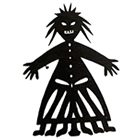

Apparently in the past, when it was the fourth Sunday of Lent, the figure was also cut from top to bottom, "as a sign of entering the second half of the Lent", a custom that gave the figure the name "sa Jaia Serrada".

Niko Kuret uses this to conclude that the old woman sawn during mid lent is a representation of the lent itself But why would lent be personified as an old woman? But where does all the hatred of that old woman comes from, which even leads to symbolic executions? 

Apparently, according to Niko Kuret, this comes from the hatred people felt towards the custom of lent which was imposed on them by the Catholic Church, and all the hatred was was actually concealed anti church sentiment...

Eeee...I doubt this is it...

The first explanation for this strange custom was proposed by W. Mannhardt in his 1874 "Wald Und Feldkulte Der Baumkultus Der Germanen Und Ihrer Nachbarstämme" where he tried to fit the sawing of the old woman into his theory about vegetation demons.  The sawing of the the old woman was to him the destruction of the vegetation demon of the previous year, i.e. a ritual of a primitive agrarian society. 

The vegetation demon is sentenced to death, and then killed — sawn, burned, hanged, buried, thrown into the water. Mannhardt does not say where the origin of the custom of the old woman being sawn originates. 

He does wonder if, considering the North-Western Mediterranean distribution of the custom, the custom has a possible Roman origin. The fact that "winter" is a feminine noun could be a clue pointing at that direction.    

But unfortunately we don't find any traces of any ritual killing of female representation of winter in Ancient Rome. Apart from maybe Anna Perenna, known from Ovid. 

Romans wrote that Anna Perenna was celebrated by the plebs, who made offerings to her so "that the circle of the year may be completed happily". On the 15th of March, beginning of the new agricultural year, her statue was ceremonially thrown into the Tiber river during.

So she could have been a representation of the "old year", but really, I wonder if she alone could have been a source of all the "killing of the old woman" rituals, which all took place at the end of winter, beginning of spring, which is when Lent takes place.

We find these rituals not just in Mediterranean, but also in Slavic countries, where people actually preserved the original meaning of this ritual: killing of winter, who was represented as the old hag, the winter earth, known as Morana (the one who kills) and Marzana (the one who freezes). 

And during the Lent, her effigies are carried around, burned (heating up of the earth) and then thrown into running water (snow melt resulting from heating up of the earth)...I talked about this in my posts "To kill a witch" and "Gryla"...

The snowmelt is in the sawing of the old woman ritual represented by the blood of the sawn old woman, and by the custom of sawing the effigy on bridges and throwing the sawn halves of the effigy into running water...

Interestingly, K. Wlislocki reports on the sawing of grandmother among the "Gypsies" in Germany in his 1891 "Volksglaube und religioser Brauch der Zigeuner". 

He says that "they made the old woman out of straw and first beat her with sticks on Palm Sunday, after which the undressed boy and girl sawed her, burned her, and threw the ashes into the water". 

He also says that "the ritual was performed in honor of the "shadow queen", a demon who torments people (gypsies) during the winter months with hunger, disease and death, disappears in the spring and returns with the winter". 

This is why on the Original Slovenian depiction of the ritual killing of winter, you see one group of people standing next to the head (start of winter) who are all despairing, and the other group of people standing next to the legs (end of winter) who are all rejoicing..."

One of the reason why the old hag is cut, like the firewood, is because firewood is prepared in the autumn to last until spring...By the end of winter, almost all firewood is spent, and this is another way to symbolically depict the end of winter...Or at least a hope for its end.

The meaning of this ritual cutting of the old hag is the same as the meaning of the milling of the old hag, also recorded in Slovenia and depicted on another old beehive panel...By the end of winter, the grain stores are getting empty...

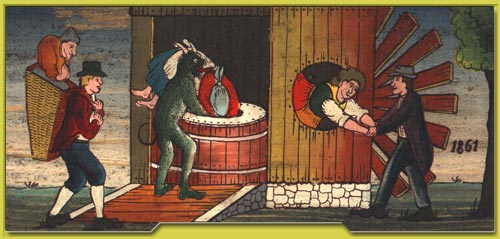
"Bablji mlin", meaning "Granny's mill" scene, Slovenia. An old hag is being milled, and thus transformed, into a young maiden. Winter being transformed into Spring...I talked about this in my post "Babji mlin"...
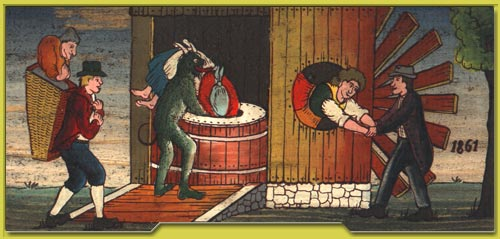

Interestingly, in this version, it's Krampus, anthropomorphised ibex goat, symbol of winter, that does the milling...I talked about this in my post "Krampus"...

BTW, this link between the end of grain and and of winter is spelled out in this Eastern Slavic ritual song was sang by young unmarried women as part of "calling the spring" rituals

Larks, larks, fly away

Take the winter cold away

Bring us spring on your way

We are tired of winter

All our bread she has eaten

I talked about it in my post "Inviting spring"...

We have an obscure version of this ritual in Scotland too, in a Gaelic folk song "The old woman of mill dust". I talked about this in this post.


That the sawing of the old woman is indeed killing of winter can be seen from the fact that in some areas of Italy the effigy of the old woman was filled with fruit and nuts, which were released (grow, become available) when the old woman (winter) gets killed (ends)...

And the reason why this is done in the middle of Lent is because Lent marks the end of winter and beginning of spring...When all the firewood, grain and other food is almost all used up, and it's the last time for the winter to end...Which is why all these magic rituals are performed: to help bring the end (death) of winter (ugly old hag)... 

So that's that. I don't think that the root of the "sawing of the old hag" custom is Roman. I think it is part of the pre Roman, possibly Europe wide agricultural ritual for marking the end (death) of winter (old hag)...

It just so happens (again, no idea why), that the actual explanation of the custom is preserved the best in Slavic folklore...Maybe Slavs are just extremely culturally conservative. 

What do you think? Do you have any info about this or similar custom from any other country?

Monday, 7 November 2022

Living stone

Stone Quarry, painted c. 1919, by Czech painter Josef Ullmann...

In Slovenia in the past, a piece of stone that was cut from the wall of a quarry, had "to calm down", because it had been torn off the "mother's body" and was perceived as still alive for a certain time...

This belief was recorded by an published by Boris Čok in  "Kamnoseško izročilo o znamenjih na portalih in kolonah po Krasu" (p: 106)

But this is not an isolated belief...

Bedrock is in the Balkans known as "živi kamen, živa stena" (living stone, living rock) and is called so, because it is believed to be still part of the living body of the Mother Earth which gives birth to all life (plant, animal, human)...

These types of stones are also known as "Baba" (Grandmother, Mother) stones...

There are many "Baba" rocks and rocky mountain peaks all over Slavic Balkans. This is one of my favourites: Babin zub (Grandmother's tooth) peak, Mt. Stara Planina (Old Mountain), Serbia...

I list a lot of them in my article "Baba, mountains and crags"...If you know of any more, please post name and link to the map location in the comments...

These Baba stones were once venerated by the local transhumance shepherds communities...

For instance on Velebit mountain in Croatia, on arriving to the summer pastures, shepherd women used to bring food offerings and leave them on the "Baba" stone.  They also used to lite candles on the stone on various holy days. The stone was also known as "the altar"...

Many of these old "Baba" stones were later Christianised, by having chapels dedicated to Mother Mary built on top of them...Same thing, different name...Like this one on Veliko Rujno, Velebit, Croatia...

I talked about this in my post "Shepherd's chapels from Velebit"...

This was done because people believed that it was "Baba" (Mother Earth) that controls cold and damp weather...While her husband, Father Sun (Sky) controlled hot and dry weather...

Father above, Mother below...

Looks familiar? I talked about this in my post "Square and compasses"...

Srbska zagonetka: 

Pitanje: Visok otac, široka majka

Odgovor: nebo i zemlja

Serbian riddle: 

Question: Tall (high) father, wide mother

Answer: sky and earth

I talked about this in my post "Riddle"...

Shepherd's in Slovenia also believed that "baba" stones were linked to weather, water, humidity, mud, soil and fertility and pasture abundance...

This bedrock outcrop near the village of Rodik in Slovenia is known locally as "Baba" (Grandmother)... 

Locals believed that "Baba" controls the (bad) weather: Baba’s urine turns to rain, her fart to wind, and when she raises her skirt, the weather gets nice...🙂

And also used to leave offerings on "Baba" stones during their spring ascent to the summer pastures...I talked about this in my post "Gryla"...

I came across this interesting article in Italian, "La leggenda dell’auricorno e la mitologia delle Alpi slovene" about "Baba" folklore from the Alps. 

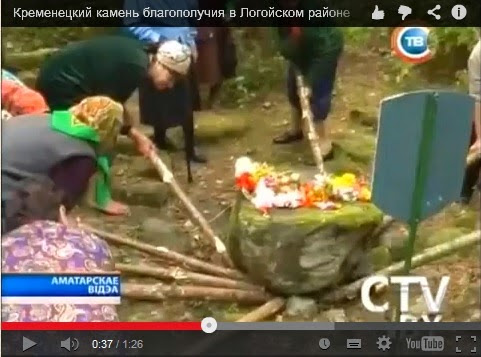
This is why stones are so prominently used in Slavic weather magic...Like here, where women raise "Dabog's stone" during drought to get cool and wet weather...

I talked about this in my posts "Weather stones", "The last megalithic ritual in Europe", "Jupiter from Ibrahimovci", "White cross"...

In South Slavic mythology, it is "Baba", meaning Grandmother, Hag, personification of the winter earth, which causes cold weather...I wrote several blog articles about this character...

"Bablji mlin", meaning "Granny's mill" scene, Slovenia. An old hag is being milled, and thus transformed, into a young maiden. Winter being transformed into Spring...I talked about this in my post "Bablji mlin"...

Interestingly, in this version, it's Krampus that does the milling...Krampus, Goat man, an animal calendar marker for winter...


Why? Because Ibex goats mate and fight during the winter...

I talked about this in my post "Krampus"...

"Bablje Leto" (Grandmother's summer), one of the names for Indian summer (warm dry autumn weather), is another remnant of the Mother Earth cult in European Christianity and European folklore...I talked about this in my post "Bablje leto"...

"Everyone knows that an ordinary bullet can't kill a witch. If you want to kill a witch, load the rifle with 3 grains of wheat and a bit of Easter beeswax candle" - Serbian saying. 

To understand why, replace witch with winter...

I gave the analysis of this proverb in my post "How to kill a witch"...

Slavs equated The Goddess of Death, Morana (mor=death) with The Old Hag, The Winter Earth, Marzana (marz=frost). She is ceremonially burned (warmed) or drowned (thawed) or both (to de sure to be sure 🙂) during Slavic spring festivals...I talked about this in my post "Gryla"...

As part of end of winter, beginning of summer rituals, men and boys blew willow horns  to scare the witch (winter) away...I talked about this custom in my post "May horns"...

Willow being symbol of spring...I talked about this in my post "Willow in Slavic folklore"...

In Cornwall we find the character called "The Old Sky Woman" who controls the snowfall across North Cornwall and children were told when the snowflakes began to fall, the Old Woman was up in the sky plucking her Goose....


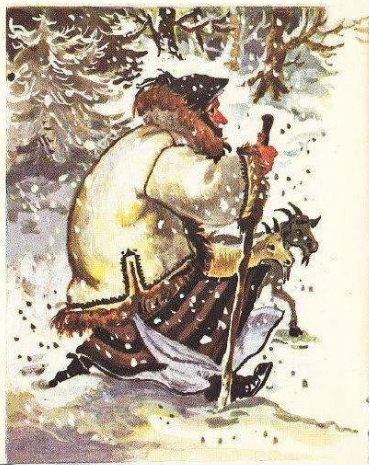
Baba, The Old Hag, The Spirit of Winter Earth...Is also found in Romanian folklore...Just like in Serbian and Slovenian folklore she is associated with goats, calendar markers for winter (🙂)...

I talked about this in my post "Babele"...

In Iceland we find Gryla, who originally was "really a personification of the winter and the darkness and the snow getting closer and taking over the land again"...


Among Kashubians in the Carpathian mountains we find saying: "the old baba (grandmother) went to dance" - when the weather suddenly changes and it starts to snow...

In the Polish Carpathians we find saying: "the baba (grandmother) is already frozen" - the mountain tops are covered with frost or the first snow...

In Gaelic lands of Ireland and Scotland she is Cailleach...

In Italy she is Befana...

In the mountains of Central Europe she is Perchta to Germans or Peruehty to Slavs...

In the North of Germany and in Scandinavia she is "Mother Holle (Hulda) or "Old Mother Frost"...

Interesting, right?

I think so...

Saturday, 18 July 2020

Bannock

In the past, at Imbolc, the first day of Spring according to Gaelic calendar, St Bride's "bannock" or "bonnach" was baked and given to the young girls as a blessing. One was also left outside as a gift for St Bride when she passed in the night to bless all the homes...


In Scotland bannocks were made for Bannock Nicht (aka Shrove Tuesday) from oatmeal, egg, and salt, with the liquid for the mixture being either beef broth or milk. They were called Sautie Bannocks because of the fact that they were baked in the fire and were covered in soot...

Sautie Bannock was made by a single girl who was not allowed to speak. The other girls would try to tease her into speaking. A silver ring was worked into the dough. The cooked bannock was shared amongst the unmarried women and the one who found the ring would get married next...

Bannock or pan bread (pan cake) is the oldest type of bread. The first bread was probably a result of a lucky accident in which a thick porridge dripped on hot hearth stone and was transformed into tasty crispy crust...


Irish and Scottish bannocks are made by virgin unmarried girls. At the beginning of Spring...To mark the arrival of Bride (Biddy), virgin Spring Earth...And these round pan breads, pan cakes when cut into slices look like a shining sun...Interesting...


Even more interesting is that in Scotland bannocks are made not on Imbolc, the first day of Spring according to the Gaelic calendar, but on Pancake Tuesday....At the same time when Slavs celebrate their ancient pan cake (pan bread) festival Maslenitsa (the original Pancake Tuesday)...When they bake and eat round yellow pancakes. Which symbolise the sun...


O yeah and Slavs like eating these sun shaped cakes while burning the effigies of Morena, Marzana (Winter Hag)...


I talked abut this in my article "Gryla"...

This is what these pancakes symbolise: the return of the Sun God Jarilo from the Otherworld which transforms the Ugly Old Barren Hag Winter Earth (Cailleach in Ireland and Morana or Marzana in Slavic countries) into a Beautiful Young Fertile Maiden Spring Earth (Brigid, Bride, Biddy in Ireland and Vesna in Slavic countries)...By warming her up...

Ever wandered why Brigid, who is celebrated at the beginning of spring, is "the fire maiden"? 

Thursday, 9 January 2020

The faceless one

Kostenki is a very important cluster of Paleolithic sites on the Don River in Russia. Dated to after 25 000 BP, these were settlements of mammoth hunters who lived in dwellings made of mammoth bones...

And they loved making "Venus" figurines from mammoth ivory...


The figurines bodies are all anatomically perfect and different, definitely modelled on real probably pregnant women from the community. But they are all the same in one respect: they are all faceless...


In my recent article about faceless "Palaeolithic venus figurines" from Europe I argued that these figurines were deliberately made faceless to emphasise the they were symbols of fertility, of fertile earth, Mother Earth, and not depiction of real women...

I concluded that this was a proof that Palaeolithic people were able to invent, transmit and understand complex symbols and their meanings...

Then someone replied that I was wrong, and that most likely the reason for making these figurines faceless was that there was a taboo on depicting human faces. Considering that we have lots of depictions of anatomically perfect animal faces.

When I replied that we have found both faceless figurines and figurines with perfectly depicted human faces (both male and female) on same archaeological sites, the same person replied that maybe there was a taboo on depicting only the face of the goddess...

This got me thinking. The thing is The Goddess has no face. Fertility, Fertile Earth, Mother Earth has no face. Putting any face on The Goddess would demeen her and "desecrate her" in the most literal sense of this word...

Our Palaeolithic ancestors seem to have understood this.

Our Neolithic ancestors also understood this, as a lot of the early Neolithic Goddess figurines don't even have a head...

Like this one from Tappeh Sarab, Kermanshah ca. 7000-6100 BCE, Iran


Or this one from Cucuteni–Trypillia, 5500-3000 BCE, Moldova, Romania, Ukraine


Those figurines that have heads are either faceless, like this Cycladic female figurine, from Amorgos, 5300 – 3200 BC...


Or look like they have masks over their faces, like this Vinca culture figurine dated to 5000 - 4500 BC.


I talked about these Vinca culture masked figurines in my post "Mask from Belo Brdo".

If you were a priestess playing the role of the Goddess, wearing a mask would transform you in the eyes of the observers from a mare woman to a Godddess personified...

Masked figurine from Gumelniţa culture, 4700BC-3950BC Bulgaria, Romania


This is very important, as we can see soon in this thread...

Of course, there were also figurines which had faces. But most of these were just outlines of human faces, usually just noses on blank face with or without eyes. Like this figurine from Starčevo culture, 6200-5300 BCE, Serbia


But eventually all Goddess (and God) depictions were made with human face.

Why?

Because if the Goddess (or God) has a human face, we can reason with her (him). We can plead to her (him). We can argue with her (him). We can bargain with her (him). We can (try to) cheat her (him)

If you are staring at an expressionless blank face, all you can do is submit and accept your faight...

Interestingly, by the time we get to the Ancient Greece, the only deity still (sometimes) depicted without a face is the dreaded Goddess of the Underworld: Persephone...


Not Hades, the god of the underworld...

Why?

Well, because it is the Goddess, Mother Earth, is the mother who eats her children...And as our return to the Mother who gave birth to us is unescapable, there is no need to put a face on it. We can't plead, argue, bargain, cheat our way out of it...

Believe or not (again) this faceless Persephone could be preserved to this day by Sorbs (Baltic Serbs)...


Every year, just before Christmas, the oldest unmaried girl in a village gets dressed as a "bride", puts on a faceless mask, and visits the houses accompanied (orginally) by two other girls bringing good luck, good fortune and presents. She never speaks...

I talked about this custom in my post "Bescherkind".

She is "the maiden", "the bride", "the giver of gifts" (all epithets of Persephone as Kore, the Young Spring Earth). Her two female companions are most likely the summer and autumn earth, bountiful Demeter, and winter earth, the "old lady", "the witch" Hekate...

But wait, the winter is in Slavic folclore the part of the year rulled by Morana, the Goddess of Death, the old hag...Why do we then have a faceless maiden wander oround villages in mid winter giving presents to little children?

Because Morana (winter), Vesna (spring) and Mokosh (summer, autumn) are just three faces of The Goddess, Mother Earth. In Serbian mythology she is known as Dajbaba (Giving Mother), the wife of Dabog (Giving God, Giving father)...Da+Mater (Give, Allow + Mother in Serbian)...

Morana, believe or not, was by Slavs also imagined as a white maiden.


Her effigies, were ceremonially burned (heating up the earth) or drawned (thowing the earth) at the beginning of February, beginning of Spring...

These effigies were originally made of sheafs of grain over which a white maiden robe was put on. She was often decorated with necklaces made of egg shells...


The meaning of this effigy was: "spring emerging from under the snow (from underworld, dead part of the year, winter)"

And remember how Serbs believe that all good luck, good fortune, good harvest are all the gifts of their dead ancestors. Which is why the dead are majorly spoiled by the living with constant prayers and sacrifices...Especially during the winter. I talked about this in my post "Wolf feast".

So who better to represent this role of the dead, but the "giver of gifts", "giving mother", the faceless Mistress of the underworld, the land of the dead, the dead time of the Year, Persephone...

Persephone, who was to Minoans known as "pe-re-swa" Interestingly (again) "pe re swa" in Slavic languages means "One who was before all others"...

Fitting name for The Goddess, the Mother Earth, the mother of gods, the one who came before all other gods...

But maybe this is just a coincidence...

Thursday, 12 January 2017

Snowdrops


Its this time of the year again. The time when first snowdrops appear out of the snow. In Serbia they are called "visibaba" meaning "hanging granny". They appear at the end of January, beginning of Febrary, which is the coldest part of the year. This is the part of the year ruled by the old white-headed hag, old earth, winter earth, Morana. And they actually look like a bent old hag with long white hair. The appearance of snowdrops at the time when Morana is most powerful signals that her power is beginning to wane. The old white-headed hag, winter earth, is soon going to die and will be replaced by the beautiful young maiden, spring earth, Vesna. 

I have just discovered a very interesting thing. Snowdrops bulbs are poisonous!! They contain galantamine, which is lethal in large quantities but in a small amount is used as a medicine against early Alzheimer's and vascular dementia...

Let me know when you spot the first snowdrop.