Showing posts with label Bronze age. Show all posts

Sunday, 3 March 2024

El Argar culture

The late 3rd millennium BC, was a time of huge upheaval in Iberia. The existing social structures collapsed...When the dust settled, around 2200BC, a new civilisation, known as El Argar culture, emerged in this area...
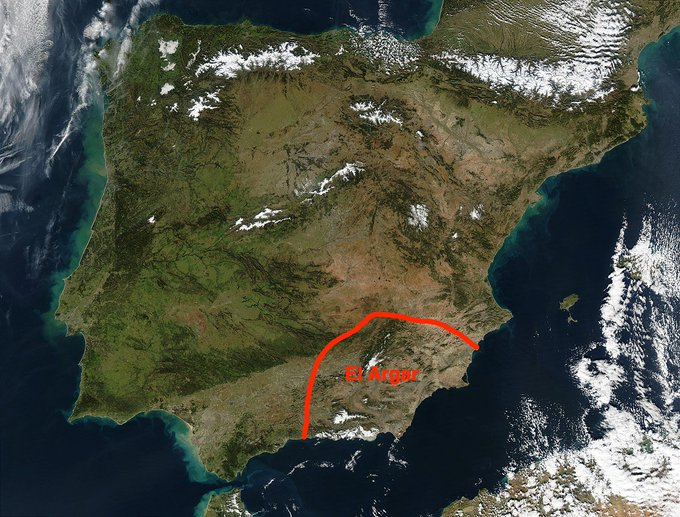
People of this culture built amazing hillforts, like the La Almoloya citadel...Which were at the time also built in Eastern Mediterranean (including Greece)...And nowhere in between...


They were metalworkers and warriors...Who were buried in single graves...Located under the floors of houses...Again feature of the cultures in Eastern Mediterranean (including Greece)...And nowhere in between, and nowhere else in Iberia...

Eventually they started burying their dead in pithoi (large grain jars)...Again feature of the cultures in Eastern Mediterranean (Greece)...And nowhere in between, and nowhere else in Iberia...


This is only possible if there was a direct maritime link between somehow culturally related groups of people in Greece and Southern Spain...We know that these kind of maritime links existed since Neolithic, so no surprises there...I talked about this in my post "Neolithic seafarers"...

BTW, these maritime routes probably facilitated extremely fast spread of Megalithic culture throughout Europe. I talked about this in my post "Childe was right"...And they stayed in use ever since...

You also might want to have a look at this post, "Giants ring", about the arrival of the first farmers to Ireland...By boat of course...

These warriors used deadly halberds as their titular weapons...Warrior grave with halberd...You can read about this in "Halberdiers and Combat Systems in the Argaric" and "The absolute chronology of Argaric halberds"...


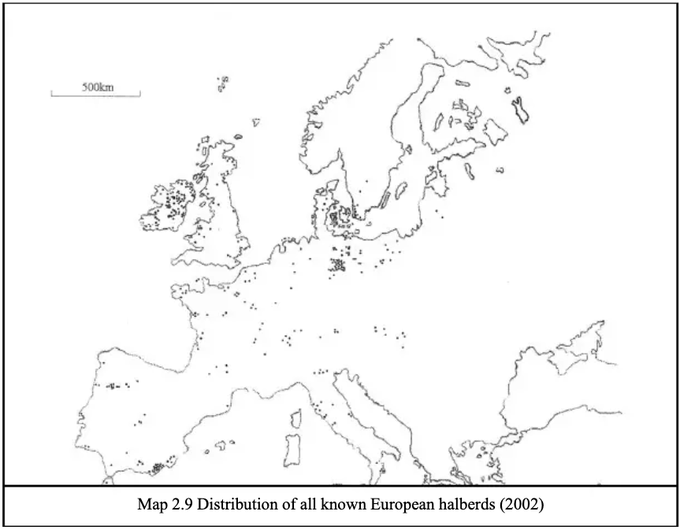
Halberds, the scull slicers I talked about in my post "Halberds" about the reconstruction of the Bronze Age halberds from Ireland, which seem to have been propagated through a maritime trade links going along Atlantic and North Mediterranean coast.

Interestingly, El Argar warriors (apparently) could have been either ruled by women, or there was a group of elite women who could have played some significant role in the society (priestesses)...

Archaeologists came to this conclusion based on the same type of diadems found on the heads of women buried in the El Algar culture graves with extremely rich burial offerings...

For instance, burial from La Almoloya, with remains of a man aged 35-40, and a woman aged 25-30, buried with over 30 prestigious objects, many of which were made or embellished with silver and almost all belonging to the female. Including the diadem...

Hmmm...Bronze Age warrior society with high status women...This sounds so Old Europe...

My favourite bit: El Algar culture marks the beginning of complete male genes replacement in Iberia. All males found in El Algar burials are R1b, Yamna related...

Ancient human DNA from southern Iberia reveals social and genomic changes during the emergence of the Bronze Age in Europe.

Sooo...You know the story about bad macho warrior Indo-Europeans who killed all the peaceful farmer Old-European, and replaced Neolithic matriarchate with Bronze Age patriarchate and ruined everything...Things were a bit more complicated than that, it seems...

But we already saw that Indo-European vs Old-European thing is pretty much dead and buried by genetic data...I talked about this here in my post about Lengyel vs Baden culture...I talked about this in my post "So Indoeuropean"...

So more reason to laugh at the whole Indo-European vs Old-European thingy. BTW, I started laughing here, in my post "Vinca culture fortifications" about Vinča warriors (Army figurine group from Stubline)...

But the important thing for me, is that here again we have proof of long distance maritime links in Bronze Age, this time between Eastern Mediterranean and South Iberia...

Which is important when we know about Irish legends talking about Bronze age immigrants (the guys who brought R1b genes, metalwork, single cyst burials, bling...) arriving to Ireland using this maritime route...
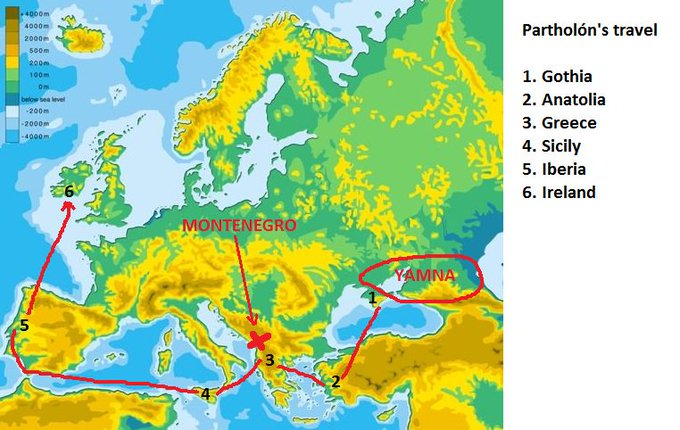

I talked about the Irish oral histories and archaeology which seems to support them in "Montenegrian tumuluses"...

See these gold discs with crosses? These ones are from the Balkans, dated first half of the 3rd mill. BC. They appear in Ireland in the second half of the 3rd mill. BC.


Halberds

One of many Bronze Age halberds found in Ireland...

You know when you were a kid, and you were told that you can't play until you finish your homework? 

This must have been how Ronan O'Flaherty felt when he started work on his archaeology PhD in UCD, Ireland...

The title of his thesis was "The Early Bronze Age Halberd in Ireland - Function and Context" and in it he tried to see if he could disprove this:

"Irish halberds have traditionally been regarded as non functional, ceremonial artefacts. In particular, the mode of hafting and the slightness of the haft head have been cited as reasons why this artefact could not have been put to any practical use"...

I know that all he wanted to do was: 

1. Cast replicas (Left) of the Bronze Age halberds from the National museum (Right), using the same copper with a very low arsenic level of 0.2%, and without cold-hammering or sharpening of the blades...


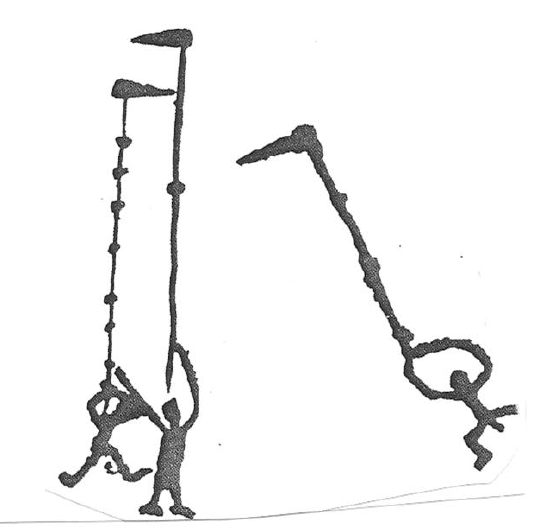
2. Haft the halberd replica (Left) based on rock carvings from Mt. Bego, Italy (Right), showing people using (well at least holding high above their heads) the original Bronze Age halberds...


3. Whack some sculls, of the same strength as human sculls, like sheep ones, repeatedly, with the replica halberds, to see what happens...

But before Ronan could do all this fun stuff, he had to do the homework...He collected all the available data about all the so far discovered European Bronze Age halberds...


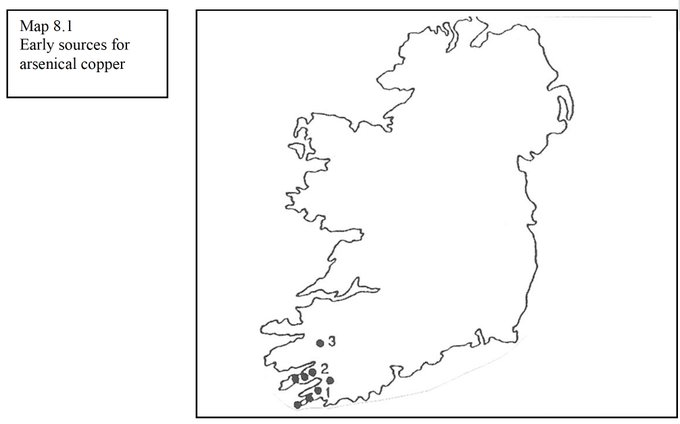
He then investigated the Early Bronze Age mining and metalworking industry in Ireland and the type of metal and metal artefacts produced during that time, so that he could try to replicate the material and the production of the Bronze Age halberds as closely as possible...

Then he investigated the hafting of Bronze Age halberds...


And finally the use of halberds in battle (from available medieval sources)...

Once he did his homework, Ronan went out to play...

And this is his report:

The replica halberd...revealed itself to be a frighteningly effective weapon, slicing skulls open with disturbing ease and proving very comfortable to handle. A short (couple of feet) chopping blow, was sufficient to pierce the skull, often very deeply indeed...

[The weapon would have been even more efficient] "if it was used by an expert", and "if it wasn't for a certain 21st century distaste of committing such violence in the first place"...Love this 🙂

Repeated blows against twenty sheep skulls, of similar strength to a human skull, failed to inflict all but the most minor damage to the halberd and there was no indication that it could not continue in such use for a prolonged period of time.

The small rounded end of the blade ensured that the full force of the blow is administered to a tiny area of the skull first, virtually guaranteeing a puncture each time.

The fact that the end of the blade was rounded rather than brought to a sharp point added strength to this area, which otherwise might have bent or even snapped on first impact.

This suggests that the blade was designed for impact on bone rather than muscle, where a sharp pointed weapon would seem more appropriate than a blunt-nosed one.

Ronan conclusion: There is no doubt in my mind that the Irish halberd is very carefully designed as a most effective weapon. [Maybe not all] Irish halberds were used in this way, but they certainly could have been and it certainly appears to be the basis for their design.

In addition, the replica halberd survives in a condition which I would categorise as "perfect" in a museum example, suggesting that even these perfect halberds could have seen some use.

Ronan's papers:

"The Early Bronze Age Halberd in Ireland - Function and Context"

"Up close and personal - impact damage on Irish helberds"

To me, most interesting bit of his work is found in boring homework section: the distribution of high concentration halberds sites  indicates that they were connected by a well established maritime trading route...

Central European Unetice culture was built around navigable rivers which empty into Baltic sea...From there you can navigate around Scotland to Ireland, Wales and England and along the French coast to Brittany, and then to Iberia, Italy, Greece...

I can bet that all the other inland sites with halberds lie on navigable rivers which empty into the seas along this route...

The existence of maritime trading routes along Mediterranean and Atlantic coast has been attested since Neolithic. 

And it was always linked with mining, first for material for stone tools and weapons and then metal for metal tools and weapons...I talked about this in my post "Neolithic seafarers"...

These maritime routes probably facilitated extremely fast spread of Megalithic culture throughout Europe. I talked about this in my post "Childe was right"...

I think this is very very interesting...Particularly when we look at the Irish oral histories, first time recorded in Medieval time, which talk about the existence of such maritime routes along Mediterranean and Atlantic coast during Bronze Age...

I talked about the Irish oral histories and archaeology which seems to support them in the posts linked from this jump page "Montenegrian tumuluses"...

That's it for today...

Saturday, 4 November 2023

Vučedol dove

How old are "Ancient Greek" myths? And are they "Greek" in origin? Like the myth about Hephaestus, the lame/limping Smith God and his wife, the goddess of love and beauty, Aphrodite? 

Why do I ask?

This is the so called "Vučedol dove"...
This figurine, is one of the most well-known objects from Vučedol culture, a  Chalcolithic/Bronze Age culture which flourished in the Balkans between 3000 and 2200 BC, and was contemporary with Sumerian Mesopotamia, Early Dynastic Egypt and Troy I/II.


Vučedol Culture was a metallurgical culture which made bronze objects on an industrial scale. The bronze made by Vučedol Culture smiths was arsenic bronze, the most primitive form of bronze, and most dangerous, if you are a smith...


Arsenic is extremely poisonous, and it gets released into the air from the molten metal in a form of toxic fumes. The first sigh of arsenic poisoning is the loss of the sensation in the legs, which then expands throughout the body and finally leads to death...

Therefore forging this metal was a dangerous job. But if you got out of your workshop on time, then the danger passed, although limping due to loss of sensation in the legs remained for some time...

Sounds familiar so far? We have a lame, limping smith...who had a figurine of a dove in his blacksmith workshop (this is where Vučedol dove was found)...

So???

Well dove is the bird of Aphrodite...Who was married to a lame/limping Smith God Hephaestus...

So, is it possible that this is an indication that some kind of mythological, symbolic link between lame limping smiths and doves, a precursor of the Lame/Limping Smith God/Love Goddess mythology, existed in the 3rd millennium BC Balkans?

I think so. But there is more...

Recently, some archaeologists proposed that this figurine does not depict a dove, but instead it depicts a partridge, and so should be known as not as "Vučedol dove" but as "Vučedol partridge".

Native Balkan dove


Native Balkan partridge


You can see how it can be difficult to determine which one of these two birds was depicted...

These archaeologists draw the link between limping smiths and male partridges, because when a predator manages to find a partridge nest, male partridge will draw the predator from the nest by running away from the nest pretending to limp, acting as if they are wounded...

Interesting...

Hephaestus, the smith, was a lame, limping Smith God.

The sister of Daedalus, the smith, is called Perdix (partridge) and her son, who became Dedalus's student was also called Perdix (partridge)...

Some say that Deadalus's student's name was Talos and that Perdix (partridge) was the name of Talos's father. Talos was such a good smith himself, that Daedalus, in a jealous rage, threw him off the rock of the Acropolis at Athens...

But Athena intervened and turned Talos/Perdix into a partridge to save his life. According to Ovid, that partridge later watched the death and burial of Daedalus’s son Icarus with glee...

Hephaestus limped like a partridge and was flung from Olympus...

Talos/Perdix (partridge), whose father was "Perdix" (partridge), and whose nickname was "Tantalus" (hobbling, or lurching), was flung from the Acropolis and was turned into a partridge...

So, we have either

1. A lame/limping Vučedol culture smith and "Vučedol dove" = Hephaestus and Aphrodite
2. A lame/limping Vučedol culture smith and "Vučedol partridge" = Hephaestus and Talos

Or both...

That's it folks. Cool, right? 🙂

Tuesday, 7 February 2023

Bronze Age tin sources in Serbia

Tin is a silvery, malleable metal. It became super important when it was discovered that when mixed with copper, it turns soft copper into hard bronze...

What is interesting is that silvery tin is obtained chiefly from the mineral cassiterite, which is black.

Cassiterite often accumulates in alluvial channels as placer deposits in granite. These deposits can be easily seen in river banks, a feature exploited by early Bronze Age prospectors...


The first evidence of tin use for making bronze appears in the Balkans in mid 5th millennium BC.  According to "Tainted ores and the rise of tin bronzes in Eurasia, c. 6500 years ago", the earliest tin bronze artefacts in Eurasia have been discovered in Pločnik, a Vinča culture site in Serbia.

The discovery prompted a reassessment of 14 other early tin bronze artefacts from the Balkans. Apart from Vinča culture sites (Serbia), tin bronze objects were also found in Karanovo-Gumelnita culture sites (Bulgaria) and Gradesnica-Krivodol culture sites (Bulgaria and Romania).

Now these bronzes were not made with cassiterite, but with another tin mineral, stannite. The source of stannite in these early Balkan bronzes is still a mystery...(Last time I checked)


Serbia remained an important metallurgical centre throughout bronze age. Serbia is full of copper. The problem was that until recently, no one knew where the tin for making bronze came from...

However, some geological studies done in Serbia in late 70s and early 80s, stated that alluvial cassiterite deposits were discovered in Cigankulja granite area of western Serbia...Specifically along Milinska reka (Milinska river)

Newer studies

"Placer Tin Ores from Mt. Cer, West Serbia, and Their Potential Exploitation during the Bronze Age"

and

"Tin sources and settlement in the Bronze Age of south-eastern Europe: a pilot study from western Serbia"

show that the area of western Serbia was actually the most significant source of the alluvial tin in the south of Europe during Bronze Age.


5 bronze age forts was discovered in the area:  Spasovine, Likodra, Mali Gradac, Kruglić and Crkvine. The locations of all of the sites indicate a possible connection with tin sources...

This part of Serbia was densely populated during the entire Bronze Age, which can be seen by many tumulus graves excavated in the area...Unfortunately the settlements in the area are far less explored (read almost not at all)...

Hmmm...Some research seem to have been done in the area...

One of the sites, Likodra, actually dates from Eneolithic, from Vinča culture. You can read about it in "Excavations of the Site Ostenjak in the Village of Likodra Near Krupanj"

Anther paper about excavations in the tin ore area is "New archaeological research in the Jadar region of West Serbia, 2010 and 2011"...

And this is super cool 🙂 (I am such a nerd) Experimental archaeology at its best. Extracting cassiterite (tin ore) from the Milinska river sands in the area where the remains of the primitive tin smelting furnaces from late antiquity were found...

Experiment showed that the amount of tin found in the sand was dependant on water level and where the biggest during high water levels. Logical, as tin was literally washed away by the rivers from the deposits 40 km upstream...

Which means that alluvial tin extraction was a seasonal activity. Which explains why there were no permanent settlements in immediate vicinity of the river...

Anyway, lots more cool things (like experimental smelting of tin, copper and making of bronze using replicas of smelting facilities discovered across the Balkans) 

can be found in the article: "Jadar: Preliminarni rezultati kampa nje 2017. godine"

From one more interesting paper "Provenance of Tin in the Late Br enance of Tin in the Late Bronze Age Balkans: Pr e Age Balkans: Preparation of ation of Cassiterite for Sn Isotope Analysis and the Probabilistic and Spatial Analysis of Sn Isotopes": Bronze Age sites with some fragments of crucibles with metal-bearing vitreous coatings occur on the river terraces adjacent to the tin bearing Milinska and Cernica rivers on the southern flank of Mt. Cer, indicating on-site exploitation of tin...

Based on isotopic analysis Mt. Cer and Mt. Bukulja were the source of the tin ores used in the Balkans (below Sava and Danube) during the Late Bronze Age... 

Monday, 25 October 2021

Tarim basin baby bottle

This infant died when he or she was less than a year old. Dark blue stones covered its eyes, and red woolen yarn was inserted into its nostrils. The infant was buried with a cow horn tip and a bottle made from a sheep’s udder...


This well-preserved infant mummy, was discovered in the cemetery of the Qizilchoqa settlement about 60 km west of Qumul (Hami), an important, old Silk Road town in the far eastern portion of the region. It was dated to ca. 1200 BC...


More info in the "Ancient mummies of the Tarim Basin" and "The mummies of East Central Asia"

It is one of hundreds of Bronze and Iron Age caucasian (European) mummies discovered in deserts along the Silk Road in Central Asia and Northern China...

Now, these are ceramic decorated horns found in infant graves of the Central European Bronze Age Encrusted Pottery culture (2000-1500BC). 

I talked about them in my post "Baby milk horns"...

Why were these horns placed in infant graves? To provide them with drink in the otherworld...How do we know this?

We know this because Encrusted Pottery culture people buried their dead with age appropriate "grave goods": big ceramic pots for adults, small ceramic pots for children and ceramic horns for babies...

I talked about this in my post "One for the road"...

And because of the ancient belief that the otherworld is "a thirsty place"...And because in Central Europe, making sure the dead have enough water in the otherworld is still seen as an imperative... I talked about this in my post "Thirst"...

Have you ever thought about how did our ancestors arrive to the idea that the otherworld was a thirsty place? Or maybe it is better to ask where and when did our ancestors arrive at the idea that the otherworld was a thirsty place?

I am thinking...

Sunday, 23 May 2021

Torine katun

Transhumance is the seasonal movement of people with their livestock between fixed summer and winter pastures. In mountainous regions like Montenegro, it implies movement between higher pastures in summer and lower valleys in winter. 


In many languages there are words for the higher summer pastures, and shepherds summer camps built on them, and frequently these words have been used as place names. In the Balkans these words are Katun, Stan, Bačija, Torine...I talked about them in my article "Katun"...


In this article I would like to talk about one of these transhumance shepherds summer camps, Torine, which could just be one of the most important archaeological sites in Montenegro, and possibly one of the most important archaeological sites in Europe...

The archaeological site covers a small plateau 150X50 meters which was on the lower side fortified with a stone wall. 


The plateau is located in the Radman gorge 


The archaeological site was discovered by chance, when local villagers tried to widen the road that passed by the plateau, and in process bulldozing away half of the site


Luckily, while pushing through the site, the bulldozers unearthed several skeletons, and the locals thought they better call the police. 


Who called the archaeologists. The archaeologist who came to examine the site was Predrag Lutovac from Polimlje museum.


Archaeologists determined that the skeletons belonged to the people buried on the site during medieval time. 

Then they started opening exploratory trenches and what they discovered was pretty astonishing. One and a half meters of soil contained occupational layers from the end of the 5th millennium BC to medieval time...


The fact that the cultural layers were very thin and very rich in mobile artifacts, indicates that it was a seasonal shepherds summer settlement, Torine... 

According to Predrag Lutovac, the earliest layer located at the depth of only one meter and twenty centimeters, is Vinča cultural layer, from the Vinča-Pločnik phase, dated to the second half of the 5th millennium BC...This is where archaeologists discovered this figurine of a nude woman with a realistically represented torso and a pentagonal head characteristic of the Vinča culture. 


Trnje near the village of Bijedići which contained few dozen houses...
Beran-krš near Berane, which consisted of about twenty houses. 

Both settlements are believed to have existed from Late Neolithic through Copper Age and into Early Bronze Age period, from 4,500 to 3,000 BC.

Now the above figurine from Torine is similar in shape to the late Vinča culture figurines found in Kosovo, at Fatos and Predionica sites. But while the Vinča culture figurines found in Kosovo are dressed and or have painted decorations, the figurine from Torine is naked and has no decorations at all much like later Bubanj-Hum culture figurines...


This earliest Neolithic Vinča layer is followed by a mixed layer of late Neolithic Vinča culture mixed with the early Copper and Bronze Age Bubanj-Hum culture from Serbia and Mediterranean Copper and Bronze Age cultures, like Nakovana culture. 

These three cultures seem to have peacefully coexisted and merged into a new South Balkan Bronze Age cultural group, that covered huge area of Eastern and Southern Serbia, Kosovo, Montenegro, Croatia and Albania... 


This culture must have had a stronghold in northern Montenegro, because the area is full of Early and Middle Bronze Age fortifications: Tumbarice in Donja Ržanica, Gradac in Budimlja, Pećina grad in Radmanska klisura near Petnjica, gradina Bihor, Samograd in the village of Brzava near Bijelo Polje, Gradac above Godočelj near Petnjica, Gradac in Crnčia near Bijelo Polje, Jerinin grad in Plav, Gradina above the village of Šabotići, Gradina in Korita and Gradina above the village of Muslić.

It is in this Bronze Age layer of the Torine site, at the depth of half a meter, that archaeologists had unearthed a base of a Bronze Age house dated to mid 2nd millennium BC. 

Inside of this Bronze Age house, archaeologists discovered a large number of fully intact ceramic dishes, bone tools, pickaxes made of deer’s antlers, needles, bradawls, studs...All located around a central fireplace. 


A wolf’s teeth necklace was also discovered, showing that here already we have the some form of the wolf cult, not surprising considering that wolves are shepherds main worry in the mountains. After the weather.


Extremely interesting discovery at Torine was a mold for making bronze daggers of the type discovered in Momišići and other Copper and Early Bronze Age tumulus graves, located in the lowlands of the souther Montenegro. 


According to Lutovac this is another proof that Torine was a seasonal summer camp used by people who spent winters in Momišići....


Soooo why is Torine so important? You mean apart from the fact that this is a site used pretty much continuously as a summer camp by transhumance shepherds for 5000 years? Transhumance shepherds which were descended from Vinča people...

Torine site shows that when Vinča culture collapsed at the end of the 5th millennium BC, Vinčans didn't disappear into thin air. We know that some of them contributed to the development of Late Neolithic early Copper Age cultures in the Danube catchment area to the north of the old Vinča territory....

But it seems that at least some of them moved into the highlands to the south of the old Vinča territory and continued living there...And they mixed...And they got influenced and they influenced the seafaring cultures of the Eastern Adriatic coast...

I talked about them in my post about Nakovana cave in Croatia and the Neolithic seafarers...

These are the guys who sailed and traded all along the northern coast of the Mediterranean sea. All the way to Iberia...And beyond? To the Atlantic coast...Ireland???

All of which resulted in the development of some very very interesting Late Neolithic, Early Copper Age links between Montenegro and Ireland...

In my series of articles about Montenegrine tumuli, I showed that archaeological finds from both Montenegro (just south of Pelješac peninsula where Nakovana cave is located) and Ireland, point at a strange link between Copper age Montenegro and Ireland, and indicate that the copper age could have been brought to Ireland by people who arrived there from Montenegro...


And guess what: the Irish legends, which were first time written down during early medieval time, say that the first farmers, miners and metalworkers arrived to Ireland by sea from the Balkans, via Sicily and Iberia...

This voyage, according to the Irish Annals, took place during the 3rd millennium BC...Of course every historian and archaeologist in the world dismissed these legends as "pseudo history"...No one was able for such maritime voyage at that time...Hmmm.....


But, some of these cultural similarities between Ireland and the Balkans predate the Copper Age, and fall right into the Late Neolithic period between disappearance of Vinča culture and the appearance of the Yamna people in the Balkans...And they have a very strange "Vinča" undertone...Which I couldn't explain, because of the time gap of a 1000 years between the disappearance of Vinča culture and the appearance of Vinča like artifacts in Ireland...Until now...


This is Newgrange, a prehistoric monument in County Meath, Ireland, located about one kilometre north of the River Boyne. It was built about 3200 BC. 

This is Newgrange entrance before excavation and renovation. You can clearly see the carved stone standing in front of the entrance. 


This is what Newgrange entrance looks like now. The carved stone is still standing in front of the entrance into the tumulus. 


Why is this stone placed in front of the entrance and what does this stone represent?

I believe that this stone is a huge votive bread. It is placed in front of the entrance of the tumulus, because this entrance represents vulva and vaginal opening of the mother earth. As I said I believe that Newgrange was designed to represent pregnant mother earth in a shape of a pregnant woman's belly together with reproductive organs. And as pregnant women give birth to babies through the vaginal opening, to continue with the symbolism, this votive bread was placed in front of the entrance (which is in this case viewed as exit) to symbolise mother earth giving birth to bread. And to give mother earth a hint how much bread we want her to give birth to. A lot.

Why do I think that this stone represents votive bread. Well have a look at these two pictures:

Entrance stone, with carved diamond and spiral ornaments, Newgrange, Ireland, 4th millennium BC:


Ritual clay votive bread with carved diamond and spiral ornaments, Potporanj - Kremenjak, Serbia, Vinča culture, 5th millennium BC, currently in Vršac museum. Quite a few of these ritual clay breads were found in Vinča sites, and they all have these types of decorations: 


From my post "Newgrange" and "Can you see me" 

Also this

Here are some examples of the so called "carved stone balls" from Scotland, dated to the beginning of the 4th millennium BC:


At least 1000 years earlier, in Serbia, people from Vinča culture made very very very similar objects from burned clay which they wore as amulets.

This one is from Vinča Beli Breg settlement near Belgrade


And then we have this: Knowth tumulus complex, in the Boyne Valley, also dated to the beginning of the 4th millennium BC...


And this one of the two miniature carved stone ball bead found under the Mound 1 at Knowth...


They were published in 1986 (Eogan 1986, fig. 21) but their significance has not been appreciated until 2011 when professor Alison Sheridan, during her visit to Dublin, saw them and realized that they were miniature versions of a very distinctive type of artefact well known from Neolithic Scotland – the carved stone ball...And a copy of Vinča objects...

I wrote about these objects in my post "Clay balls - stone balls"...

As I said I couldn't explain the almost 1000 years between the Balkan objects and Irish objects mentioned above...But now that we know about the Montenegrin settlements which span period 4500-3000BC and link between Vinča culture and the Late Neolithic and Copper Age cultures of the Mediterranean....