Showing posts with label Serbian archaeology. Show all posts

Tuesday, 5 March 2024

Prince Stefan Prvoslav

This is the Church of the Đurđevi Stupovi Monastery in Berane, Montenegro. 

It was built in 1213 as a memorial to the Serbian Prince Stefan Prvoslav, whose grave is in the nave...His grave slab is decorated with a very interesting symbol: triskele of Celtic Scordisci type.


The Scordisci were a Celtic Iron Age cultural group centered in the territory of present-day Serbia...From the 3rd c. BC until the 1st c. AD they ruled over a tribal state which at its zenith also included parts of Croatia, Bulgaria and Romania...

During the 3rd and 2nd c. BC they successfully fought Romans in the Balkans. You can read more about this on the Balkan Celts blog... 

Lucius Annaeus Florus in his Epitome  XXXVIIII (The Thracian War), says about them: "The cruelest of all the Thracians were the Scordisci...their haunts among the woods and mountains..."

They are the guys who lived in the fortress on Veliki Vetren peak on Mount Juhor, Central Serbia...
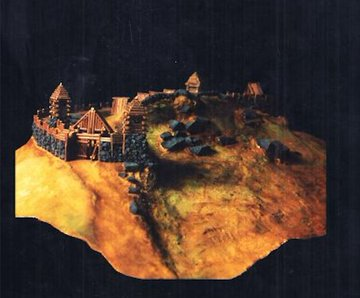

"14 horsemen came down from Devil's Town on Veliki Vetren peak, Serbia, on foggy nights and abducted young girls, croaking like Ravens" (Local legend). 14 sets of cavalry equipment were found in the Celtic opidium on Veliki Vetren peak 🙂 

Where this button was found...With the identical triskele symbol...

From my post "Veliki Vetren"...

During the 1st c. BC their power begins to weaken and eventually they were crushed in 15 BC by Tiberius, and became Roman subjects, after which they started fighting for the Romans as mercenaries...

After the Roman conquest in the 1st century AD, their territories were included into the Roman provinces of Pannonia, Moesia and Dacia. 


Strabo's Geographica (20 BC–23 AD) says that "the Major Scordisci, lived between moths of Sava and Morava rivers (Serbia)"...

So what happened to Scordisci after they became "Romans"? Well they stayed in the Balkans...And most likely became one of (many) Serbian ancestors...Look at Serbian genes...

Is this why Serbian Prince Stefan Prvoslav has a Scordisci triskele on his grave slab? Or maybe this is just a meaningless squiggle...

BTW, do you remember my post "Death of Prince Marko" about Celtic style "ritual killing" of weapons during warrior funerals, depicted in Medieval Serbian folk epic poems? 
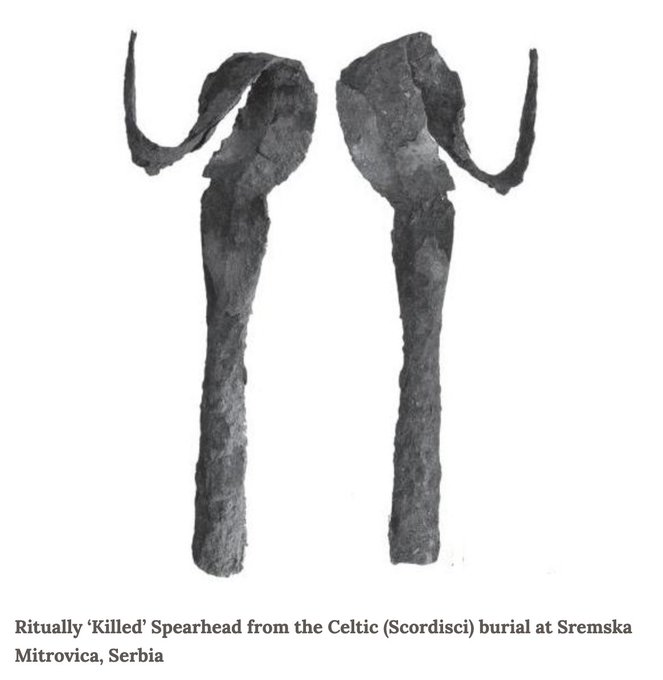

More about Scordisci can be found on this great site "Balkan Celts, Journal of Celtic Studies in Eastern Europe and Asia-Minor"

But I don't think you will find anything there about Serbian Prince Stefan Prvoslav's grave...

PS: By @LazarStojkovic

And let’s not forget this…

In “Red and White: Serbian-Celtic Parallels" (In Serbian), the late Serbian linguistic scholar, Celticist, and academician Professor Ranka Kuić identified ~600 words shared between Welsh and Serbian.

For comparison, that’s about 10x the number of words shared between the languages considered to be the members of the Finno-Ugric language group...

Tuesday, 7 February 2023

Bronze Age tin sources in Serbia

Tin is a silvery, malleable metal. It became super important when it was discovered that when mixed with copper, it turns soft copper into hard bronze...

What is interesting is that silvery tin is obtained chiefly from the mineral cassiterite, which is black.

Cassiterite often accumulates in alluvial channels as placer deposits in granite. These deposits can be easily seen in river banks, a feature exploited by early Bronze Age prospectors...


The first evidence of tin use for making bronze appears in the Balkans in mid 5th millennium BC.  According to "Tainted ores and the rise of tin bronzes in Eurasia, c. 6500 years ago", the earliest tin bronze artefacts in Eurasia have been discovered in Pločnik, a Vinča culture site in Serbia.

The discovery prompted a reassessment of 14 other early tin bronze artefacts from the Balkans. Apart from Vinča culture sites (Serbia), tin bronze objects were also found in Karanovo-Gumelnita culture sites (Bulgaria) and Gradesnica-Krivodol culture sites (Bulgaria and Romania).

Now these bronzes were not made with cassiterite, but with another tin mineral, stannite. The source of stannite in these early Balkan bronzes is still a mystery...(Last time I checked)


Serbia remained an important metallurgical centre throughout bronze age. Serbia is full of copper. The problem was that until recently, no one knew where the tin for making bronze came from...

However, some geological studies done in Serbia in late 70s and early 80s, stated that alluvial cassiterite deposits were discovered in Cigankulja granite area of western Serbia...Specifically along Milinska reka (Milinska river)

Newer studies

"Placer Tin Ores from Mt. Cer, West Serbia, and Their Potential Exploitation during the Bronze Age"

and

"Tin sources and settlement in the Bronze Age of south-eastern Europe: a pilot study from western Serbia"

show that the area of western Serbia was actually the most significant source of the alluvial tin in the south of Europe during Bronze Age.


5 bronze age forts was discovered in the area:  Spasovine, Likodra, Mali Gradac, Kruglić and Crkvine. The locations of all of the sites indicate a possible connection with tin sources...

This part of Serbia was densely populated during the entire Bronze Age, which can be seen by many tumulus graves excavated in the area...Unfortunately the settlements in the area are far less explored (read almost not at all)...

Hmmm...Some research seem to have been done in the area...

One of the sites, Likodra, actually dates from Eneolithic, from Vinča culture. You can read about it in "Excavations of the Site Ostenjak in the Village of Likodra Near Krupanj"

Anther paper about excavations in the tin ore area is "New archaeological research in the Jadar region of West Serbia, 2010 and 2011"...

And this is super cool 🙂 (I am such a nerd) Experimental archaeology at its best. Extracting cassiterite (tin ore) from the Milinska river sands in the area where the remains of the primitive tin smelting furnaces from late antiquity were found...

Experiment showed that the amount of tin found in the sand was dependant on water level and where the biggest during high water levels. Logical, as tin was literally washed away by the rivers from the deposits 40 km upstream...

Which means that alluvial tin extraction was a seasonal activity. Which explains why there were no permanent settlements in immediate vicinity of the river...

Anyway, lots more cool things (like experimental smelting of tin, copper and making of bronze using replicas of smelting facilities discovered across the Balkans) 

can be found in the article: "Jadar: Preliminarni rezultati kampa nje 2017. godine"

From one more interesting paper "Provenance of Tin in the Late Br enance of Tin in the Late Bronze Age Balkans: Pr e Age Balkans: Preparation of ation of Cassiterite for Sn Isotope Analysis and the Probabilistic and Spatial Analysis of Sn Isotopes": Bronze Age sites with some fragments of crucibles with metal-bearing vitreous coatings occur on the river terraces adjacent to the tin bearing Milinska and Cernica rivers on the southern flank of Mt. Cer, indicating on-site exploitation of tin...

Based on isotopic analysis Mt. Cer and Mt. Bukulja were the source of the tin ores used in the Balkans (below Sava and Danube) during the Late Bronze Age... 

Thursday, 4 March 2021

Monastirište


Are local legends true? And is Monastirište, a plateau in Crna Trava area of Eastern Serbia, which has always been treated by the local villagers as a sacred place, rally the location of an Early Christian monastery?

Well yes 🙂 The geophysical data showed the church walls at the depth of 2,8 meters and many other walled structures located even deeper... 

Short documentary in Serbian:

I just love the fact that archaeologists get "surprised" every time they find an ancient fortress at the place local villagers call "gradina" or "gradište" or "grad" (all meaning city, fort, place where city, fort once stood)...

Or when they find an ancient church or monastery at the place which local villagers call "crkvina", "crkvište" (both mean church, place where church once stood) or "manastir", "manastirište" (both mean monastery, place where monastery once stood)...

Saturday, 27 February 2021

Until all this sh*t blows over

Bronze sickle, hollow axe and spearhead, late Bronze age – early Iron age, around 1200-900 years BC, part of hoard of metal objects found in Serbia. Collection of National Museum of Serbia in Belgrade...

Hoards of bronze objects are very common finds from the period of transition from Bronze to Iron age in the Balkans, and they contain variety of metal objects, weapons, tools and jewellery...

They are considered to be wealth deposits hidden from the dangers of war, hoards containing objects belonging to an entire community or votive hoards with objects pledged to a deity...But there is another explanation...

Balkans was a major metallurgical centre during the late Bronze Age. Metal was mined, smelted and cast into objects destined for the rich Mediterranean market...Which collapsed around 1200...

The metal hoards found in the Balkans almost all date to that period...All this merchandise and no customers...The best thing Balkan metalworkers could do with all this, now worthless stuff, was to burry it "until all this shit blows over"...

Which took few hundred years...By which time iron was all the rage...

BTW, here is an article about the evolution of sickles, from animal jawbones, through animal jawbones with stone teeth and wooden animal jawbone like thingies with stone teeth and stone animal jawbone like thingies to metal animal jawbone like thingies... 


Friday, 5 February 2021

Ring with anchor and fishes

The ring, found on the hand of the buried person, in an intact early Christian grave from the start of the 3rd c. AD, found in graveyard of the Roman city of Viminacium, Serbia. Engraved with early Christian symbols, cross-like anchor and two fish...

Roman bronze coin was placed on a chest of a deceased. It was minted by the emperor Caracalla, in the early 3rd c. AD. 


Apart from the ring and the coin, the grave also contained a bronze compasses. Ring and possibly compass are suggesting that person buried in this grave was important figure in early Christian community in Viminacium.

Just so people understand why the archaeologists are so excited about this find and why they believe it was a christian burial. Christian graffiti, fish, anchor and compasses, from the Catacombs of Saint Domitilla in Rome 

Compass is sometimes used as a symbol of the Creation, and sometimes, especially in the Medieval period, God was shown with a compass in his hands, measuring the world that has just been created...For instance: The Frontispiece of Bible Moralisee, 13th c.

By the way, do you know that for measuring the heavenly dome you need compasses and for measuring the earth which lies underneath you need square? I talked about square and compasses, the tools of God, the Great Architect in this post...And about the origin of this symbol in Mesopotamia in this post...

Anyway, the discoveries from the last few years are showing that significant early Christian and Gnostic communities existed in the 2nd and 3rd c. AD in Viminacium, capital of Moesia Superior, a fortified Roman city which had around 30 000 inhabitants...

Site of Viminacium covers area of 450 hectares, and so far, only 2% have been excavated. Archaeologists say that there is enough material for the next 300 years of digging and exploration...

More than 14 000 graves and tombs with more than 30 000 interesting and valuable grave goods inside them have been found at Viminacium necropolis, which makes it the largest Roman cemetery in the world...

Unfortunately, most of Viminacium’s remains were found at the foot of a massive coal-fired power station and above the coal mine deposits, and archaeological excavations are hurriedly carried out before new units of the plant and intensive coal mining devastate this ancient site.

What these discoveries are proving is that Balkans was a centre of Early Christianity. When Serbian archaeologist Djordje Jankovic claimed the same thing years ago, he was ridiculed...But now his claims are being vindicated...

Jankovic based his claims on the discovery of these two 1st c. AD bronze rings, with engraved fish, good shepherd and palm branch! 

These are the oldest christian rings found so far. They were found in Židovar, an archeological site near Vršac, Serbia. I talked about this in my post "Church on threshing floor" 

Interestingly, Slavic legends claim that "Slavs were Christianised in the Balkans by St Paul". 

Which places Christian Slavs in the Balkans in the 1st c. AD...I talked about this in my post "St Paul among the Slavs"...

So were there any Slavs among the Christians from Viminacium?

Monday, 1 February 2021

Sun on top of pyramid

In 2017, after the discovery of a strange trapezoid Natufian culture "shrine" (L) with paved floor and central hearth:


I wrote an article asking is there a link between it and and Lepenski Vir trapezoid houses (R) with paved floors and central hearths...

As a link I proposed Pre Potery Neolithic A and B cultures of levant, which were established by the descendants of the Natufians...

They, just like Lepenski Vir people buried their dead under the floors of their houses. And they plastered the heads of their ancestors, and displayed them in their settlements...

Well Lepenski Vir people made stone heads and displayed them in their settlements...

Well, I just found out today that it seems someone else pointed at possible link between Lepenski Vir culture and Pre Pottery Neolithic Levant cultures. In 2007...

Dusan Boric from Columbia University. In his article "The house between grand narratives and microhistories: a house society in the Balkans" he says that:

And then

And that's all 10 years before the discovery of the Natufian trapezoid "shrine"...You should read his article. It's an interesting one. The archaeologists who excavated Lepenski Vir, believed that the trapezoidal houses developed from shrines and were sacred "house-shrines"...

They believed that the people from Lepenski Vir built their houses to resemble the rocky outcrop, cliff, hill, called Treskavac, which is clearly visible from the settlement site...


The hill looks like a flat top pyramid. The houses look exactly like the hill. They are equilateral triangles with the cut off top...

But why would anyone bother building houses that look like a hill? Because every summer solstice, at sunrise, if you stand at the Lepenski Vir site, you see this. The sun on top of the pyramid...

I mean that will leave an impression, right? Now we are talking about 6300-6000 BC...And people in the Balkans being obsessed with sun on top of a pyramid. So much so that they built house-shines in its liking...

Do you think this is where the idea that "pyramids are cool" comes from?

Here is something interesting about these Mesolithic pyramid worshipers. The carried two very interesting haplogroups: I2 and R1b. The I2 are generally accepted as being Neolithic "Old Europeans". But R1b are generally thought to be Bronze Age "Invaders from Eurasian steppe"...

It seems reality is different from "generally accepted and believed" things...From the pyramid worship point of view, it is very very very interesting that these Lepenski Vir R1b people seem to have dispersed in all directions...Some time around 6000BC...

The earliest R1b R-V88 sample from Lepenski Vir is about 11,000 years old. From the Balkans, these individuals at some stage, in one or many waves, moved to Ukraine, where their eastern expansion ends. They also moved north, to Germany, and south, to the Mediterranean.

One theory is that at some point all R-V88 lived in Sardinia and that around 7,500 years ago some of them crossed from Sardinia into Africa. It is also possible that RV88 arrived to Africa through Levant. But to Africa they arrived, before any pyramid was built there...

Some of these R-V88 carriers moved from the coast towards, what was then, Lake Mega Chad, a much larger version of Lake Chad, that existed during the Green Sahara period, which lasted until 5,500 years ago...

As the area became dry, they moved further and further south. They lived in the oases, rivers, and lakes of Niger, Cameroon, Chad, and Nigeria. Their genes are today found in west African populations...

But not all of the R1b R-V88 moved into African Interior. They show up today throughout the Mediterranean, including Spain, Malta, Lebanon, Egypt, and amongst Jewish populations...You can read more about R1b distribution on Eupedia R1b page...

Were some of them among the people who one day, all that time ago, stood on the Giza plateau looking at the vast emptiness before them and said: you know what would look great here? A pyramid. To remind us of the Old Country...

One thing that really puzzles me. Lepenski Vir culture was both territorially and numerically small, at least based on the archaeological data. Yet, they managed to cross half the world, spread all over Mediterranean and central Africa. How?

In Cameroon alone their descendants make up 90% of the male population...Something is wrong here...

I think we are missing something important...

Tuesday, 26 January 2021

Heavenly throne


Remains of an early Christian basilica, built in 4th c. AD and abandoned in 6th c. AD. It was built on a little plateau called “Nebeske stolice” (Sky chairs), located 1800 meters above the sea level on the Kopaonik mountain, central Serbia...

The interior of the basilica was richly decorated, floors were covered with mosaics, while walls were painted with frescoes. Size of the basilica and its lavish decorations are suggesting that it was connected to a large nearby settlement, whose remains are yet to be found...

I mean, if you wanted to be close to god...I just love the name: "Nebeske stolice". It means "Sky chair" but could also mean "Heavenly throne"...

Saturday, 17 October 2020

Veliki Vetren

In 1997, a group of hunters was chasing a fox up the slopes of the Veliki Vetren peak on Mount Juhor, Central Serbia. 


Finally the fox reached the area which surrounds the peak and which is littered with giant bedrock outcrops. 


There it disappeared in a hole under one of the rocks...


The hunters sent the hound in, and when it emerged back out with the dead fox in its mouth, the hunters noticed that the fox had "a piece of ceramic in its jaws" and that it was entangled "in some rusted irons"...

Tomica Stefanović from the local museum, who heard the story from the hunters, went to the fox hole to see it for himself. And after some poking around, he managed to get out of it a bronze spearhead...


He immediately informed dr Milorad Stojić from the Archaeological institute about his find. The fox hole dig led by dr Stojić unearthed over 400 metal objects: 

Jewellery of Celtic type


Buttons with a Celtic triskelion 


But the most amazing find was a complete equipment for 14 riders. A complete cavalry unit...A Celtic cavalry unit...From the 2nd c. BC...Why was this equipment buried on Veliki Vetren?


Now who were these Celts from Veliki Vetren? Most likely Scordisci, who at that time controlled northern Balkans...Apparently according to dr Milorad Stojić, the historical sources say that Scordisci cavalry units were lead by a leader and two lieutenants. The equipment found on Veliki Vetren confirms this, as three of the cavalry sets were more luxurious than the others. 

The further digs in the area discovered that the whole top of the Veliki Vetren peak was fortified and turned into a Celtic oppidum. 


Celts built the oppidum walls around the existing bedrock outcrops which they incorporated into the walls. 


They also used large boulders to form the rest of the wall


Why would anyone want to build a fortress on Veliki Vetren? Those who controlled the Veliki Vetren peak, controlled the transport along the Morava valley below it, which was the main North-South transport route across the Balkans...

That controlling this part of Serbia was very important throughout Balkan history can be seen from the fact that remnants of 40 fortified settlements were found so far on the mountain Juhor...

So Celtic oppidum on Veliki Vetren was an important military centre, as can be seen from the military equipment found on the site, but it was also an important metallurgical centre, as can be seen from many smelting furnaces found on the site too...

Local villagers say that Veliki Vetren peak "attracts lightning"...Probably because huge amount of metal deposits, particularly slag, located in and around the Celtic oppidum...

Dr Stojić believes that the Celtic opidium was destroyed during the campaign against the Scordisci lead by the Cornelius Scipio Asiagenus in 74BC. 

Dr  Milorad Stojić published his findings in a book entitled "Veliki Vetren". He has since retired... 


When the news about the discovery of the Veliki Vetren oppidum hit the archaeological circles, it caused a sensation..."Celtic lexicon" gave it a special place in its list of Celtic sites. Veliki Vetren is the only known Celtic fort and metallurgical centre south of the Sava and Danube rivers. Way out of the "Land of the Celts"...


One of the world's leading Celts researcher, professor Vaclav Kruta, considered Vetren one of the most important European Celtic sites. 

But, promises made by the Serbian government that they will finance further digs on Veliki Vetren never materialised...No other investigation of the site was done by archaeologists and Veliki Vetren was soon forgotten...Well, by the archaeologists and the press. Not by treasure hunters who are the only people who dig around Mount Juhor today, based on numerous holes that can be seen everywhere in an around the Celtic oppidum...

Now this is amazing in itself. But it gets better...

There are many legends related to the "Devil's Town" on Veliki Vetren peak recorded in the villages surrounding the mountain. And the most famous story is the one about the "14 horsemen who came down the mountain on foggy nights and abducted young girls". 

How incredible is this??? 

Now is it just a coincidence that the archaeologists have found exactly 14 sets of cavalry equipment in the "Devil's town"? I mean the number 14 is not one of the usual mythological numbers, like 1, 3, 7, 9, 10, 15, 30, 100 which are found in so many legends...14 is a very non mythological number...So the chance that this number was picked by the legend makers by chance is very very low... So what then? How old is this legend? Is it possible that it is dating to the time when "riders resided in the oppidum on Veliki Vetren" and from it, terrorised the local population in villages below? How then was it preserved to this day? Passed on from father to son in the villages surrounding Veliki Vetren since the 2nd century BC? 

Now this is amazing in itself...But it gets better...

The legend also says that the riders from the Devil's Town "croaked like ravens" which obviously meant that they spoke in, to the local villagers, foreign and incomprehensible language, which to them sounded like croaking of ravens...


Now, believe or not, in the local Serbian dialect spoken in villages around Veliki Vetren, the word for raven is "gal"...So "the Galli (Celts) croaked like Gali (Ravens)"...

What? Is this a coincidence?

Does this have anything to do with "Galli"??? You know, the Celts? 

I am not entirely sure...This could all be just a coincidence...

But:

Serbian word "gal" which means raven also means black...Black like a corvid...It is the word that gave us Kali and Cailleach...I talked about this in my post "Gal"...

This is indeed very interesting, I can hear you say. But what does any of this have to do with Celts? Particularly when we know that the Hellenistic folk etymology connected the name of the Galatians (Γαλάται, Galátai) to the supposedly "milk-white" skin (γάλα, gála "milk") of the Gauls. 

Well I don't know...

It is this picture that makes me wonder:

"Four Provinces Bringing Tribute to Emperor Otto III" is an illustration from the manuscript: "Gospel Book of Otto III" which was made around the year 1000AD.


What is very interesting is that in this medieval depictions of the people of the Holy Roman Empire, each nation was depicted with different racial characteristics: 

Sclavini, Slavs are depicted with dark skin and red straight hair. 
Germanics were depicted with pale skin and blond straight hair. 
Romans were depicted with pale skin and brown curly hair. 

And

Galls were depicted with dark skin and black curly hair. 

Was this deliberate? Was this based on what people thought Slavs, Germanics, Galls and Romans looked like at the time? Or was this random rubbish which means nothing?

If this was deliberate, is it possible that Gali once meant "people with black hair"???

I think it was deliberate, as Procopius in the 6th century AD says for Slavs: "Their skin is not very white and their hair is reddish".


Just like the depiction of Slavia in the Gospel Book of Otto lll...So I would say the rest is accurate too... 

Also, Celts which lived on Veliki Vetren came to the Balkans in the 3rd century BC lead by Brennus. Apparently: 

The recurrence of the name Brennus makes it possible that it was a title rather than a proper name. Some 19th century scholars connected the name with the modern Welsh word "breenhín", and Irish words "branán, braine, braineach" meaning "a prince, a chief, leader". There is also an Irish name "Bran" with the same meaning. 

Now in Serbian the word "bran" means to defend, "brana" means defence, "Branko" means defender...So is it possible that Celtic Bran (prince, leader, chief) and Serbian Bran (defend), Brana (defence) and Branko (defender) come from the same root? Leader's first duty is defence of his people and his land...

Also, interestingly

In  Breton word Bran means Raven and Crow. 

In Welsh, word Frân mean crow and word Gigfran means raven. Fran is in old Welsh also spelt Bran, Vran and Uran.

In Irish, word Bran means raven. 

In Serbian we have these two words: 

Bran - defend, protect, be a barrier
Vran - black, Crow

And

As early as the 12th century AD, authors such as Geoffrey of Monmouth (in his Historia Regum Britanniae were connecting the name Brennus with the Welsh personal name Bran (spelt Vran, Uran, Fran in old Welsh) meaning "Crow". 

I wrote about this in my post Bran Vran...

So I don't know what to think really...

It could be all just a coincidence...

PS: Celtic raven helmet from Romania...