Showing posts with label Dove mythology. Show all posts

Monday, 2 March 2026

Assyrian bull and pleiades seal

Neo-Assyrian seal, 900 - 775 BC. The official description: "Charging bull, rosette before it, 7 globes in sky". From Morgan Library...

The rosette is I think the sun and the 7 globes are I think Pleiades which rise with the sun in Taurus (Apr/May)...Taurus, ancient animal calendar marker for the beginning of the calving season of wild Eurasian cattle...


I talked about this in many of my posts...

Old Sumerian summer (hot dry half of the year), can be depicted using animal calendar markers like this: 

Starts in Apr/May, Bull head/horns, Taurus

Peaks in Jul/Aug, Lion body, Leo

Ends in Oct/Nov, Scorpion tail/Eagle wings and talons, Scorpio/Eagle

I talked about this in my post "Angra Mainyu"...

The bull is charging towards the sun, towards Jul/Aug, the hottest and driest time of the year in Mesopotamia. 


Also towards the beginning of the mating season of the wild Eurasian cattle...I talked about charging bull symbolism in many of my posts...

According to the Greek mythology, the Pleiades are the seven daughters of Atlas

whom Zeus transformed first into doves

and then into stars...

Why first into doves and then into stars? Animal calendar markers of course...Doves nest when Pleiades rise with the sun...In Apr/May, Taurus...I talked about this in my post "Pleiades"...

I talked about the link between Bull and Pleiades in my post "Seven maidens", about this ancient petroglyph from Gobustan, Azerbaijan... 

And in my post "Pendant", about this pendant with an image of a bull and and what looks like seven bees or seven women. It was found in Ryazan area of Russia, and is attributed to Radimichi (related to Vyatichi), an early medieval Slavic tribe. Pendant, one of many found in Radimich kurgans, is dated to 11th - 12th century AD...  

According to ancient writers, bees only collect honey during the 7 months between the helical rising (Apr/May, Taurus) and setting (Oct/Nov) of Pleiades. Funnily, 7 is also the number of stars (bees or maiden sisters) of the constellation of Pleiades...

You can find all my articles that mention pleiades here...

You can find all my articles that mention bees here...

To read more about ancient animal and plant calendar markers, which are at the root of all our mythologies, start here…Then check my twitter threads I still didn't convert to blog post...I am way way behind...


Friday, 13 February 2026

Lion eating sun

A lion eating the sun. Detail from the Alchemical and Rosicrucian compendium - c.1760. Credit:  Beinecke Rare Book & Manuscript Library.

The end of Jul - beginning of Aug, Leo, is the hottest time of the year in the northern hemisphere. From that moment on, the earth begins to cool...This is also the time of the year when the characteristics of the sunlight actually change...I talked about this in my post "Transfiguration"...


But there are other possible meanings of this image. In Mesopotamia Jul/Aug, Leo, is hottest and driest part of the year...


Which is why lion was the symbol of Nergal, the deified destructive "burning" sun in Leo, that brings drought, disease and death. He was actually depicted as a lion man and held a lion sceptre...

Talked abut him in my post "Winged superhuman hero"...

BTW, Jul/Aug is marked by a lion because the main mating season of eurasian lions starts in Jul/Aug...

In the "THE ASIATIC LION: A study of ecology and behaviour" by Paul Joslin we can read that based on the observation of the large number of wild lions, the mating season of the Asiatic lions starts in August and lasts until October. 


Jul/Aug is the middle of the hot dry half of the year (Apr/May - Oct/Nov), the old Sumerian summer. Which is why Sumerian dragons have lion body and seven snake heads. Snake being the symbol of sun's heat. I talked about this first in my post "Seven headed dragon" The oldest depiction of a Hero(es) killing a 7 headed dragon dragon...Mesopotamia, 2200BC...With 7 snake heads...One for each hot month of Mesopotamian summer...They are killing the 4th head. Apr/May, May/Jun, Jun/Jul, Jul/Aug...  

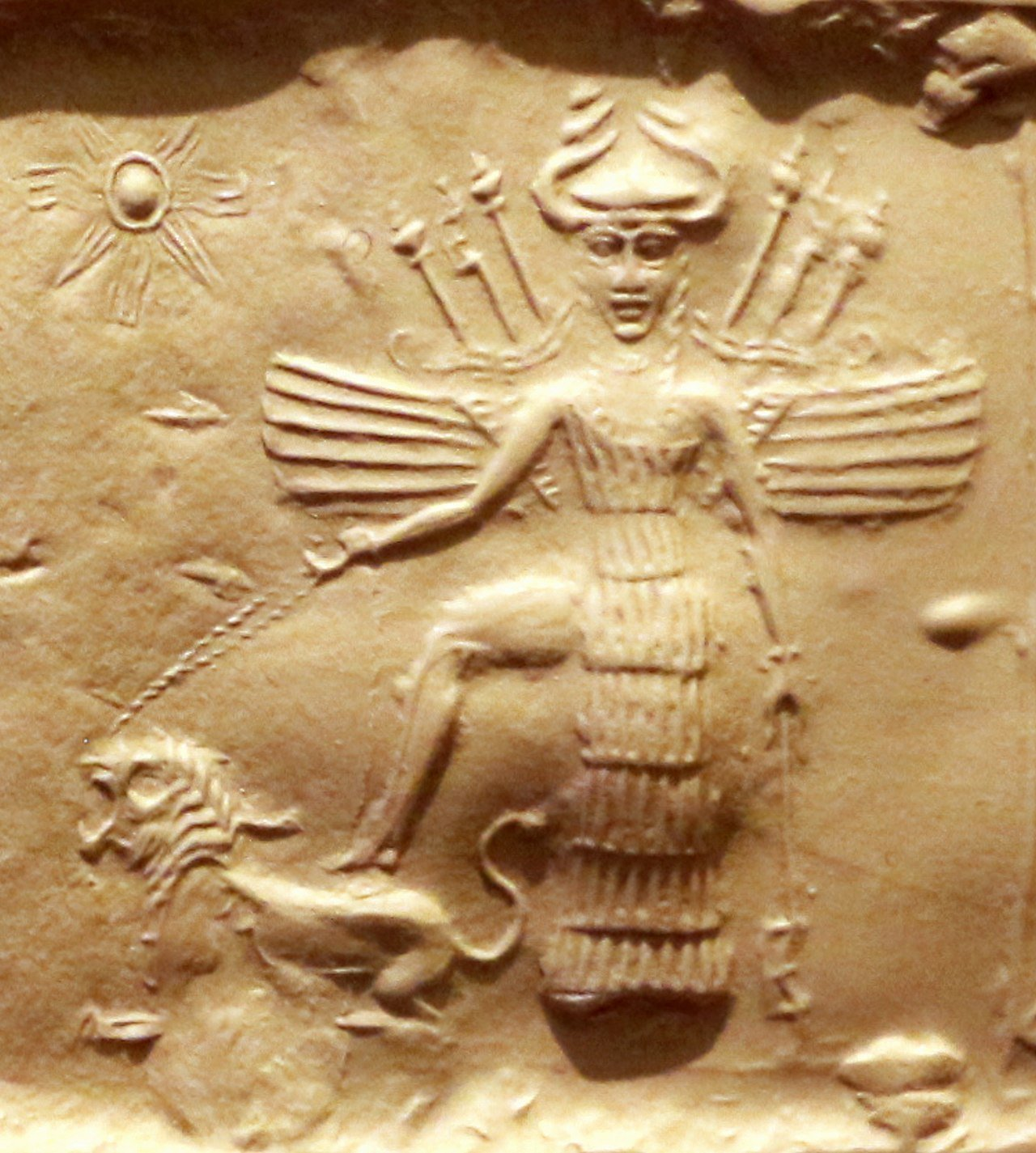
Leo...The time when Sirius rises with the sun..Do you see "The Lady" (of heaven), Inanna/Ishtar, standing under a star (Sirius) 🙂...

Here is Inanna/Ishtar, deified Sirius, which rises with the sun (morning star) in Leo, Jul/Aug, the hottest time of the year. Which is why she is depicted standing on a lion with the sun above lion's head and is known as "The Lioness of heaven"...

I talked about Inanna/Ishtar as Sirius in many of my posts...

Same girl, same beast (summer)...

Woman of the Apocalypse...I gave Full symbolic analysis of the Chapter 12 of the Book of Revelation in my post "Apocalypse"...

Here is another depiction of the lions eating the sun. See seven stars? Seventh month, Jul/Aug, Leo? Or seven months of old Sumerian summer, Apr/May - Oct/Nov? 

This is same "Beast" was also depicted like this...

I talked about this in my post "Angra Mainyu"...

The beginning of the Eurasian lion main mating season marks the beginning of autumn and the mating season spans the whole of autumn (Aug,Sep,Oct)...

Which is why lion is also the symbol for autumn. I talked about this in my post "Symbols of the seasons"... 

So on our original image, if the head of the lion represents Jul/Aug, the beginning of autumn, then the lion tail represents the Oct/Nov, the end of autumn...

Do you see all the birds flying away above the lion's tail? Autumn bird migration season starts in Jul/Aug and ends in Oct/Nov, the season marked by Leo...

But also, do you see that there are actually 7 birds. Could these be 7 doves of Pleiades, which become visible int the night sky in Oct/Nov, at the end of the summer. I talked about Doves and Pleiades in many of my posts...

Some people would ask what cold be the connection between Mesopotamian lion/sun symbolism and Medieval European lion/sun symbolism. 

The answer is Apollo, the terrible sun god, who was directly linked to lions and Nergal...

You should check my articles about Apollo if you want to fully understand what I am talking about here:

"Palil". About "Palil" a nickname of Nergal, the terrible, burning, destructive sun of Jul/Aug, Leo...And about the origin of the name Apollo and its meaning...

"Lord of the flies". About Nergal and Apollo as "The lords of the flies"...And about Jul/Aug, Leo, being the peak of the fly and fly born diseases season in Northern Hemisphere...

"Lions of Delos". About the Lions of Delos, the burning destructive sun in Jul/Aug, Leo, and the fact that both Nergal and Apollo are linked to lions. 

"Apollo and dolphins". About Jul/Aug, Leo being the "best time to sail in Eastern Mediterranean", and the link between dolphins and Lions...and Apollo...

"Marble throne of Apollo". About snakes (symbols of sun's heat), dragons (symbols of burning sun's heat) and terrible sun gods, Nergal and Apollo who are dragons themselves...

"Apollo and Python". About why Python followed Apollo after his birth? Cause snakes are solar animals...According to the Delphian tradition, Apollo was born on the 7th day of the month of Bysios (Jan/Feb)

"White raven". About the black and white raven legend which is found in both Nergal and Apollo mythology, Egyptian vultures and the twins that guard the gates of hell. And some other weird stuff...

"Threshing floor of Apollo". About the threshing floors as solar observatories/temples, about the threshing floor of Apollo from Delphi, about Jul/Aug, Leo, being the holy month of Apollo, and about solar bonfires...

"Apollo the great archer". About why Apollo was the terrible "far shooting" archer...About arrow and bow constellation from Mesopotamia, Ishtar, Sirius, and Jul/Aug, the season of Perseid meteor shower...

"Apollo Sminthius". About Apollo and peak infectious diseases season, Jul/Aug

Not convinced? Check this out:

 IONIA. Miletos. Circa 340-325 BC. Drachm. 

Front: Laureate head of Apollo. 

Back: Lion with eight-pointed star above

This coin, I think, confirms my hypothesis that Apollo was Sun in Leo...Basically, Greek version of Mesopotamian Nergal...

That's that. To read more about ancient animal and plant calendar markers, start here…Then check my twitter threads I still didn't convert to blog post...I am way way behind...

Sunday, 7 September 2025

7 maidens

Recently I watched a tv program called "The Silk Roads - Wonders of Azerbaijan" by Bettany Hughes. In it she talked about this ancient petroglyph from Gobustan, which, if I remember correctly, she called "7 maidens"...

Unfortunately I can only find this copy of this program online in, I guess, Azerbaijani, so I can't confirm this myself. If anyone has access to the English version, I would really appreciate if you cold confirm this for me. Thanks. Or alternatively, I would rally appreciate if @bettanyhughes could confirm that this is indeed what she called the petroglyph in question. And if she could clarify if this was a nickname given to the petroglyph by the local archaeologists, or was it her own poetic invention 🙂

The reason why I ask is that on the highlighted image from the program, I could only see 6 figures, not 7. Is there a 7th figure that wasn't highlighted, or that is not visible from the angle from which the petroglyph was filmed?

Why I would like to determine if there are indeed "7 maidens" depicted on this petroglyph, is because in the program, Bettany proceeded to talk about how "the meaning of the petroglyph is unknown".

Now if there are indeed 7 female figures depicted on this petroglyph (I guess we think they are females because of the public triangles ???, but they could just be as easily men wearing some kind of weird loincloths), then maybe I could offer a possible explanation...

Is this a bovine, depicted behind the human figures? It certainly looks like one. If so, then the meaning of the "7 maidens" petroglyph could be the "7 sisters", the Pleiades, which rise with the sun in Apr/May...

Apr/May, when wild Eurasian cattle start to calve...


Which is why this time of the year is is still marked with a bovine, Taurus...

I talked about this animal calendar marker in many of my posts, for instance "Cow and calf ivory", "Foundation peg of the goddess Nanshe", "Elamite water bull", "Human bull hybrid", "White calf", "Calydonian boar"...

According to this paper, "Agricultural Practices at Mentesh Tepe (Kura Valley, Azerbaijan) during the Neolithic, Chalcolithic and Bronze Age: An Overview from Sickle Elements and Botanical Remains", the main Neolithic, Bronze Age crop grown in Azerbaijan was barley, which was sown in the Oct/Nov, and harvested in May/Jun...Using sickles with composite stone blades...

Basically small sharp stone flakes, inserted into crescent shaped wooden frame...Something like this.

These sickles evolved from wild ass, deer jaw bones. 

We know that some primitive jaw bone sickles actually had long handles.


The sickles then evolved into wild ass, deer jawbones with artificial flint teeth

Then into artificial wooden jawbones with artificial flint teeth

And finally into serrated (toothed) jawbone shaped piece of metal...

I talked about the evolution of sickles in my post "Sickle"...

So it is quite possible that the things held by the figures are long handle sickles...Or maybe what is depicted on this rock engraving from Azerbaijan is something like this: Cain (farmer) killing Abel (shepherd) with a "ass jawbone", [my comment: the earliest form of a sickle]. 

New York, Pierpont Morgan Library: Ms 43, Huntingfield Psalter, XII Century, fol. 8. Pic from "Cain's Jaw-Bone that Did the First Murder"

Taking all this into account, is this image a calendar marker for harvest your barley when wild cattle starts to calve and Pleiades rise with the sun? I talked about Pleiades, barley harvest and animal calendar markers in my post "Pleiades". In it, explained why, according to the Greek mythology, the Pleiades, the seven daughters of Atlas, were transformed by Zeus first into doves, and only then into stars...


It's all to do with the link between doves and grain harvest (goddess)...Like Demeter, who was depicted on this terracotta statuette enthroned with a turtle-dove on her lap. The cult image of the harvest goddess was likely venerated in a sanctuary. From Sicily, 5th century BC. Milan Archaeological Museum. Pic by Gareth Harney


I explained this link in my posts "Demeter and dove" and "Cup of Nestor"...

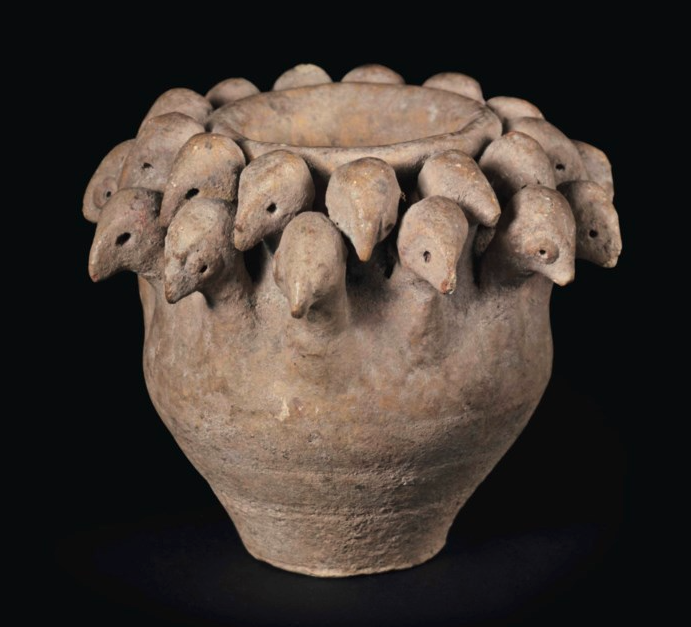
This link between grain goddess and doves also existed in Mesopotamia, where Inanna was also linked with doves. 1800-1600 BC pottery cup, Syria. The rounded body tapering to a flat base, with 26 bird heads. Similar objects were interpreted as votive objects dedicated to Ishtar/Inanna. 

I talked about this in my post "Inanna and dove"... 

The reason why doves are linked with grain goddesses and with pleiades is because doves, both European and Asian, nest during the grain harvest which starts in Apr/May, when pleiades rise with the sun, in Taurus...


But maybe there are no 7 but indeed only 6 figures depicted on this petroglyph, and they are not female but male figures with (admittedly weird) loin cloths, and these are not sickles they are holding but battle axes...

In which case this is just a depiction of a bovine hunt 🙂

To read more about ancient animal and plant calendar markers, start here…Then check my twitter threads I still didn't convert to blog post...I am way way behind...

Saturday, 9 August 2025

7 heads

Good morning. Old Assyrian (2000 BC-1800 BC) cylinder seal. Currently in the British museum...

Official description: Man in a chariot driving four horses; before him seven human heads and two birds; one other bird is above the two horses

Hmmm...

Quadriga in 2nd millennium BC Mesopotamia... Interesting...A man? Or a God? Like Sun god? They love horse drawn chariots...Like Helios depicted in his horse drawn quadriga on this Apulian vase dated to 350BC...

Why would sun gods like horses so much? The natural breeding season of horses starts in Apr/May and ends in Sep/Oct spanning the sunny, hot half of the year in the continental Eurasia, and is marked by wild stallion fights for mares...

The horse fertility is governed by the sunlight and peaks on summer solstice. I heard summer solstice was a big thing for sun worshipers....

Hence solar horses all over Eurasia...

Articles about solar horse (equid):

Iran "Water carrier equid", "Dioscuri plate from Iran"

Mesopotamia "Shamash playing with the solar horse", "Sun god from Tell Brak"

India "Hayagriva"

China "Longma", "Three legged crow", "Mythical beast from Xian"

Levant "Alexamenos graffito", "Goddess on a horse", "Unicorn"

Europe "Archaic rider", "Beotian solar pyxis", "Pegasus and chimera", "King John", "The horseman"

But the quadriga rider depicted on this Assurian seal can't be Helios...And his quadriga can't be pulled by horses...

He is most likely Sun God Shamash who was depicted on this 3rd mill BC cylinder seal imprint found in Tell Brak, Syria riding on a quadriga. Quadriga pulled not by horses but by "kungas", donkey hybrids so highly regarded, that "they were the preferred draught animal for drawing the chariots of kings and gods"... I talked about this in my post "Sun god from Tell Brak"...


Shamash rides on the quadriga pulled by donkeys, because donkeys are also solar animals, just like horses. This is because just like the mating season of horses, the mating seasons of donkeys is directly linked with the amount of sunlight and peaks on Summer solstice... 

Interestingly: In a letter dated to 1775 BCE, Bahdi-Lim, governor under the Mari king Zimri-Lim, insists that the king should not ride horses in his capital, as it was considered uncivilised. Instead, he urges the king to honour his royal status by riding in a donkey-drawn wagon...

From my post "Alexamenos graffito" about this:

Christ riding into Jerusalem on a donkey by Oleksandr Antonyuk. 

Why did Jesus have to ride into Jerusalem on a donkey?

People say: He was fulfilling a scripture prophecy.

"Rejoice, O people of Zion! Shout in triumph, O people of Jerusalem! Look, your king is coming to you. He is righteous and victorious, yet he is humble, riding on a donkey" Zechariah 9:9

God/King riding on the favourite ride of the old Gods/Kings... 

And this:

Christ is born on Winter Solstice, (re)birth day of the sun (god), he enters Jerusalem on a donkey, "animal of the (sun) gods and kings", and gets put on a cross, symbol of the sun (god)...Interesting...Early Christian "Alexamenos graffito", Rome. 


Anyway, back to our Assyrian seal. Why 7 human heads? Maybe 7 months of Mesopotamia summer? 

I talked about this first in my post "Seven headed dragon" The oldest depiction of a Hero(es) killing a 7 headed dragon dragon...Mesopotamia, 2200BC...With 7 snake heads...One for each hot month of Mesopotamian summer...They are killing the 4th head. Apr/May, May/Jun, Jun/Jul, Jul/Aug...  


Leo...The time when Sirius rises with the sun..There is also a princess (Inanna/Ishtar) standing under a star (Sirius) 🙂...

Here is Inanna/Ishtar, deified Sirius, which rises with the sun (morning star) in Leo, Jul/Aug, the hottest time of the year. Which is why she is depicted standing on a lion with the sun above lion's head and is known as "The Lioness of heaven"...

I talked about Inanna/Ishtar as Sirius in many of my posts...

Same girl, same beast (summer)...

Woman of the Apocalypse...I gave Full symbolic analysis of the Chapter 12 of the Book of Revelation in my post "Apocalypse"...

Anyway, back to our Assyrian seal. Why birds? Originally I thought that maybe these are migratory birds, cause migratory birds announce the start and end of summer, the domain of the Sun god?

I talked about migratory birds in Mesopotamian mythology in my post "Nanshe'. In Sumerian mythology, Nanshe was the daughter of Enki (god of water) and Ninhursag (earth goddess). This 3rd Dynasty or Ur plaque depicts goddess Nanshe with geese.


This is because the arrival and departure of migratory geese marks the beginning and end of the wet half of the year in Mesopotamia. On the flip side the departure and the arrival of the migratory geese marks the beginning and the end of the dry half of the year in Mesopotamia.


 But now, I am thinking that based on the shape of the birds they could actually be doves. 

Dove was sacred to Inanna/Ishtar. 1800-1600 BC pottery cup, Syria. The rounded body tapering to a flat base, with 26 bird heads. Similar objects were interpreted as votive objects dedicated to Ishtar/Inanna, who was also linked to grain and doves. 

The reason for that is that nesting season of doves overlaps with the grain harvest season. 

Which brings me to: is that grain depicted just above the two birds? Right in front the chariot...

We know that this has been a grain symbol in Eastern Mediterranean, Mesopotamia, Central Asia, Iran, since at least Sumerian times...

I talked about this in many of my posts...

Mesopotamian harvest coincides with the beginning of summer (Apr/May), the beginning of the mating of wild donkeys and the beginning of summer, the domain of the Sun God...

Maybe I am just reading too much into this. Maybe it is a man, a king, riding triumphantly over severed heads of his enemies which are being pecked by vultures and ravens....That's kind of cool too...

PS: A 5,000-year-old toy chariot found during the excavations in the ancient city of Sogmatar in the southeastern Turkish province of Sanliurfa...With what looks like grain symbols?


To read more about ancient animal and plant calendar markers, start here…Then check my twitter threads I still didn't convert to blog post...I am way way behind...