Saturday, 4 November 2023
Vučedol dove
Monday, 24 April 2023
Eyes
What is the best way to symbolically depict "Mother Earth"?
Well, place mountains, plants and animals between wide open eyes and vulva...Simple...
Decorated bone depicting slightly bewildered "Mother Earth", 6th - 5th millennium BC, Hagoshrim, Southern Levant.
Decorated bone depicting Mother Earth with a stern "I am watching you!" expression, 6th - 5th millennium BC, Neve Yam, Southern Levant...
Reconstruction of a stone palette depicting Mother Earth who...well...had enough and is ready for bed...6th - 5th millennium BC, Ein Zippori, Southern Levant...
This symbolic depiction of the Mother Earth later found its way to Upper Euphrates. Stele of Mari, found in a pit at the temple of Ninhursag...
Now remember this? 6th mil BC, Balkans. No eyes, but the "important" bit, plants growing out of the vulva, is there...Early Vinča Culture terracotta figurine from Jela, Iron Gate region of the Danube, Serbia, c. 5200 BC...
The oldest European one from Lepenski Vir is from c. 8000BC. Anyone knows of any Levantine examples from before 8000BC?These Levantine Mother Goddess depictions are from this article: "Iconographic motifs from the 6th–5th millennia BC in the Levant and Mesopotamia: Clues for cultural connections and existence of an interaction sphere"...
BTW, these guys were farmers, grain farmers...This is very important...So this Mother Earth is Mother of Grain...This girl
Left: Anthropomorphic vessel with breasts, Neolithic Lengyel culture (5000-3400 BC)
Right: Anthropomorphic vessel with breasts and grain ears (?) instead of hands, Chalcholitic Baden culture (3600–2800 BC) which developed from Lengyel culture.
Both from Central Europe...
I talked about this in my post "Femal pots from Europe"...
Thursday, 10 March 2022
Bronze Age money
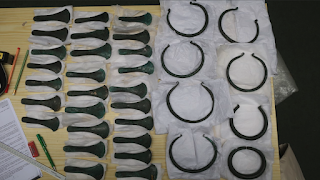
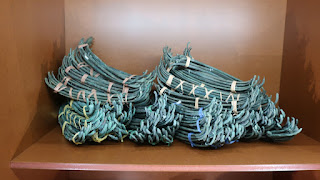
Very interesting. Just came across this paper "The origins of money: Calculation of similarity indexes demonstrates the earliest development of commodity money in prehistoric Central Europe" which proposes that 5,000 years ago, in Central Europe, rings, bangles and axe blades, standardized by shape and weight, were used as an early form of money...
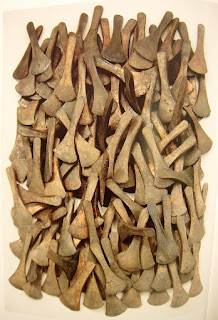
The same goes for bronze axes, which although had practical value, were also status symbols and could have been used as a value token, which could be exchanged for other goods...Basically money...Over 250 bronze axes, found in a pot, most virtually identical in terms of weight.
Of course this can all be explained in another way...The axes are the same weight and size because that is functionally the best weight and size for an average Joe Bronze Age guy...Most axe heads made today are also very much standard in size...For the same reason...
The general rule is that there's three sizes of standard axes. Handaxe / hatchet (usually about 1.25-1.5lb). Boy's axe / house axe (usually 2-3lb). Felling axe (usually 3.5-6lb)...
Maybe the 250 axe heads were stored together in a pot by the guy who made them...Hidden "until this shit blows over"...I wrote about similar hoard found all over Balkans and date to the time of the Bronze Age collapse in this post...
Maybe torcs are all the same (actually very similar) size and weight because human necks are also very similar...And so is the amount of bling a Bronze Age Joe and Jane Blogs would feel comfortable carrying around said necks of theirs...
Maybe the bronze ribs were all standard in size because they were used for making something standard in size...I have no idea what, but that is not really the point...We can explain the existence of all these identical objects in other ways, and just as money...
The best bit is that just because axe head is standard size because it is practically the best size for an axe head, doesn't mean that it wasn't also used as money...These two things are not mutually exclusive...
In fact, the manufacture of many identical (for practical reasons) highly sought after objects would naturally turn them into money...Well valuable barter exchange tokens...Which is what money is...
Monday, 25 October 2021
Tarim basin baby bottle
This infant died when he or she was less than a year old. Dark blue stones covered its eyes, and red woolen yarn was inserted into its nostrils. The infant was buried with a cow horn tip and a bottle made from a sheep’s udder...
This well-preserved infant mummy, was discovered in the cemetery of the Qizilchoqa settlement about 60 km west of Qumul (Hami), an important, old Silk Road town in the far eastern portion of the region. It was dated to ca. 1200 BC...
More info in the "Ancient mummies of the Tarim Basin" and "The mummies of East Central Asia"
It is one of hundreds of Bronze and Iron Age caucasian (European) mummies discovered in deserts along the Silk Road in Central Asia and Northern China...
Now, these are ceramic decorated horns found in infant graves of the Central European Bronze Age Encrusted Pottery culture (2000-1500BC).
I talked about them in my post "Baby milk horns"...
Why were these horns placed in infant graves? To provide them with drink in the otherworld...How do we know this?
We know this because Encrusted Pottery culture people buried their dead with age appropriate "grave goods": big ceramic pots for adults, small ceramic pots for children and ceramic horns for babies...
I talked about this in my post "One for the road"...
And because of the ancient belief that the otherworld is "a thirsty place"...And because in Central Europe, making sure the dead have enough water in the otherworld is still seen as an imperative... I talked about this in my post "Thirst"...
Have you ever thought about how did our ancestors arrive to the idea that the otherworld was a thirsty place? Or maybe it is better to ask where and when did our ancestors arrive at the idea that the otherworld was a thirsty place?
I am thinking...
Sunday, 28 February 2021
Baal from Cornwall
Bronze figure of god Baal dated to 14th-12th c. BC, found in Ras Shamra (ancient Ugarit), located in today's Syria.
In simple terms, bronze is the mixture of two metals:
copper
and tin
When the Bronze Age arrived to the Eastern Mediterranean, the copper-rich region was able to quickly source copper at mines like Timna...
But where tin came from has been a lingering mystery for scholars. A new paper from an international team of researchers proposes a surprisingly faraway source, Cornwall and Devon...
In a paper "Isotope systematics and chemical composition of tin ingots from Mochlos (Crete) and other Late Bronze Age sites in the eastern Mediterranean Sea: An ultimate key to tin provenance?" published in June , the authors analyze 27 tin ingots, or blocks, from five sites bordering the eastern Mediterranean Sea.
Now this is very interesting indeed. The strong connection between Eastern Mediterranean and British Isles during the 2nd millennium BC could bring back the cultural diffusion theory as the explanation for all the similarities between far flung Bronze Age cultures...
Like for instance why the "Celtic" (actually specifically Insular Celtic) year has two seasons: winter (Nov-Apr) and summer (May-Oct). Climatically this makes no sense in Ireland and Britain. But it makes a lot of sense in Levant, where the climatic year is divided into two seasons: winter, wet and cool season (Nov - Apr) and summer, dry and hot season (May - Oct)...
We shouldn't really be surprised that there was a maritime link between Britain and Eastern Mediterranean during the late early 2nd millennium BC....The Irish Annals, oral histories written down in early medieval time, talk about the first metalworkers arrived to Ireland during mid 3rd millennium BC, from Black Sea, via Mediterranean, by boat...
And opened the oldest copper mine in Ireland, Ross Island copper mine, the remains of which are still visible very near to the place where the Irish Annals say these foreign metalworkers landed...
I talked about this in my post "Ór - Ireland's Gold"...More about Eastern Mediterranean - Irish links during the early Copper Age can be found in these articles about "Montenegrian tumuluses"...
And we have even earlier evidence that Mediterranean seafaring mining prospectors, which mined, sailed and traded all over Mediterranean seas during Neolithic, also landed in Ireland, during the late 4th millennium BC...
So the maritime link between the British Isles and Mediterranean was in existence for thousands of years before the first tin mine was opened in Cornwall...The cultural exchange that happened along this trading route is very difficult to measure as yet...But it could account for a lot of "coincidental cultural similarities", "parallel independent cultural developments"...
Friday, 26 February 2021
Tartan
These decorations repeatedly occur on specific parts of the vessels and in specific combinations, which correspond to the position of the body parts...
I talked about the fact that the actual jewelry depicted on the Central European Bronze Age idols was found in graves of the same culture which made these idols in my post "Klicevo idol"...
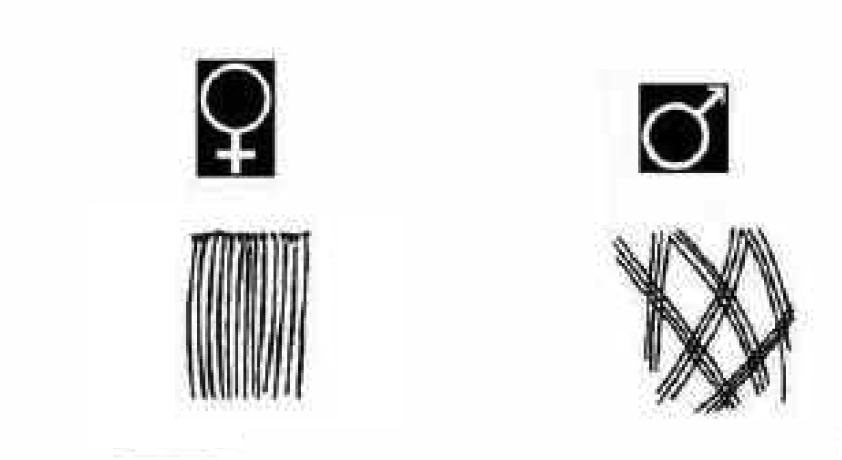
Certain motifs were related to the sex of the buried person and only appeared on the funerary vessel placed in the graves of the persons of that sex. Most interesting are these two patterns which appear on the bottom part of the vessel corresponding to the figurine legs...
Now what we see on the left is, I think, schematic depiction of the string skirt, like the one found in the grave of the so called "Egtved girl" who died and was buried in Denmark (far away from the lower Carpathians) around 1350BC...
I talked about this in my post "Egtved girl"...
But what about the "male" motif? Are we here looking at the schematic depiction of tartan? We know people of that time were perfectly able to make tartan...How do we know this? Because of this:
This piece of tartan was found on one of the Indoeuropean mummies from Tarim basin, northern China, dated to about 1200BC...
But do we have any proof that tartan was worn by men in Europe of that time? Weeeell we actually do...Remember the so called "The Griffin Warrior", a person buried in the Bronze Age, Mycenaean shaft tomb dating to around 1450 BC?
And remember the so called "Combat agate" found in his grave, which depicts a battle scene in which a Minoan warrior is kicking the crap out of Mycenaeans?
Here is the drawing of the scene, on which you can see the details much better:
Well, both Mycenaeans depicted on that gem wear kilts made of tartan...
I talked about this in my post "Legendary battle"...
But wait. We are here talking about the funerary pottery found in Carpathian basin in Hungary...Does that mean that the people living between 1500BC and 1200BC from Balkans to Baltic, from Europe to China, were the same people, or did they just all follow the same fashion???
Sources about the Encrusted Pottery culture vessels:
1. The chronology and meaning of the Transdanubian encrusted pottery decoration
Wednesday, 24 February 2021
One for the road
This is really cool. The people of the Bronze Age Encrusted Pottery Culture (Middle Bronze Age, 2000-1500BC) from the Carpathian basin, buried children with miniature versions of the pottery with which the adults were buried. Pic: pottery from children graves (L) vs pottery from adult graves (R)
This was also observed when remains of adults were found in the same grave. For instance, the remains of a child and of an adult male were found in the same grave, and their vessels could be clearly separated on the basis of their size and differing decoration....
Furthermore, vessels accompanying children showed differences according to age at death, since small, horn-shaped vessels (baby horns) typically occurred in graves of infants.
I talked about these baby rhyta here in my post "Baby (milk) horns"...
Now the reason why this is soooooo cool, is because it explains why these vessels were buried with the dead...To provide them with the food (or drink) for their trip to the other world... I proposed that these vessels originally contained drink in my post "Thirst"...More about insatiable thirst and hunger of the dead in my post "Blood red wine"...
Oh and remember goat Amaltheia ("Nourishing Goddess"), who fed baby Zeus with her milk? And then he "accidentally broke off one of her horns", which then became "cornucopia", the horn which had "the divine power to provide unending nourishment"...I talked about this in my post "Cornucopia"...
Well this whole link between goats, thunder gods and abundance originates from the fact that Ibex goat mating season in Crete coincides with the beginning of the rain season. And it is rain that bring fertility and abundance...
I talked about this in my post "Goat riding thundergods"
If horn vessels were buried with infants, this means that what was contained inside of the funeral vessels was drink. Because it is impossible to feed infants using horns. Unless you fed them milk...
How would you use these baby horns? Just like you would use gunpowder horns like this one.
You cut the tip off. You close the hole with your finger. You fill the horn with water, milk, soup...You stick the horn tip into the baby's mouth and voila...Suck suck suck...This basically proves my hypothesis, which I based on ethnographic data, that the funerary vessels found in Neolithic, Bronze age and Iron age burials were buried full of drink...Most likely just water...Cause the otherworld is a thirsty place...
But that would mean that the same beliefs and the same rituals related to the departure of the dead have survived in Europe since Neolithic...How interesting...But not surprising...At least not to me...
Baby (milk) horns
Among the ceramic finds from the cemetery of the Bronze Age Encrusted Pottery culture at Bonyhád in Hungary, archaeologists have found many ceramic "drinking horn" vessels, like this one, in the graves of infants...
This may suggest that the drinking horns functioned as special items used for the nutrition of children, i.e. like contemporary baby-bottles, or possibly they were related to customs related to birth and new life...
The location of Bonyhád inside of the Encrusted Pottery Culture territory in the Carpathian Basin.
From "The chronology and meaning of the Transdanubian encrusted pottery decoration"
What did the kids doing from these horns? Milk? Quite possibly, considering that Central Europe was where milk tolerance seem to have developed, and where we find Copper age and Bronze Age ceramic butter churns and Neolithic, Copper Age and Bronze Age cheese strainers...I talked about this in my post "Milk Butter Cheese"...