Showing posts with label Ningirsu. Show all posts

Saturday, 30 November 2024

Kassite bird demon

A Kassite period (1595-1155 BC) seal depicting a "bird-demon" πŸ™‚, holding two ibexes, by their hind legs. 


Found in Iraq, UChicago, A29439. The description reads: "Marduk, great lord, on the servant who reverences you show mercy."

What is really depicted here?

First, who is the birdman? Did you know that originally rain god was in Mesopotamia imagined as a giant storm bird, giant black eagle? Why?

Eagle dance...


Montenegro 1963AD

Syria, 1800BC

Eagle (vulture) couples dance above the mountains at the beginning of their mating season, which coincides with the beginning of the rain season in Fertile Crescent...I talked about this in my post "Eagle dance"...

The storm bird eventually became anthropomorphised, and became first a birdman and then a storm god with a pet eagle...

Who is the mysterious "birdman" depicted with his hands tied behind his back, being judged by Enki, Sumerian god of water and the annual flood? This article, "The judgement of the birdman" tries to answer this question...

Birdman=Old thunder god, starts flying over Mesopotamia in Oct/Nov. The rain that the Birdman brings supports the tree of life. This is also when Ibex goats start to mate. 

Which is why ibex became "The goat of rain"...

I talked about symbolism of ibex goats in many of my posts, like 

Europe:

"Pitys", "Goat in European culture", "Patera of Rennes"... 

Levant:

"The tree of life/light", "Lachish animal calendar"...

Mesopotamia:

"Feast plaque from Louvre", "Green pastures", "Problems with Abzu", "Relief from Dur Sharrukin", "Goatfish"...

Iran: 

"Flamingos from Susa", "Goat carrier", "Iranian goat of rain", "Strider", "A vessel from Tepe Hissar"...

This is also when gazelles start to mate. 

Hence gazelles flanking the tree of life on this Akkadian cylinder seal which also depicts a birdman. I talk about this seal in my article, "Mysterious creature"...
Speaking of gazelles, you'll like this πŸ™‚:

This is a wall painting from a provincial palace on the Assyrian borderlands, c. 9th - 7th century BC, depicting a "demigod holding animals that urinate on him to purify him". OMG...Winter animal calendar markers (gazelle) and winter moon...Rain season...I talk about this in my post "Pissing gazelles"...
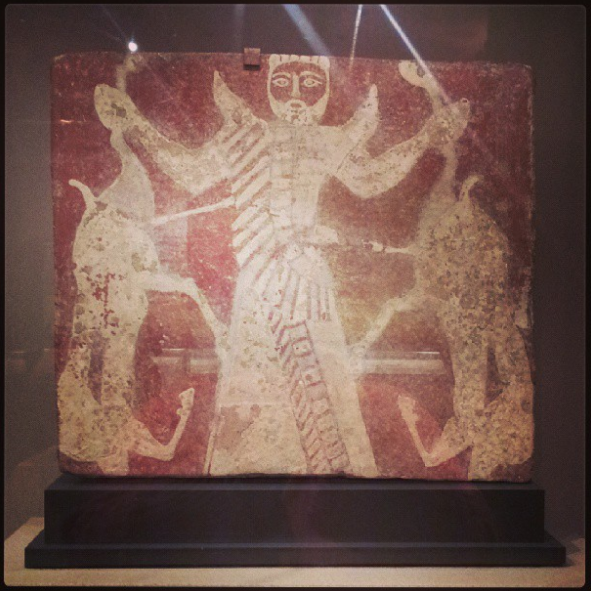
Gazelles, are identical calendar markers as ibex goats depicted on the Kassite seal. They both have the same mating season, starting in Oct/Nov, when rain (bird) arrives...

Anyway, the same "birdman holding ibex goats" scene is also found in Bactria.  Here is winged vulture guy holding two winged ibex goats...From Bactrian seal, end of 3rd beginning of 2nd millennium BC...I talked about it in my post "Fluffy"...

Finally, this Kassite seal, (18th-12th centuries BC) from Syria, currently in the National Museum of Damascus, spells the link between vultures, ibex goats and Enki, the God of the source of fresh water...The full analysis can be found in my post "Kassite seal with Apkallu"

See the same tree of life? Anyway, time to go. 

For the end: My post "Pero", in which I proposed that the root of the name of the Slavic thunder god Perun is "pero" = feather, which would make Perun = Feathered one, and not from PIE perkwus, meaning "oak" or "mountain"...


To read more about ancient animal and plant calendar markers, start here…Then check my twitter threads I still didn't convert to blog post...I am way way behind...

Wednesday, 16 November 2022

Green stone cylinder seal

Green stone cylinder seal; A walking bull, below which is a smaller horned animal (Ibex goat btw) and above the bull is a branch. Jemdet Nasr or Old Elamite period (3100 to 2900 BC). Currently in the British Museum.

Meaning? Apparently, according to the museum experts: "we have no idea"...

Let me try:

Remember this post, "Problems of Abzu"? I completely forgot about it πŸ™‚ This post tries to answer the question: Why was Enki, Sumerian god of fresh water and annual flood, called both "Goat of Abzu" and "Bull of Abzu"? Abzu being source of fresh water in Mesopotamia...In short: Because the rains season in Mesopotamia starts when wild goats start to mate and ends when wild cattle start to calve πŸ™‚

Rain that falls during the rain season is what makes Mesopotamia and Iran green and fertile...So maybe this is what is depicted on this green cylinder seal with goat, bull and branch???

But maybe the "branch" isn't just a branch. Maybe it is the symbol for grain...

Grain harvest in Mesopotamia and Elam started in Apr/May, Taurus...Hence the "bull and grain" symbolism found all over the place...I talked about it in my post "Bull carrying granary"...

Oh, and guess when the grain was sown? At the end of autumn, Oct/Nov, is when the first rains arrive, brought by the goat of rain. Here is rain god Ninurta/Ningirsu, who was, in the earliest records, also agriculture god, giving plough to the people...I talked about this in my post "Black basalt stone of Esarhaddon"...

So is this what this seal depicts? Small goat (grain seeds are sown). Big bull (grain ears are harvested)...

I don't know if either of these two "potential interpretations" are correct, but to me they are definitely better than "" we get from British Museum...

To read more about ancient animal and plant calendar markers, start here…then check the rest of the blog posts related to animal calendar markers I still didn't add to this page, and finally check my twitter threads I still didn't convert to blog post...I am 9 months behind now...

Sunday, 31 October 2021

Mysterious Creature

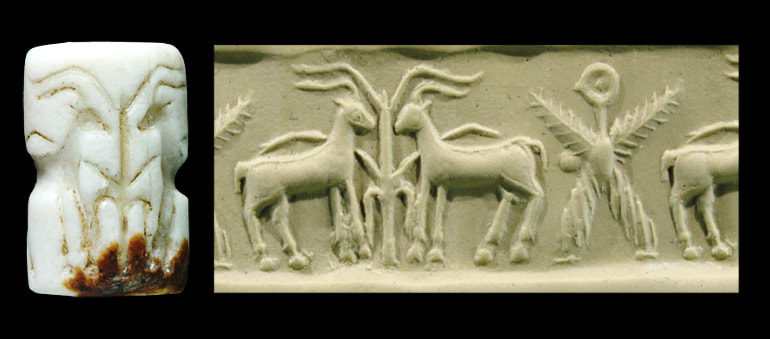
Akkadian Cylinder Seal with a Mysterious Creature, Mesopotamia, 2300-2200 BC. Description: A carved white marble seal with two ibexes flanking a stylised tree and a bird-man figure...

What's all this about?

Well first, these are not ibexes. These are Goitered gazelles...See the horns? 

Gazelle. 


Ibex...


They are flanking a tree, which is usually indication that this is a depiction of the tree of life...

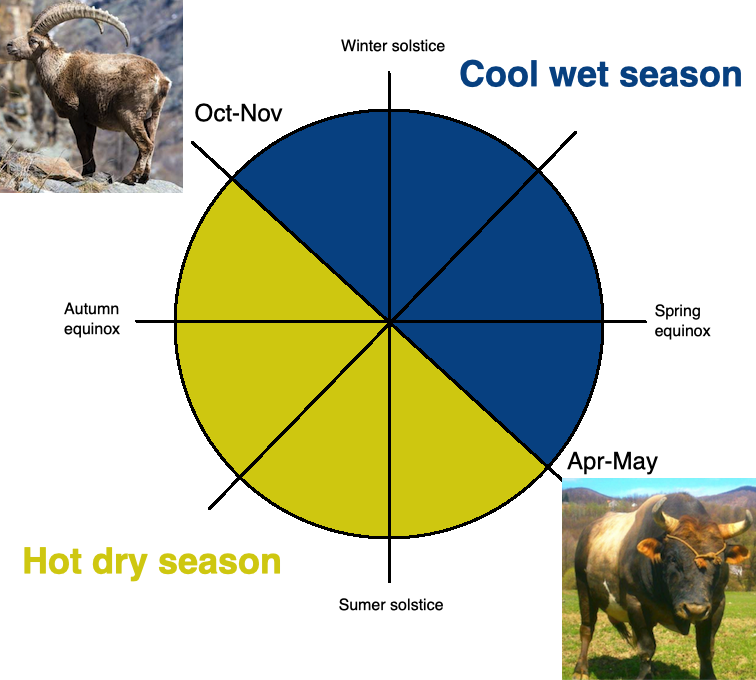
In Mesopotamia, the climatic year is divided into hot/dry half and cool/wet half...

It is this rain that supports (the tree of) life in Mesopotamia...And the arrival of the life giving rain, is announced by the beginning of the mating season of Ibex goats, which starts in Oct/Nov...

I talked about this in my post "Green pastures" about this votive plaque from Tell Asmar, Iraq...


Which is why Ibex goat is the most depicted animal in Mesopotamia and Iran...I talked about this in my posts 

"A vessel from Tepe Hissar" about the "Goat of rain"


"Goat petroglyphs from Iran" about the development of the "God of rain" from "Goat of rain"


 "Goat carrier" about sacrificing goats to gods...

But gazelles have the the same mating season as ibex goats. Which is why they are here used to represent the same idea as ibex goats: It is this rain that supports (the tree of) life in Mesopotamia...And the arrival of the life giving rain, is announced by the beginning of the mating season of Goitered gazelles, which starts in Oct/Nov...


This is why gazelles and ibexes are sometimes even used together to emphasise that they have the same meaning as animal calendar markers. Like this seal that I talk about in my post "Pissing gazelle"


It is that rain that turns desert into green pastures...Which is why gazelles are found on the base of the statue of the god Abu, also known as the "father of the pasture". I talked about this in my post "Abu"...

Interestingly, this guy could be just another incarnation of Ninurta, the god of rain, who was originally imagined as a huge storm bird, then as a bird man and then as god with a pet (monster) bird...I talked about this in my post "The judgement of the Birdman", about this amazing Babylonian seal...

The reason for this is that the rain season in Mesopotamia coincides with the mating season of vultures who at that time perform their synhronised flying routines...

So, gazelles, tree of life and a bird man with outstretched wings...The rains are coming...Rejoice...

Sunday, 24 October 2021

Green pastures

Another interesting object found in Tell Asmar and is dated to ED II period (2750/2700–2600BC)...The image are from this amazing paper "Sculpture of the Third Millennium B.C. from Tell Asmar and Khafajah


This is a plaque with with three scenes. 

In another amazing paper, "God or worshiper", we can read that the first scene depicts worshipers in front of Abu the god of green pastures, and his consort, goddess of fertility...These guys.

The second scene depicts two wild goats (Ibex) or two wild sheep (mouflon)...Sometimes it is difficult to discern which one of the animals is depicted as the horns are sometimes depicted smaller because of the space. Like this goat from Nipur, that I talked about in my post "Goat in a tree"...

The third scene depicts two calves. 

Both goat/sheep and calves are depicted among green branches...

Are these animals chosen and arranged randomly?

In my previous post "Abu", I talked about the above statue of Abu found in Tell Asmar. And I talked about the fact that Abu was just another name for Ninurta/Ningirsu, the old god of rain...

That is of course fitting, because in Mesopotamia, the pastures are only green during the rain season, Oct/Nov-Apr/May....So only God of rain can be God of green pastures...

The start of the rain season in Mesopotamia coincides with the start of the mating season of wild goats and sheep, which is why they are the symbol of the rain season in the region...Particularly wild Ibex goat. Goat of rain...

The end of the rain season in Mesopotamia coincides with the beginning of the calving season of wild cattle, aurochs. We don't really have any photos of aurochs (extinct), but here is a reconstruction based on what we know


So what is depicted on this plaque from Tell Asmar is the time when Abu/Ninurta/Ningirsu rules is rain season which lasts from when the wild goats and sheep start to mate until the wild cattle start to calve...


This is basically the same time period depicted symbolically on this Early Dynastic Sumerian seal I talked about in my post "Rain and flood"...


Abu

This statue was found under the floor of the Square Temple in Tell Asmar and is dated to ED II period (2750/2700–2600BC)...The images are from this amazing paper "Sculpture of the Third Millennium B.C. from Tell Asmar and Khafajah


In this article, Henry Frankfort proposes that this statue, much bigger than any other statue found in Tell Asmar, is the depiction of the god Abu, god of vegetation, whose name means "Father pasture"...

Most people talk about this statue's eyes. And cool eyes they are.

But to me, the statue's feet are much more interesting. 


What is interesting is that the statue stands on a base with a very interesting relief. Henry Frankfort describes it as "Anzu bird standing between two mountain goats lying on leafy branches..." 

I have to correct Henry Frankfort. These are Goitered gazelles, not mountain goats. See the horns?

Ibex goat


Goitered gazelle


Anzu bird was the symbol of the thunder god Ninurta/Ningirsu. It is best known from the Entemena vase where it is depicted as a lion headed eagle flanked by (actually grabbing) two mountain goats (Ibexes). 

I talked about this in my post about "Entemena vase"

But apparently the earliest depiction of Anzu bird has eagle head...In the paper "God or worshiper" Thorkild Jakobsen says that the earliest form under which Ninurta/Ningirsu was worshiped was an enormous black eagle gliding with outstretched wings. 


Thorkild Jakobsen says that this was a representation of a black storm cloud, but I think that this was actually an enormous eagle gliding with outstretched wings: a vulture...

But also a storm cloud. 

Remember the link between vultures and the rain season: in Mesopotamia vultures start mating at the beginning of the rain season, in November...I talked about it in my post "Giant eagle dude with mouflons" about this beautiful Bactrian gold stamps seal...


Ninurta is The Eagle, turned The Eagle Dude...

And apparently, Abu, the god of vegetation, was just another name for Ninurta/Ningirsu, thunder god...Which is kind of obvious considering that in Mesopotamia, it is the rain season, which brings vegetation back to life...

And interestingly, the rains season starts when vultures start their mating synchronised gliding routines. Oh and when Goitered gazelles start their mating too...I talked about this in my post "Two headed dragon" about this beautiful Iranian Marlik cup.


Which is why on the base of the statue of the god of vegetation Abu, we see the (lion headed) Eagle of the thunderstorm god, flanked by two Goitered gazelles...

By the way, I will talk about how the Storm Eagle acquired the lion head soon...

Saturday, 13 June 2020

Queen Puabi’s cylinder seal


This is a very interesting shell seal from the Early Dynastic IIIa period, ca. 2550– 2400 BC, inscribed: "Lugal-shΓ -pΓ -da". Found in the dromos of the Queen Puabi’s Tomb. Kept in University of Pennsylvania Museum of Archaeology and Anthropology, Philadelphia

The official description of the scene depicted on this Sumerian seal is kind of funny: "Nude Hero Grappling with Lions Attacking Horned Animals"...Ok, "lions attacking horned animals" part is kind of obvious. "Nude hero grappling with lions"...Well that's not at all obvious...

The lions are Eurasian (Asiatic) lions.


The lion facing left is attacking a Persian fallow deer stag. 


The lion facing right is attacking an Ibex (Bezoar) goat. 


The "hero" is actually nowhere near the lions...He is pulling the stag by his horns...

The hairstyle of the "hero" is very interesting. No middle eastern curls seen on all the sculptures from that period...Instead, spikes of straight hair pointing upright...I have only seen things like this on depictions of Helios, the deified sun, from another time and culture...

So who is the "hero"? Not sure...It might turn out that linking him to the sun is not that crazy at all...You will see why soon, when I explain what the central part of the scene means: the two lions attacking a stag and a goat...

Believe or not I have already explained the meaning of this scene in my article about another early Sumerian artefact: Entemena vase, an amazing silver vase made around 2400 BC for Entemena, the king of Lagash... 


This vase vas dedicated to the storm god Ningirsu...The engraving on the vase is very interesting. 


Note the lion headed eagle, the symbol of Ningirsu and Lagash...The interesting thing is that the central scene of this freeze depicts lions attacking a deer and an ibex...

As I already explained in my article about this vase, mating season of the Eurasian lions starts during the mating season of Persian Fallow deer (August-September) and ends during the mating season of Bezoar Ibex goat (November-January)...

Which is why the order of the animals: deer--lion+lion--ibex is important...The animals are depicted like this because the whole scene taken together depicts autumn, the season whose symbol is a lion... 


You can read more about this in my article "Symbols of the seasons"...

Interestingly, the seal actually has a proof that my interpretation of this scene is correct. There is a scorpion next to the head of the Ibex goat...


Zodiac sign Scorpio (23rd of Oct - 22nd of Nov) marks the time when scorpions disappear, hide to escape cold and wet weather brought by the Goat of rain πŸ™‚, Ibex. 

In Eastern Mediterranean and Middle East the rain season arrives when Ibexes start to mate, in Scorpio...

I already talked about this link between ibex goats, scorpions and the tree of life which sprouts from the rains which the Goat of rain brings in Scorpio in in my article about this seal from Dilmun 


So we know what the animals represent. But what about our "hero"? Well he is pulling onto the horns of the stag, which in this scene symbolises end of summer and the beginning of autumn...Just like the ibex symbolises the end of autumn and beginning of winter...

So is he the sun god? Hmmm...

The fact that the authors of this scene have added the scorpion next to the ibex head, makes me doubt this...I think this could be Ninurta...Who is described as "Ninurta, the farmer’s version of the god of the thunder and rainstorms"...What does this mean?

Well, in the earliest records, he is the god of agriculture...Whose symbol was the plough...Which he gave to the people...Here is a god (Ninurta) giving plough to the people...


And guess who is depicted next to the seat of the god of plough? Ibex goat...Why?

As I explained in this article about the link between scorpion and ploughing, in Mesopotamia, after scorching summer, fields can only be ploughed after the soil has been moistened and softened. Before irrigation, that happened after the first rains. The ones brought by the Goat of rain. In Scorpio...

This Mesopotamian cylinder seal kept at the Morgan Library and Museum, shows a scorpion standing between two plants, most likely grain. Scorpions go into hiding during the cold wet part of the year, which in Mesopotamia starts at the beginning of November, in the middle of Scorpio :) This is also the time when grain is planted...


Precipitation and temperature tables in North Iraq desert area...Similar situation is throughout Iraq...


So is the spiky hair "hero" in the original seal Ninurta, the farmer's thunder god? Or the sun god? Still not sure... πŸ™‚ But that is not even that important...I will finish this article with this question: did you notice the animal which the figure on the far left is bringing to the god of rain and plough?


 It's Markhor goat...


Do you want to know why is this figure carrying a Markhor goat? Have a look at this article entitled "A goat in a tree"