Showing posts with label tree of life. Show all posts

Monday, 20 July 2026

Sassanian goats with tree of life

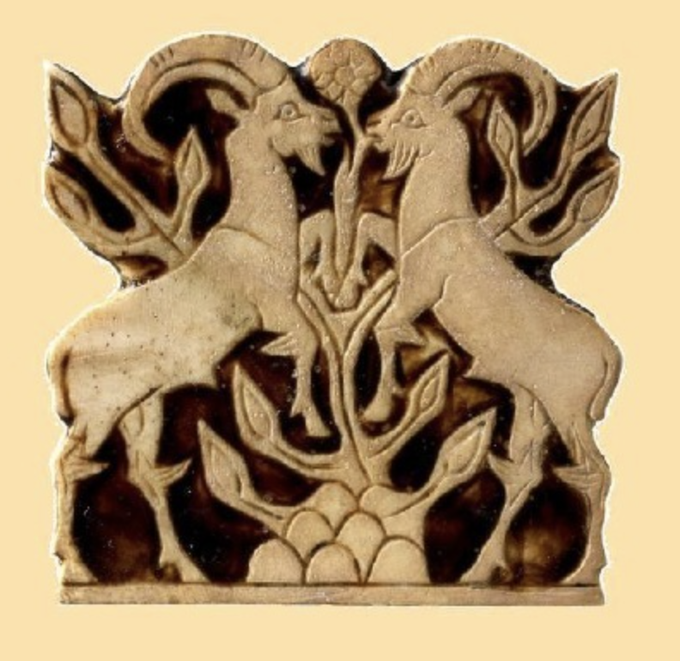
Two Sassanian wall relief slabs dated to the 5th-6th c. AD, depicting rampant ibex goats flanking "the tree of life"...


This is an ancient symbol found throughout Iran, Mesopotamia, Central Asia, Levant, Crete. The reason for that is that in all these regions, year is divided into two halves: 

hot, dry half, roughly Apr/May - Oct/Nov

wet, cool half, roughly Oct/Nov - Apr/May


And the wet, cool (rainy, snowy) half, which makes life possible in these arid areas, begins when ibex goats start their mating fights...see, "flanking"...

I talked about this and gave examples of goats flanking tree of life from all these regions in my post "Bactrian bronze age menorah"...

Example: Goats flanking the tree of life. Ritual vessels from Gonur-depe, the administrative and ritual center of Ancient Margina, the Northern regions of the Oxus civilization, dated to 2300˗1600 BC. 

What is interesting about these two Sassanian slabs is the fruit depicted growing on these two trees of life:

L: grapes

R: pomegranates

In the traditional Iranian fruit growing regions, like Shiraz, both the grape and  pomegranate harvest seasons start in Sep/Oct. This is also when grape and pomegranate festivals are held...

Right after that in Oct/Nov, the ibex goats start mating and the rains, which support the (tree of) life in this region arrive...

For those interested in Sassanian art with animal and plant calendar markers (which hint at Indian influence) check this post, "Rainbows and peacocks", out about this Sassanian dish, 400-600AD, Iran, Currently in Al Thani collection...What is exactly depicted here? Some would say just an exotic dancer. I think that this is a depiction of the goddess Anahita, Zoroastrian goddess of water and fertility...

And this post, "Ram with royal ribbon", about this 400–699 AD Sassanian silver plate originally from Iran, currently in the Museum of Fine Arts, Boston, USA...

What is actually depicted on this plate? Definitely not just a lost lamb...

And this post, "King killing bull", about this very strange 5th c. AD Sassanian silver dish, depicting a warrior with a spear sitting on a bull, about to stab another bull...


If you are interested in reading more about ancient animal and plant calendar markers, which are at the root of all our mythologies, start here…Then check my twitter threads I still didn't convert to blog post...I am way way behind...

Saturday, 19 April 2025

The sacred tree and a bee

The sacred tree motif...may be associated with a bee in a Hittite text: "An eagle is perched on the branches of the tree above, wrapped around the roots of the tree is a snake below, a bee hangs at the middle of the tree"...

From "Apiculture in Hittite cuneiform texts". Here is my symbolic depiction of the above passage. Cool, right?


This tree is usually interpreted as "the world tree", "a colossal tree, located at the centre of the world, which supports the heavens, thereby connecting the heavens, the terrestrial world, and, through its roots, the underworld"...

The World Tree, often has an eagle in its crown and serpent /dragon in its roots. As in Hittite mythology. And Germanic mythology where we find Yggdrasil. 1897 depiction by Ernst Hermann Walther

Here are examples of the depiction of "the world tree" from Serbian epic poetry.

Excerpt from a Serbian folk poem which talks about the tree of life with Falcon (Perun) sitting on its top and Serpent/Dragon (Veles) coiling around its roots:

Here is another variant of the same poem about the Tree of Life with Eagle (Perun) sitting on its top and Dragon (Veles) coiling around its roots. This one narrated by the tree of life itself:


It is commonly believed that the eagle symbolises the heaven and the serpent symbolises the underworld...But the world tree can also be interpreted as "the tree of life". Basically "everything between the earth and the sky"...

In which case the eagle symbolises rain (god) and serpent symbolises sun (god)...I talked about this symbolism of eagle and serpent in my post "Eagle snake struggle" in which I analysed the symbolic meaning of the Eagle-Snake struggle mosaic from the palace of the Emperor Justinian I  (527-565), Istambul.


Basically this is a complex animal calendar marker for the thunderstorm season in Europe Apr/May -  Sep/Oct, which is also when migratory snake eagles and snakes can be seen in South Eastern Europe... 

BTW if you look at the above thunderstorm chart, and if you look at the Hittite part of Anatolia, you will see that Apr/May is also the start of the main thunderstorm season there too...

Eagle (Rain) and Snake (Sun)...Whose balance is needed if we want (the tree of) life to flourish. And between them, bees...Without whom...

In Polesye, area along Belarus and Ukraine border, there is a belief that God created bees "to live til the end of the world" and that "when all bees die, the world will end"... More Slavic bee folklore can be found in my post "Bee"... 

You can find lots and lots of posts about eagles and their link to thunder/rain and about snakes and their link to sun on my blog

BTW, I talked about bee as an animal calendar marker in Asia Minor, in my post "Deer and bee", about this Silver tetradrachm from Ephesus minted c. 390–380 BC.


All this helps us understand the Hittite myth about the disappearance of Telipinu, the god of agriculture. His disappearance caused all fertility to fail, both plant and animal. Everyone is looking for him, but finally it is the bee who finds the god after everyone else gave up search. And by finding the missing Telipinu, it is the bee that brings the fertility back to the world...

It is interesting that bees reappear in the spring, when the winter is finally over, and are one of the main signs that the winter (infertile time of the year) has ended and summer (fertile time of the year) had began...

One more thing about Hittites and bees:

Amulet of a bee goddess, 700 - 600 BC. Found in excavations of Kamiros, Rhodes, Greece. One of the nicknames of Persephone, The Queen of the Underworld, was Melitodes ("sweet as honey"), and the priestesses of Demeter and Persephone, were known as Melissae ("bees")...


You can read more about this in "The Eleusinian Mysteries and the Bee"...

Interestingly, Hittites believed that bees were "the gift of The Sun Goddess of the Earth", Hittite equivalent of Persephone, The Queen of the Underworld...

You can read more about this in "Apiculture in Hittite cuneiform texts"...

Both of these Queens of the Underworld were also linked to land fertility...

That's it. To read more about ancient animal and plant calendar markers, start here…Then check my twitter threads I still didn't convert to blog post...I am way way behind...

Friday, 17 May 2024

Menorah from Nipur

This is one of the most interesting seals I have ever seen. It was found in the scribal quarters of Nippur, and was documented in the excavation report published by the Oriental Institute of the University of Chicago.

I am not sure exactly what the dating of this seal is, but the scribal quarter has layers from Akkadian, Gutian and the Third Dynasty of Ur periods...So the late 3rd mil BC...

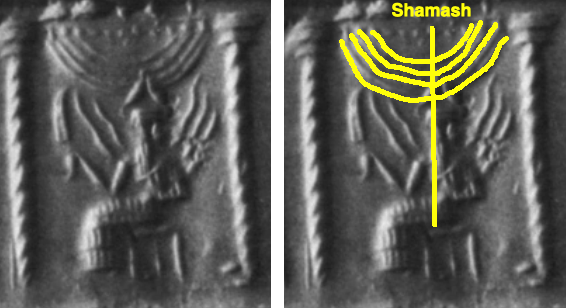
So why is this seal so interesting? Let me explain: The seal depicts the sun god Utu/Shamash, identifiable by the wavy sun/heat rays emanating from his shoulders.

I talked about this in my post "Utu or Enki" about the above images found in an incredible book called "Seal cylinders of Wester Asia". 

This same symbolism was found not only in Mesopotamia in the late 3rd mil BC...This is a great example of the use of related animal calendar markers. Bactrian two side seal. Sun god with sun rays emanating from his shoulders (like Shamash/Utu), with snakes, symbols of sun's heat and winged lion, Nergal, symbol of hottest part of the year...

I talked about this in my post "Summer and winter BMAC seals"...

Utu/Shamash is  sitting on a throne, holding a cerated knife, another one of his identifying symbols...That tells us that this is old Utu/Shamash, the summer sun...

Sun God Utu/Shamash with sun (heat) rays emanating from his shoulders, standing in in an empty canal, in Leo (between the lions), the hottest, driest time of the year in Mesopotamia, and the time when canals were repaired, holding reed cutting knife...I talked about this in my post "Canals"

I talked about young and old Utu/Shamash here

It is Young Utu/Shamash, Spring Sun, who climbs up the mountains to release Enki/Ea, (god of) fresh water, from (his) it's icy prison. It is he who fills the rivers and canals...And it is Old Utu/Shamash, Summer Sun, who empties them...I talked about this in my post "Shamash young and old"...


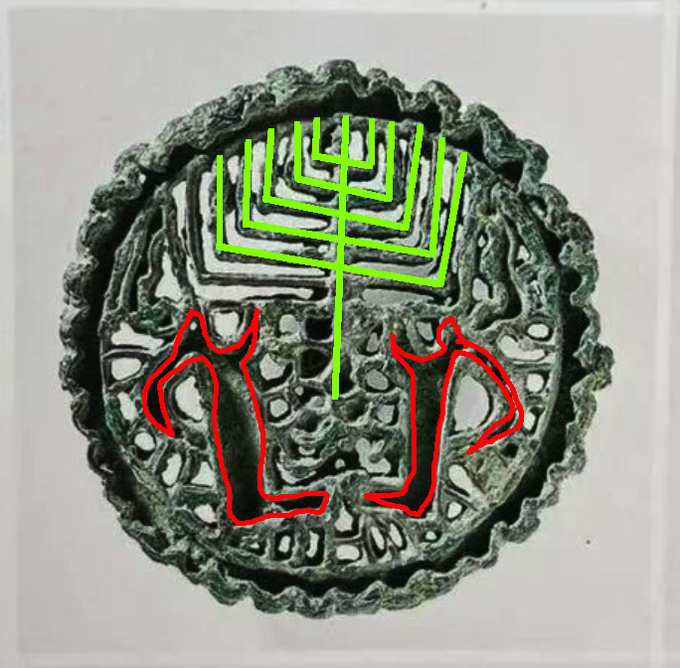
On our Nipur seal, Shamash is flanked by two bull-men, holding (???)...Whatever they are holding, is telling us that we are looking at the sun in Taurus, Apr/May, beginning of summer, ruled by the old Utu/Shamash...

Similar to this:

The sun god stands "between two bulls", which means "in Taurus" (Apr/May). Out of the bulls grows grain, which means beginning of grain harvest in Apr/May...From my post "Bull carrying grannary"...

Sooooo....What's so special about this???

Remember my post "The tree of light/life" about the solar symbolism of Menorah? 

In it I talked about the fact that the central candle of the Hanukah (Solstice) Menorah is called Shamash, and that this candle has to be lit first, and then used to light all the other candles...

Now have a look at the central part of the Shamash cylinder seal from Nippur. Are you seeing what I am seeing, or am I just seeing things...again? Is this a symbolic depiction of the Menorah emanating from Shamash himself?

I think this could finally settle the debate about why the central Menorah candle is called Shamash, and why Menorahs are lit during winter solstice, the time when "people have to make sure the sun's fire does't die"...Which BTW is the point of Yule logs...

"The ancient fire-festival of the winter solstice...has survived...in the custom of the Yule log...[once]...widespread in Europe, it seems to have flourished especially in England, France, and among the South Slavs"...From "The Golden Bough"...I talked about Yule log tradition from around Europe in my posts "Badnjak", "First footer", "La buche de Noel", "Yule log in English tradition"

Now, as I explained in my post about Menorah, Menorah was not just the solar symbol, but also the tree of life symbol...Remember this post, "Bactrian bronze age menorah" about the tree of life depiction on this super cool Bactrian bronze stamp, dated to 2400BC-1600BC...

All the images of the rampant goats flanking the tree of life can be explained through animal calendar markers: Ibex goats mating season, which starts in Oct/Nov, overlaps with the rain season in all these areas, and it is the rain that makes life possible in these arid lands...


The ibex goat mating season peaks around the winter solstice/Hanukah...When the Menorahs are lit up using central Shamash candle...Until now I could not see the direct link between the solar and tree of life meaning of Menorah...But now I can...

Remember, every spring, the young Utu/Shamash, the spring sun, climbs up the mountains to release the fresh water (Enki/Ea) from its icy prison (melt the snow)

Which is why the poem "Enki and Ninhursanga" states that "When Utu [the sun god] steps up into Heaven (Holy mountain), fresh waters shall run out of the ground for you"...I talked about this in my post "When Utu steps up into heaven"...

The snowmelt peaks at the beginning of summer, Apr/May, in Taurus. 

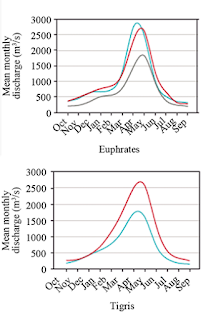
Which is when Tigris and Euphrates flood reaches its peak. 

Which is why Utu/Shamash was depicted as a golden bull (Sun in Taurus) with flowing lapis lazuli beard (flowing water)...

And it is this flood (caused by the snowmelt, caused by the sun, Utu/Shamash) that was the (main) source of life in Mesopotamia...The tree of life literally grew out of Shamash...

Makes more sense now? 🙂

I want to thank my friend @dalaygiz for this great observation: 3-waves on each side, with the solar-head in the centre 🤔


Oh and BTW, in Mesopotamia, summer lasted seven hot months...Which is why local dragon, symbol of summer, had seven snake (symbol of sun's heat) heads...So number seven (seven lights) here becomes kind of obvious??? I talked about this in my post "Seven headed dragon"...


That's it. To read more about ancient animal and plant calendar markers, start here…then check the rest of the blog posts related to animal calendar markers I still didn't add to this page, and finally check my twitter threads I still didn't convert to blog post...I am 9 months behind now...


Wednesday, 15 May 2024

Bactrian bronze age menorah

Today I stumbled across this super cool Bactrian bronze stamp, dated to 2400BC-1600BC...

It depicts a motif, found in Eastern Mediterranean, Levant, Mesopotamia, Iran, Central Asia, of two rampant male ibex goats flanking the tree (of life)...

Why are ibex goats flanking the tree of life?

Climate charts for BMAC (Bactria-Margiana) Turkmenistan, Afghanistan, Uzbekistan, Tajikistan.


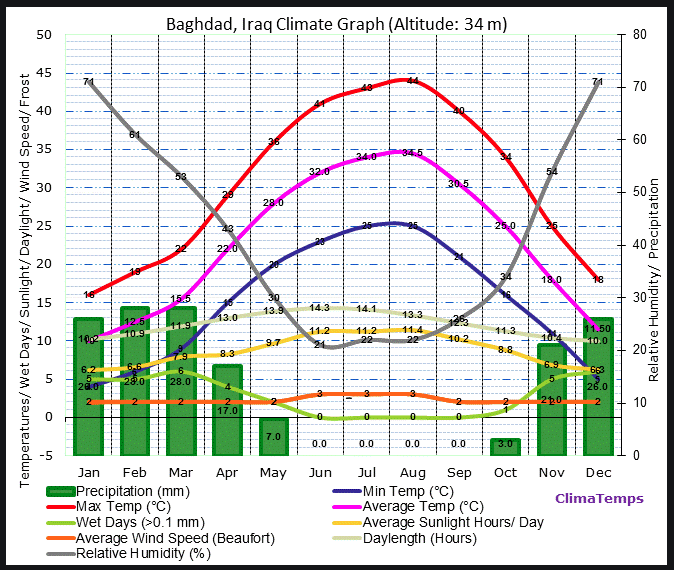
In this part of the world, the climatic year is divided into hot/dry summer (Apr/May - Oct/Nov) and cool/wet winter (Oct/Nov - Apr/May)...

Interestingly, Oct/Nov is also the time when male ibex goats start their ferocious mating fights...

And because the wet season in these parts of the world starts when ibex goats start mating, ibex goat became an animal calendar marker for the beginning of the rain season...

And because it is the rain and snow (as spring snowmelt runoff) that are the source of life in these otherwise dry areas...

And because "people are very good at noticing patterns in nature and very bad at distinguishing between correlation and causation", ibex was turned from goat that mates when it rains and snows into a goat whose mating brings rain, The Goat of Rain...

One more example of the tree of life with goats from Central Asia

Goats flanking the tree of life. Ritual vessels from Gonur-depe, the administrative and ritual center of Ancient Margina, the Northern regions of the Oxus civilization, dated to 2300˗1600 BC. Pic from this article...


Now the shape of the original Bactrian tree of life is very interesting...It reminds me very much of the tree of life from this 3,000 BC Sumerian Stamp Seal with Impression Tree of Life with Rampant Goats. Mesopotamia. Chicago. Oriental Institute Museum...I talked about it in my post "The tree of life/light".


BTW in Mesopotamia rain/snow also arrives when goats start dancing, in Oct/Nov.

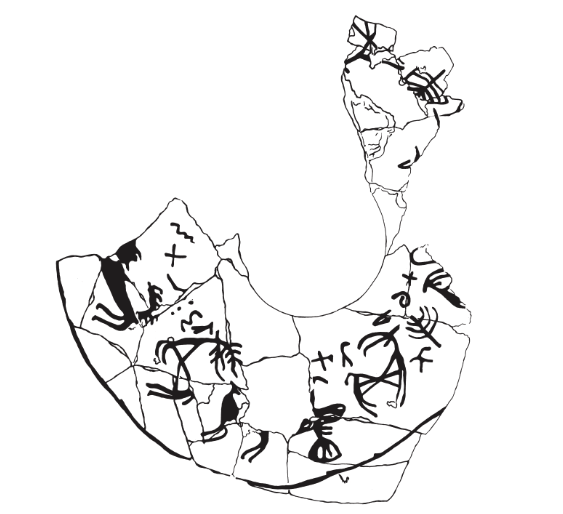
And these depictions of the tree of life flanked by rampant goats also reminds me very much of this depiction of the same scene from a pottery vessel, a ewer, from the Fosse temple at Lachish dated to the 13th century BC, bears an inscription on the shoulder which reads from left to right "Mattan (the donor), an offering to my lady ’Elat". 


I wrote full analysis of this amazing object in my post "Lachish animal calendar"...

Interesting right?

More examples of ibexes flanking the tree of life from

Mesopotamia

This is a shell plaque found in Queen Pu-abi's tomb dated to c. 2600 BC. It shows ibexes rearing up on their hind legs on both sides of the tree of life topped by the eight-pointed rosette...I talked about this in my post "Shell plaque with ibexes"...


Turkey

Wall painting from a house in Çatalhöyük (7500-6500 BC) showing a fruit tree and ibexes/wild goats...I talked about this in my post "Goats and tree of life from Catalhoyuk"...

Turkey again

A seal impression found in Alalakh/Tell Atchana, located 20 km from Antakya (Antioch) in what is now Turkey's Hatay Province. It was found in one of the rooms of the Level VII (c. 1800BC) palace...It depicts two ibex goats flanking the tree (of life)...I talked about this in my post "Goats with tree of life from Alalakh"...

Also Turkey

Hittite, half oval plaque, two goats and palmetto tree, Tell-Halaf, 900 BC, Museum of Oriental Antiquities, Istanbul...

Iran

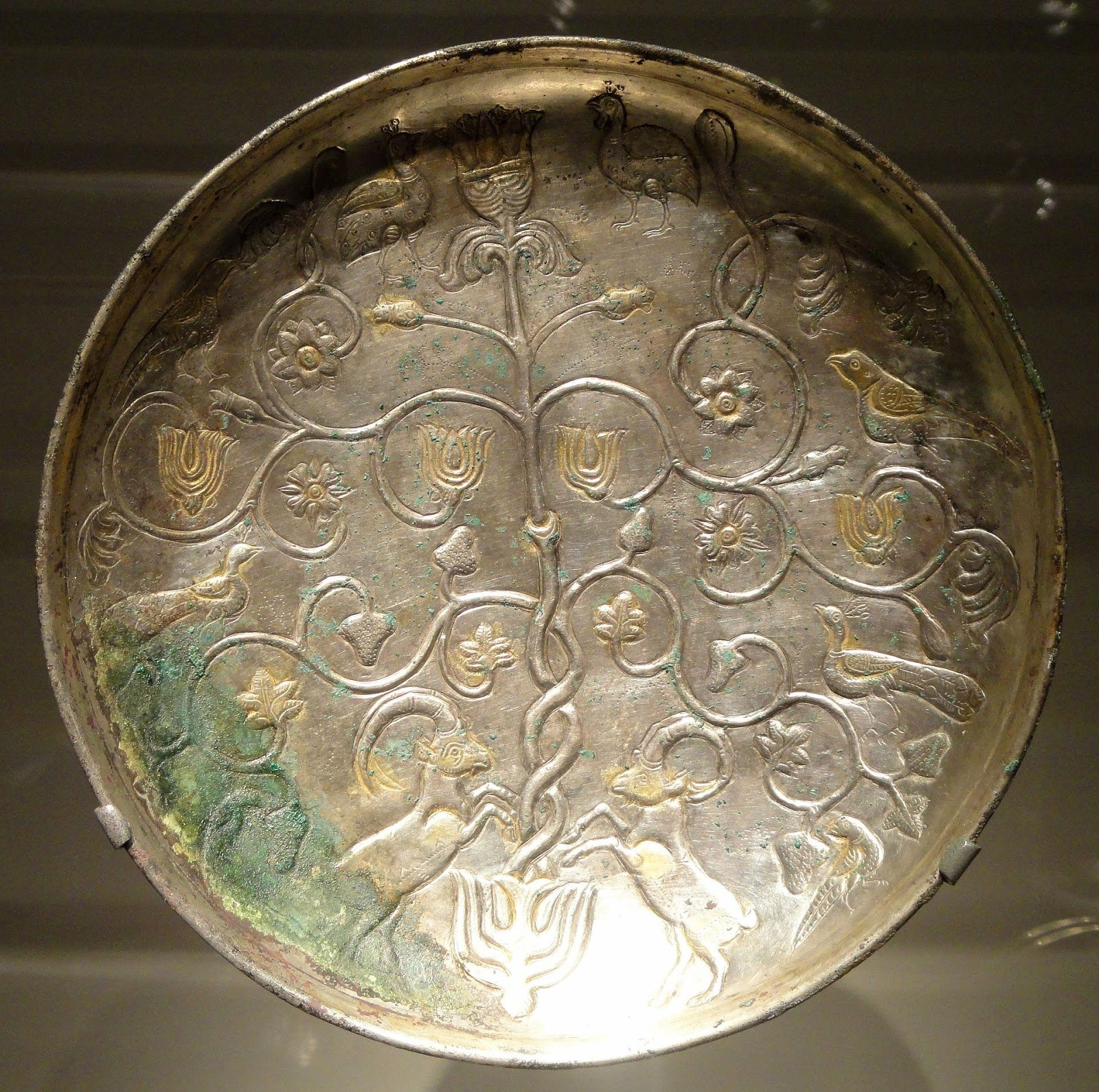
Sassanian dish which depicts the tree of life, flanked by two ibex goats, the goats of rain...From my post "Rainbows and peacocks"...


Minoan Crete

Two ibex goats flanking an olive tree (of life). I talked about this in my post "Goat riding thunder god"

To read more about ancient animal and plant calendar markers, start here…then check the rest of the blog posts related to animal calendar markers I still didn't add to this page, and finally check my twitter threads I still didn't convert to blog post...I am 9 months behind now...