Showing posts with label Abu. Show all posts

Sunday, 31 October 2021

Mysterious Creature

Akkadian Cylinder Seal with a Mysterious Creature, Mesopotamia, 2300-2200 BC. Description: A carved white marble seal with two ibexes flanking a stylised tree and a bird-man figure...

What's all this about?

Well first, these are not ibexes. These are Goitered gazelles...See the horns? 

Gazelle. 


Ibex...


They are flanking a tree, which is usually indication that this is a depiction of the tree of life...

In Mesopotamia, the climatic year is divided into hot/dry half and cool/wet half...

It is this rain that supports (the tree of) life in Mesopotamia...And the arrival of the life giving rain, is announced by the beginning of the mating season of Ibex goats, which starts in Oct/Nov...
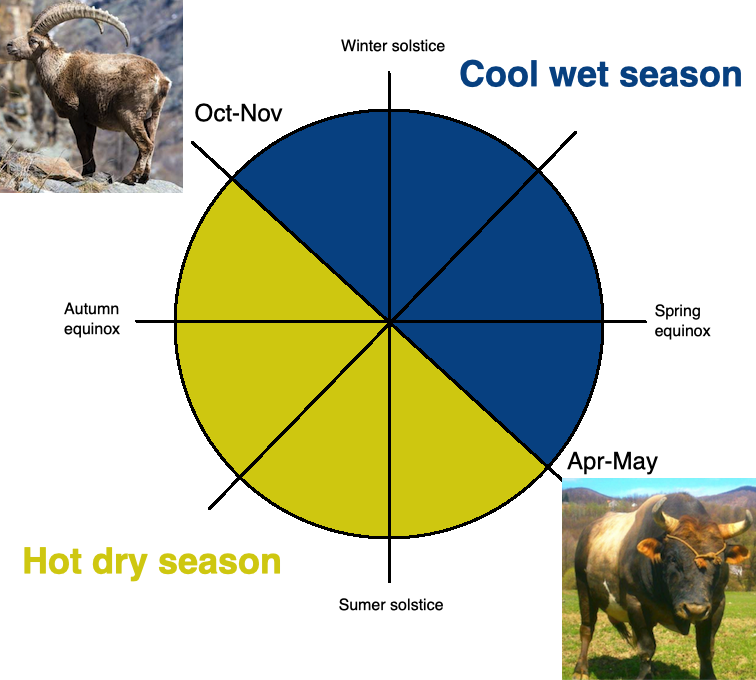
I talked about this in my post "Green pastures" about this votive plaque from Tell Asmar, Iraq...


Which is why Ibex goat is the most depicted animal in Mesopotamia and Iran...I talked about this in my posts 

"A vessel from Tepe Hissar" about the "Goat of rain"


"Goat petroglyphs from Iran" about the development of the "God of rain" from "Goat of rain"


 "Goat carrier" about sacrificing goats to gods...

But gazelles have the the same mating season as ibex goats. Which is why they are here used to represent the same idea as ibex goats: It is this rain that supports (the tree of) life in Mesopotamia...And the arrival of the life giving rain, is announced by the beginning of the mating season of Goitered gazelles, which starts in Oct/Nov...


This is why gazelles and ibexes are sometimes even used together to emphasise that they have the same meaning as animal calendar markers. Like this seal that I talk about in my post "Pissing gazelle"


It is that rain that turns desert into green pastures...Which is why gazelles are found on the base of the statue of the god Abu, also known as the "father of the pasture". I talked about this in my post "Abu"...

Interestingly, this guy could be just another incarnation of Ninurta, the god of rain, who was originally imagined as a huge storm bird, then as a bird man and then as god with a pet (monster) bird...I talked about this in my post "The judgement of the Birdman", about this amazing Babylonian seal...

The reason for this is that the rain season in Mesopotamia coincides with the mating season of vultures who at that time perform their synhronised flying routines...

So, gazelles, tree of life and a bird man with outstretched wings...The rains are coming...Rejoice...

Sunday, 24 October 2021

Green pastures

Another interesting object found in Tell Asmar and is dated to ED II period (2750/2700–2600BC)...The image are from this amazing paper "Sculpture of the Third Millennium B.C. from Tell Asmar and Khafajah


This is a plaque with with three scenes. 

In another amazing paper, "God or worshiper", we can read that the first scene depicts worshipers in front of Abu the god of green pastures, and his consort, goddess of fertility...These guys.

The second scene depicts two wild goats (Ibex) or two wild sheep (mouflon)...Sometimes it is difficult to discern which one of the animals is depicted as the horns are sometimes depicted smaller because of the space. Like this goat from Nipur, that I talked about in my post "Goat in a tree"...

The third scene depicts two calves. 

Both goat/sheep and calves are depicted among green branches...

Are these animals chosen and arranged randomly?

In my previous post "Abu", I talked about the above statue of Abu found in Tell Asmar. And I talked about the fact that Abu was just another name for Ninurta/Ningirsu, the old god of rain...

That is of course fitting, because in Mesopotamia, the pastures are only green during the rain season, Oct/Nov-Apr/May....So only God of rain can be God of green pastures...

The start of the rain season in Mesopotamia coincides with the start of the mating season of wild goats and sheep, which is why they are the symbol of the rain season in the region...Particularly wild Ibex goat. Goat of rain...

The end of the rain season in Mesopotamia coincides with the beginning of the calving season of wild cattle, aurochs. We don't really have any photos of aurochs (extinct), but here is a reconstruction based on what we know


So what is depicted on this plaque from Tell Asmar is the time when Abu/Ninurta/Ningirsu rules is rain season which lasts from when the wild goats and sheep start to mate until the wild cattle start to calve...


This is basically the same time period depicted symbolically on this Early Dynastic Sumerian seal I talked about in my post "Rain and flood"...


Abu

This statue was found under the floor of the Square Temple in Tell Asmar and is dated to ED II period (2750/2700–2600BC)...The images are from this amazing paper "Sculpture of the Third Millennium B.C. from Tell Asmar and Khafajah


In this article, Henry Frankfort proposes that this statue, much bigger than any other statue found in Tell Asmar, is the depiction of the god Abu, god of vegetation, whose name means "Father pasture"...

Most people talk about this statue's eyes. And cool eyes they are.

But to me, the statue's feet are much more interesting. 


What is interesting is that the statue stands on a base with a very interesting relief. Henry Frankfort describes it as "Anzu bird standing between two mountain goats lying on leafy branches..." 

I have to correct Henry Frankfort. These are Goitered gazelles, not mountain goats. See the horns?

Ibex goat


Goitered gazelle


Anzu bird was the symbol of the thunder god Ninurta/Ningirsu. It is best known from the Entemena vase where it is depicted as a lion headed eagle flanked by (actually grabbing) two mountain goats (Ibexes). 

I talked about this in my post about "Entemena vase"

But apparently the earliest depiction of Anzu bird has eagle head...In the paper "God or worshiper" Thorkild Jakobsen says that the earliest form under which Ninurta/Ningirsu was worshiped was an enormous black eagle gliding with outstretched wings. 


Thorkild Jakobsen says that this was a representation of a black storm cloud, but I think that this was actually an enormous eagle gliding with outstretched wings: a vulture...

But also a storm cloud. 

Remember the link between vultures and the rain season: in Mesopotamia vultures start mating at the beginning of the rain season, in November...I talked about it in my post "Giant eagle dude with mouflons" about this beautiful Bactrian gold stamps seal...


Ninurta is The Eagle, turned The Eagle Dude...

And apparently, Abu, the god of vegetation, was just another name for Ninurta/Ningirsu, thunder god...Which is kind of obvious considering that in Mesopotamia, it is the rain season, which brings vegetation back to life...

And interestingly, the rains season starts when vultures start their mating synchronised gliding routines. Oh and when Goitered gazelles start their mating too...I talked about this in my post "Two headed dragon" about this beautiful Iranian Marlik cup.


Which is why on the base of the statue of the god of vegetation Abu, we see the (lion headed) Eagle of the thunderstorm god, flanked by two Goitered gazelles...

By the way, I will talk about how the Storm Eagle acquired the lion head soon...