Showing posts with label Mesopotamia. Show all posts

Saturday, 17 May 2025

Golden men

One of two golden men with large erect penises found in the settlement of Tell el-Farcha, located in the Nile Delta, Egypt, and dated to c. 3000 BC...Pic from this article...

This is the second, smaller figurine...

The figurines had a core made of probably wood, which was then covered with thin gold foil, which was fastened by golden rivets, 4 mm long and 1 mm in diameter. Whoever made these figurines was a seriously good goldsmith...

The archaeologists who found these figurines believe that "It is possible that the golden figurines, depict...a Predynastic ruler...and his son"...

I have to disagree with this. I believe that they depict a god (not sure which one) linked to the sun and the flood...

The reason why I believe this is because figurines were made of gold (sun), had huge penis (fertility), and had eyes made of lapis-lazuli (water)...And in Egypt, the flood which makes the land fertile arrives during the sunniest and hottest time of the year (Jul/Aug)...

But that's just my opinion...BTW...lapis lazuli used for the eyes of the golden figurines was was imported from the area of today’s Afghanistan!!! How cool is this? 3000 BC...

Mesopotamian god Utu/Shamash was depicted as a golden bull (Sun in Taurus) with flowing lapis lazuli beard (flowing water)...This object was found in Ur and dates to 2450 BC. It is currently in the Pen Museum...


Why lapis lazuli beard on the solar bull? Cause flood, caused by the snowmelt in the North-Eastern Mountains, caused by sun's heat, arrives there in Taurus...

I talked about this in my posts: "Solar bull", "Water bull",  "Bactrian snakes and dragons", "Shamash young and old", "Butt chewing", "When Utu steps up into heaven", "Maran", "Sun god tablet", "Gisgis relief", "Lyres of Ur"... 

Hmmmm....

Osiris and Horus, Father and Son?

I talked about Osiris and its link to flood in my posts "Braided beard" and the "Beard of Osiris"...

That's it. To read more about ancient animal and plant calendar markers, start here…Then check my twitter threads I still didn't convert to blog post...I am way way behind...

Tuesday, 15 April 2025

Mother of grain from Mari

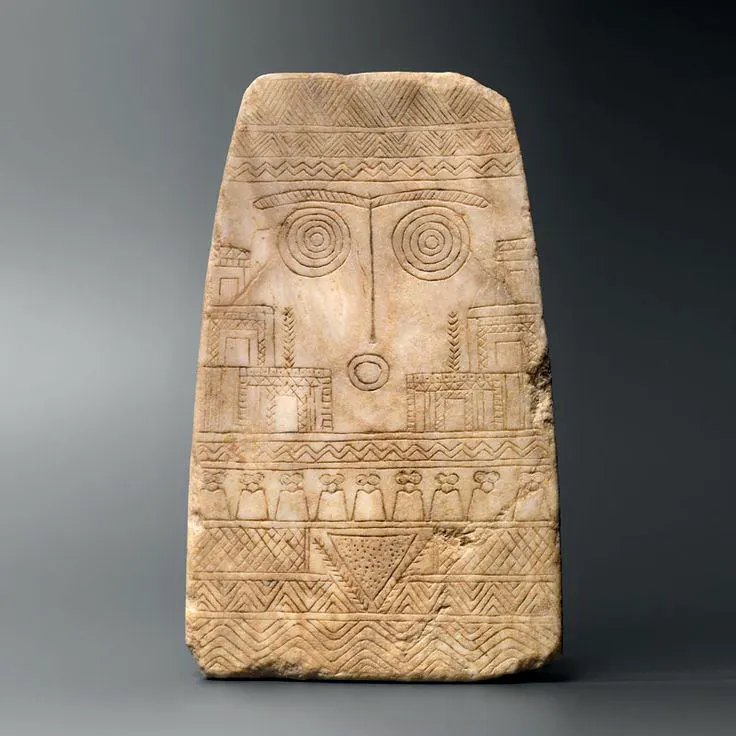
This alabaster stele [my comment: depicting the Mother of Grain, see more further down the thread], was presented in 2012 catalog of the Phoenix Ancient Art, as a cult plaque originating from the Near East and dating from the beginning of the third millennium BC...

According to Professor Michel Al-Maqdissi, an expert in oriental archaeology at the universities of Damascus and Saint-Joseph des Jésuites in Beirut, this stele almost certainly came from the ancient Mesopotamian city of Mari...

Located in Syria, not far from the Iraqi border, Mari was literally devastated by the wild searches and massive looting that took place before and after Daesh/Isis proclaimed its Islamic caliphate...

The offices of the Phoenix Ancient Art were raided by the customs in 2016 and a number of archaeological objects were seized under the suspicion that they were looted in the Middle East and smuggled into Europe...

The owner of the Phoenix Ancient Art was later sentenced in Switzerland for forging documents in order to disguise the true origin of the artefacts he was selling. You can read more about this here...

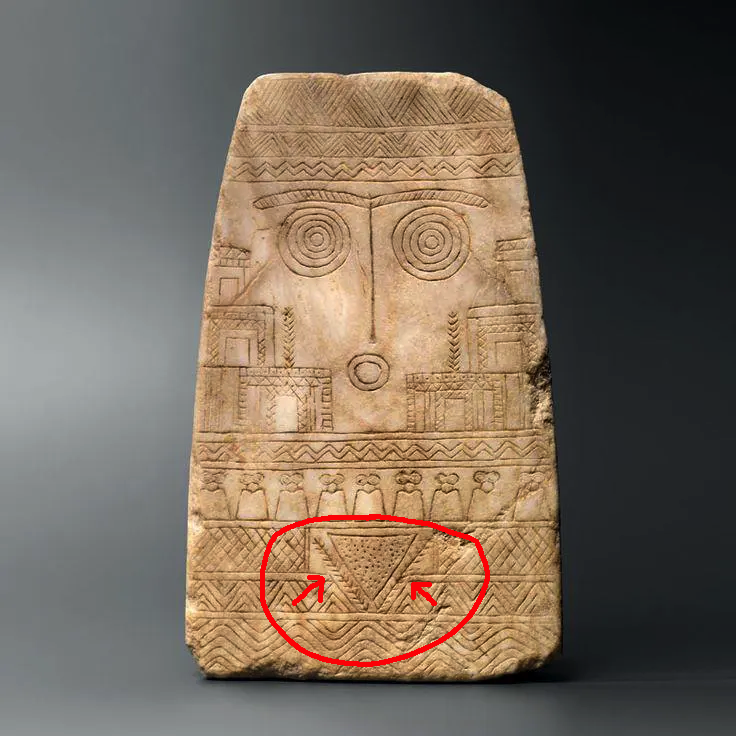
Now the interesting bit. The mother of grain? What the hell is the Mother of Grain? Well she is Mother Earth of course...Our stele from Mari also has eyes and vulva as well as water, plants, buildings and people...

What is the best way to symbolically depict "Mother Earth"? Place moutains, plants and animals between eyes and  a pubic triangle. Decorated bone depicting slightly bewildered "Mother Earth", 6th - 5th millennium BC, Hagoshrim, Southern Levant. From my post "Eyes"...


But Mother of Grain is a special version of Mother Earth. She is the mother earth of the grain farmers...

We know this because the plant depicted on the stele from Mari is grain...

I first talked about Mother of Grain in my post "Mother of grain"...

Mother of grain...Grain seed and vulva symbolism from Vinča, Starčevo and Lepenski vir cultures...Link between female fertility and earth/grain field fertility...

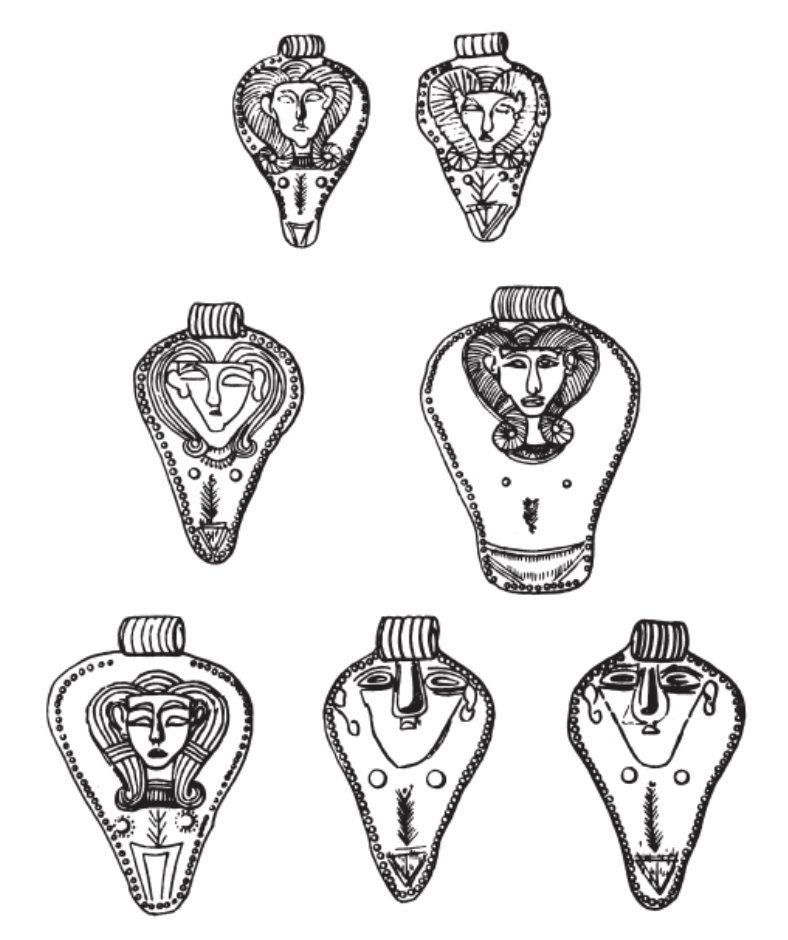
The same symbol, grain growing out of a vulva can be seen on these levantine pendants

Golden pendant with the image of Hathor. From Tel el Adjul. Gaza, middle of the 2nd mill BC. 

Similar pendants with a depiction of grain growing from the vulva. 

I wrote about them in my post "Hathor grain pendants"...

And then I talked about mother of grain in my post "Sabi Abyad venus"...

A figurine from the Late Neolithic and Early Halaf Village at Sabi Abyad, Northern Syria, part of Fertile Crescent. dated to 7th mill BC...Depicting Mother Earth turning into Mother of Grain...

And then in my post "Altyn Tepe mother of grain"...

How to depict "Mother of Grain"? Like a voluptuous woman (Mother) whose vulva (where new life come from) is horizontal (like Earth, Field) with horizontal lines (furrows) with plant (Grain) growing out of them. Altyn Tepe, BMAC,  3200-2000 BC...  

An I talked about the mother of grain in my post "Mother of grain from Yarim Tepe"...

Figurine of a nude "woman"? Or a depiction of the "Mother of grain"? Yarim Tepe, Iraq. Ubaid period, 5000-4000 BCE. Iraq Museum... Interpretation from: 

And finally i talked about the mother of grain in my post "Arjoune venus"...

An early Halaf culture figurine from the Arjoune site in Syria. It is made from a natural pebble, and it depicts a female form, with large eyes and long hair. And a square pubic area...Grain field?...Mother of grain?  

The Mother of Grain had a name in Mesopotamia: Inanna:

As for me, Inanna,

Who will plow my vulva?

Who will plow my high field?

Before my lord, Dumuzi,

...

I poured out grain before him,

I poured out grain before my womb...


From: "The Courtship of Inanna and Dumuzi"

I talked about Inanna and grain in many of my posts...

Just as Inanna says herself, we are supposed to see the vulva depicted on the stele from Mari as a grain field. Hence two grain symbols depicted on both sides of it...

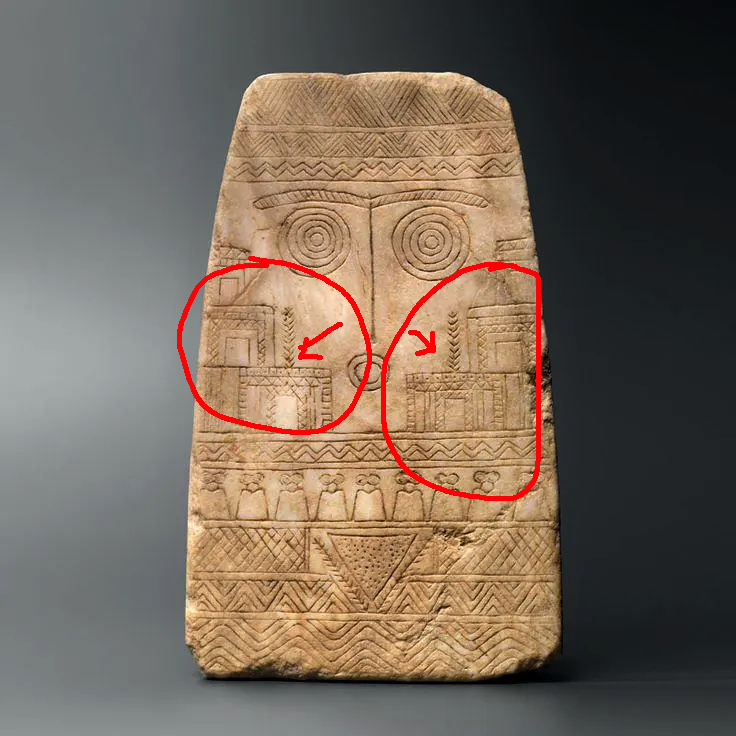
We are also supposed to see the buildings as temple granaries, again because of the grain symbols depicted on top of these buildings...

We are also supposed to see this feature as an irrigation canal. People from Mari used canal irrigation extensively...You can read more about it here...

In which case this is feature is supposed to be seen as the Euphrates river...

As for the little minions, they are supposed to be seen as people from Mari...I talked about them in my post "Eye idols from Tell Brak"...

To read more about ancient animal and plant calendar markers, start here…Then check my twitter threads I still didn't convert to blog post...I am way way behind...

Saturday, 30 November 2024

Clay boat from Shuruppak

Clay boat model dated to 2200-2000 BC from Shuruppak, modern Tell Fara, an ancient Sumerian city situated about 55 kilometres south of Nippur on the banks of the Euphrates. Currently in the Penn Museum...


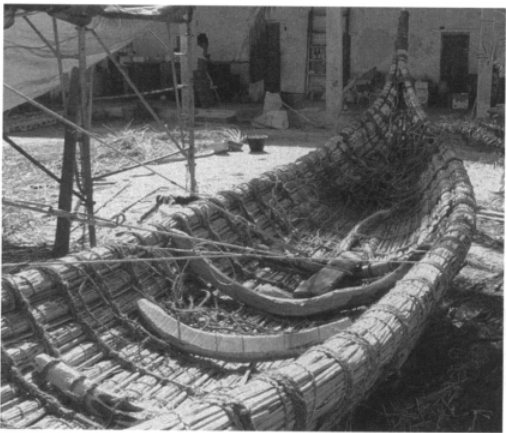
Here's the real thing, a boat made from reed bundles...

I talked about these boats in my post "Canals" where I talked about how knowing the best time to cut reed for boat building can helps us understand why the sun god Shamash is depicted with reed cutting knife.

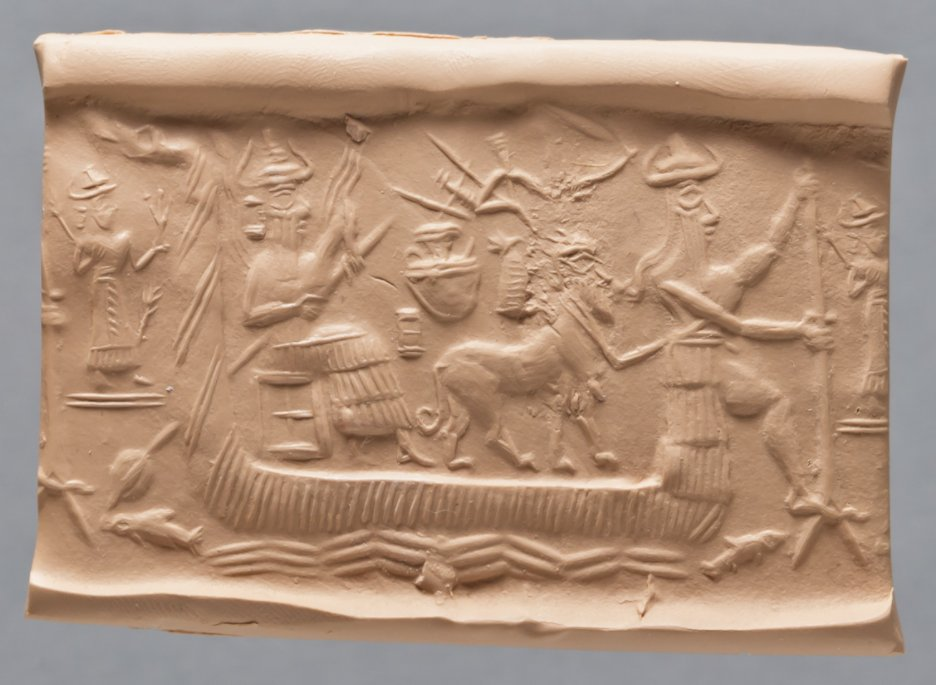
This is the same type of boat in which the god of water and annual flood is depicted sailing down Tigris and Euphrates...2300–2150 BC. 

Talked about it in my post "Enki's little boat" where I discussed interesting animal calendar markers from the poem describing Enki's boat trip...

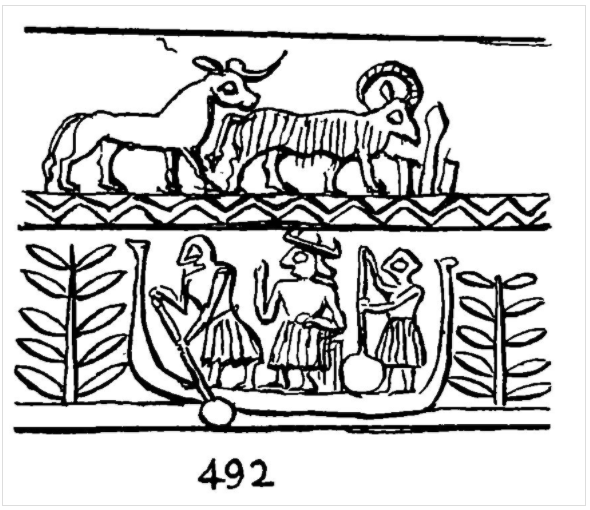
Here is the same Enki's flood boat, from a Sumerian Early Dynoastic seal, also depicting the goat (mating of wild goats, Oct/Nov, beginning of the wet season) and bull (calving of wild cattle, Apr/May, end of the wet season, beginning of the annual flood). 


I talked about it in my post "Rain and flood"...

This is also the same boat shown here as being Enki...I talked about this amazing seal in this post "Fertility goddess with poppies". Lots of animal and plant calendar markers everywhere...Including grain (important 🙂)...

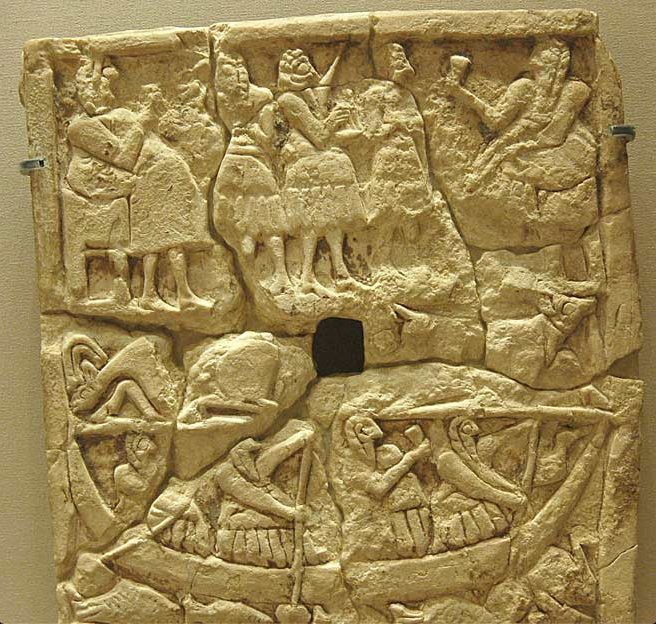
And the same flood boat depicted on this perforated votive limestone plaque dated to ca. 2700-2650BC currently in Louvre...I talked about this in my post "Feast plaque from Louvre"...

So boat from Shuruppak is the symbol of???

Look at this: "Shuruppak became a grain storage and distribution city and had more silos than any other Sumerian city"...

Boat in the Grain storage...Check this post, "A person in a little boat", about the same "Little boat" depicted on this Proto-Elamite tablet from Iran, dated to 3400-3100 BC...

Is that grain sticking out of the butt of the "person in the little boat"? Apr/May, the beginning of the flood, is also the beginning of the grain harvest, and Jul/Aug, the end of the flood, is also the end of the grain harvest...Interesting...

To read more about ancient animal and plant calendar markers, start here…Then check my twitter threads I still didn't convert to blog post...I am way way behind...

Sunday, 24 November 2024

Inanna in Egypt

Inanna in Egypt? Hmmm...


Recently, I discovered that Inanna was "associated with cattle and particularly calves"...Here is a depiction of the Inanna's "nuptial hut" as a calving hut, on a carved stone vase from  Khafajah. Pic from "The Three Faces of Inanna: an Approach to her Polysemic Figure in her descent to the Netherworld."

One of Inanna's appellations was "wild cow", and wild cows start calving in Apr/May, the time of the year marked by Taurus, the animal calendar marker which today means Bull, but which originally most likely meant Calf...


"...you were a baby, Assurbanipal, when you sat in the lap of the Queen of Nineveh (Ishtar/Inanna). Her four teats are placed in your mouth [Ishtar/Inanna is often pictured as a wild cow, so four teats are normal for her]..."

Inanna was also associated with grain and grain harvest.


This is Inanna speaking:

"Before my lord, Dumuzi,

I placed grain before him,

I poured out grain before him,

I poured out grain before my womb..."

Mother of grain...Link between female fertility and earth/grain field fertility...

Some posts about the symbol for grain and the Mother of grain in Neolithic Europe, Central Asia, Mesopotamia, Iran, Levant: "Mother of grain", "Altyn Tepe mother of grain", "A person in a little boat", "Sabi Abyad venus", "Hathor grain pendants"...


Apr/May, Taurus, is also the time when the water levels in Tigris and Euphrates peak. The time of the annual flood, and it is this flood that makes the land fertile...


Which is why Mesopotamian sun god Utu/Shamash was depicted as a golden bull (Sun in Taurus) with flowing lapis lazuli (flowing water) beard...

I talked about this in many of my posts. Like: "Lyres of Ur", "Shamash young and old", "When Utu steps up into heaven", "Butt chewing", "Maran"...

This is also the time when Sirius, the true star of Inanna (Elaborated on this in my post "Inanna and Sukaletuda") is last seen in the night sky, just before the sunset. Between Apr/May and Jul/Aug, Sirius is in the sky during the day, with the sun, and therefore invisible...

Sirius reappears in the night sky, just before dawn, in Jul/Aug...This is Ishtar, the destructive form of Inanna...

For those who will say "Ishtar was the morning star", yes she was, in Leo (Jul/Aug), when Sirius rose in the morning before the sun...Which is why Ishtar stands on a lion (with sun above the lion) and is known as "The Lioness of heaven"...

Destructive why? Cause of the Mesopotamian climate and the hydrology of Tigris and Euphrates. Jul/August is not just the hottest and the driest time of the year, but this is also the time when the two great rivers have the lowest water levels...

Sun God Utu/Shamash with sun (heat) rays emanating from his shoulders, standing in in an empty canal, in Leo (between the lions), the hottest, driest time of the year in Mesopotamia, and the time when canals were repaired, holding reed cutting knife...I talked about this in my post "Canals"...

The destructive sun in Leo is also symbolically depicted like this


Nergal, the deified destructive "burning" sun, was depicted as a lion man, because Jul/Aug, Leo, is the hottest and driest part of the year in Mesopotamia...


Talked abut him in my posts "Winged superhuman hero", "Lord of the flies"...

So here we have the same goddess with two faces, life giving (holy cow, Inanna, good) and life taking (holy lioness, Ishtar, bad)...And this switch can be perfectly explained through the Mesopotamian climate and Tigris and Euphrates hydrology...

And interestingly, we find the same thing in Ancient Egypt. A goddess with two faces, life giving (holy cow, Hathor) and life taking (holy lioness, Sekhmet)...I talked about this in my post "Holy cow"... 

Except, this switch can't be explained through the Egyptian climate and Nile hydrology...

The holy cow, the life giving Hathor, linked to water, grain, milk (calving), and her symbolism is easy to explain...


I talked a lot about it in "Holy cow" "White calf" "Cow and calf ivory", "Lotus and papyrus"

Hathor marks the "return of waters of the Nile".

The holy lioness, the life taking Sekhmet not so easy...Actually it is impossible to explain this switch in Egypt. Lioness should be a super positive, life giving goddess, because it is Leo, Jul/Aug, when the Nile flood peaks...

I already started wondering about the lion mythology in Egypt, and whether it originated in Mesopotamia in my posts "Sphinx" and "Giza lioness", "Sirius the mother of Venus"...

In there I explained why Atum, the Creator God of Egyptian world, created himself as a lion (Leo, Jul/Aug), after emerging from the primordial (read annual) flood (starts in Leo, Jul/Aug), the flood which makes land fertile without which there would be no Egypt...

I then talked about the Egyptian holy lioness, the precursor of the Sphinx, which again fits into the whole "lion(ness) good in Egypt"...

But for some reason, while writing these articles, I completely forgot about the murderous, destructive, Sekhmet...

"Cow good - Lioness bad" makes a lot of sense in Mesopotamia. 

"Cow good - Lioness great" would make a lot of sense in Egypt.

But...

What do you think?

To read more about ancient animal and plant calendar markers, start here…Then check my twitter threads I still didn't convert to blog post...I am way way behind...

Wednesday, 10 April 2024

Snake water bowl

Spouted silver bowl decorated with entwined serpents. Southeastern Iran Mid 3rd millennium BC. From Al-Sabah collection.

Why was this vessel decorated with entwined serpents? Here's what I think:

I already talked about this type of vessels in my post "Elamite water bull" about this Proto-Elamite silver figurine of a clothed anthropomophised kneeling bull...holding a spouted [water] vessel. c. 3000BC. Currently in the Met Museum...

My guess that this figure is either Enki (Sumerian god of sweet water) or Utu (Sumerian sun god)...Or their unnamed Elamite equivalent who possibly combines both of them in one...
They were both described as bulls. Why?
These are yearly charts of the water levels in Tigris and Euphrates. You can see that they both peak in Apr/May, Taurus, Bull...

BTW, Taurus here is The Old Taurus, the animal calendar marker for the beginning of the calving season of wild eurasian cattle...

This rise in water levels in Tigris and Euphrates is the result of the sun heating up of the mountains which are the source of the two great rivers: Anatolian highlands and the Zagros mountains...Which causes the snow to melt, which causes the rivers to swell...

Snowmelt, Zagros


Hence the humanoid bull holding a spouted water vessel...Which looks just like the vessel from the  Al-Sabah collection...

I talked about another water carrier figurine from Iran in my post "Water carrier equid", about this "Spouted Anthropomorphic Vessel", Western Iran, circa 1000-650 BCE. Currently in Los Angeles County Museum of Art...


Here the anthropomorphised animal water carrier is not a bull but an equid, horse or a donkey. Why? Cause equid mating season, starts in Apr/May, right when the water discharge peaks in the rivers in Mesopotamia/Iran...

But why was the vessel from the Al-Sabah collection decorated with entwined serpents?

First, snake is a solar animal, pretty much a universal symbol of the sun's heat. Snakes follow sun everywhere. They are in our world when sun is in our world (day, summer) and in the underworld when the sun is in the underworld (night, winter)...I talked about this in many of my posts. For instance "Snake god from Hatra"...

And it is the sun's heat that melts the snow...

Second, snake mating season, when snakes intertwine, starts in Apr/May, the time of the peak snowmelt runoff in Iranian mountains, and the peak discharge of the rivers in the Tigris/Euphrates system...

Which is why in the Deliver Me from Evil: Mesopotamian Incantations, 2500-1500 BC, By Graham Cunningham, we can read that in the Earliest Sumerian texts, Enki, the god of sweet flowing water and the source of Tigris and Euphrates, was associated with poisonous snakes...

Hence Enki (Or at least Elamite equivalent of Enki) sitting on a snake throne....

And which is why I think the [water] vessel from the Al-Sabah collection is decorated with entwined serpents...

Great info can be found in this X thread by @dalaygiz

“Twenty different officiants are attested in connection with Napiriša. Their designations vary from simple šatin (4) and makuš (7) to (makuš) pirramadda (3) and (makuš) haturmakša; their names are all Iranian except for two.”

“Elsewhere, the same individuals are associated with a range of other sacrifices, including sacrifices for or at various mountains, for Adad, Auramazdā, Išpandaramattiš, and (the) Mišebaka.”

(‘The Heartland Pantheon’, Henkleman, pg 1229)

“The syllabic spellings of the name (AN na‐pír‐šá‐ra, AN na‐pír‐ir‐šá‐ir‐ra) follow the development riša > irša, “great,” suggesting that the name of the god was still understood as a compound (logographic spellings: AN dingir.gal MEŠ, AN gal MEŠ).”

The origins of Napiriša, attested since the early second millennium BCE, may lie in the eastern highlands of Elam. This may also account for his popularity in the PFA*. 

The water‐giving god and his wife are shown here at the open‐air sanctuary of Kūrāngūn:

It’s majorly held for the figures above that they are Napiriša (or Napiriša‐Inšušinak) and his spouse Kiririša, the ‘Great Goddess’ of Liyan/Būšehr. 

Also, Mesopotamians identified “Naprušu/Napriš” as their own Ea/Enki.  

(‘The Heartland Pantheon’, Henkleman, pg 1228)

*Persepolis Fortification Tablets 

This deity is attested for 26 times and given Iranian epithets.

Here’s the Kurangun relief, which depicts a horned Elamite deity seated upon a snake-coiled throne. 17th century BCE. It’s in Fars, Iran. 

“He is seated on a throne formed by the body of a snake, coiled back upon itself over and over again, and he grasps the tail of the snake in his left hand. In his right he holds the divine rod and ring [my comment, he is not holding rod and ring, he is holding a cup, just like Enki/Ea] from which two streams of water flow [...]” 

(D.T Potts, From Handaxe to Khan, 1990, pg.146) 

You can read more here: The numinous and the immanent

Snakes did appear a lot in Elamite art...

"In terms of identification, he has been called Inshushinak, who was the patron of Susa anyways. Enki/Ea/Napirisha are mentioned as well; the author deduces that these names/figures are all in fact related, with the former being used as epithets, besides the shared identity"...


That's it. To read more about ancient animal and plant calendar markers, start here…then check the rest of the blog posts related to animal calendar markers I still didn't add to this page, and finally check my X threads I still didn't convert to blog post...I am 9 months behind now...