Showing posts with label Grain symbolism. Show all posts

Friday, 16 October 2026

Mother Earth from Revadim

A clay plaque of the Mother Earth, from the Late Bronze Age, Found in Revadim, Levant, dating around 1250 BC. Similar terracotta plaques have been found in archaeological excavations in sites like Tel Harasim, and Tel Aphek. 

The Revadim mother earth is depicted:

1. With a prancing Ibex goat facing a tree on each of her legs...

2.  Spreading her vagina...

3. Nursing people...

4. Wearing a crescent moon necklace pendant...

Why?

Let me try to decipher these symbols in this post:


The Revadim mother earth is depicted:  

1. With a prancing Ibex goat facing a tree on each of her legs...

The reason why rampant Ibex goats are depicted facing trees (of life) is because the climate in Levant is divided into hot, dry half (Apr/May-Oct/Nov) and cool, wet half (Oct/Nov-Apr/May)...


The rains, which support (the tree of) life in Levant, arrive when male Ibex goats start their mating fights over females, in Oct/Nov...

So prancing (fighting) ibex goat became an animal calendar marker for the start of the rain season...

This is why we also find two prancing ibex goats facing the tree of life on this pottery vessel, a ewer, from the Fosse temple at Lachish, Levant, dated to the 13th century BC, which also bears an inscription on the shoulder which reads from left to right "Mattan (the donor), an offering to my lady ’Elat"...

I talk about this amazing animal calendar in my post Lachish animal calendar

Here is another vessel from the Fosse temple at Lachish also dated to the 13th century BC. On this vessel we see two rampant goats facing not a tree, but a vulva...Vulva is the symbol of fertility number one...Obviously...Easy to understand why...

Vulva is used on a lot of ancient artefacts to represent the fertility of the land. And here this is explicitly spelled out: mating goats of rain, rain which makes land fertile, facing vulva, symbol of fertility...

Please note that the tree of life surrounded by prancing Ibex goats is on the Lachish vessel depicted in a shape of Menorah...Just like here, on this 3,000 BCE Sumerian Stamp Seal with Impression Tree of Life with Rampant Goats. Mesopotamia. Chicago. Oriental Institute Museum...

I talk about the link between Menorah and the Tree of life and the Hanukah that is celebrated in Tevet, Dec/Jan, the "muddy month" (peak of the rain season in Levant) which is marked by the goat mazal (which marks Dec/Jan, middle of the Ibex goat mating season)...in my post The Tree of Life/Light...

The tree of life also resembles menorah here too, on this super cool Bactrian bronze stamp, dated to 2400BC-1600BC...And again it is surrounded by prancing Ibex goats...

I talk about it in my post Bactrian Bronze Age menorah...

The tree of life surrounded by prancing Ibex goats was also depicted on this seal found in Alalakh/Tell Atchana, located 20 km from Antakya (Antioch) in what is now Turkey's Hatay Province. It was found in one of the rooms of the Level VII (c. 1800BC) palace...

I talk about it and another similar find from the same site in my post Pottery shard from Alalakh...

Same climate, same animals, with the same behaviour, same animal calendar marker, which later gets deified...And eventually into a god...

Elamite bronze idol of a (goat-) man with large ibex horns, 3rd-2nd millennium BC...

I talked about this transition, which is found all over the world, in my post Kuseh Gardani about the traditional Iranian "Kuseh Gardani" ritual, which is performed by men dressed as Ibex goats, in times of drought or low rainfall...

"Kuseh" (rain god turned devil of drought)...

The Revadim mother earth is depicted:

2.  Spreading her vagina (giving birth to all things)...


Bedrock is in the Balkans known as "živi kamen, živa stena" (living stone, living rock) because it is believed to be still part of the living body of the Mother Earth which gives birth to all life...I talk about it in my post Living stone...

I think this belief was what lied at the core of all mother goddess all over the world. Because:

"Man — despite his artistic pretensions, his sophistication, and his many accomplishments — owes his existence to a six-inch layer of topsoil and the fact that it rains."

What is the best way to symbolically depict "Mother Earth"? Place mountains, plants and animals between eyes and  a pubic triangle. Decorated bone depicting slightly bewildered "Mother Earth", 6th - 5th millennium BC, Hagoshrim, Southern Levant. I talked about this in my post Eyes...

Or in the case of the Revadim mother earth, place the "goat of rain" and a "tree of life" on her thighs, just below here vagina, the source of all life...

This Revadim Goddess is believed to be the earliest depiction of Asherah, who herself is just another name for Inanna/Ishtar...

Remember what Inanna, Sumerian Mother of Grain, said in "The Courtship of Inanna and Dumuzi":

"...Before my lord, Dumuzi,

I poured out plants from my womb.

I placed plants before him,

I poured out plants before him.

I placed grain before him,

I poured out grain before him,

I poured out grain before my womb..."

I talked about "Mother of Grain" in many of my posts...

So I think that the Revadim goddess could be depicted giving birth to food (grain)...

This is explicitly depicted on this gold pendant, dated 1400-1200 BC. It is 4.9 cm in height and was found in Ugarit, Syria. Louvre Museum, Paris, France. See grain growing out of the Goddess's pubic area? Another very common symbol found all over Central Asia, Mesopotamia, Iran, Levant, Aegean...

I talked about this in my post Hathor grain pendants...

BTW, do you see how the trees (of life) depicted on Revadim Goddess's thighs, one on each side of her vulva, look like grain ears?

Just like the grain ears depicted on the (possibly) the earliest (symbolic) depiction of Demeter (Vulva/Mother surrounded with grain ears)...

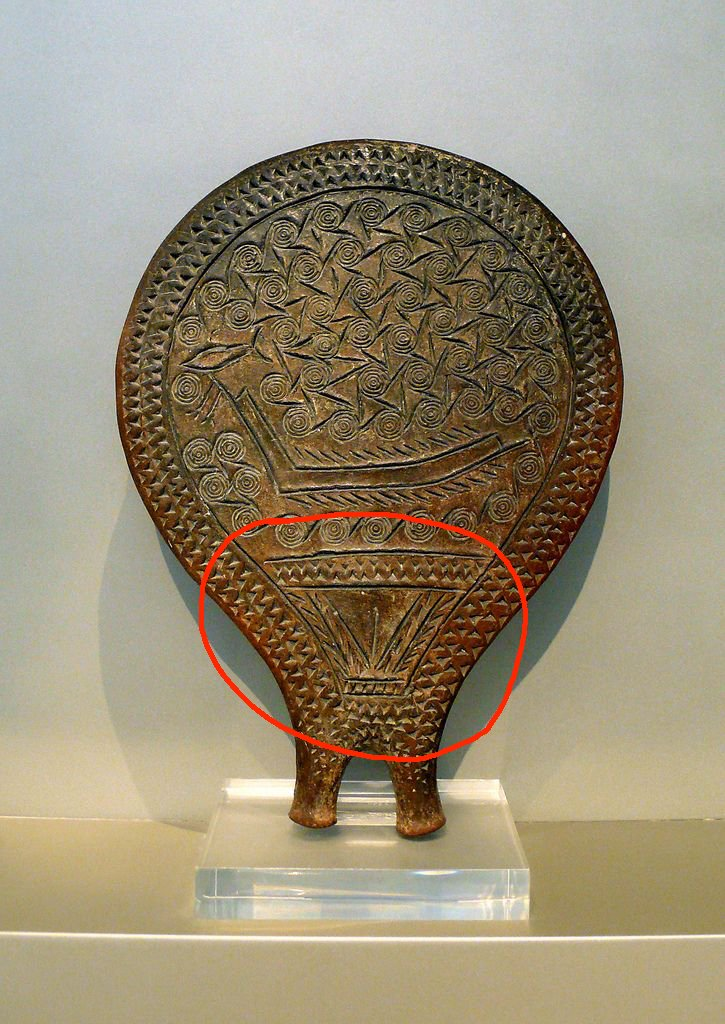
This symbol is hidden in plain sight on one of many mysterious Early Cycladic "Frying Pans" found on Cycladic islands in Greece and dated to the second half of the 3rd mill BC...

I talk about it in my post The oldest Demeter depiction...

The Revadim mother earth is also depicted:

3. Nursing (her) people...

What is the milk of the Mother Earth? Spring water of course...

And considering that Asherah was called the "Divine Nurse" of gods and people...

This image shows few of thousands of similar pillar figurine of Asherah, found in house shrines from the Iron Age II period (8th–7th century BC) Levant...

I talk about "the milk of the Mother Earth" in these two posts, Mesa Mouliana vessel and Anavlochos mountain, where I talk about Cretan version of the same goddess, where similar figurines were found deposited inside cracks on limestone mountain peaks (remember living rock, the body of mother earth):

The Revadim mother earth is finally depicted:

4. Wearing a crescent moon necklace pendant...

I wonder if this is "The Wet Moon", the Winter/Spring (Wet Season) Moon...Just depicted inverted...Pouring water on the Mother Earth...

Wet Moon?

During the winter, the ecliptic plane intersects the western horizon at its steepest, most vertical angle at sunset. Because a waxing crescent Moon follows right behind the Sun along this steep line, it sits directly above the Sun. This makes the crescent look like a upright bowl (the "wet moon") that sinks straight down into the horizon...

I talk about the Wet Moon and why Moon Gods were so important in places where winter is the rainy part of the year, like Mesopotamia, Iran, Levant, Northern Arabia in many of my post...

Also, guess what else happens in Dec/Jan, around Winter Solstice, the peak rain season in Levant, the peak Ibex mating season in Levant, when the Wet Moon starts shining in the night sky?

Sirius, the original Star of Inanna/Ishtar/Asherah..., reaches its highest point in the night sky... 

Ever seen this symbol?

I talked about Inanna/Ishtar and why it was Sirius that was her original "star" in Sirius mother of venus, Inana and Sukaletuda, The brightest star, Inanna in Egypt, Temple of Isis on Philae Island, Apocalypse, Whore of Babylon, Dog coin...

I think this is all I have to say about this clay plaque of the Mother Earth, from the Late Bronze Age, Found in Revadim, Levant, dating around 1250 BC. And why she was depicted 

1. With a prancing Ibex goat facing a tree on each of her legs...  

2.  Spreading her vagina...  

3. Nursing people...  

4. Wearing a crescent moon necklace pendant...


To read more about ancient animal and plant calendar markers, start here…Then check my twitter threads I still didn't convert to blog post...I am way way behind...

Saturday, 7 March 2026

Ultime grida dalla savana

Petroglyph, Wadi Mathendous, Libya

After the mandatory giggle, let's think what this image could represent?

Remember this? "We owe our existence to a six-inch layer of topsoil and the fact it rains".

My guess is that in places like Libya, where life depends on rain, life is created by Sky (Father) inseminating (raining on) Earth (Mother)...

I talked about this in several of my posts: "Riddle", "Living nature", "An Ki Ankh"

Srbska zagonetka: Visok otac, široka majka = nebo i zemlja 🙂

Serbian riddle: Tall (high) father, wide mother = sky and earth 🙂


Father Sky and Mother Earth creating Life, preserved in Serbian tradition.

Because of the above identification of Sky = Father = Male and Earth = Mother = female, in many cultures around the world we find symbolic and ritual linking between:

Male fertility (ability to produce semen), sky fertility (ability to produce rain), seed and sowing...

Female fertility (ability to conceive after being inseminated), earth fertility (ability to grow plants after them being sown), fruit and harvesting...

I talked about this in my post "Sowing", in which I discussed this strange Serbia custom: In Serbia in the past people lived in extended families called "zadruga". When grain needed to be sown, the family would choose one man to do all the sowing. He had to abstain from sex from that moment until all the seeds were sown...

This brings me to a great Italian documentary I saw years ago, "Ultime grida dalla savana" ( Final Cry of the Savanna) which was in 1975 directed by Antonio Climati and Mario Morra...

And in it, if my memory is serving me right, they showed men from some African tribe, ritually inseminating Mother Earth, by each digging a small hole in the ground, lying down over it and...

Basically ritually playing the role of the Sky Father...

Sunday, 18 May 2025

The oldest Demeter depiction

So...How old is the oldest depiction of Demeter, Greek Mother of Grain? How about 4500-4200 years old? Do you want to see it? Here she is in all her glory...

Mother (vulva) surrounded with grain...This symbol is hidden in plain sight on this strange object. This is one of many mysterious Early Cycladic "Frying Pans" found on Cycladic islands in Greece and dated to the second half of the 3rd mill BC

I talk about this particular frying pan, in my post "Tuna boats" about Bronze Age Cycladic tuna fishermen, in which I was discussing the ancient fishing/sailing calendar for the Cyclades. A lot of these "Frying Pans" depict boats, tuna fish and swirling waves...

And of course I completely missed the most important bit: vulva surrounded with grain, symbolic depiction of the Mother of Grain...

We know that this has been a grain symbol in Eastern Mediterranean, Mesopotamia, Central Asia, Iran, since at least Sumerian times...

I talk about this symbol being used in combination with vulva to depict the mother of grain in many of my posts. Like this post, "Arjoune Venus", about the 6th mill BC Halaf culture figurines from Syria. This one has vulva on front and ears of grain on the back...

We even have this symbol described in "The Courtship of Inanna and Dumuzi" where Inanna, Sumerian Mother of Grain, says:

Before my lord, Dumuzi...

I poured out grain before my womb...


I talked about this in many of my posts...

BTW, we find the same symbolism (grain before womb) described in the Greek legends about Baubo and Demeter...I talked about this in this recent post "Baubo", in which I explain why she is one of the most misunderstood figures from Ancient Greek mythology. 

This is one of many "Baubo" figurines which were found in the Sanctuary of Demeter and Kore at Priene and dated to the 2nd c. BC. 

The fact that we find the earliest use of this symbolism in the Fertile Crescent is important. You'll see why soon.

Anyway, I suddenly remembered the vulva with grain "detail" from our Cycladic "Frying Pan" while I was writing my post "Poseidon pursuing demeter", in which I gave symbolic analysis of this Tetradrachm minted in Byzantium, Thrace, ca 240–220 BC, which depicts veiled head of Demeter, wreathed with corn and Poseidon seated right on rock, holding aphlaston in extended right hand and trident over shoulder. 

In it, I tried to answer the question: why were Demeter, Goddess of grain harvest (season) and Poseidon, God of sailing (season) paired together? As horses?

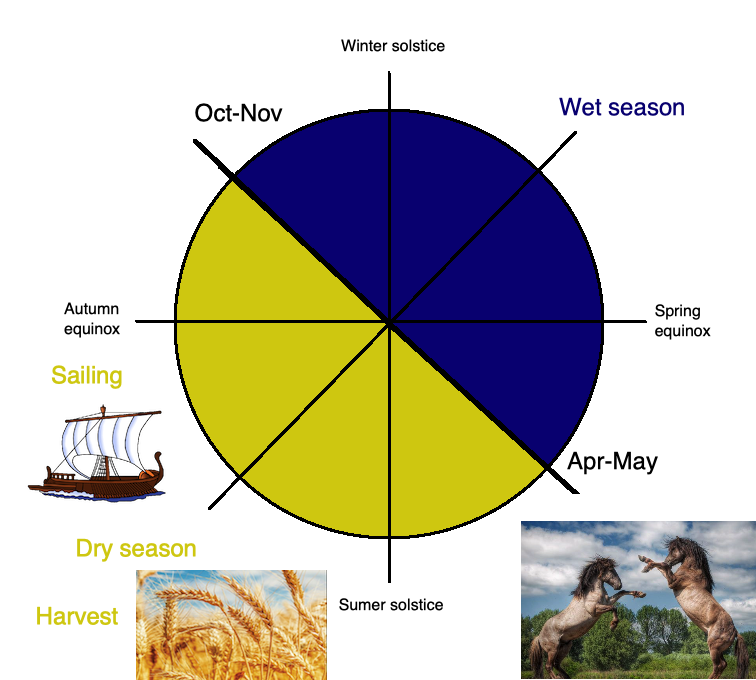
Basically, horse mating season, Apr/May-Sep/Oct overlaps with both grain harvest and sailing season in Ancient Greece...

Hence the link between Demeter (Mother of grain), Persephone (Grain) and horses. Here is Demeter in her horse-drawn chariot with her daughter Persephone, driving between two prancing stallions. 🙂 Selinunte, Sicily 6th c. BC

And the link between Poseidon and horses. I talked about this link in my posts "Trojan horse", "Three sacrifices", "Tetradrachm from Byblos", "Seahorse ring"...

Anyway, I expanded on it in my post "To sail - To harvest", about the heliacal rising of Pleiades being a calendar marker for the start of both harvest and sailing season in Ancient Greece...Greek name "Πλειαδες" comes from πλεω, which means "to sail"...

I think we find proof for this link between the goddess of grain (harvest) and god of the sea (sailing) in Minoan Crete in the 2nd mill BC.

Actually goddesses of grain, Persephone (grain seed) and Demeter (grain harvest)...

Here they are, in a horse drawn chariot, depicted on a late Minoan limestone sarcophagus, dated to around 1400 BC, excavated from a chamber tomb at Hagia Triada, Crete, Greece...

I just remembered I wrote a whole post, "Agia Triada Sarcophagus", about this a while back where I actually talk about this link between Poseidon, Demeter, Persephone and horses in detail. I am getting old and forgetful...

This link between grain harvest season (Demeter) and sailing season (Poseidon) is I think what is depicted on our Cycladic "Frying Pan":

Tuna fishing boat (Poseidon)

Vulva surrounded with grain (Demeter)

What do you think?

But 🙂 there is something that makes me wonder...

This stele, most likely from the ancient city of Mari in Syria, depicts the Mother of Grain in exactly the same symbolic way...And dates from...🥁🥁🥁...the beginning of the third mill BC...Pretty much the same time as our Cycladic "Frying Pan"...

I talk about this amazing object in my post "Mother of grain from Mari"...

So what I am wondering is, does the vulva surrounded with grain depicted on our Cycladic "Frying Pan" depict Demeter...Or maybe her Levantine double, Inanna/Ishtar/Asherah/Astarte...

I already talked about the possibility that the 2nd mill BC Mycenaean Greeks worshipped Asherah who eventually turned into Demeter in my post "Cup of Nestor"...

Cup from Mycenae with doves. 

And the lions flanking a pole depicted above the main gate of the Mycenae fortress.

Interestingly, Asherah, who was symbolically depicted as an Asherah Pole, was associated with both lions and doves...And so were Inanna and Demeter...

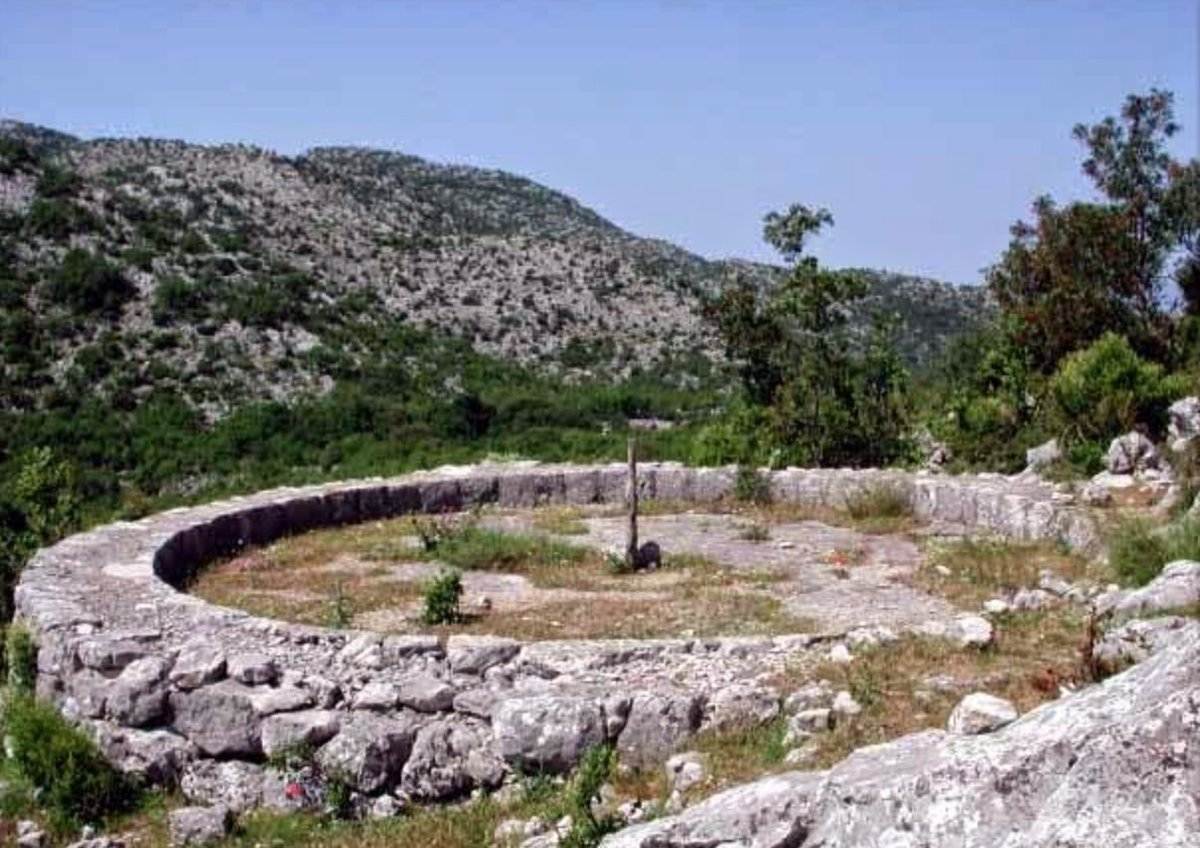
Asherah the goddess represented as a wooden pole erected on "high places". We have no idea what this means, but I have a hunch that the "high places" were threshing floors and that Asherah poles were central poles of the threshing floors...

I talked about this in my post "Sacred marriage on the threshing floor"...

And this is what Homer says about Demeter and threshing floors:

"And even as the wind carries chaff about the sacred threshing-floors / of men that are winnowing, when fair-haired Demeter / amid the driving blasts of wind separates the grain from the chaff"...

Which is why Eugene Vanderpool in "ΕΠΙ ΠΡΟϒΧΟΝΤΙ ΚΟΛΩΝΩΙ: The Sacred Threshing Floor at Eleusis" proposes that threshing floors were sacred to Demeter and were in fact her temples...I talked about this in my post "Demeter riding panther"...

But as we can see from the our "Frying Pan", I think that this "Mother of Grain" from the Fertile Crescent came to Greece much earlier...In the 3rd mill BC. Via Greek Islands...Already linked with the god of the sea...

Look at this:

Asherah's son is Yam, god of the sea, or more precisely Yam, deified sea itself. And because of all this, Asherah's title "Rabat Athirat Yam", found in the Baal Cycle, can be translated as "Lady Aṯhirat (Asherah) of the Sea"...

The same sea god Yam, who in Phoenician and Canaanite mythology, was associated with horses?🙂

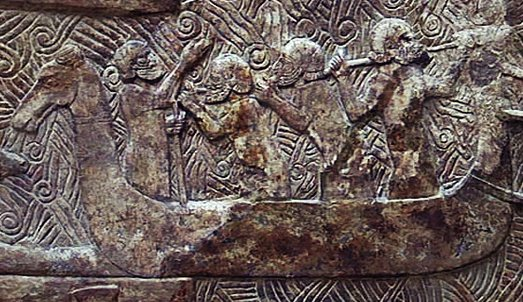
Phoenician ships often adorned with horse heads as tributes to Yam, who was believed to be appeased with such offerings to prevent destructive storms.

Reproduction of a Phoenician ship from the Archaic era, called a hippoi by the Greeks (due to the horse head at the bow), carved in bone, c. 11th-9th centuries BC, Ifergan Collection, Malaga, Spain (2019)

I talked about this in my post "Trojan horse", in which I asked a question: was Trojan horse "hypos" - a wooden horse left as tribute, or  "hypos" - a wooden boat with a horse head used for transporting tributes...

And in this article I also pointed at this "coincidence":

In the Phoenician religion, there was a tripartite division of power between Baal (Storm god), Mot (God of death) and Yamm (Sea god)...

This "seems to have" (first understatement of a millennium) influenced the Greek division between Zeus (Storm god), Hades (God of death) and Poseidon (Sea god)...

Are you kidding me? How many other tripartite divisions of power like this do we have?

It "is possible" (second understatement of a millennium) that Poseidon/Neptune was directly inspired by a Phoenician counterpart Yam...

Is Asherah/Astarte then "inspiration" for Demeter? I just realised I wrote another post, "Goddess on a horse", about this 13th c. BC levantine gold plaque, depicting a lady on a horse, probably Astarte or Anat (according to Israel Museum), who was linked to grain and sailing...

Sooooo...What do you think of all this? 

The oldest symbolic depiction of Demeter and Poseidon? 

Or 

The oldest depiction of Asherah and Yam?

Or both?

I hope you had fun reading this thread. I definitely had a lot of fun researching it, thinking about it and writing it...

That's it. To read more about ancient animal and plant calendar markers, start here…Then check my twitter threads I still didn't convert to blog post...I am way way behind...

Thursday, 15 May 2025

To sail - To harvest

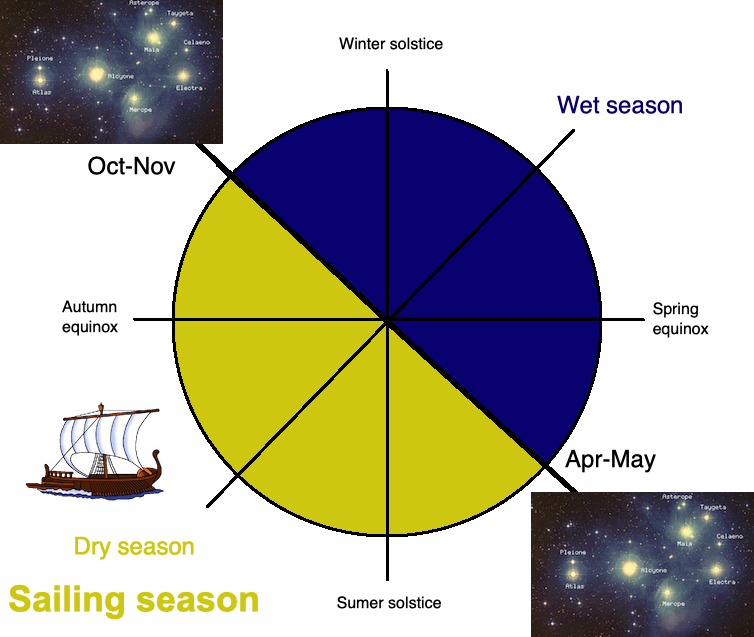
In Ancient Greece, the heliacal rising and setting of Pleiades, whose ancient Greek name "Πλειαδες" comes from πλεω, which means “to sail”), was used as a calendar marker for the beginning and the end of the sailing season...


Heliacal rising and setting of Pleiades marks (roughly) the beginning and the end of the "good sailing winds" season. Winds caused by the sun, heating up the Eastern Mediterranean, and creating an updrift, which sucks the cooler air from Europe to start streaming southward...


I talked about this first in my article "Trojan horse", in which I asked a question: was Trojan horse "hypos" - a wooden horse left as tribute, or  "hypos" - a wooden boat with a horse head used for transporting tributes...

In this article I also explained the link between Eastern Mediterranean Sea gods and horses: The start of the horse mating season marks the start of the sailing season in the Eastern Mediterranean...

For those interested, I also talked about the Etesian winds in my article "Three sacrifices" about human sacrifices made "for good winds" at the beginning and the end of the Trojan war. And about animal and plant calendar markers from the description of these sacrifices, that can help us determine when the Trojan war started and ended...

And I also talked about the Etesian winds, in my article "Anat" about this Semitic "warrior" goddess worshipped by the Canaanites & Egyptians during the Bronze and Iron Ages...

Anyway, after a while I wrote this article, "Demeter with dove", in which I explained why Dove was sacred to Demeter. The reason for that is that nesting season of doves overlaps with the grain harvest season...

After that I wrote this article, "Pleiades", in which I explained this strange Greek legend about the origin of the Pleiades constellation.

According to the Greek mythology, the Pleiades are the seven daughters of Atlas

whom Zeus transformed first into doves

and then into stars...

Why first into doves and then into stars? Animal calendar markers of course...

And in it I also wrote that the Heliacal "Rising" and "Falling" of pleiades divided Greek year into two halves: grain growing agriculture season (Oct/Nov-Apr/May) and sailing season (Apr/May-Oct/Nov)...Kind of important...

Oct/Nov being the time when grain sowing season started and Apr/May being the time when grain harvest season started.

And Apr/May being the time when sailing season started and Oct/Nov being the time when the sailing season ended.

And then last week I wrote this article, "Poseidon pursuing Demeter",  in which I explained the meaning of the strange legend about Poseidon as a stallion eloping with Demeter as a mare...

Poseidon pursuing a woman, 480-450BC. Currently in the Metropolitan Museum of Art, Manhattan NY...


Could this unidentified "woman" actually be Demeter? 

And in it I pointed that horse is an (animal) calendar marker which links the beginning of the grain harvest (Demeter) season and sailing (Poseidon) season...

It just occurred to me today that doves/pleiades is another (animal) calendar marker that links beginning of the grain harvest (Demeter) season and sailing (Poseidon) season...

That's it. To read more about ancient animal and plant calendar markers, start here…Then check my twitter threads I still didn't convert to blog post...I am way way behind...