Showing posts with label Bactria. Show all posts

Wednesday, 15 May 2024

Bactrian bronze age menorah

Today I stumbled across this super cool Bactrian bronze stamp, dated to 2400BC-1600BC...

It depicts a motif, found in Eastern Mediterranean, Levant, Mesopotamia, Iran, Central Asia, of two rampant male ibex goats flanking the tree (of life)...
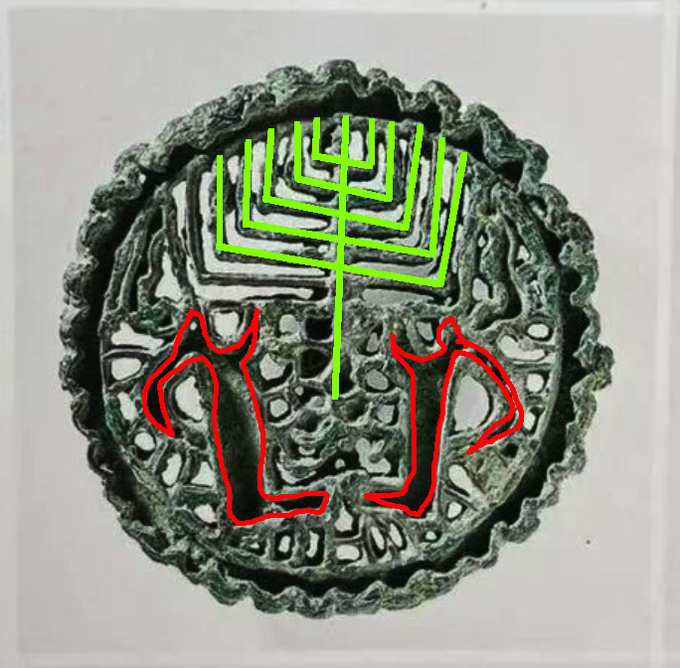
Why are ibex goats flanking the tree of life?

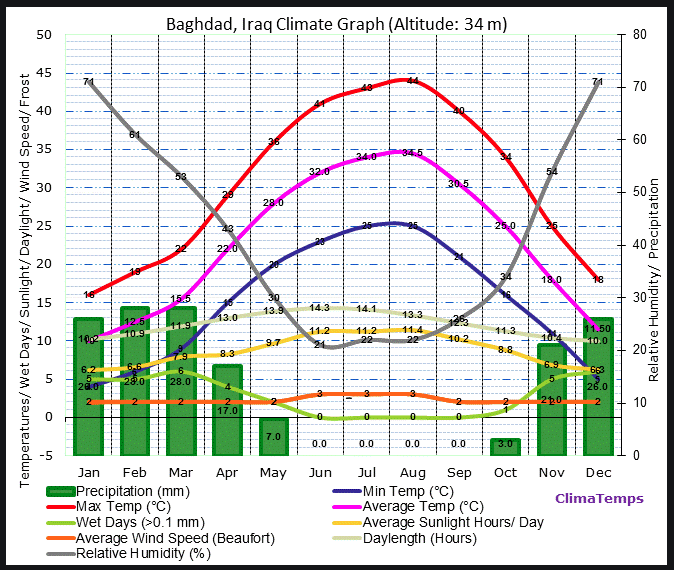
Climate charts for BMAC (Bactria-Margiana) Turkmenistan, Afghanistan, Uzbekistan, Tajikistan.


In this part of the world, the climatic year is divided into hot/dry summer (Apr/May - Oct/Nov) and cool/wet winter (Oct/Nov - Apr/May)...

Interestingly, Oct/Nov is also the time when male ibex goats start their ferocious mating fights...

And because the wet season in these parts of the world starts when ibex goats start mating, ibex goat became an animal calendar marker for the beginning of the rain season...

And because it is the rain and snow (as spring snowmelt runoff) that are the source of life in these otherwise dry areas...

And because "people are very good at noticing patterns in nature and very bad at distinguishing between correlation and causation", ibex was turned from goat that mates when it rains and snows into a goat whose mating brings rain, The Goat of Rain...

One more example of the tree of life with goats from Central Asia

Goats flanking the tree of life. Ritual vessels from Gonur-depe, the administrative and ritual center of Ancient Margina, the Northern regions of the Oxus civilization, dated to 2300˗1600 BC. Pic from this article...


Now the shape of the original Bactrian tree of life is very interesting...It reminds me very much of the tree of life from this 3,000 BC Sumerian Stamp Seal with Impression Tree of Life with Rampant Goats. Mesopotamia. Chicago. Oriental Institute Museum...I talked about it in my post "The tree of life/light".


BTW in Mesopotamia rain/snow also arrives when goats start dancing, in Oct/Nov.
And these depictions of the tree of life flanked by rampant goats also reminds me very much of this depiction of the same scene from a pottery vessel, a ewer, from the Fosse temple at Lachish dated to the 13th century BC, bears an inscription on the shoulder which reads from left to right "Mattan (the donor), an offering to my lady ’Elat". 
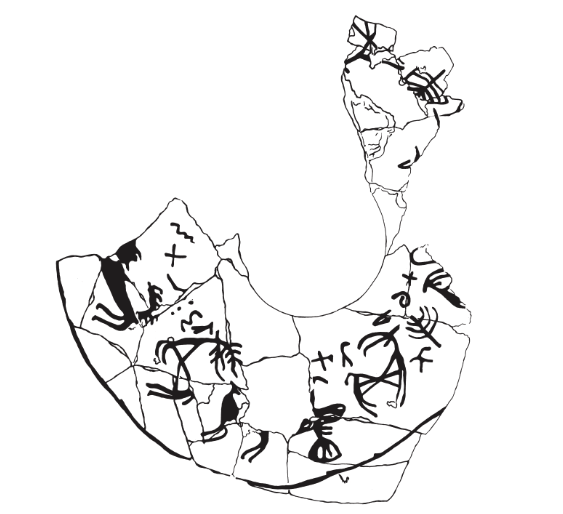

I wrote full analysis of this amazing object in my post "Lachish animal calendar"...

Interesting right?

More examples of ibexes flanking the tree of life from

Mesopotamia

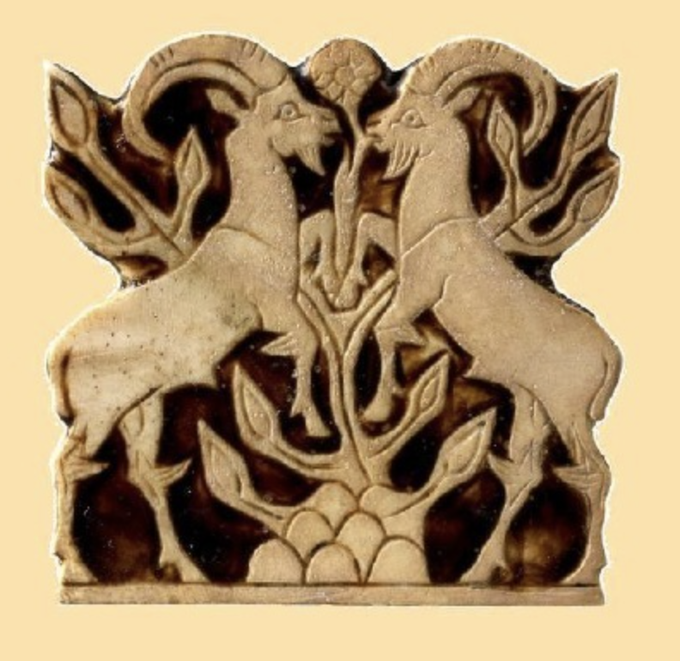
This is a shell plaque found in Queen Pu-abi's tomb dated to c. 2600 BC. It shows ibexes rearing up on their hind legs on both sides of the tree of life topped by the eight-pointed rosette...I talked about this in my post "Shell plaque with ibexes"...

Turkey

Wall painting from a house in Çatalhöyük (7500-6500 BC) showing a fruit tree and ibexes/wild goats...I talked about this in my post "Goats and tree of life from Catalhoyuk"...

Turkey again

A seal impression found in Alalakh/Tell Atchana, located 20 km from Antakya (Antioch) in what is now Turkey's Hatay Province. It was found in one of the rooms of the Level VII (c. 1800BC) palace...It depicts two ibex goats flanking the tree (of life)...I talked about this in my post "Goats with tree of life from Alalakh"...

Also Turkey

Hittite, half oval plaque, two goats and palmetto tree, Tell-Halaf, 900 BC, Museum of Oriental Antiquities, Istanbul...

Iran

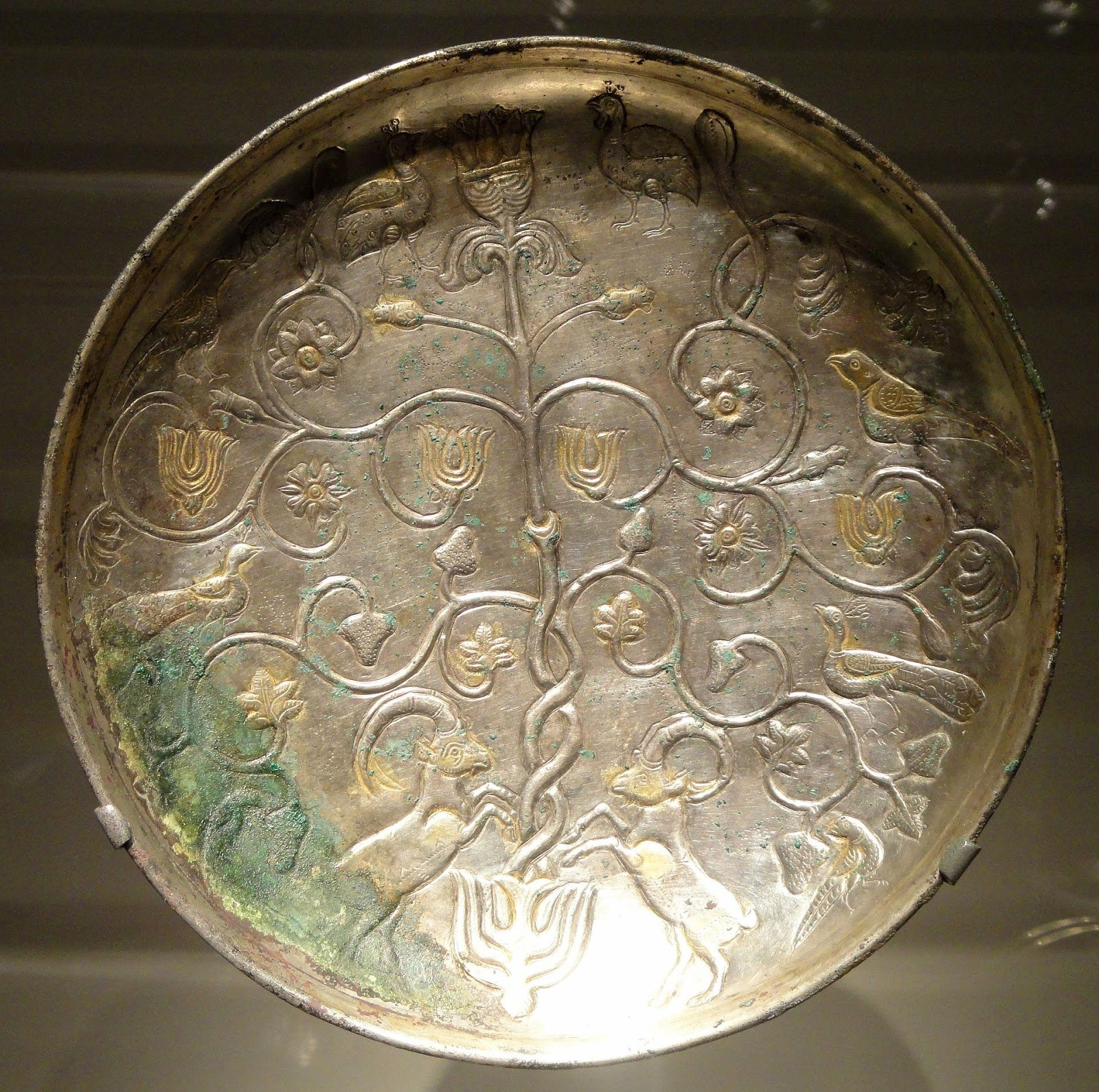
Sassanian dish which depicts the tree of life, flanked by two ibex goats, the goats of rain...From my post "Rainbows and peacocks"...

Minoan Crete

Two ibex goats flanking an olive tree (of life). I talked about this in my post "Goat riding thunder god"

To read more about ancient animal and plant calendar markers, start here…then check the rest of the blog posts related to animal calendar markers I still didn't add to this page, and finally check my twitter threads I still didn't convert to blog post...I am 9 months behind now...

Saturday, 4 December 2021

Admetus

Apollo mounting a chariot drawn by lions and boars, accompanied by Hermes and two women...


This is a flattened out decoration from this Ancient Greek, Attic black-figure Lekythos, dated to ca. 500-490 BC, and currently kept at the Yale University Art Gallery.

The depicted scene is from the legend of how Admetus got to win the hand of Alcestis. Which goes like this:

"When Apollo was sentenced to a year of servitude to a mortal, as a punishment for killing Delphyne, the monstrous serpent (dragon) from Delphi, the god was sent to serve as a herdsman at the home of Admetus, the king of Pherae in Thessaly...

Admetus was famed for his hospitality and justice and treated Apollo very well. In return, Apollo made all the cows bear twins while he served as his cowherd. But more importantly, Apollo also helped Admetus to get the girl. Alcestis...

Alcestis was the daughter of Pelias, king of Iolcus. She was so popular, that her father Pelias, bored with constant procession of suitors, set an apparently impossible task for those who wanted the hand of his daughter: they must yoke a boar and a lion to a chariot...

Of course Admetus also fancied Alcestis. So he asked Apollo for help. Apollo said "No bother!", and yoked the animals to the chariot. Admetus jumped on it, drove to Iolcus, waved at Pelias and said: I came for the girl! (while winking at Alcestis)...Happy End...(well for a while)

So how come no one but Apollo could yoke boar and lion to a chariot? I mean is it important that it was Apollo who did "the impossible thing", or could any other god have done it?"

I think that this is another example of a clever animal calendar marker allegory...Involving boar, symbol of winter and lion, symbol of summer...


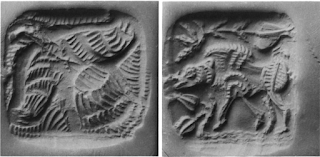
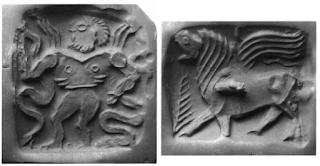
We find the same animals used symbolically in the same way on these two Bactrian seals:


I talked about them my article "Bactrian summer and winter seals", where I explained how boar and lion, became calendar markers for winter and summer...

Being symbols of winter and summer, the two opposite "old seasons of the oldest calendars", boar and lion can never be "yoked together"...Except by the Sun god...After all, winter and summer are just two halves of the same solar year...

Thursday, 11 November 2021

Tulip goddess

Seated female figure (goddess? ) drinking out of a goblet - next to a tulip, bronze seal, late 3rd - early 2nd millennium BC, (BMAC), Afghanistan. Currently in a Private collection Linenthal, San Francisco. 


Just a pretty picture or...? Who is this girl?

Mobile perfume or cosmetic bottle, winged goddess among flowering tulips. Bactrian, the end of the 3rd, beginning of the 2nd millennium BC, Louvre Museum...

Tulips grow wild in Central Asia and bloom in Spring...So who's the goddess? The zigzag and wavy lines at the top usually represent flowing water. So is the goddess somehow linked with the flowing water?

Bactria was centered around the upper reaches of  Amu Darya (Oxus River). This river was fed 


Amu Darya (Oxus River) is partially fed by the rain that falls during the cool, wet half of the year (Oct/Nov-Apr/May)...


Climate Tajikistan

Climate Uzbekistan


Climate Afghanistan


But the majority of the water in the river comes from the snowmelt from the Hindu Kush, Tian Shan and Pamirs mountains. 


Total snow melt contribution is between 65 and 72%...


You can read more about this in "Runoff from glacier ice and seasonal snow in High Asia: separating melt water sources in river flow"

The annual Amu Darya water level chart. 

The water level starts rising sharply in Feb, at the beginning of the snowmelt season. Now you know why Aquarius 🙂 water pourer, is where it is on the zodiac.  

The water flow peaks in May. In Taurus, and then sharply decreases...

This rising of the water level, which enables irrigation and agriculture in the area, happens during the tulip flowering season...So tulips are definitely linked with flowing water...


I talked more about tulips as calendar markers in Bactria in my post "Sumer and winter BMAC seal"...


So who is the goddess? Earth...Mother Earth...Young, virgin, spring earth...Who just had her first period...So let me introduce you to: Aunt Flo...🙂

This could be the same girl. From a Bactrian seal: Mother earth flowering with tulips next to the flowing river. The snake is under ground (cold part of the year) and the Goitered gazelle (whose mating coincides with the beginning of the cool wet season) is looking at the amazing effect of "the rain it has brought"...I talked about this in my post "Fluffy"...

I wander if this girl has anything to do with Iranian Anahita, the goddess of water...Which features on Iranian artifacts since at least Jiroft culture...The Annual water cycle is identical, so...I talked about it in my post "Anahita"...


I think this answers my original question about the identity of the girl with the drinking cup sitting among the flowering tulips...

Sunday, 24 October 2021

Abu

This statue was found under the floor of the Square Temple in Tell Asmar and is dated to ED II period (2750/2700–2600BC)...The images are from this amazing paper "Sculpture of the Third Millennium B.C. from Tell Asmar and Khafajah


In this article, Henry Frankfort proposes that this statue, much bigger than any other statue found in Tell Asmar, is the depiction of the god Abu, god of vegetation, whose name means "Father pasture"...

Most people talk about this statue's eyes. And cool eyes they are.

But to me, the statue's feet are much more interesting. 


What is interesting is that the statue stands on a base with a very interesting relief. Henry Frankfort describes it as "Anzu bird standing between two mountain goats lying on leafy branches..." 

I have to correct Henry Frankfort. These are Goitered gazelles, not mountain goats. See the horns?

Ibex goat


Goitered gazelle


Anzu bird was the symbol of the thunder god Ninurta/Ningirsu. It is best known from the Entemena vase where it is depicted as a lion headed eagle flanked by (actually grabbing) two mountain goats (Ibexes). 

I talked about this in my post about "Entemena vase"

But apparently the earliest depiction of Anzu bird has eagle head...In the paper "God or worshiper" Thorkild Jakobsen says that the earliest form under which Ninurta/Ningirsu was worshiped was an enormous black eagle gliding with outstretched wings. 


Thorkild Jakobsen says that this was a representation of a black storm cloud, but I think that this was actually an enormous eagle gliding with outstretched wings: a vulture...

But also a storm cloud. 

Remember the link between vultures and the rain season: in Mesopotamia vultures start mating at the beginning of the rain season, in November...I talked about it in my post "Giant eagle dude with mouflons" about this beautiful Bactrian gold stamps seal...


Ninurta is The Eagle, turned The Eagle Dude...

And apparently, Abu, the god of vegetation, was just another name for Ninurta/Ningirsu, thunder god...Which is kind of obvious considering that in Mesopotamia, it is the rain season, which brings vegetation back to life...

And interestingly, the rains season starts when vultures start their mating synchronised gliding routines. Oh and when Goitered gazelles start their mating too...I talked about this in my post "Two headed dragon" about this beautiful Iranian Marlik cup.


Which is why on the base of the statue of the god of vegetation Abu, we see the (lion headed) Eagle of the thunderstorm god, flanked by two Goitered gazelles...

By the way, I will talk about how the Storm Eagle acquired the lion head soon...