Showing posts with label Grain. Show all posts

Tuesday, 22 August 2023

Sabi Abyad venus

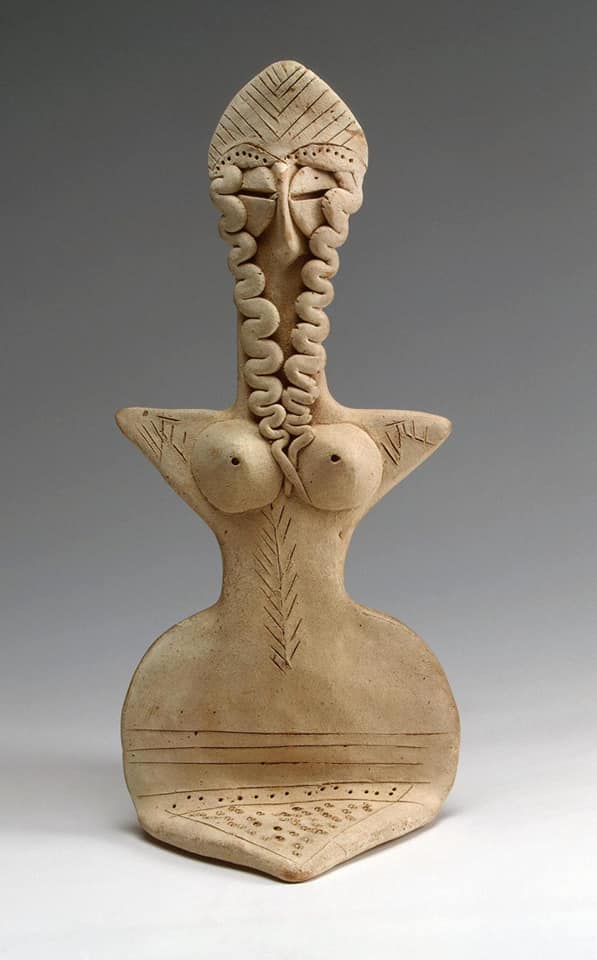
A figurine from the Late Neolithic and Early Halaf Village at Sabi Abyad, Northern Syria, part of Fertile Crescent. dated to 7th mill BC...Depicting Mother Earth turning into Mother of Grain...From "A Late Neolithic and Early Halaf Village at Sabi Abyad, Northern Syria". 

On the front you see what you would expect to see on any female fertility (Mother Earth) figurine: Large vulva and large breasts...


What is depicted on the sides and the back of the legs is what transforms this Mother Earth into Mother of Grain figurine: ears of grain...

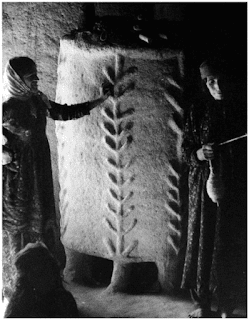
How do we know this is grain?

Remember my post about the Mother of Grain?

Aliabad women standing beside a grain bin, Iranian Kurdistan...From "Home is where we keep our food: The origins of agriculture and Late Pre-Pottery Neolithic food storage". Very important image, as it confirms that this design pattern, found on pottery and figurines since the Earliest Neolithic all over Eurasia, means "grain"... 


I first talked about this in my post "Scarlet ware harvest vase"...


I then talked about this symbol in my post "Mother of grain"...


And in "Altyn tepe mother of grain"...


And in my post "Arjoune venus"...


And here they all are (so far):


We find the same symbolism on figurines found from the Balkans to Iran. They use similar combination of vulva + grain to depict the same thing: Mother Earth turning into Mother of 

BTW, have you ever heard of the Grain spirit? That "lives in the corn dolly made from the last sheaf of grain"?

I talked about it in my post about it in my post "The old woman of the mill dust

In Gaelic, the word Cailleach means both an old woman and the last sheaf of wheat and the corn dolly made from it. Corn dolly which represents Mother Earth, the life (grain) giving mother...


Who is this "Grain spirit"? Well the mother of grain of course. The mother earth...The mother of all of us (and grain)...The Proto Mother...The ancestor...

I also talked about this in my post "Diduch", the representation of an ancestor "who gives us wheat"...

And my post "Wheat cross"...About living corn dollies from Eastern Europe...

The wheat wreath was the most important part of the Romanian end of harvest ceremonies. It was made from the last sheaf of wheat...

It was normally then used to "crown" the "most beautiful unmarried girl" that participated in the harvest, who then carried it back to the village on her head...Love these pics of the reenactment of this ceremony by Vasile Sarb


Interesting, right?

To read more about ancient animal and plant calendar markers, start here…then check the rest of the blog posts related to animal calendar markers I still didn't add to this page, and finally check my twitter threads I still didn't convert to blog post...I am 9 months behind now...

Sunday, 19 March 2023

Mother of grain

MOTHER Earth...The symbolic link between women and earth depicted on this Early Vinča Culture terracotta figurine from Jela, Iron Gate region of the Danube, Serbia, c. 5200 BC, H. 5.3 cm, which has a branching plant growing out of the womb...Pic from "The Body of Woman as Sacred Metaphor"...

It is interesting that this Neolithic Early Vinča culture depiction of the mother goddess was found in the same region where in Mesolithic we find Lepenski Vir culture, whose people made exactly the same image out of a bone...5000 years earlier...around 10,600 BC. It was found at Cuina Turcului, a rock shelter in the Iron Gates gorges on the Danube river, Romania.


The symbolic depiction of a mother earth as a woman is kind of easy to understand. They both give birth to things...

What is interesting is that Slavs who live in the area today, have preserved this symbolic depiction of the mother earth as a female...

Baba, the word which means Mother, Grandmother, Midwife...Birth Giver...The rock which gives birth to life...Which is why we have so many rocky mountain peaks in the Balkans named Baba. Like this one, "Baba's tooth" from Stara Planina (Old Mountain) You can find many more examples in my post "Baba, mountains and crags"...


That mountain alone has all these toponyms and hydronyms with Baba (mother, grandmother) in them...

But Slavs have also preserved something else: belief that female fertility and earth fertility, particularly agricultural fertility, and even more specifically grain fertility, are directly linked, and that one can affect the other...

Which is why we have Slavic agricultural rituals like these: In the past in Russia, after the last sheaf of grain was cut, women harvesters would lie down on the ground and roll around the field "to return the strength to the earth"...I talked about this in my post "Walking sheafs of wheat"...

Or why we have Slavic beliefs like this: A pregnant woman was forbidden to climb fruit trees or even touch them, because "the tree would dry out" (she would steal the tree's fertile energy for her own pregnancy)...I talked about this in my post "Planting tree when the child is born"... 

Or why bread oven is called "baba" (mother, grandmother, midwife, birth giver, mother earth)...I talked about this in my post "Baba, earthen bread oven"...

Now back to our mother earth figurines. The people from Lepenski vir who made that figurine depicting plants growing out of the womb of the mother earth, also made these: womb stones. Sculpture from the hearth of house No. 51, Lepenski Vir (9500–6000 BC, Serbia). It shows a vulva in a specific physiological state, just before giving birth, with all its anatomical details...Photo: From "Lepenski Vir" by Dragoslav Srejović 1972...

They also made very strange trapezoidal shaped houses dated to 6300-6000BC. 

They are all shaped like a flat top pyramid they could see from their settlement. Why? Because every summer solstice, the sun rose on top of it...I talked about this in my post "Sun on top of pyramid"...

Interestingly the only other example of a house like this was a Natufian culture "shrine", dated to 12,600-10,000 BC. I talked about this in my post "Natufian house"...

Natufians also made lots of stones like these...The pic is from this paper "The Natural Inspiration for Natufian Art: Cases from Wadi Hammeh 27, Jordan" which says that "They have sometimes been referred to as ‘shaft straighteners’ with the idea being that they were used to straighten bone or wooden shafts, perhaps when heated..."

"This function is unlikely, however, given direct observations of traditional artisans and experimental reconstructions of these objects’ use. Wooden spears or shafts are usually straightened by hand while being held over a fire..."

"Alternatively, the grooved stones were probably used to abrade softer materials such as Phragmites reeds, while drawing shafts back and forth through the cavity formed by binding two stones tied together with the grooves opposed..."


So we don't know what these stones were used for. That they were tools becomes doubtful (at least to me) when we know that they also made decorated, stones of the same type...The pic is from the same above article...


And this is why I don't think these were tools. The same type of objects, just made from clay, were found deposited in a sacrificial pit in the 7th mill BC early grain farming Starčevo culture Blagotin settlement in Serbia. I talked about this in my post "Blagotin"...

These were the guys who brought grain to Europe...The guys who built temple dedicated to grain. 

If we look at the clay objects from Blagotin, we can see that the groves made in them are too wide and shallow to be used for any kind of straightening of anything...

Which is why they were interpreted by Serbian archaeologists as "grain seed models", grain fertility idols...Now if you squint you will see that they don't just look like grain seeds. They also look like vulvas...Vulvas made of stone and clay, made of the body of mother earth...

Starčevo culture was ancestral culture of the Vinča culture...So we have come full circle...Hence plants growing out of the womb of the Vinča culture idol...But also out of the womb of the Lepenski Vir idol. Which predates Starčevo...

I recently came across this: A gynomorphic (woman like) figurine made of "soil mixed with chaff and grain seeds" from Grčac, Serbia. Proto-Starčevo culture, 6200-5500 BC. Direct symbolic link between earth, grain and female fertility. Basically, "Mother of Grain"...

Now that I think about it, the plant is most likely grain...These are symbols for grain from Mesopotamia and Central Asia...


This (widespread) belief that plants (especially grain) grow out of the womb of the mother earth was for the first time spelled out in Mesopotamia, where in "The Courtship of Inanna and Dumuzi" we find these verses:

"...Before my lord, Dumuzi,

I poured out plants from my womb.

I placed plants before him,

I poured out plants before him.

I placed grain before him,

I poured out grain before him,

I poured out grain before my womb..."

BTW, every year during the harvest, a man and a woman performed ritual sexual act on a threshing floor, imitating Inanna (earth, womb) and Enki (sweet water, seed) consummating their holy marriage. I talked about this in my post "Sacred marriage on the threshing floor"...


The result of which was grain grew out of Inanna's womb...

And so on and so forth...I will end this rambling article here. Got to go and make dinner...

PS: Forgot to say that Natufians were some of the first people to eat, gather and maybe even grow grain...I talked about this in my post "How grain came to Sumer"...


Thursday, 26 March 2020

Seven seals

In the Book of Revelation, the Seven Seals are the seven symbolic seals that secure the book or scroll that John of Patmos saw in an apocalyptic vision. The opening of the seals of the document occurs in Revelation Chapters 5–8 and marks the Second Coming of the Christ.

At the time when Revelation was written, important documents were sent written on a papyrus scroll sealed with several wax seals. Wax seals were typically placed across the opening of a scroll, so that only the proper person, in the presence of witnesses, could open the document.


But there is another possible meaning of the "Breaking of seven seals which announces the second coming of Christ". 

It has to do with Christ being "the bread of life"...

Since Neolithic times, in Fertile Crescent, farmers stored their grain in storage vessels which were they sealed using stone seals imprinted on clay.


The earliest evidence for this practice was found in Syria and dates to the seventh millennium B.C. You can read about this in "Deciphering Later Neolithic stamp seal imagery of Northern Mesopotamia" and "More Seals and Sealings from Neolithic Tell Sabi Abyad, Syria"...


And we know that palaces and temples were used as grain stores...


Storage vessels from the store room


Seals imprints. 


This is the table showing articultyral year in Levant


You can see that grain (barley and wheat) was sown by December and was harvested by July. 

When grain was harvested, it was stored in storage jars and was used for food until next harvest. Now if I was a grain farmer from Levant, I would have divided my grain into 13 jars. The grain in 12 jars would be used for food. Why 12 jars? Well this way you will know exactly how much you can eat each month so that you can ration the grain and not run out of it half way through the year. The 13th jar would contain seeds for the next sowing. 

Each storage jar would then be closed and sealed probably with a family seal...

Now if the grain was indeed kept like this, then a family would open a new storage jar every new month, and would use the grain contained inside during that month. To to that they would have to break the seal...

Now what is the second coming of Christ? The Second Coming is a Christian belief regarding the future (or past) return of Jesus after his ascension to heaven...Basically, Christ dies, he gets buried, he ascends (Empty grave)...Now we wait...For Christ's resurrection basically...

You know how Grain is used as a symbol of resurrection? It gets killed (harvesting), buried (planting) and resurrected (sprouting and growing)...Year after year after year. 

Now what if "the bread of life" should be taken literally? How long should we wait for the "second coming", "resurrection" of grain? Well, 7 months, from the end of sowing (beginning of December) to the end of the Harvesting (beginning of July). The longest 7 months in the life of any grain farmer whose life depends on the good harvest...

And every one of these long 7 months begins with opening one of the last 7 jars of grain...By breaking the seal which protected it...When the 7th seal is broken, the harvest is finished and the storage jars are refilled...

Was this the root of the 7 seals "vision" about the Second coming of the "Bread of life"???

Tuesday, 23 December 2014

Christmas trees from garden of eden


What is the origin of Christmas trees? We can read that the Christmas tree customs are the Christianized versions of the older pagan Winter Solstice customs involving evergreen trees. But why are the two main European Chrismas trees Oak and Pine (Spruce, Fir)? Are these two trees somehow connected to the ancient idea of the garden of Eden? And if so, how are they connected? These are the questions that I would like to try to shed some light on.


A few days ago I came across this early christian relief from Naxos depicting the nativity (birth) of Jesus scene. Unlike the later representations of the Nativity which take place in a stable, the Nativity scene on this early marble slab is framed by two trees, which means that the scene takes place in a forest, a grove. I found a good high resolution picture of the above image in Wikipedia. 

 
When I looked at trees depicted on the relief more closely, I discovered, to my astonishment, that these two trees were a Pine and an Oak, the two Christmas trees of Europe. You can clearly see the pine cone on the left tree and the acorn on the right tree. But these were not just any pine tree and any oak. Based on the shape of the trees, their leaves and fruit, I think that I managed to identify these two trees as the Stone Pine and the Downy Oak, ancient species used and cultivated by people as food since prehistory. 

The downy oak (qercus pubescens), is a white oak. It is native to southern Europe and southwest Asia, from northern Spain (Pyrenees) east to the Crimea and the Caucasus. It is also found in France and parts of central Europe. Downy oaks typically grow in dry, lime-rich soils. It is a submediterranean species, growing from the coastline to deep in the continent. Its optimum is in the submediterranean region, characterized by hot dry summers and cold winters with little rainfall. In western and central Europe, downy oak is confined to areas with a submediterranean microclimate (gorges, sandplains, steppe slopes) or to coastlines of former lakes. In Serbian, this oak is known as "medun", "medunac" or honey oak referring to its sweet taste.


The stone pine (Pinus pinea), also called Italian stone pine, umbrella pine and parasol pine, is a tree from the pine family (Pinaceae). It has been used and cultivated for its edible pine nuts since prehistoric times. The tree is native to the Mediterranean region. At present it is found in Europe ( Iberia, Italy, Southern France, Balkans, Aegean and Western Turkey), Western Asia (Southern Anatolia, Lebanon, Syria, Northern Israel) and North Africa (Morocco and Algeria). It grows in dry arid areas mixed with oaks and shrubs.
 
 
Here are the tree details enlarged so you can see the leaves and fruit:

Stone Pine with pine cones:


Downy Oak with acorns:


So what we have here is the nativity of Christ taking place in the Garden of Eden which consists of the edible wild trees, oaks and pines, the oldest starch foods of the Mediterranean from Upper Paleolithic onward. Both acorns and pine nuts were found among the oldest plant food remains in Upper Paleolithic and Mesolithic archaeological sites in Europe, Western and Eastern Asia, North Africa and North America. Even though the types of Oaks and Pines used as food sources by people differ from area to area, wherever we find major acorn eating cultures we find that pine nuts were also collected and used as food. 

So Here is the above Nativity scene again with the trees and fruits identification.


Is this a coincidence considering that most of the European Christmas (Winter solstice) traditions and customs are in some way related to the agricultural and particularly the corn, bread fertility?

In Genesis we can read this description of Eden: 

A river rises in Eden[a] to water the garden; beyond there it divides and becomes four branches. The name of the first is the Pishon; it is the one that winds through the whole land of Havilah, where there is gold. The gold of that land is good; bdellium and lapis lazuli are also there. The name of the second river is the Gihon; it is the one that winds all through the land of Cush. The name of the third river is the Tigris; it is the one that flows east of Asshur. The fourth river is the Euphrates.

In Genesis we also find this: 

Then God said, “Let the land produce vegetation: seed-bearing plants and trees on the land that bear fruit with seed in it, according to their various kinds.” And it was so. 12 The land produced vegetation: plants bearing seed according to their kinds and trees bearing fruit with seed in it according to their kinds. And God saw that it was good....Then God said, “I give you every seed-bearing plant on the face of the whole earth and every tree that has fruit with seed in it. They will be yours for food. 30 And to all the beasts of the earth and all the birds in the sky and all the creatures that move along the ground—everything that has the breath of life in it—I give every green plant for food.” And it was so.

In the brilliant book: Oak: The Frame of Civilization,  William Bryant Logan has this to say about the garden of Eden:


The above excerpt from the Genesis is a description of the area comprising of the Zagros Mountains, Oak Pistachio uplands, Assyrian steppe and alluvial Mesopotamian bottom land. This is where we find some of the earliest settled villages in the world. While excavating these settlements, archaeologists found many grinding stones and underground storage pits. But very few sickles. And those sickles that were found were not the right kind for harvesting wheat. So what were the people in these first settled communities grinding, storing and eating? 

As I have shown in my last few posts about acorns in archaeology, eating acorns and grinding acorns, they were grinding, storing and eating acorns. 

Oak uplands can easily support large villages of up to 1000 people and these people could harvest in 3 weeks enough acorns to last them 2 to 3 years. Acorns could be stored in above ground aerated bins, in underground pits or they can be buried at the edge of streams where they can get leached while they keep fresh. The people of these oak cultures could, with very little effort, provide their daily bread doing what god told them to do: eat the fruit of the trees and plants that bear seeds. With plenty of free time people could enjoy life and develop their culture and technology. With plentiful supply of food there was no need to kill and eat all the animals that were caught. So people could catch and keep the animals, breed them and eventually domesticate them. It was these animals that were probably first fed the wild grasses which later became our grains. 

If we look at the word Eden we see that the origin and the meaning of the word "Eden" is uncertain. The official etymology says that it comes from Hebrew עדן (eden), perhaps from Sumerian e-den "Steppe, garden".

But I believe that the root of this word is much simpler. In Serbian we have word "jede" which is in the old south Serbian dialect found in a form "ede". This word means eat. It comes from the Proto Indo European root "*h₁ed" meaning to eat from which the English word eat also comes from. In Serbian we have the following words derived from the root "ede, jede":

jelo, jedja, jedivo, jestivo – food
edenje, jedenje - food (south Serbian dialect). Literally means eating and is the direct cognate of the English word eating.
eden, jeden - eaten

The garden of Eden was the garden of edible trees. It was the garden of god given food, of edenje, jedenje, eating. Is this the actual original, simple meaning of the word Eden = Eating, Food? Was the garden of Eden the post glacial Northern hemisphere, which was going through an incredible transformation from a cold wasteland into a lush garden full of easily obtainable abundant food? And was then, as William Bryant Logan says, this garden of Eden responsible for human transformation from humans into modern humans? I believe so. If we look at the Mesolithic northern hemisphere, we see first civilizations hatching in Western and Easten Asia, In the Balkans and Iberia, in north Africa and in Mexico, all situated in "gardens of edenje", gardens of eating, food, full of easy to collect and store acorns, nuts, roots, wild grains, and easy to catch small game, fish, shellfish and snails. The garden of Eden was the old Golden Age of the Greeks and Romans, the post glacial northern hemisphere.


That this is the actual meaning of the garden of Eden we can see from the choice of the trees present on the above Nativity scene. Thees trees turn out to be the two main Winter Solstice (Christmas) trees in Europe

In the northern hemisphere, the shortest day and longest night of the year, the winter solstice, falls on the 21st of December. Many ancient people believed that the sun was a living god and that winter came every year because the sun god had become old, sick and weak. The sign of this was the fact that the days were getting shorter and colder, and that the vegetation was dying. Winter solstice was the turning point when the days start getting longer again heralding the arrival of spring, warmth and new vegetative cycle. People who depended on this vegetative cycle celebrated the solstice as the rebirth of the sun god.

The accepted theory is that around the time of the Winter Solstice, people decorated their homes and temples with evergreen branches and worshipped evergreen trees and plants in general, because the evergreen plants reminded them of all the green plants that would grow again when the sun god gets reborn after the Winter Solstice. This is a good enough explanation. But it is the choice of these Winter Solstice (Christmas) trees which is very interesting: Oak and Pine (Spruce, Fir). I believe that the choice of the choice of these trees has as much to do with the fact that they were the oldest starch (bread) bearing trees, as with the fact that they were evergreen. To illustrate this I will here give the list of the European Winter Solstice (Christmas) traditions involving trees to show that all of these trees are Either Oak or Pine (Spruce, Fir), the oldest starch (bread) bearing trees, the trees that appear on the Naxos stelle.

Romans

Romans marked the solstice with a feast called the Saturnalia in honor of Saturn, the god of agriculture. In Roman mythology, Saturn was an agricultural deity who was said to have reigned over the world in the Golden Age, when humans enjoyed the spontaneous bounty of the earth without labor in a state of social egalitarianism. The revelries of Saturnalia were supposed to reflect the conditions of the lost mythical age, not all of them desirable. The Greek equivalent was the Kronia. The Romans knew that the solstice meant that soon farms and orchards would be green and fruitful. To mark the occasion, they decorated their homes and temples with evergreen boughs. We are told that it was holly tree branches that were used because they don't lose their leaves during the winter. But is it possible that it wasn't holly tree branches that were used, but the branches of the evergreen Mediterranean oaks, such as Quercus coccifera (Kermes Oak), Quercus suber (Cork Oak) and  Quercus ilex (Holm Oak)? Holm oak is called Holm oak because its leaves resemble holly tree leaves, holm being the old name for holly. The thing is the other two evergreen oak trees have leaves which resemble holly leaves even more.  Have a look at these pictures and tell me if it was easy to confuse the evergreen oaks and holly:
Holly


Kermes oak. The Kermes Oak was historically important as the only food plant of the Kermes scale insect, from which a red dye called crimson was obtained. Red berries, red dye...


Cork oak


Holm (Holly) oak


Which of these trees do you think is a more appropriate symbol of the god of agriculture, the god of food, the god of the old Golden Age "when humans enjoyed the spontaneous bounty of the earth without labor"? Do you thing that it is the one that bears edible acorns like oak, or the one that bears poisonous berries like holly? Who got it wrong, the Romans who misunderstood or forgot the old customs of their forefathers, or us who misinterpreted Roman customs? Or did roman customs change and adopt as they migrated further and further up north where these evergreen oaks are not found and so they had to replace them with what every looked the most like these evergreen oaks, and that is holly tree?

Celts

Apparently Druids, the priests of the ancient Celts, also decorated their temples with evergreen boughs as a symbol of everlasting life. The evergreen plant that the Druids used is said to have been Mistletoe. Mistletoe which is said to have been used by Druids actually grows on Oaks. The Druids preached in oak forests, and considered oaks sacred. Young deciduous oaks keep their leaves through the winter.  Also a lot of Southern European oaks are evergreen, like the sweet Holm Oak or Holy Oak.

Pliny the Elder, writing in the first century AD, describes a religious ceremony in Gaul in which white-clad druids climbed a sacred oak, cut down the mistletoe growing on it, sacrificed two white bulls and used the mistletoe to cure infertility:

“ The druids — that is what they call their magicians — hold nothing more sacred than the mistletoe and a tree on which it is growing, provided it is Valonia oak..."

Quercus macrolepis, (Valonia oak), is another Mediterranean oak with leaves which look like holly tree leaves. The trees of this oak species shed leaves in October through January with a peak in December–January, but even during these months at least 10% of the trees remained evergreen.

 
Quercus macrolepis is found in the Southern Mediterranean, in the Balkans including the Greek Islands, in Morocco, and in Anatolia....


Quercus macrolepis has a subspecies known as Quercus ithaburensis (Mount Tabor oak). Quercus ithaburensis is found in Southeastern Europe, from Southeastern Italy across Southern Albania to Greece, and in Southwestern Asia from Turkey South through Lebanon, Israel, and neighbouring Jordan.

Mount Tabor (Hebrew: הַר תָּבוֹר, Modern Har Tavor Tiberian Har Tāḇôr, Arabic: جبل الطور, Jabal aṭ-Ṭūr, Greek: Όρος Θαβώρ) is located in Lower Galilee, Israel, at the eastern end of the Jezreel Valley, 11 miles (18 km) west of the Sea of Galilee. It was the site of the Mount Tabor battle between Barak under the leadership of the Israelite judge Deborah, and the army of Jabin commanded by Sisera, in the mid 12th century BC.

It is believed by many Christians to be the site of the Transfiguration of Jesus.The Transfiguration of Jesus is an episode in the New Testament narrative in which Jesus is transfigured (or metamorphosed) and becomes radiant upon a mountain.In these accounts, Jesus and three of his apostles go to a mountain (the Mount of Transfiguration). On the mountain, Jesus begins to shine with bright rays of light. The fact that Christ started shining on the mount Tabor became very significant when you see the acorns of the mount tabor oak:

They look like a shining sun. Is the reason why the druids would prefer this oak to all the other oaks is because of the shape of its acorns which are shaped like a blazing sun? Is the transfiguration of Jesus in some way linked to the transfiguration of mount tabor oak acorns as they ripen?

Any sun worshipper would prefer this oak to any other. But these oaks don't grow in the Northwest of Europe. Where did Celts and Druids come from and who were they if their sacred acorn, the sun acorn, only grew in Southern Mediterranean, in the Balkans including the Greek Islands, in Morocco, and in Levant??? Are the Irish legends about the migration from the Balkans true?
I believe that the main solstice tree of the Celts was the Oak tree. In the areas where the "sun acorn" oaks grow, the acorns generally begin to ripen in November and the shedding of acorns extends from December until January. Right through the solstice time. So on the day of the Winter Solstice, the "sun oaks" are full of evergreen leaves and full of acorns, food. I believe that if there was mistletoe worship among Celts, it was a substitution for the evergreen sun oak worship. When Celts migrated from the Mediterranean to the Northwest of Europe they adopted their belief system to the new type of oaks which weren't evergreen but which had evergreen mistletoe growing on them. Evergreen mistletoe leaves became the substitute for the evergreen oak leaves. And mistletoe, became a substitute fertility symbol for acorns...

Germanic, Scandinavian

According to the Encyclopædia Britannica, "Tree worship was common among the pagan Europeans and survived their conversion to Christianity in the Scandinavian customs of decorating the house and barn with evergreens at the New Year to scare away the devil and of setting up a tree for the birds during Christmastime."

A yule log is a large wooden (oak) log which is burned in the hearth as a part of traditional Yule or modern Christmas celebrations in several European cultures.

In Scandinavian mythology, the oak was sacred to the thunder god, Thor. Here I would need help in clarifying something. Is there any reference in Norse mythological sources to any tree being used during Winter solstice celebrations? I found some vague references to Yule log. 

It was apparently a large oak log decorated with sprigs of fir, holly or yew. Runes were carved on it, asking the Gods to protect the people from misfortune. The log was struck by a smith with a hammer, playing the role of Thor the thunder god. The new fire was kindled on log. A piece of the log was saved to protect the home during the coming year and light next year's fire....

But I could not find any concrete reference to any of these customs. Are there any sagas, historical texts, ethnographic records that record any such customs among the Scandinavians? Was Yule log actually part of the Yule celebration in the Scandinavian countries during old pagan times?


Georgian

In Georgia people have their own traditional Christmas tree called Chichilaki, made from dried up hazelnut or walnut branches that are shaved to form a small coniferous tree. 


These pale-colored ornaments differ in height from 20 cm (7.9 in) to 3 meters (9.8 feet). Chichilakis are most common in the Guria and Samegrelo regions of Georgia near the Black Sea, but they can also be found in some stores around the capital of Tbilisi. Sometimes the Christmas tree is hazelnut branch which is carved into a Tree of Life-like shape and decorated with fruits and sweets.

Slavic Polish

In Poland there was an old pagan custom of suspending at the ceiling a branch of fir, spruce or pine called Podłaźniczka associated with Koliada the ancient Slavic winter solstice festival. The name Koliada comes from the word "kolo" meaning wheel, spinning circle and representing the spinning of the circle of sun and therefore of life.

 
The branches were decorated with apples, nuts, cookies, colored paper, stars made of straw, ribbons and colored wafers. Some people believed that the tree had magical powers that were linked with harvesting and success in the next year. In the late eighteenth and early nineteenth century, these traditions were almost completely replaced by the German custom of decorating the Christmas tree.

Slavic Serbian and Bulgarian

For the Serbs, all trees have always been considered sacred, but the Oak was and still is the most sacred tree of all. This is why in Serbia oak is also the Christmas tree in a shape of a Christmas log and the Christmas boughs. The tree from which the log and the boughs are cut, has to be a young and straight oak, which is ceremonially felled early on the morning of Christmas Eve. 


It is then brought into the house and placed on the fire on the evening of Christmas Eve where it is supposed to burn through the whole night. The felling, preparation, bringing in, and laying on the fire, are surrounded by elaborate rituals, with many regional variations. This is the central tradition in Christmas celebrations among the Orthodox Serbs and Bulgarians, much like a yule log in some other European traditions. In Serbian language the oak Christmas tree is called Badnjak and in Bulgarian language it is called Budnik. This literally means the awoken one, the one that stays awake, that keeps you awake. In Serbian the Christmas Eve is called Badnje Veče and in Bulgarian the name for Christmas Eve is Budni Večer which means "The evening when we stay awake". Serbs believed that the sun is a living being which has a lifespan of one year. On the winter solstice night, the old sun dies and on the winter solstice morning the new sun is born. The burning of the Christmas tree log ritual is the remnant of the ancient wither solstice ritual performed to help rekindle the sun and to insure that the sun's fire starts blazing and producing heat again. The ceremony also includes the feast which is organized to celebrate the birth of the new sun, the young sun. Christmas itself is in Serbian called Božić (Cyrillic: Божић, pronounced [ˈbɔ̌ʒitɕ]), which is the diminutive form of the word bog ("god"), and can be translated as "young god". The whole ritual is also linked to fertility, particularly grain fertility, bread fertility. In Serbian tradition we find the direct link between the old bread source (oak and acorn) and new bread source (grain). This can even be seen from the fact that both oak branches and grain sheaves and hay are used in ceremonies.


I will dedicate a whole post to this Christmas tradition (Badnjak - Yule log).

As you can see, the choice of trees used as Winter Solstice (Christmas) trees is very consistent. It is Oak (acorns), Pine, Spruce, Fir (pine cones), Walnut, Hazelnut. You can also add to this list Chestnut, as chestnuts are also roasted for Winter Solstice (Christmas). These are all the large seed bearing trees, the trees which provided the humans on the northern hemisphere with the first starch food, first bread during the Golden Age time. These trees were the main sources of food for the Mesolithic cultures living in the Oak - Pine ring of the northern hemisphere, the Garden of Eden, and they must have been worshipped as gods. That this was the case can be seen from the worship of the Oaks which still exists in Serbia and the adoration of the Oak tree itself during the Winter Solstice (Christmas) ceremonies. The worship of these trees continued even when the grain replaced the acorns and pine nuts as the main starch source. The main old "bread" trees, Oak and Pine, Spruce, Fir are still used as central symbols in the Winter Solstice (Christmas) agricultural grain fertility festival. This shows that the transition from the old tree bread to the new field bread was slow and long, allowing the preservation of the old tree fertility customs albeit thinly disguised as grain fertility customs. Like a Serbian Badnjak oak wrapped in a wheat sheaf...
Merry Christmas.