Showing posts with label Neolithic Syria. Show all posts

Tuesday, 22 August 2023

Sabi Abyad venus

A figurine from the Late Neolithic and Early Halaf Village at Sabi Abyad, Northern Syria, part of Fertile Crescent. dated to 7th mill BC...Depicting Mother Earth turning into Mother of Grain...From "A Late Neolithic and Early Halaf Village at Sabi Abyad, Northern Syria". 

On the front you see what you would expect to see on any female fertility (Mother Earth) figurine: Large vulva and large breasts...


What is depicted on the sides and the back of the legs is what transforms this Mother Earth into Mother of Grain figurine: ears of grain...

How do we know this is grain?

Remember my post about the Mother of Grain?

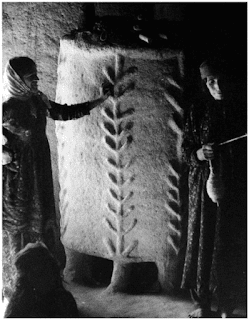
Aliabad women standing beside a grain bin, Iranian Kurdistan...From "Home is where we keep our food: The origins of agriculture and Late Pre-Pottery Neolithic food storage". Very important image, as it confirms that this design pattern, found on pottery and figurines since the Earliest Neolithic all over Eurasia, means "grain"... 

I first talked about this in my post "Scarlet ware harvest vase"...


I then talked about this symbol in my post "Mother of grain"...


And in "Altyn tepe mother of grain"...

And in my post "Arjoune venus"...


And here they all are (so far):


We find the same symbolism on figurines found from the Balkans to Iran. They use similar combination of vulva + grain to depict the same thing: Mother Earth turning into Mother of 

BTW, have you ever heard of the Grain spirit? That "lives in the corn dolly made from the last sheaf of grain"?

I talked about it in my post about it in my post "The old woman of the mill dust

In Gaelic, the word Cailleach means both an old woman and the last sheaf of wheat and the corn dolly made from it. Corn dolly which represents Mother Earth, the life (grain) giving mother...


Who is this "Grain spirit"? Well the mother of grain of course. The mother earth...The mother of all of us (and grain)...The Proto Mother...The ancestor...

I also talked about this in my post "Diduch", the representation of an ancestor "who gives us wheat"...

And my post "Wheat cross"...About living corn dollies from Eastern Europe...

The wheat wreath was the most important part of the Romanian end of harvest ceremonies. It was made from the last sheaf of wheat...

It was normally then used to "crown" the "most beautiful unmarried girl" that participated in the harvest, who then carried it back to the village on her head...Love these pics of the reenactment of this ceremony by Vasile Sarb


Interesting, right?

To read more about ancient animal and plant calendar markers, start here…then check the rest of the blog posts related to animal calendar markers I still didn't add to this page, and finally check my twitter threads I still didn't convert to blog post...I am 9 months behind now...

Sunday, 7 May 2023

Arjoune venus

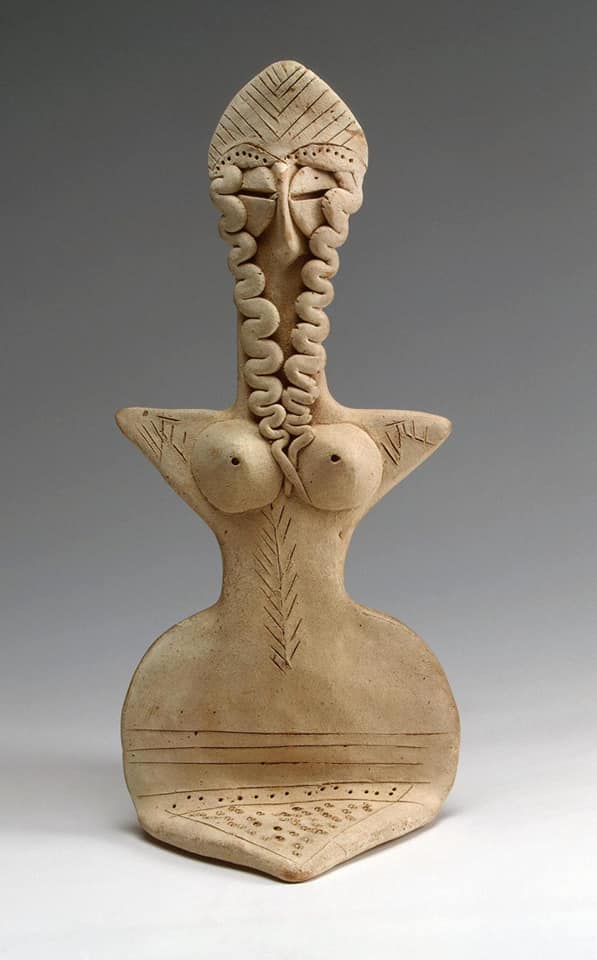
An early Halaf culture figurine from the Arjoune site in Syria. Pic from: Embodiment of the Halaf: Sixth Millennium Figurines from Northern Mesopotamia.

It is made from a natural pebble, and it depicts a female form, with large eyes with eyelashes and long hair. The very very very interesting bit is the pubic area, which is depicted as a square...


The Halaf culture is a neolithic early farming culture which flourished in the Fertile Crescent, in south-eastern Turkey, Syria, and northern Iraq, between about 6100 BC and 5100 BC...


The people from the same area, just slightly later, made this figurine which I interpreted as the depiction of the Fertile Mother Earth between two great rivers, Tigris and Euphrates

Figurine of a nude "woman" form Yarim Tepe, Iraq. Ubaid period, 5000-4000 BCE. Iraq Museum...


I talked about this in my post "Mother of grain from Yarim Tepe"...

So I am convinced that whoever made this figurine in Arjoune, knew very well what vulva looks like...The fact that here we have vulva depicted as a square, makes me believe that what we have here is a depiction of the fertile Mother Earth, and more specifically Mother of grain...Where the square vulva represents a grain field...

Remember this:

Inanna spoke:

...

As for me, Inanna,

Who will plow my vulva?

Who will plow my high field?

Who will plow my wet ground?

...

From: "The Courtship of Inanna and Dumuzi"

More about depictions of Mother Earth, Mother of Grain, can be found in my article "Altyn Tepe mother of grain", in which I talk about this BMAC figurine...Again Mother Earth, Mother of Grain, Goddess, just different mountains and rivers...


Another Early Halaf figurine depicting female form with square pubic area. Tell Kurdu...Pic from: Embodiment of the Halaf: Sixth Millennium Figurines from Northern Mesopotamia.


Late Halaf figurine. Discovery location unknown. Pubic triangle on front with line representing vulva and dots representing pubic hair. On back, two ears of grain...

Pic from: Embodiment of the Halaf: Sixth Millennium Figurines from Northern Mesopotamia.

Mother Earth turned Mother of grain, true and true...

Most common Halaf figurine depicted voluptuous female form covered in horizontal stripes. Are these supposed to be furrows?

Thursday, 14 May 2020

Gourd pottery

This is an example of a "Dark Faced Burnished Ware", the earliest form of pottery developed in the western world...This bowl is from Shir, in Syria and was dated to c. 7000 BC. 


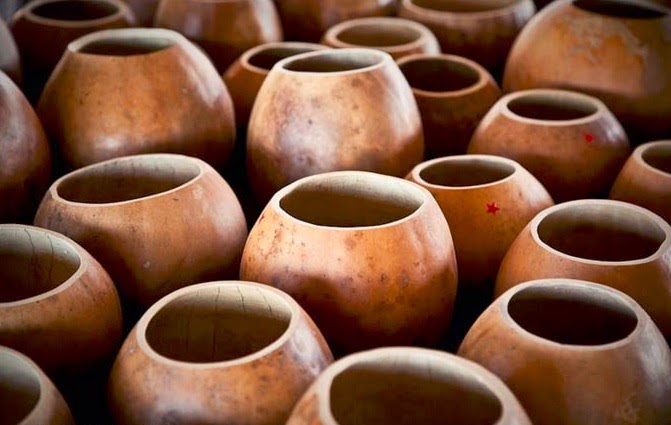
Interestingly, this almost spherical vessel looks very much like a clay version of one of these:


And each one of these vessels is made of one these: a bottle gourd.


And gourd is what pre pottery, pre metal, pre glass people used for making vessels and utensils for handling cold liquids...Well people continued to use gourd for the same purpose even after pottery, metal and glass were invented. My grandparents had loads of things like these...


Now back to the original Dark faced burnished ware vessel. How was it made? Did people use a gourd vessel as a mould? Basically plastering the clay on the outside of the gourd vessel and then firing it all together? Gourd would combust leaving just a ceramic crust (pot)?

The oldest pots ever made were made in Asia, about 20,000 years ago. They look like someone plastered an inside of a basket and then fired the whole thing together. Basket burned away, leaving basket shaped and patterned vessel. I wrote about it in my post "Basket pottery":  


Interestingly, the vessels made in Syria before the "Dark faced burnished ware", in 9th millennium BC, are known as "White ware". They are crumbly form of proto-pottery made from white plaster kind of mixture and then just air or sun dried. Don't they look like plastered baskets?


So we know that Pre Pottery Neolithic Syrians knew how to make plaster, and that they possibly used some kind of basket mould for making their White ware vessels...So it is possible that eventually someone made a "plaster" that when accidentally burned turned hard and black...

What was the first product of this newly discovered technology was something like this. Selection of pots and bowls from Tell Sabi Abyad (ca. 6600-6200 B.C.), among the earliest pottery currently known from Syria...Again very sack, basket like, right? 


What I find absolutely amazing, is that before people of Neolithic Syria discovered how to make proper clay pots, in the 8th millennium BC, they were making things like this: A bowl made from stone, calcite alabaster...From Met museum


This whole thing is a great example of two things: 
1. How people "invent" by trying to imitate nature
2. How skill and technology are so very different.

Which brings me to the question: what should we use for judging cultural development? Aesthetics or technology? Because they don't always match...Just look at the last two pictures...