Showing posts with label Mesopotamian archaeology. Show all posts

Friday, 26 September 2025

Stork bowl from Kurdistan

A ceramic bowl, covered with flying birds, found in the Kurdistan region of Iraq. Currently in the local Duhok museum. The Pic is from this Facebook post. I don't know who the photographer is...

Now I don't know exactly when the bowl was made. But it is displayed in this display cabinet...

Together with this statuette, which was dated to 4000 BC, so I assume the bowl is from the same period. Stylistically it fits...

I am of course interested in the birds depicted on this vessel. 

After a lot of checking through the lists of birds of Iraq, and a lot of comparing of depicted birds with real birds, I believe that the depicted birds are white storks...

Depicted during their spring migration back to their nesting grounds in North Eastern Iraq...


Storks usually arrive back to their nesting grounds in Mar/Apr and begin their nesting season in Apr/May and the first eggs hatch in May...

Nesting storks are a spectacle, and a very hard thing to miss, so it is possible that storks here are animal calendar markers for Apr/May...A very important part of the year in Mesopotamia...

Apr/May, is the time when the grain harvest  begins in Mesopotamia...

Apr/May is also the time when Tigris, which flows through the area where this stork bowl was found, reaches its peak annual water levels...and floods...

That the depicted birds could in some way be linked to grain agriculture, can be deduced from the fact that they are depicted flying over checkered rectangular surfaces, usually interpreted as fields...

But, who knows...

That's it. To read more about ancient animal and plant calendar markers, start here…Then check my twitter threads I still didn't convert to blog post...I am way way behind...

Tuesday, 15 April 2025

Mother of grain from Mari

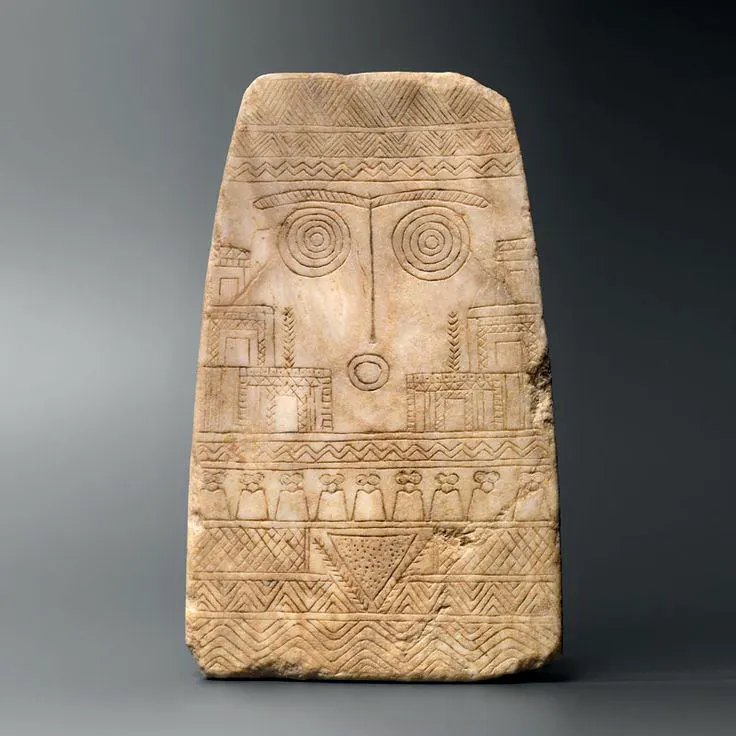
This alabaster stele [my comment: depicting the Mother of Grain, see more further down the thread], was presented in 2012 catalog of the Phoenix Ancient Art, as a cult plaque originating from the Near East and dating from the beginning of the third millennium BC...

According to Professor Michel Al-Maqdissi, an expert in oriental archaeology at the universities of Damascus and Saint-Joseph des Jésuites in Beirut, this stele almost certainly came from the ancient Mesopotamian city of Mari...

Located in Syria, not far from the Iraqi border, Mari was literally devastated by the wild searches and massive looting that took place before and after Daesh/Isis proclaimed its Islamic caliphate...

The offices of the Phoenix Ancient Art were raided by the customs in 2016 and a number of archaeological objects were seized under the suspicion that they were looted in the Middle East and smuggled into Europe...

The owner of the Phoenix Ancient Art was later sentenced in Switzerland for forging documents in order to disguise the true origin of the artefacts he was selling. You can read more about this here...

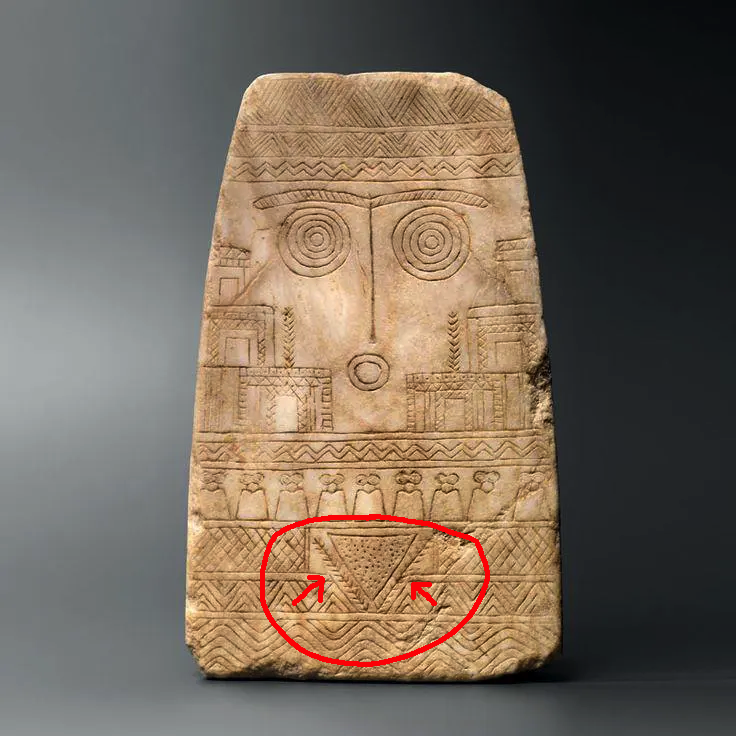
Now the interesting bit. The mother of grain? What the hell is the Mother of Grain? Well she is Mother Earth of course...Our stele from Mari also has eyes and vulva as well as water, plants, buildings and people...

What is the best way to symbolically depict "Mother Earth"? Place moutains, plants and animals between eyes and  a pubic triangle. Decorated bone depicting slightly bewildered "Mother Earth", 6th - 5th millennium BC, Hagoshrim, Southern Levant. From my post "Eyes"...


But Mother of Grain is a special version of Mother Earth. She is the mother earth of the grain farmers...

We know this because the plant depicted on the stele from Mari is grain...

I first talked about Mother of Grain in my post "Mother of grain"...

Mother of grain...Grain seed and vulva symbolism from Vinča, Starčevo and Lepenski vir cultures...Link between female fertility and earth/grain field fertility...

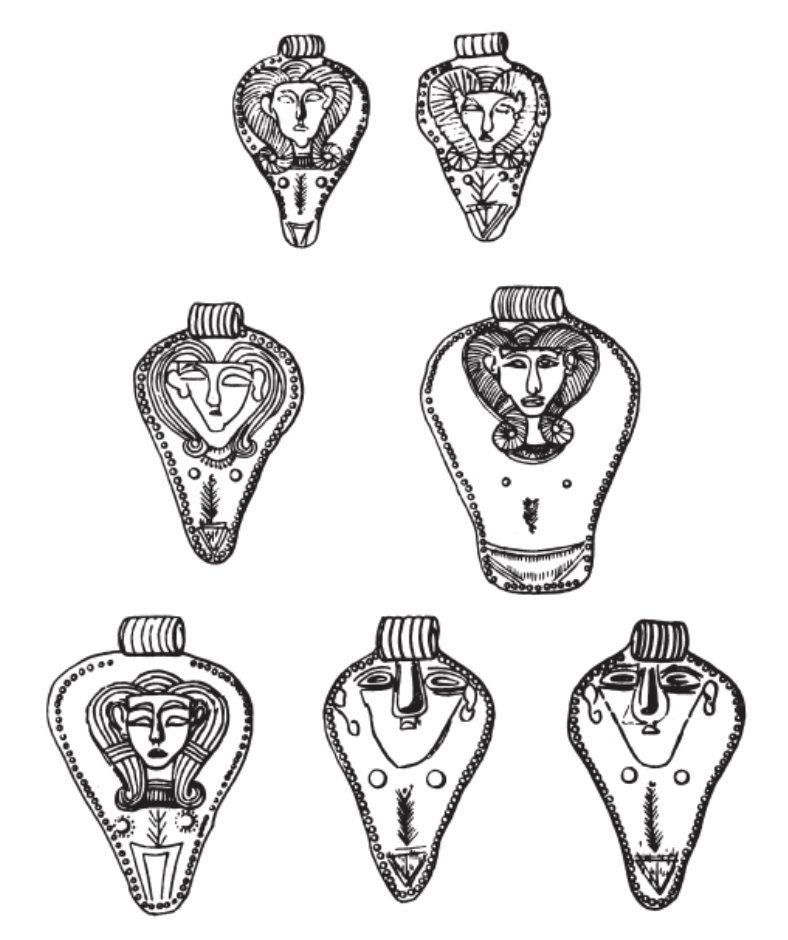
The same symbol, grain growing out of a vulva can be seen on these levantine pendants

Golden pendant with the image of Hathor. From Tel el Adjul. Gaza, middle of the 2nd mill BC. 

Similar pendants with a depiction of grain growing from the vulva. 

I wrote about them in my post "Hathor grain pendants"...

And then I talked about mother of grain in my post "Sabi Abyad venus"...

A figurine from the Late Neolithic and Early Halaf Village at Sabi Abyad, Northern Syria, part of Fertile Crescent. dated to 7th mill BC...Depicting Mother Earth turning into Mother of Grain...

And then in my post "Altyn Tepe mother of grain"...

How to depict "Mother of Grain"? Like a voluptuous woman (Mother) whose vulva (where new life come from) is horizontal (like Earth, Field) with horizontal lines (furrows) with plant (Grain) growing out of them. Altyn Tepe, BMAC,  3200-2000 BC...  

An I talked about the mother of grain in my post "Mother of grain from Yarim Tepe"...

Figurine of a nude "woman"? Or a depiction of the "Mother of grain"? Yarim Tepe, Iraq. Ubaid period, 5000-4000 BCE. Iraq Museum... Interpretation from: 

And finally i talked about the mother of grain in my post "Arjoune venus"...

An early Halaf culture figurine from the Arjoune site in Syria. It is made from a natural pebble, and it depicts a female form, with large eyes and long hair. And a square pubic area...Grain field?...Mother of grain?  

The Mother of Grain had a name in Mesopotamia: Inanna:

As for me, Inanna,

Who will plow my vulva?

Who will plow my high field?

Before my lord, Dumuzi,

...

I poured out grain before him,

I poured out grain before my womb...


From: "The Courtship of Inanna and Dumuzi"

I talked about Inanna and grain in many of my posts...

Just as Inanna says herself, we are supposed to see the vulva depicted on the stele from Mari as a grain field. Hence two grain symbols depicted on both sides of it...

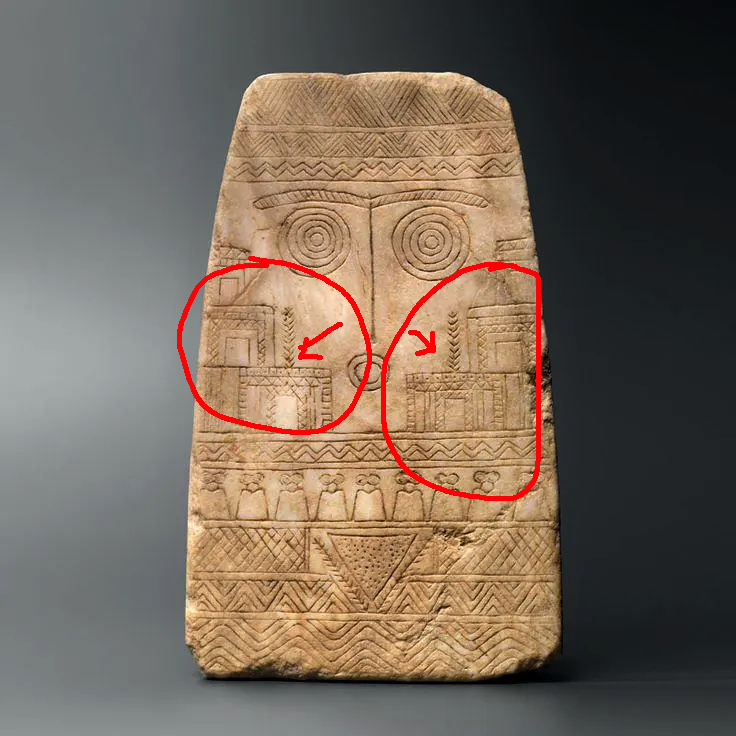
We are also supposed to see the buildings as temple granaries, again because of the grain symbols depicted on top of these buildings...

We are also supposed to see this feature as an irrigation canal. People from Mari used canal irrigation extensively...You can read more about it here...

In which case this is feature is supposed to be seen as the Euphrates river...

As for the little minions, they are supposed to be seen as people from Mari...I talked about them in my post "Eye idols from Tell Brak"...

To read more about ancient animal and plant calendar markers, start here…Then check my twitter threads I still didn't convert to blog post...I am way way behind...

Tuesday, 8 April 2025

Blue bull with golden horns

Stone figurine of a bull with a golden horns, Gilan, Iran, 1st mill BC.  The bull's blue(ish) stone body and golden horns suggest (to me at least🙂) that here we have an animal symbol linked with water and sun...And Taurus...  Why? Here's why:

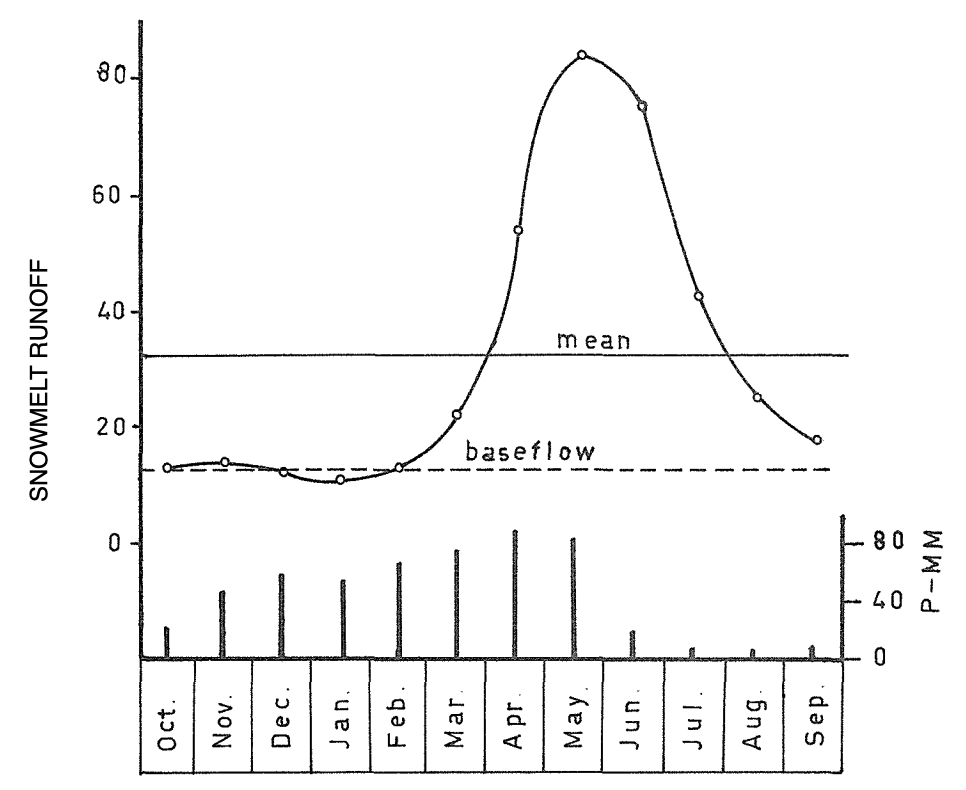
This is the chart of the monthly flow of the Sefid Rud river, which flows through Gilan province of Iran from this article…You can see that the river is from Feb fed by snowmelt, which peaks in Apr/May, in Taurus...

Taurus which marks the beginning of summer, season symbolised by a bull...And ruled by the sun...I talked about this in my post "Symbols of the seasons"...

Taurus which originally had nothing to do with stars. It is an ancient animal calendar marker, which originally marked the beginning of the calving season of wild Eurasian cattle...

I talked about this in many of my articles, for instance "Cow and calf ivory", "Foundation peg of the goddess Nanshe", "Elamite water bull", "Human bull hybrid", "White calf", "Calydonian boar"...

It is the sun rising elevation 

and rising temperature which causes the snowmelt which fills the rivers with water.

And so, symbolically, every spring, the sun god Utu / Shamash climbs the holy mountain (Abzu, source of water) to free Enki / Ea, the god of sweet water from his icy prison and release the waters...

I talked about this in my posts "Shamash young and old", "When Utu steps up to heaven", "Problems of Abzu"...

Snowmelt which is the main water source for both Iranian rivers and Tigris and Euphrates.


Tigris and Euphrates annual flood (fed by snowmelt caused by the sun) peaks in Taurus, beginning of summer...


Hence Utu/Shamash depicted as a golden bull's head (sun) with lapis beard (flowing water). How do we know this is Utu/Shamash? Cause in "Enki and the world order" we read  "Utu/Shamash...the great herald in the east of holy An...with a lapis-lazuli beard, rising from the horizon..."  


I talked about this in my posts "Butt chewing", "Maran", "Lyres of Ur", "Solar bull"...

The Iranian blue bull with golden horns is most likely the Iranian symbolic equivalent of this golden bull Sun/Water bull Utu/Shamash or Enki/Ea, cause Enki was also known as "Great lord...Enki...great bull of the Abzu"...

BTW, I talked about Elamite/Iranian symbolic links between bulls and flood/water in my posts "Dedicated to Inshushinak", "Elamite water bull", "Harness ring from Luristan"...

To read more about ancient animal and plant calendar markers, start here…Then check my twitter threads I still didn't convert to blog post...I am way way behind...

Saturday, 30 November 2024

Clay boat from Shuruppak

Clay boat model dated to 2200-2000 BC from Shuruppak, modern Tell Fara, an ancient Sumerian city situated about 55 kilometres south of Nippur on the banks of the Euphrates. Currently in the Penn Museum...


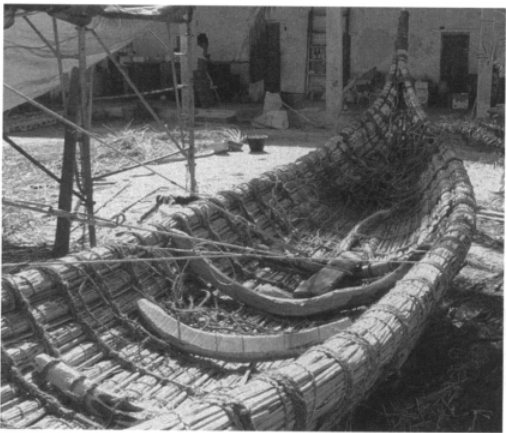
Here's the real thing, a boat made from reed bundles...

I talked about these boats in my post "Canals" where I talked about how knowing the best time to cut reed for boat building can helps us understand why the sun god Shamash is depicted with reed cutting knife.

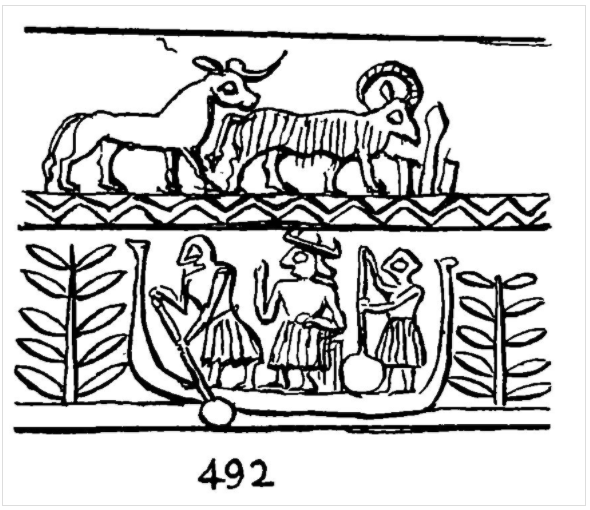
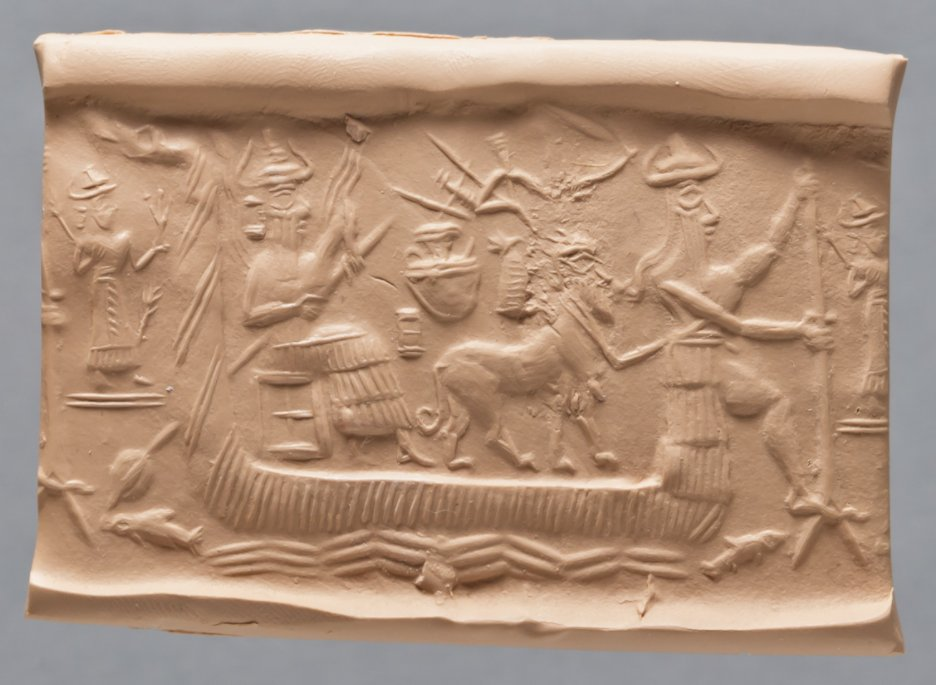
This is the same type of boat in which the god of water and annual flood is depicted sailing down Tigris and Euphrates...2300–2150 BC. 

Talked about it in my post "Enki's little boat" where I discussed interesting animal calendar markers from the poem describing Enki's boat trip...

Here is the same Enki's flood boat, from a Sumerian Early Dynoastic seal, also depicting the goat (mating of wild goats, Oct/Nov, beginning of the wet season) and bull (calving of wild cattle, Apr/May, end of the wet season, beginning of the annual flood). 


I talked about it in my post "Rain and flood"...

This is also the same boat shown here as being Enki...I talked about this amazing seal in this post "Fertility goddess with poppies". Lots of animal and plant calendar markers everywhere...Including grain (important 🙂)...

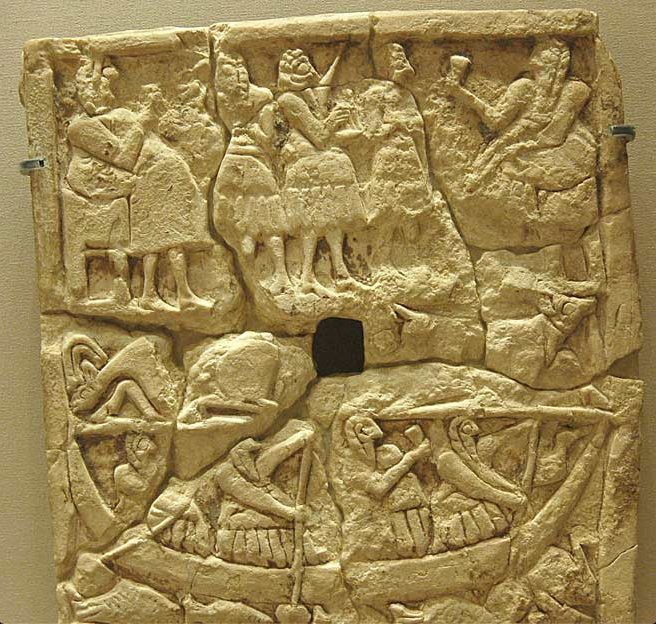
And the same flood boat depicted on this perforated votive limestone plaque dated to ca. 2700-2650BC currently in Louvre...I talked about this in my post "Feast plaque from Louvre"...

So boat from Shuruppak is the symbol of???

Look at this: "Shuruppak became a grain storage and distribution city and had more silos than any other Sumerian city"...

Boat in the Grain storage...Check this post, "A person in a little boat", about the same "Little boat" depicted on this Proto-Elamite tablet from Iran, dated to 3400-3100 BC...

Is that grain sticking out of the butt of the "person in the little boat"? Apr/May, the beginning of the flood, is also the beginning of the grain harvest, and Jul/Aug, the end of the flood, is also the end of the grain harvest...Interesting...

To read more about ancient animal and plant calendar markers, start here…Then check my twitter threads I still didn't convert to blog post...I am way way behind...

Sunday, 6 October 2024

Fighting lion among the reeds

Akkadian cylinder seal, dated to 2400BC-2200BC, depicting "two antithetical groups, each consisting of a bearded hero fighting a lion"...Currently in the British museum...

There is a lot of speculation about the identity of the "hero". But no one is asking the question: why are there reeds depicted in the centre of the seal? Let me try to answer this question myself. 

Remember this seal from my post "Canals"?

Sun God Utu/Shamash with sun (heat) rays emanating from his shoulders, standing in in an empty canal, in Leo (between the lions), the hottest, driest time of the year in Mesopotamia, and the time when canals were repaired, holding reed cutting knife...

In this post I talked not just about the best time to repair the canals (August) but also about the best time to cut reeds for boat building (Also August):

"Marsh Arabs of Iraq say that Berdi reed, must be cut in August, and only in August, or it absorbs water quickly and sinks"...

So I wonder if this Akkadian seal also symbolically depicts that the best time to cut reeds is "between lions", in Leo (Jul/Aug). BTW Leo marks Jul/Aug, because this is when Eurasian lions main mating season used to start...

Another post, "Scarlet ware with goat" in which I talk about the exploitation of reeds in Mesopotamia, this time as animal fodder...


That's it. To read more about ancient animal and plant calendar markers, start here…Then check my twitter threads I still didn't convert to blog post...I am way way behind...