Showing posts with label Natufian culture. Show all posts

Sunday, 19 March 2023

Mother of grain

MOTHER Earth...The symbolic link between women and earth depicted on this Early Vinča Culture terracotta figurine from Jela, Iron Gate region of the Danube, Serbia, c. 5200 BC, H. 5.3 cm, which has a branching plant growing out of the womb...Pic from "The Body of Woman as Sacred Metaphor"...

It is interesting that this Neolithic Early Vinča culture depiction of the mother goddess was found in the same region where in Mesolithic we find Lepenski Vir culture, whose people made exactly the same image out of a bone...5000 years earlier...around 10,600 BC. It was found at Cuina Turcului, a rock shelter in the Iron Gates gorges on the Danube river, Romania.


The symbolic depiction of a mother earth as a woman is kind of easy to understand. They both give birth to things...

What is interesting is that Slavs who live in the area today, have preserved this symbolic depiction of the mother earth as a female...

Baba, the word which means Mother, Grandmother, Midwife...Birth Giver...The rock which gives birth to life...Which is why we have so many rocky mountain peaks in the Balkans named Baba. Like this one, "Baba's tooth" from Stara Planina (Old Mountain) You can find many more examples in my post "Baba, mountains and crags"...


That mountain alone has all these toponyms and hydronyms with Baba (mother, grandmother) in them...

But Slavs have also preserved something else: belief that female fertility and earth fertility, particularly agricultural fertility, and even more specifically grain fertility, are directly linked, and that one can affect the other...

Which is why we have Slavic agricultural rituals like these: In the past in Russia, after the last sheaf of grain was cut, women harvesters would lie down on the ground and roll around the field "to return the strength to the earth"...I talked about this in my post "Walking sheafs of wheat"...

Or why we have Slavic beliefs like this: A pregnant woman was forbidden to climb fruit trees or even touch them, because "the tree would dry out" (she would steal the tree's fertile energy for her own pregnancy)...I talked about this in my post "Planting tree when the child is born"... 

Or why bread oven is called "baba" (mother, grandmother, midwife, birth giver, mother earth)...I talked about this in my post "Baba, earthen bread oven"...

Now back to our mother earth figurines. The people from Lepenski vir who made that figurine depicting plants growing out of the womb of the mother earth, also made these: womb stones. Sculpture from the hearth of house No. 51, Lepenski Vir (9500–6000 BC, Serbia). It shows a vulva in a specific physiological state, just before giving birth, with all its anatomical details...Photo: From "Lepenski Vir" by Dragoslav Srejović 1972...

They also made very strange trapezoidal shaped houses dated to 6300-6000BC. 

They are all shaped like a flat top pyramid they could see from their settlement. Why? Because every summer solstice, the sun rose on top of it...I talked about this in my post "Sun on top of pyramid"...

Interestingly the only other example of a house like this was a Natufian culture "shrine", dated to 12,600-10,000 BC. I talked about this in my post "Natufian house"...

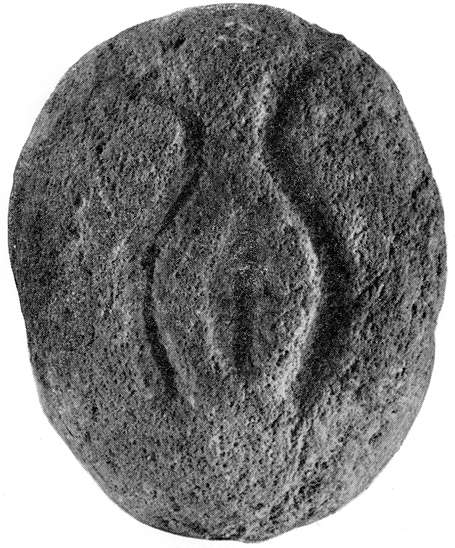
Natufians also made lots of stones like these...The pic is from this paper "The Natural Inspiration for Natufian Art: Cases from Wadi Hammeh 27, Jordan" which says that "They have sometimes been referred to as ‘shaft straighteners’ with the idea being that they were used to straighten bone or wooden shafts, perhaps when heated..."

"This function is unlikely, however, given direct observations of traditional artisans and experimental reconstructions of these objects’ use. Wooden spears or shafts are usually straightened by hand while being held over a fire..."

"Alternatively, the grooved stones were probably used to abrade softer materials such as Phragmites reeds, while drawing shafts back and forth through the cavity formed by binding two stones tied together with the grooves opposed..."


So we don't know what these stones were used for. That they were tools becomes doubtful (at least to me) when we know that they also made decorated, stones of the same type...The pic is from the same above article...


And this is why I don't think these were tools. The same type of objects, just made from clay, were found deposited in a sacrificial pit in the 7th mill BC early grain farming Starčevo culture Blagotin settlement in Serbia. I talked about this in my post "Blagotin"...

These were the guys who brought grain to Europe...The guys who built temple dedicated to grain. 

If we look at the clay objects from Blagotin, we can see that the groves made in them are too wide and shallow to be used for any kind of straightening of anything...

Which is why they were interpreted by Serbian archaeologists as "grain seed models", grain fertility idols...Now if you squint you will see that they don't just look like grain seeds. They also look like vulvas...Vulvas made of stone and clay, made of the body of mother earth...

Starčevo culture was ancestral culture of the Vinča culture...So we have come full circle...Hence plants growing out of the womb of the Vinča culture idol...But also out of the womb of the Lepenski Vir idol. Which predates Starčevo...

I recently came across this: A gynomorphic (woman like) figurine made of "soil mixed with chaff and grain seeds" from Grčac, Serbia. Proto-Starčevo culture, 6200-5500 BC. Direct symbolic link between earth, grain and female fertility. Basically, "Mother of Grain"...

Now that I think about it, the plant is most likely grain...These are symbols for grain from Mesopotamia and Central Asia...


This (widespread) belief that plants (especially grain) grow out of the womb of the mother earth was for the first time spelled out in Mesopotamia, where in "The Courtship of Inanna and Dumuzi" we find these verses:

"...Before my lord, Dumuzi,

I poured out plants from my womb.

I placed plants before him,

I poured out plants before him.

I placed grain before him,

I poured out grain before him,

I poured out grain before my womb..."

BTW, every year during the harvest, a man and a woman performed ritual sexual act on a threshing floor, imitating Inanna (earth, womb) and Enki (sweet water, seed) consummating their holy marriage. I talked about this in my post "Sacred marriage on the threshing floor"...


The result of which was grain grew out of Inanna's womb...

And so on and so forth...I will end this rambling article here. Got to go and make dinner...

PS: Forgot to say that Natufians were some of the first people to eat, gather and maybe even grow grain...I talked about this in my post "How grain came to Sumer"...


Friday, 8 December 2017

Natufian house

According to a report in Seeker, published in August 2017, researchers led by Tobias Richter of the University of Copenhagen have excavated a Natufian culture site in Jordan known as Shubayqa 1, which was occupied between 12,600 and 10,000 BC. The early radiocarbon date for the site, obtained through accelerator mass spectrometry, suggests that Natufians lived across the region of the Levant earlier than had been previously thought, and adapted to a wide range of habitats. The site could also offer scientists information on the transition from hunting and gathering to farming. Richter said the people living at Shubayqa 1 domesticated dogs as early as 12,000 BC. They produced art in the form of carved bone and stone figures. They also buried their dead. “Some have argued that this is evidence for the presence of ritual specialists—shamans—or some kind of group leaders,” Richter said. “What seems clear is that the Natufians had developed a complex symbolic cosmology and treated their dead with respect.”

They also built one of the world’s earliest stone buildings, complete with a stone-paved floor. A stone-lined fire pit, and food remains from birds, gazelle, and tubers, vegetables, and wild cereals and legumes were also uncovered.

This is the building the article is talking about:


In the article "High Resolution AMS Dates from Shubayqa 1, northeast Jordan Reveal Complex Origins of Late Epipalaeolithic Natufian in the Levant" by Tobias Richter, Amaia Arranz-Otaegui, Lisa Yeomans & Elisabetta Boaretto, we can see the aerial view of Shubayqa 1 showing the main excavation area A/B and location of Shubayqa 1 (insert bottom left). And in the centre we can see the above house with the paved floor and the stone lined hearth, which is clearly trapezoid in its shape.


This is very very interesting. Because there is another site, in Serbia, full of trapezoid houses with paved floors and central lined hearth.

Lepenski Vir, located in Serbia, is an important archaeological site of the Mesolithic Iron Gates culture of the Balkans. The latest radiocarbon and AMS data suggests that the chronology of Lepenski Vir is compressed between 9500/7200-6000 BC. The late Lepenski Vir (6300-6000 BC) architectural development was the development of the Trapezoidal buildings and monumental sculpture...


The houses are completely standardized in design, and have a very distinct shape, built according to a complicated geometric pattern.  


They however greatly vary in size. The smallest of the houses have an area of 1.5 m2 (16 sq ft) while the largest one covers 30 m2 (320 sq ft). Here are these trapezoidal buildings in situ.


In Lepenski Vir, it appears that there was a process of gradual desacralization, which means that the shrines turned into the houses in time.

The basis of each of the houses is a circle segment of exactly 60 degrees, constructed in the manner of an equilateral triangle. The tip of the trapezoid base, a shape previously unknown in human settlements, is pointed into the direction of the prevailing wind (košava).  The material used for the floors is the local limestone clay, which, when mixed with the animal dung and ash, hardens like a concrete. Because of that, the floors are almost in perfect condition. On the edges of the floors there are remnants of the stone reinforcements which served as the carriers of the upper constructions, which means the houses were covered. The covering material was some easily degradable material or was similar to the surrounding loess, so it couldn't be distinguished from it during the excavations.

According to the archaeologists who worked on the site, the planned design of the settlement, its functionality and proportional forms, shows the almost modern sense of architecture. Despite a major age distance between then and now, the architectural plan of the settlement seems so contemporary and recognizable today.

The shape of the house base was, until I saw the above Natufian house, thought to be completely authentic and not recorded in any other locality.

Now what? Are these two cultures connected? 

Let's see what we have:

Natufian single trapezoid house (temple???) with stone paved floor and stone lined hearth. 

Lepenski vir trapezoid houses with stone paved floors and stone lined hearths, which Serbian archaeologists say developed from temples...

Natufians founded Jericho which may be the oldest city in the world. People of the PPNA culture which succeeds the Natufian culture in Jericho, buried their dead under the floors of their houses. There are 279 burials, below floors, under household foundations, and in between walls found in the PPNA period layer in Jericho. During PPNB period, Skulls were often dug up and reburied, or mottled with clay and (presumably) displayed. 


Lepenski vir people also buried their dead under the floors of their houses, sometimes with the head cut off. They also made many stone heads which were displayed in the settlements.


Is this all just a coincidence? The cultural traits I have just described are so unique, and dates of the late Natufian culture and the early Lepenski vir culture are so close, that I believe that there is a distinct possibility that there is a link between these two cultures.

And so did Dusan Boric from Columbia University. In his article "The house between grand narratives and microhistories: a house society in the Balkans" he says that:


And:


And that's all 10 years before the discovery of the Natufian trapezoid "shrine"...You should read his article. It's an interesting one. 

The archaeologists who excavated Lepenski Vir, believed that the trapezoidal houses developed from shrines and were sacred "house-shrines". 

They believed that the people from Lepenski Vir built their houses to resemble the rocky outcrop, cliff, hill, called Treskavac, which is clearly visible from the settlement site.


The hill looks like a flat top pyramid. As you can see above, the Lepenski Vir houses look exactly like the hill. They are equilateral triangles with the cut off top.

But why would anyone bother building houses that look like a hill? Because every summer solstice, at sunrise, if you stand at the Lepenski Vir site, you see this. The sun on top of the pyramid...


I mean that will leave an impression, right? Now we are talking about 6300-6000 BC...And people in the Balkans being obsessed with sun on top of a pyramid. So much so that they built house-shines in its liking...

Do you think this is where the idea that "pyramids are cool" comes from? I don't know but I think it could have...

Here is something interesting about these Mesolithic pyramid worshipers. The carried two very interesting haplogroups: I2 and R1b. The I2 are generally accepted as being Neolithic "Old Europeans". But R1b are generally thought to be Bronze Age "Invaders from Eurasian steppe"...

It seems reality is different from "generally accepted and believed" things...From the pyramid worship point of view, it is very very very interesting that these Lepenski Vir R1b people seem to have dispersed in all directions...Some time around 6000BC...

The earliest R1b R-V88 sample from Lepenski Vir is about 11,000 years old. From the Balkans, these individuals moved to Ukraine, where their eastern expansion ends. They also moved south, to the Mediterranean. 

One theory is that at some point all R-V88 lived in Sardinia and that around 7,500 years ago some of them crossed from Sardinia into Africa. It is also possible that RV88 arrived to Africa through Levant. Or from several directions at different times. But to Africa they arrived, and before any pyramid was built there... 

Some of these R-V88 carriers moved from the coast towards, what was then, Lake Mega Chad, a much larger version of Lake Chad, that existed during the Green Sahara period, which lasted until 5,500 years ago. 

As the area became dry, these people moved further and further south. They lived in the oases, rivers, and lakes of Niger, Cameroon, Chad, and Nigeria. Their genes are still present in the population of that area.

But not all. They show up today throughout the Mediterranean, including Spain, Malta, Lebanon, Egypt, and amongst Jewish populations. 

Were some of them among the people who built first pyramids in Egypt?

Were some of theses R1b guys among the people, who one day, all that time ago, stood on the Giza plateau looking at the vast emptiness before them and said: you know what would look great here? A pyramid. To remind us of the Old Country...

What do you think?