Showing posts with label Cultural anthropology. Show all posts

Sunday, 15 December 2019

Fire goddess


Tapati is a Hindu goddess, a  daughter of the sun god Surya. Her name means the "warming", "the hot one", "burning one".  The name comes from PIE root "tp-" meaning warmth, shine. 

Herodotus tells us that Scythians respected one goddess more than any other and called her the queen of gods: Tabiti. This is most likely Tapati...

Herodotus also tells us that Tabiti is actually Hestia, the Greek goddess of the hearth, actually of the hearth fire. Which fits in with the meaning of the Tapati's (Tabiti's) name: warm one, burning one, bright one...

The hearth fire was believed to be directly linked to the sun fire. This can be seen from the Yule log ritual preserved in the Balkans. In it the Yule log (Serbian: Badnjak) was specifically kept burning through "the longest night" so that the fire of the sun doesn't get extinguished...You can read more about this in my post "Badnjak".

Remember originally only Sky god (Sun + Thunder) knew how to make fire. Sun, created Thunder (Lighting) which created fire. By the way this link sun-thunder-fire has been scientifically proven recently. You can read more about it in my post "Sun thunder fire".

This "sacred fire" kindled by Sky God, once found in nature, was brought to the hearth and had to be perpetually kept burning... This ancient memory was preserved in the rituals of eternal flame. Which is what Hestia was. The eternal flame which had to be kept burning...

The tradition of keeping the house hearth fire burning at all times was still one of the main duties of the mistress of the house in Serbian villages in the early 20th century.

Just like in Ancient Greece, accidental or negligent extinction of a domestic hearth-fire represented a failure of domestic and religious care for the family.

Hestia's name means "hearth, altar". And in Serbian houses the hearth was the original altar around which the most important religious ceremonies were performed, officiated by the mistress of the house, the high priestess of the domestic cult, the keeper of the sacred fire.

In Serbia when a family moved house, the new hearth fire was kindled with the flame brought from the old hearth. When a sons built his own house, he kindled the first fire in his new house with the flame brought from his parent's hearth. I wrote about house building rituals in my post "New house".

In Ancient Greece: "...with the establishment of a new colony, flame from Hestia's public hearth in the mother city would be carried to the new settlement...". Do we have the same custom in Ancient Greece with regards to family fire, like in Serbia?

Serbian expression "his hearth was extinguished" is identical to "his line has ended, his family died out"

The hearth fire is here clearly equated with the family. Hence the responsibility for the propagation of both, the hearth fire and the family lied on the mistress of the house...

While keeping the fire burning inside of the hearth, the mistress of the house has to keep fire burning inside of her womb too. As without either of these fires, the house will go dead and cold...

This link between the generative power of the hearth fire and the generative power of the womb fire can be seen in the fact that in some parts of Serbia a bread oven, like this one, is called "Baba" (Mother, Grandmother, Birth giver). 


You can read more about it in my post "Baba - Earthen bread oven".

Only the fire burning inside the woman's womb can transform man's seed into living child. Only the fire burning inside the oven can transform dough into bread. Only the fire burning inside the earth can transform Sun light into Life... Interesting, right?

O and only a female fire burning inside the crucible can transform ore, that a male smith puts into it, into metal. Is this the reason why Irish "hearth fire goddess" Brigid was also the patron of smiths?

This magic transformative power of "female fire" burning inside of the house hearth is what turned difficult to digest raw carcasses into nutritious broths and roasts allowing our ancestors to grow bigger stronger and smarter...

This magic transformative power of "female fire" burning inside of the house hearth is what turned inedible acorns full of poisonous tannins, through leaching and roasting, into nutritious gruels, broths and breads... You can read more about this in my post "Eating acorns". 

This magic transformative power of "female fire" burning inside of the house hearth is what turned inedible grains into porridge and bread...

This magic transformative power of "female fire" burning inside of the house hearth is what turned leaves, root and bark into medicines...

House hearth was the first alchemical laboratory and the house mistress was the first alchemist, preserving and enriching the accumulated knowledge of generations of women who tended the "sacred fire" and used it to make food and medicine...

Is this where the image of an old witch bent over a bubbling cauldron hanged over a house hearth making magic potions comes from? And is it possible that this image was not originally a negative one?


You can read more about this in my post "The skilful one".

Sunday, 1 December 2019

Pelasgos

Pausanias was a Greek traveler and geographer of the second-century AD, who lived in the time of Roman emperors Hadrian, Antoninus Pius, and Marcus Aurelius. He wrote "Description of Greece" in ten books, each dedicated to some portion of Greece


One of the books was about Arcadia (Greek: Ἀρκαδία), a region in the central Peloponnese, the old and mysterious place where Pelasgians, the followers of Pelasgus, started human civilisation.


Pausanius tells us that it was Pelasgus who "invented huts that humans should not shiver, or be soaked by rain, or oppressed by heat. He also invented coats of sheep-skins, such as poor folk still wear in Euboea and Phocis." 


I talked about the history of these sheep skin coats in my post "Gown"

Pausanius also tells us that Pelasgus "introduced as food the nuts of trees, not those of all trees but only the acorns of the edible oak." He notes that still in his own time, the Arcadians were fond of acorns.  

This is one of the Arcadian coins with the depiction of an acorn:

You can read more about depictions of acorn eating in ancient texts in my post "Acorns in ancient texts".

This is very interesting because acorns were the first starch food eaten by people, before they switched to grains...

When people lived in the "Garden of Eden" which is in the Old Testament described like this


I wrote about this in my post "Garden of Eden"

In my article about Garden of Eden, I proposed that the name "Eden" comes from PIE root for eating, which would make "Garden of Eden" "Garden of edible tree fruits" like acorns, nuts, apples, pears, cherries... 

In my article "Eat to break fast" about Eid ul-Fitr, Muslim holiday feast that marks the end of Ramadan, the Islamic holy month of fasting, I talked about the fact that the Arabic word Eid (festivity) could come from PIE root for eating...

The time when people lived in the Garden of Eden was to the Greeks known as the "Golden Age", which Ovid describes in Metamorphoses 1. 88 like this:

"The Golden Age (Aetas Aurea) was that first age [of mankind] which unconstrained, with heart and soul, obedient to no law, gave honour to good faith and righteousness. No punishment they knew, no fear; they read no penalties engraved on plates of bronze; no suppliant throng with dread beheld their judge; no judges had they then, but lived secure. No pine had yet, on its high mountain felled, descended to the sea to find strange lands afar; men knew no shores except their own. No battlements their cities yet embraced, no trumpets straight, no horns of sinuous brass, no sword, no helmet then--no need of arms; the world untroubled lived in leisured ease. Tellus (Earth) [Gaia] willingly, untouched, not wounded yet by hoe or plough, gave all her bounteous store; men were content with nature's food unforced, and gathered strawberries on the mountainside and cherries and the clutching bramble's fruit, and acorns fallen from Jove's [Zeus'] spreading tree. Springtime it was, always, for ever spring; the gentle zephyrs with their breathing balm caressed the flowers that sprang without a seed; anon the earth untilled brought forth her fruits, the unhallowed fields lay gold with heavy grain, and streams of milk and springs of nectar flowed and yellow honey dripped from boughs of green..."

And interestingly, the tradition arose in Greece that the site of the original Golden Age had been Arcadia, an impoverished rural area of Greece where the herdsmen still lived on acorns...


For those with dirty minds, you would fit right into Ancient Greece. The word for acorn in Ancient Greek was βάλανος (Balanos). The same word also meant glans penis (dick head)... 

Now here is something that has been bugging me for a while. The main thing Pelasgos did was to introduce acorn into human diet. Is it possible that Pelasgians just means acorn eaters??? I will try to explain why

Slavs living in the Balkans have been eating acorns until the mid 20th c. Most only during "hungry years", but some mountain populations regularly, to supplement their poor diet.

To ensure the supply of edible acorns, sweat oak forests were planted and maintained on village boundaries. Edible acorns were called "sladun" (sweat) "medun" (honney) "granica" (food)

These "sacred" oak forests were called "gaj" (cultivated forest), "zabran" (forbidden forest), "lug" (light forest) and for us particularly interesting "zabel, zabela" (???) name used in Serbia and Macedonia

In the book "Leskovački zbornik" (History of Leskovac) we find that certain forests in the area are caled zabel.

In another book called "Uzroci nestajanja šuma u Srbiji u XIX veku" (The reason for disapearence of forests in Serbia in the 19th century) we find that oak forests are called zabel, zabran in the south of Serbia. 

Another book "Скопље и његова околина" (Skoplje and its surrounding) we find that zabel is "родовскa својнa" (clan property), basically a clan, village forests which is not allowed to be cut, because it is used for the collection of acorns for human and animal consumption.

The book "Istorija seljackog društva. Deo III" (The history of the agricultural society part 3) talks about the evolution of the clan oak forests to village oak forests (zabel, zabran), and how they are used by the villagers.

In the book "Narodna književnost Srba na Kosovu", (Folk literature of the Serbs in Kosovo) we find that zabel is also called zabe and that it is a general word for a clan forest. 

In the magazine "Brastvo, broj 7" (Brotherhood) we find that zabran is called zabel and zabeo.

In "Antropogeografski i etnografski spisi" we find that the names for communal forests are branjevina, braničište, branište, zabran, zabel. 

In the book "Задужбине Косова" (Legats of Kosovo), we find that in Metohija, part of Old Serbia, the common name for protected oak forests among the Serbs was zabel and among Ghog Alabanians Gogaj. 


These were ancient oak forests left to grow between village lands or specifically planted on the boundaries of the village lands and which were forbidden to be cut. These oak forests were not just source of acorns, but also a natural habitat for wild boar, deer, rabit...important sources of meet. Every autumn villagers would go into the village oak forest and collect acorn, which was used both as animal feed and for human consumption. Each familly would collect over 1000 kilos of acorn every year which is a very significan amount of food. 

There is no etymology for "zabel". One possibility is that it comes from the fact that the sacred oaks were in Serbia marked with crosses. Like this one


These marks, and the trees on which they are made are called "zapis"

These kind of marks are also called "beleg", because of the lighter colour of the scar tissue, so it is possible that the zabel comes from za + bel = for + white, marked trees, but this is unlikely...

Ancient Greek word Balanos which means both acorn and oak comes from PIE root *gʷelh₂ (acorn) which in Greek became bel, bal. Is it possible that somehow in the Balkan mountains this word was used to build zabel = za + bel, bal = for oaks, for acorn???

Pelasgos is said to mean "Ancient", but wiktionary says that it is "likely of Pre-Greek origin" and of unknown meaning. As cognates we find Akkadian Pilistu, Palastu and Hebrew Pəlíštim (Philestines, Palestinians) 

Based on the latest genetic studies we know that Philestines came to Middle East from Europe. Based on ethnographic studies we know that in the middle east we have a sharp division on people who eat acorns: Palestinians and people who don't: Jews...

Now if we look at Pelasgos, Pilistu, Palastu, Pəlíštim, we can see that all of these names for acorns eaters start with "pel, pal". Is it possible that these names come from (pal) bal, (bel) bel + jes(t) = acorn + eat? 

"ἐσθίω" is the Ancient Greek for I eat...

"Coincidentally" in South Slavic languages where "zabel" = "za" + "bel" = "for" + "acorns" means "cultivated oak forest" we find that "jesti" means "to eat". So beljest = bel + jest = acorn + he eats = acorns eater = Belest

And interestingly, Pelasgoi was also spelled Pelastoi...Was it Pel+jest+toj (pronounced pelyestoy) = acorn+eat+they = acorn eaters?

This is very possible, as the so-called Harris Papyrus, a biography of Ramses III written under his son and successor Ramses IV, tells us that the pharaoh defeated the "Peleset" – as the Egyptians called the Philistines and other Sea Peoples early in his reign (around 1190 B.C.E.) and brought them back as captives to his lands...

Another interesting thing: in Macedonia where we find "zabel" cultivated oak forests, lowland people use "acorn eaters" as a derogatory term for hillbillies who eat acorns because their land is poor and they can't grow enough grain.

So If Pelesti (Belesti) really comes from pel, bel (acorn) + jest (eat), could Pelasgoi, Pelastois once have been used as an insulting term for the "acorn eaters" by the grain eaters?

Now have a look at this: 

Hebrew: balut - acorn
Iraq: bellut - oak, khubez bellut - acorn bread; 
Zagros mountains, Iran: Beli - acorn
Kurdish = bellot - acorn
Aramaic: bəllūṭā, ballūṭā - oak, acorn

So In all these languages root "bel" means acorn and oak...

So how does this fit with the official etymology of the Ancient Greek "βάλανος" (oak, acorn) which says that this word comes from Proto-Hellenic "*gʷə́lanos", ultimately from Proto-Indo-European "*gʷelh₂-" (“acorn”)...

Isn't it more likely that it is related to all the above Semitic words? And if so did Greeks borrow this word from the Semites?

Well I think the borrowing actually happened the other way round. Look at this:

Aramaic word bəllūṭā, ballūṭā, “oak; acorn” possibly relates to Akkadian 𒋾 (balāṭu, “to live...life-bringing trees or seeds”) and 𒄑𒁁𒀖 (be-lit, baluṭ, “a strong tree...bearing edible produce”) 

But this is not the main Semitic root meaning oak, acorn. The main Semitic root meaning oak, acorn is Akkadian 𒀠𒆷𒀭 (ʾallānu, alyānu) from Sumerian 𒄑𒀠𒆷𒈝 (allanum, “oak; acorn, acorn-shaped”)...

So how and when did "bel" (oak, acorn) come into Semitic languages??? Did it happen during the Bronze Age collapse when Pelestoi (Philestines) came to Middle East from Europe? But how do we then explain the Akkadian words with the root "bel"???

I think this is a very interesting subject which needs further investigation, don't you think?

Sunday, 24 November 2019

Pan

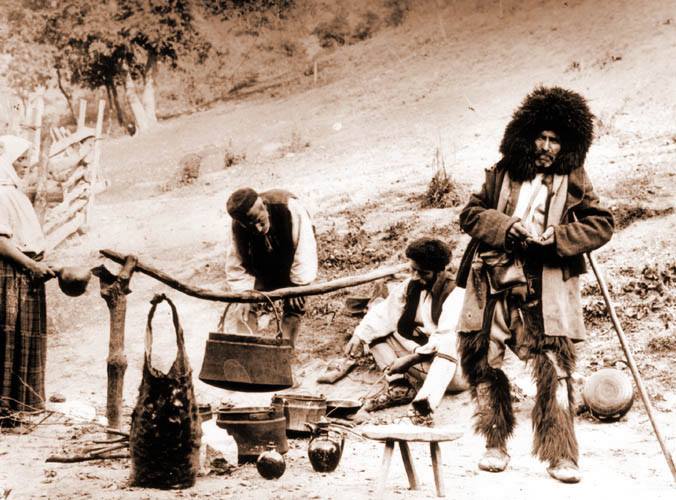
Bačije (summer highland shepherd settlement) Koželj region, Timočka Krajina, Eastern Serbia. People in the background are cooking food or boiling milk. The interesting bit is the shepherd on the right in his sheep fleece trousers...


This is a detail of the fresco called "The birth of Jesus" (dated to 1346) from the Serbian monastery Pećka patrijaršija lokated in Kosovo. The old shepherd in the fresco also wears fleece trousers. 


The strange sheep on the fresco are "Racka" (meaning Serbian) sheep. I wrote about this strange sheep in my post "Racka sheep".

Now meet Pan, Ancient Greek god of the wild, shepherds, flocks, nature of mountain wilds... Is it possible that the "goat legs" of Pan were not originally not goat legs at all, but highland shepherd fleece trousers, misinterpreted by coastal Greeks to be goat legs? 


After all in Greece the worship of Pan began in Arcadia which was always the principal seat of his worship. Arcadia was a district of mountain people, culturally separated from other Greeks.  

Shepherd deity, the protector of flocks would be imagined by shepherds like a shepherd, dressed the way shepherds dress, which includes the fleece trousers. 

If you didn't know what you were looking at, you could be forgiven for thinking that you were looking at a man with goat legs when you saw one of these highland shepherds for the first time in a distance...And this is how myths are made... 


Saturday, 2 November 2019

Thunderer - Thunder


The most terrifying sight for any grain farmer anywhere. Angry thunder god about to destroy everything they worked for all year. I talked about this in my post "The power of thunder giant". 

In the past people were convinced that the sky was the domain of the sky father, sky (thunder) god. It was him who caused thunder and lightning. And so when people heard thunder and saw lightning, they would point to the sky and say with fear: "the sky (thunder) god such and such"...


This is why in some Slavic and Baltic languages the word for thunderbolt and for thunder god is the same: Perun. This was originally just the God's name, which people exclaimed in fear during thunderstorms, and only later, after Christianisation this became "only" a  thunderbolt.

This is the depiction of the god Perun holding his axe. Left of him is the so called "Perunika" (Perun's flower, or Perun's wheel), otherwise known as "Thunder mark". Thunder marks were engraved on buildings to protect them against lightning...


We find the same situation in Celtic culture, where thunder god Taranis eventually became "just thunderbolt". Welsh "taranu, taran", Breton: "taraniñ, taran", Cornish "taran", Gaelic "tórnach" all mean "to thunder and thunder"...

This is the depiction of the god Taranis holding both the solar wheel and thunderbolt...


In Slavic mythology, Thunder god Perun's wheel is blazing Sun god Svetovid's wheel...


In Slavic mythology this dual aspect of Sky God is preserved in the character of St Elijah the Thunderer. I wrote about him in my post "Thundering sun god"...

Finnish Sky (Thunder) god was Ukko and thunder is Ukkonen. Again the Sky god became "just thunder"...

In Germanic mythology there's something similar. In most Germanic languages the name of the thunder god and the word for thunder were (almost) identical. Proto-Germanic root for thunder was *þunraz and Proto-Germanic root for the thunder god was also *Þunraz...


This is a statuette of Zeus hurling a thunderbolt from Dodona, Epirus, Greece


Now here is the question: where does South Slavic word "sev, sijev" meaning flash (chiefly referring to lightning) come from? And does it have anything to do with Zeus (Zevs in Serbian, Zefs in early mediaeval Greek)? Maybe Balkan "Slavic" population originally pronounced the God's name as Sev which became the name for the thunder and lightning after the Christianisation? 

What is very interesting is this: The god's name in the nominative was Ζεύς (Zeús). It was inflected as follows: vocative: Ζεῦ (Zeû); accusative: Δία (Día); genitive: Διός (Diós); dative: Διί (Dií). 

A vocative expression is an expression of direct address. This is what we use when we are shouting someones name. In this case when we are shouting thunder god's name. So maybe I am right? People used to look at the rumbling sky and shout Ζεῦ (Zeû) = Sev...

Interesting indeed...

BTW, the official etymology of sevati is Limited to South Slavic, formed as *sijati (“to shine, to illuminate”) +‎ *-vati, from Proto-Indo-European *(s)ḱeh₁y- (“to shine”)...

Sunday, 8 September 2019

Donja Dolina

Helmet (6th. c. BC) from Sisak, Croatia found in Illyrian warrior grave. Prior to the arrival of the Romans, who gave it the Latin name Siscia, the region was Celtic and Illyrian and the city there was named Segestica or Segesta


Similar helmet, also dated to 7th-6th c BC, was found in 1896, by Ilija Knežević, a peasant from the village of Donja Dolina (Lower valley) located further downstream on Sava river in Bosnia

The discovery of this second helmet led to the discovery of a very important prehistoric industrial and trading centre, which was continuously inhabited from the second half of the second millennium BC until the Roman times.

The Donja Dolina site is located on the right bank of the river Sava, near marshy area full of fish, surrounded by big forests full of game and on the land which is ideal for agriculture. 50km southwest are mountains full of iron ore. Ideal settlement for an Iron Age community


Interestingly, the old Iron Age settlements (there were two, an older and newer one), which were abandoned 2000 years earlier, were found in areas known locally as Velika i Mala Gradina (Big and Small ruined city)...


The old, Late Bronze Age settlement was built on land. But right about the time when the place was settled (1300-1200 BC), a sudden catastrophic climate change made climate much wetter and colder.


This diagram is from my post about ancient salt extraction techniques

The cold and wet period, which increased the river water level, caused frequent floods, made land even more marshy and pretty much completely wiped out agriculture in the area, culminated around 850 BC.

It is around 800 BC when people finally abandoned land life and started living in houses on stilts. The image by Igor Ilijev from his upcoming book about Donja Dolina.


The excavations started in 1896. The settlement was exceptionally well preserved because of the fact that it was covered by thick layers od mud. Pic 1: support substructure. Pic 2: stairs going down to the water level


A very interesting burials were discovered in the settlement. 8 people were buried in wooden coffins in the ground between the stakes which supported the house platforms. None of the people buried under the settlement were warriors


Most of the people were buried in cemeteries located near the settlement. They were either cremated and urns (pic) were placed in shallow graves or their bodies were placed in the ground either directly or in wooden coffins


Most burials had no grave goods apart from food vessels (bowls and cups). These are particularly beautiful examples


However hight status individuals were buried with jewellery, armour and lots of additional grave goods (multiple ceramic vessels). This is a grave of a high status woman buried with her jewellery


Warrior graves contained weapons and food and drink vessels. Here are contents of three warrior graves all dated to 7th-6th c BC. From: The Forgotten Graves from Donja Dolina 


The Donja Dolina was an important trading centre. Goods from as far as Greece in the south, Italy in the west, Bulgaria in the east and Baltic in the north were found in the graves belonging to the people from settlement


The settlement was also an important metallurgical centre. This fibula mould found in one of the graves is of a type found only in Italy at the time, suggesting that this was a grave of an immigrant metalworker


Among many items produced in the Donja Dolina Iron Age settlement, I particularly like this type of bracelets. Are they unique? Anyone seen anything similar from the period 800-400 BC?

Another interesting type of objects found in Donja Dolina Iron Age settlement were bronze "ornamental rods". Up to 10cm long, they are found in graves as components of the funerary ornaments. Anything similar anywhere else? Meaning?

Here is a complete inventory of one of the warrior graves where these ornamental rods (also classified as staffs, even though they are only 10cm long) were found


Most helmets found in the Donja Dolina 7th-6th c BC graves, were made in Macedonia where they were found in princely graves. At that time in Greece, they are found only in sanctuaries, linked with the territory of ancient Macedonia

Among the scattered finds from the cemetery, these two peculiarly shaped clay objects stroke my attention. The size of the objects is less than 10cm. Use unknown. Any ideas? Stamps of sort? For bread maybe?


Another type of objects without good explanation are these sandstone prisms with swastikas engraved on the top and bottom.


Another interesting swastika design was reconstructed from several fragments found at the site


The results of the excavations, were published by Ćiro Truhelka in 1904 in "Der vorgeschichtliche Pfahlbau im Savebette bei Donja Dolina

I like this stamp issued by Bosna i Hercegovina - Republika Srpska (Bosnia and Herzegovina - Serbian Republic), showing weapons found in Donja Dolina site


To me the most interesting finds from Donja Dolina Iron Age archaeological site are boats. This is the biggest one, 12 meter long oak dugout, currently in Zemaljski muzej Bosne I Hercegovine, Sarajevo


And this is the photo from 1901 showing the lifting of the boat from the site. Were boats like this one used during the early Iron Age for trade transport along Sava river?


And this is the picture showing the smallest boat found in the Early Iron Age settlement Donja Dolina in Bosnia, a miniature model of an oak dugout. Several are found in every house in the settlement. Toys? Or???


What is interesting is that almost identical boats were still used in Donja Dolina in the early 20th century. In the book "Vremeplov: Narodno ribarstvo u Bosni I Hercegovini" we find this fishing boat


I particularly like this picture from the book about the folk fishing from Bosnia, showing three types of dugout boats from Donja Dolina: a) male, b) female, c) front male back female...

The dugout boats are not the only thing which has been in continuous use since the early Iron Age in Donja Dolina. These are stilt houses in which people lived in Donja Dolina in the early 20th c


And finally here is my favourite picture. Women from Donja Dolina, in a "female" boat, coming back home from a bridal party. This could easily be a scene from the Iron Age Donja Dolina...


In the end, here is the link to the report about Donja Dolina Archaeological site published by the commission for preservation of national monuments from Bosnia and Hercegovina from which I translated some excerpts for this post.