Showing posts with label Croatia. Show all posts

Sunday, 8 September 2019

Donja Dolina

Helmet (6th. c. BC) from Sisak, Croatia found in Illyrian warrior grave. Prior to the arrival of the Romans, who gave it the Latin name Siscia, the region was Celtic and Illyrian and the city there was named Segestica or Segesta


Similar helmet, also dated to 7th-6th c BC, was found in 1896, by Ilija Knežević, a peasant from the village of Donja Dolina (Lower valley) located further downstream on Sava river in Bosnia

The discovery of this second helmet led to the discovery of a very important prehistoric industrial and trading centre, which was continuously inhabited from the second half of the second millennium BC until the Roman times.

The Donja Dolina site is located on the right bank of the river Sava, near marshy area full of fish, surrounded by big forests full of game and on the land which is ideal for agriculture. 50km southwest are mountains full of iron ore. Ideal settlement for an Iron Age community


Interestingly, the old Iron Age settlements (there were two, an older and newer one), which were abandoned 2000 years earlier, were found in areas known locally as Velika i Mala Gradina (Big and Small ruined city)...


The old, Late Bronze Age settlement was built on land. But right about the time when the place was settled (1300-1200 BC), a sudden catastrophic climate change made climate much wetter and colder.


This diagram is from my post about ancient salt extraction techniques

The cold and wet period, which increased the river water level, caused frequent floods, made land even more marshy and pretty much completely wiped out agriculture in the area, culminated around 850 BC.

It is around 800 BC when people finally abandoned land life and started living in houses on stilts. The image by Igor Ilijev from his upcoming book about Donja Dolina.


The excavations started in 1896. The settlement was exceptionally well preserved because of the fact that it was covered by thick layers od mud. Pic 1: support substructure. Pic 2: stairs going down to the water level


A very interesting burials were discovered in the settlement. 8 people were buried in wooden coffins in the ground between the stakes which supported the house platforms. None of the people buried under the settlement were warriors


Most of the people were buried in cemeteries located near the settlement. They were either cremated and urns (pic) were placed in shallow graves or their bodies were placed in the ground either directly or in wooden coffins


Most burials had no grave goods apart from food vessels (bowls and cups). These are particularly beautiful examples


However hight status individuals were buried with jewellery, armour and lots of additional grave goods (multiple ceramic vessels). This is a grave of a high status woman buried with her jewellery


Warrior graves contained weapons and food and drink vessels. Here are contents of three warrior graves all dated to 7th-6th c BC. From: The Forgotten Graves from Donja Dolina 


The Donja Dolina was an important trading centre. Goods from as far as Greece in the south, Italy in the west, Bulgaria in the east and Baltic in the north were found in the graves belonging to the people from settlement


The settlement was also an important metallurgical centre. This fibula mould found in one of the graves is of a type found only in Italy at the time, suggesting that this was a grave of an immigrant metalworker


Among many items produced in the Donja Dolina Iron Age settlement, I particularly like this type of bracelets. Are they unique? Anyone seen anything similar from the period 800-400 BC?

Another interesting type of objects found in Donja Dolina Iron Age settlement were bronze "ornamental rods". Up to 10cm long, they are found in graves as components of the funerary ornaments. Anything similar anywhere else? Meaning?

Here is a complete inventory of one of the warrior graves where these ornamental rods (also classified as staffs, even though they are only 10cm long) were found


Most helmets found in the Donja Dolina 7th-6th c BC graves, were made in Macedonia where they were found in princely graves. At that time in Greece, they are found only in sanctuaries, linked with the territory of ancient Macedonia

Among the scattered finds from the cemetery, these two peculiarly shaped clay objects stroke my attention. The size of the objects is less than 10cm. Use unknown. Any ideas? Stamps of sort? For bread maybe?


Another type of objects without good explanation are these sandstone prisms with swastikas engraved on the top and bottom.


Another interesting swastika design was reconstructed from several fragments found at the site


The results of the excavations, were published by Ćiro Truhelka in 1904 in "Der vorgeschichtliche Pfahlbau im Savebette bei Donja Dolina

I like this stamp issued by Bosna i Hercegovina - Republika Srpska (Bosnia and Herzegovina - Serbian Republic), showing weapons found in Donja Dolina site


To me the most interesting finds from Donja Dolina Iron Age archaeological site are boats. This is the biggest one, 12 meter long oak dugout, currently in Zemaljski muzej Bosne I Hercegovine, Sarajevo


And this is the photo from 1901 showing the lifting of the boat from the site. Were boats like this one used during the early Iron Age for trade transport along Sava river?


And this is the picture showing the smallest boat found in the Early Iron Age settlement Donja Dolina in Bosnia, a miniature model of an oak dugout. Several are found in every house in the settlement. Toys? Or???


What is interesting is that almost identical boats were still used in Donja Dolina in the early 20th century. In the book "Vremeplov: Narodno ribarstvo u Bosni I Hercegovini" we find this fishing boat


I particularly like this picture from the book about the folk fishing from Bosnia, showing three types of dugout boats from Donja Dolina: a) male, b) female, c) front male back female...

The dugout boats are not the only thing which has been in continuous use since the early Iron Age in Donja Dolina. These are stilt houses in which people lived in Donja Dolina in the early 20th c


And finally here is my favourite picture. Women from Donja Dolina, in a "female" boat, coming back home from a bridal party. This could easily be a scene from the Iron Age Donja Dolina...


In the end, here is the link to the report about Donja Dolina Archaeological site published by the commission for preservation of national monuments from Bosnia and Hercegovina from which I translated some excerpts for this post.  

Sunday, 17 April 2016

Majka Božja Krasanska

Holy Mary chapel on Krasno hill


This is the Church of the Ascension of the Blessed Virgin Mary which stands on Krasanski brijeg (Krasno hill) near the village of Krasno in the area of the North Velebit. There is a local legend which tells the story about how and why the church was built where it was built. This legend is very interesting and I believe very important because it is an allegory which contains, in one paragraph, the history of Christianization of Velebit population. 

This is the full text of the legend:

"Where the church stands today, there once used to be a thick old (oak) forest. In this forest local shepherds used to shelter from the heat of the summer. One day they saw a rose growing out of an old tree stump and in this rose they saw the image of Virgin Mary. The shepherds picked the rose and brought it to Krasno village. As there was still no Catholic church in Krasno, they took the rose to the "Greek" chapel in Krasno field. But the rose didn't want to stay in the "Greek" chapel. The next time the shepherds came to the oak forest, the rose was back growing from the same old stump. Then shepherds took the rose to another church in Kosinj, but the rose didn't want to stay there either. The next time the shepherds came to the oak forest, the rose was back growing from the same old stump. So shepherds realized that the Virgin Mary wants to stay in the Oak forest. So they built a stone altar over the old tree stump and the rose and then they built a stone chapel around it. "

Now here is what I believe this story actually means:

Where the church stands today, there once was a holly (oak?) grove where local pagan population worshiped the Mother Earth. Then during the early Medieval time, the Christian missionaries, which belonged to the "Greek" church tried to convert the pagans into Christianity. These "Greeks" were either pre Schism Roman Christians or post Schism Eastern Orthodox Christians which were by Catholics called  "Grko-istocnjački šizmatici (Greek eastern schismatics).  So these "Greeks" built a church in Krasno and for a while people may have even (probably just nominally) accepted Christianity. Anyway this first conversion ultimately failed and the local people returned to their old ways, and worshiping of the old gods in the holy (oak?) grove. The return to paganism probably happened because of the disintegration of the Roman power in the Balkans during the Arrival of the Slavs and the creation of the Slavic Early Medieval states. Another attempt to Chrisitanize the local highland population was made, this time by the Catholic church, probably during the Hungarian rule, but that also failed. People again returned to their old ways. This probably happened because of the Turkish invasion and occupation. Finally after the Turks were expelled from the area, the Catholic church which moved in made another final attempt to Christianize the local population. This time they realized that in order to "Christianize" the local population, they had to Christianize the old pagan temple and the old pagan god(s) to which the temple was dedicated. And this is exactly what they did. Basically the old goddess (Baba, Mother Earth) was converted into the new equivalent Christian character (Virgin Mary, The mother of god) and the chapel of the Virgin Mary was built on top of the old temple. Why do I think that the original temple was dedicated to Baba, Mother Earth? In my post "Shepherd's chapels from Velebit" I already described how old temples dedicated to Baba, Mother Earth in South Velebit were converted to the churches dedicated to the Virgin Mary. Because the same shepherd population lived everywhere on Velebit, I believe that the people in the North Velebit also worshiped Baba, Mother Earth and that the same thing happened with her temple here in Krasno. 

How important this old Pagan center was, can be seen from the fact that the newly built Church of the Ascension of the Blessed Virgin Mary became the most important center of the Marian cult in Croatia. Basically the local people continued flocking to the old (new) temple, to pray to the old (new) Goddess...

Well this is what I think. What do you think?

Source:

"Usmena predaja o gradnji crkve svete Marije u Krasnu" by Ante Glavičić

Wednesday, 13 April 2016

Shepherd's chapels from Velebit

In my post about the Indian Summer, which is in Central Europe called Babje Leto (Grandmother's summer), I showed that the beliefs related to Babje Leto (Grandmother's summer), show that the old Mother Goddess, Mother Earth, Baba, was with the arrival of Christianity replaced with Mary, the Holy Mother of Christianity. 

In this post I will talk about the shepherd's chapels from Mount Velebit in Croatia. They offer us even more direct proof of the replacement of the Mother Goddess, Mother Earth, Baba with Mary, the Holy Mother.

Alpine transhumance is a seasonal droving of grazing livestock between the valleys in winter and the high mountain pastures in summer. Transhumance is a traditional practice that has shaped much of the landscape in the Alps, as without it, most areas below 2,000 m would be forests. The exactly the same type of practice existed once on Dinaric Alps

This is the highland pasture area called Jezera (Lakes) on mountain Velebit in Croatia. This is the area where in the past people living around the mountain used to bring flocks of sheep and goats and herds of  cows to spend the hot summers grazing on a good green highland grass. 

Jezera plateau
Jezera plateau
Each large grazing area had pre Christian shepherd's temples with sacrificial altar. These pagan temples were later turned into Christian churches, locally known as "stočarske kapelice" (shepherd's chapels). The oldest one is the shepherd's chapel in Jezera (Lakes) plateau grazing area. There on top of the "Goli hrbat" (Naked back), at the height of 1470 m above the sea level, lie in complete isolation ruins of an ancient sacral building with dimension 10 x 5 meters. The stone walls, which were built using dry wall building technique, were 1.3 meters thick. The most unusual thing about this chapel is the altar stone. The altar is actually bedrock, which existed there before the church was built. Bedrock is in the Balkans known as "kamen živac, živi kamen, živa stena" (living stone, living rock) and is venerated as sacred. They are called so, because they are believed to be still part of the living body of the Mother Earth. These types of stones are also known as "baba" stones. The fact that the altar stone was carved out of bedrock shows that this was an ancient pre Christian altar stone which was later encased inside of the Christian church, surrounded by the thick church walls in order to have it's "evil" power contained.

Remains of the old shepherd's chapel

There is something very interesting about this church though. In his article: "Nekateri topografski vidiki obrednih mest [Some Topographic Aspects of Ritual Places ]" Andrej Pleterski says:
"One of the diagonals of the church is aligned exactly to the east west line. The longitudinal axis of the church has azimuth of 123,5° (angle from geographic north). This means that the church is oriented towards the local point of the Christmas sunrise. Therefore, it is very likely that the original orientation of the pagan temple which was replaced with the church, was towards the winter solstice sunrise."

Was this an ancient solar observatory used for determining the beginning of the solar year? In order to carve the shepherd's solar year calendars that I wrote about in this post....

The church which is now the only visible structure in the area was once surrounded by a large summer shepherd's settlement which is in the Balkans called "stan" or "katun" or "tor". This settlement even had an artificial lake made from a converted sink hole. The bottom of the sink hole was paved with large stone plates and a stone wall was built along the perimeter, turning the sink hole into a giant cistern. This is why the area was known as Jezera (Lakes). Every year on the 15th of August, on the day of the Assumption of Mary, shepherd's had a large festival with a fair which was organized in the area around the holy Baba stone and later the church dedicated to Holy Mary. On that day, all the sheep, goats and cattle had to be gathered and brought to the pens and corals before 10 am in the morning, because that was the time when the holy mass started. After the mass, a special meal was prepared. Every family would kill (sacrifice) a lamb or a young goat, which was then cooked in a broth. This soup was then brought to the church where a communal meal would take place.

The shepherd's chapel in Jezera (Lakes) area is not the only Christian chapel built around an ancient bedrock altar stone. There used to be another one on "Veliko Rujno" (Big Rujno) plateau.

Veliko Rujno
But today the only thing left is the original bedrock altar - Baba. The stones from the old church which once encased this old pagan altar were used to build a new church dedicated to Holy Mary in 1930 and which stands 50 meters away from the old altar stone.

Veliko Rujno chapel
Next to old bedrock altar lies a large stone slab. The locals say that this slab marks "the grave of an innocent child". Every year on the 15th of August, on the day of the Assumption of Mary the shepherd's used to drive their flocks over this slab in order to cleanse them from decease and evil.

Near by is another highland plateau called "Malo Rujno" (Little Rujno).

Malo Rujno

On it there is a similar stone block which local shepherd's called "Baba". On the arrival, shepherd women used to bring food offerings and leave them on the stone. They also used to lite candles on the stone on various holy days. The stone was also known as "the altar".

According to the local informer Dara Babac :) , who was 80 years old when she was interviewed, Baba stone on Malo Rujno was blessed by a priest from Lika region, and this is why this stone is also called Babin kuk (Baba's stone, kuk being another word for rock, boulder) or Popov kuk (Priest's stone). Women who couldn't have children were praying to the Baba stone to help them to stay pregnant and give birth to a healthy child. During this prayer they were kissing the stone. After the second world war, the stone lost it's cultic importance, but the act of kissing the Baba stone was transferred to kissing any old woman. Young girls which were earlier urged to kiss the Baba stone "for their own good" were urged to kiss any old woman that they see, also "for their own good". The kissing ritual was also transferred from the Baba stone to its Christian replacement, the statue of the Holy Mary. During the prayer in the chapel on Veliko Rujno, women circled the altar on their knees. At the end of the prayer they would kiss the feet and the dress of the statue. They were also kissing the picture of the Holy Mary during the procession which circled the church.

Another ancient shepherd's chapel on Velebit mountain lies at the end of the "Grabov dol" (hornbeam valley) on the edge of the "Mala Paklenica" (Small hell) gorge.

Mala Paklenica

The chapel was dedicated to the shepherd's saint, Saint Jacob. Today the chapel lies in ruins. Please note the statue of Mary placed inside the church ruins.

Saint Jacob chapel

Another shepherd's chapel used to stand in the near by Libinje plateau, under Sveto brdo (Holy hill).

Libinje plateau
The chapel was dedicated to st Antun, but about 20 years ago the last trace of this chapel have disappeared. This is another place where shepherd's used to have their gathering, mass and fair immediately after the arrival on the mountain in the spring. The chapel was surrounded with stone sheep pens where the flocks were kept during the ceremonies. The sheep pens were made using the same dry wall building technique used to build the chapel.

I actually believe that both of these last two chapels, the one dedicated to St Jacob and the other one dedicated to St Antun, were originally dedicated to Holy Mary and were only later "rechristened". The same was done with the chapel on Jezera, which is today called the chapel of St Antun, even though it is known from interviews with the locals, that the church was originally dedicated to the Holy Mary...Is this being done to remove the link between the original Baba worship and its Christian replacement, the worship of the Holy Mary? I believe so. 

The fact that Baba (stone, mountain, earth) was specially venerated on Velebit can be seen from a large number of toponyms with the root Baba which are found in immediate vicinity (20 km radius)

Babin kuk (Baba's hip or baba's rock), Bobički kuk (Baba's hip or baba's rock), Babin kamen (žrtvenik), Babino jezero (Baba's lake), 3 mountain tops called Babin vrh (Baba's peak), Babino brdo (Baba's hill), Babin dolac (Baba's valley), Babino vrelo (Baba's well), Babac, Babica,

So what happened after the local population was Christianized? The same area became the most important center of the Marian cult. Coincidence?

Conclusion:

It seems that the shepherd's from south Velebit, both Orthodox and Catholic, preserved many pre-Christian traditions, customs and ceremonies until the mid 20th century. The most important set of these pagan rituals is linked to the veneration of the Mother Goddess, the female symbol of fertility and wealth - Baba, Mother Earth. These rituals were performed on and around protruding amorphous lumps of bedrock which are in this region, as well as in many other parts of the Balkans, known as Baba stones, like this one.  


The fact that the same type of veneration was directed towards these stones by both Catholics on Veliko Rujno plateau and by Orthodox Christians and Muslims on Malo Rujno plateau, shows that this custom predates the arrival of Christianity and Islam.

What is interesting is that with the arrival of Christianity, the veneration of Baba, Mother Goddess, Mother Earth was replaced with the veneration of the Holy Mary...

References:

"Mitske predaje i legende južnovelebitskog Podgorja" by Mirjana Trošelj

"Nekateri topografski vidiki obrednih mest [Some Topographic Aspects of Ritual Places" by  Pleterski, Andrej

"Deruralizacija južnog Velebita – aspekti života velebitskih Podgoraca u prvoj polovini XX. stoljeća" by Anita Bušljeta

Friday, 28 August 2015

Krkava Triglav stone


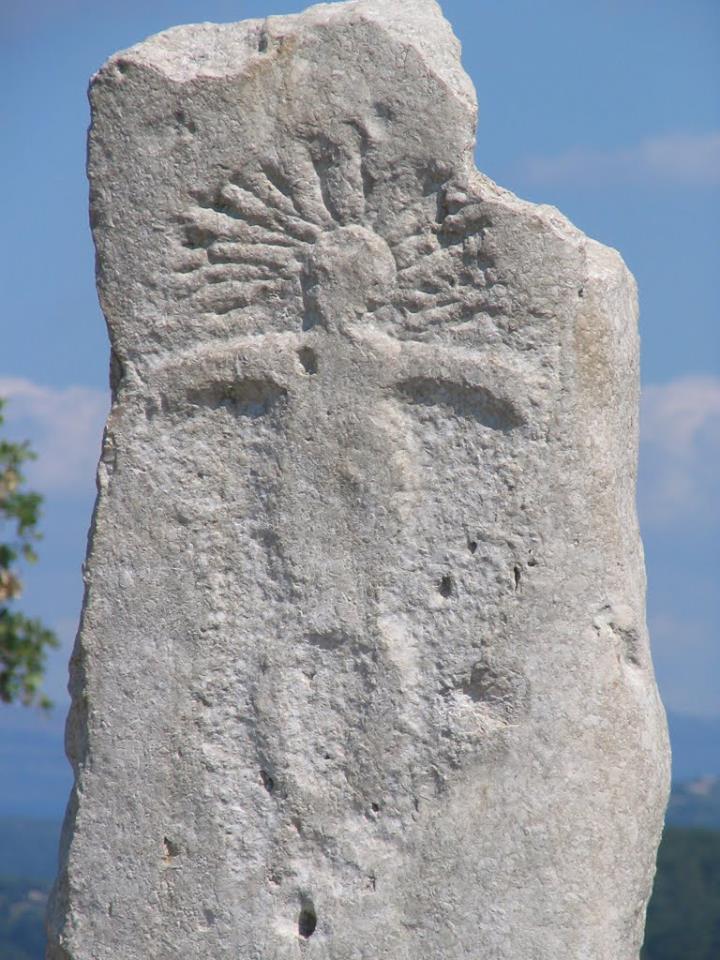
This is Krkavški Kamen (Krkava stone) also known as Triglav stone from Istria. Dating of the stone is uncertain but it is proposed that it was not built later than the 12 century and that it could be much older. It stands 400 metres southeast of the Krkavče cemetery, north of the path leading past the Gradišče field towards the Škrljevec hamlet.

The monolith is approximately 2.5 metres high and roughly hewed. Only 1.6 m still stand above ground and the upper part of the monolith is partially damaged. There is a stylised human image carved on both sides. 


It is an anthropomorphic image with widely spread arms, erect penis and with a crown of sun rays. 


In this the image from the Krkava stone resembles the "Lion man" stone from Armagh in Ireland. 


I wrote about this stone and its link with the Slavic Triglav worship in my post about Radegast.

The surface of the two images shows different treatment and the reliefs were probably made in two if not even three phases. 

The locals say that the stone once had three heads carved on its top which are now missing. Some say that it was only one head with three faces. Maybe like this one from Ireland:


This is why the stone is called Troglav, Triglav, the Three headed one. This Triglav is the the old European Trinity, Sun, Fire, Thunder, the three in one, the one which is three, the Trinity known in India as Trimurti. I wrote about Triglav worship in Serbian tradition in my post about Triglav.  

There are local legends that claim that in the field called Gradišče, which means "Fortified city" once stood a stone city and that the Triglav stone was erected by the people who built the city. Other legends say that the stone is older than the city. People say that the city was built by the king who had a golden calf...Other legends say the it was the Devil himself who lived in the old stone city and who had the golden calf. They say that the Devil went under ground to protect his gold. This is very interesting as in Serbia we also have legends of the evil king Trojan (Triglav) who lived in the old stone city on top of the mountain. Trojan, Triglav was in Serbia identified with Dabog, who later became Christian Devil.. Archaeologists have found Roman villa in the field, but there is an Illyrian fortress nearby. 

Locals say that the stone was once worshiped as holy. They say that according to the local lore, the stone is dedicated to the sun god. On the day of St. Vid people used to come to the stone to lay hands on the stone. St Vid is Christianized Slavic sun god Svetovid, who was originally celebrated on the day of the Summer Solstice. On Christmas eve, which is Christianized Winter Solstice celebration, people used to spend all night burning oak logs around the stone. This is the ceremony of rekindling of the fire of the Sun which is still performed in the Balkans for Orthodox Christmas. At the dawn the whole village would gather around the stone and celebrate the rising of the first sun of the new solar year. This is the rebirth of the young Sun god which Christians turned into the birth of Christ. In Serbian the word for god is "bog" and the word for young god is "božić", which is what Serbians call Christmas. The whole Winter Solstice ceremony around the stone was linked to fertility. I already wrote about similar ceremonies from Serbian territories in the Balkans in my post about threshing floors. These pagan ceremonies were condemned by the Christian clergy and were performed in secret and eventually abandoned. They were replaced by church processions following the same routes that the old pagan processions probably followed.  


There were many Christian processions which either started or ended at the stone or passed by the stone. The main one started from the stone and and ended in front of  the Church of St. Michael the Archangel. These processions took place on Rogation Days preceding Accession Day. The Accenssion Day is the old Beginning of the Summer ceremony, Beltane, the day of Jarilo, the Fire part of the Triglav. I wrote about Beltane, the Day of Jarilo in my post about the Beltane circle. It is very interesting that the procession ends at the church dedicated to the Archangel Michael. In Serbian tradition, Triglav was replaced by Archangel Michael who represents the lightning part of the Triglav trinity.

According to the local tradition the stone used to be used as a punishment, shaming stone. People who committed a crime were tied to the stone. They were then spat on and had insults and curses hurled at them. In recent times children were threatened with being tied to the stone when they did something wrong. Was this an ingenious way devised by Christians to replace the veneration of the holy Triglav Sun Stone with loathing of the Punishment and Humiliation stone? Or was the stone used as a shame stone even before the arrival of Christianity? In Serbian we still have an expression "to put someone on the pillar of shame" when you want to expose and shame someone for the bad deeds that he had committed. Is this somehow linked with the "prokletija" stoning ceremony about which I wrote in my last post? Were people who were tied to the Triglav stone originally stoned? Was spitting and hurling of abuse originally spitting and hurling of stones and abuse?

Archaeologists Pleterski and Puhar have proposed that the stone is part of a large spatial alignment. The stone and the four surrounding churches form perfect Latin Cross. 


The churches are all linked to the stone with well trodden paths once used for annual processions.  Local legends say that the churches were deliberately build like this around the stone so that they would "destroy the devil's power residing in the stone". But they were probably built on top of the old holy places which with the Triglav stone once formed the larger holy landscape dedicated to the celebration of Triglav, the old Trinity. 

You can read detailed study of the stone written by Jana Puhar and Andrej Pleterski in Slovenian here.