Showing posts with label Thor. Show all posts

Monday, 20 June 2022

Axe or hammer

Perun, Slavic thunder god wielded an axe...

Thor, Norse thunder god, wielded a hammer...

Both Slavs and Norse wore axe (hammer) protective amulets...

Left: Thor's hammer amulet

Right: Perun's axe amulet


I always thought that Thor's hammer looked like a stylised axe...

That Thor's "hammer" probably was originally an axe, can be seen from this next artifact. A museum in Utrecht has a relic called "the hammer of St. Martin of Tours". 

The "hammer" was made in the 13th or 14th c. from a Bronze Age stone axe dated to 1,000 - 700 BC...

What does this have to do with Thor's hammer? Well, St Martin thunder god in saintly disguise. Oh and Utrecht was founded by Slavic tribe Wiltzi (who worshiped thunder god with an axe) and was originally called Wiltaburg. More in my post "Axe of Martin"...

But the main indication that Thor's hammer was originally an axe, is the etymology of the the Thor's axe name: Mjǫllnir, "which is disputed among historical linguists". You'll quickly see why. Here are proposed etymologies, and you tell me which one is most plausible...

1. Old Norse Mjǫllnir developed from Proto-Norse *melluniaR. This connects it to Old Church Slavonic mlunuji and Russian molnija meaning "lightning", which would make Mjǫllnir "the lightning-maker" (either borrowed from a Slavic or both stemming from a common source)...

2. Another proposal connects Mjǫllnir to Old Norse mjǫll meaning "new snow" and modern Icelandic mjalli meaning "the color white", rendering Mjǫllnir as "shining lightning weapon"???

3. Finally, another proposal connects Old Norse Mjǫllnir to Old Norse mala meaning "to grind" and Gothic malwjan "to grind", yielding Mjǫllnir as meaning 'the grinder'???

Considering the amount of mixing between Slavs and Norse and mutual cultural influences, and the fact that Thor made lightning with his "hammer" (actually axe), I would go with number one...Controversial!!! 🙂 But most logical...

Particularly in light of the fact that stone axes were directly linked with thunder gods for millenniums in Eurasia...And that so many thunder gods wielded axes...I talked about this in my post "Kataibates"...

One last thing: In Scandinavia thunderstones (Neolithic/Bronze Age flint axes) were frequently worshiped as family gods who kept off spells and witchcraft...So...

And finally (promise 🙂) The word "mo(ld)nya" (lightning) exists in all Slavic languages. It's cognates, apart from Norse Mjǫllnir are: Latvian milna (hammer of the thunderer 🙂), Old Prussian mealde (lightning), Middle Welsh mellt, myllt (lightning)...

Also, did I mention that the word for Thursday (Thor’s day) was in the Polabian Baltic Slavic language, Peründan (Perun's day)... 

PS: Someone asked me: Did Perun's axe have a name like Thor's hammer?

Considering that Mjǫllnir just means lightning, and that both Slavs and Norse believed that stone axes were remnants of lightnings, then I would guess that Thor's hammer's "name" is just misunderstanding of Slavs pointing to a stone axe and saying: look, lightning...

Sunday, 4 July 2021

Kataibates

Zeus, the god of lightning, had a nickname "Kataibates" (he who descends). This basically equated Zeus with Thunder/Lightning...

Pic: Antikenabteilung, Staatliche Museen zu Berlin—Preussischer Kulturbesitz

Remember this article about what came first: Thunder/Lightning or Thunder God? Thunder gods of course...

The piece of ground hit by lightning cannot be walked on, is consecrated to Zeus and is marked by a monument or an altar. These altars were then used to make offerings to Zeus in exchange for protection from lightning...

Same altars dedicated to Zeus Kataibates were also built in front of houses, and there too offerings were made in order to protect the house from lightning. This custom seems to have been fairly common in Greece. 

You can read more about this in "Greek Popular Religion" by Martin P. Nilsson...

Interestingly, Zeus's thunderbolt was imagined to be a stone or a stone axe. Like this one. 


Which is interesting considering that Zeus didn't wield an axe...Well that's not exactly true. Late Roman god Jupiter Dolichenus, whose mystery cult was widespread in the Roman Empire from the early-2nd to mid-3rd centuries AD, wielded an axe. And rode on a bull... Here is an altar from Vindolanda dedicated to Jupiter Dolichenus...


It is believed that he came from the east...And in the east, in Anatolia, we find Hittite thunder god(s) wielding an axe...

Pic: www.mesopotamiangods.com

And even further east we find Adad, Mesopotamian storm god, who also loved axes...


Pic: History of Egypt, Chaldea, Syria, Babylonia and Assyria, Vol. III

How far East and how far back in time should we go?

Stone axes or adzes, originally shaped and polished in Neolithic times, sometimes turn up in later archaeological sites or graves from the Bronze Age down to the medieval period...

Because they were apparently thought to have some kind of magical power to protect buildings and people, especially from lightning and violent storms...

We know something about these beliefs thanks to a string of testimonia in technical treatises on stones, beginning with a third-century BCE Greek author named Sotacus and ending with a twelfth-century bishop of Rennes. And thanks to European folklore...

It is important to understand that there is no evidence that the Greeks or Romans realized that these axe-heads were manufactured by previous stone-age cultures. They were believed to be “natural” stones which, like amber, jet or coral, had special protective powers...

Sotacus, the Hellenistic author of a lost treatise on stones maintained (according to Pliny’s abridged account) that "cerauniae are similar to axes" except they are not axes but magic thunderstones...

Latin lapidary (natural history) attributed to Damigeron-Evax, devotes an entire chapter (12) to the "lapis ceraunius" (thunderstone), which is found in places where lightning has struck...

Timotheos of Gaza, a 5th c. CE author tells us that "you will have an amulet against a thunderblast (keraunon), if you inscribe a thunderstone (lithon keraunion) with the letters αφια αφρυξ and keep it in your house"

In his Etymologies Isidore, the early 7th c. CE bishop of Seville, also notes that "ceraunia" (thunderstones), were found in places struck by lightening and could avert lightening...

In the 12th c. AD, Marbodaeus, the bishop of Rennes, preserves a similar account in his own Liber lapidum.

And in the 11th century the Byzantine emperor sent to the Holy Roman emperor a "heaven axe" as a present...

Ethnographers and folklorists have also established the existence of similar long-standing and widespread beliefs throughout Europe.

For instance, in modern Greece, astropelékia ("lightening axes") are sought out at places where "lightning has fallen" and are kept in houses to ward off lightning and fire...

Perun, Slavic thunder god, also wielded an axe...According to Slavic folk beliefs, prehistoric stone axes found in the ground were remains of these weapons...

Thor wielded a hammer...And we know that in Scandinavia thunderstones were frequently worshiped as family totems which kept off spells and witchcraft...

Both Slavs and Scandinavians wore axe (hammer) amulets...

Thor's hammer amulet

Pic: Sveriges hednatid, samt medeltid, förra skedet, från år 1060 till år 1350

Perun's axe amulet

Pic: Древнерусские амулеты-топорики

I always thought that Thor's hammer looked like a stylized axe

That Thor's "hammer" was originally an axe, can be seen from this next artifact. A museum in Utrecht has a relic called "the hammer of St. Martin of Tours". 

Pic: Museum Catharijneconvent

The "hammer" was made in the 13th or 14th c. from a Bronze Age stone axe dated to 1,000 - 700 BC...

What does this have to do with Thunder gods? Well, St Martin is another "saint" who is nothing more than the thunder god in disguise. I talked about this in my post The "The axe of Martin"...

Another indication that Thor's hammer was originally an axe, can be seen from the etymology of the the Thor's axe name: Mjǫllnir. The etymology of the hammer's name is disputed among historical linguists.

Here are proposed etymologies. You tell me which one is most plausible:

1. Old Norse Mjǫllnir developed from Proto-Norse *melluniaR and one proposed derivation connects this form to Old Church Slavonic mlunuji and Russian molnija meaning 'lightning' (either borrowed from a Slavic source or both stemming from a common source) and subsequently yielding the meaning 'lightning-maker'. 

2. Another proposal connects Mjǫllnir to Old Norse mjǫll meaning 'new snow' and modern Icelandic mjalli meaning 'the color white', rendering Mjǫllnir as 'shining lightning weapon'. 

3. Finally, another proposal connects Old Norse Mjǫllnir to Old Norse mala meaning 'to grind' and Gothic malwjan 'to grind', yielding Mjǫllnir as meaning 'the grinder'.

Considering the amount of mixing between Slavs and Norse and mutual cultural influences...

Also, The word "mo(ld)nya" (lightning) exists in all Slavic languages. It's cognates, apart from Norse Mjǫllnir are: Latvian "milna" (hammer of the thunderer 🙂), Old Prussian "mealde" (lightning), Middle Welsh "mellt, myllt" (lightning)...So...

Archaeological evidence confirms, that this belief in the link between Thunder Gods and stone axes, and the belief in their protective power was already widespread all over early Roman Empire.

For instance, in a survey of pre-historic axe-heads found in Roman sites in Britain, of the forty known examples, twenty nine were found in or closely associated with buildings...Some in temples...

You can read more about this in "Inscribed Greek Thunderstones as House- and Body-Amulets in Roman Imperial Times". 

The generally accepted belief was that a thunderstone fallen from the sky will in future protect against thunderstorms and lightning strikes. It's power will be greatly increased if inscribed with a magic spell...Like this roman example with Greek inscription...

Pic: www.nat.museum-digital.de

Or like this Roman stone axe amulet worn as a protection against evil...Lightning too...


Pic: Inscribed Greek Thunderstones as House- and Body-Amulets in Roman Imperial Times

So...

Are European folk beliefs related to the thunderstones Roman in origin?

Are Roman beliefs related to thunderstones Greek in origin?

Are Greek beliefs related to thunderstones Hittite in origin?

Are Hittite beliefs in thunder gods armed with an axe Mesopotamian in origin?

Where and when does the link between the stone axe and thunder god originate?

I would suggest that this link between a stone, more specifically flint axe, and thunder gods, already existed in the 4th millennium BC Europe...Enter exploding flint axes dudes from Southern Baltic... 

Pic: www.naturstyrelsen.dk


Sunday, 17 January 2021

Tanngnjostr and Tanngrisnir

One of the versions of the Scandinavian Yule Goat has long sharp teeth...

Meet Tanngnjostr and Tanngrisnir, the magic goats of Thor...They are the guys that pull his chariot...

Have you ever thought why a thunder god would travel in a chariot pulled by goats? I did...I puzzled and puzzled until my puzzler was sore...Then I presented the result of my puzzling :) in my post "Goat riding thunder gods"...

Now as you can imagine, Thor's goat were not ordinary goats...No god would ride on a chariot pulled by ordinary goats...

First, they have teeth like carnivores which eat raw flesh, based on their names Tanngrisnir (Old Norse "teeth-barer, snarler") and Tanngnjóstr (Old Norse "teeth grinder")...

Also they are immortal. As described in this story:

Once Thor travelled together with Loki. When evening came, they sought cover in a farmhouse. Thor then killed his goats with his hammer, Mjolnir, and skinned them, roasted them and everyone ate the meat...

But, he said, nobody must break any of the bones to suck the delicious marrow. 

But Thialfi, the farmer's son, broke one of the bones, because the marrow inside the bones tastes by far the best.

Next morning Thor spread the two skins on the ground and laid all the bones on them. Then he swung his hammer, Mjolnir, and the skins and bones moved around until suddenly the two goats stood whole and completely alive again, ready to drive on...

But one of them had a bad leg! Thor got really angry, and Thialfi had to admit what he had done. As punishment Thialfi had to come with Thor as a servant...

And this is why one of Thor's goats is lame...

Sounds familiar? The goat that gets killed and then resurrects? I talked about the goats that get killed and then get resurrected during European winter rituals in my article "Krampus"...

The goats whose death and resurrection symbolizes the end of winter and the beginning of spring...The death of winter earth and birth of spring earth. Otherwise known as resurrection of nature... 

But what about the goats with teeth? What's that about? Well there is a very strange fairy tale found in Serbia, Germany and Italy...It's about a goat...A very annoying goat. 

Goat which is constantly complaining that it doesn't have enough to eat...Until its owner has enough...

In the German version of the story, the annoyed owner "shaves the goat off" and then whips it until it runs away...

In the Serbian version of the story, which is probably the oldest which survived, the owner kills the goat, skins it, salts it, puts it on the spit over the fire to roast it, when the goat jumps off the spit and runs away shouting: 

"Ja sam jarac živodarac (živoderac), živ drt neodrt, živ klat nezaklat, živ pečen neispečen, živ jeden neizeden. Zubi su mi kao kolac, pregrišću te kao konac."

In some versions of this story the goat calls himself (živoderac) which means "skinned alive"...In some versions he calls himself "živodarac" (from život darac), which means "life giver" and which actually rimes with "jarac" (goat): jarac živodarac...

Knowing the symbolic meaning of the resurrecting goat (the bringer, giver of spring, life) I think that what the resurrected goat says is:

"I am the life-giving goat, skinned yet not skinned, slaughtered yet not slaughtered, roasted yet not roasted, eaten yet not eaten. My teeth are like stakes, I will bite you in two like a thread..."

Wow...Just like in the story about Thor's goats...Resurrecting goat...With deadly sharp teeth...Wow indeed...

Now...What the goat does next, in both Serbian and German version of the story, is that it decides to hide in an empty fox's lair...

In the main Italian version of the story "Grandmother Goat decides to move into the Grandmother Fox's house"...

Anyway, the fox asks the fox to get out of its lair, but fox refuses and instead:

In the Italian version of the story, the goat shouts: "I am Godmother Goat. I have a sword at my side, and with my horns I will tear you in pieces"

We don't know if the German goat shouted anything or not...

In the Serbian version, the goat shouts again: "I am the life-giving goat, skinned yet not skinned, slaughtered yet not slaughtered, roasted yet not roasted, eaten yet not eaten. My teeth are like stakes, I will bite you in two like a thread..."

In all the versions of this story, the poor fox enlists the help of different animals, who one after the other come to try to get the goat out of the fox's lair...They all fail, until finally:

In the Serbian version a hedgehog kicks the goat out...

In the German version a bee kicks the goat out...

In one Italian version a mouse in another a little bird and in yet another a cricket kicks the goat out...

WTF...I mean this is a bonkers story. Did all these people smoke the same shit when they came up with the same crazy story? Or did they all preserve the same ancient story slightly changed over time?

Well I think that the only way to understand this part of the story is to turn to real animals that feature in it: Goat, Fox, Hedgehog, Bee, Field Mouse, Little Bird, Cricket...And check if maybe they are here as calendar markers...

Spoiler: they are...

I have already talked about the mating habits of Wild Ibex Goats and how because their mating season in Eurasia spans winter months (Nov-Jan), they became calendar markers for winter...

Winter which in continental Europe is cold and dark time of hunger, when trees are bare, grass is covered with snow, no food grows...Is this why the goat is constantly complaining it's hungry? Because it represents the hungry part of the year? And is this why the death of the goat (symbol of winter) and its resurrection (symbol of spring) is the part of the winter goat rituals across Europe? I talked about these rituals in my article "Krampus"...

That's cool. But why evil toothed goats?

There is a Romanian legend about a grandmother who insulted the month of March. She did so either by badmouthing Him or by going up to the mountain with a herd of goats too early. March then borrowed frosty days from February and froze her to death...

Interestingly in Serbian folklore, "babini jarci" (grandmother's goats) and "pozаjmenci" (borrowed days), both mean "cold stormy snowy days in March or April"...Which can turn green spring full of life into this...

I talked about this link between goats and winter cold in my posts "Babele" and "Gryla"...

What's this all about? What's with goats and grandmothers?

Well:

The pale winter sun which doesn't bring warmth but instead brings freezing cold (cloudy winter days are warmer than bright winter days)...In Serbia this sun is called "Zubato sunce" (Toothed Sun, Sun with teeth)...The same expression translatable to "Sun with teeth" is also found in Greece, just below Serbia and in Romania, just above Serbia...

What is the "sun with teeth"? This is the sun that causes the "frostbite", a burn like wounds which cause parts of your body to fall of...Or have to be amputated...Hence "toothed" sun which literally bites the part of your body off...

Now, in Serbian folklore, the word Baba (Grandmother) was used for Earth, Mother (Grandmother) Earth...But the word also means "Hag" and was used as the name for Frozen Winter Earth...The goddess of death...I talked about this in my posts "Babele" and "Gryla"

Across the Balkans, Baba was also "the one that controls the bad, wet, cold weather". 

Which is why shepherd's in Slovenia believed that "baba" stones (exposed bedrock) like this on, were linked to weather. And which is why they sacrificed to them during their spring ascent to the mountain pastures...And why stones are used by slavs in weather manipulation magic...I talked about this in my post "Weather stones"

Because if you were a shepherd on your way up the mountain pastures and you got caught in one of the late spring snow storms, the chances of your survival were very slim...So you had to make sure that Baba (Mother Earth as Winter Hag) doesn't get angry...

By the way

Yin = Earth, dark, cold, wet, down...Winter

Yang=Sun, bright, warm, dry, up...Summer

Both absolute Yin (freezing dark wet cold winter) and absolute Yang (roasting bright dry hot summer) are time of death...Life only flourishes between these two absolutes, Yin and Yang, Mother and Father, Earth and Sun...I talked about this in my post "Yin and Yang"....

So I think this is why we have Baba's (Grandmother's) goats. Both Baba and Goat are symbols of winter. So Baba's goats are cold winter days (brrrrrr)...The same cold winter like days which can "bite your fingers, toes, nose, ears..." off...Hence scary toothed killer goats from Serbian and Norse folklore (mythology)...

So we know now why the goat from the Serbian fairy tale has teeth. I think that this is also the reason why Thor's goats have teeth like carnivores which eat raw flesh. But does this mean then that Thor is not god of rain storms, but the god of snow storms??? 

As I explained in my post "Goat riding thunder god", the fact that Norse, Baltic and Slavic thunder gods ride goats, is one of the biggest mysteries of the European folklore. One which opens (for some an uncomfortable) question about the origins of these goat riding gods...But Thor and his flesh eating goats are a great example how mythology gets changed by climate. How life bringing rain storm god who rides on a good goats from Eastern Mediterranean became death bringing snow storm god who rides on evil goats...

Finally let's get back to our fairytale. The goat is lounging in the fox's hole and the poor fox is trying to get it out. What is all this about?

I think to figure this out, we have a look at mating seasons of Wild goats and Foxes. Why? To see if these seasonal activities, which occur every year at the same time, are so easily observable and impossible to ignore, that they make good calendar markers...

Throughout the Ibex range, their mating season starts from Oct/Nov and lasts until Jan. Which is why eventually goat became a calendar marker which means: when Ibexes mate, Oct/Nov, beginning of winter, and winter itself.

Foxes mating season is Jan/Feb...Mating takes place during the night...Foxes make really loud mating calls which can easily wake you up and are basically impossible to miss...Hence I think fox could be a calendar marker which means: when foxes mate = Jan/Feb, the end of winter, winter itself.

Is this the reason why the Italian version of the weird Goat and Fox fairytale, Goat and Fox are actually called Grandmother Goat and Grandmother fox? To point to the fact that both Goat and Fox are animal calendar markers for winter...They both mate in winter, the time of Baba (grandmother, hag), one at the beginning the other at the end...

Remember the annoying always hungry goat was annoying for a while, before it was thrown out, killed and ran away...So I think that the time when the goat enters the fox's hole is towards the end of the winter, beginning of spring, Jan/Feb. Right at the time when foxes are out partying...So the goat finds empty fox's lair and takes over...

The fox has finished with her looooove (Feb/Mar) and is pregnant and needs her lair because the litter arrives in late March, and the cubs remain exclusively inside the lair for about six to eight weeks...

As calendar markers then, "when goats mate" would be succeeded by "when foxes mate" and then by "when fox cubs are born"...

So that would I think explain the fighting over the fox hole...

But are the animals that finally manage to get the evil undead big toothed goat (winter) out of the fox's lair  picked randomly or are they also calendar markers? 

Spoiler: they are not picked randomly. 

In the two oldest versions of the story (according to ethnographers), Serbian and German:

Serbian: Hedgehogs - Hibernate in holes from October to April

German: Bees - Hide in hives from November to April

Let's not forget the Italians. The animals that manage to throw the goat out of the fox's hole (hose) in Italian versions of the story are: 

Field mice, hide during winter, appear after the snow has melted and start mating in March - April


Birds, here probably migratory birds, appear in March - April


And for crickets...Well European field cricket turn into adults and appear in April


So in all cases, the animals that finally get rid of the scary goat, which is the symbol of winter, cold, are animals that reappear in nature in April...Once winter is finally finally finally over. And any possibility that the winter hag (Baba Marta - Grandmother March in the Balkans) can return is gone. In April... 

How interesting....

So, crazy story full of random rubbish, or a complex animal calendar markers filled allegory?

By the way, this could also explain the negative aspects of the dancing goat character from the European folklore. The taker of presents (good things nature gives) and why it has to die for people to rejoice...

Tuesday, 31 March 2020

Jörmungandr

The other day I came across this pendant on one of the auction sites with the description: "Medieval Period - Viking Pendant Depicting Coiled Sea Serpent - Jörmungandr". Lot closed. 145$...


In Norse mythology, Jörmungandr is a giant serpent whom Odin tossed into the great ocean that encircles Midgard.  The serpent is so large that it is able to surround the earth and grasp its own tail, receiving the name "World Serpent". It's arch-enemy is the thunder-god Thor...


The stories about Thor's encounters with this serpent are very interesting. They are full of symbols whose meaning, by the time the stories were recorded, was almost completely forgotten...Uncovering the meaning of these symbols will show us the true identity of Jörmungandr...

Before I analyse the only two preserved Norse stories about the encounters between Jörmungandr and Thor, I will first just quickly remind you all of the main thing Thor (as the thunder god) has to do in Indoeuropean mythology: he has to kill the dragon (Serpent)...

The identity of this Dragon (Serpent) can be deduced from, for instance, the Slavic myth about Perun, Thunder god, killing Veles, Great Serpent, who stole Perun's cattle (clouds). Perun kills Veles, releases his cattle (clouds), and rains return...

Snake is in Slavic mythology directly linked with the sun. It is the symbol of sun's heat. The symbol of summer. The snakes are in the underworld during the winter and are in our wold during the spring, summer autumn, when sun dominates the Sun-Earth system...


In the spring, sun's heat is a positive force which creates life. But as summer progresses, the heat gets stronger and stronger. And by the end of the summer, sun's heat becomes a negative force which destroys life. And so the snake grows into the Great Snake, The Dragon...

The dragon that has to be killed, or his fiery breath will turn everything into cinder. Ta-Dah!!! Enters The Thunder god of your choice, battle ensues...and the dragon dies...The drought ends, the rains return, the world is saved (again)...

In Slavic mythology, Thunder god Perun kills Great Snake Veles on Perun's day, 2nd of August, the day that marks the end of Summer, and beginning of Autumn. This day falls in the middle of Leo zodiac sign, when sun is the hottest...I talked about this in my post "Thundering sun god"...

So, Great Serpent, Dragon (Draught) dies in Leo :) Or to say it another way, Lion kills Serpent. This Romanesque object depicts Lion killing Snake under the head of Helios. Perun's day is in Serbia also the day of St Elijah, Christianised Helios...I talked about it in my post "Lion killing snake"...


Ok, back to Thor and Jörmungandr. This is one of only two preserved stories about the encounters between the Thunder god and the Great Serpent...You'll love it...


The part "the serpent disguised by magic in the form of a magic colossal cat" would make no sense at all, if we didn't know that in Slavic mythology, the Thunder God fights and kills the Great Serpent in the middle of Leo...

Now all of a sudden it all makes perfect sense...Including the fact that Thor can't lift the Great Serpent disguised as a Great Cat. One other story, from Egypt, can also be decoded using the same symbol dictionary: The story of Apep, Great Chaos Serpent...I talked about this in detail in my post "Apep"...

Guess what. Apep is killed by Ra (Sun) in a form of a Cat (Leo)...When the Great Serpent is killed, inundation of the Nile is at it's highest level, nature is saved, hence the tree behind the snake...


Of course this whole thing doesn't make much sense in far north, where there is little chance of sun causing draughts...

Jörmungandr and Thor meet again when Thor goes fishing with the giant Hymir. Hymir is a very interesting giant indeed. He is the father of the god Týr, whom Romans identified as Aries, the god of War...

Now in Slavic mythology, god Jarilo, is the Young Sun God, who was in Greek Mythology personified by Apollo, who replaced Helios, the old Titan (Giant) Sun God...

The root of the name Jarilo is "jar" which can mean both "green, young" and "raging heat, raging anger". Jarilo is symbol of male (and Sun) energy, which can be both creative and distructive...It is suspicious how close Jarilo is to Ares, the god of rage (jara)...

So is Giant Hymir, the father of Týr (Ares, Jarilo) actually Titan Helios? After all Perun kills The Great Serpent on the day of Helios, the hottest day in the northern hemisphere...And here in this story Thor kills Jörmungandr while fishing with Hymir (father of Ares)...


This story is great. The part: "Hymir refuses to provide Thor with bait, Thor strikes the head off Hymir's largest ox to use as his bait" makes no sense unless we know that Summer which is ruled by The Great Serpent, starts in Taurus, Bull...

In Slavic mythology, Perun kills the Great Serpent at the end of summer. At the end of the season whose symbol is The bull...So Bull also dies on Perun's day...I talked about this in my post "Symbols of the seasons"...


That there is a direct link between bull and dragon can be seen from some legends preserved in the Balkans, in which young girls were sacrificed to the Giant Bull rather than to the Dragon...I talked about this in my post "Water bull"...

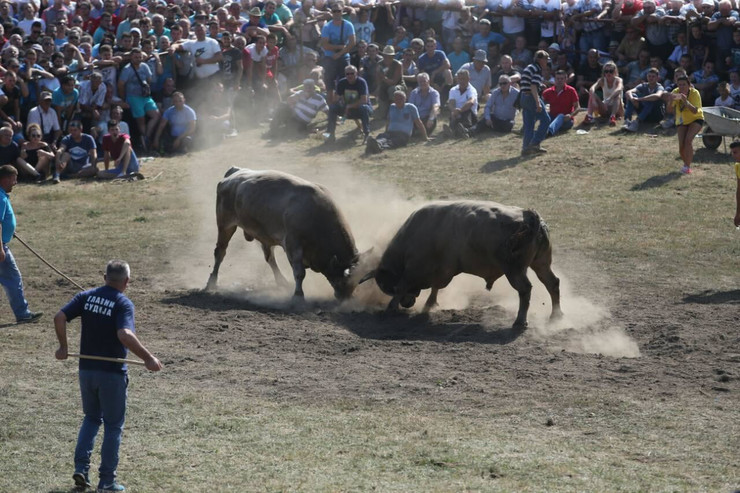
So Thor kills the bull to kill the Dragon...This is the Altuna Runestone showing Thor fishing for three headed dragon using a bull head...With his hammer on the ready to strike the final blow...


What is interesting is that in the Balkans, the day of Perun, the day of Helios, is the day when people organise Bull fights. I talked about this in my post "Alidjun"...


This is also the day when bulls are ceremonially slaughtered, roasted and eaten...Historical sources tell us that Slavs sacrificed bulls to Perun...So these bull fights were originally probably a ritual in which the best bull was chosen to be sacrificed to Perun...

I talked about ritual slaughtering of Bulls in Slavic culture, and the meaning of this ritual, in my  post "Bull of Grom Div"...

But it wasn't just Slavs who sacrificed bulls, symbol of summer which starts in Taurus, at the end of summer...The Old Gaels (The Irish) did it too. I talked about this in my post "Bull of Crom Dubh"...

So what are we to make of all this? Well, well done Thor, you are truly Indoeuropean Thunder god now. You killed your Great Serpent, Dragon...But why is it that this Norse legend can be explained through Slavic folk tradition, but not through Norse folk tradition? Or can it be?

Also, as I already said, the story makes no sense in the far north. In the far north the Thunder god has no need to kill the heat of the summer. The opposite is the case...In the far north you want sun to be hot and the summer to last as long as possible...

There is one more thing that can be decoded once we know what does the cat represent. Why is Freya riding around in chariots pulled by cats...She is just another representation of Virgo, the feminine, yin, earth influence which becomes ever stronger from the middle of Leo...


I talked about this ubiquitous Lion Lady in my post "Assumption of Mary"...

One other thing. Why is The Great Serpent Jörmungandr biting its tail? Enters Ouroboros. This symbol of the serpent biting its tail was first seen in Egypt. There it is linked to deity Mehen, who in other funerary texts protects Ra in his underworld journey...


Ra spends every night in cold watery underworld. In order to emerge bright and shining in the morning, Ra's fire, his heat, needs to be preserved. By coiled snake... Symbol of sun's heat in Slavic mythology...

Ra's heat also needs to be preserved during the winter. According to the 4th-century AD Latin commentator Servius who was aware of the Egyptian use of the Ouroboros symbol, the image of a snake biting its tail represented the cyclical nature of the year...Solar wheel...

That Ouroboros did represent the solar year, the ever turning (changing) life creating solar wheel, can be seen from Gnostic Pistis Sophia (c. 400 AD), which describes the ouroboros, the soul of the world, as a twelve-part dragon, surrounding the world with its tail in its mouth

In my post "Yin and Yang", I talked about this ever changing, life producing interplay between the Earth and the Sun...


One thing that most people don't know, is that the Yin-Yang symbol is spinning and ever changing. The Great serpent, the Sun, The Yang, is constantly oscillating between its minimum (in the middle of maximum Yin) to it's maximum (where we find minimum Yin in the middle of it)...

This is what "Serpent biting it's tail means". Dragon, The Great Serpent doesn't get killed by Thor or Perun or any other Thunder god. It kills (eats) itself. Spring-Summer-Autumn-Winter-Spring...The ever spinning Ouroboros, the solar wheel...


And this is why the end of the world will come when Jörmungandr spits its tail...Because that means that the Earth-Sun system has gone out of balance. The heat will either increase so much that the world will burn, or will decrease so much that the world will freeze...

I love Jörmungandr...

Sunday, 16 February 2020

Goat riding thunder god


Norse thunder god Thor, Slavic thunder god Perun and Baltic thunder god Perkūnas all rode the sky in a chariot drawn by goats...Why?

I will here try to answer this question. But I have to warn you: answering this question will open many many interesting questions about the origin of North European pagan religions...

From what I can see, there is not explanation why these north European thunder gods are driving around in goat pulled chariots. Apart from "this belief comes from common Indo-European belief system"...Which is like saying "I have no idea what all this goat rubbish is all about".

To find why Northern European thunder gods ride around in goat pulled chariots, we have to look southward. To Ancient Greece...

In Greek mythology, the thunder god Zeus was a son of Cronus and Rhea. Cronus learned from Gaia and Uranus that he was destined to be overthrown by his son as he had previously overthrown Uranus, so as soon as Rhea had a child, Cronus would promptly swallow it.

When Zeus was about to be born, Rhea sought Gaia to devise a plan to save him. So she gave birth to Zeus in Crete, and gave him to Ἀμάλθεια  (Amaltheia) who became his foster mother. Rhea then gave Cronus a rock wrapped in swaddling clothes, which he promptly swallowed.


Ἀμάλθεια  (Amaltheia) took Zeus to a cave in Cretan Αἰγαῖον ὄρος (Goat Mountain), today Dikti where she nursed him feeding him goat milk. In order that Cronus should not hear the wailing of the infant, Amalthea gathered about the cave the Kuretes or the Korybantes to dance, shout, and clash their spears against their shields...

Now here is an interesting thing about Zeus's foster mother. The name Amaltheia, means "tender goddess" in Ancient Greek. There were two different traditions regarding her identity. In the first one, Amaltheia is a goat-tending nymph of uncertain parentage. In the second one Amaltheia is a she goat...

In some traditions, Amaltheia's skin, or that of her goat which sucked infant Zeus, taken by Zeus in honour of her when she died, became the "Αιγις" (Aegis),  a kind of "protective thing carried by Zeus who then gave it to Athena". Apparently, the exact nature of "aegis" is uncertain...

In "The New World Encyclopedia" we can read that the Greek word Αιγις (Aegis) has 3 meanings:

1. "violent windstorm" from the verb 'αïσσω (stem 'αïγ-) meaning "I rush or move violently"
2. "goatskin coat" from treating the word as "something grammatically feminine pertaining to goat (Greek αιξ (stem αιγ-))"
3. "Zeus' shield"

"The New World Encyclopedia then goes to say that the original meaning of Aegis may have been "storm". That would mean that Zeus's epithet "Ζευς Αιγιοχος" (Zeus Aigioxos), usually understood to mean "Zeus who holds the aegis", may have originally meant "Stormy sky".

The transition to the meaning "shield" may have emerged as a folk-etymology among a people familiar with draping an animal skin over the left arm as a shield. It is also noted that since the Greek word aegis contains the double-meaning of "stormy" and "goatish" that this accounts for the close connection between the goat and storms in myth...

In "Indo-European Poetry and Myth" By M. L. West, Morris West we read that Zeus "Αιγιοχος" might originally have meant Zeus who rides on a goat...Apparently, in one of Orphic theogonies, Zeus rode to heaven on a goat...

So, it seems that the Indo-Europeans really did have a thing for making their thunder gods ride on goats...

But why was Zeus nursed by a goat? And why did he also ride on a goat?

Well to get the answer this this question we have to look at Cretan climate.

I lived in Chania in Crete many years ago. It is an incredibly beautiful place full of charm and history.


I arrived in May and left next April...There was not a drop of rain between May and late October. Then after occasional October shower, it started to rain in November, and it pretty much didn't stop until early April...

The Crete climate is characterised by hot, dry summers and mild, rainy winters. The rainy season starts in late October and lasts till March or even April.


Snowfalls are extremely rare in the coastal zone of Crete, especially so in the eastern part of the island, but are plentiful in the central mountain region. This is what I saw above Chania when I arrived in May. It was already 30 degrees in town and I thought the mountain tops were white because of white rocks. It turned out they were covered in half a meter of snow...


Now what does this have to do with goats?

This is Cretan wild goat (scient. Capra aegagrus creticus), also known as agrimi, kri-kri, or Cretan Ibex, an endemic subspecies of wild goat.


Red-brown steatite pyramidal stamp seal engraved with a design of an Ibex goat. Middle Minoan I, Early Minoan III, 2300BC-1850BC, Excavated in Crete


The Cretan Ibex lives in arid high mountain areas. They go out for pasture in the morning and evening, sheltering during the day in rocky recesses and caves!!! Most of the year they live in same-sex herds of up to 20 animals, with fully mature males actually living alone. During the breeding season however, male and female animals mix and the most dominant males form harems. The male domination is determined through spectacular fights...


Now here is the important bit: The mating period of the Cretan Ibex goat, during which it radically changes its behaviour starts in October and November. Right at the beginning of the Cretan rain season.


Agrimi or wild goats, Middle Minoan II (1900 BC-1750 BC) seal stone. 


Why would Minoans have wild ibex goat mating on seal?

In the past people believed that rain is the gift of rain (storm) gods. Rain storms were equaled with storm gods...

Minoans could be excused for believing that the arrival of rain was in some way linked to Ibex goats. Every year the beginning of the Cretan Ibex mating season signalled the arrival of the rain storms...It almost looks like the rain storms were caused by, brought by Ibex goat...Which eventually lead to the image of the rain (storm) god arriving  on a goat, or in chariots pulled by goats...

Now let's go back to the Ancient Greek legend about the infant Zeus.

Infant Zeus - the storms and storm gods were equated in the past, the beginning of the storm season can then be symbolically depicted as the infancy of the Storm god Zeus.

Infant Zeus was nursed by a goat in a cave on a Goat Mountain (!!!) - during the beginning of the storm season, Cretan Ibex (which shelters in caves) ascends to the rocky snow free mountain tops and begins its mating season.

Infant Zeus is protected by clashing, noise making Kuretes or the Korybantes (!!!) - Cretan Ibex mating season is the time of vicious clanging banging male goat fights...

Zeus, once grown up, ascends from the goat mountain to the sky (heaven) riding on a goat, or wearing a goat skin, or carrying a goat shield (!!!)...

Sounds pretty obvious when you put it side by side...

I believe that Ibex had a huge religious significance in Minoan culture. Here is why:

The dry season in Crete is the dead season. The relentless sun burns down day after day, scorching and drying everything. By the time the first October rains arrive, the soil is rock hard and dead dry, the plants are dead yellow brown, and the wells and river beds are dry...


Everyone is looking at the sky, waiting for the arrival of the first rain bearingn clouds...

And then the Ibex mating season starts, and the first rains arrive...The wells and river beds start filling in again. The flowers, like wild saffron, start flowering.


By the way the main wild flower season in Crete starts in late autumn and ends in early spring...

The soil, which is now softened by rain, is ploughed and winter grain is sown, which very quickly sprouts and starts groing as more and more rain falls.

The life returns.

In Crete, the Storm god, who arrives when Cretan Ibex mating season starts, doesn't just bring rain. He brings life. Well actually, Minoans probably saw Ibex as the bringer of life...Which is why Ibex is seen on Minoan fresco from Knossos flanking "the tree of life" while crocuses are blooming all around. By the way, the tree is olive. And olives are harvested from late October, early November...So this fresco depicts the beginning of the rain season, when ibexes fight, crocuses bloom and olives are ripe...


The above fresco is from the article "The Frescoes from the House of the Frescoes at Knossos: A Reconsideration of Their Architectural Context and a New Reconstruction of the Crocus Panel" by Anne P. Chapin and Maria C. Shaw

Here is another depiction of ibexes facing the tree of life, this time on a Minoan seal from Goulas Crete


Of course the religious importance of this image is totally missed by archaeologists...

I like this statement: Some academics believe that Cretan Ibex was worshiped on the island during antiquity. But why? The same academics have no idea...


What is interesting about the depictions of Ibexes in Minoan art is that they are depicted in two completely different ways. 

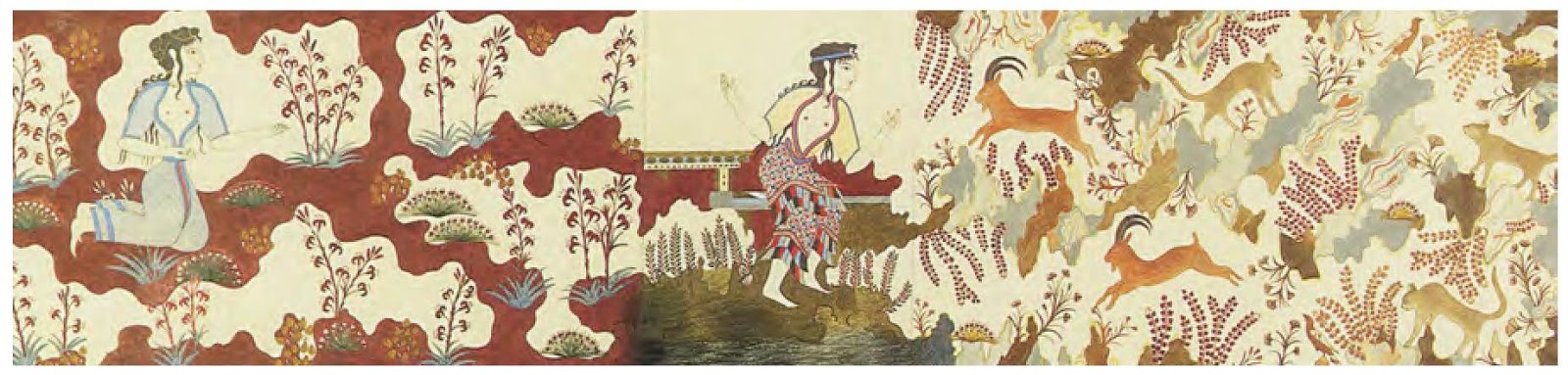
If they are in the same scene with women they are depicted happily roaming among the vegetation with women, like on this wall paintings from Room 14 at Hagia Triada


or they are even being petted by women, like on these seals


Both images are from "Image and Architecture: Reflections of Mural Iconography in Seal Images and Other Art Forms of Minoan Crete" by Fritz Blakolmer

If they are in the same scene with men, they are being hunted by men...

Like on these votive plaques depicting men hunting Crete Ibex from  "The Knossos Hunt and wild goats in ancient Crete" by Jonas Eiring


They were found in the "Simi sanctuary". This sanctuary complex is situated on the southern side of Mount Dikte (yes the goat mountain where goat suckled infant Zeus), 1,200 metres above sea level, just above the village of Kato Simi or Symi. Unusually for Crete this sanctuary remained in constant use from the Minoan Protopalatial MM II period (1900 BC-1750 BC), up to Roman times. The explanation proposed was that hunting Ibex goats was a kind of initiation rite for young men in Minoan society...

Maybe. Or maybe the Ibex hunting was reenacting of a cosmic hunt which takes place every year right in the middle of the Eurasian Ibex mating season (November-January) when Sagittarius (the hunter) ends and Capricorn (the goat) begins. On winter solstice... 


I talked about this in my post "Zlatorog-Goldhorn". By pure "coincidence" this is the period of the highest precipitation in Crete...Which is what goat brings...

The hunting scenes depicting men and dogs hunting Ibex goats become very common on seals and gems from Middle Minoan period (1900BC). This is one from the base of an ivory half cylinder found in Knossos. Ibex is again depicted together with a green branch...


From "The palace of Minos : a comparative account of the successive stages of the early Cretan civilization as illustrated by the discoveries at Knossos" by Sr Arhur Evans

These "talismanic" seals depicting ibex about to be pierced by a spear...They all also have depictions of growing plants. What were they depicting? Are these spears or lightning bolts? Was Ibex ritually hunted and sacrificed? These plaques are dated to Late Minoan I period (1480BC-1425BC) are from "Minoan Goat Hunting: Social Status and the Economics of War" by Angela Murock Hussein


In "Wild Nature? Human–Animal Relations on Neopalatial Crete" by Andrew Shapland we can read that "The goats are often shown speared, suggesting that these are hunting scenes"...Basically Ibex goats were for Minoans just game, hunted for meat, skin and horn...

But this doesn't explain why was Ibex apparently treated differently by women and men? Well, again I couldn't find any answer to this question.

So here is what I think.

Remember Serbian and Celtic calendar, which divided the solar year into only two seasons: one Dark, Wet, Cold, Yin, Feminine, Dominated by The Goddess, Mother Earth (Rhea???) (Winter and Spring) which started in November and the other one Light, Dry, Hot, Yang, Masculine, Dominated by The God, Father Sun (Summer and Autumn) which started in May?


Where did Serbs and Celts get this idea of two season year? Where did the Celts get the idea that the New Year should start on Samhain, 1st of November? This certainly doesn't match the Central European climate...I talked about this calendar in my posts "Two crosses" and "Two Georges"...

From Minoans maybe? The Ibex mating season which starts at the end of October beginning of November marks the beginning of the Yin, Female season. Now Ibex gestation period is 147 to 180 days, which means that the kids are born between April and June...Righ at the beginning of the Yang, Male season...I talked about this in my post "Yin and Yang".

And guess what: The winter grain planted at the beginning of the Ibex mating season are ready to be harvested at the end of the Ibex gestation period, right when the young Ibex kids are being born...How cool is this? Here is a seal depicting ibex and what looks like barley...What is the symbol above the Ibex?


Now in my post "Symbols of the seasons" I talked about the fact that Ibex is the symbol of winter. The reason why Ibex is the symbol of winter is because all Ibexes in northern hemisphere mate during the winter period, normally from October-November to January.

So...

Yin, Female, Goddess, part of the year, was life producing part of the year, hence happy goats with women (goddesses)??? Yang, Male, God part of the year was life destroying part of the year, hence dead goats with men (gods)???

At the opposite side of the solar circle, summer starts in May with the calving and ends in August with mating of of aurochs (wild Eurasian cattle). Which is why Bull is the symbol of summer.

Do we find this division of the solar year between bull and goat part? I think we do.

This is a larnax, a type of small closed coffin, box or "ash-chest" often used as a container for human remains. It was found in Mycenaean Tanagra cemetery which was dated to 14th - 13th century BC...


And it was definitely developed under huge Minoan influence. This can be seen from the fact that the bottom part of the panel depicts bull leaping, favourite "past time" of the Minoans. I would say that this activity was a religious ceremony performed during the bull part of the year, summer. In the top panel we see Ibex goat hunt. I would say religious ceremony performed during the goat part of the year, winter.  The main question here is why was this panel divided like this? And why were these two scenes depicted separated like this?

We know that the Ibex cult existed in Mycenae, to where it was most likely brought from Minoan Crete. We can see this from seals found in Mycenaean sites.

This is a Lentoid Gem depicting Sacred Tree and Ibex Goats from Mycenae.


This is next artefact, a Gold Signet Ring from Mycenae, is even more interesting.


In "Mycenaean Tree and Pillar Cult and Its Mediterranean Relations, Journal of Hellenic Studies 21, 1901" Arthur Evans says this about this artefact:

"In the gold ring from the Lower Town of Mycenae, a man in the usual Mycenaean garb, who perhaps answers to the male attendant of the Goddess in other religious scenes, is seen reaching out his hand towards the topmost bough of what is perhaps also intended for a fruit tree. Behind him with the branches of another tree visible above the back, stands a large agrimi or Cretan wild goat - an animal seen elsewhere in connexion with female votaries. This goat may represent the sacred animal of either the male or female member of the divine pair referred to in the preceding- sections....the votive remains of the Diktaean Cave as well as the traditions of Amaltheia tend to show that this animal was sacred to the indigenous 'Zeus' at an earlier period than the bull. The ox indeed in any form seems to be absent in the more primitive archaeological strata of the island"

This is very very interesting on so many levels...

Cretan wild goat - an animal seen elsewhere in connexion with female votaries (Symbol of the Goddess, Yin, part of the year), was once the symbol of Zeus, who was later associated with the bull, but Evans didn't know why...

Now the climate in Mycenae, on Peloponnesus, is similar the climate in Crete, consisting of hot dry summers and mild wet winters. But year is not clearly divided into dry and wet period, as can be seen from the precipitation table.


The main reason why Mycenaeans associated the Thunder God with bull and why Minoans associated the Thunder God with goat is because of this: the distribution of thunderstorms across the year....


If we look at the Balkans, the thunderstorm season starts in May...When Aurochs start calving...At the end of the wet part of the year...During the period, which by the time of Mycenaeans, has already been marked by a bull all over Eastern Mediterranean, Central Asia, Middle East for thousands of years...  

If we look at Crete, the thunderstorm season starts in October...When Ibex goats start their mating season...At the beginning of the rain season...During the period, which by the time of Minoans, has already been marked by a goat all over Eastern Mediterranean, Central Asia, Middle East for thousands of years...
  
So Mycenaeans didn't have a direct obvious reason to associate Ibex with Zeus, Rains storm...Whereas Minoans did...

Yet on mainland Greece, Ibex was still seen as "the bringer of life"...Except after a while everyone forgot why...Which is why eventually this life bringing goat, whose mad mating causes nature to flourish, flowers to flower, trees to bud, rivers to flow....became Πάν (Pan)...

Pan, who has the hindquarters, legs, and horns of a goat, in the same manner as a faun or satyr. Whose skin is Pan carrying? Is this "Αιγις" (Aegis),  the goat skin which Zeus carried from Crete? It just occurred to me. What do you get if you clothe Holy Zeus, the bringer of rain, in goat skin? Holy Ibex Goat, the bringer of rain, of course...


Pan, the god of the wild, nature of mountain wilds, natural vegetative cycle caused by gods rather than men.

Pan, the lover and companion of the Nymphs (nature sprits) and particularly the darling of Naiades (nymphs presiding over fountains, wells, springs, streams, brooks and other bodies of fresh water)...No wonder considering that it is the Holy Goat who used to bring rain and fresh water to Minoan Crete... 

Pan, the symbol of sex and lust and therefore symbol of fertility. Who because of different climate on Greek mainland, became associated with the season of spring and Aphrodite, goddess of love and spring. No wonder, that on mainland Greece Spring, and not Winter, was the time when life returned to the nature...


Pan, who in his earliest appearance in literature, Pindar's Pythian Ode iii. 78, was associated with a mother goddess. Perhaps Rhea??? The Goddess which is always playing with goats on Minoan artefacts??? And who gave Zeus to a goat to mind him?

Pan, whose worship began in Arcadia which was always the principal seat of his worship. Arcadia was a district of mountain people, culturally separated from other Greeks. Remember, Greeks considered Arcadians the oldest inhabitants of Greece, Pelasgians. They were so ancient and so traditional and archaic that they still ate acorns...I talked about this in my posts "Acorns in ancient texts" and "Pelasgos". And they still remembered at leas part of the "Old faith", before Olympians arrived...Ahh. Arcadia is sooo close to Mycenae...Where Minoan Holy Ibex landed on the Greek mainland...

Pan, who as a "rustic god" (read here "old god"), was not worshipped in temples or other built edifices, but in natural settings, usually caves or grottoes such as the one on the north slope of the Acropolis of Athens. These are often referred to as the Cave of Pan...Hmmm...Cave...Just like the holy cave in holy Goat Mountain here the Holy Goat nursed the Holy Infant Zeus...

Pan, who was a hunter, and to whom hunters owed their success or failure and whose statue Arcadian hunters used to scourge if they had been disappointed during hunt. Hmmmm....Holy hunt again???

And here is the best bit...

Pan's parentage is unclear. In most accounts though, he is the son of Zeus...Hmmm...Considering that it is the Holy Goat which brings forth the Holy God...

Hyginus says that Aega (whose name means probably She Goat) who was a daughter of Melisseus, king of Crete, was chosen to suckle the infant Zeus. But as she had no milk, it was goat Amalthea who suckled infant Zeus. Hyginus also says that while married to Pan, Aega had a son by Zeus whom she called Aegipan (Goat Pan), and who was also suckled by Amalthea...Hmmm...So both Zeus and Pan were suckled by the same She Goat...


Zeus actually tells Athena that "...goatfoot Pan...once was mountain-ranging shepherd of the goat Amaltheia my nurse, who gave me milk"...Meaning that Pan, Holy Goat, was there before the arrival of Zeus, Holy God...

And finally, the BESTEST :) bit: 

Pan aided his foster-brother Zeus in the battle with the Typhon...


TYPHOEUS (Typhon) was a monstrous "storm-giant" who laid siege to heaven but was defeated by Zeus. He was the source of devastating storms which issued forth from that dark nether-realm. 

I don't think Typhon was a storm giant or a source of devastating storms...He was The Dragon, the symbol of destructive blazing heat of the late summer...

Typhoeus was a winged giant, said to be so huge that his head brushed the stars. He was a sky being not being of the nether realm...


Hesiod in his Theogony dated to 8th or 7th century BC describes him like this:

"Typhoeus; the hands and arms of him are mighty, and have work in them, and the feet of the powerful god were tireless, and up from his shoulders there grew a hundred snake heads, those of a dreaded drakon (dragon-serpent), and the heads licked with dark tongues, and from the eyes on the inhuman heads fire glittered from under the eyelids: from all his heads fire flared from his eyes' glancing; and inside each one of these horrible heads there were voices that threw out every sort of horrible sound, for sometimes it was speech such as the gods could understand, but at other times, the sound of a bellowing bull, proud-eyed and furious beyond holding, or again like a lion shameless in cruelty, or again it was like the barking of dogs, a wonder to listen to..."

Snakes are symbol of sun's heat.

Dragons breathing fire or glaring fire are symbols of the destructive sun's heat at the end of the summer which brings draught. 

Bellowing bull is the symbol of summer, because summer starts in Taurus. 

Lion is the symbol of the end of summer, the hottest part of the year, which falls in the middle of Leo. 

Dogs are symbol of "Dogs days", the hottest 7 days of the year. Middle of Leo falls in the middle of Dog Days...

Typhoeus was also described as a giant which was "breathing fire" and whose eyes were "flashing fire"...

Hardly a description of a Storm Giant...

But then, I love that Typhoeus also had "a filthy, matted beard and pointed ears"...Just like Pan who looks suspiciously like an Ibex goat. The Holy Goat which brought rain to Minoan Crete every October-November and ended the drought...The Goat who killed Typhoeus...Or as Zeus bragged "who helped him kill Typhoeus"...

Oh, by the way, did you know that we also have Panes "rustic spirits" of the mountains and highland pastures who protected the goat herds and sheep flocks which grazed these lands. Panes were depicted as goat-footed men with the horns, tail, beard, snub nose and ears of a goat. They sometimes had actual goat-heads instead of just a few goatish features. As lascivious fertility spirits they were often depicted with erect members...


Jumping, noise making, horny Ibex Goats during their mating season, which announce the arrival of life bringing rain to Minoan Crete, springs to mind immediately...No wonder Panes were "the attendants upon the sacred rites of Rhea and Dionysos"...Life bringing sacred rites of Mother Goddess and...That is another story for another time...

Soooooo....

What was the original question? Ah yes: Why are Norse thunder god Thor, Slavic thunder god Perun and Baltic thunder god Perkūnas all riding the sky in a chariot drawn by goats?

Well we know now why. But how come this image of the Thunder god arriving in a chariot pulled by goats was preserved by Norse, Balts and Slavs...All the way up in the north of Europe, where Thunder god riding on a chariot pulled by goats makes no sense at all, because the climate there is completely different...

And how come it did not survive in Greece? Or Rome? 

I believe that this means that this belief must have been brought to the north of Europe from all the way down south before the Greek Dark Age...Before the collapse of the Greek Bronze Age...Before the collapse of Minoan and Mycenaean civilisations...Before the reason why it is the Holy Goat who brings life was forgotten...

One possible scenarios is:

Mycenaeans controlled amber trading route which connected Balkan and Baltic. They brought their stories about rain bringing goat up north. Time passed... Civilisations crumbled... The stories became legends... Legends whose original meaning was forgotten... And we ended up with goat riding thunder gods of the Norse, Slavs and Balts...

This would mean that these legends are what, only 3500 years old!!! And that Mycenaeans influenced the development of Norse, Slavic and Baltic culture...Not bad...

Another possible scenario...

Well it makes these legends much much older...Over 7000 years old...You didn't think Minoans were the first people to worship the Holy Goat???

I will write about this in my next post. This one is already toooooooo long... And this next post will open many many many interesting questions about the origin of the "Indo-European" religious beliefs, culture and language...